×
Request Free Sample ×

Kindly complete the form below to receive a free sample of this Report

* Please use a valid business email

Leading companies partner with us for data-driven Insights

clients tt-cursor
Hero Background

Respiratory Therapies Market

ID: MRFR/HC/20296-HCR
128 Pages
Rahul Gotadki
October 2025

Respiratory Therapies Market Research Report Information By Type (Diagnostic and Monitoring Devices (Spirometers, Sleep Test Devices, Peak Flow Meters, Pulse Oximeters, Capnographs, Other Diagnostic and Monitoring Devices), Therapeutic Devices (CPAP Devices, BiPAP Devices, Humidifiers, Nebulizers, Oxygen Concentrators, Ventilators, Inhalers, Other Therapeutic Devices), Disposables (Masks, Breathing Circuits, Other Disposables)), And By Region (North America, Europe, Asia-Pacific, And Rest Of The World) – Industry Forecast Till 2035

Share:
Download PDF ×

We do not share your information with anyone. However, we may send you emails based on your report interest from time to time. You may contact us at any time to opt-out.

Respiratory Therapies Market Infographic
Purchase Options

Respiratory Therapies Market Summary

As per MRFR analysis, the Respiratory Therapies Market Size was estimated at 12.67 USD Billion in 2024. The Respiratory Therapies industry is projected to grow from 13.47 USD Billion in 2025 to 22.16 USD Billion by 2035, exhibiting a compound annual growth rate (CAGR) of 5.17 during the forecast period 2025 - 2035.

Key Market Trends & Highlights

The Respiratory Therapies Market is experiencing robust growth driven by technological advancements and increasing awareness of respiratory health.

  • Technological advancements are revolutionizing respiratory devices, enhancing patient outcomes and treatment efficacy.
  • Personalized treatment approaches are gaining traction, particularly in managing chronic obstructive pulmonary disease and asthma.
  • North America remains the largest market, while the Asia-Pacific region is emerging as the fastest-growing area for respiratory therapies.
  • The rising prevalence of respiratory diseases and increased healthcare expenditure are key drivers propelling market expansion.

Market Size & Forecast

2024 Market Size 12.67 (USD Billion)
2035 Market Size 22.16 (USD Billion)
CAGR (2025 - 2035) 5.17%

Major Players

Philips (NL), Medtronic (US), Boehringer Ingelheim (DE), GSK (GB), AstraZeneca (GB), Novartis (CH), Teva (IL), ResMed (AU), Fisher & Paykel Healthcare (NZ)

Respiratory Therapies Market Trends

The Respiratory Therapies Market is currently experiencing a dynamic evolution, driven by a confluence of factors that shape its landscape. Advances in technology, particularly in the development of innovative devices and treatment modalities, appear to enhance patient outcomes and improve the quality of care. Furthermore, the increasing prevalence of respiratory disorders, alongside a growing awareness of the importance of respiratory health, seems to propel demand for effective therapies. This market is characterized by a diverse range of products, including inhalers, nebulizers, and oxygen therapy devices, which cater to various patient needs and preferences. In addition, the ongoing emphasis on personalized medicine and tailored treatment approaches indicates a shift towards more patient-centric care. Healthcare providers are increasingly adopting strategies that focus on individual patient profiles, which may lead to improved adherence and satisfaction. Regulatory bodies are also playing a crucial role in ensuring the safety and efficacy of respiratory therapies, thereby fostering trust among consumers. As the Respiratory Therapies Market continues to evolve, it is likely to witness further innovations and expansions, ultimately enhancing the overall landscape of respiratory care.

Technological Advancements

The Respiratory Therapies Market is witnessing a surge in technological innovations, particularly in the development of smart inhalers and portable oxygen concentrators. These advancements not only improve the efficiency of treatment but also enhance patient engagement through real-time monitoring and feedback.

Personalized Treatment Approaches

There is a growing trend towards personalized medicine within the Respiratory Therapies Market. Tailoring therapies to individual patient needs and preferences appears to improve treatment adherence and outcomes, reflecting a shift towards more patient-centered care.

Increased Focus on Preventive Care

The emphasis on preventive care in respiratory health is becoming more pronounced. This trend suggests a proactive approach to managing respiratory conditions, with a focus on early intervention and education, which may ultimately reduce the burden of chronic diseases.

Respiratory Therapies Market Drivers

Market Growth Projections

The Global Respiratory Therapies Market Industry is projected to experience substantial growth over the next decade. With a market value anticipated to reach 541.32 USD Billion by 2035, the industry is on a trajectory of robust expansion. The compound annual growth rate (CAGR) of 7.84% from 2025 to 2035 indicates a strong demand for respiratory therapies driven by various factors, including technological advancements and demographic changes. This growth presents opportunities for stakeholders to innovate and invest in the respiratory health sector, ultimately enhancing patient care and treatment outcomes.

Rising Awareness and Education

Increased awareness and education regarding respiratory health contribute to the growth of the Global Respiratory Therapies Market Industry. Public health organizations and healthcare providers are actively promoting knowledge about respiratory diseases and available treatment options. This heightened awareness encourages individuals to seek timely interventions, thereby driving demand for respiratory therapies. Educational programs targeting both patients and healthcare professionals are essential in improving treatment adherence and outcomes. As awareness continues to rise, the Global Respiratory Therapies Market Industry is expected to expand, reflecting the positive correlation between education and healthcare utilization.

Increasing Geriatric Population

The demographic shift towards an aging population significantly influences the Global Respiratory Therapies Market Industry. Older adults are more susceptible to respiratory ailments, leading to a heightened demand for respiratory therapies. As the global population aged 65 and above continues to grow, healthcare systems are compelled to address the unique needs of this demographic. This trend is expected to drive market growth, as respiratory therapies become increasingly essential for managing chronic conditions prevalent among the elderly. The Global Respiratory Therapies Market Industry is thus positioned to expand in response to this demographic shift, reflecting the evolving healthcare landscape.

Government Initiatives and Funding

Government initiatives aimed at improving respiratory health significantly impact the Global Respiratory Therapies Market Industry. Various countries are implementing policies and funding programs to enhance access to respiratory therapies and promote research and development. For example, public health campaigns focused on smoking cessation and air quality improvement are pivotal in reducing the burden of respiratory diseases. Such initiatives not only raise awareness but also facilitate the adoption of innovative therapies. As governments prioritize respiratory health, the Global Respiratory Therapies Market Industry is likely to benefit from increased funding and support, fostering further growth.

Rising Prevalence of Respiratory Diseases

The Global Respiratory Therapies Market Industry experiences a notable surge due to the increasing prevalence of respiratory diseases such as asthma and chronic obstructive pulmonary disease (COPD). According to health statistics, millions of individuals globally are affected by these conditions, necessitating effective therapeutic interventions. This growing patient population drives demand for respiratory therapies, contributing to the market's expansion. The market is projected to reach 235.94 USD Billion in 2024, reflecting the urgent need for innovative treatment solutions. As healthcare systems adapt to these rising demands, the Global Respiratory Therapies Market Industry is poised for significant growth.

Technological Advancements in Respiratory Devices

Technological innovations play a pivotal role in shaping the Global Respiratory Therapies Market Industry. The development of advanced respiratory devices, including nebulizers, inhalers, and ventilators, enhances treatment efficacy and patient compliance. For instance, smart inhalers equipped with digital tracking capabilities provide real-time data to healthcare providers, improving management of respiratory conditions. These advancements not only facilitate better patient outcomes but also stimulate market growth. As the industry embraces cutting-edge technologies, the Global Respiratory Therapies Market Industry is expected to witness substantial advancements, aligning with the projected CAGR of 7.84% from 2025 to 2035.

Market Segment Insights

By Application: Chronic Obstructive Pulmonary Disease (Largest) vs. Asthma (Fastest-Growing)

The Respiratory Therapies Market is significantly characterized by its diverse application segments. Among them, Chronic Obstructive Pulmonary Disease (COPD) holds the largest share, primarily due to its prevalent nature and the increasing aging population. Asthma follows closely, growing rapidly as awareness and diagnosis improve, leading to higher treatment rates. Other segments, such as Sleep Apnea, Pulmonary Rehabilitation, and Cystic Fibrosis, while important, represent smaller market shares in comparison to these leading conditions.

COPD (Dominant) vs. Asthma (Emerging)

Chronic Obstructive Pulmonary Disease (COPD) remains the dominant application in the Respiratory Therapies Market, driven by high prevalence rates and a growing emphasis on effective management protocols. Therapies focusing on COPD often include bronchodilators and corticosteroids, which have proven efficacy in symptom relief. On the other hand, Asthma is emerging as a rapidly growing segment, supported by advancements in biologics and inhaler technology. This rapid growth is being fueled by increased awareness and early intervention strategies, along with a rise in the younger demographic diagnosed with asthma, reflecting a dynamic shift in focus towards innovative treatments.

By Device Type: Nebulizers (Largest) vs. Inhalers (Fastest-Growing)

The device type segment in the respiratory therapies market showcases a diverse distribution of market share among various devices. Nebulizers secure the largest share thanks to their widespread use in treating chronic respiratory conditions, particularly among children. Inhalers, on the other hand, while not having the largest share, have been gaining remarkable traction as they offer convenience and portability for patients needing immediate relief from asthma or COPD symptoms. Oxygen concentrators, ventilators, and positive airway pressure devices also contribute to the overall market landscape, but their specific applications cater to more defined user needs.

Nebulizers (Dominant) vs. Inhalers (Emerging)

Nebulizers stand out as the dominant device in the respiratory therapies market due to their effectiveness in delivering medication directly to the lungs, making them particularly suitable for pediatric patients and those with severe respiratory issues. On the contrary, inhalers have emerged as a vital option, appealing to patients for their ease of use and rapid relief capabilities. The growth in inhaler technology, particularly dry powder inhalers and smart inhalers, facilitates better patient adherence and management of chronic conditions. Both devices encapsulate the evolving landscape of respiratory care, with nebulizers maintaining dominance, while inhalers penetrate deeper into the consumer market, driven by demand for compact and efficient delivery systems.

By End User: Hospitals (Largest) vs. Home Care Settings (Fastest-Growing)

The Respiratory Therapies Market is largely driven by hospitals, which account for a significant portion of the overall market share. This segment, encompassing various services and treatments, benefits from the high patient volume and advanced technology available in medical facilities. Conversely, home care settings are quickly gaining ground, reflecting a shift towards more patient-centered care and the increasing demand for home-based therapies. This segment's growth is catalyzed by enhanced patient comfort and the rising prevalence of chronic respiratory diseases.

Hospitals (Dominant) vs. Home Care Settings (Emerging)

Hospitals represent the dominant force in the Respiratory Therapies Market, attributed to their comprehensive infrastructure, advanced healthcare technologies, and a professional workforce adept at managing complex respiratory conditions. They provide a wide array of services, including intensive care, emergency respiratory therapies, and rehabilitation programs. Conversely, home care settings are emerging rapidly, driven by an increasing preference among patients for receiving care in the comfort of their homes. This shift reflects larger trends towards personalized medicine and ongoing monitoring capabilities, made feasible by technological advancements in home healthcare equipment.

Get more detailed insights about Respiratory Therapies Market

Regional Insights

North America : Market Leader in Respiratory Care

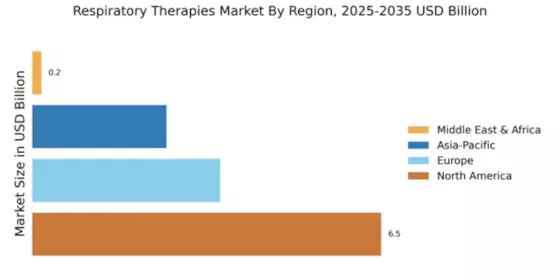
North America is poised to maintain its leadership in the Respiratory Therapies Market, holding a significant market share of 6.5 billion. Key growth drivers include an aging population, rising prevalence of respiratory diseases, and advancements in technology. Regulatory support, such as streamlined approval processes for innovative therapies, further fuels market expansion. The demand for home healthcare solutions is also increasing, driven by patient preferences for at-home treatment options. The competitive landscape in North America is robust, featuring major players like Medtronic and Philips, which are at the forefront of innovation. The U.S. is the leading country, contributing significantly to the market size, followed by Canada. The presence of established healthcare infrastructure and investment in R&D by key players enhances the region's market dynamics, ensuring a steady growth trajectory in respiratory therapies.

Europe : Emerging Market with Growth Potential

Europe's Respiratory Therapies Market is valued at 3.5 billion, driven by increasing awareness of respiratory diseases and supportive healthcare policies. The region benefits from a strong regulatory framework that encourages innovation and ensures patient safety. The demand for advanced therapies is rising, particularly in countries with aging populations, such as Germany and Italy. Additionally, the integration of digital health solutions is enhancing patient management and treatment outcomes. Leading countries in Europe include Germany, France, and the UK, where major players like Boehringer Ingelheim and GSK are actively investing in new product development. The competitive landscape is characterized by collaborations and partnerships aimed at expanding market reach. The presence of a well-established healthcare system and funding for research initiatives further supports the growth of respiratory therapies in the region.

Asia-Pacific : Rapidly Growing Market Segment

The Asia-Pacific region, with a market size of 2.5 billion, is experiencing rapid growth in the Respiratory Therapies Market. Key drivers include increasing pollution levels, a rise in smoking rates, and a growing awareness of respiratory health. Governments are implementing regulations to improve air quality and promote public health, which is expected to further boost demand for respiratory therapies. The region's diverse population and varying healthcare needs also contribute to market expansion. Countries like China and India are leading the charge, with significant investments in healthcare infrastructure and technology. The competitive landscape features both global players and local manufacturers, creating a dynamic market environment. Companies like ResMed and Teva are focusing on innovative solutions tailored to regional needs, ensuring they remain competitive in this burgeoning market.

Middle East and Africa : Emerging Market with Challenges

The Middle East and Africa region, with a market size of 0.17 billion, is gradually emerging in the Respiratory Therapies Market. Key growth drivers include increasing urbanization, rising pollution levels, and a growing prevalence of respiratory diseases. However, challenges such as limited healthcare infrastructure and access to advanced therapies hinder rapid growth. Governments are beginning to recognize the importance of respiratory health, leading to initiatives aimed at improving healthcare access and quality. Countries like South Africa and the UAE are at the forefront of market development, with investments in healthcare facilities and technology. The competitive landscape is evolving, with both international and local players seeking to establish a foothold. Companies are focusing on affordable and accessible solutions to cater to the diverse needs of the population, ensuring a gradual but steady growth in respiratory therapies.

Key Players and Competitive Insights

The Respiratory Therapies Market is characterized by a dynamic competitive landscape, driven by increasing prevalence of respiratory diseases and a growing emphasis on innovative treatment solutions. Key players such as Philips (NL), Medtronic (US), and Boehringer Ingelheim (DE) are strategically positioned to leverage advancements in technology and patient care. Philips (NL) focuses on digital health solutions, enhancing patient monitoring and management through connected devices. Medtronic (US) emphasizes its commitment to innovation, particularly in the development of advanced therapeutic devices. Boehringer Ingelheim (DE) is dedicated to expanding its portfolio of inhalation therapies, aiming to improve patient outcomes through targeted drug delivery systems. Collectively, these strategies foster a competitive environment that prioritizes innovation and patient-centric solutions.

In terms of business tactics, companies are increasingly localizing manufacturing to enhance supply chain efficiency and reduce operational costs. The market structure appears moderately fragmented, with several key players exerting influence while also allowing for niche companies to thrive. This fragmentation encourages competition, driving companies to optimize their offerings and improve service delivery.

In November 2025, Philips (NL) announced the launch of a new line of connected inhalers designed to improve medication adherence among asthma patients. This strategic move is significant as it aligns with the growing trend towards digital health solutions, potentially enhancing patient engagement and treatment efficacy. By integrating technology into respiratory therapies, Philips aims to solidify its market position and respond to the increasing demand for personalized healthcare solutions.

In October 2025, Medtronic (US) completed the acquisition of a leading telehealth platform, which is expected to enhance its capabilities in remote patient monitoring. This acquisition is pivotal as it allows Medtronic to expand its service offerings and integrate advanced analytics into its respiratory therapy solutions. The move reflects a broader industry trend towards digital transformation, where companies seek to provide comprehensive care through technology.

In September 2025, Boehringer Ingelheim (DE) launched a new inhalation device that utilizes smart technology to optimize drug delivery. This innovation is crucial as it addresses the need for more effective treatment options in respiratory care. By focusing on technological advancements, Boehringer Ingelheim is likely to enhance its competitive edge and meet the evolving needs of patients and healthcare providers.

As of December 2025, the competitive trends in the Respiratory Therapies Market are increasingly defined by digitalization, sustainability, and the integration of artificial intelligence (AI). Strategic alliances among key players are shaping the landscape, fostering collaboration that enhances innovation and accelerates product development. The shift from price-based competition to a focus on technology, reliability, and innovative solutions is evident. Companies that prioritize these aspects are likely to differentiate themselves in a crowded market, ensuring long-term success.

Key Companies in the Respiratory Therapies Market market include

Industry Developments

July 2022: Smile Train, Inc. introduced the Lifebox-Smile Train pulse oximeter in collaboration with Lifebox, a longstanding partner. This initiative aims to enhance access to pulse oximetry for anesthesia and critical care, addressing a critical need in healthcare.

July 2022: Omron Healthcare unveiled its newest innovation in the oxygen therapy sector by introducing a portable oxygen concentrator. This device, based on medical molecular sieve technology, ensures a consistent flow of high-purity oxygen, marking a significant advancement in respiratory care.

Future Outlook

Respiratory Therapies Market Future Outlook

The Respiratory Therapies Market is projected to grow at a 5.17% CAGR from 2024 to 2035, driven by technological advancements, increasing prevalence of respiratory diseases, and rising healthcare expenditure.

New opportunities lie in:

  • Development of portable oxygen concentrators for home use
  • Integration of telehealth services for remote patient monitoring
  • Expansion of personalized medicine approaches in respiratory treatment

By 2035, the market is expected to achieve substantial growth, reflecting evolving healthcare needs and innovations.

Market Segmentation

Respiratory Therapies Market End User Outlook

  • Hospitals
  • Home Care Settings
  • Ambulatory Surgical Centers
  • Long-term Care Facilities
  • Specialty Clinics

Respiratory Therapies Market Application Outlook

  • Chronic Obstructive Pulmonary Disease
  • Asthma
  • Sleep Apnea
  • Pulmonary Rehabilitation
  • Cystic Fibrosis

Respiratory Therapies Market Device Type Outlook

  • Nebulizers
  • Inhalers
  • Oxygen Concentrators
  • Ventilators
  • Positive Airway Pressure Devices

Report Scope

MARKET SIZE 202412.67(USD Billion)
MARKET SIZE 202513.47(USD Billion)
MARKET SIZE 203522.16(USD Billion)
COMPOUND ANNUAL GROWTH RATE (CAGR)5.17% (2024 - 2035)
REPORT COVERAGERevenue Forecast, Competitive Landscape, Growth Factors, and Trends
BASE YEAR2024
Market Forecast Period2025 - 2035
Historical Data2019 - 2024
Market Forecast UnitsUSD Billion
Key Companies ProfiledPhilips (NL), Medtronic (US), Boehringer Ingelheim (DE), GSK (GB), AstraZeneca (GB), Novartis (CH), Teva (IL), ResMed (AU), Fisher & Paykel Healthcare (NZ)
Segments CoveredApplication, Device Type, End User
Key Market OpportunitiesIntegration of artificial intelligence in personalized respiratory therapy solutions.
Key Market DynamicsTechnological advancements and regulatory changes drive innovation and competition in the respiratory therapies market.
Countries CoveredNorth America, Europe, APAC, South America, MEA

Leave a Comment

FAQs

How much is the Respiratory Therapies market?

The Respiratory Therapies Market size was valued at Significant Value in 2023.

What is the growth rate of the Respiratory Therapies market?

The global market is projected to grow at a CAGR of 8.80% during the forecast period 2024-2032.

Which region held the largest market share in the Respiratory Therapies market?

North America had the largest share in the global market

Who are the key players in the Respiratory Therapies market?

The key players in the market are Philips Respironics, ResMed Inc., Medtronic plc, Fisher & Paykel Healthcare, Masimo Corporation, Hamilton Medical, Vyaire Medical, Smiths Medical, Drägerwerk AG & Co. KGaA, GE Healthcare and others Company.

Which type led the Respiratory Therapies market?

The diagnostic and monitoring devices category dominated the market in 2023.

Download Free Sample

Kindly complete the form below to receive a free sample of this Report

Compare Licence

×
Features License Type
Single User Multiuser License Enterprise User
Price $4,950 $5,950 $7,250
Maximum User Access Limit 1 User Upto 10 Users Unrestricted Access Throughout the Organization
Free Customization
Direct Access to Analyst
Deliverable Format
Platform Access
Discount on Next Purchase 10% 15% 15%
Printable Versions