Download Free Sample
Kindly complete the form below to receive a free sample of this Report
Retirement Planning Services Market Size, Share and Trends Analysis Research Report Information By Age Group (Pre-Retirement, Early Retirement, Late Retirement), By Client Type (Individuals, Corporates, Non-Profits), By Service Type (Financial Planning, Investment Management, Tax Planning, Estate Planning), By Investment Strategy (Conservative, Moderate, Aggressive, Target Date), By Distribution Channel (Online Platforms, Financial Advisors, Banks, Insurance Companies), And By Region – Market Forecast Till 2035.
As per MRFR analysis, the Retirement Planning Services Market was estimated at 4.5 USD Billion in 2024. The Retirement Planning Services industry is projected to grow from 4.7 in 2025 to 7.2 by 2035, exhibiting a compound annual growth rate (CAGR) of 4.37% during the forecast period 2025 - 2035.
The Retirement Planning Services Market is experiencing a transformative shift towards more integrated and customized solutions.
| 2024 Market Size | 4.5 (USD Billion) |
| 2035 Market Size | 7.2 (USD Billion) |
| CAGR (2025 - 2035) | 4.37% |
Fidelity Investments (US), Vanguard Group (US), Charles Schwab (US), T. Rowe Price (US), BlackRock (US), Edward Jones (US), Merrill Lynch (US), Wells Fargo Advisors (US), Prudential Financial (US)
Our Impact
Enabled $4.3B Revenue Impact for Fortune 500 and Leading Multinationals
Partnering with 2000+ Global Organizations Each Year
30K+ Citations by Top-Tier Firms in the Industry
The Retirement Planning Services Market is currently experiencing a notable transformation, driven by evolving demographic trends and changing consumer preferences. As individuals increasingly recognize the importance of financial security in their later years, there is a growing demand for tailored retirement solutions. This shift is further influenced by advancements in technology, which facilitate more personalized and accessible planning services. Financial institutions are adapting their offerings to meet the diverse needs of clients, ranging from traditional investment strategies to innovative digital platforms that enhance user engagement and education. Moreover, the Retirement Planning Services Market is witnessing a heightened focus on holistic approaches to retirement. This encompasses not only financial planning but also health and wellness considerations, reflecting a broader understanding of what constitutes a secure and fulfilling retirement. As the market evolves, providers are likely to emphasize comprehensive strategies that integrate various aspects of clients' lives, thereby fostering a more sustainable and enriching retirement experience. The interplay of these factors suggests a dynamic landscape where adaptability and client-centric solutions will be paramount for success in the coming years.
The integration of technology into the Retirement Planning Services Market is reshaping how individuals approach their financial futures. Digital tools and platforms are becoming increasingly prevalent, offering clients enhanced access to information and personalized planning resources. This trend indicates a shift towards more interactive and user-friendly experiences, allowing clients to engage with their retirement planning in real-time.
There is a growing emphasis on holistic retirement solutions that encompass not only financial aspects but also health and lifestyle considerations. This trend reflects a broader understanding of retirement as a multifaceted experience, prompting service providers to offer comprehensive strategies that address various dimensions of clients' lives. Such an approach may lead to more sustainable and fulfilling retirement outcomes.
The Retirement Planning Services Market is witnessing an increased demand for customized solutions tailored to individual needs and preferences. As clients seek more personalized experiences, providers are likely to adapt their offerings to accommodate diverse financial situations and retirement goals. This trend suggests a move away from one-size-fits-all approaches, fostering greater client satisfaction and engagement.
The increasing number of individuals reaching retirement age is a primary driver of the Retirement Planning Services Market. As life expectancy rises, a larger segment of the population is entering retirement, necessitating comprehensive planning services. According to recent demographic data, the proportion of people aged 65 and older is projected to rise significantly, leading to heightened demand for retirement planning. This demographic shift compels financial institutions and advisory firms to adapt their offerings to cater to the unique needs of retirees. The Retirement Planning Services Market must respond to this trend by providing tailored solutions that address the financial, healthcare, and lifestyle concerns of an aging population.
Changes in regulations and policies related to retirement savings and pensions are influencing the Retirement Planning Services Market. Governments are increasingly implementing measures to encourage retirement savings, such as tax incentives and automatic enrollment in retirement plans. These regulatory shifts create opportunities for financial advisors and planning services to guide clients through complex compliance requirements. For instance, the introduction of new retirement account options or modifications to existing pension schemes can significantly impact how individuals plan for their retirement. The Retirement Planning Services Market must stay abreast of these changes to effectively assist clients in navigating the evolving regulatory landscape.
Technological advancements are revolutionizing the Retirement Planning Services Market. The integration of digital tools and platforms enables financial advisors to offer more efficient and personalized services. Innovations such as robo-advisors, mobile applications, and data analytics are enhancing the client experience by providing real-time insights and tailored recommendations. As technology continues to evolve, clients increasingly expect seamless interactions and access to their financial information. This trend compels service providers to invest in technology to remain competitive. The Retirement Planning Services Market must leverage these advancements to improve service delivery and meet the changing expectations of tech-savvy consumers.
The growing emphasis on financial literacy is shaping the Retirement Planning Services Market. As individuals become more aware of the importance of financial planning for retirement, there is a corresponding increase in demand for educational resources and advisory services. Various organizations and governments are launching initiatives aimed at improving financial literacy, which in turn drives interest in retirement planning. Data indicates that individuals with higher financial literacy are more likely to engage in proactive retirement planning. Consequently, the Retirement Planning Services Market is likely to see a surge in clients seeking guidance on investment strategies, savings plans, and risk management as they become more informed about their financial futures.
There is a noticeable shift towards holistic retirement planning within the Retirement Planning Services Market. Clients are increasingly seeking comprehensive solutions that encompass not only financial aspects but also health care, lifestyle, and legacy planning. This trend reflects a broader understanding that retirement is not solely about financial security but also about quality of life. As a result, financial advisors are expanding their services to include wellness programs, estate planning, and long-term care considerations. This holistic approach is likely to attract a wider client base, as individuals recognize the value of integrated planning. The Retirement Planning Services Market must adapt to this evolving demand by offering multifaceted services that address the diverse needs of retirees.
In the Retirement Planning Services Market, the Financial Planning segment holds the largest market share, representing the backbone of advisory services offered to individuals as they prepare for retirement. Financial planning encompasses a wide array of services, including budgeting, savings plans, and risk assessment, which are critical for enabling retirees to navigate their finances successfully during retirement. In contrast, the Investment Management segment, while smaller in share compared to Financial Planning, is the fastest-growing area due to heightened awareness of investment strategies and the growing need for professional management of retirement savings portfolios. This rapid expansion reflects the increasing complexity of investment options available to retirees today. The growth trends in the Retirement Planning Services Market are influenced significantly by demographic shifts and changing consumer preferences. As more individuals approach retirement age, there is a growing emphasis on tailored financial solutions that address unique retirement goals. Similarly, technological advancements in investment platforms and advisory services are driving greater engagement in the Investment Management segment. The focus on personalized investment strategies, including risk tolerance assessments and long-term growth objectives, is crucial. Furthermore, the desire for sustainable and socially responsible investments is gaining traction, leading to a surge in demand for professional investment management services in the retirement planning space.
Financial Planning: Dominant vs. Investment Management: Emerging
The Financial Planning segment is the dominant player in the Retirement Planning Services Market, characterized by its comprehensive approach to helping clients achieve their financial goals. Financial planners offer personalized services that not only create but also manage effective retirement income strategies. This segment draws on a wide range of expertise, including social security benefits and healthcare cost planning. The emphasis on holistic financial wellness contributes to its strong position in the market. On the other hand, the Investment Management segment is emerging prominently as a critical player, leveraging technological advancements and innovative financial tools. This segment appeals primarily to clients seeking professional guidance in navigating complex investment landscapes. Investment management emphasizes portfolio diversification, risk assessment, and performance tracking, which are becoming increasingly essential for retirees looking to maximize returns on their accumulated wealth.
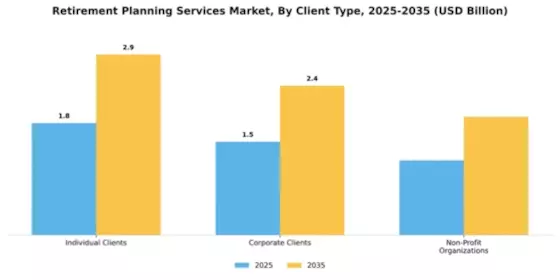
In the Retirement Planning Services Market, the distribution of market share among client types is notably diverse, with Individual Clients commanding the largest share due to their increasing awareness of the importance of retirement planning. Corporate Clients, while trailing behind, have seen significant growth as businesses recognize the importance of offering retirement planning services as part of their employee benefits package. As employers strive to attract and retain talent, Corporate Clients are emerging as a compelling focus in this market. The growth trends for these segments highlight a shift in priorities, with Individual Clients driven by personal financial objectives and the desire for financial independence during retirement. Conversely, Corporate Clients are being propelled by regulatory changes and the need for businesses to provide comprehensive retirement solutions. These dynamics serve as key drivers, shaping the future landscape of retirement planning services in the market.
Individual Clients (Dominant) vs. Non-Profit Organizations (Emerging)
Individual Clients are a dominant force in the Retirement Planning Services Market, characterized by a proactive approach to managing their future financial needs. They prioritize personalized services and financial advisory that cater to their specific retirement goals. On the other hand, Non-Profit Organizations represent an emerging segment that is increasingly recognizing the need for retirement planning services for their employees. These organizations are gradually expanding their focus on employee benefits, which includes offering competitive retirement solutions. This segment often operates with budget constraints but seeks innovative, cost-effective retirement plans that align with their mission. As both segments navigate the market, their distinct characteristics and needs are likely to influence the service offerings and strategies of retirement planning providers.
The Retirement Planning Services Market is diversifying rapidly across various distribution channels. Online platforms currently hold the largest market share due to the increasing preference for digital solutions among consumers. This growth can be attributed to enhanced accessibility and cost-effectiveness, with more retirees and pre-retirees opting for these platforms to aid their financial planning. Financial advisors, while holding a smaller share, are experiencing a significant surge in demand as personalized financial planning gains importance, driven by the complexities of retirement savings.
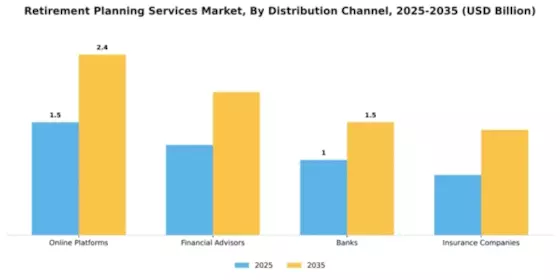
Online Platforms (Dominant) vs. Financial Advisors (Emerging)
Online platforms in the Retirement Planning Services Market have established themselves as the dominant force, primarily due to their ability to cater to a tech-savvy demographic that values convenience and information accessibility. These platforms offer a range of services, from retirement calculators to portfolio management tools, making retirement planning more approachable for users. In contrast, financial advisors are emerging as an increasingly vital component, driven by a growing recognition of the value of personalized advice. As potential retirees seek reassurance and customized strategies to navigate their financial futures, the human touch provided by advisors is becoming indispensable, fostering a unique synergy between traditional and digital approaches in this sector.
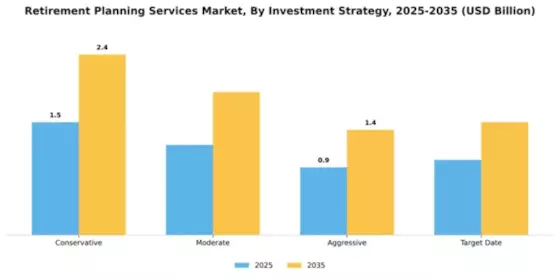
In the Retirement Planning Services Market, the investment strategy segment is characterized by a distribution among four primary categories: Conservative, Moderate, Aggressive, and Target Date. Among these, the Moderate strategy leads the market with the largest share, as it effectively balances risk and return, appealing to a wide range of investors. This is followed by the Aggressive strategy, which, while encompassing a smaller share, showcases rapid growth due to a shift in investor preferences towards higher risk and potential higher returns as individuals seek to maximize their retirement savings.
Moderate (Dominant) vs. Aggressive (Emerging)
The Moderate investment strategy stands out in the Retirement Planning Services Market as a dominant force, primarily appealing to investors looking for a balanced approach that caps risk while providing decent returns. This strategy is well-suited for individuals approaching retirement, as it aims to preserve capital while still offering some growth potential. Conversely, the Aggressive strategy is emerging rapidly, capturing attention from younger investors willing to take more risks in hopes of achieving significant growth. This segment attracts those who have a longer time horizon and are less concerned about short-term volatility, reflecting a broader trend towards more dynamic investment approaches.
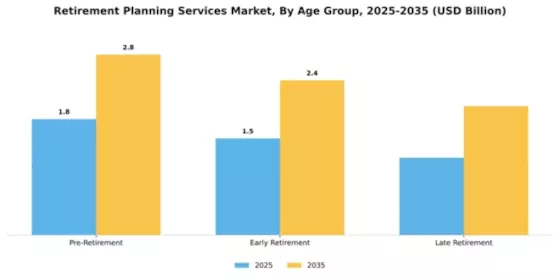
In the Retirement Planning Services Market, the age group segment is primarily dominated by the Pre-Retirement category, which encompasses individuals aged 50 to 64. This demographic holds a significant portion of the market share due to their immediate financial needs and heightened awareness of retirement savings. As they approach retirement age, they tend to invest more in services and products designed to secure their financial future. Meanwhile, the Late Retirement category, targeting those aged 65 and above, presents a growing segment with increasing awareness of financial planning as they navigate retirement living expenses and healthcare costs. The growth trends within the Age Group segment are influenced by various factors including rising life expectancy and changing economic conditions. The Late Retirement segment is witnessing rapid growth, fueled by a demographic shift as more individuals live longer and healthier lives. Additionally, the rise of late-career financial planning and a wealth of information available online contributes to this growth, empowering retirees to take charge of their financial futures. As a more significant portion of the population enters the late retirement phase, the demand for tailored retirement planning services is also accelerating, making this category particularly attractive to service providers.
Pre-Retirement (Dominant) vs. Late Retirement (Emerging)
The Pre-Retirement segment stands as the dominant force in the Retirement Planning Services Market due to its large base of individuals actively planning for retirement within the next few years. This age group is characterized by a proactive approach towards securing their financial future, often seeking comprehensive financial counseling, investment advice, and retirement savings plans. They are influenced by a combination of personal finance education and the urgency of impending retirement needs. Conversely, the Late Retirement segment is emerging rapidly as a vital demographic, consisting of those who, although already retired, require ongoing financial planning and management services. Their needs revolve around sustainable income sources, healthcare costs, and asset management during retirement, making tailored solutions essential for this group.
Get more detailed insights about Retirement Planning Services Market Request Free Sample
North America continues to lead the Retirement Planning Services market, holding a significant share of 2.25B in 2024. Key growth drivers include an aging population, increasing awareness of retirement savings, and favorable regulatory frameworks. The demand for personalized financial planning services is on the rise, supported by government initiatives aimed at enhancing retirement security. As a result, the market is expected to expand further, driven by technological advancements and innovative service offerings. The competitive landscape in North America is robust, featuring major players like Fidelity Investments, Vanguard Group, and Charles Schwab. These firms are leveraging technology to enhance customer engagement and streamline service delivery. The presence of established financial institutions fosters a competitive environment, encouraging innovation and improved service offerings. As the market evolves, these key players are well-positioned to capture a larger share of the growing demand for retirement planning services.
Europe's Retirement Planning Services market is valued at 1.5B, reflecting a growing recognition of the need for effective retirement solutions. Key drivers include an aging demographic, increasing life expectancy, and regulatory changes aimed at enhancing retirement savings. The European Union's initiatives to promote financial literacy and retirement planning are pivotal in shaping market dynamics. As consumers become more proactive about their financial futures, demand for tailored retirement solutions is expected to rise significantly. Leading countries in this region include Germany, the UK, and France, where established financial institutions are adapting to meet evolving consumer needs. The competitive landscape features both traditional banks and fintech companies, creating a diverse service offering. Key players like Prudential Financial and BlackRock are investing in technology to enhance customer experience and expand their market reach. This competitive environment is likely to drive innovation and improve service delivery in the retirement planning sector.
The Asia-Pacific region, with a market size of 0.9B, is witnessing rapid growth in Retirement Planning Services. Factors such as increasing disposable incomes, urbanization, and a shift towards individual responsibility for retirement savings are driving this trend. Governments are also implementing policies to encourage retirement savings, which is expected to further boost market growth. As awareness of retirement planning increases, more individuals are seeking professional advice and tailored solutions to secure their financial futures. Countries like Japan, Australia, and China are leading the charge in this evolving market. The competitive landscape is characterized by a mix of local and international players, including firms like T. Rowe Price and Edward Jones. These companies are focusing on innovative products and services to cater to the diverse needs of consumers. As the market matures, the presence of established financial institutions will play a crucial role in shaping the future of retirement planning in the region.
The Middle East and Africa (MEA) region, with a market size of 0.35B, is an emerging market for Retirement Planning Services. The growth is driven by increasing awareness of the importance of retirement savings, coupled with a young population that is beginning to plan for their financial futures. Regulatory frameworks are gradually evolving to support retirement savings initiatives, which is expected to catalyze market growth. As financial literacy improves, more individuals are seeking professional retirement planning services to secure their financial well-being. Leading countries in this region include South Africa and the UAE, where financial institutions are beginning to offer more comprehensive retirement solutions. The competitive landscape is still developing, with both local and international players entering the market. Companies are focusing on educating consumers about retirement planning and offering tailored solutions to meet diverse needs. As the market matures, the presence of key players will be crucial in shaping the future of retirement planning services in MEA.
The Retirement Planning Services Market is currently characterized by a dynamic competitive landscape, driven by a confluence of factors including demographic shifts, increasing life expectancy, and a growing awareness of the necessity for financial security in retirement. Major players such as Fidelity Investments (US), Vanguard Group (US), and BlackRock (US) are strategically positioned to leverage these trends. Fidelity Investments (US) emphasizes innovation in digital tools to enhance customer engagement, while Vanguard Group (US) focuses on low-cost investment options to attract a broader client base. BlackRock (US), on the other hand, is increasingly integrating sustainable investment strategies into its offerings, reflecting a shift towards socially responsible investing. Collectively, these strategies not only enhance their competitive positioning but also shape the overall market dynamics by setting new standards for service delivery and client expectations.In terms of business tactics, companies are increasingly localizing their services to better cater to regional needs, optimizing their supply chains to enhance efficiency, and investing in technology to streamline operations. The market appears moderately fragmented, with a mix of large firms and smaller niche players. However, the influence of key players is substantial, as they often set the benchmarks for service quality and innovation, thereby impacting the competitive structure significantly.In November Vanguard Group (US) announced the launch of a new retirement planning tool designed to provide personalized investment strategies based on individual risk profiles. This initiative is strategically important as it not only enhances client engagement but also positions Vanguard as a leader in the digital transformation of retirement planning services. By offering tailored solutions, Vanguard aims to attract a younger demographic, which is crucial for long-term growth in the sector.In October Fidelity Investments (US) expanded its partnership with a leading fintech company to enhance its robo-advisory services. This move is indicative of Fidelity's commitment to integrating advanced technology into its service offerings, thereby improving efficiency and client satisfaction. The partnership is likely to bolster Fidelity's competitive edge by providing clients with more sophisticated investment options and automated financial advice, which is increasingly sought after in today's market.In September BlackRock (US) launched a new suite of sustainable investment products aimed at environmentally conscious investors. This strategic action reflects a growing trend towards sustainability in investment choices, catering to a demographic that prioritizes ethical considerations in their financial decisions. By aligning its offerings with these values, BlackRock not only enhances its market appeal but also positions itself as a forward-thinking leader in the retirement planning space.As of December the competitive trends in the Retirement Planning Services Market are increasingly defined by digitalization, sustainability, and the integration of artificial intelligence (AI) into service offerings. Strategic alliances among firms are shaping the landscape, fostering innovation and enhancing service delivery. The shift from price-based competition to a focus on technological advancement and supply chain reliability is evident, suggesting that future competitive differentiation will hinge on the ability to innovate and adapt to changing consumer preferences.






The Retirement Planning Services Market is projected to grow at a 4.37% CAGR from 2025 to 2035, driven by increasing life expectancy, financial literacy, and demand for personalized services.
New opportunities lie in:
By 2035, the market is expected to be robust, reflecting evolving consumer needs and technological advancements.
| MARKET SIZE 2024 | 4.5(USD Billion) |
| MARKET SIZE 2025 | 4.7(USD Billion) |
| MARKET SIZE 2035 | 7.2(USD Billion) |
| COMPOUND ANNUAL GROWTH RATE (CAGR) | 4.37% (2025 - 2035) |
| REPORT COVERAGE | Revenue Forecast, Competitive Landscape, Growth Factors, and Trends |
| BASE YEAR | 2024 |
| Market Forecast Period | 2025 - 2035 |
| Historical Data | 2019 - 2024 |
| Market Forecast Units | USD Billion |
| Key Companies Profiled | Fidelity Investments (US), Vanguard Group (US), Charles Schwab (US), T. Rowe Price (US), BlackRock (US), Edward Jones (US), Merrill Lynch (US), Wells Fargo Advisors (US), Prudential Financial (US) |
| Segments Covered | Service Type, Client Type, Distribution Channel, Investment Strategy, Age Group |
| Key Market Opportunities | Integration of digital tools enhances personalized strategies in the Retirement Planning Services Market. |
| Key Market Dynamics | Rising consumer demand for personalized retirement solutions drives innovation and competition in retirement planning services. |
| Countries Covered | North America, Europe, APAC, South America, MEA |
The projected market valuation for the Retirement Planning Services Market in 2035 is 7.2 USD Billion.
The overall market valuation for the Retirement Planning Services Market in 2024 was 4.5 USD Billion.
The expected CAGR for the Retirement Planning Services Market during the forecast period 2025 - 2035 is 4.37%.
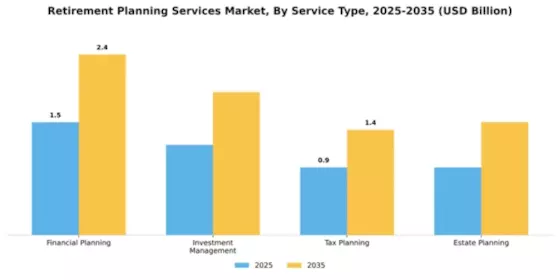
By 2035, the Financial Planning service type segment is projected to reach 2.4 USD Billion.
In 2035, individual clients are expected to have a market valuation of 2.9 USD Billion, surpassing corporate clients at 2.4 USD Billion.
By 2035, online platforms are anticipated to lead the market with a valuation of 2.4 USD Billion.
The Tax Planning segment is projected to reach a valuation of 1.4 USD Billion by 2035.
The Conservative investment strategy segment is expected to show the most growth, reaching 2.4 USD Billion by 2035.
The Late Retirement age group segment is projected to reach a valuation of 2.0 USD Billion by 2035.
Key players in the Retirement Planning Services Market include Fidelity Investments, Vanguard Group, and Charles Schwab, among others.


Kindly complete the form below to receive a free sample of this Report

“This is really good guys. Excellent work on a tight deadline. I will continue to use you going forward and recommend you to others. Nice job”


“Thanks. It’s been a pleasure working with you, please use me as reference with any other Intel employees.”


“Thanks for sending the report it gives us a good global view of the Betaïne market.”


“Thank you, this will be very helpful for OQS.”


“We found the report very insightful! we found your research firm very helpful. I'm sending this email to secure our future business.”


“I am very pleased with how market segments have been defined in a relevant way for my purposes (such as "Portable Freezers & refrigerators" and "last-mile"). In general the report is well structured. Thanks very much for your efforts.”


“I have been reading the first document or the study, ,the Global HVAC and FP market report 2021 till 2026. Must say, good info! I have not gone in depth at all parts, but got a good indication of the data inside!”


“We got the report in time, we really thank you for your support in this process. I also thank to all of your team as they did a great job.”


“The Automotive 48V ECU Components Procurement Intelligence Study” was a complex project, but the Market Research Future (MRFR) team handled it with quality, agility, and customer-centricity. They delivered all requested data on time and within the agreed scope. The team, including Shubhendra Anand and Rahul Gotadki, was always readily available to clarify questions and swiftly implement necessary adjustments, driving the project to a successful conclusion within a very demanding timeframe.
I would also like to specifically commend Akshay Agarwal for his responsiveness and support at every stage—from our initial inquiry on May 6th through to final delivery on June 18th. His dedication made the entire process seamless.”



