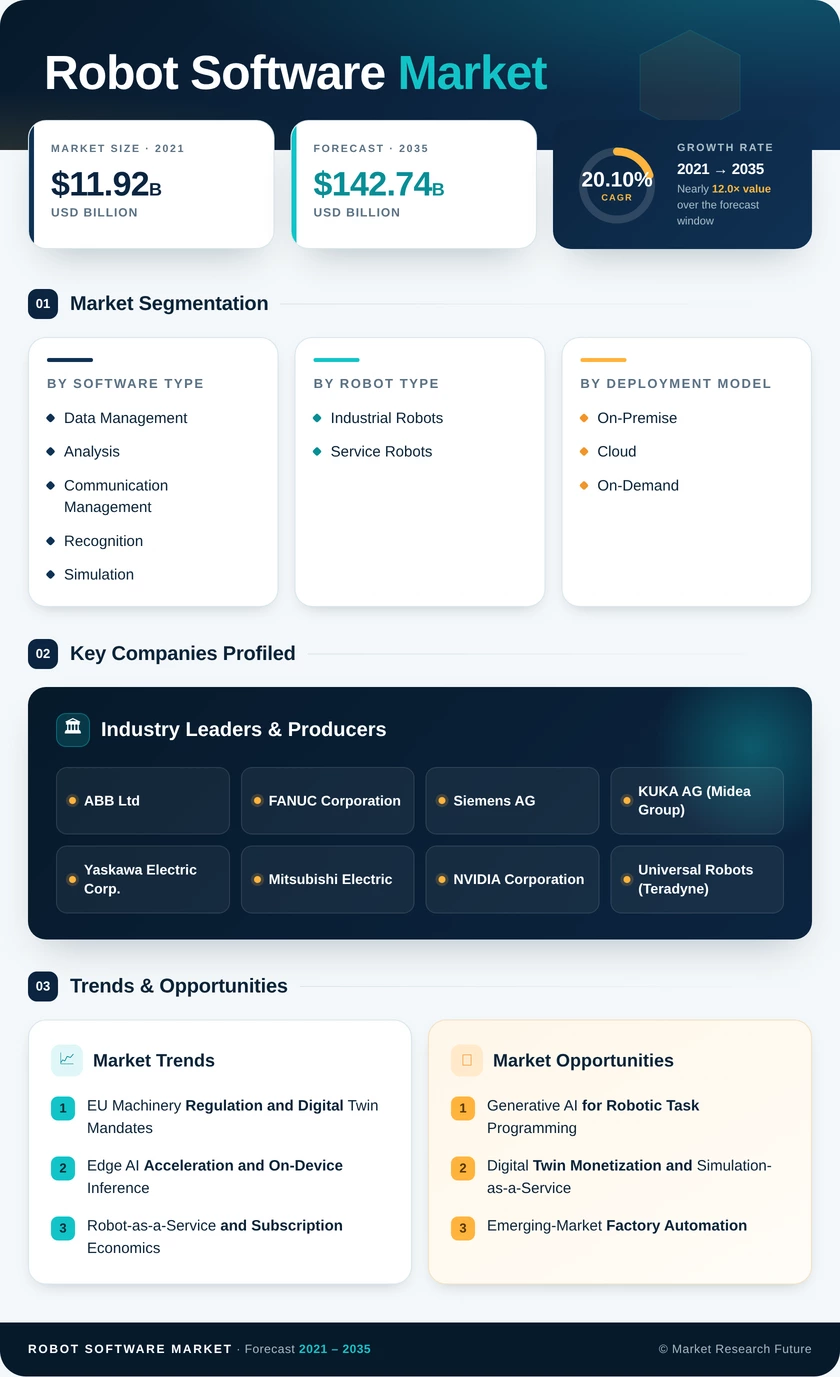
Robot Software Market

ID: MRFR/ICT/6387-HCR
111 Pages
Apoorva Priyadarshi
Last Updated: June 22, 2026
Robot Software Market Size, Share and Research Report By Software Type (Data Management and Analysis, Communication Management, Recognition, Simulation, Predictive Maintenance), By Robot Type (Industrial Robots, Service Robots), By Deployment Model (On-Premise, Cloud and On-Demand), By End-User Vertical (Manufacturing, Automotive, Healthcare, Transportation and Logistics, Retail and E-Commerce) and By Regional (North America, Europe, South America, Asia Pacific, Middle East and Africa) - Industry Forecast to 2035.
Download PDF ×

We do not share your information with anyone. However, we may send you emails based on your report interest from time to time. You may contact us at any time to opt-out.

  1. 1 Market Overview |
    1. 1.1 Study Assumptions & Market Definition |
    2. 1.2 Scope of the Study |
    3. 1.3 Research Methodology
  2. 2 Market Summary & Key Takeaways
  3. 3 Market Dynamics |
    1. 3.1 Market Drivers Analysis | |
      1. 3.1.1 EU Machinery Regulation & Virtual Safety Validation | |
      2. 3.1.2 Edge AI Inference Acceleration (NVIDIA Jetson Thor) | |
      3. 3.1.3 Robot-as-a-Service Subscription Models | |
      4. 3.1.4 Open-Architecture Platforms (ROS 2 Ecosystem) | |
      5. 3.1.5 Cloud Hyperscaler Robotics Toolkits | |
      6. 3.1.6 5G/Edge Network Densification | |
      7. 3.1.7 Cybersecurity Mandates for Connected Robots |
    2. 3.2 Market Restraints Analysis | |
      1. 3.2.1 Fragmented Interoperability Standards | |
      2. 3.2.2 Cybersecurity Vulnerability Surface | |
      3. 3.2.3 Skilled Workforce Shortage (Robotics Engineers) | |
      4. 3.2.4 High Integration Complexity for Legacy Lines | |
      5. 3.2.5 Data Sovereignty & Cross-Border Transfer Rules |
    3. 3.3 Market Opportunity Analysis | |
      1. 3.3.1 Generative AI for Robotic Task Programming | |
      2. 3.3.2 Digital Twin Monetization and Simulation-as-a-Service | |
      3. 3.3.3 Emerging-Market Factory Automation | |
      4. 3.3.4 Healthcare and Surgical Robotics Software | |
      5. 3.3.5 Cybersecurity and Compliance Software Layers |
    4. 3.4 Industry Value Chain Analysis |
    5. 3.5 Porter's Five Forces Analysis
  4. 4 Global Robot Software Market Size & Forecast (2021–2035) |
    1. 4.1 Historical Market Size (2021–2025) |
    2. 4.2 Current & Forecast Market Size (2026–2035) |
    3. 4.3 Market Size by Revenue (USD Billion) |
    4. 4.4 Year-over-Year Growth Analysis
  5. 5 Segmentation Analysis |
    1. 5.1 By Software Type | |
      1. 5.1.1 Data Management and Analysis | |
      2. 5.1.2 Communication Management | |
      3. 5.1.3 Recognition | |
      4. 5.1.4 Simulation | |
      5. 5.1.5 Predictive Maintenance |
    2. 5.2 By Robot Type | |
      1. 5.2.1 Industrial Robots | |
      2. 5.2.2 Service Robots |
    3. 5.3 By Deployment Model | |
      1. 5.3.1 On-Premise | |
      2. 5.3.2 Cloud and On-Demand |
    4. 5.4 By End-User Vertical | |
      1. 5.4.1 Manufacturing | |
      2. 5.4.2 Automotive | |
      3. 5.4.3 Healthcare | |
      4. 5.4.4 Transportation and Logistics | |
      5. 5.4.5 Retail and E-Commerce
  6. 6 Regional Analysis |
    1. 6.1 North America | |
      1. 6.1.1 United States | |
      2. 6.1.2 Canada | |
      3. 6.1.3 Mexico |
    2. 6.2 Europe | |
      1. 6.2.1 Germany | |
      2. 6.2.2 United Kingdom | |
      3. 6.2.3 France | |
      4. 6.2.4 Italy | |
      5. 6.2.5 Spain | |
      6. 6.2.6 Nordic Countries | |
      7. 6.2.7 Russia | |
      8. 6.2.8 Rest of Europe |
    3. 6.3 Asia-Pacific | |
      1. 6.3.1 China | |
      2. 6.3.2 India | |
      3. 6.3.3 Japan | |
      4. 6.3.4 South Korea | |
      5. 6.3.5 ASEAN | |
      6. 6.3.6 Rest of Asia-Pacific |
    4. 6.4 South America | |
      1. 6.4.1 Brazil | |
      2. 6.4.2 Argentina | |
      3. 6.4.3 Rest of South America |
    5. 6.5 Middle East & Africa | |
      1. 6.5.1 Saudi Arabia | |
      2. 6.5.2 UAE | |
      3. 6.5.3 South Africa | |
      4. 6.5.4 Egypt | |
      5. 6.5.5 Rest of MEA
  7. 7 Competitive Landscape |
    1. 7.1 Market Share Analysis (2025) |
    2. 7.2 Competitive Benchmarking Matrix |
    3. 7.3 Company Profiles | |
      1. 7.3.1 ABB Ltd | |
      2. 7.3.2 FANUC Corporation | |
      3. 7.3.3 Siemens AG | |
      4. 7.3.4 KUKA AG (Midea Group) | |
      5. 7.3.5 Yaskawa Electric Corporation | |
      6. 7.3.6 Mitsubishi Electric | |
      7. 7.3.7 NVIDIA Corporation | |
      8. 7.3.8 Universal Robots (Teradyne) | |
      9. 7.3.9 PTC Inc. | |
      10. 7.3.10 Dassault Systèmes | |
      11. 7.3.11 Rockwell Automation | |
      12. 7.3.12 Cognex Corporation
  8. 8 Future Outlook & Strategic Recommendations (2026–2035) |
    1. 8.1 Foundation Models and Embodied AI |
    2. 8.2 Platform Economics and Marketplace Models |
    3. 8.3 Sustainability-Driven Software Demand |
    4. 8.4 Cybersecurity as a Product Layer
  9. 9 Recent Developments & News
  10. 10 Frequently Asked Questions (FAQs)
  11. 11 Report Scope & Methodology |
    1. 11.1 Study Period & Base Year |
    2. 11.2 Data Sources & Citations |
    3. 11.3 Abbreviations
  12. 12 LIST OF TABLES |
  13. TABLE 1 Robot Software Market – Summary Parameters |
  14. TABLE 2 Global Robot Software Market Size & Forecast, by Revenue (USD Billion), 2021–2035 |
  15. TABLE 3 Robot Software Market – Driver Impact Analysis, 2026–2035 |
  16. TABLE 4 Robot Software Market – Restraint Impact Analysis, 2026–2035 |
  17. TABLE 5 Robot Software Market Size, by Region, 2025 (USD Billion / Share %) |
  18. TABLE 6 North America Robot Software Market Size, by Country, 2021–2035 |
  19. TABLE 7 Europe Robot Software Market Size, by Country, 2021–2035 |
  20. TABLE 8 Asia-Pacific Robot Software Market Size, by Country, 2021–2035 |
  21. TABLE 9 South America Robot Software Market Size, by Country, 2021–2035 |
  22. TABLE 10 Middle East & Africa Robot Software Market Size, by Country, 2021–2035 |
  23. TABLE 11 Robot Software Market Size, by Software Type, 2021–2035 |
  24. TABLE 12 Robot Software Market Size, by Robot Type, 2021–2035 |
  25. TABLE 13 Robot Software Market Size, by Deployment Model, 2021–2035 |
  26. TABLE 14 Robot Software Market Size, by End-User Vertical, 2021–2035 |
  27. TABLE 15 Competitive Benchmarking Matrix – Robot Software Market, 2025 |
  28. TABLE 16 Company Profiles – Key Players, Robot Software Market |
  29. TABLE 17 Recent Developments & Strategic Announcements, 2023–2025 |
  30. TABLE 18 Report Scope & Methodology Summary |
  31. TABLE 19 Detailed Sources and Citations |
  32. TABLE 20 North America Robot Software Market Size, by Software Type, 2021–2035 (USD Billion) |
  33. TABLE 21 North America Robot Software Market Size, by Robot Type, 2021–2035 (USD Billion) |
  34. TABLE 22 North America Robot Software Market Size, by Deployment Model, 2021–2035 (USD Billion) |
  35. TABLE 23 North America Robot Software Market Size, by End-User Vertical, 2021–2035 (USD Billion) |
  36. TABLE 24 Europe Robot Software Market Size, by Software Type, 2021–2035 (USD Billion) |
  37. TABLE 25 Europe Robot Software Market Size, by Robot Type, 2021–2035 (USD Billion) |
  38. TABLE 26 Europe Robot Software Market Size, by Deployment Model, 2021–2035 (USD Billion) |
  39. TABLE 27 Europe Robot Software Market Size, by End-User Vertical, 2021–2035 (USD Billion) |
  40. TABLE 28 Asia-Pacific Robot Software Market Size, by Software Type, 2021–2035 (USD Billion) |
  41. TABLE 29 Asia-Pacific Robot Software Market Size, by Robot Type, 2021–2035 (USD Billion) |
  42. TABLE 30 Asia-Pacific Robot Software Market Size, by Deployment Model, 2021–2035 (USD Billion) |
  43. TABLE 31 Asia-Pacific Robot Software Market Size, by End-User Vertical, 2021–2035 (USD Billion) |
  44. TABLE 32 South America Robot Software Market Size, by Software Type, 2021–2035 (USD Billion) |
  45. TABLE 33 South America Robot Software Market Size, by Robot Type, 2021–2035 (USD Billion) |
  46. TABLE 34 South America Robot Software Market Size, by Deployment Model, 2021–2035 (USD Billion) |
  47. TABLE 35 South America Robot Software Market Size, by End-User Vertical, 2021–2035 (USD Billion) |
  48. TABLE 36 Middle East & Africa Robot Software Market Size, by Software Type, 2021–2035 (USD Billion) |
  49. TABLE 37 Middle East & Africa Robot Software Market Size, by Robot Type, 2021–2035 (USD Billion) |
  50. TABLE 38 Middle East & Africa Robot Software Market Size, by Deployment Model, 2021–2035 (USD Billion) |
  51. TABLE 39 Middle East & Africa Robot Software Market Size, by End-User Vertical, 2021–2035 (USD Billion)
  52. 13 LIST OF FIGURES |
  53. FIGURE 1 Robot Software Market – Market Dynamics Overview |
  54. FIGURE 2 Robot Software Market – Industry Value Chain Analysis |
  55. FIGURE 3 Robot Software Market – Porter's Five Forces Analysis |
  56. FIGURE 4 Global Robot Software Market Size Trend & Forecast, 2021–2035 (USD Billion) |
  57. FIGURE 5 Robot Software Market Share, by Software Type, 2025 (%) |
  58. FIGURE 6 Robot Software Market Share, by Robot Type, 2025 (%) |
  59. FIGURE 7 Robot Software Market Share, by Deployment Model, 2025 (%) |
  60. FIGURE 8 Robot Software Market Share, by End-User Vertical, 2025 (%) |
  61. FIGURE 9 Robot Software Market Share, by Region, 2025 (%) |
  62. FIGURE 10 North America Robot Software Market Size & Forecast, 2021–2035 (USD Billion) |
  63. FIGURE 11 Europe Robot Software Market Size & Forecast, 2021–2035 (USD Billion) |
  64. FIGURE 12 Asia-Pacific Robot Software Market Size & Forecast, 2021–2035 (USD Billion) |
  65. FIGURE 13 South America Robot Software Market Size & Forecast, 2021–2035 (USD Billion) |
  66. FIGURE 14 Middle East & Africa Robot Software Market Size & Forecast, 2021–2035 (USD Billion) |
  67. FIGURE 15 Robot Software Market – Competitive Landscape Heat Map, 2025

Segmentation Quick Reference

DimensionSub-SegmentsDominant SegmentFastest Growing Segment
Robot software Market TypeData Management and Analysis, Communication Management, Recognition, Simulation, Predictive MaintenanceData Management and AnalysisCommunication Management
Robot TypeIndustrial Robots, Service RobotsIndustrial RobotsService Robots
Deployment ModelOn-Premise, Cloud and On-DemandOn-PremiseCloud and On-Demand
End-User VerticalManufacturing, Automotive, Healthcare, Transportation and Logistics, Retail and E-CommerceManufacturingTransportation and Logistics
GeographyNorth America, Europe, Asia-Pacific, South America, Middle East & AfricaNorth AmericaAsia-Pacific


Market Segmentation Overview

By Robot software Market Type

Sub-SegmentKey Trend
Data Management and AnalysisReal-time telemetry ingestion and AI-driven yield optimization at scale
Communication ManagementMulti-robot fleet coordination protocols (DDS, MQTT-SN) for warehouse autonomy
RecognitionVision-guided manipulation using 3D point clouds and deep-learning models
SimulationDigital twin and virtual commissioning platforms mandated by EU regulation
Predictive MaintenanceCondition-based monitoring reduces unplanned downtime by 25–40%


Robot software Market type segmentation captures the functional layers that transform a mechanical robot into an intelligent system. Data Management and Analysis dominate because every robot generates sensor data that must be processed for quality assurance, throughput optimization, and compliance reporting. Communication Management is expanding fastest as multi-robot fleets require low-latency, deterministic messaging to coordinate movement in shared workspaces.

By Robot Type

Sub-SegmentKey Trend
Industrial RobotsMigration from proprietary control stacks to open-architecture ROS 2 middleware
Service RobotsCloud-connected autonomy for healthcare, hospitality, and last-mile delivery


Industrial robots retain the larger software footprint due to decades of installed base in automotive and electronics manufacturing. Service robots are closing the gap rapidly, however, as hospital logistics, restaurant automation, and retail inventory management create new demand for flexible, cloud-native software platforms.

By Deployment Model

Sub-SegmentKey Trend
On-PremiseDeterministic real-time control requiring sub-millisecond latency
Cloud and On-DemandSimulation, fleet analytics, and OTA updates are migrating to hyperscaler infrastructure.


On-Premise deployments continue to serve safety-critical control loops where network jitter is unacceptable. Cloud and On-Demand is the growth vector, enabling Robot-as-a-Service economics and centralized fleet management across geographically distributed facilities.

By End-User Vertical

Sub-SegmentKey Trend
ManufacturingIndustry 4.0 digital transformation is driving software layering onto legacy lines
AutomotiveEV assembly retooling requiring reconfigurable robotic programming
HealthcareSurgical navigation, pharmacy automation, and patient-logistics robots
Transportation and LogisticsAutonomous mobile robot fleets for e-commerce fulfillment
Retail and E-CommerceMicro-fulfillment centers and autonomous inventory scanning


Manufacturing is the established anchor vertical, while Transportation and Logistics is the fastest-growing end-user category, powered by the global e-commerce boom that demands autonomous sortation, goods-to-person picking, and last-mile delivery robots operating around the clock.

By Geography

Sub-SegmentKey Trend
North AmericaDefense robotics procurement and Silicon Valley venture ecosystem
EuropeEU Machinery Regulation compliance and Industry 4.0 investment
Asia-PacificGovernment subsidies and massive factory automation buildout
South AmericaAgritech and mining automation in Brazil and Chile
Middle East & AfricaSmart-city projects and oil & gas inspection robotics


North America leads on the strength of U.S. defense spending and a mature technology startup ecosystem. Asia-Pacific is the fastest-growing region, with China, India, Japan, and South Korea collectively investing heavily in next-generation factory automation and robotics skill development.