Root Canal Market Research Report Information By Type (Nonsurgical Root Canal, Secondary Root Canal, Apicoectomy, Pulpotomy, and Pulpectomy), By Drug (Anesthetics, Painkillers, and Antibiotics), By Device (Crowns, and Endodontic Instruments), By Region (North America, Europe, Asia-Pacific, And Rest Of The World) –Market Forecast Till 2035
Forecast Period
2025 - 2035
CAGR
4.16%
2024 Market Size
$ 1.2 Billion
2035 Market Size
$ 1.88 Billion
Medical Device● Updated July 20, 2026Report ID: MRFR/MED/3320-HCR|Pages: 110|Author: Vikita Thakur, Kinjoll Dey
As per Market Research Future analysis, the Root Canal Market Size was estimated at 1.2 USD Billion in 2024. The Root Canal industry is projected to grow from USD 1.25 Billion in 2025 to USD 1.879 Billion by 2035, exhibiting a compound annual growth rate (CAGR) of 4.16% during the forecast period 2025 - 2035
Key Market Trends & Highlights
The Root Canal Market is experiencing a dynamic shift driven by technological advancements and increasing patient awareness.
Technological advancements are revolutionizing root canal procedures, enhancing efficiency and patient outcomes.
Increased patient awareness regarding oral health is driving demand for root canal treatments, particularly in North America.
The nonsurgical root canal segment remains the largest, while the apicoectomy segment is emerging as the fastest-growing in the market.
Rising incidence of dental diseases and advancements in dental technology are key drivers propelling market growth.
Market Size & Forecast
2024 Market Size
1.2 (USD Billion)
2035 Market Size
1.879 (USD Billion)
CAGR (2025 - 2035)
4.16%
Major Players
Dentsply Sirona (US), Kavo Kerr (US), Coltene Holding AG (CH), Henry Schein Inc. (US), Septodont (FR), Voco GmbH (DE), Bisco Inc. (US), 3M Company (US), Shofu Inc. (JP)
Our Impact
Enabled $4.3B Revenue Impact for Fortune 500 and Leading Multinationals
Partnering with 2000+ Global Organizations Each Year
30K+ Citations by Top-Tier Firms in the Industry
Root Canal Market Trends
The Root Canal Market is currently experiencing a dynamic evolution, driven by advancements in dental technology and an increasing awareness of oral health. Innovations in endodontic instruments and materials are enhancing the efficiency and effectiveness of root canal procedures. As patients become more informed about dental care, there is a growing demand for minimally invasive treatments, which are perceived to offer better outcomes and reduced recovery times. This shift in patient expectations is prompting dental professionals to adopt new techniques and technologies that align with contemporary standards of care.
Moreover, the rising prevalence of dental diseases globally is contributing to the expansion of the Root Canal Market. As more individuals seek treatment for conditions such as pulpitis and periapical abscesses, the need for skilled practitioners and advanced treatment options becomes increasingly critical. The market appears poised for further growth, as ongoing research and development efforts continue to yield innovative solutions that address the complexities of endodontic therapy. In this context, the Root Canal Market is likely to witness a surge in both demand and supply, reflecting the broader trends in healthcare and patient-centered care.
Technological Advancements
The Root Canal Market is witnessing a notable shift due to the integration of cutting-edge technologies. Innovations such as digital imaging, laser-assisted endodontics, and advanced irrigation systems are enhancing procedural accuracy and patient comfort. These advancements not only streamline the treatment process but also improve clinical outcomes, making root canal therapy more appealing to both practitioners and patients.
Increased Patient Awareness
There is a discernible rise in patient awareness regarding oral health, which is influencing the Root Canal Market. As individuals become more educated about dental procedures and their importance, they are more likely to seek timely treatment for dental issues. This trend is fostering a proactive approach to dental care, leading to an uptick in root canal procedures as patients prioritize their oral health.
Focus on Minimally Invasive Techniques
The Root Canal Market is increasingly leaning towards minimally invasive techniques, which are favored for their potential to reduce discomfort and recovery time. As dental professionals adopt these approaches, patients are more inclined to choose root canal therapy over extraction. This trend reflects a broader movement within dentistry towards preserving natural teeth and enhancing patient experiences.
Root Canal Market Drivers
Rising Awareness of Oral Health
The heightened awareness of oral health among the general population is significantly influencing the Root Canal Market. Educational campaigns and public health initiatives are effectively informing individuals about the importance of maintaining oral hygiene and seeking timely dental care. As awareness increases, patients are more likely to recognize the symptoms of dental issues that require root canal treatment. Market data suggests that this trend is leading to an uptick in dental visits and procedures. Consequently, the Root Canal Market is poised for growth, as more individuals prioritize their oral health and seek out necessary treatments.
Advancements in Dental Technology
Technological innovations in dental practices are transforming the landscape of the Root Canal Market. The introduction of advanced imaging techniques, such as cone beam computed tomography, enhances diagnostic accuracy and treatment planning. Additionally, the development of rotary endodontic instruments has improved the efficiency and success rates of root canal procedures. Market data suggests that the adoption of these technologies is increasing, as dental practitioners seek to provide better patient outcomes. Furthermore, the integration of laser technology in endodontics is gaining traction, potentially reducing discomfort and recovery time for patients. As these advancements continue to evolve, they are likely to drive growth within the Root Canal Market.
Rising Incidence of Dental Diseases
The increasing prevalence of dental diseases, particularly among aging populations, appears to be a primary driver of the Root Canal Market. As individuals age, they often experience a higher incidence of dental issues, including pulpitis and tooth decay, which necessitate root canal treatments. According to recent data, dental caries affect a significant portion of the population, leading to a growing demand for endodontic procedures. This trend is likely to continue, as the World Health Organization indicates that oral diseases are among the most common non-communicable diseases worldwide. Consequently, the Root Canal Market is expected to expand in response to this rising need for effective dental care solutions.
Growing Demand for Aesthetic Dentistry
The rising consumer preference for aesthetic dentistry is influencing the Root Canal Market significantly. Patients are increasingly seeking treatments that not only address dental health but also enhance the appearance of their smiles. Root canal procedures, often associated with tooth preservation, play a crucial role in aesthetic outcomes. Market analysis indicates that the demand for cosmetic dental procedures is on the rise, with many individuals opting for treatments that improve both function and aesthetics. This trend is likely to propel the Root Canal Market forward, as more patients recognize the importance of maintaining their natural teeth for both health and cosmetic reasons.
Increased Accessibility to Dental Care
The expansion of dental care access is a notable driver of the Root Canal Market. Various initiatives aimed at improving healthcare infrastructure and increasing the number of dental professionals are contributing to this trend. As more individuals gain access to dental services, the likelihood of seeking timely treatment for dental issues, including root canal therapy, increases. Data indicates that regions with enhanced dental care access report higher rates of dental visits and procedures. This growing accessibility is expected to positively impact the Root Canal Market, as more patients are likely to pursue necessary treatments without delay.
Market Segment Insights
By Type: Nonsurgical Root Canal (Largest) vs. Apicoectomy (Fastest-Growing)
In the Root Canal Market, 'Nonsurgical Root Canal' accounts for the largest share, reflecting its preference among dental professionals. This is primarily due to its efficacy in treating various endodontic conditions without invasive procedures. 'Secondary Root Canal' and 'Pulpotomy' follow closely, catering to specific patient needs, while 'Apicoectomy' and 'Pulpectomy' serve niche segments but are crucial in certain complex scenarios.
The growth trends in the Root Canal Market indicate a rising preference for less invasive procedures, driving the popularity of 'Nonsurgical Root Canal'. On the other hand, 'Apicoectomy' is gaining traction as advancements in technology enhance its success rates and patient outcomes. This trend is further supported by the growing elderly population requiring endodontic interventions, contributing to the overall market expansion.
Nonsurgical Root Canal (Dominant) vs. Apicoectomy (Emerging)
The 'Nonsurgical Root Canal' segment dominates the market due to its established efficacy and lower risk profile, making it the first choice for many practitioners. Its widespread acceptance is bolstered by advancements in techniques and materials, allowing for better outcomes and patient satisfaction. In contrast, 'Apicoectomy', while an emerging option, is gaining ground as a preferred choice for cases where nonsurgical options fail. This procedure, which involves the surgical removal of the root tip, is seeing improved acceptance due to enhanced surgical techniques and improved recovery times. Both segments cater to the evolving demands of dental professionals and patients, highlighting a shift towards minimally invasive endodontic treatments.
By Drugs: Anesthetics (Largest) vs. Painkillers (Fastest-Growing)
In the Root Canal Market, the segment distribution among drugs shows anesthetics holding the largest share. They are essential for managing pain during procedures, leading to their predominant role in treatment protocols. Painkillers, while not as widely used as anesthetics, are experiencing significant growth, attributed to increased awareness of post-treatment pain management among patients. Antibiotics also play a crucial role, although their market presence is smaller compared to these two categories.
The growth trends in this segment are driven by several factors, including advancements in pharmaceutical formulations that enhance the efficacy of anesthetics and painkillers. An increasing patient demographic seeking dental care, coupled with the rise in awareness of root canal treatment effectiveness, is further propelling the demand for these drugs. Moreover, ongoing research and development activities aim to improve drug delivery systems, promising better patient outcomes and driving market expansion for this segment.
Anesthetics: Essential vs. Painkillers: Emerging
Anesthetics in the Root Canal Market serve a critical role in ensuring patient comfort during procedures, making them a staple in dental practices. This segment is characterized by a variety of formulations, including local anesthetics that provide targeted pain relief. They are widely accepted and trusted by dental professionals. On the other hand, painkillers represent an emerging segment, gaining traction due to heightened patient awareness and demand for effective post-operative pain management. As dental practices evolve and patient care paradigms shift, painkillers are increasingly being integrated into treatment protocols. Overall, while anesthetics remain a dominant force, painkillers are rapidly positioning themselves as a necessary adjunct in root canal procedures.
By Devices: Crowns (Largest) vs. Endodontic Instruments (Fastest-Growing)
In the Root Canal Market, the distribution of market share among the devices reveals that Crowns occupy the largest segment, benefiting from their essential role in restorative dentistry. Endodontic Instruments, while smaller in overall share, are gaining traction among dental professionals. This growth is attributed to advancements in technology and increased awareness of the importance of endodontic procedures in preserving natural teeth. The rising prevalence of dental issues and an aging population further bolster the appeal of these devices, underscoring their relevance in modern dentistry.
The growth trends in the Root Canal Market indicate a noteworthy increase in the adoption of Endodontic Instruments driven by innovations such as rotary systems and improved materials. Dental care providers are increasingly investing in these advanced tools due to their efficiency and effectiveness in performing endodontic treatments. Moreover, the rising emphasis on minimally invasive procedures and patient comfort complements this trend, making Endodontic Instruments a burgeoning segment within the market, poised for significant expansion in upcoming years.
Crowns: Dominant vs. Endodontic Instruments: Emerging
Crowns are the dominant force in the Root Canal Market, recognized for their vital role in final teeth restoration after endodontic treatment. Their popularity stems from their durability, aesthetic appeal, and capability to restore tooth function. On the other hand, Endodontic Instruments represent the emerging segment of this market, driven by rapid technological innovations and a growing emphasis on effective root canal therapies. These instruments range from manual files to advanced rotary systems, each designed to enhance precision in endodontic procedures. As more dentists adopt these advanced tools to improve patient outcomes, the market for Endodontic Instruments is expected to exhibit substantial growth. The combination of skill improvement, efficiency, and enhanced treatment results positions endodontic instruments as a valuable asset in modern dental practice.
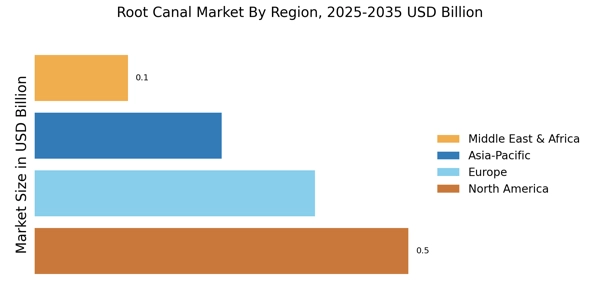
North America is the largest market for root canal products, holding approximately 40% of the global market share. The region's growth is driven by increasing dental procedures, a rise in dental insurance coverage, and advancements in dental technology. Regulatory support from organizations like the FDA ensures high standards for dental products, further boosting market confidence.
The United States is the primary contributor, with key players such as Dentsply Sirona and Henry Schein Inc. leading the competitive landscape. The presence of advanced healthcare infrastructure and a growing emphasis on preventive dental care are significant factors. Canada also plays a vital role, contributing to the overall market dynamics with its increasing adoption of innovative dental solutions.
Europe : Emerging Market with Growth Potential
Europe is the second-largest market for root canal products, accounting for approximately 30% of the global market share. The region's growth is propelled by increasing awareness of dental health, a rise in dental tourism, and supportive regulations from the European Union. The Medical Device Regulation (MDR) enhances product safety and efficacy, fostering consumer trust and market expansion.
Leading countries include Germany, France, and the UK, where established dental practices and a high standard of care drive demand. Key players like Coltene Holding AG and Septodont are well-positioned in this competitive landscape. The presence of innovative technologies and a focus on research and development further enhance the market's attractiveness.
Asia-Pacific : Rapidly Growing Market Segment
Asia-Pacific is witnessing rapid growth in the root canal market, holding approximately 20% of the global market share. Factors such as increasing disposable incomes, a growing population, and rising awareness of dental health are driving demand. Countries like India and China are experiencing significant growth due to expanding healthcare infrastructure and government initiatives promoting dental care.
The competitive landscape is characterized by the presence of both local and international players, including Shofu Inc. and Voco GmbH. The region's market is also influenced by the increasing adoption of advanced dental technologies and materials, which are enhancing treatment outcomes and patient satisfaction. This growth trajectory is expected to continue as dental care becomes more accessible.
Middle East and Africa : Untapped Market with Opportunities
The Middle East and Africa region represents an emerging market for root canal products, holding approximately 10% of the global market share. The growth is driven by increasing urbanization, rising healthcare expenditure, and a growing awareness of dental health. Regulatory frameworks are evolving, with governments focusing on improving healthcare standards, which is expected to catalyze market growth in the coming years.
Countries like South Africa and the UAE are leading the market, with a growing number of dental clinics and practitioners. The competitive landscape includes both local and international players, creating opportunities for market entry and expansion. The increasing demand for quality dental care and innovative solutions presents a significant opportunity for growth in this region.
Key Players and Competitive Insights
Leading market players are investing heavily in research and development in order to expand their product lines, which will help the Root Canal Market grow even more. Market participants are also taking various strategic activities to spread their footprint, with important market developments including new product launches, contractual agreements, mergers and acquisitions, higher investments, and collaboration with other organizations. The Root Canal industry must offer cost-effective items to expand and survive in a more competitive and rising market climate.
Manufacturing locally to minimize operational costs is one of the key business tactics manufacturers use in the Root Canal industry to benefit clients and increase the market sector. In recent years, the Root Canal industry has offered some of the most significant advantages to medicine. Major players in the Root Canal Market, including Coltene Group Dentsply Sirona Inc., Envista Holdings Corporation, Brasseler USA, Diadent Group International, Ivoclar Vivadent Group., Mani Inc., 3M, Septodont, Inc., Ultradent Products Inc., and others are attempting to increase market demand by investing in research and development operations.
Dentsply Sirona Incorporation, founded in 2016, and located in New York City, United States of America, is an American dental equipment manufacturer and producer of dental consumables which markets in more than 100 countries. It designs and manufactures laboratory and specialty products related to dental supplies. It specializes in anesthetics, plaque and gum disease prevention, tooth polishers, and develops artificial teeth. Dentsply Sirona, an increasing root canal treatment company, announced an anatomy system that enables and eases out the treatment process.
The product offers superior outcomes even in curved canals or limited root access and reduces the risk of bleeding and other associated problems.
Steven Rales and Mitchell Rales's Danaher Corporation, founded in 1969, located in Washington, D.C., United States, is an American company that designs, markets and manufactures medical, industrial, and commercial products and services. Its divisions include environmental & applied solutions, life sciences, diagnostics, dental, and many more. Danaher, a root canal industry leader, recently launched its holding company, Envista Holdings Corporation, which would be separate in the dental segment. It would enable the company to spread its control and business in the entire market all around the globe.
Key Companies in the Root Canal Market include
Industry Developments
Brasseler USA announced a smart supply automatic ordering system in the USA and Canada whereby dental professionals can order dental instruments anytime online from the company's website and be delivered at the scheduled time.
Future Outlook
Root Canal Market Future Outlook
The Root Canal Market is projected to grow at a 4.16% CAGR from 2025 to 2035, driven by technological advancements, increasing dental awareness, and rising demand for minimally invasive procedures.
New opportunities lie in:
Development of AI-driven diagnostic tools for root canal procedures.
Expansion of tele-dentistry services to enhance patient access.
Introduction of biodegradable root canal filling materials for sustainability.
By 2035, the Root Canal Market is expected to achieve robust growth, reflecting evolving consumer needs and technological innovations.
Market Segmentation
Root Canal Market Type Outlook
Nonsurgical Root Canal
Secondary Root Canal
Apicoectomy
Pulpotomy
Pulpectomy
Root Canal Market Drugs Outlook
Anesthetics
Painkillers
Antibiotics
Root Canal Market Devices Outlook
Crowns
Endodontic Instruments
Report Scope
MARKET SIZE 2024
1.2(USD Billion)
MARKET SIZE 2025
1.25(USD Billion)
MARKET SIZE 2035
1.879(USD Billion)
COMPOUND ANNUAL GROWTH RATE (CAGR)
4.16% (2025 - 2035)
REPORT COVERAGE
Revenue Forecast, Competitive Landscape, Growth Factors, and Trends
BASE YEAR
2024
Market Forecast Period
2025 - 2035
Historical Data
2019 - 2024
Market Forecast Units
USD Billion
Key Companies Profiled
Dentsply Sirona (US), Kavo Kerr (US), Coltene Holding AG (CH), Henry Schein Inc. (US), Septodont (FR), Voco GmbH (DE), Bisco Inc. (US), 3M Company (US), Shofu Inc. (JP)
Segments Covered
Type, Drug, Device, Region
Key Market Opportunities
Integration of advanced imaging technologies enhances precision in Root Canal Market procedures.
Key Market Dynamics
Technological advancements in dental procedures drive demand for root canal treatments and enhance patient outcomes.
What is the projected market valuation of the Root Canal Market by 2035?
The Root Canal Market is projected to reach a valuation of 1.879 USD Billion by 2035.
What was the market valuation of the Root Canal Market in 2024?
In 2024, the overall market valuation of the Root Canal Market was 1.2 USD Billion.
What is the expected CAGR for the Root Canal Market during the forecast period 2025 - 2035?
The expected CAGR for the Root Canal Market during the forecast period 2025 - 2035 is 4.16%.
Which companies are considered key players in the Root Canal Market?
Key players in the Root Canal Market include Dentsply Sirona, Kavo Kerr, Coltene Holding AG, and Henry Schein Inc.
What are the main segments of the Root Canal Market?
The main segments of the Root Canal Market include types such as Nonsurgical Root Canal, Secondary Root Canal, and devices like Crowns and Endodontic Instruments.
How much did the Nonsurgical Root Canal segment generate in 2024?
The Nonsurgical Root Canal segment generated approximately 0.48 USD Billion in 2024.
What is the projected revenue for Painkillers in the Root Canal Market by 2035?
The projected revenue for Painkillers in the Root Canal Market is expected to reach 0.8 USD Billion by 2035.
What is the expected growth for the Apicoectomy segment from 2024 to 2035?
The Apicoectomy segment is expected to grow from 0.12 USD Billion in 2024 to 0.19 USD Billion by 2035.
Which segment is anticipated to have the highest revenue in the Root Canal Market by 2035?
The Crowns segment is anticipated to have the highest revenue, projected to reach 0.95 USD Billion by 2035.
What role do anesthetics play in the Root Canal Market?
Anesthetics are projected to generate approximately 0.6 USD Billion in revenue by 2035, indicating their critical role in the market.
Author
Author
Vikita Thakur
Senior Research Analyst
She holds an experience of about 5+ years in market research and business consulting projects for sectors such as life sciences, medical devices, and healthcare IT. She possesses a robust background in data analysis, market estimation, competitive intelligence, pipeline analysis market trend identification, and consumer behavior insights. Her expertise lies in technical Sales support, client interaction and project management, designing and implementing market research studies, conducting competitive analysis, and synthesizing complex data into actionable recommendations that drive business growth.
read more
Co-Author
Kinjoll Dey
Senior Research Analyst
He is an extremely curious individual currently working in Healthcare and Medical Devices Domain. Kinjoll is comfortably versed in data centric research backed by healthcare educational background. He leverages extensive data mining and analytics tools such as Primary and Secondary Research, Statistical Analysis, Machine Learning, Data Modelling. His key role also involves Technical Sales Support, Client Interaction and Project management within the Healthcare team. Lastly, he showcases extensive affinity towards learning new skills and remain fascinated in implementing them.
The secondary research process involved comprehensive analysis of regulatory databases, peer-reviewed dental journals, clinical publications, and authoritative health organizations. Key sources included the US Food & Drug Administration (FDA), European Medicines Agency (EMA), American Dental Association (ADA), American Association of Endodontists (AAE), International Association for Dental Research (IADR), National Institutes of Health (NIH), National Center for Biotechnology Information (NCBI/PubMed), Centers for Disease Control and Prevention (CDC) Division of Oral Health, World Health Organization (WHO) Global Health Observatory, EU Eurostat Health Database, and national dental health ministry reports from key markets. These sources were used to collect procedure statistics, regulatory approval data for endodontic devices and materials, clinical safety studies, demographic trends, and market landscape analysis for nonsurgical root canals, apicoectomy procedures, pulpotomy, pulpectomy, endodontic instruments, and crown materials.
Primary Research
Qualitative and quantitative insights were obtained by interviewing supply-side and demand-side stakeholders during the primary research process. The supply-side sources consisted of CEOs, VPs of Product Development, regulatory affairs chiefs, and commercial directors from endodontic device manufacturers, dental materials companies, and OEMs. Board-certified endodontists, general dentists, dental clinic procurement leads, hospital dental department heads, and dental academic institution faculty constituted demand-side sources. Primary research has confirmed the timelines of product pipelines, gathered insights on clinical adoption patterns, pricing strategies, and reimbursement dynamics, and validated market segmentation across procedure types (nonsurgical root canal, secondary root canal, apicoectomy, pulpotomy, pulpectomy), drug categories (anesthetics, painkillers, antibiotics), and device segments (crowns, endodontic instruments).
Primary Respondent Breakdown:
By Designation: C-level Primaries (32%), Director Level (31%), Others (37%)
By Region: North America (38%), Europe (29%), Asia-Pacific (25%), Rest of World (8%)
Market Size Estimation
Global market valuation was derived through revenue mapping and procedure volume analysis. The methodology included:
Identification of 40+ key manufacturers across North America, Europe, Asia-Pacific, and Latin America specializing in endodontic instruments, obturation materials, and restorative devices
Product mapping across nonsurgical root canal, secondary root canal, apicoectomy, pulpotomy, pulpectomy procedures, and anesthetics, painkillers, antibiotics drug categories, plus crowns and endodontic instruments device segments
Analysis of reported and modeled annual revenues specific to root canal treatment portfolios
Coverage of manufacturers representing 70-75% of global market share in 2024
Extrapolation using bottom-up (procedure volume × ASP by country) and top-down (manufacturer revenue validation) approaches to derive segment-specific valuations
No country-specific reports available for this market.
Customer Stories
“This is really good guys. Excellent work on a tight deadline. I will continue to use you going forward and recommend you to others. Nice job”
Noah MalgeriCo-Founder
“Thanks. It’s been a pleasure working with you, please use me as reference with any other Intel employees.”
Joseph AguayoSales Operations & Pricing Manager
“Thanks for sending the report it gives us a good global view of the Betaïne market.”
Peter Groot koerkampAccount and Business Manager
“Thank you, this will be very helpful for OQS.”
La Terria DoddProgram Support Specialist
“We found the report very insightful! we found your research firm very helpful. I'm sending this email to secure our future business.”
Younghwan ChoiSenior Retail Manager
“I am very pleased with how market segments have been defined in a relevant way for my purposes (such as "Portable Freezers & refrigerators" and "last-mile").
In general the report is well structured. Thanks very much for your efforts.”
Mark IrwinManagement Consultant
“I have been reading the first document or the study, ,the Global HVAC and FP market report 2021 till 2026. Must say, good info! I have not gone in depth at all parts, but got a good indication of the data inside!”
Rob KooikerGroup Product Manager HVAC & Fire Protection GMA
“We got the report in time, we really thank you for your support in this process. I also thank to all of your team as they did a great job.”
Akif MorogluStrategy & Business Development Director
“The Automotive 48V ECU Components Procurement Intelligence Study” was a complex project, but the Market Research Future (MRFR) team handled it with quality, agility, and customer-centricity. They delivered all requested data on time and within the agreed scope. The team, including Shubhendra Anand and Rahul Gotadki, was always readily available to clarify questions and swiftly implement necessary adjustments, driving the project to a successful conclusion within a very demanding timeframe.
I would also like to specifically commend Akshay Agarwal for his responsiveness and support at every stage—from our initial inquiry on May 6th through to final delivery on June 18th. His dedication made the entire process seamless.”
Guilherme Gomes MartinsProduct Management Director