×
Request Free Sample ×

Kindly complete the form below to receive a free sample of this Report

* Please use a valid business email

Leading companies partner with us for data-driven Insights

clients tt-cursor
Hero Background

Russia Aerospace Steel Market

ID: MRFR/CnM/45778-HCR
200 Pages
Chitranshi Jaiswal
October 2025

Russia Aerospace Steel Market Research Report By Product (Steel Bar Stock, Forgings, Castings, Others) and By Aircraft (Commercial Aircraft, Business & General Aviation, Military Aircraft, helicopter)- Forecast to 2035

Share:
Download PDF ×

We do not share your information with anyone. However, we may send you emails based on your report interest from time to time. You may contact us at any time to opt-out.

Russia Aerospace Steel Market Infographic
Purchase Options

Russia Aerospace Steel Market Summary

As per analysis, the Russia aerospace steel market is projected to grow from USD 64.82 Million in 2024 to USD 116.23 Million by 2035, exhibiting a compound annual growth rate (CAGR) of 5.45% during the forecast period (2025 - 2035).

Key Market Trends & Highlights

The Russia aerospace steel market is poised for growth driven by technological advancements and increased domestic production.

  • The commercial aviation segment remains the largest contributor to the aerospace steel market in Russia.
  • Military aviation is emerging as the fastest-growing segment, reflecting heightened defense spending and modernization efforts.
  • Stainless steel continues to dominate the market, while titanium alloys are gaining traction due to their lightweight properties.
  • Government support and growing demand for aerospace components are key drivers propelling market expansion.

Market Size & Forecast

2024 Market Size 64.82 (USD Million)
2035 Market Size 116.23 (USD Million)
CAGR (2025 - 2035) 5.45%

Major Players

United Metallurgical Company (RU), Severstal (RU), NLMK Group (RU), TMK (RU), Alcoa Corporation (US), Thyssenkrupp AG (DE), ArcelorMittal (LU), VSMPO-AVISMA Corporation (RU)

Russia Aerospace Steel Market Trends

The Russia aerospace steel market is currently experiencing a period of transformation, driven by advancements in technology and increasing demand for lightweight materials. The aerospace sector in Russia is focusing on enhancing the performance and efficiency of aircraft, which necessitates the use of high-strength steel alloys. This shift is likely influenced by the need for improved fuel efficiency and reduced emissions, aligning with global trends in the aviation industry. Furthermore, the Russian government appears to be investing in domestic production capabilities, aiming to reduce reliance on foreign suppliers and bolster local manufacturing. In addition, the market is characterized by a growing emphasis on research and development. Russian aerospace companies are collaborating with academic institutions to innovate new steel compositions that meet the rigorous standards of the aerospace industry. This collaborative approach may lead to the development of advanced materials that offer superior performance under extreme conditions. As the market evolves, it seems poised to adapt to the changing landscape of aerospace requirements, potentially positioning Russia as a key player in the aerospace steel sector.

Increased Focus on Lightweight Materials

The Russia aerospace steel market is witnessing a heightened emphasis on lightweight materials. This trend is driven by the need for improved fuel efficiency and performance in aircraft design. Manufacturers are exploring advanced steel alloys that provide strength without adding excessive weight, which is crucial for modern aerospace applications.

Investment in Domestic Production

There appears to be a strategic push within the Russia aerospace steel market towards enhancing domestic production capabilities. The government is likely prioritizing local manufacturing to reduce dependency on imports. This initiative may foster innovation and create a more resilient supply chain for the aerospace sector.

Collaboration in Research and Development

The market is characterized by increased collaboration between aerospace companies and research institutions. This partnership aims to develop new steel compositions that meet the stringent requirements of the aerospace industry. Such collaborative efforts may lead to breakthroughs in material science, enhancing the overall performance of aerospace components.

Market Segment Insights

By Application: Commercial Aviation (Largest) vs. Military Aviation (Fastest-Growing)

In the Russia aerospace steel market, the application segments are diversely distributed among Commercial Aviation, Military Aviation, Space Exploration, Unmanned Aerial Vehicles (UAVs), and General Aviation. Currently, Commercial Aviation accounts for a substantial share of the market due to the ongoing recovery in global air travel and increased domestic demand. Although it remains the dominant segment, Military Aviation is rapidly gaining traction thanks to substantial investments by the government in defense and modernization programs, indicating a dynamic shift in the market landscape.

Commercial Aviation (Dominant) vs. Military Aviation (Emerging)

Commercial Aviation remains the cornerstone of the Russia aerospace steel market, driven by strong passenger demand and fleet modernization initiatives. This segment capitalizes on high-strength steel properties essential for airframe and engine durability, ensuring safety and reliability in flight operations. In contrast, Military Aviation, although currently an emerging sector, is experiencing vital growth due to strategic national defense priorities. With rising defense budgets and a focus on advanced military capabilities, producers in this segment are innovating to meet military specifications while exploring more efficient materials that ensure lighter, stronger applications.

By Material Type: Stainless Steel (Largest) vs. Titanium Alloys (Fastest-Growing)

In the Russia aerospace steel market, the material type segmentation reveals a clear dominance of stainless steel, which is preferred for its exceptional corrosion resistance and strength. Stainless steel accounts for a significant portion of the market share, reflecting its vital role in aircraft manufacturing and components. Other materials, like alloy steel and carbon steel, follow, but not at the same level of importance in aerospace applications, which favor durability and high performance.

Steel: Stainless (Dominant) vs. Titanium Alloys (Emerging)

Stainless steel continues to dominate the Russia aerospace steel market due to its superior mechanical properties, adaptability, and durability, making it the material of choice for various structural components in aircraft. Meanwhile, titanium alloys are emerging rapidly, particularly in high-performance segments where weight optimization and corrosion resistance are critical. Titanium is gaining traction for engine components and structural applications, where weight savings directly translate to performance improvements. The demand for advanced materials such as titanium alloys is expected to rise as manufacturers seek to enhance efficiency and reduce emissions.

By End Use: Airframe Components (Largest) vs. Engine Components (Fastest-Growing)

In the Russia aerospace steel market, the end use segment consists of various critical components that play pivotal roles in aircraft manufacturing. Among these, airframe components hold the largest market share due to their essential function in providing structural integrity and durability to aircraft. These components include the fuselage, wings, and tail sections, which are fundamental to the aircraft's overall performance. On the other hand, engine components are witnessing rapid growth, primarily driven by advancements in engine technology and increasing demand for fuel-efficient aircraft. The growth trends in these segments reflect the broader dynamics of the aerospace industry in Russia. With increasing investments in the aviation sector, manufacturers are focusing on enhancing the performance of engine components, making them faster-growing within the market. Factors such as the modernization of existing fleets and a rising emphasis on lightweight materials are propelling the demand for engine components. Simultaneously, the airframe component segment continues to dominate, supported by large-scale production and the ongoing need for new aircraft manufacturing.

Airframe Components (Dominant) vs. Engine Components (Emerging)

Airframe components are characterized by their robust design and are made from various high-strength steel grades to withstand the demanding conditions of flight. This segment's dominance in the Russia aerospace steel market stems from its critical role in the aircraft structure, ensuring safety and performance. Conversely, engine components, while emerging, are rapidly evolving due to technological advancements that focus on enhancing engine efficiency and reducing operating costs. These components are designed for high-performance applications and are increasingly incorporating advanced alloys to improve thermal resistance and fatigue strength. As the aerospace industry gears up for increased demand, both segments are poised for growth, albeit with distinct market dynamics.

Get more detailed insights about Russia Aerospace Steel Market

Key Players and Competitive Insights

The aerospace steel market in Russia is characterized by a competitive landscape that is increasingly shaped by innovation, strategic partnerships, and a focus on sustainability. Key players such as United Metallurgical Company (RU), Severstal (RU), and VSMPO-AVISMA Corporation (RU) are actively pursuing strategies that enhance their operational capabilities and market positioning. United Metallurgical Company (RU) has been focusing on expanding its product portfolio to include advanced high-strength steels, which are essential for modern aerospace applications. Severstal (RU), on the other hand, is investing in digital transformation initiatives aimed at optimizing production processes and improving supply chain efficiency. VSMPO-AVISMA Corporation (RU) is leveraging its expertise in titanium and aerospace materials to forge strategic alliances with global aerospace manufacturers, thereby enhancing its competitive edge.

The business tactics employed by these companies reflect a concerted effort to localize manufacturing and optimize supply chains. The market structure appears moderately fragmented, with several players vying for market share while also collaborating on various projects. This collective influence of key players fosters a dynamic environment where innovation and operational efficiency are paramount.

In October 2025, VSMPO-AVISMA Corporation (RU) announced a partnership with a leading European aerospace manufacturer to develop next-generation aerospace components. This collaboration is expected to enhance VSMPO-AVISMA's technological capabilities and expand its footprint in the European market. The strategic importance of this partnership lies in its potential to drive innovation and improve product offerings, positioning the company favorably against competitors.

In November 2025, Severstal (RU) unveiled a new production line dedicated to the manufacturing of lightweight steel alloys specifically designed for aerospace applications. This investment not only signifies Severstal's commitment to meeting the evolving demands of the aerospace sector but also enhances its competitive positioning by offering advanced materials that contribute to fuel efficiency and performance. The establishment of this production line is likely to attract new clients and strengthen existing relationships within the industry.

In December 2025, United Metallurgical Company (RU) completed a strategic acquisition of a smaller steel manufacturer specializing in aerospace-grade materials. This acquisition is anticipated to bolster United Metallurgical's production capacity and diversify its product offerings. The strategic significance of this move lies in the potential for increased market share and enhanced competitiveness in a rapidly evolving market.

As of December 2025, current trends in the aerospace steel market are increasingly defined by digitalization, sustainability, and the integration of artificial intelligence. Strategic alliances are playing a crucial role in shaping the competitive landscape, enabling companies to pool resources and expertise. Looking ahead, it is likely that competitive differentiation will evolve from traditional price-based competition to a focus on innovation, technological advancements, and supply chain reliability. This shift underscores the importance of adaptability and forward-thinking strategies in maintaining a competitive edge.


Key Companies in the Russia Aerospace Steel Market market include

Industry Developments

The Russia Aerospace Steel Market has recently seen significant developments, particularly surrounding companies such as United Metallurgical Company, Rusal, and NLMK Group. In August 2023, United Metallurgical Company announced strategic investments in advanced steel production technologies aimed at enhancing their aerospace-grade steel offerings.

Meanwhile, the market has experienced considerable valuations, partly driven by increased demand from the aerospace sector as airlines and manufacturers ramp up production post-pandemic. Additionally, Evraz Group reported a partnership with the Russian aerospace manufacturer in September 2023, focusing on high-grade steel supplies for aircraft components.

Notably, in February 2023, the ChTPZ Group initiated discussions for potential collaboration with aerospace entities to develop innovative steel alloys tailored for future aircraft designs. There have been reports of Rusal optimizing its production processes to reduce carbon emissions, further positioning itself as a leader in sustainable aerospace materials.

The market has shown resilience amid global economic shifts, emphasizing Russian firms' capabilities in fulfilling international aerospace material demands. Key players like TMK and Mechel continue to explore collaborative ventures to strengthen their foothold in the aerospace sector, paving the way for future opportunities.

Future Outlook

Russia Aerospace Steel Market Future Outlook

The aerospace steel market in Russia is projected to grow at a 5.45% CAGR from 2024 to 2035, driven by increased defense spending, technological advancements, and rising demand for lightweight materials.

New opportunities lie in:

  • Development of high-strength, lightweight steel alloys for aerospace applications.
  • Investment in advanced manufacturing technologies to enhance production efficiency.
  • Strategic partnerships with aerospace manufacturers for tailored steel solutions.

By 2035, the aerospace steel market in Russia is expected to be robust, driven by innovation and strategic collaborations.

Market Segmentation

Russia Aerospace Steel Market End Use Outlook

  • Airframe Components
  • Engine Components
  • Landing Gear
  • Fuel Tanks
  • Structural Components

Russia Aerospace Steel Market Application Outlook

  • Commercial Aviation
  • Military Aviation
  • Space Exploration
  • Unmanned Aerial Vehicles
  • General Aviation

Russia Aerospace Steel Market Material Type Outlook

  • Stainless Steel
  • Alloy Steel
  • Carbon Steel
  • Titanium Alloys
  • Nickel Alloys

Report Scope

MARKET SIZE 202464.82(USD Million)
MARKET SIZE 202568.35(USD Million)
MARKET SIZE 2035116.23(USD Million)
COMPOUND ANNUAL GROWTH RATE (CAGR)5.45% (2024 - 2035)
REPORT COVERAGERevenue Forecast, Competitive Landscape, Growth Factors, and Trends
BASE YEAR2024
Market Forecast Period2025 - 2035
Historical Data2019 - 2024
Market Forecast UnitsUSD Million
Key Companies ProfiledUnited Metallurgical Company (RU), Severstal (RU), NLMK Group (RU), TMK (RU), Alcoa Corporation (US), Thyssenkrupp AG (DE), ArcelorMittal (LU), VSMPO-AVISMA Corporation (RU)
Segments CoveredApplication, Material Type, End Use
Key Market OpportunitiesGrowing demand for lightweight aerospace steel driven by advancements in aircraft design and fuel efficiency regulations.
Key Market DynamicsGrowing demand for lightweight aerospace steel driven by advancements in aircraft design and efficiency regulations in Russia.
Countries CoveredRussia

Leave a Comment

FAQs

What is the expected market size of the Russia Aerospace Steel Market in 2024?

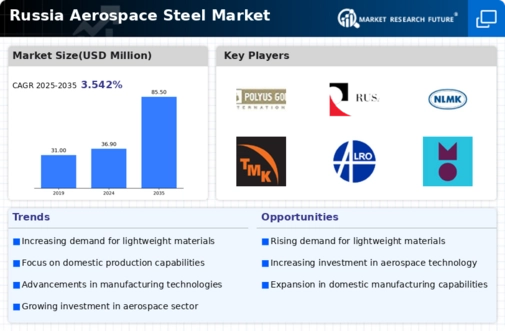
The Russia Aerospace Steel Market is expected to be valued at 58.3 million USD in 2024.

What is the forecasted market size of the Russia Aerospace Steel Market by 2035?

By 2035, the Russia Aerospace Steel Market is anticipated to reach a value of 85.5 million USD.

What is the expected compound annual growth rate (CAGR) for the Russia Aerospace Steel Market from 2025 to 2035?

The expected CAGR for the Russia Aerospace Steel Market from 2025 to 2035 is 3.542 percent.

Who are the key players in the Russia Aerospace Steel Market?

Major players in the market include Polyus Gold, United Metallurgical Company, Rusal, and TMK among others.

What is the market value of Steel Bar Stock in the Russia Aerospace Steel Market for 2024?

Steel Bar Stock in the Russia Aerospace Steel Market is valued at 22.5 million USD in 2024.

What is the projected market value of Forgings by 2035?

Forgings in the Russia Aerospace Steel Market are projected to be valued at 21.4 million USD by 2035.

What is the anticipated value of Castings in the market for 2024?

In 2024, the anticipated value of Castings in the Russia Aerospace Steel Market is 12.0 million USD.

What growth opportunities exist within the Russia Aerospace Steel Market?

The market exhibits growth opportunities driven by increasing demand for high-performance aerospace components.

How does the regional aspect affect the growth rate of the Russia Aerospace Steel Market?

The regional market dynamics, including demand from aerospace manufacturing hubs, greatly influence growth rates.

What is the expected market value for 'Others' in the Russia Aerospace Steel Market by 2035?

The market value for 'Others' is expected to reach 14.2 million USD by 2035.

Download Free Sample

Kindly complete the form below to receive a free sample of this Report

Compare Licence

×
Features License Type
Single User Multiuser License Enterprise User
Price $4,950 $5,950 $7,250
Maximum User Access Limit 1 User Upto 10 Users Unrestricted Access Throughout the Organization
Free Customization
Direct Access to Analyst
Deliverable Format
Platform Access
Discount on Next Purchase 10% 15% 15%
Printable Versions