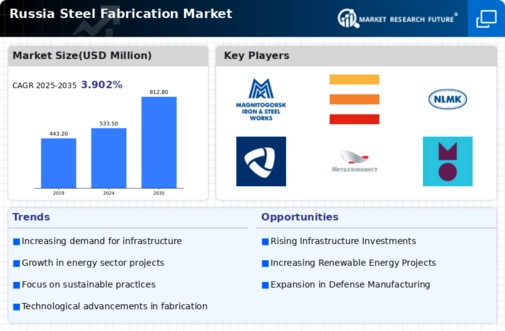
The steel fabrication market in Russia is characterized by a competitive landscape that is both dynamic and multifaceted. Key growth drivers include increasing domestic demand for infrastructure development, a push towards modernization, and a focus on sustainability. Major players such as Severstal (RU), NLMK (RU), and Evraz (RU) are strategically positioned to leverage these trends. Severstal (RU) emphasizes innovation through advanced manufacturing technologies, while NLMK (RU) focuses on expanding its product portfolio to include high-value-added products. Evraz (RU) is actively pursuing regional expansion, particularly in Eastern Europe, which collectively shapes a competitive environment that is increasingly focused on technological advancement and market responsiveness.
In terms of business tactics, companies are localizing manufacturing to reduce costs and enhance supply chain efficiency. The market structure appears moderately fragmented, with several key players exerting considerable influence. This fragmentation allows for a variety of competitive strategies, as companies seek to differentiate themselves through quality, service, and technological capabilities.
In November 2025, Severstal (RU) announced a partnership with a leading technology firm to develop AI-driven solutions for predictive maintenance in steel production. This strategic move is likely to enhance operational efficiency and reduce downtime, positioning Severstal (RU) as a leader in technological innovation within the market. The integration of AI into manufacturing processes may also serve to attract new clients seeking advanced solutions.
In October 2025, NLMK (RU) unveiled a new line of eco-friendly steel products aimed at reducing carbon emissions during production. This initiative aligns with global sustainability trends and positions NLMK (RU) favorably among environmentally conscious consumers and businesses. The strategic importance of this move lies in its potential to capture a growing segment of the market that prioritizes sustainability in procurement decisions.
In September 2025, Evraz (RU) completed the acquisition of a regional competitor, enhancing its market share and operational capabilities. This acquisition is significant as it not only expands Evraz's (RU) production capacity but also allows for greater economies of scale. The consolidation of resources may lead to improved competitiveness in pricing and service delivery, further solidifying Evraz's (RU) position in the market.
As of December 2025, current competitive trends are increasingly defined by digitalization, sustainability, and the integration of AI technologies. Strategic alliances are becoming more prevalent, as companies recognize the need to collaborate in order to innovate and meet evolving market demands. Looking ahead, competitive differentiation is likely to shift from traditional price-based competition to a focus on innovation, technological advancement, and supply chain reliability. This evolution suggests that companies that invest in these areas will be better positioned to thrive in the future.




















Leave a Comment