×
Request Free Sample ×

Kindly complete the form below to receive a free sample of this Report

* Please use a valid business email

Leading companies partner with us for data-driven Insights

clients tt-cursor
Hero Background

Seismic Monitoring Equipment Market

ID: MRFR/Equip/17727-HCR
128 Pages
Sakshi Gupta
October 2025

Seismic Monitoring Equipment Market Research Report Information By Type (Drilling Type and Surface Type), By Application (Oil and Gas Industry, Metal Industry, Mining, and Construction Industry), And By Region (North America, Europe, Asia-Pacific, And Rest of The World) –Market Forecast Till 2035

Share:
Download PDF ×

We do not share your information with anyone. However, we may send you emails based on your report interest from time to time. You may contact us at any time to opt-out.

Seismic Monitoring Equipment Market Infographic
Purchase Options

Seismic Monitoring Equipment Market Summary

As per MRFR analysis, the Seismic Monitoring Equipment Market Size was estimated at 785.0 USD Billion in 2024. The seismic monitoring industry is projected to grow from 835.0 in 2025 to 1430.0 by 2035, exhibiting a compound annual growth rate (CAGR) of 5.5 during the forecast period 2025 - 2035.

Key Market Trends & Highlights

The Seismic Monitoring Equipment Market is poised for substantial growth driven by technological advancements and increasing infrastructure investments.

  • Technological advancements are enhancing the accuracy and efficiency of seismic monitoring systems.
  • North America remains the largest market, while Asia-Pacific is emerging as the fastest-growing region in seismic monitoring.
  • Seismic Data Acquisition dominates the market, whereas Seismic Data Processing is witnessing rapid growth.
  • Key market drivers include increased investment in infrastructure and growing awareness of natural disaster preparedness.

Market Size & Forecast

2024 Market Size 785.0 (USD Billion)
2035 Market Size 1430.0 (USD Billion)
CAGR (2025 - 2035) 5.5%

Major Players

Kinemetrics (US), RST Instruments (CA), GeoSIG (CH), Nanometrics (CA), Guralp Systems (GB), Seismic Source (US), K2 Engineering (US), Rocscience (CA)

Seismic Monitoring Equipment Market Trends

The Seismic Monitoring Equipment Market is currently experiencing a notable evolution, driven by advancements in technology and increasing awareness of seismic risks. The integration of sophisticated sensors and data analytics tools has enhanced the ability to monitor seismic activities with greater precision. This evolution is further propelled by the growing demand for real-time data, which is crucial for disaster preparedness and response. As urbanization continues to expand, the need for robust seismic monitoring systems becomes increasingly critical, particularly in regions prone to earthquakes. Furthermore, government initiatives aimed at improving infrastructure resilience are likely to bolster market growth, as investments in monitoring equipment become a priority for safeguarding communities. In addition to technological advancements, the Seismic Monitoring Equipment Market is influenced by a heightened focus on environmental sustainability. Companies are exploring eco-friendly materials and energy-efficient solutions in their product offerings. This shift not only aligns with global sustainability goals but also appeals to a more environmentally conscious consumer base. As the market evolves, collaboration between public and private sectors appears essential for fostering innovation and ensuring the widespread adoption of seismic monitoring technologies. Overall, the Seismic Monitoring Equipment Market is poised for continued growth, driven by a combination of technological innovation, regulatory support, and a commitment to sustainability.

Technological Advancements

The Seismic Monitoring Equipment Market is witnessing rapid technological advancements, particularly in sensor technology and data processing capabilities. Innovations such as wireless sensors and cloud-based data analytics are enhancing the efficiency and accuracy of seismic monitoring systems. These developments enable real-time data collection and analysis, which is crucial for timely disaster response.

Increased Investment in Infrastructure

There is a growing trend of increased investment in infrastructure, particularly in earthquake-prone regions. Governments and private entities are prioritizing the installation of seismic monitoring equipment to enhance safety and resilience. This trend reflects a broader commitment to disaster preparedness and risk mitigation.

Focus on Sustainability

The Seismic Monitoring Equipment Market is also experiencing a shift towards sustainability. Manufacturers are increasingly adopting eco-friendly practices and materials in their production processes. This focus on sustainability not only meets regulatory requirements but also caters to a market that values environmental responsibility.

Seismic Monitoring Equipment Market Drivers

Market Growth Projections

The Global Seismic Monitoring Equipment Market Industry is projected to experience substantial growth over the next decade, with estimates indicating a market size of 3250 USD Million in 2024 and an anticipated increase to 5670 USD Million by 2035. This growth trajectory suggests a CAGR of 5.19% from 2025 to 2035, reflecting the increasing investments in seismic monitoring technologies and infrastructure. The market is likely to be driven by various factors, including technological advancements, government initiatives, and the rising frequency of natural disasters. Such projections indicate a promising future for the seismic monitoring equipment sector.

Technological Advancements

Rapid advancements in technology are significantly influencing the Global Seismic Monitoring Equipment Market Industry. Innovations in sensor technology, data analytics, and machine learning are enhancing the accuracy and efficiency of seismic monitoring systems. For example, the integration of IoT devices allows for real-time data transmission and analysis, enabling quicker responses to seismic events. As these technologies evolve, they are likely to attract investments from both public and private sectors, further propelling market growth. The anticipated CAGR of 5.19% from 2025 to 2035 suggests a robust expansion driven by these technological improvements.

Increasing Natural Disasters

The frequency of natural disasters, such as earthquakes and tsunamis, is rising globally, which drives the demand for the Global Seismic Monitoring Equipment Market Industry. Countries prone to seismic activity, like Japan and Indonesia, are investing heavily in advanced monitoring systems to enhance disaster preparedness and response. For instance, Japan has implemented a nationwide seismic monitoring network that provides real-time data, aiding in timely evacuations and minimizing casualties. This trend is expected to continue, with the market projected to reach 3250 USD Million in 2024, reflecting the urgent need for reliable seismic monitoring solutions.

Government Initiatives and Funding

Government initiatives aimed at improving disaster resilience are crucial drivers of the Global Seismic Monitoring Equipment Market Industry. Various nations are allocating substantial budgets to enhance their seismic monitoring capabilities. For instance, the United States Geological Survey has been instrumental in funding research and development of advanced seismic monitoring technologies. Such initiatives not only bolster national safety but also stimulate economic growth through job creation in the technology sector. As governments recognize the importance of seismic monitoring, the market is expected to grow significantly, reaching an estimated 5670 USD Million by 2035.

Urbanization and Infrastructure Development

The rapid urbanization and infrastructure development in seismic-prone regions are driving the Global Seismic Monitoring Equipment Market Industry. As cities expand, the potential for earthquake-related damages increases, necessitating robust monitoring systems to protect lives and property. Countries like Turkey and Chile are investing in seismic monitoring technologies to safeguard their urban infrastructure. The integration of seismic monitoring into urban planning is becoming a standard practice, ensuring that new constructions are equipped with the necessary safety measures. This trend is expected to further fuel market growth as urban areas continue to develop.

Growing Awareness of Earthquake Preparedness

There is a growing awareness regarding earthquake preparedness among communities and governments, which is positively impacting the Global Seismic Monitoring Equipment Market Industry. Educational campaigns and training programs are being implemented to inform the public about the importance of seismic monitoring and preparedness measures. This heightened awareness is leading to increased investments in monitoring equipment and infrastructure. For instance, regions with high seismic risk are prioritizing the installation of advanced monitoring systems to ensure safety and minimize damage. This trend is likely to contribute to the market's growth trajectory in the coming years.
Market Segment Insights

By Application: Seismic Data Acquisition (Largest) vs. Seismic Data Processing (Fastest-Growing)

In the Seismic Monitoring Equipment Market, the application segment is dominated by Seismic Data Acquisition, attributed to its critical role in capturing real-time seismic activity. In contrast, Seismic Data Processing is rapidly gaining traction, reflecting the increasing demand for sophisticated data analysis techniques. Other applications, including Seismic Monitoring, Seismic Analysis, and Seismic Hazard Assessment, contribute to the overall market but do not match the share of the top two segments.

Seismic Data Acquisition (Dominant) vs. Seismic Data Processing (Emerging)

Seismic Data Acquisition represents the dominant force in the seismic monitoring landscape, primarily due to its integral role in capturing accurate data from seismic events. This segment enables geoscientists and engineers to collect essential information for further analysis. Conversely, Seismic Data Processing is an emerging segment characterized by technological advancements that enhance the interpretation of seismic data. As organizations seek to optimize their processes, the demand for advanced processing techniques is expected to rise, driven by the necessity for quicker and more precise insights into seismic activities.

By End Use: Oil and Gas Exploration (Largest) vs. Environmental Monitoring (Fastest-Growing)

The Seismic Monitoring Equipment Market is primarily driven by the Oil and Gas Exploration sector, which holds a significant share due to its reliance on seismic data for resource discovery. This sector’s extensive investments in exploration and production activities foster a robust demand for advanced seismic monitoring technologies. In contrast, Environmental Monitoring is gaining traction, fueled by increasing regulatory requirements and a growing emphasis on sustainability. This emerging segment serves various industries by providing critical data for environmental assessments and compliance.

Oil and Gas Exploration (Dominant) vs. Environmental Monitoring (Emerging)

The Oil and Gas Exploration segment continues to dominate the Seismic Monitoring Equipment Market, characterized by its advanced technology applications in resource exploration and extraction. Companies in this sector depend heavily on seismic data to mitigate risks, optimize drilling processes, and locate hydrocarbon reserves efficiently. Conversely, the Environmental Monitoring segment is emerging rapidly, driven by heightened awareness and regulatory frameworks regarding environmental protection. This segment leverages seismic monitoring to assess geological hazards and monitor natural resources, increasingly becoming an integral part of sustainability initiatives across various industries.

By Product Type: Seismographs (Largest) vs. Accelerometers (Fastest-Growing)

In the Seismic Monitoring Equipment Market, the product type segment demonstrates a diverse distribution of market share. Seismographs lead as the largest segment due to their critical role in providing accurate seismic data, thus ensuring safety and efficient monitoring of seismic activities. Following closely are Accelerometers, which are gaining traction because of their ability to detect ground motion and are increasingly used in various applications, including earthquake research and structural health monitoring. The growth trends within this segment are primarily driven by advancements in technology and increasing investment in seismic research and infrastructure. Accelerometers, in particular, are emerging as the fastest-growing segment due to a rising demand for precise motion detection in both urban construction and natural disaster monitoring. Furthermore, the increasing awareness of earthquake preparedness is catalyzing the adoption of various seismic monitoring devices, contributing to a robust market landscape.

Seismographs (Dominant) vs. Geophones (Emerging)

Seismographs are recognized as the dominant force in the seismic monitoring equipment market due to their established reliability and comprehensive data acquisition capabilities, crucial for both research and safety applications. They provide detailed insights into seismic events and are favored in academic and governmental sectors for their precision. Conversely, Geophones represent an emerging segment, gaining popularity for their versatility and effectiveness in subsurface exploration and environmental monitoring. While Geophones traditionally have had a smaller market presence, their role in resource exploration, particularly in oil and gas, and environmental assessments is expanding. The lightweight and high sensitivity of modern Geophones make them increasingly attractive for various applications, fueling their growth and enhancing competition within the segment.

By Technology: Digital Technology (Largest) vs. Wireless Technology (Fastest-Growing)

In the Seismic Monitoring Equipment Market, Digital Technology holds the largest share due to its precise data capturing and processing capabilities. This segment benefits from advancements in digital signal processing and enhanced software applications that facilitate real-time seismic data analysis. Following closely, Wireless Technology is emerging as a vital player, driven by the need for flexibility and reduced installation costs. Companies increasingly adopt wireless solutions, especially in remote locations where wired connections are challenging. Growth trends indicate a robust shift towards embracing advanced digital and wireless solutions in seismic monitoring. The rising demand for enhanced site safety, environmental monitoring, and stricter regulations are propelling innovations in these technologies. Factors such as increased investment in infrastructure and disaster management, alongside growing awareness of seismic safety, are driving the market forward. This momentum is expected to accelerate the incorporation of these technologies in various applications across sectors, including oil and gas, and urban development.

Technology: Digital (Dominant) vs. Wireless (Emerging)

Digital Technology is currently the dominant segment in the Seismic Monitoring Equipment Market, characterized by its superior accuracy and efficiency in capturing seismic waves. It leverages modern algorithms for data interpretation, thus providing stakeholders with actionable insights. The rise of Artificial Intelligence and Machine Learning in this space further enhances its value, making it irreplaceable for critical applications such as earthquake prediction and response. Conversely, Wireless Technology is rapidly becoming an emerging segment, valued for its ease of installation and adaptability in diverse environments. Wireless sensors are being deployed in increasingly remote or challenging terrains, expanding the breadth of seismic monitoring without the limitations of traditional wired systems. As technology progresses, the synergy between digital and wireless solutions is set to revolutionize the industry's operational frameworks.

By Component: Sensors (Largest) vs. Software Solutions (Fastest-Growing)

The seismic monitoring equipment market showcases a diverse range of components, with sensors dominating the market share due to their critical role in detecting ground motions and vibrations. These components play an essential role in geological research, earthquake monitoring, and construction safety, making them indispensable across various applications. Following sensors, data acquisition systems provide crucial support by collecting and storing seismic data, while signal processing units enhance the interpretation of seismic waves, further solidifying their positions in this evolving market. Growth trends indicate a significant increase in demand for software solutions, which are becoming integral for data analysis and visualization in seismic monitoring. As technology advances, there is a push for more sophisticated algorithms and real-time processing capabilities. This is leading to greater investment in software solutions, reflecting the industry's need for efficient data-driven decision-making, ultimately driving innovation and market expansion in the seismic monitoring equipment sector.

Data Acquisition Systems (Dominant) vs. Power Supply Units (Emerging)

In the seismic monitoring equipment market, data acquisition systems are recognized as dominant players, capturing substantial attention for their fundamental role in collecting data from seismic sensors and ensuring that high-quality information is available for analysis. These systems are essential for accurate measurements and reliable operation of seismic networks. Meanwhile, power supply units, while emerging, are gaining traction due to the increasing demand for efficient energy solutions in remote and off-grid seismic monitoring locations. As renewable energy sources become more prevalent and as the need for sustainable operations grows, power supply units are being acknowledged for their capability to ensure uninterrupted service in challenging environments. This emerging role supports the overall goal of enhancing the reliability and efficiency of seismic monitoring efforts.

Get more detailed insights about Seismic Monitoring Equipment Market

Regional Insights

North America : Market Leader in Seismic Tech

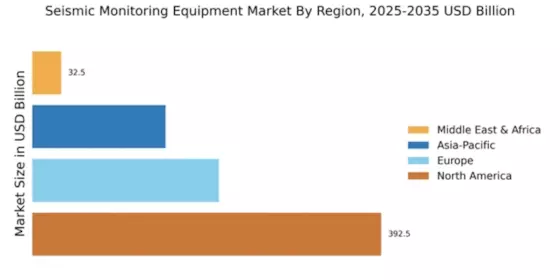
North America is poised to maintain its leadership in the seismic monitoring equipment market, holding a significant share of 392.5M in 2025. The region's growth is driven by increasing investments in infrastructure, stringent regulatory frameworks, and heightened awareness of seismic risks. The demand for advanced monitoring solutions is further fueled by technological advancements and the need for real-time data in disaster management. The competitive landscape is robust, with key players like Kinemetrics, RST Instruments, and Nanometrics leading the charge. The U.S. and Canada are the primary markets, benefiting from government initiatives aimed at enhancing seismic safety. The presence of established companies ensures a steady supply of innovative products, catering to both public and private sectors, thus solidifying North America's market position.

Europe : Growing Demand for Safety Solutions

Europe's seismic monitoring equipment market is expanding, with a market size of 210.0M in 2025. The growth is driven by increasing regulatory requirements for infrastructure safety and a rising awareness of seismic risks. Countries like Italy and Greece, which are prone to earthquakes, are particularly focused on enhancing their monitoring capabilities. The European Union's commitment to disaster risk reduction further catalyzes market growth, pushing for advanced technologies in seismic monitoring. Leading countries in this region include Germany, France, and Italy, where companies like GeoSIG and Guralp Systems are making significant contributions. The competitive landscape is characterized by a mix of established firms and innovative startups, all striving to meet the growing demand for reliable seismic data. The emphasis on safety and compliance with EU regulations is shaping the market dynamics, ensuring a steady influx of new technologies and solutions.

Asia-Pacific : Emerging Market with Potential

The Asia-Pacific region is witnessing a burgeoning demand for seismic monitoring equipment, with a market size of 150.0M in 2025. Rapid urbanization, coupled with an increase in construction activities, has heightened the need for effective seismic monitoring solutions. Countries like Japan and China are at the forefront, driven by their vulnerability to seismic events and the necessity for advanced monitoring systems to protect infrastructure and lives. The competitive landscape features both local and international players, with companies like Nanometrics and K2 Engineering making significant inroads. The region's growth is supported by government initiatives aimed at enhancing disaster preparedness and response capabilities. As awareness of seismic risks grows, the demand for innovative monitoring technologies is expected to rise, positioning Asia-Pacific as a key player in the global market.

Middle East and Africa : Emerging Focus on Seismic Safety

The Middle East and Africa region is gradually recognizing the importance of seismic monitoring, with a market size of 32.5M in 2025. The growth is primarily driven by increasing urbanization and the need for infrastructure safety in earthquake-prone areas. Countries like Turkey and South Africa are beginning to invest in seismic monitoring technologies, spurred by regulatory frameworks aimed at enhancing public safety and disaster preparedness. The competitive landscape is still developing, with a mix of local and international players entering the market. Companies are focusing on providing cost-effective solutions tailored to the unique challenges of the region. As awareness of seismic risks increases, the demand for reliable monitoring systems is expected to grow, paving the way for future investments and innovations in the sector.

Key Players and Competitive Insights

The Seismic Monitoring Equipment Market is characterized by a dynamic competitive landscape, driven by the increasing demand for advanced monitoring solutions in the face of natural disasters and infrastructure development. Key players such as Kinemetrics (US), GeoSIG (CH), and Nanometrics (CA) are strategically positioned to leverage innovation and technological advancements. Kinemetrics (US) focuses on enhancing its product offerings through continuous research and development, while GeoSIG (CH) emphasizes regional expansion to tap into emerging markets. Nanometrics (CA) appears to be investing heavily in digital transformation initiatives, which collectively shape a competitive environment that prioritizes technological superiority and market responsiveness.

In terms of business tactics, companies are increasingly localizing manufacturing to reduce costs and optimize supply chains. The market structure is moderately fragmented, with several players vying for market share. This fragmentation allows for a diverse range of products and services, but also intensifies competition among key players, who must continuously innovate to maintain their positions.

In November 2025, Kinemetrics (US) announced a partnership with a leading technology firm to develop AI-driven seismic analysis tools. This strategic move is likely to enhance Kinemetrics' capabilities in predictive analytics, positioning the company as a frontrunner in the integration of AI within seismic monitoring. Such advancements may significantly improve the accuracy and efficiency of seismic data interpretation, thereby attracting a broader client base.

In October 2025, GeoSIG (CH) launched a new line of portable seismic sensors designed for rapid deployment in disaster-stricken areas. This initiative not only showcases GeoSIG's commitment to innovation but also addresses the urgent need for effective monitoring solutions in emergency situations. The ability to provide timely data could enhance the company's reputation and market share in critical applications.

In September 2025, Nanometrics (CA) expanded its operations into Southeast Asia, establishing a new manufacturing facility aimed at meeting the growing demand in that region. This expansion reflects a strategic focus on regional growth and supply chain optimization, potentially allowing Nanometrics to reduce lead times and improve service delivery in a rapidly developing market.

As of December 2025, the competitive trends in the Seismic Monitoring Equipment Market are increasingly defined by digitalization, sustainability, and the integration of AI technologies. Strategic alliances are becoming more prevalent, as companies recognize the value of collaboration in enhancing their technological capabilities. Moving forward, competitive differentiation is likely to evolve from traditional price-based competition to a focus on innovation, technological advancements, and supply chain reliability, suggesting a shift towards a more sophisticated and resilient market landscape.

Key Companies in the Seismic Monitoring Equipment Market market include

Industry Developments

October 2023: In October 2023, Silixa Ltd introduced DScover, a novel well surveillance and optimization service. This offering empowers operators to enhance well placement and completion design through the integration of analysis with improved data quality from Distributed Temperature Sensing (DTS), Distributed Acoustic Sensing (DAS), and the new Distributed Strain Sensing (DSS) measurements.

May 2023: In May 2023, Güralp Systems Ltd. established a new distribution partnership with Rift Systems Inc., based in California, for the U.S. market. Rift Systems is well-positioned to offer localized support to U.S. customers, possessing an in-depth understanding of the unique challenges and requirements faced by operators in the industry

In July 2022, Geospace Technologies Corporation announced the signing of a long-term rental purchase agreement with SAExploration, which is a major partner in maritime geophysical services. SAExploration is expected to rent the OBX-750E seabed ocean bottom wireless seismic data collection nodes. As per the existing contractual conditions, the value placed on this agreement stands at USD 12 Million.

SeaBird Exploration, in its statement, reported that in February 2022, an Ocean Bed Nodes (OBN) resource contract of about 5 months duration had been approved in the Asia-Pacific region. The company wants to employ the Voyager Explorer on the contract, hence the extension of the charter of the unmanned vessel; the contract is projected to commence in April 2020.

Future Outlook

Seismic Monitoring Equipment Market Future Outlook

The Seismic Monitoring Equipment Market is projected to grow at a 5.5% CAGR from 2024 to 2035, driven by technological advancements, increased investment in infrastructure, and heightened awareness of seismic risks.

New opportunities lie in:

  • Development of advanced real-time data analytics platforms
  • Integration of IoT technology for remote monitoring solutions
  • Expansion into emerging markets with tailored seismic solutions

By 2035, the market is expected to be robust, driven by innovation and strategic investments.

Market Segmentation

Seismic Monitoring Equipment Market End Use Outlook

  • Oil and Gas Exploration
  • Mining Industry
  • Civil Engineering
  • Environmental Monitoring
  • Research and Development

Seismic Monitoring Equipment Market Component Outlook

  • Sensors
  • Data Acquisition Systems
  • Signal Processing Units
  • Power Supply Units
  • Software Solutions

Seismic Monitoring Equipment Market Technology Outlook

  • Analog Technology
  • Digital Technology
  • Wireless Technology
  • Fiber Optic Technology
  • Microelectromechanical Systems

Seismic Monitoring Equipment Market Application Outlook

  • Seismic Data Acquisition
  • Seismic Data Processing
  • Seismic Monitoring
  • Seismic Analysis
  • Seismic Hazard Assessment

Seismic Monitoring Equipment Market Product Type Outlook

  • Seismographs
  • Accelerometers
  • Geophones
  • Seismic Sensors
  • Data Loggers

Report Scope

MARKET SIZE 2024785.0(USD Billion)
MARKET SIZE 2025835.0(USD Billion)
MARKET SIZE 20351430.0(USD Billion)
COMPOUND ANNUAL GROWTH RATE (CAGR)5.5% (2024 - 2035)
REPORT COVERAGERevenue Forecast, Competitive Landscape, Growth Factors, and Trends
BASE YEAR2024
Market Forecast Period2025 - 2035
Historical Data2019 - 2024
Market Forecast UnitsUSD Billion
Key Companies ProfiledKinemetrics (US), RST Instruments (CA), GeoSIG (CH), Nanometrics (CA), Guralp Systems (GB), Seismic Source (US), K2 Engineering (US), Rocscience (CA)
Segments CoveredApplication, End Use, Product Type, Technology, Component
Key Market OpportunitiesIntegration of advanced artificial intelligence in Seismic Monitoring Equipment Market enhances predictive capabilities and data analysis.
Key Market DynamicsTechnological advancements and regulatory changes drive demand for innovative seismic monitoring equipment across various sectors.
Countries CoveredNorth America, Europe, APAC, South America, MEA

Market Highlights

Author
Sakshi Gupta
Research Analyst Level II

I have about two years of experience working in the consumer goods and retail industries and I am a biotech graduate.A tech-savvy analytically focused professional with a strong capabilities in identification, concept generation, and strategy evaluation. I can produce data-driven solutions while fusing unusual viewpoints with original concepts. I have been extensively working on business case studies, competitive & comparative analyses, and strategic reports. My primary areas of experience include client management, financial analysis, supply chain evaluation, market entry strategy evaluation, and estimating and forecasting market size.

Leave a Comment

FAQs

How much is the Seismic Monitoring Equipment Market?

The Seismic Monitoring Equipment Market size was valued at Significant Value in 2022.

What is the growth rate of the Seismic Monitoring Equipment Market?

The Seismic Monitoring Equipment Market is projected to grow at a CAGR of 4.50% during the forecast period, 2024-2032.

Which region held the largest market share in the Seismic Monitoring Equipment Market?

North America had the largest share of the global market

Who are the key players in the Seismic Monitoring Equipment Market?

The key players in the market are Schlumberger, CGG, and INOVA

Which Type led the Seismic Monitoring Equipment Market?

The Drilling Type segment dominated the market in 2022.

Which Application had the largest market share in the Seismic Monitoring Equipment Market?

The Oil and Gas Industry segment had the largest share in the global market.

Download Free Sample

Kindly complete the form below to receive a free sample of this Report

Compare Licence

×
Features License Type
Single User Multiuser License Enterprise User
Price $4,950 $5,950 $7,250
Maximum User Access Limit 1 User Upto 10 Users Unrestricted Access Throughout the Organization
Free Customization
Direct Access to Analyst
Deliverable Format
Platform Access
Discount on Next Purchase 10% 15% 15%
Printable Versions