×
Request Free Sample ×

Kindly complete the form below to receive a free sample of this Report

* Please use a valid business email

Leading companies partner with us for data-driven Insights

clients tt-cursor
Hero Background

Self consolidating Concrete Market

ID: MRFR/PCM/0838-HCR
115 Pages
Snehal Singh
October 2025

Self-Consolidating Concrete Market Research Report By Application (Residential Construction, Commercial Construction, Infrastructure), By Type (Flowable Concrete, SLUMP Concrete, Self-Compacting Concrete), By End Use (Architectural Structures, Bridges, Roads), By Composition (Cement, Aggregates, Additives) and By Regional (North America, Europe, South America, Asia Pacific, Middle East and Africa) - Forecast to 2035

Share:
Download PDF ×

We do not share your information with anyone. However, we may send you emails based on your report interest from time to time. You may contact us at any time to opt-out.

Self consolidating Concrete Market Infographic
Purchase Options

Self consolidating Concrete Market Summary

As per MRFR analysis, the Self Consolidating Concrete Market Size was estimated at 12414.2 USD Billion in 2024. The Self consolidating Concrete industry is projected to grow from 13047.58 in 2025 to 21460.54 by 2035, exhibiting a compound annual growth rate (CAGR) of 5.1 during the forecast period 2025 - 2035.

Key Market Trends & Highlights

The Self Consolidating Concrete Market is poised for robust growth driven by sustainability and urbanization.

  • North America remains the largest market for self consolidating concrete, driven by increasing infrastructure projects.
  • Asia-Pacific is emerging as the fastest-growing region, fueled by rapid urbanization and construction activities.
  • The residential construction segment holds the largest share, while infrastructure development is witnessing the fastest growth in demand.
  • Key market drivers include the rising demand for high-performance materials and regulatory support for sustainable construction practices.

Market Size & Forecast

2024 Market Size 12414.2 (USD Billion)
2035 Market Size 21460.54 (USD Billion)
CAGR (2025 - 2035) 5.1%

Major Players

LafargeHolcim (CH), CEMEX (MX), HeidelbergCement (DE), BASF (DE), Sika (CH), Saint-Gobain (FR), GCP Applied Technologies (US), Firth Industries (NZ), UltraTech Cement (IN)

Self consolidating Concrete Market Trends

The Self consolidating Concrete Market is currently experiencing a notable evolution, driven by advancements in material science and increasing demand for high-performance construction materials. This market segment is characterized by its ability to flow and fill molds without the need for mechanical vibration, which enhances the efficiency of construction processes. As urbanization accelerates globally, the need for innovative concrete solutions that can meet the challenges of modern infrastructure is becoming increasingly apparent. Furthermore, sustainability concerns are prompting manufacturers to explore eco-friendly alternatives, which may reshape product offerings in the near future. In addition, the Self consolidating Concrete Market is witnessing a shift towards automation and digitalization in production processes. This trend appears to be fostering greater precision and consistency in product quality, which is essential for meeting stringent regulatory standards. The integration of smart technologies into construction practices is likely to enhance the overall performance of self consolidating concrete, making it a preferred choice among builders and contractors. As the market continues to evolve, stakeholders must remain vigilant to emerging trends and adapt their strategies accordingly to maintain competitiveness in this dynamic landscape.

Sustainability Initiatives

The Self consolidating Concrete Market is increasingly influenced by sustainability initiatives, as stakeholders seek to reduce the environmental impact of construction activities. This trend encompasses the use of recycled materials and the development of low-carbon concrete formulations, which may appeal to environmentally conscious consumers and regulatory bodies alike.

Technological Advancements

Technological advancements are playing a pivotal role in the evolution of the Self consolidating Concrete Market. Innovations in mixing techniques and material formulations are enhancing the performance characteristics of self consolidating concrete, potentially leading to improved durability and workability.

Urbanization and Infrastructure Development

The ongoing trend of urbanization and infrastructure development is significantly impacting the Self consolidating Concrete Market. As cities expand and require more robust construction solutions, the demand for self consolidating concrete is likely to rise, driven by its efficiency and effectiveness in meeting modern construction needs.

Self consolidating Concrete Market Drivers

Increasing Urbanization

The rapid pace of urbanization globally is a primary driver for the Global Self-Consolidating Concrete Market Industry. As cities expand, the demand for innovative construction materials that facilitate faster and more efficient building processes grows. Self-consolidating concrete, known for its ability to flow and fill forms without mechanical vibration, is particularly advantageous in densely populated urban areas. This trend is expected to contribute to the market's growth, with projections indicating a market value of 7.3 USD Billion in 2024. Urban centers increasingly require materials that enhance construction efficiency while minimizing labor costs, thus driving the adoption of self-consolidating concrete.

Market Growth Projections

The Global Self-Consolidating Concrete Market Industry is projected to experience robust growth over the next decade. With a market value of 7.3 USD Billion anticipated in 2024, the industry is expected to expand significantly, reaching an estimated 12.0 USD Billion by 2035. The compound annual growth rate (CAGR) of 4.66% from 2025 to 2035 indicates a steady increase in demand for self-consolidating concrete. This growth is likely driven by various factors, including urbanization, technological advancements, and sustainability initiatives. The market's expansion reflects the increasing recognition of self-consolidating concrete as a preferred choice for modern construction projects.

Infrastructure Development

The ongoing global infrastructure development projects are a crucial driver for the Global Self-Consolidating Concrete Market Industry. Governments worldwide are investing heavily in infrastructure to support economic growth, which includes roads, bridges, and public buildings. Self-consolidating concrete is particularly suited for these applications due to its ability to achieve high strength and durability while minimizing labor costs. As infrastructure projects continue to expand, the demand for self-consolidating concrete is expected to rise, contributing to the market's growth trajectory. This trend aligns with the broader push for modernization and improved public facilities across various regions.

Sustainability Initiatives

Growing environmental concerns and sustainability initiatives are shaping the Global Self-Consolidating Concrete Market Industry. The construction sector is increasingly focusing on reducing its carbon footprint, and self-consolidating concrete offers a viable solution due to its efficient use of materials and reduced waste generation. Many construction projects are now mandated to adhere to green building standards, which often favor the use of sustainable materials like self-consolidating concrete. This shift towards eco-friendly construction practices is likely to bolster market growth, as more builders and contractors seek to comply with regulations and meet consumer demand for sustainable solutions.

Technological Advancements

Technological innovations in concrete formulation and production processes are significantly influencing the Global Self-Consolidating Concrete Market Industry. Advances in admixture technology and the development of high-performance concrete mixtures have improved the properties of self-consolidating concrete, making it more appealing to construction professionals. These advancements allow for better workability, durability, and sustainability, aligning with modern construction demands. As a result, the market is projected to grow at a CAGR of 4.66% from 2025 to 2035, reaching an estimated value of 12.0 USD Billion by 2035. The continuous evolution of concrete technology is likely to enhance the performance characteristics of self-consolidating concrete, further driving its adoption.

Labor Shortages in Construction

Labor shortages in the construction industry are increasingly influencing the Global Self-Consolidating Concrete Market Industry. The construction sector faces challenges in finding skilled labor, which has led to a growing interest in materials that require less manual intervention. Self-consolidating concrete, which can be placed without the need for extensive vibration or finishing, presents a practical solution to this issue. As construction companies seek to optimize their operations and reduce reliance on skilled labor, the adoption of self-consolidating concrete is likely to increase. This trend may further accelerate market growth as companies adapt to the evolving labor landscape.
Market Segment Insights

By Application: Residential Construction (Largest) vs. Infrastructure Development (Fastest-Growing)

The Self Consolidating Concrete Market is significantly influenced by its application across various segments, with Residential Construction representing the largest share. This segment benefits from the increasing demand for innovative building techniques and efficient construction processes that are integral to residential projects. On the other hand, Infrastructure Development has emerged as a major force in the market, capitalizing on the global push for modern infrastructure and urban regeneration, contributing positively to market dynamics.

Commercial Construction (Dominant) vs. Precast Concrete Products (Emerging)

Within the application segment of self consolidating concrete, Commercial Construction holds a dominant position due to the high demand for speed and quality in building commercial spaces. It captures a substantial portion of the market as developers prioritize efficiency and durability. In contrast, Precast Concrete Products are rapidly emerging, supported by the need for modular construction solutions that enhance time and cost efficiency. This segment is bolstered by advancements in manufacturing technologies, enabling the production of high-quality precast elements that meet diverse architectural demands.

By End Use: Building Construction (Largest) vs. Road Construction (Fastest-Growing)

In the Self Consolidating Concrete Market, the Building Construction segment dominates with the largest share, driven by the increasing demand for rapid construction techniques and high-quality finishes. This segment benefits from the rising construction of residential, commercial, and industrial infrastructures, which enhances the overall market viability. Meanwhile, Road Construction, although smaller in comparison, is rapidly gaining traction as governments and infrastructure entities prioritize the development and maintenance of roadways, increasing the use of self consolidating concrete for its efficiency and durability. Growth trends within these segments indicate that Building Construction will continue to thrive due to urbanization and population growth. Conversely, the Road Construction segment is experiencing the fastest growth resulting from infrastructural investments, particularly in emerging economies. These investments are augmented by the need for sustainable and cost-effective construction solutions, positioning self consolidating concrete as a preferred choice for road development, enabling faster project completion and reduced labor costs.

Building Construction (Dominant) vs. Road Construction (Emerging)

The Building Construction segment remains the dominant force in the Self Consolidating Concrete Market, characterized by its extensive usage in constructing high-rise buildings, residential complexes, and various commercial structures. This segment leverages the superior workability and finish of self consolidating concrete, which allows for intricate designs and faster placement rates. Additionally, resistance to segregation and segregation of aggregates enhances its appeal among builders. On the other hand, the Road Construction segment is emerging as a significant player, driven by increased public and private investment in transport infrastructure. The demand for sustainable materials coupled with the advantages of self consolidating concrete, such as reduced maintenance and longevity, are reshaping practices in road building, making it an essential component of modern infrastructure projects.

By Type: High-Performance Concrete (Largest) vs. Lightweight Concrete (Fastest-Growing)

The Self Consolidating Concrete (SCC) market showcases a diverse range of concrete types, with High-Performance Concrete holding the largest market share among them. This type is primarily favored for its superior strength, durability, and fluidity, which make it an ideal choice for various construction applications. Following closely, Normal Strength Concrete maintains a significant presence, while Lightweight Concrete is emerging rapidly due to its beneficial properties like reduced weight, making it increasingly appealing for building projects focused on efficiency and eco-friendliness. Growth trends in the Self Consolidating Concrete market indicate a remarkable surge in demand for Lightweight Concrete, driven by the construction industry's shift towards sustainable practices. This type of concrete not only supports eco-friendly objectives but also contributes to lower transportation costs due to its lighter weight. Additionally, High-Performance Concrete continues to grow steadily as its applications expand within high-stress environments, thereby solidifying its relevance in modern construction methodologies.

High-Performance Concrete (Dominant) vs. Lightweight Concrete (Emerging)

High-Performance Concrete (HPC) is recognized as the dominant segment within the Self Consolidating Concrete market, renowned for its enhanced strength and durability. This concrete type is engineered to meet specific performance criteria, making it the preferred choice for projects demanding exceptional performance under challenging conditions, such as bridges and high-rise buildings. On the other hand, Lightweight Concrete is emerging as a significant player, characterized by its reduced density and excellent insulation properties. This segment is increasingly favored in construction projects that prioritize sustainability and energy efficiency, allowing for innovative design solutions. As more builders seek cost-effective and resource-efficient materials, Lightweight Concrete's market share is expected to rise, challenging the dominance of HPC while complementing modern construction practices.

By Distribution Channel: Direct Sales (Largest) vs. Online Sales (Fastest-Growing)

In the Self Consolidating Concrete Market, the distribution channels are primarily segmented into Direct Sales, Online Sales, and Retail Sales. Direct Sales hold the largest market share due to strong relationships between manufacturers and contractors, ensuring a reliable supply chain. Conversely, Online Sales, although currently smaller, show a promising trend with growing demand for convenience and accessibility, particularly among smaller contractors who prefer ordering materials digitally rather than through conventional means.

Direct Sales: Dominant vs. Online Sales: Emerging

Direct Sales remain the dominant distribution channel in the Self Consolidating Concrete Market, characterized by established channels between producers and large-scale customers. This method fosters long-term business relationships and offers competitive pricing, making it favorable for bulk orders. On the other hand, Online Sales, classified as an emerging channel, are rapidly gaining traction, driven by technological advancements and the increasing cravings of customers for convenience. The ease of access to product information and online ordering has attracted contractors and builders who may not have previously considered digital purchasing. This shift is indicative of changing market dynamics and consumer preferences.

By Formulation: Polymer Modified Concrete (Largest) vs. Fiber Reinforced Concrete (Fastest-Growing)

In the Self Consolidating Concrete Market, Polymer Modified Concrete holds the largest market share, driven by its superior performance and enhanced durability characteristics. This segment caters to a broad range of applications, making it a preferred choice among contractors and builders. In contrast, Fiber Reinforced Concrete, while having a smaller share, is rapidly gaining traction due to its added tensile strength and crack resistance, appealing particularly to projects requiring high resilience.

Polymer Modified Concrete (Dominant) vs. Fiber Reinforced Concrete (Emerging)

Polymer Modified Concrete is characterized by its ability to enhance the bonding properties and overall performance of concrete through the incorporation of polymers. This formulation is widely adopted for projects that demand high durability and resistance to environmental factors. On the other hand, Fiber Reinforced Concrete represents an emerging segment, integrating fibers to improve tensile strength and ductility. As construction trends shift towards more sustainable and resilient materials, Fiber Reinforced Concrete is experiencing growth due to its advantages in reducing cracking and enhancing overall structural integrity, positioning it as a vital player in the evolving concrete landscape.

Get more detailed insights about Self consolidating Concrete Market

Regional Insights

North America : Established Market with Growth Potential

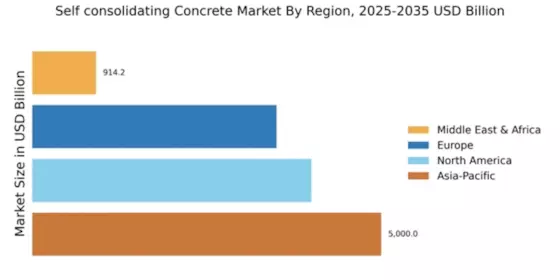
The North American self consolidating concrete market is projected to reach $4,000.0 million by 2025, driven by increasing infrastructure projects and a growing emphasis on sustainable construction practices. Regulatory support for green building initiatives and advancements in concrete technology are key growth catalysts. The demand for high-performance concrete solutions is also on the rise, reflecting a shift towards more efficient construction methods. Leading the market are the United States and Canada, where major players like LafargeHolcim and GCP Applied Technologies are actively innovating. The competitive landscape is characterized by a mix of established companies and emerging players, all vying for market share. The presence of significant construction activities, particularly in urban areas, further fuels the demand for self consolidating concrete solutions, ensuring a robust market environment.

Europe : Innovative Solutions Driving Growth

Europe's self consolidating concrete market is expected to reach $3,500.0 million by 2025, propelled by stringent regulations promoting sustainable construction and innovative building practices. The region's commitment to reducing carbon emissions and enhancing energy efficiency in construction is a significant driver. Countries like Germany and France are leading the charge, with increasing investments in infrastructure and green building technologies. Germany, France, and the UK are the primary markets, hosting key players such as HeidelbergCement and BASF. The competitive landscape is marked by a strong emphasis on R&D, with companies focusing on developing advanced concrete formulations. The presence of regulatory bodies advocating for sustainable practices further enhances market dynamics, ensuring that the region remains at the forefront of concrete innovation.

Asia-Pacific : Rapid Growth and Expansion

The Asia-Pacific region dominates the self consolidating concrete market, projected to reach $5,000.0 million by 2025. This growth is fueled by rapid urbanization, increasing infrastructure investments, and a rising demand for high-quality construction materials. Countries like China and India are at the forefront, with significant government initiatives aimed at enhancing infrastructure and promoting sustainable building practices. China is the largest market, followed by India and Japan, where major players like UltraTech Cement and Sika are expanding their operations. The competitive landscape is vibrant, with both local and international companies striving to capture market share. The region's focus on innovation and technology adoption in construction further strengthens its position as a leader in the self consolidating concrete market.

Middle East and Africa : Emerging Market with Potential

The Middle East and Africa's self consolidating concrete market is projected to reach $914.2 million by 2025, driven by increasing infrastructure development and urbanization. Countries in the Gulf Cooperation Council (GCC) are investing heavily in construction projects, supported by government initiatives aimed at diversifying economies. The demand for high-performance concrete is growing, reflecting the region's commitment to modernizing its infrastructure. Leading countries include the UAE and South Africa, where key players like LafargeHolcim and Saint-Gobain are establishing a strong presence. The competitive landscape is evolving, with both local and international firms competing for market share. The region's focus on sustainable construction practices is expected to further enhance growth opportunities in the self consolidating concrete market.

Key Players and Competitive Insights

The Self consolidating Concrete Market is characterized by a dynamic competitive landscape, driven by increasing demand for high-performance concrete solutions across various construction applications. Key players such as LafargeHolcim (CH), CEMEX (MX), and BASF (DE) are strategically positioned to leverage innovation and sustainability as core components of their operational focus. These companies are actively investing in research and development to enhance product performance and reduce environmental impact, thereby shaping a competitive environment that prioritizes quality and sustainability over traditional metrics.

In terms of business tactics, companies are increasingly localizing manufacturing to reduce transportation costs and enhance supply chain efficiency. The market appears moderately fragmented, with several key players exerting influence through strategic partnerships and regional expansions. This collective approach not only strengthens their market presence but also fosters a collaborative environment that encourages innovation and responsiveness to local market needs.

In November 2025, LafargeHolcim (CH) announced a partnership with a leading technology firm to develop a new line of eco-friendly self consolidating concrete products. This strategic move is expected to enhance their product portfolio while addressing the growing demand for sustainable construction materials. The collaboration signifies a commitment to innovation and positions LafargeHolcim as a frontrunner in the sustainable construction sector.

Similarly, in October 2025, CEMEX (MX) launched a digital platform aimed at optimizing the supply chain for self consolidating concrete. This initiative is designed to streamline operations and improve customer engagement, reflecting a broader trend towards digital transformation in the construction industry. By enhancing operational efficiency, CEMEX is likely to gain a competitive edge in a market that increasingly values technology-driven solutions.

In September 2025, BASF (DE) expanded its production capacity for self consolidating concrete in Europe, responding to the rising demand in the region. This expansion not only reinforces BASF's commitment to meeting market needs but also highlights the importance of scalability in maintaining competitive advantage. The increased capacity is expected to facilitate quicker response times and better service delivery to customers.

As of December 2025, the competitive trends in the Self consolidating Concrete Market are increasingly defined by digitalization, sustainability, and the integration of advanced technologies such as AI. Strategic alliances are becoming pivotal in shaping the landscape, as companies seek to enhance their capabilities and market reach. The shift from price-based competition to a focus on innovation, technology, and supply chain reliability is evident, suggesting that future competitive differentiation will hinge on the ability to adapt and innovate in response to evolving market demands.

Key Companies in the Self consolidating Concrete Market market include

Industry Developments

Recent developments in the Self-Consolidating Concrete Market have been marked by strong growth and increasing demand influenced by urbanization and infrastructure projects. Companies such as Martin Marietta and UltraTech Cement are expanding their capabilities to meet the rising need for high-performance concrete solutions. In addition, CRH and HeidelbergCement are focusing on sustainability initiatives, integrating eco-friendly practices in their production processes.

Notable mergers and acquisitions include CEMEX acquiring a regional supplier and enhancing its market share and distribution network, while LafargeHolcim and Boral are exploring strategic alliances to optimize resource utilization. The market has witnessed a significant increase in valuations, reflected in the performance of companies like BASF and Sika, which have reported enhanced revenue projections due to innovative product offerings. Messe Frankfurt and Fibo intercon are playing an instrumental role in promoting the industry through exhibitions, contributing to networking and collaboration opportunities.

Overall, the robust growth trajectory is driven by advancements in technology, a focus on sustainability, and increasing construction demands around the globe.

Future Outlook

Self consolidating Concrete Market Future Outlook

The Self Consolidating Concrete Market is projected to grow at a 5.1% CAGR from 2024 to 2035, driven by urbanization, infrastructure development, and technological advancements.

New opportunities lie in:

  • Development of eco-friendly self consolidating concrete formulations
  • Integration of smart technology for real-time monitoring
  • Expansion into emerging markets with tailored solutions

By 2035, the market is expected to achieve robust growth, driven by innovation and strategic expansion.

Market Segmentation

Self consolidating Concrete Market Type Outlook

  • High-Performance Concrete
  • Normal Strength Concrete
  • Lightweight Concrete
  • Heavyweight Concrete

Self consolidating Concrete Market End Use Outlook

  • Building Construction
  • Road Construction
  • Bridge Construction
  • Tunneling

Self consolidating Concrete Market Application Outlook

  • Residential Construction
  • Commercial Construction
  • Infrastructure Development
  • Precast Concrete Products

Self consolidating Concrete Market Formulation Outlook

  • Polymer Modified Concrete
  • Fiber Reinforced Concrete
  • Self-Leveling Concrete

Self consolidating Concrete Market Distribution Channel Outlook

  • Direct Sales
  • Online Sales
  • Retail Sales

Report Scope

MARKET SIZE 202412414.2(USD Billion)
MARKET SIZE 202513047.58(USD Billion)
MARKET SIZE 203521460.54(USD Billion)
COMPOUND ANNUAL GROWTH RATE (CAGR)5.1% (2024 - 2035)
REPORT COVERAGERevenue Forecast, Competitive Landscape, Growth Factors, and Trends
BASE YEAR2024
Market Forecast Period2025 - 2035
Historical Data2019 - 2024
Market Forecast UnitsUSD Billion
Key Companies ProfiledLafargeHolcim (CH), CEMEX (MX), HeidelbergCement (DE), BASF (DE), Sika (CH), Saint-Gobain (FR), GCP Applied Technologies (US), Firth Industries (NZ), UltraTech Cement (IN)
Segments CoveredApplication, End Use, Type, Distribution Channel, Formulation
Key Market OpportunitiesGrowing demand for sustainable construction materials enhances opportunities in the Self consolidating Concrete Market.
Key Market DynamicsRising demand for sustainable construction materials drives innovation in self consolidating concrete formulations and applications.
Countries CoveredNorth America, Europe, APAC, South America, MEA

Market Highlights

Author
Snehal Singh
Assistant Manager - Research

High acumen in analyzing complex macro & micro markets with more than 6 years of work experience in the field of market research. By implementing her analytical skills in forecasting and estimation into market research reports, she has expertise in Packaging, Construction, and Equipment domains. She handles a team size of 20-25 resources and ensures smooth running of the projects, associated marketing activities, and client servicing.

Leave a Comment

FAQs

What was the market size of the Self-Consolidating Concrete Market in 2024?

Self consolidating Concrete Market crossed a valuation of USD 12414.20 Billion in 2024

What is the expected CAGR for the Self-Consolidating Concrete Market from 2024 to 2035?

Self consolidating Concrete Market is projected to grow at a CAGR of 5.1% during the forecast period, 2025-2035

Which application held the largest market share in the Self-Consolidating Concrete Market?

Infrastructure is the application segment that held the largest market share, valued at 3.14 USD Billion in 2024.

Who are the key players in the Self-Consolidating Concrete Market?

Significant players in the market include Martin Marietta, UltraTech Cement, CRH, HeidelbergCement, and LafargeHolcim.

What is the expected market size for the North America region by 2035?

The North America region is expected to be valued at 3.12 USD Billion by 2035.

How much is the European market for Self-Consolidating Concrete expected to grow by 2035?

The European market for Self-Consolidating Concrete is expected to grow to 2.84 USD Billion by 2035.

What was the market size for Residential Construction in 2024?

Self consolidating Concrete Market was valued at USD 12414.20 Billion in 2024

What is the expected value of the South American Self-Consolidating Concrete Market by 2035?

The South American Self-Consolidating Concrete Market is expected to reach 0.82 USD Billion by 2035.

What challenges might affect the growth of the Self-Consolidating Concrete Market?

Challenges may include fluctuating raw material costs and the implementation of stringent regulations.

Download Free Sample

Kindly complete the form below to receive a free sample of this Report

Compare Licence

×
Features License Type
Single User Multiuser License Enterprise User
Price $4,950 $5,950 $7,250
Maximum User Access Limit 1 User Upto 10 Users Unrestricted Access Throughout the Organization
Free Customization
Direct Access to Analyst
Deliverable Format
Platform Access
Discount on Next Purchase 10% 15% 15%
Printable Versions