×
Request Free Sample ×

Kindly complete the form below to receive a free sample of this Report

* Please use a valid business email

Leading companies partner with us for data-driven Insights

clients tt-cursor
Hero Background

Service Mesh Tool Market

ID: MRFR/ICT/22934-HCR
100 Pages
Ankit Gupta
October 2025

Service Mesh Tool Market Research Report By Deployment Model (On-Premise, Cloud-Based), By Organization Size (Small and Medium-sized Enterprises (SMEs), Large Enterprises), By Application Architecture (Microservices, Monorepos, Service-Oriented Architecture (SOA)), By Cloud Platform (Amazon Web Services (AWS), Microsoft Azure, Google Cloud Platform (GCP)), By Protocol Support (HTTP/1, HTTP/2, gRPC, WebSockets) and By Regional (North America, Europe, South America, Asia Pacific, Middle East and Africa) - Forecast to 2035

Share:
Download PDF ×

We do not share your information with anyone. However, we may send you emails based on your report interest from time to time. You may contact us at any time to opt-out.

Service Mesh Tool Market Infographic
Purchase Options

Service Mesh Tool Market Summary

As per MRFR analysis, the Service Mesh Tool Market Size was estimated at 2.202 USD Billion in 2024. The Service Mesh Tool industry is projected to grow from 2.925 USD Billion in 2025 to 49.94 USD Billion by 2035, exhibiting a compound annual growth rate (CAGR) of 32.81 during the forecast period 2025 - 2035.

Key Market Trends & Highlights

The Service Mesh Tool Market is experiencing robust growth driven by cloud-native architectures and increasing security demands.

  • North America remains the largest market for service mesh tools, driven by extensive cloud adoption and technological advancements.
  • The Asia-Pacific region is emerging as the fastest-growing market, fueled by rapid digital transformation and increasing investments in cloud infrastructure.
  • Cloud-based solutions dominate the market, while on-premise deployments are witnessing the fastest growth due to specific enterprise needs.
  • Rising demand for microservices architecture and an enhanced focus on application performance are key drivers propelling market expansion.

Market Size & Forecast

2024 Market Size 2.202 (USD Billion)
2035 Market Size 49.94 (USD Billion)
CAGR (2025 - 2035) 32.81%

Major Players

HashiCorp (US), Red Hat (US), Google (US), IBM (US), Microsoft (US), Buoyant (US), Solo.io (US), Nginx (US), Tetrate (US)

Service Mesh Tool Market Trends

The Service Mesh Tool Market is currently experiencing a notable evolution, driven by the increasing complexity of microservices architectures and the growing demand for seamless communication between distributed applications. Organizations are increasingly adopting service mesh solutions to enhance observability, security, and traffic management within their cloud-native environments. This shift appears to be influenced by the need for improved operational efficiency and the desire to streamline application development processes. As businesses continue to embrace digital transformation, the relevance of service mesh tools is likely to expand, suggesting a robust trajectory for market growth in the foreseeable future. Moreover, the Service Mesh Tool Market seems to be characterized by a diverse range of offerings, catering to various industry needs. The integration of advanced features such as automated policy enforcement and service discovery is becoming more prevalent, indicating a trend towards more sophisticated solutions. Additionally, the rise of hybrid and multi-cloud strategies among enterprises may further propel the adoption of service mesh technologies, as organizations seek to manage their applications across different environments effectively. This dynamic landscape suggests that stakeholders must remain agile and responsive to emerging trends to capitalize on the opportunities presented by this evolving market.

Increased Adoption of Cloud-Native Architectures

The Service Mesh Tool Market is witnessing a surge in the adoption of cloud-native architectures, as organizations seek to leverage the benefits of scalability and flexibility. This trend indicates a shift towards microservices, where service mesh tools play a crucial role in managing inter-service communication and ensuring reliability.

Focus on Security and Compliance

There is a growing emphasis on security and compliance within the Service Mesh Tool Market. Organizations are increasingly prioritizing tools that offer robust security features, such as encryption and access control, to protect sensitive data and meet regulatory requirements.

Integration with DevOps Practices

The integration of service mesh tools with DevOps practices is becoming more pronounced. This trend suggests that organizations are looking to streamline their development and deployment processes, enabling faster delivery of applications while maintaining high levels of performance and reliability.

Service Mesh Tool Market Drivers

Emphasis on Security and Compliance

In the Service Mesh Tool Market, there is a pronounced emphasis on security and compliance measures. As organizations increasingly adopt microservices and cloud-native architectures, the potential security vulnerabilities associated with service-to-service communication become a critical concern. Service mesh tools provide essential security features such as mutual TLS, access control, and policy enforcement, which are vital for safeguarding sensitive data. Recent findings suggest that organizations implementing service mesh solutions can reduce security incidents by up to 40%. This heightened focus on security is driving the demand for service mesh tools, as businesses seek to ensure compliance with regulatory standards and protect their digital assets. As a result, the service mesh tool market is likely to expand in response to the growing need for enhanced security and compliance in modern application architectures.

Enhanced Focus on Application Performance

In the Service Mesh Tool Market, there is an increasing emphasis on application performance optimization. Organizations are recognizing that performance issues can lead to significant operational challenges and customer dissatisfaction. Service mesh tools play a crucial role in monitoring and managing application performance by providing insights into service interactions and latency. Recent studies suggest that companies utilizing service mesh solutions can achieve up to 30% improvement in application response times. This focus on performance is driving investments in service mesh technologies, as businesses seek to ensure seamless user experiences and maintain competitive advantages. Consequently, the service mesh tool market is likely to expand as organizations prioritize performance enhancement in their digital transformation strategies.

Increased Investment in Cloud Infrastructure

The Service Mesh Tool Market is benefiting from increased investments in cloud infrastructure. As organizations migrate to cloud environments, the need for effective service management becomes paramount. Service mesh tools facilitate seamless communication between services deployed across various cloud platforms, ensuring reliability and performance. Recent reports indicate that cloud spending is projected to reach over 500 billion dollars by 2025, highlighting the substantial financial commitment organizations are making towards cloud technologies. This investment trend is likely to drive the adoption of service mesh solutions, as businesses seek to optimize their cloud-native applications and enhance service reliability. Consequently, the service mesh tool market is expected to experience robust growth as organizations prioritize cloud infrastructure optimization.

Rising Demand for Microservices Architecture

The Service Mesh Tool Market is experiencing a notable surge in demand for microservices architecture. Organizations are increasingly adopting microservices to enhance scalability, flexibility, and maintainability of applications. This architectural shift necessitates robust service mesh solutions to manage the complexities of inter-service communication. According to recent data, the microservices market is projected to grow at a compound annual growth rate of over 20% in the coming years. This growth is likely to drive the adoption of service mesh tools, as they provide essential features such as traffic management, service discovery, and observability. As businesses strive to improve their software delivery processes, the service mesh tool market is poised to benefit significantly from this trend, indicating a strong correlation between microservices adoption and the demand for service mesh solutions.

Growing Importance of Observability and Monitoring

The Service Mesh Tool Market is witnessing a growing importance placed on observability and monitoring capabilities. As applications become more distributed, understanding their behavior and performance becomes increasingly complex. Service mesh tools offer advanced observability features that enable organizations to gain insights into service interactions, dependencies, and performance metrics. This trend is underscored by the fact that companies with robust observability practices are 2.5 times more likely to exceed their performance goals. As organizations strive for greater transparency and control over their microservices environments, the demand for service mesh solutions that provide comprehensive monitoring and observability is expected to rise. This shift indicates a significant opportunity for growth within the service mesh tool market.

Market Segment Insights

By Deployment Model: Cloud-Based (Largest) vs. On-Premise (Fastest-Growing)

In the Service Mesh Tool Market, the deployment model is distinctly divided into On-Premise and Cloud-Based solutions. Recent trends indicate that Cloud-Based offerings capture the majority of market share, appealing to organizations looking for flexibility, scalability, and reduced infrastructure overhead. This segment benefits from increased adoption by businesses migrating to digital solutions, leading to a dominant position in the market.

Deployment Model: Cloud-Based (Dominant) vs. On-Premise (Emerging)

Cloud-Based service mesh tools are characterized by their quick deployment capabilities, immediate access to updates, and ease of scaling according to demand. This makes them the preferred choice for many enterprises transitioning to microservices architectures. In contrast, On-Premise solutions are witnessing rapid growth due to heightened concerns over data security and regulatory compliance. Companies that require rigorous control over their environments are increasingly gravitating towards On-Premise deployments, which offer extensive customization options. Thus, while Cloud-Based solutions remain dominant, On-Premise options are emerging as critical players for organizations seeking stringent governance.

By Organization Size: Small and Medium-sized Enterprises (SMEs) (Largest) vs. Large Enterprises (Fastest-Growing)

In the Service Mesh Tool Market, Small and Medium-sized Enterprises (SMEs) hold a significant portion of the overall market share due to their increasing adoption of cloud-native architectures and microservices. As technology becomes more accessible, SMEs are leveraging service mesh tools to enhance their application performance, security, and scalability, thereby gaining a competitive edge. Conversely, Large Enterprises, while still maintaining substantial market presence, are catching up quickly with investments aimed at optimizing their existing infrastructure, demonstrating that they are also a vital component of the market landscape.

SMEs (Dominant) vs. Large Enterprises (Emerging)

Small and Medium-sized Enterprises (SMEs) are characterized by their agile operations and rapid adaptability, which align perfectly with the evolving demands of the Service Mesh Tool Market. These organizations adopt service mesh solutions to simplify their microservices management and improve inter-service communication. On the other hand, Large Enterprises are emerging as key players driven by their need for robust infrastructure solutions that support extensive service orchestrations. They are increasingly investing in service meshes to enhance their operational efficiencies and to address complex networking challenges on a larger scale, marking a significant shift towards a more service-oriented architecture.

By Application Architecture: Microservices (Largest) vs. Service-Oriented Architecture (Fastest-Growing)

In the Service Mesh Tool Market, microservices hold a prominent position, commanding a large share of the overall architecture preference. This dominance is attributed to their ability to facilitate the development and deployment of distributed applications in a modular fashion. By allowing teams to work independently on different services, microservices ensure higher efficiency and quicker time-to-market, making them a preferred choice for organizations aiming to leverage agile methodologies. On the other hand, Service-Oriented Architecture (SOA) is emerging as the fastest-growing segment within the market. The trend towards decoupling services has propelled SOA's growth, driven by the increasing need for integration and communication among disparate services. As businesses transition to more flexible architectures, SOA is gaining traction, particularly in sectors that require robust interoperability. This shift highlights a significant transformation in how enterprises approach application architecture.

Architecture: Microservices (Dominant) vs. Service-Oriented Architecture (Emerging)

Microservices stand out as the dominant architecture in the Service Mesh Tool Market due to their modular structure, which allows for independent deployment and scaling of applications. This architecture fosters innovation through its support for continuous delivery and deployment processes while enhancing fault isolation. Enterprises leveraging microservices can quickly adapt to changing market demands, leading to increased competitiveness. In contrast, Service-Oriented Architecture (SOA) is characterized by its emphasis on interoperability and reusability. It supports complex integrations across diverse systems, making it suitable for enterprises needing seamless communication between legacy systems and modern applications. With a focus on service reusability, SOA is gaining momentum, especially as companies look to modernize their architectures.

By Cloud Platform: Amazon Web Services (Largest) vs. Google Cloud Platform (Fastest-Growing)

In the Service Mesh Tool Market, the distribution of market share among the leading cloud platforms reveals Amazon Web Services (AWS) as the predominant player, holding the largest portion of the market. Its robust features, extensive ecosystem, and established reputation among enterprises contribute to its stronghold. Microsoft Azure and Google Cloud Platform (GCP) are notable contenders, with GCP emerging as a challenger due to its innovative service offerings and strong adoption in cloud-native environments.

Cloud Platforms: AWS (Dominant) vs. GCP (Emerging)

Amazon Web Services represents the dominant choice in the Service Mesh Tool Market due to its extensive range of services, scalability, and integration capabilities. Businesses favor AWS for its reliability and comprehensive support, which makes it the preferred cloud environment for implementing service mesh solutions. Conversely, Google Cloud Platform, labeled as an emerging player, is gaining traction quickly through its unique offerings, such as Anthos, driving modernization efforts in cloud-native applications. GCP's focus on advanced data analytics and machine learning is attracting new customers, contributing to its rapid growth in market share.

By Protocol Support: HTTP/2 (Largest) vs. gRPC (Fastest-Growing)

The Service Mesh Tool Market showcases a diverse landscape of protocol support, with HTTP/2 holding the largest market share due to its streamlined performance and reduced latency compared to HTTP/1. This dominance is attributed to enterprises favoring HTTP/2 for its ability to handle multiple requests in a single connection, enhancing application efficiency. gRPC, on the other hand, is gaining traction as a fast-growing player, appealing particularly to microservices architectures because of its use of HTTP/2 for transport and its focus on high-performance communication. Growth trends in the Service Mesh Tool Market indicate a shift towards protocols that support real-time communication and improved resource utilization. As enterprise adoption of containerized applications and microservices architecture increases, the demand for advanced protocols like gRPC and WebSockets is expected to rise. These protocols are well-suited for modern applications requiring low-latency and high-efficiency communication, thus driving the market forward as organizations look to enhance their application performance and scalability.

HTTP/2 (Dominant) vs. WebSockets (Emerging)

HTTP/2 stands as a dominant force in the Service Mesh Tool Market, appealing to organizations through its ability to multiplex streams, compress headers, and maintain persistent connections, leading to improved user experiences and reduced loading times. In contrast, WebSockets are emerging as a key player, especially for applications needing bi-directional communication in real-time. While HTTP/2 enhances traditional web traffic effectiveness, WebSockets enable interactive applications such as chat features and live updates. As industries increasingly demand responsive applications, WebSockets are projected to gain substantial market share, integrating seamlessly with service mesh architectures. This creates a competitive landscape where both protocols play pivotal roles in the evolution of service-oriented frameworks.

Get more detailed insights about Service Mesh Tool Market

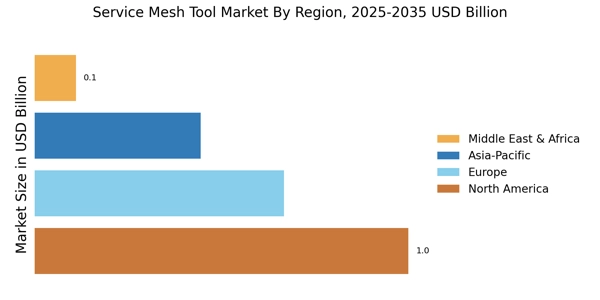
Regional Insights

North America : Innovation and Leadership Hub

North America is the largest market for service mesh tools, holding approximately 45% of the global market share. The region's growth is driven by the rapid adoption of cloud-native technologies, increasing demand for microservices architecture, and strong investments in digital transformation. Regulatory support for cloud computing and data privacy further catalyzes market expansion, making it a key player in the global landscape. The United States leads the North American market, with major players like HashiCorp, Red Hat, and Google driving innovation. The competitive landscape is characterized by a mix of established tech giants and agile startups, fostering a dynamic environment for service mesh solutions. The presence of advanced IT infrastructure and a skilled workforce enhances the region's attractiveness for service mesh tool development and deployment.

Europe : Emerging Market with Potential

Europe is witnessing significant growth in the service mesh tool market, accounting for approximately 30% of the global share. The region's expansion is fueled by increasing cloud adoption, the rise of DevOps practices, and regulatory frameworks promoting data security and interoperability. Countries like Germany and the UK are at the forefront, driving demand for innovative solutions that enhance application performance and reliability. Leading countries in Europe include Germany, the UK, and France, where companies are increasingly adopting service mesh technologies to streamline operations. The competitive landscape features both local startups and established players like IBM and Microsoft, which are investing heavily in research and development. The European market is characterized by a strong emphasis on compliance and security, shaping the future of service mesh tools.

Asia-Pacific : Rapid Growth and Innovation

Asia-Pacific is emerging as a significant player in the service mesh tool market, holding around 20% of the global market share. The region's growth is driven by the rapid digital transformation across industries, increasing cloud adoption, and a burgeoning startup ecosystem. Countries like China and India are leading this growth, supported by favorable government policies and investments in technology infrastructure. China and India are the leading countries in this region, with a growing number of enterprises adopting service mesh solutions to enhance their IT capabilities. The competitive landscape is vibrant, featuring both local and international players, including companies like Nginx and Tetrate. The region's focus on innovation and scalability positions it well for future growth in the service mesh market.

Middle East and Africa : Emerging Frontier for Technology

The Middle East and Africa region is gradually emerging in the service mesh tool market, accounting for about 5% of the global share. The growth is primarily driven by increasing investments in digital infrastructure, a rise in cloud computing adoption, and government initiatives aimed at fostering technology innovation. Countries like the UAE and South Africa are leading this trend, supported by favorable regulatory environments. In the Middle East, the UAE is at the forefront of adopting service mesh technologies, while South Africa is making strides in cloud services. The competitive landscape is evolving, with both local startups and international firms exploring opportunities in this space. The region's focus on enhancing digital capabilities is expected to drive further growth in the service mesh market.

Service Mesh Tool Market Regional Image

Key Players and Competitive Insights

Major players in the Service Mesh Tool Market industry are investing heavily in research and development to enhance their product offerings and gain a competitive edge. Leading Service Mesh Tool Market players are focusing on developing innovative features and integrating advanced technologies such as artificial intelligence (AI) and machine learning (ML) to automate tasks and improve service mesh management. The Service Mesh Tool Market development is being driven by the growing adoption of microservices and cloud-native architectures, which require efficient and reliable service mesh solutions.

The competitive landscape is characterized by both established players and emerging startups, each offering a unique set of capabilities and value propositions.

One of the prominent players in the Service Mesh Tool Market is Istio, an open-source service mesh developed by Google, IBM, and Lyft. Istio provides a comprehensive set of features for managing and securing microservices, including traffic management, load balancing, service discovery, and security enforcement. Another key player is Linkerd, an open-source service mesh known for its simplicity and performance. Linkerd focuses on providing a lightweight and easy-to-use solution for managing microservices, with a focus on service discovery, load balancing, and metrics collection.

Another notable player in the Service Mesh Tool Market is Consul, a service mesh solution from HashiCorp. Consul is known for its strong focus on service discovery, service registration, and health checks. It provides a robust and scalable solution for managing and securing microservices, particularly in large-scale environments. These are just a few examples of the key players in the Service Mesh Tool Market, and the competitive landscape continues to evolve as new technologies and innovations emerge.

Key Companies in the Service Mesh Tool Market market include

Industry Developments

The Service Mesh Tool Market is anticipated to witness substantial growth in the coming years, driven by the increasing adoption of microservices and cloud-native applications. In 2023, the market was valued at USD 1.24 billion, and it is projected to reach USD 16.0 billion by 2032, exhibiting a CAGR of 32.81% during the forecast period. The rising need for improved service reliability, security, and observability in complex distributed systems is fueling the market growth.

Moreover, the growing popularity of Kubernetes and the increasing adoption of service mesh tools by enterprises for managing and securing their microservices environments are contributing to the market expansion.

Recent news developments in the service mesh tool market include the acquisition of Solo.io by Google Cloud in February 2023, which aims to strengthen Google Cloud's service mesh offerings. Additionally, HashiCorp announced the latest version of its service mesh tool, Consul, in March 2023, introducing new features for improved observability and traffic management. These developments indicate the growing interest and investment in service mesh technologies by major industry players.

Future Outlook

Service Mesh Tool Market Future Outlook

The Service Mesh Tool Market is projected to grow at a 32.81% CAGR from 2024 to 2035, driven by increasing cloud adoption, microservices architecture, and enhanced security requirements.

New opportunities lie in:

  • Development of AI-driven service mesh analytics tools
  • Integration of service mesh with edge computing solutions
  • Expansion into emerging markets with tailored service mesh offerings

By 2035, the market is expected to be robust, reflecting substantial growth and innovation.

Market Segmentation

Service Mesh Tool Market Cloud Platform Outlook

  • Amazon Web Services (AWS)
  • Microsoft Azure
  • Google Cloud Platform (GCP)

Service Mesh Tool Market Deployment Model Outlook

  • On-Premise
  • Cloud-Based

Service Mesh Tool Market Protocol Support Outlook

  • HTTP/1
  • HTTP/2
  • gRPC
  • WebSockets

Service Mesh Tool Market Organization Size Outlook

  • Small and Medium-sized Enterprises (SMEs)
  • Large Enterprises

Service Mesh Tool Market Application Architecture Outlook

  • Microservices
  • Monorepos
  • Service-Oriented Architecture (SOA)

Report Scope

MARKET SIZE 20242.202(USD Billion)
MARKET SIZE 20252.925(USD Billion)
MARKET SIZE 203549.94(USD Billion)
COMPOUND ANNUAL GROWTH RATE (CAGR)32.81% (2024 - 2035)
REPORT COVERAGERevenue Forecast, Competitive Landscape, Growth Factors, and Trends
BASE YEAR2024
Market Forecast Period2025 - 2035
Historical Data2019 - 2024
Market Forecast UnitsUSD Billion
Key Companies ProfiledMarket analysis in progress
Segments CoveredMarket segmentation analysis in progress
Key Market OpportunitiesIntegration of artificial intelligence enhances operational efficiency in the Service Mesh Tool Market.
Key Market DynamicsRising demand for microservices architecture drives competition and innovation in the Service Mesh Tool Market.
Countries CoveredNorth America, Europe, APAC, South America, MEA

Leave a Comment

FAQs

What is the projected market valuation of the Service Mesh Tool Market by 2035?

The projected market valuation for the Service Mesh Tool Market by 2035 is 49.94 USD Billion.

What was the overall market valuation of the Service Mesh Tool Market in 2024?

The overall market valuation of the Service Mesh Tool Market in 2024 was 2.202 USD Billion.

What is the expected CAGR for the Service Mesh Tool Market during the forecast period 2025 - 2035?

The expected CAGR for the Service Mesh Tool Market during the forecast period 2025 - 2035 is 32.81%.

Which deployment model segment is projected to have the highest valuation by 2035?

The Cloud-Based deployment model segment is projected to reach 39.952 USD Billion by 2035.

How do small and medium-sized enterprises (SMEs) contribute to the Service Mesh Tool Market?

Small and medium-sized enterprises (SMEs) contributed 0.661 USD Billion in 2024 and are expected to grow to 12.49 USD Billion by 2035.

What are the key players in the Service Mesh Tool Market?

Key players in the Service Mesh Tool Market include HashiCorp, Red Hat, Google, IBM, Microsoft, Buoyant, Solo.io, Nginx, and Tetrate.

What is the projected valuation for the Microservices application architecture segment by 2035?

The Microservices application architecture segment is projected to reach 20.0 USD Billion by 2035.

Which cloud platform is expected to have the highest valuation in the Service Mesh Tool Market by 2035?

Amazon Web Services (AWS) is expected to have the highest valuation, reaching 9.99 USD Billion by 2035.

What is the expected growth for the HTTP/2 protocol support segment by 2035?

The HTTP/2 protocol support segment is expected to grow to 15.0 USD Billion by 2035.

How does the Service Mesh Tool Market's growth compare between large enterprises and SMEs?

Large enterprises are projected to grow from 1.541 USD Billion in 2024 to 37.45 USD Billion by 2035, indicating a more substantial growth compared to SMEs.

Download Free Sample

Kindly complete the form below to receive a free sample of this Report

Compare Licence

×
Features License Type
Single User Multiuser License Enterprise User
Price $4,950 $5,950 $7,250
Maximum User Access Limit 1 User Upto 10 Users Unrestricted Access Throughout the Organization
Free Customization
Direct Access to Analyst
Deliverable Format
Platform Access
Discount on Next Purchase 10% 15% 15%
Printable Versions