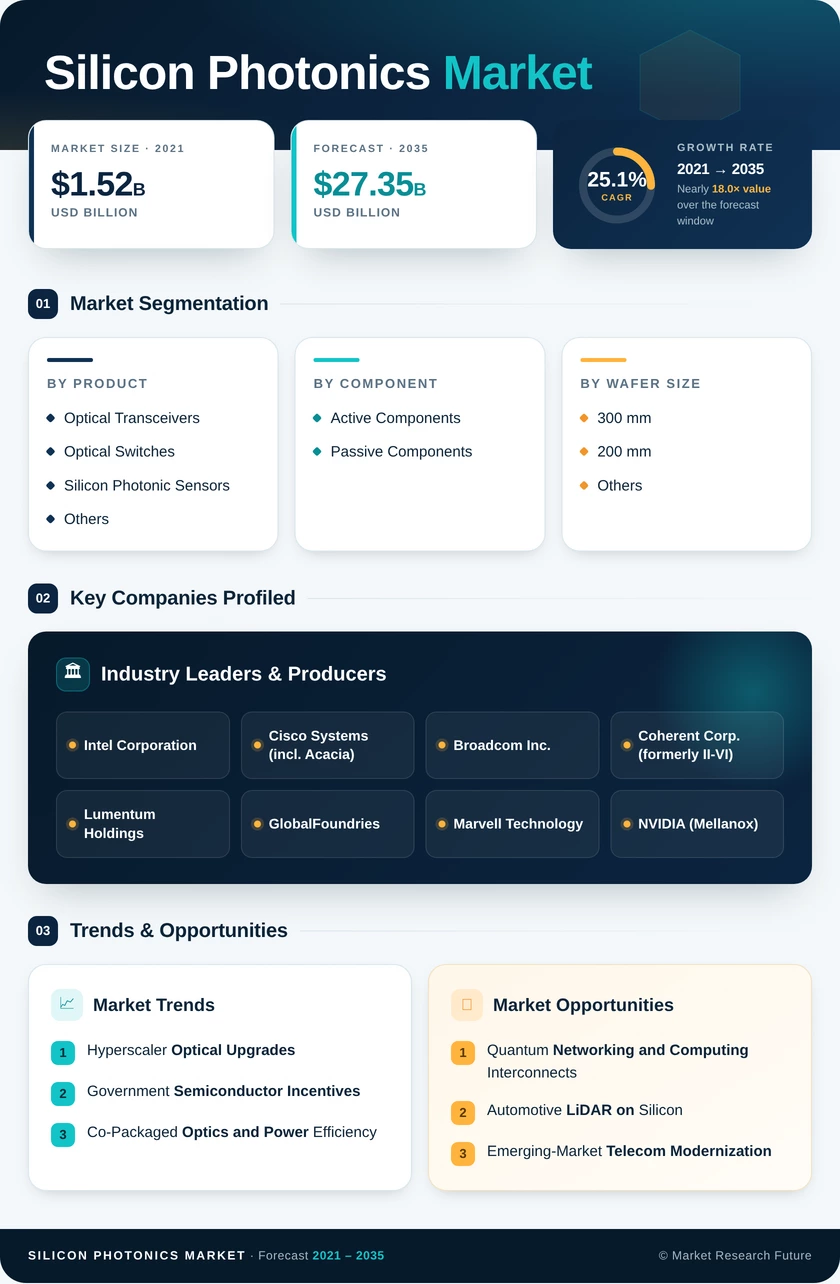
Silicon Photonics Market

ID: MRFR/SEM/2092-CR
204 Pages
Nirmit Biswas
Last Updated: June 17, 2026
Silicon Photonics Market Size, Share and Research Report By Product (Optical Transceivers, Optical Switches, Silicon Photonic Sensors, Others), By Component (Active Components, Passive Components), By Wafer Size (300 mm, 200 mm, Others), By Data Rate (200 Gbps, 400 Gbps, Above 1.6 Tbps), By Application (Data Centers & High-Performance Computing, Telecommunications, Quantum Computing, Others), By End User (Hyperscale Cloud Providers, Telecom Operators, Automotive OEMs & Tier-1 Suppliers, Others) - Industry Forecast to 2035
Download PDF ×

We do not share your information with anyone. However, we may send you emails based on your report interest from time to time. You may contact us at any time to opt-out.

  1. 1 Market Overview |
    1. 1.1 Study Assumptions & Market Definition |
    2. 1.2 Scope of the Study |
    3. 1.3 Research Methodology
  2. 2 Market Summary & Key Takeaways
  3. 3 Market Dynamics |
    1. 3.1 Market Drivers Analysis | |
      1. 3.1.1 Hyperscaler Data Center Optical Upgrades | |
      2. 3.1.2 CHIPS Act & EU Chips Act Fab Incentives | |
      3. 3.1.3 Co-Packaged Optics Power Savings | |
      4. 3.1.4 300 mm Wafer Migration & Cost Reduction | |
      5. 3.1.5 AI/ML Training Cluster Bandwidth Demands | |
      6. 3.1.6 Quantum Computing Interconnect Trials | |
      7. 3.1.7 Autonomous-Vehicle LiDAR Adoption |
    2. 3.2 Market Restraints Analysis | |
      1. 3.2.1 III-V Laser Integration Yield Challenges | |
      2. 3.2.2 Limited 300 mm Fab Capacity (Near-Term Supply Gap) | |
      3. 3.2.3 High Packaging and Testing Costs | |
      4. 3.2.4 Design-Tool Ecosystem Immaturity | |
      5. 3.2.5 Export-Control Uncertainty on Advanced Photonics |
    3. 3.3 Market Opportunity Analysis | |
      1. 3.3.1 Quantum Networking and Computing Interconnects | |
      2. 3.3.2 Automotive LiDAR on Silicon | |
      3. 3.3.3 Emerging-Market Telecom Modernization | |
      4. 3.3.4 Photonics-as-a-Service and IP Licensing | |
      5. 3.3.5 Data Monetization through Optical Sensing |
    4. 3.4 Industry Value Chain Analysis |
    5. 3.5 Porter's Five Forces Analysis
  4. 4 Global Silicon Photonics Market Size & Forecast (2021–2035) |
    1. 4.1 Historical Market Size (2021–2025) |
    2. 4.2 Current & Forecast Market Size (2026–2035) |
    3. 4.3 Market Size by Revenue (USD Billion) |
    4. 4.4 Year-over-Year Growth Analysis
  5. 5 Segmentation Analysis |
    1. 5.1 By Product | |
      1. 5.1.1 Optical Transceivers | |
      2. 5.1.2 Optical Switches | |
      3. 5.1.3 Silicon Photonic Sensors | |
      4. 5.1.4 Others |
    2. 5.2 By Component | |
      1. 5.2.1 Active Components | |
      2. 5.2.2 Passive Components |
    3. 5.3 By Wafer Size | |
      1. 5.3.1 300 mm | |
      2. 5.3.2 200 mm | |
      3. 5.3.3 Others |
    4. 5.4 By Data Rate | |
      1. 5.4.1 200 Gbps | |
      2. 5.4.2 400 Gbps | |
      3. 5.4.3 Above
    5. 1.6 Tbps |
    6. 5.5 By Application | |
      1. 5.5.1 Data Centers & High-Performance Computing | |
      2. 5.5.2 Telecommunications | |
      3. 5.5.3 Quantum Computing | |
      4. 5.5.4 Others |
    7. 5.6 By End User | |
      1. 5.6.1 Hyperscale Cloud Providers | |
      2. 5.6.2 Telecom Operators | |
      3. 5.6.3 Automotive OEMs & Tier-1 Suppliers | |
      4. 5.6.4 Others
  6. 6 Regional Analysis |
    1. 6.1 North America | |
      1. 6.1.1 United States | |
      2. 6.1.2 Canada | |
      3. 6.1.3 Mexico |
    2. 6.2 Europe | |
      1. 6.2.1 Germany | |
      2. 6.2.2 United Kingdom | |
      3. 6.2.3 France | |
      4. 6.2.4 Italy | |
      5. 6.2.5 Spain | |
      6. 6.2.6 Nordic Countries | |
      7. 6.2.7 Russia | |
      8. 6.2.8 Rest of Europe |
    3. 6.3 Asia-Pacific | |
      1. 6.3.1 China | |
      2. 6.3.2 India | |
      3. 6.3.3 Japan | |
      4. 6.3.4 South Korea | |
      5. 6.3.5 ASEAN | |
      6. 6.3.6 Rest of Asia-Pacific |
    4. 6.4 South America | |
      1. 6.4.1 Brazil | |
      2. 6.4.2 Argentina | |
      3. 6.4.3 Rest of South America |
    5. 6.5 Middle East & Africa | |
      1. 6.5.1 Saudi Arabia | |
      2. 6.5.2 UAE | |
      3. 6.5.3 South Africa | |
      4. 6.5.4 Egypt | |
      5. 6.5.5 Rest of MEA
  7. 7 Competitive Landscape |
    1. 7.1 Market Share Analysis (2025) |
    2. 7.2 Competitive Benchmarking Matrix |
    3. 7.3 Company Profiles | |
      1. 7.3.1 Intel Corporation | |
      2. 7.3.2 Cisco Systems (incl. Acacia) | |
      3. 7.3.3 Broadcom Inc. | |
      4. 7.3.4 Coherent Corp. | |
      5. 7.3.5 Lumentum Holdings | |
      6. 7.3.6 GlobalFoundries | |
      7. 7.3.7 Marvell Technology | |
      8. 7.3.8 NVIDIA (Mellanox) | |
      9. 7.3.9 STMicroelectronics | |
      10. 7.3.10 Juniper Networks
  8. 8 Future Outlook & Strategic Recommendations (2026–2035) |
    1. 8.1 AI-Driven Compute Fabrics |
    2. 8.2 Platform Economics in Photonic Design |
    3. 8.3 Sustainability and Carbon-Reduction Mandates |
    4. 8.4 Quantum and Neuromorphic Convergence
  9. 9 Recent Developments & News
  10. 10 Frequently Asked Questions (FAQs)
  11. 11 Report Scope & Methodology |
    1. 11.1 Study Period & Base Year |
    2. 11.2 Data Sources & Citations |
    3. 11.3 Abbreviations
  12. 12 LIST OF TABLES |
  13. TABLE 1 Global Silicon Photonics Market Size & Forecast, by Revenue (USD Billion), 2021–2035 |
  14. TABLE 2 Global Silicon Photonics Market – Year-over-Year Growth Analysis, 2021–2035 |
  15. TABLE 3 Global Silicon Photonics Market – Driver Impact Analysis |
  16. TABLE 4 Global Silicon Photonics Market – Restraints Impact Analysis |
  17. TABLE 5 Global Silicon Photonics Market Size, by Product, 2021–2035 (USD Billion) |
  18. TABLE 6 Global Silicon Photonics Market Size, by Component, 2021–2035 (USD Billion) |
  19. TABLE 7 Global Silicon Photonics Market Size, by Wafer Size, 2021–2035 (USD Billion) |
  20. TABLE 8 Global Silicon Photonics Market Size, by Data Rate, 2021–2035 (USD Billion) |
  21. TABLE 9 Global Silicon Photonics Market Size, by Application, 2021–2035 (USD Billion) |
  22. TABLE 10 Global Silicon Photonics Market Size, by End User, 2021–2035 (USD Billion) |
  23. TABLE 11 Global Silicon Photonics Market Size, by Region, 2021–2035 (USD Billion) |
  24. TABLE 12 North America Silicon Photonics Market Size, by Country, 2021–2035 (USD Billion) |
  25. TABLE 13 Europe Silicon Photonics Market Size, by Country, 2021–2035 (USD Billion) |
  26. TABLE 14 Asia-Pacific Silicon Photonics Market Size, by Country, 2021–2035 (USD Billion) |
  27. TABLE 15 South America Silicon Photonics Market Size, by Country, 2021–2035 (USD Billion) |
  28. TABLE 16 Middle East & Africa Silicon Photonics Market Size, by Country, 2021–2035 (USD Billion) |
  29. TABLE 17 Competitive Benchmarking Matrix – Global Silicon Photonics Market, 2025 |
  30. TABLE 18 Company Profiles – Key Players, Global Silicon Photonics Market |
  31. TABLE 19 Recent Developments & Strategic Announcements, 2023–2025 |
  32. TABLE 20 Regional Summary – Key Metrics & Investment Themes, 2025 |
  33. TABLE 21 Report Scope & Methodology Summary |
  34. TABLE 22 Detailed Sources & Citations
  35. 13 LIST OF FIGURES |
  36. FIGURE 1 Silicon Photonics Market Dynamics — Drivers, Restraints, Opportunities |
  37. FIGURE 2 Industry Value Chain Analysis — Silicon Photonics Market |
  38. FIGURE 3 Porter's Five Forces Analysis — Silicon Photonics Market |
  39. FIGURE 4 Global Silicon Photonics Market Size Trend (USD Billion), 2021–2035 |
  40. FIGURE 5 Silicon Photonics Market Share, by Product, 2025 (%) |
  41. FIGURE 6 Silicon Photonics Market Share, by Component, 2025 (%) |
  42. FIGURE 7 Silicon Photonics Market Share, by Wafer Size, 2025 (%) |
  43. FIGURE 8 Silicon Photonics Market Share, by Data Rate, 2025 (%) |
  44. FIGURE 9 Silicon Photonics Market Share, by Application, 2025 (%) |
  45. FIGURE 10 Silicon Photonics Market Share, by End User, 2025 (%) |
  46. FIGURE 11 Silicon Photonics Market Share, by Region, 2025 (%) |
  47. FIGURE 12 North America Silicon Photonics Market Size Trend, 2021–2035 |
  48. FIGURE 13 Europe Silicon Photonics Market Size Trend, 2021–2035 |
  49. FIGURE 14 Asia-Pacific Silicon Photonics Market Size Trend, 2021–2035 |
  50. FIGURE 15 South America Silicon Photonics Market Size Trend, 2021–2035 |
  51. FIGURE 16 Middle East & Africa Silicon Photonics Market Size Trend, 2021–2035 |
  52. FIGURE 17 Competitive Landscape — Market Share Distribution, 2025

Segmentation Quick Reference

DimensionSub-SegmentsDominant Segment (2025)Fastest Growing Segment (2026–2035)
ProductOptical Transceivers, Optical Switches, Silicon Photonic Sensors, OthersOptical Transceivers (51.2 % share)Silicon Photonic Sensors (26.5 % CAGR)
ComponentActive Components, Passive ComponentsActive Components (63.1 % share)Active Components
Wafer Size300 mm, 200 mm, Others300 mm300 mm (25.6 % CAGR)
Data Rate200 Gbps, 400 Gbps, Above 1.6 Tbps400 Gbps (49.2 % share)Above 1.6 Tbps (26.0 % CAGR)
ApplicationData Centers & HPC, Telecommunications, Quantum Computing, OthersData Centers & HPC (51.4 % share)Quantum Computing (26.6 % CAGR)
End UserHyperscale Cloud Providers, Telecom Operators, Automotive OEMs & Tier-1 Suppliers, OthersHyperscale Cloud Providers (54.1 % share)Automotive OEMs & Tier-1 Suppliers (26.2 % CAGR)


Market Segmentation Overview

By Product

Sub-SegmentKey Trend
Optical TransceiversMigration from 400G to 800G and 1.6T form factors for hyperscale deployment
Optical SwitchesGrowth in reconfigurable optical add-drop multiplexer (ROADM) mesh architectures
Silicon Photonic SensorsExpansion into automotive LiDAR, biomedical point-of-care, and environmental monitoring
OthersSpecialty couplers, attenuators, and polarization-management devices for niche applications


Optical transceivers drive the majority of silicon photonics revenue today, with the technology roadmap progressing toward higher lane rates and co-packaged form factors that integrate optics directly onto switch ASICs.

By Component

Sub-SegmentKey Trend
Active ComponentsHigher-speed modulators and germanium photodetectors for 800G and 1.6T links
Passive ComponentsLow-loss waveguides and arrayed waveguide gratings for on-chip WDM


Active components command the larger share because they define the performance envelope of every transceiver and sensor module, while passive structures serve as routing and multiplexing infrastructure.

By Wafer Size

Sub-SegmentKey Trend
300 mmCHIPS Act–funded fab build-out enabling high-volume, low-cost production
200 mmLegacy node serving mature products and specialty sensors
OthersEmerging exploration of non-standard substrates for heterogeneous integration


The 300 mm node is the primary growth vector, offering roughly 2.25× the die area per wafer versus 200 mm platforms and enabling significant cost-per-device reduction.

By Data Rate

Sub-SegmentKey Trend
200 GbpsSteady demand from enterprise campus and edge deployments
400 GbpsCurrent mainstream hyperscaler standard with broad supply chain maturity
Above 1.6 TbpsEmerging specification driven by AI training cluster bandwidth requirements


The data-rate mix is shifting rapidly upward as each new generation of GPU clusters demands higher aggregate bandwidth per switch, compressing pluggable-to-co-packaged transition timelines.

By Application

Sub-SegmentKey Trend
Data Centers & HPCDominant use case fueled by AI/ML workload scaling
TelecommunicationsMetro and long-haul coherent links transitioning to silicon photonics PICs
Quantum ComputingPhotonic interconnects for qubit control and entanglement distribution
OthersDefense, industrial sensing, and biomedical diagnostics


Data center and HPC applications absorb the majority of silicon photonics output, with telecom and quantum computing representing the highest incremental growth vectors through 2035.

By End User

Sub-SegmentKey Trend
Hyperscale Cloud ProvidersLargest buyer cohort driving technology roadmap and volume pricing
Telecom OperatorsNetwork disaggregation creating demand for open, interoperable photonic modules
Automotive OEMs & Tier-1 SuppliersLiDAR and in-vehicle sensing adoption accelerating in ADAS and autonomy
OthersGovernment, research institutions, and defense contractors


Hyperscale cloud providers set the pace for silicon photonics innovation through direct engagement with foundries and design houses, while automotive represents the highest-growth opportunity as silicon photonics enables affordable solid-state LiDAR at mass-market scale.