×
Request Free Sample ×

Kindly complete the form below to receive a free sample of this Report

* Please use a valid business email

Leading companies partner with us for data-driven Insights

clients tt-cursor
Hero Background

Silicone Defoamer Market

ID: MRFR/CnM/34618-HCR
111 Pages
Chitranshi Jaiswal
October 2025

Silicone Defoamer Market Research Report By Application (Water Treatment, Pulp and Paper, Food and Beverage, Chemical Processing), By Formulation Type (Emulsion, Silicone Oil, Powder, Granules), By Industry (Textile, Agriculture, Pharmaceutical, Construction), By Concentration (High Concentration, Medium Concentration, Low Concentration) and By Regional (North America, Europe, South America, Asia Pacific, Middle East and Africa) - Forecast to 2035.

Share:
Download PDF ×

We do not share your information with anyone. However, we may send you emails based on your report interest from time to time. You may contact us at any time to opt-out.

Silicone Defoamer Market Infographic
Purchase Options

Silicone Defoamer Market Summary

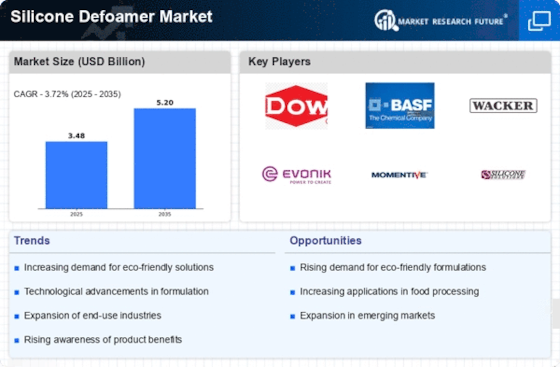
As per MRFR analysis, the Silicone Defoamer Market Size was estimated at 3.482 USD Billion in 2024. The Silicone Defoamer industry is projected to grow from 3.611 USD Billion in 2025 to 5.204 USD Billion by 2035, exhibiting a compound annual growth rate (CAGR) of 3.72 during the forecast period 2025 - 2035.

Key Market Trends & Highlights

The Silicone Defoamer Market is experiencing robust growth driven by diverse applications and increasing environmental awareness.

  • The demand for silicone defoamers is rising significantly in the food and beverage sector, particularly in North America.
  • There is a notable shift towards eco-friendly formulations, reflecting growing consumer preferences in both North America and Asia-Pacific.
  • Technological innovations are enhancing product development, particularly in the water treatment segment, which remains the largest market.
  • Key market drivers include increasing industrial applications and regulatory support for silicone products, which are crucial in the personal care sector.

Market Size & Forecast

2024 Market Size 3.482 (USD Billion)
2035 Market Size 5.204 (USD Billion)
CAGR (2025 - 2035) 3.72%

Major Players

Dow Chemical Company (US), BASF SE (DE), Wacker Chemie AG (DE), Evonik Industries AG (DE), Momentive Performance Materials Inc. (US), Silicone Solutions (US), KCC Corporation (KR), Shin-Etsu Chemical Co., Ltd. (JP), Huntsman Corporation (US)

Silicone Defoamer Market Trends

The Silicone Defoamer Market is currently experiencing a notable evolution, driven by various factors that influence its demand across multiple industries. The increasing need for efficient foam control solutions in sectors such as food and beverage, pharmaceuticals, and textiles appears to be a primary driver. As industries strive for enhanced productivity and quality, the adoption of silicone-based defoamers is likely to rise, given their superior performance characteristics. Furthermore, the growing emphasis on sustainability and eco-friendly products may lead to innovations in formulation, aligning with consumer preferences for environmentally responsible solutions. In addition, the Silicone Defoamer Market seems to be shaped by technological advancements that enhance product efficacy and application versatility. Manufacturers are increasingly focusing on developing specialized formulations tailored to specific industrial requirements, which could potentially expand the market's reach. The competitive landscape is also evolving, with companies exploring strategic partnerships and collaborations to strengthen their market position. Overall, the Silicone Defoamer Market is poised for growth, reflecting broader trends in industrial efficiency and sustainability.

Rising Demand in Food and Beverage Sector

The food and beverage industry is increasingly recognizing the importance of silicone defoamers for maintaining product quality and consistency. As manufacturers seek to optimize production processes, the demand for effective foam control solutions is likely to grow.

Focus on Eco-Friendly Formulations

There is a noticeable shift towards sustainable practices within the Silicone Defoamer Market. Companies are exploring eco-friendly formulations that meet regulatory standards while appealing to environmentally conscious consumers, potentially reshaping product offerings.

Technological Innovations in Product Development

Advancements in technology are driving the development of more efficient silicone defoamers. Innovations in formulation and application techniques may enhance performance, allowing for broader usage across various industries.

Silicone Defoamer Market Drivers

Rising Environmental Concerns

The Silicone Defoamer Market is influenced by growing environmental concerns, prompting manufacturers to seek sustainable solutions. Silicone defoamers are often perceived as more environmentally friendly compared to their petroleum-based counterparts, as they can reduce the overall environmental footprint of various processes. The market data suggests that the demand for eco-friendly formulations is on the rise, with consumers increasingly favoring products that align with sustainability goals. This shift is likely to drive innovation in the silicone defoamer market, as companies strive to develop formulations that meet both performance and environmental standards. As awareness of environmental issues continues to grow, the silicone defoamer market may see a significant transformation, with a focus on sustainable practices and products.

Growth in Personal Care Products

The Silicone Defoamer Market is witnessing substantial growth attributed to the rising demand for personal care products. Silicone defoamers are increasingly incorporated into formulations for shampoos, conditioners, and lotions to improve texture and stability. The market data suggests that the personal care segment is expected to experience a compound annual growth rate (CAGR) of over 5% in the coming years, driven by consumer preferences for high-performance and aesthetically pleasing products. As manufacturers strive to meet these demands, the integration of silicone defoamers becomes essential in ensuring product efficacy and consumer satisfaction. This trend indicates a robust future for silicone defoamers within the personal care sector, as brands seek to differentiate their offerings in a competitive marketplace.

Increasing Industrial Applications

The Silicone Defoamer Market is experiencing a notable surge in demand due to its increasing applications across various industrial sectors. Industries such as textiles, paints, and coatings utilize silicone defoamers to enhance product quality and performance. For instance, in the textile industry, silicone defoamers are employed to prevent foam formation during dyeing processes, thereby improving color consistency and reducing waste. The market data indicates that the industrial segment is projected to account for a significant share of the silicone defoamer market, driven by the need for efficient production processes and high-quality end products. As industries continue to expand and innovate, the reliance on silicone defoamers is likely to grow, further solidifying their role in enhancing operational efficiency.

Regulatory Support for Silicone Products

The Silicone Defoamer Market benefits from increasing regulatory support for silicone-based products, which are often viewed as safer alternatives to traditional chemical defoamers. Regulatory bodies are progressively endorsing the use of silicone defoamers in various applications, particularly in food processing and pharmaceuticals, where safety and compliance are paramount. This regulatory backing not only enhances consumer confidence but also encourages manufacturers to adopt silicone defoamers in their formulations. The market data indicates that the regulatory environment is becoming increasingly favorable, which could lead to a rise in the adoption of silicone defoamers across multiple sectors. As regulations evolve, the silicone defoamer market is likely to expand, driven by the need for compliant and safe product formulations.

Technological Advancements in Manufacturing

The Silicone Defoamer Market is poised for growth due to ongoing technological advancements in manufacturing processes. Innovations in production techniques are enabling the development of more efficient and effective silicone defoamers, which can cater to diverse industrial needs. For example, advancements in formulation chemistry allow for the creation of silicone defoamers that perform better at lower concentrations, thereby reducing costs and enhancing application efficiency. The market data indicates that the introduction of new technologies is likely to drive competition among manufacturers, leading to improved product offerings and increased market penetration. As technology continues to evolve, the silicone defoamer market is expected to expand, driven by the demand for high-performance and cost-effective solutions.


Market Segment Insights

By Application: Water Treatment (Largest) vs. Pulp and Paper (Fastest-Growing)

In the Silicone Defoamer Market, the application segment displays diverse market share distribution among four key areas: Water Treatment, Pulp and Paper, Food and Beverage, and Chemical Processing. Water Treatment emerges as the largest segment, owing to its critical role in reducing foam in various water purification processes. Pulp and Paper follows closely, reflecting its significant importance in the manufacturing processes used by this industry, where foam reduction is essential to enhance efficiency and product quality. Growth trends indicate that the Pulp and Paper segment is currently the fastest-growing area within the Silicone Defoamer Market. This growth is driven by increasing demand for paper products and the need for efficient processing methods. Additionally, factors such as environmental regulations mandating reduced pollution and improved manufacturing efficiencies further propel the adoption of silicone defoamers in this sector, which positions it for substantial growth in the coming years.

Water Treatment (Dominant) vs. Food and Beverage (Emerging)

Water Treatment is the dominant application segment for silicone defoamers, driven by its essential role in various industrial processes, including wastewater treatment and water recycling. Silicone defoamers are favored in this sector for their effectiveness and stability in a range of conditions. Conversely, the Food and Beverage sector is categorized as an emerging segment, experiencing growth due to rising food safety standards and the need for foam control in production processes. The increasing focus on maintaining product quality and compliance with regulations drives demand for silicone defoamers tailored for food applications, indicating a promising future for this segment.

By Formulation Type: Emulsion (Largest) vs. Silicone Oil (Fastest-Growing)

In the Silicone Defoamer Market, Emulsion holds a significant share, primarily due to its versatility and effectiveness across various applications. This formulation type is favored for its ability to provide stable and efficient foaming control. Meanwhile, Silicone Oil is emerging as a critical player, rapidly gaining traction due to its superior performance in specialized applications. As industries seek enhanced product performance, the market for silicone oils is witnessing enhanced growth rates.

Formulation Type: Emulsion (Dominant) vs. Silicone Oil (Emerging)

Emulsion silicone defoamers are acknowledged for their dominance in the market, given their broad applicability in water-based solutions across various industries such as food processing, pharmaceuticals, and oil and gas. These defoamers typically contain surfactants that aid in the dispersion of silicone in water, making them effective even in challenging conditions. On the other hand, silicone oil defoamers are recognized as the emerging segment within the market. They offer advantages such as lower dosage requirements and enhanced efficiency in oil-based systems. As companies strive for improved product performance and sustainability, the demand for silicone oils continues to surge, signaling a growing recognition of their benefits over traditional emulsion formulations.

By Concentration: High Concentration (Largest) vs. Low Concentration (Fastest-Growing)

In the Silicone Defoamer Market, the 'High Concentration' segment holds the most significant share, benefiting from its efficacy in various industrial applications such as oil and gas, chemicals, and water treatment. This segment's ability to reduce foam quickly and maintain system efficiency has solidified its dominance. On the other hand, 'Medium Concentration' and 'Low Concentration' segments are capturing increasing attention due to their versatility and suitability for niche applications. As industries continue to seek more sustainable and effective solutions, these segments are gradually gaining footholds in markets previously dominated by high-concentration products.

High Concentration (Dominant) vs. Low Concentration (Emerging)

The 'High Concentration' silicone defoamers are recognized for their powerful antifoaming properties, making them essential in industries where foam control is critical. Their concentrated formulations allow for lower dosage requirements, increasing overall cost-effectiveness for large-scale operations. On the other hand, 'Low Concentration' silicone defoamers are emerging as an attractive option for industries focused on eco-friendliness due to their lighter chemical footprint. Ideal for sensitive applications, low concentration products tend to blend seamlessly with the medium, offering efficiency that encourages their adoption in newer markets. As regulatory pressures increase, low concentration variants are rapidly gaining traction among businesses aiming for sustainable operation methodologies.

Get more detailed insights about Silicone Defoamer Market

Regional Insights

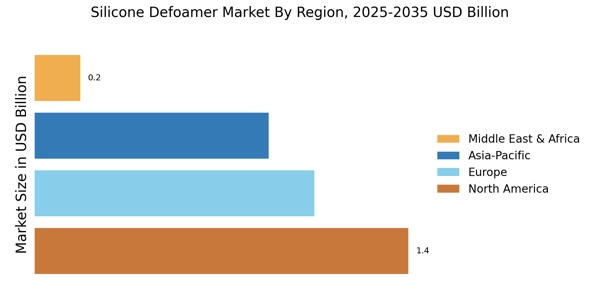
North America : Market Leader in Defoamers

North America is the largest market for silicone defoamers, holding approximately 40% of the global market share. The region's growth is driven by increasing demand from industries such as food and beverage, pharmaceuticals, and personal care. Regulatory support for eco-friendly products further catalyzes market expansion, with initiatives promoting sustainable manufacturing practices. The United States is the primary contributor, with key players like Dow Chemical Company and Momentive Performance Materials leading the market. The competitive landscape is characterized by innovation and strategic partnerships, as companies focus on developing advanced silicone formulations to meet diverse industrial needs.

Europe : Innovation and Sustainability Focus

Europe is the second-largest market for silicone defoamers, accounting for around 30% of the global share. The region's growth is propelled by stringent environmental regulations and a strong emphasis on sustainability. The European Union's Green Deal encourages the adoption of eco-friendly products, which is a significant driver for silicone defoamers in various applications, including construction and automotive. Germany and France are leading countries in this market, with major players like BASF SE and Wacker Chemie AG. The competitive landscape is marked by a focus on research and development, as companies strive to innovate and meet the evolving regulatory standards. This has led to a surge in demand for high-performance silicone defoamers that align with sustainability goals.

Asia-Pacific : Emerging Market Potential

Asia-Pacific is witnessing rapid growth in the silicone defoamer market, holding approximately 25% of the global share. The region's expansion is driven by increasing industrialization, particularly in countries like China and India, where demand for silicone defoamers is rising in sectors such as textiles, paints, and coatings. Government initiatives to boost manufacturing capabilities further support market growth. China is the largest market in the region, with significant contributions from local manufacturers and international players like Shin-Etsu Chemical Co., Ltd. The competitive landscape is evolving, with companies focusing on cost-effective solutions and enhanced product performance to cater to diverse industrial applications, making it a dynamic market for silicone defoamers.

Middle East and Africa : Resource-Rich Market Dynamics

The Middle East and Africa region is gradually emerging in the silicone defoamer market, holding about 5% of the global share. The growth is primarily driven by increasing investments in the oil and gas sector, which utilizes silicone defoamers in various applications. Additionally, the region's expanding manufacturing base is creating new opportunities for silicone defoamer adoption across different industries. Countries like South Africa and the UAE are leading the market, with a growing presence of both local and international players. The competitive landscape is characterized by a mix of established companies and new entrants, focusing on innovative solutions to meet the specific needs of the region's diverse industrial sectors.

Silicone Defoamer Market Regional Image

Key Players and Competitive Insights

The Silicone Defoamer Market is currently characterized by a dynamic competitive landscape, driven by increasing demand across various industries such as paints and coatings, food and beverage, and pharmaceuticals. Key players are actively engaging in strategies that emphasize innovation, sustainability, and regional expansion. For instance, Dow Chemical Company (US) has been focusing on enhancing its product portfolio through the development of eco-friendly silicone defoamers, which aligns with the growing trend towards sustainable solutions. Similarly, BASF SE (DE) is leveraging its extensive research capabilities to innovate in the silicone defoamer space, thereby strengthening its market position. These strategies collectively contribute to a competitive environment that is increasingly focused on meeting regulatory standards and consumer preferences for environmentally friendly products.

In terms of business tactics, companies are localizing manufacturing and optimizing supply chains to enhance efficiency and responsiveness to market demands. The market structure appears moderately fragmented, with several key players holding substantial market shares while also facing competition from smaller, specialized firms. This fragmentation allows for a diverse range of products and innovations, although the influence of major players like Wacker Chemie AG (DE) and Evonik Industries AG (DE) remains significant in shaping market trends and standards.

In August 2025, Wacker Chemie AG (DE) announced the launch of a new line of silicone defoamers specifically designed for the food and beverage industry. This strategic move is likely to enhance their market share by catering to the stringent regulatory requirements and quality standards prevalent in this sector. The introduction of these specialized products not only demonstrates Wacker's commitment to innovation but also positions the company as a leader in providing tailored solutions for niche markets.

In September 2025, Momentive Performance Materials Inc. (US) expanded its production capabilities by investing in a new manufacturing facility in the Midwest. This expansion is expected to significantly increase their output of silicone defoamers, thereby improving supply chain efficiency and reducing lead times for customers. Such a strategic investment indicates Momentive's focus on meeting the rising demand for silicone defoamers in North America, while also enhancing its competitive edge through localized production.

In October 2025, Shin-Etsu Chemical Co., Ltd. (JP) entered into a strategic partnership with a leading agricultural firm to develop silicone-based defoamers tailored for agricultural applications. This collaboration is indicative of a broader trend where companies are seeking to diversify their product offerings and tap into emerging markets. By aligning with agricultural needs, Shin-Etsu is likely to enhance its market presence and drive growth in a sector that is increasingly recognizing the benefits of silicone defoamers.

As of October 2025, the competitive trends in the Silicone Defoamer Market are increasingly influenced by digitalization, sustainability, and the integration of advanced technologies such as AI. Strategic alliances are becoming more prevalent, as companies recognize the value of collaboration in driving innovation and expanding market reach. Looking ahead, it appears that competitive differentiation will evolve from traditional price-based competition to a focus on innovation, technological advancements, and the reliability of supply chains. This shift suggests that companies that prioritize these aspects will likely emerge as leaders in the market.

Key Companies in the Silicone Defoamer Market market include

Industry Developments

The  Silicone Defoamer Market has recently witnessed notable developments, with several key players actively expanding their footprint. 3M has initiated the launch of new silicone-based defoamers, focusing on enhancing performance across various applications.

Nusil Technology is advancing its portfolio to include environmentally sustainable options, while Huntsman Corporation is reported to be increasing production capabilities to meet growing demand in the construction and automotive sectors.

Additionally, BASF has made strategic moves to optimize its silicone products, particularly in spray applications. In terms of market growth, Elkem Silicones has experienced a significant rise in valuation due to increased investments in research and development for innovative defoaming solutions.

Meanwhile, KCC Corporation is exploring partnerships to strengthen its market presence, and Dow has been emphasizing its commitment to sustainability, which has positively impacted consumer sentiment.

On the merger and acquisition front, Momentive Performance Materials announced its intent to explore strategic partnerships to bolster its offerings in silicone technologies, aligning with the ongoing trend of consolidation in the industry. Such developments reflect robust competition and an evolving landscape within the  Silicone Defoamer Market, driven by innovation and sustainability.

Future Outlook

Silicone Defoamer Market Future Outlook

The Silicone Defoamer Market is projected to grow at a 3.72% CAGR from 2024 to 2035, driven by increasing demand in various industries and advancements in formulation technologies.

New opportunities lie in:

  • Development of eco-friendly silicone defoamers for sustainable applications.
  • Expansion into emerging markets with tailored product offerings.
  • Integration of smart technology for real-time defoaming solutions.

By 2035, the market is expected to solidify its position as a key player in industrial applications.

Market Segmentation

Silicone Defoamer Market Application Outlook

  • Water Treatment
  • Pulp and Paper
  • Food and Beverage
  • Chemical Processing

Silicone Defoamer Market Concentration Outlook

  • High Concentration
  • Medium Concentration
  • Low Concentration

Silicone Defoamer Market Formulation Type Outlook

  • Emulsion
  • Silicone Oil
  • Powder
  • Granules

Report Scope

MARKET SIZE 20243.482(USD Billion)
MARKET SIZE 20253.611(USD Billion)
MARKET SIZE 20355.204(USD Billion)
COMPOUND ANNUAL GROWTH RATE (CAGR)3.72% (2024 - 2035)
REPORT COVERAGERevenue Forecast, Competitive Landscape, Growth Factors, and Trends
BASE YEAR2024
Market Forecast Period2025 - 2035
Historical Data2019 - 2024
Market Forecast UnitsUSD Billion
Key Companies ProfiledMarket analysis in progress
Segments CoveredMarket segmentation analysis in progress
Key Market OpportunitiesGrowing demand for eco-friendly formulations in the Silicone Defoamer Market presents significant opportunities.
Key Market DynamicsRising demand for eco-friendly formulations drives innovation and competition in the Silicone Defoamer Market.
Countries CoveredNorth America, Europe, APAC, South America, MEA

Leave a Comment

FAQs

What is the current valuation of the Silicone Defoamer Market as of 2024?

The Silicone Defoamer Market was valued at 3.482 USD Billion in 2024.

What is the projected market size for the Silicone Defoamer Market in 2035?

The market is projected to reach 5.204 USD Billion by 2035.

What is the expected CAGR for the Silicone Defoamer Market during the forecast period 2025 - 2035?

The expected CAGR for the Silicone Defoamer Market during 2025 - 2035 is 3.72%.

Which application segment is anticipated to show significant growth in the Silicone Defoamer Market?

The Chemical Processing segment, valued at 1.904 USD Billion in 2024, is anticipated to show significant growth.

How does the valuation of the Water Treatment segment compare to other segments in 2024?

The Water Treatment segment was valued at 1.2 USD Billion in 2024, making it one of the higher-valued segments.

What formulation type is expected to dominate the Silicone Defoamer Market?

The Emulsion formulation type, valued at 2.034 USD Billion in 2024, is expected to dominate the market.

Which key players are leading the Silicone Defoamer Market?

Key players include Dow Chemical Company, BASF SE, and Wacker Chemie AG, among others.

What is the projected growth for the Silicone Oil formulation type by 2035?

The Silicone Oil formulation type is projected to grow from 1.045 USD Billion in 2024 to 1.516 USD Billion by 2035.

What concentration type is expected to have the highest valuation in 2035?

The Medium Concentration type, valued at 2.034 USD Billion in 2024, is expected to have the highest valuation in 2035.

Download Free Sample

Kindly complete the form below to receive a free sample of this Report

Compare Licence

×
Features License Type
Single User Multiuser License Enterprise User
Price $4,950 $ $7,250
Maximum User Access Limit 1 User Upto 10 Users Unrestricted Access Throughout the Organization
Free Customization
Direct Access to Analyst
Deliverable Format
Platform Access
Discount on Next Purchase 10% 15% 15%
Printable Versions