×
Request Free Sample ×

Kindly complete the form below to receive a free sample of this Report

* Please use a valid business email

Leading companies partner with us for data-driven Insights

clients tt-cursor
Hero Background

Small Scale Single Multirotor Wind Turbine Market

ID: MRFR/EnP/34047-HCR
100 Pages
Chitranshi Jaiswal
October 2025

Small Scale Single and Multirotor Wind Turbine Market Research Report By Application (Residential, Commercial, Industrial, Off-Grid), By Type (Single Rotor, Multi Rotor), By Installation Type (Roof Mounted, Ground Mounted, Portable), By Technology (Horizontal Axis Wind Turbine, Vertical Axis Wind Turbine) and By Regional (North America, Europe, South America, Asia Pacific, Middle East and Africa) - Forecast to 2035

Share:
Download PDF ×

We do not share your information with anyone. However, we may send you emails based on your report interest from time to time. You may contact us at any time to opt-out.

Small Scale Single Multirotor Wind Turbine Market Infographic
Purchase Options

Small Scale Single Multirotor Wind Turbine Market Summary

As per MRFR analysis, the Small Scale Single Multirotor Wind Turbine Market Size was estimated at 2800.77 USD Million in 2024. The Small Scale Single Multirotor Wind Turbine industry is projected to grow from 3107.79 USD Million in 2025 to 8794.17 USD Million by 2035, exhibiting a compound annual growth rate (CAGR) of 10.96 during the forecast period 2025 - 2035.

Key Market Trends & Highlights

The Small Scale Single Multirotor Wind Turbine Market is poised for growth driven by technological advancements and increasing environmental awareness.

  • Technological advancements in turbine design are enhancing efficiency and performance in the market.
  • North America remains the largest market, while Asia-Pacific is emerging as the fastest-growing region for small scale wind turbines.
  • The residential segment dominates the market, whereas the commercial segment is experiencing rapid growth.
  • Rising demand for renewable energy sources and economic incentives are key drivers propelling market expansion.

Market Size & Forecast

2024 Market Size 2800.77 (USD Million)
2035 Market Size 8794.17 (USD Million)
CAGR (2025 - 2035) 10.96%

Major Players

Siemens Gamesa (ES), GE Renewable Energy (US), Nordex (DE), Vestas Wind Systems (DK), Suzlon Energy (IN), Enercon (DE), Goldwind (CN), Senvion (DE), Acciona Energy (ES), Mingyang Smart Energy (CN)

Small Scale Single Multirotor Wind Turbine Market Trends

The Small Scale Single Multirotor Wind Turbine Market is currently experiencing a notable evolution, driven by increasing interest in renewable energy solutions. This market segment appears to be gaining traction as individuals and small businesses seek sustainable alternatives to traditional energy sources. The growing awareness of environmental issues and the need for energy independence seem to be propelling the adoption of these innovative wind turbines. Furthermore, advancements in technology are likely enhancing the efficiency and reliability of these systems, making them more appealing to potential users. In addition, the Small Scale Single Multirotor Wind Turbine Market is characterized by a diverse range of applications, from residential energy generation to small-scale commercial use. This versatility may contribute to its expanding footprint in the energy landscape. As regulatory frameworks evolve to support renewable energy initiatives, the market could witness further growth. Stakeholders in this sector might find opportunities in developing more efficient designs and exploring new markets, thereby fostering a more sustainable energy future.

Technological Advancements

Recent innovations in turbine design and materials are enhancing the performance of small scale single multirotor wind turbines. These advancements may lead to increased energy output and improved durability, making them more attractive to consumers.

Growing Environmental Awareness

There appears to be a rising consciousness regarding climate change and environmental sustainability. This trend is likely driving demand for renewable energy solutions, including small scale wind turbines, as individuals and businesses seek to reduce their carbon footprints.

Regulatory Support for Renewables

Government policies and incentives aimed at promoting renewable energy adoption are becoming more prevalent. This regulatory support could facilitate the growth of the Small Scale Single Multirotor Wind Turbine Market, encouraging investments and installations.

Small Scale Single Multirotor Wind Turbine Market Drivers

Growing Demand for Renewable Energy

The Global Small Scale Single and Multirotor Wind Turbine Market Industry is experiencing a surge in demand for renewable energy sources. As nations strive to meet their climate goals, the adoption of wind energy is becoming increasingly prevalent. In 2024, the market is valued at approximately 2.8 USD Billion, reflecting a growing awareness of sustainable energy solutions. Governments worldwide are implementing policies and incentives to promote renewable energy projects, which further stimulates market growth. This trend is expected to continue, with projections indicating that the market could reach 8.8 USD Billion by 2035, suggesting a robust CAGR of 10.97% from 2025 to 2035.

Market Segment Insights

By Application: Residential (Largest) vs. Commercial (Fastest-Growing)

In the Small Scale Single Multirotor Wind Turbine Market, the application segment is diverse, with residential, commercial, industrial, and agricultural sectors contributing to market dynamics. Residential applications hold the largest share, driven by the growing interest in sustainable energy solutions among homeowners looking for independence from conventional energy sources. In contrast, the commercial sector is experiencing rapid growth, propelled by increasing corporate sustainability initiatives and the desire to reduce operational costs through renewable energy investments.

Residential (Dominant) vs. Commercial (Emerging)

The residential application of small scale single multirotor wind turbines is characterized by a strong emphasis on energy self-sufficiency and reduced electricity costs. Homeowners are increasingly adopting these systems to harness local wind resources, which are often more reliable and consistent than other renewable sources. On the other hand, the commercial sector represents an emerging field within this market, as businesses seek innovative ways to enhance their green credentials and achieve energy savings. This segment is characterized by larger installations to meet higher energy demands, often integrating solar and other energy systems, making them pivotal in advancing corporate sustainability goals.

By End Use: Energy Generation (Largest) vs. Remote Power Supply (Fastest-Growing)

The Small Scale Single Multirotor Wind Turbine Market is primarily segmented into Energy Generation, Remote Power Supply, Off-Grid Applications, and Research and Development. Among these segments, Energy Generation holds the largest share as it encompasses the core function of wind turbines, catering to both residential and commercial energy needs. Meanwhile, Remote Power Supply is gaining traction owing to the rising demand for power in remote areas that are not connected to the main grid, thus contributing to its rapid growth.

Energy Generation (Dominant) vs. Off-Grid Applications (Emerging)

Energy Generation is the dominant segment in the Small Scale Single Multirotor Wind Turbine Market, as it directly influences the core utility of wind energy for various applications. It serves a wide range of consumers, from homeowners seeking sustainable energy sources to businesses aiming for greener operations. On the other hand, Off-Grid Applications are emerging with increasing importance, especially in regions where conventional electricity supply is unreliable or non-existent. These applications leverage small-scale wind turbines to provide an independent energy solution, appealing particularly to rural areas and developing nations. The shift toward self-sufficient energy systems is accelerating the momentum in this segment.

By Technology: Horizontal Axis Wind Turbine (Largest) vs. Vertical Axis Wind Turbine (Fastest-Growing)

In the Small Scale Single Multirotor Wind Turbine Market, Horizontal Axis Wind Turbines (HAWT) dominate the technology landscape, holding the largest share due to their established technology, efficiency, and widespread adoption. Vertical Axis Wind Turbines (VAWT), although historically less common, are gaining traction due to their unique advantages and adaptability in urban environments, representing a growing segment of the market.

Technology: Horizontal Axis Wind Turbine (Dominant) vs. Vertical Axis Wind Turbine (Emerging)

Horizontal Axis Wind Turbines are recognized for their high energy conversion efficiency and capacity to operate at various wind speeds, making them a preferred choice for small scale applications. Meanwhile, Vertical Axis Wind Turbines, characterized by their vertical rotor orientation, are emerging as an innovative solution. Their design allows for 360-degree wind capture and reduced noise levels, appealing to urban developers and environmentally conscious consumers. As technology advances and awareness of renewable energy grows, both types will likely see increased deployment in localized energy solutions.

By Installation Type: Ground Mounted (Largest) vs. Roof Mounted (Fastest-Growing)

In the Small Scale Single Multirotor Wind Turbine Market, the installation type segment is critical in defining consumer preferences and applications. Ground-mounted turbines capture the largest share due to their robustness and suitability for various terrain types, appealing especially to off-grid applications. In contrast, roof-mounted systems are gaining traction as they are ideal for urban settings and residential installations, facilitating efficient energy production without requiring extensive land use. The growth trends in this segment are significantly propelled by an increasing emphasis on renewable energy solutions and sustainability initiatives. Ground-mounted turbines are being utilized more in rural and agricultural areas, while the rapid adoption of roof-mounted systems is driven by technological advancements, decreasing costs, and incentives for residential solar power integration. This dual growth reflects a broadening market appeal across different consumer segments seeking to harness wind energy efficiently.

Ground Mounted (Dominant) vs. Roof Mounted (Emerging)

Ground-mounted wind turbines are the dominant force in the Small Scale Single Multirotor Wind Turbine Market due to their larger scale and capacity for higher energy yield. These installations are preferred in open spaces, allowing for optimal wind capture and efficiency. Their robust design enables them to operate in various environmental conditions, making them suitable for diverse geographic locations. Conversely, roof-mounted turbines represent the emerging trend as they cater to urban consumers looking for renewable energy solutions without significant land footprint. These systems are typically compact and easier to install, appealing for residential and commercial building adaptations. The growing focus on sustainability is likely to see roof-mounted systems become more prevalent as urban energy needs evolve, and technological advancements continue to improve their efficiency.

Get more detailed insights about Small Scale Single Multirotor Wind Turbine Market

Regional Insights

North America : Leading Market Innovators

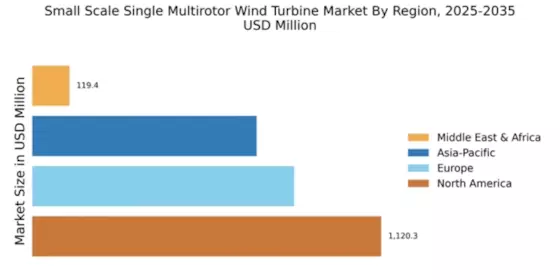
North America is poised to maintain its leadership in the Small Scale Single Multirotor Wind Turbine Market, holding a market size of $1120.31M in 2025. The region benefits from strong regulatory support, including incentives for renewable energy adoption and a growing demand for sustainable energy solutions. The increasing focus on reducing carbon emissions and enhancing energy independence further drives market growth. The United States is the primary player in this market, with significant contributions from Canada. Major companies like GE Renewable Energy and Siemens Gamesa are at the forefront, leveraging advanced technologies to enhance efficiency. The competitive landscape is characterized by innovation and strategic partnerships, ensuring a robust supply chain and market presence.

Europe : Sustainable Energy Leaders

Europe is a key player in the Small Scale Single Multirotor Wind Turbine Market, with a market size of $840.58M projected for 2025. The region's commitment to sustainability and stringent regulations on carbon emissions are significant growth drivers. Initiatives like the European Green Deal aim to boost renewable energy sources, creating a favorable environment for wind energy investments. Countries like Germany, Denmark, and Spain lead the market, supported by established companies such as Vestas Wind Systems and Nordex. The competitive landscape is marked by innovation and collaboration among industry players, enhancing technology and efficiency. The European market is expected to see continued growth as governments push for cleaner energy solutions.

Asia-Pacific : Emerging Market Potential

Asia-Pacific is witnessing significant growth in the Small Scale Single Multirotor Wind Turbine Market, with a projected market size of $720.46M by 2025. The region's increasing energy demands, coupled with government initiatives promoting renewable energy, are key drivers of this growth. Countries are investing heavily in wind energy to meet sustainability goals and reduce reliance on fossil fuels. China and India are the leading countries in this market, with major players like Goldwind and Suzlon Energy driving innovation. The competitive landscape is evolving, with a focus on technology advancements and cost reductions. As the region continues to embrace renewable energy, the market is expected to expand rapidly, attracting both domestic and international investments.

Middle East and Africa : Untapped Renewable Resources

The Middle East and Africa region is emerging as a potential market for Small Scale Single Multirotor Wind Turbines, with a market size of $119.42M anticipated by 2025. The region's abundant wind resources and increasing energy demands present significant opportunities for growth. Governments are beginning to recognize the importance of diversifying energy sources, leading to supportive policies for renewable energy projects. Countries like South Africa and Morocco are taking the lead in wind energy initiatives, with investments in infrastructure and technology. The competitive landscape is still developing, with a mix of local and international players entering the market. As awareness of renewable energy benefits grows, the region is expected to see increased activity in the wind energy sector.

Key Players and Competitive Insights

The Small Scale Single Multirotor Wind Turbine Market is currently characterized by a dynamic competitive landscape, driven by increasing demand for renewable energy solutions and advancements in turbine technology. Key players such as Siemens Gamesa (ES), GE Renewable Energy (US), and Vestas Wind Systems (DK) are at the forefront, each adopting distinct strategies to enhance their market presence. Siemens Gamesa (ES) focuses on innovation, particularly in developing more efficient turbine designs, while GE Renewable Energy (US) emphasizes strategic partnerships to expand its technological capabilities. Vestas Wind Systems (DK) is actively pursuing regional expansion, particularly in emerging markets, which appears to be a critical component of its growth strategy. Collectively, these strategies contribute to a competitive environment that is increasingly centered around technological advancement and market responsiveness.

In terms of business tactics, companies are localizing manufacturing to reduce costs and optimize supply chains, which is particularly relevant in the context of fluctuating global trade dynamics. The market structure is moderately fragmented, with several players vying for market share, yet the influence of major companies remains substantial. This competitive structure allows for a diverse range of offerings, catering to various customer needs while fostering innovation across the sector.

In November 2025, Siemens Gamesa (ES) announced a partnership with a leading technology firm to develop AI-driven predictive maintenance solutions for its wind turbines. This strategic move is likely to enhance operational efficiency and reduce downtime, thereby increasing the overall reliability of their products. Such innovations not only improve customer satisfaction but also position Siemens Gamesa as a leader in integrating advanced technologies into renewable energy solutions.

In October 2025, GE Renewable Energy (US) unveiled a new line of small-scale multirotor wind turbines designed specifically for urban environments. This launch reflects a strategic pivot towards addressing the unique challenges of urban energy generation, potentially opening new markets and customer segments. By tailoring products to meet specific regional needs, GE Renewable Energy is likely to strengthen its competitive edge in densely populated areas.

In September 2025, Vestas Wind Systems (DK) completed the acquisition of a local wind turbine manufacturer in Southeast Asia, which is expected to bolster its production capabilities and market reach in the region. This acquisition not only enhances Vestas's supply chain resilience but also aligns with its strategy to localize operations, thereby reducing costs and improving service delivery.

As of December 2025, the competitive trends in the Small Scale Single Multirotor Wind Turbine Market are increasingly defined by digitalization, sustainability, and the integration of AI technologies. Strategic alliances are becoming more prevalent, as companies recognize the value of collaboration in driving innovation and enhancing operational efficiencies. Looking ahead, competitive differentiation is likely to evolve from traditional price-based competition towards a focus on technological innovation, reliability of supply chains, and sustainable practices, which are becoming paramount in the eyes of consumers and stakeholders alike.

Key Companies in the Small Scale Single Multirotor Wind Turbine Market market include

Industry Developments

In the Small Scale Single and Multirotor Wind Turbine Market, recent developments have indicated heightened competition and innovation among leading companies such as Siemens Gamesa, Vestas, and Nordex, focusing on enhancing turbine efficiency and reducing environmental impacts. Siemens Gamesa has spearheaded initiatives for decentralized wind energy production, contributing to local energy independence. Energiekontor has made strides in expanding its operational capacity through strategic partnerships to develop new wind farms. Meanwhile, Vestas is actively working towards integrating digital technologies to optimize wind farm management.

Significantly, mergers and acquisitions have played a role, with reports of Acciona Energy acquiring stakes in several projects aimed at diversifying its portfolio in the renewable sector. The valuation of companies in this market has seen notable growth, propelled by increased investments and government incentives supporting sustainable energy solutions, further attracting interest from investors. Additionally, the shift towards decarbonization in various regions has prompted companies like Suzlon Energy and General Electric to ramp up their production and innovation capabilities, positioning themselves favorably in the growing market landscape.

The overall market dynamics are evolving rapidly as companies respond to global sustainability goals and technological advancements.

Future Outlook

Small Scale Single Multirotor Wind Turbine Market Future Outlook

The Small Scale Single Multirotor Wind Turbine Market is projected to grow at a 10.96% CAGR from 2024 to 2035, driven by technological advancements, increasing energy demands, and sustainability initiatives.

New opportunities lie in:

  • Development of integrated energy management systems for optimized performance.
  • Expansion into emerging markets with tailored financing solutions.
  • Partnerships with local governments for renewable energy incentives.

By 2035, the market is expected to be robust, driven by innovation and strategic partnerships.

Market Segmentation

Small Scale Single Multirotor Wind Turbine Market End Use Outlook

  • Energy Generation
  • Remote Power Supply
  • Off-Grid Applications
  • Research and Development

Small Scale Single Multirotor Wind Turbine Market Technology Outlook

  • Horizontal Axis Wind Turbine
  • Vertical Axis Wind Turbine
  • Multirotor Design
  • Control Systems

Small Scale Single Multirotor Wind Turbine Market Application Outlook

  • Residential
  • Commercial
  • Industrial
  • Agricultural

Small Scale Single Multirotor Wind Turbine Market Installation Type Outlook

  • Roof Mounted
  • Ground Mounted
  • Portable
  • Fixed

Report Scope

MARKET SIZE 20242800.77(USD Million)
MARKET SIZE 20253107.79(USD Million)
MARKET SIZE 20358794.17(USD Million)
COMPOUND ANNUAL GROWTH RATE (CAGR)10.96% (2024 - 2035)
REPORT COVERAGERevenue Forecast, Competitive Landscape, Growth Factors, and Trends
BASE YEAR2024
Market Forecast Period2025 - 2035
Historical Data2019 - 2024
Market Forecast UnitsUSD Million
Key Companies ProfiledSiemens Gamesa (ES), GE Renewable Energy (US), Nordex (DE), Vestas Wind Systems (DK), Suzlon Energy (IN), Enercon (DE), Goldwind (CN), Senvion (DE), Acciona Energy (ES), Mingyang Smart Energy (CN)
Segments CoveredApplication, End Use, Technology, Installation Type
Key Market OpportunitiesGrowing demand for renewable energy solutions drives innovation in the Small Scale Single Multirotor Wind Turbine Market.
Key Market DynamicsRising demand for renewable energy drives innovation and competition in the small scale single multirotor wind turbine market.
Countries CoveredNorth America, Europe, APAC, South America, MEA

Leave a Comment

FAQs

What is the estimated market size of the Small Scale Single and Multirotor Wind Turbine Market in 2025?

The estimated market size of the Small Scale Single and Multirotor Wind Turbine Market in 2025 is approximately 3.11 USD Billion.

What is the projected market value of the Small Scale Single and Multirotor Wind Turbine Market by 2034?

The projected market value of the Small Scale Single and Multirotor Wind Turbine Market by 2034 is around 7.93 USD Billion.

What is the expected CAGR for the Small Scale Single and Multirotor Wind Turbine Market from 2025 to 2034?

The expected CAGR for the Small Scale Single and Multirotor Wind Turbine Market from 2025 to 2034 is 10.96%.

Which region is expected to show the highest market growth in the Small Scale Single and Multirotor Wind Turbine Market?

North America is expected to show significant market growth, increasing from 0.55 USD Billion in 2023 to 1.33 USD Billion in 2032.

How much is the residential application segment valued in 2023 within the Small Scale Single and Multirotor Wind Turbine Market?

The residential application segment is valued at 0.9 USD Billion in the Small Scale Single and Multirotor Wind Turbine Market in 2023.

What is the market size for the commercial segment of the Small Scale Single and Multirotor Wind Turbine Market in 2032?

The market size for the commercial segment in 2032 is projected to be 1.5 USD Billion.

What are some of the key players in the Small Scale Single and Multirotor Wind Turbine Market?

Key players in the market include Siemens Gamesa, Vestas, and General Electric, among others.

What is the market forecast for the industrial segment by 2032 in the Small Scale Single and Multirotor Wind Turbine Market?

The market forecast for the industrial segment is 1.6 USD Billion by 2032.

What is the expected market growth rate for the APAC region from 2023 to 2032?

The expected market growth rate for the APAC region is reflected in its increase from 0.65 USD Billion in 2023 to 1.6 USD Billion by 2032.

How much is the off-grid application segment valued in 2023 within the Small Scale Single and Multirotor Wind Turbine Market?

The off-grid application segment is valued at 0.27 USD Billion in 2023.

Download Free Sample

Kindly complete the form below to receive a free sample of this Report

Compare Licence

×
Features License Type
Single User Multiuser License Enterprise User
Price $4,950 $5,950 $7,250
Maximum User Access Limit 1 User Upto 10 Users Unrestricted Access Throughout the Organization
Free Customization
Direct Access to Analyst
Deliverable Format
Platform Access
Discount on Next Purchase 10% 15% 15%
Printable Versions