×
Request Free Sample ×

Kindly complete the form below to receive a free sample of this Report

* Please use a valid business email

Leading companies partner with us for data-driven Insights

clients tt-cursor
Hero Background

Smart Baby Monitor Market

ID: MRFR/SEM/8635-HCR
128 Pages
Ankit Gupta
October 2025

Smart Baby Monitor Market Research Report By Connectivity (Wi-Fi, Bluetooth, Cellular), By Type (Audio Only, Video Only, Audio and Video), By Features (Two-Way Audio, Night Vision, Motion Detection, Temperature and Humidity Monitoring, Sleep Tracking), By Target Market (Parents of Newborns, Parents of Toddlers, Parents of Older Children) and By Regional (North America, Europe, South America, Asia Pacific, Middle East and Africa) -Industry Size, Share and Forecast to 2035

Share:
Download PDF ×

We do not share your information with anyone. However, we may send you emails based on your report interest from time to time. You may contact us at any time to opt-out.

Smart Baby Monitor Market Infographic
Purchase Options

Smart Baby Monitor Market Summary

As per MRFR analysis, the Smart Baby Monitor Market Size was estimated at 2187.64 USD Million in 2024. The Smart Baby Monitor industry is projected to grow from 2330.27 in 2025 to 4382.57 by 2035, exhibiting a compound annual growth rate (CAGR) of 6.52 during the forecast period 2025 - 2035.

Key Market Trends & Highlights

The Smart Baby Monitor Market is experiencing robust growth driven by technological advancements and increasing parental awareness.

  • The integration with smart home systems is becoming a prevalent trend, enhancing user convenience and functionality.
  • Enhanced security features are gaining traction as parents prioritize the safety of their children.
  • AI and machine learning capabilities are on the rise, offering advanced monitoring solutions that adapt to user needs.
  • In North America, the demand for video monitoring remains dominant, while in Asia-Pacific, the fastest-growing segment is temperature monitoring, driven by increasing parental awareness and rising disposable income.

Market Size & Forecast

2024 Market Size 2187.64 (USD Million)
2035 Market Size 4382.57 (USD Million)
CAGR (2025 - 2035) 6.52%

Major Players

Nanit (US), Owlet (US), Motorola (US), Philips (NL), Summer Infant (US), Angelcare (CA), iBaby (US), Babysense (IL), VTech (TW)

Smart Baby Monitor Market Trends

The Smart Baby Monitor Market is currently experiencing a notable evolution, driven by advancements in technology and changing consumer preferences. Parents increasingly seek devices that not only provide basic monitoring capabilities but also integrate features such as video streaming, two-way communication, and smart home compatibility. This shift reflects a broader trend towards connected devices that enhance convenience and peace of mind for caregivers. As a result, manufacturers are focusing on developing innovative solutions that cater to the diverse needs of modern families, emphasizing user-friendly interfaces and enhanced security measures. Moreover, the market landscape is characterized by a growing emphasis on health and safety features. Many consumers are now prioritizing monitors that offer additional functionalities, such as temperature monitoring, sleep tracking, and even integration with health apps. This trend suggests a shift towards a more holistic approach to child care, where technology plays a crucial role in ensuring the well-being of infants. As the Smart Baby Monitor Market continues to evolve, it appears poised for further growth, driven by ongoing technological advancements and an increasing demand for multifunctional devices that support parents in their caregiving roles.

Integration with Smart Home Systems

The Smart Baby Monitor Market is witnessing a trend towards integration with smart home ecosystems. This development allows parents to control and monitor their devices through a centralized platform, enhancing convenience and functionality. Such integration may include compatibility with voice assistants and other smart devices, creating a seamless user experience.

Focus on Enhanced Security Features

There is a growing emphasis on security within the Smart Baby Monitor Market. Consumers are increasingly concerned about privacy and data protection, prompting manufacturers to implement advanced encryption and secure data transmission methods. This trend indicates a shift towards prioritizing user trust and safety in product development.

Rise of AI and Machine Learning Capabilities

The incorporation of artificial intelligence and machine learning into smart baby monitors is becoming more prevalent. These technologies can provide personalized insights and alerts based on a child's behavior, potentially improving monitoring efficiency. This trend suggests a future where devices not only observe but also learn and adapt to individual family needs.

Smart Baby Monitor Market Drivers

Market Growth Projections

The Global Smart Baby Monitor Market Industry is poised for substantial growth, with projections indicating a market value of 2.19 USD Billion in 2024 and an anticipated increase to 4.38 USD Billion by 2035. This growth reflects a compound annual growth rate (CAGR) of 6.5% from 2025 to 2035, underscoring the increasing adoption of smart baby monitors among parents worldwide. The market's expansion is driven by various factors, including technological advancements, rising disposable incomes, and growing awareness of child safety, all contributing to a favorable environment for investment and innovation.

Rising Parental Awareness

In the Global Smart Baby Monitor Market Industry, rising parental awareness regarding child safety and health is a significant driver. Parents are increasingly informed about the benefits of using smart baby monitors, which can provide real-time alerts for various conditions, such as temperature changes or unusual sounds. This heightened awareness encourages parents to invest in smart monitoring solutions that offer peace of mind. As a result, the market is expected to grow steadily, with projections indicating a value of 4.38 USD Billion by 2035, highlighting the importance of safety in parenting.

Technological Advancements

The Global Smart Baby Monitor Market Industry is experiencing rapid growth due to continuous technological advancements. Features such as high-definition video streaming, two-way audio communication, and smartphone integration enhance user experience and convenience. For instance, many monitors now offer Wi-Fi connectivity, enabling parents to monitor their infants remotely via mobile applications. This trend is likely to drive the market's expansion, as parents increasingly seek innovative solutions for child monitoring. The market is projected to reach 2.19 USD Billion in 2024, reflecting a growing demand for advanced baby monitoring technologies.

Increased Disposable Income

The Global Smart Baby Monitor Market Industry is positively influenced by rising disposable incomes among families. As economic conditions improve, parents are more willing to invest in premium baby monitoring solutions that offer advanced features. This trend is particularly evident in developing regions, where a growing middle class is prioritizing child safety and comfort. The increased purchasing power allows families to opt for high-quality smart monitors, which are often equipped with innovative functionalities. Consequently, the market is anticipated to grow at a CAGR of 6.5% from 2025 to 2035, driven by this economic shift.

Growing Demand for Remote Monitoring

The Global Smart Baby Monitor Market Industry is witnessing a surge in demand for remote monitoring solutions. As more parents return to work or engage in other activities, the need for reliable monitoring systems that can be accessed from anywhere becomes paramount. Smart baby monitors equipped with mobile applications allow parents to check on their infants in real-time, providing reassurance and flexibility. This trend is likely to contribute to the market's growth, as the convenience of remote access aligns with modern parenting needs and lifestyles, further solidifying the market's trajectory.

Integration of Smart Home Technology

The Global Smart Baby Monitor Market Industry is increasingly integrating with broader smart home technology ecosystems. Many smart baby monitors can now connect with other devices, such as smart speakers and home security systems, creating a cohesive home monitoring experience. This integration not only enhances functionality but also appeals to tech-savvy parents looking for seamless solutions. As the demand for interconnected devices grows, the smart baby monitor market is expected to benefit significantly, with projections indicating a robust growth trajectory in the coming years.

Market Segment Insights

By Application: Video Monitoring (Largest) vs. Temperature Monitoring (Fastest-Growing)

In the Smart Baby Monitor Market, video monitoring has emerged as the largest segment, capturing significant market share due to its ability to provide a visual connection between parents and their infants. This segment caters to parents who prioritize seeing their child's activities in real time. Conversely, audio monitoring, while popular, holds a smaller share in terms of market presence. Temperature monitoring, on the other hand, is gaining traction as parents focus on creating a safe environment for their babies, thus enhancing the segment's reach and penetration.

Video Monitoring (Dominant) vs. Movement Detection (Emerging)

The video monitoring segment stands out as the dominant force in the Smart Baby Monitor Market, providing parents with real-time visuals and peace of mind. This technology enables users to observe their babies, ensuring their safety and well-being from a distance. In contrast, movement detection is an emerging segment, offering innovative features that alert parents to any unusual activity or lack of movement from the child. This segment emphasizes advanced technology and is becoming increasingly relevant as parents seek comprehensive monitoring solutions that go beyond standard audio and visual capabilities. As safety becomes paramount for new parents, the growth of movement detection aligns with a broader trend toward enhanced baby monitoring technologies.

By Technology: Wi-Fi (Largest) vs. Bluetooth (Fastest-Growing)

In the Smart Baby Monitor Market, Wi-Fi technology holds a significant market share, dominating the landscape due to its robust connectivity and ability to support streaming video and audio. Bluetooth, while smaller in share compared to Wi-Fi, is emerging as a robust contender, particularly appealing to consumers looking for simple, low-energy consumption options. As the demand for smart home devices increases, both technologies are vying for consumer preference, with Wi-Fi taking the lead in functionality and versatility. Growth trends indicate that while Wi-Fi remains the backbone of smart baby monitors, Bluetooth technology is gaining traction, especially among younger parents prioritizing convenience and cost. The increased interest in Bluetooth-enabled devices, driven by their simplicity and integration with smartphones, suggests that this segment will experience rapid growth. Additionally, the push towards energy-efficient solutions has led to a surge in interest in Bluetooth monitors, marking them as an essential segment in this competitive market.

Wi-Fi (Dominant) vs. Bluetooth (Emerging)

Wi-Fi technology is the dominant force in the Smart Baby Monitor Market, offering extensive ranges, additional features, such as cloud access, and better video quality. This technology caters to a tech-savvy audience looking for high performance and reliability in monitoring their babies. Wi-Fi monitors typically provide higher bandwidth, allowing for smoother video streaming and connectivity with multiple devices. In contrast, Bluetooth technology represents an emerging trend, attracting consumers who prefer ease of use and portability. While Bluetooth monitors may lack some of the advanced features of Wi-Fi devices, their low energy consumption and straightforward setup appeal to budget-conscious families. As such, Bluetooth is rapidly becoming a viable alternative for parents who prioritize simplicity without compromising on essential monitoring functions.

By End User: Parents (Largest) vs. Caregivers (Fastest-Growing)

The Smart Baby Monitor Market exhibits a diverse distribution of end user segments, with parents holding the largest share. They prioritize safety and convenience, driving high demand for smart monitors packed with features like real-time audio and video monitoring. In contrast, caregivers and healthcare professionals are gradually transforming this market landscape. Caregivers, who often require efficient ways to monitor infants in their charge, are increasingly turning to smart baby monitors, highlighting a significant shift in usage patterns. Growth trends indicate that while parents remain the dominant force, caregivers are the fastest-growing segment, largely due to the rise in dual-income households and increased utilization of childcare services. Simultaneously, healthcare professionals are recognizing the value of these monitors for remote patient care and early intervention, contributing to their gradual penetration into the market. This trend showcases a shift towards technological integration in caregiving, creating new opportunities for smart baby monitor manufacturers.

Parents (Dominant) vs. Caregivers (Emerging)

Parents represent the dominant segment within the Smart Baby Monitor Market, driven by their deep-rooted need for security and efficient monitoring solutions for their infants. They seek devices that offer advanced features such as high-definition video, two-way audio, and connectivity to mobile devices. This demographic values reliability and user-friendly interfaces, making brand reputation and customer service providers critical factors. Conversely, caregivers are emerging as a significant force, often utilizing baby monitors to facilitate the care of multiple children efficiently. Their preference is leaning toward monitors that provide enhanced audio sensitivity and the ability to connect seamlessly in a childcare setting. As caregivers increasingly integrate technology into their daily operations, both segments are expected to co-evolve, influencing product development and marketing strategies.

By Features: Two-way Communication (Largest) vs. Smart Alerts (Fastest-Growing)

In the Smart Baby Monitor Market, the segment values hold varying shares. Two-way communication has established itself as the largest segment, resonating strongly with parents who desire the ability to interact with their baby remotely. Close behind, mobile app integration has shown robust demand as technology-savvy parents seek seamless connectivity and enhanced functionalities. Night vision also plays a crucial role in consumer decision-making, while smart alerts are gaining traction as an essential feature. As parents increasingly prioritize peace of mind and real-time communication with their babies, growth in features like two-way communication and mobile app integration is anticipated. The trend towards smart alerts is driven by the need for immediate notifications regarding the baby's safety, indicating a growing preference for proactive monitoring solutions. Overall, innovations and technological advancements will likely further drive demand in this competitive market.

Two-way Communication (Dominant) vs. Smart Alerts (Emerging)

Two-way communication represents the dominant feature in the Smart Baby Monitor Market, acting as a critical benchmark for user expectations. This functionality not only allows parents to hear their baby but also to speak to them, creating an interactive experience that fosters comfort and reassurance. In contrast, smart alerts have emerged as a rapidly growing segment, reflecting parents' desire for comprehensive monitoring that includes real-time notifications about their baby’s activities. Smart alerts often incorporate advanced features like motion detection and breathing monitoring, offering peace of mind to tech-savvy families. As these two features enhance user experience in different ways, they reflect the evolving landscape of smart home technology that prioritizes safety and interaction.

Get more detailed insights about Smart Baby Monitor Market

Regional Insights

North America : Market Leader in Innovation

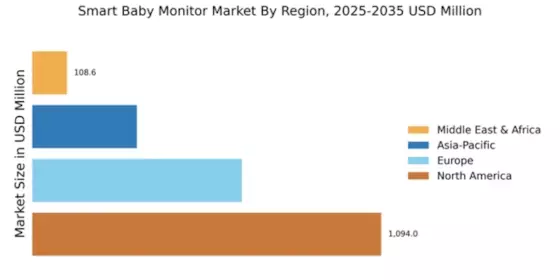
North America continues to lead the Smart Baby Monitor market, holding a significant share of 1094.0M in 2024. The growth is driven by increasing parental awareness regarding child safety and technological advancements in monitoring devices. Regulatory support for smart technology integration in childcare is also a key catalyst, enhancing market demand. The region's focus on innovation and quality assurance further propels its market position. The competitive landscape in North America is robust, featuring key players like Nanit, Owlet, and Motorola. These companies are at the forefront of technological advancements, offering features such as real-time monitoring and health tracking. The U.S. remains the largest market, followed by Canada, with a growing interest in smart baby monitors among tech-savvy parents. The presence of established brands ensures a dynamic market environment, fostering continuous innovation.

Europe : Emerging Market with Growth Potential

Europe's Smart Baby Monitor market is valued at 657.0M, reflecting a growing trend towards smart parenting solutions. Factors such as increasing disposable income, heightened awareness of child safety, and the rise of e-commerce are driving demand. Regulatory frameworks in the EU promote the use of smart devices, ensuring safety and compliance, which further stimulates market growth. The region is witnessing a shift towards integrated smart home solutions, enhancing the appeal of baby monitors. Leading countries in this market include Germany, the UK, and France, where consumer demand is rapidly increasing. Key players like Philips and Summer Infant are capitalizing on this trend, offering innovative products that cater to modern parenting needs. The competitive landscape is characterized by a mix of established brands and emerging startups, fostering a dynamic environment for growth and innovation. The market is expected to expand as more parents seek advanced monitoring solutions for their children.

Asia-Pacific : Rapid Growth in Emerging Markets

The Asia-Pacific Smart Baby Monitor market, valued at 328.0M, is experiencing rapid growth driven by urbanization and increasing disposable incomes. Parents in this region are becoming more tech-savvy, leading to a surge in demand for smart monitoring solutions. Regulatory initiatives aimed at enhancing child safety and promoting technological adoption are also contributing to market expansion. The region's growing middle class is increasingly investing in smart home technologies, including baby monitors. Countries like China, Japan, and Australia are leading the charge in this market, with a notable presence of both local and international brands. Companies such as iBaby and VTech are gaining traction by offering innovative features tailored to the needs of modern parents. The competitive landscape is evolving, with new entrants emerging to capture market share, indicating a vibrant and dynamic market environment that is set for continued growth.

Middle East and Africa : Untapped Market with Potential

The Middle East and Africa Smart Baby Monitor market, valued at 108.64M, presents significant growth opportunities as awareness of child safety increases. Factors such as rising disposable incomes and urbanization are driving demand for smart baby monitoring solutions. Regulatory bodies are beginning to recognize the importance of child safety technologies, which is expected to catalyze market growth. The region is gradually embracing smart home technologies, creating a favorable environment for baby monitor adoption. Leading countries in this region include South Africa and the UAE, where consumer interest in smart devices is on the rise. The competitive landscape is characterized by a mix of established brands and new entrants, with companies like Babysense and Angelcare making notable contributions. As the market matures, the presence of innovative products and solutions will likely enhance consumer confidence and drive further adoption of smart baby monitors.

Key Players and Competitive Insights

The Smart Baby Monitor Market is currently characterized by a dynamic competitive landscape, driven by technological advancements and evolving consumer preferences. Key players such as Nanit (US), Owlet (US), and Motorola (US) are at the forefront, each adopting distinct strategies to enhance their market positioning. Nanit (US) focuses on innovation through advanced analytics and AI integration, while Owlet (US) emphasizes health monitoring features that appeal to health-conscious parents. Motorola (US), on the other hand, leverages its established brand reputation to expand its product offerings, thereby enhancing its competitive edge. Collectively, these strategies contribute to a market that is increasingly competitive, with companies striving to differentiate themselves through unique value propositions.

In terms of business tactics, companies are increasingly localizing manufacturing and optimizing supply chains to enhance efficiency and reduce costs. The Smart Baby Monitor Market appears moderately fragmented, with several key players exerting influence over various segments. This fragmentation allows for niche players to emerge, while larger companies consolidate their market share through strategic partnerships and acquisitions, thereby shaping the overall competitive structure.

In November 2025, Nanit (US) announced a partnership with a leading pediatric health organization to integrate its monitoring technology with health tracking services. This strategic move is likely to enhance Nanit’s product offerings, positioning it as a leader in health-focused baby monitoring solutions. The collaboration not only expands its market reach but also reinforces its commitment to providing parents with comprehensive health insights, which could be a game-changer in the industry.

In October 2025, Owlet (US) launched a new line of smart monitors that incorporate sleep tracking and breathing analysis features. This innovation aligns with the growing consumer demand for multifunctional devices that prioritize child safety and well-being. By enhancing its product capabilities, Owlet (US) is likely to strengthen its competitive position, appealing to tech-savvy parents who seek advanced monitoring solutions.

In September 2025, Motorola (US) expanded its product line to include a new series of eco-friendly baby monitors, reflecting a growing trend towards sustainability in consumer electronics. This strategic initiative not only caters to environmentally conscious consumers but also positions Motorola (US) as a forward-thinking brand in the Smart Baby Monitor Market. The emphasis on sustainability may resonate well with modern parents, potentially driving sales and enhancing brand loyalty.

As of December 2025, the competitive trends in the Smart Baby Monitor Market are increasingly defined by digitalization, AI integration, and sustainability. Strategic alliances are becoming more prevalent, as companies recognize the value of collaboration in enhancing product offerings and market reach. Looking ahead, competitive differentiation is likely to evolve from traditional price-based competition to a focus on innovation, technology, and supply chain reliability. This shift suggests that companies that prioritize these aspects will be better positioned to thrive in an increasingly complex market.

Key Companies in the Smart Baby Monitor Market market include

Industry Developments

The Smart Baby Monitor Market is projected to grow significantly over the next decade, driven by rising demand for advanced and connected parenting solutions. Key trends shaping the market include the integration of artificial intelligence (AI) and machine learning (ML) algorithms, enabling real-time monitoring and data analytics. Additionally, the proliferation of smartphones and IoT devices is fueling the adoption of mobile-based baby monitors. Major players are focusing on expanding their product offerings through strategic partnerships and acquisitions to cater to the evolving needs of parents.

The Asia-Pacific region is expected to witness substantial growth due to increasing disposable income and rising awareness about infant care. Furthermore, government initiatives aimed at promoting maternal and child health are creating a favorable environment for the market's expansion.

Future Outlook

Smart Baby Monitor Market Future Outlook

The Smart Baby Monitor Market is projected to grow at a 6.52% CAGR from 2024 to 2035, driven by technological advancements, increasing parental concerns, and rising disposable incomes.

New opportunities lie in:

  • Integration of AI for enhanced monitoring features
  • Expansion into emerging markets with tailored products
  • Development of subscription-based services for premium features

By 2035, the market is expected to be robust, driven by innovation and diverse offerings.

Market Segmentation

Smart Baby Monitor Market End User Outlook

  • Parents
  • Caregivers
  • Healthcare Professionals
  • Childcare Facilities

Smart Baby Monitor Market Features Outlook

  • Two-way Communication
  • Night Vision
  • Mobile App Integration
  • Smart Alerts

Smart Baby Monitor Market Technology Outlook

  • Wi-Fi
  • Bluetooth
  • Infrared
  • Cloud-based

Smart Baby Monitor Market Application Outlook

  • Video Monitoring
  • Audio Monitoring
  • Temperature Monitoring
  • Movement Detection

Report Scope

MARKET SIZE 20242187.64(USD Million)
MARKET SIZE 20252330.27(USD Million)
MARKET SIZE 20354382.57(USD Million)
COMPOUND ANNUAL GROWTH RATE (CAGR)6.52% (2024 - 2035)
REPORT COVERAGERevenue Forecast, Competitive Landscape, Growth Factors, and Trends
BASE YEAR2024
Market Forecast Period2025 - 2035
Historical Data2019 - 2024
Market Forecast UnitsUSD Million
Key Companies ProfiledNanit (US), Owlet (US), Motorola (US), Philips (NL), Summer Infant (US), Angelcare (CA), iBaby (US), Babysense (IL), VTech (TW)
Segments CoveredApplication, Technology, End User, Features
Key Market OpportunitiesIntegration of artificial intelligence and enhanced connectivity features in Smart Baby Monitor Market.
Key Market DynamicsRising consumer demand for advanced features drives innovation and competition in the Smart Baby Monitor market.
Countries CoveredNorth America, Europe, APAC, South America, MEA

Leave a Comment

FAQs

What is the market size of the Smart Baby Monitor Market?

The Smart Baby Monitor Market size was valued at USD 2.19 billion in 2024 and is projected to reach USD 4.38 billion by 2035, exhibiting a CAGR of 6.52% during the forecast period.

Which region is expected to dominate the Smart Baby Monitor Market?

North America is expected to dominate the Smart Baby Monitor Market throughout the forecast period. The region's dominance can be attributed to the presence of key market players, high disposable income, and increasing awareness about advanced baby monitoring solutions.

What are the key growth factors driving the Smart Baby Monitor Market?

The growth of the Smart Baby Monitor Market is primarily driven by the increasing demand for remote monitoring of infants, technological advancements, and the rising adoption of smart home devices. Additionally, the growing number of working parents and the increasing awareness about newborn safety contribute to market growth.

What are the major applications of Smart Baby Monitors?

Smart baby monitors find applications in various settings, including homes, daycare centers, and hospitals. They are primarily used for monitoring an infant's vital signs, such as heart rate, breathing, and temperature, as well as for providing audio and video surveillance.

Who are the key competitors in the Smart Baby Monitor Market?

Major players in the Smart Baby Monitor Market include Angelcare, Owlet, Nanit, Motorola, Summer Infant, VTech, and Samsung. These companies offer a range of smart baby monitors with advanced features, such as high-definition cameras, two-way audio, and mobile app connectivity.

What are the challenges faced by the Smart Baby Monitor Market?

The smart baby monitor market faces certain challenges, including concerns over data privacy and security, potential technical glitches, and competition from traditional baby monitors. Additionally, the high cost of some smart baby monitors can limit their adoption in certain markets.

What are the emerging trends in the Smart Baby Monitor Market?

Emerging trends in the smart baby monitor market include the integration of artificial intelligence (AI) for advanced monitoring capabilities, the adoption of cloud-based platforms for data storage and analysis, and the development of wearable baby monitors for enhanced portability and convenience.

What is the impact of COVID-19 on the Smart Baby Monitor Market?

The COVID-19 pandemic had a positive impact on the smart baby monitor market as parents sought advanced monitoring solutions to ensure the safety and well-being of their infants during lockdowns and social distancing measures.

What is the future outlook for the Smart Baby Monitor Market?

The future of the Smart Baby Monitor Market appears promising, driven by technological advancements, growing awareness about infant safety, and the increasing adoption of smart home devices. The market is anticipated to witness continued growth in the coming years, with a focus on innovation and the development of user-friendly and feature-rich products.

What are the regulatory considerations for Smart Baby Monitors?

Smart baby monitors are subject to regulatory considerations related to data privacy, product safety, and wireless communication standards. Different regions have varying regulations, such as the General Data Protection Regulation (GDPR) in the European Union and the Health Insurance Portability and Accountability Act (HIPAA) in the United States, that manufacturers must adhere to ensure compliance.

Download Free Sample

Kindly complete the form below to receive a free sample of this Report

Compare Licence

×
Features License Type
Single User Multiuser License Enterprise User
Price $4,950 $5,950 $7,250
Maximum User Access Limit 1 User Upto 10 Users Unrestricted Access Throughout the Organization
Free Customization
Direct Access to Analyst
Deliverable Format
Platform Access
Discount on Next Purchase 10% 15% 15%
Printable Versions