Smart Mining Market (2026 - 2035)

Smart Mining Market Size, Share and Research Report By Solution (Smart Control Systems, Smart Asset Management, Autonomous Haulage & Drilling), By Service Type (System Integration, Consulting Services, Engineering & Maintenance, Managed Services), By Mining Type (Surface (Open-Pit) Mining, Underground Mining), By Technology (IoT Platforms, Robotics & Automation, AI & Analytics) and By Regional (North America, Europe, South America, Asia Pacific, Middle East and Africa) - Industry Forecast to 2035.
ID: MRFR/SEM/10505-HCR
128 Pages
Apoorva Priyadarshi
Last Updated: July 13, 2026
Smart Mining Market
Market Size
Forecast Period2026-2035
CAGR (2026-2035)11.8%
2025 Market SizeUSD 17.52 Billion
2035 Market SizeUSD 54.30 Billion
Key Players
Caterpillar Inc.
Komatsu Ltd.
Sandvik AB
Hexagon AB
Epiroc AB
ABB Ltd.
Opportunities
  • Underground Autonomy as a Safety Dividend
  • Data Monetization through Ore-Body Intelligence
  • Emerging-Market Electrification Demand

Smart Mining Market Summary

The Smart Mining Market reached a valuation of USD 17.52 Billion in 2025 and is projected to expand from USD 19.90 Billion in 2026 to USD 54.30 Billion by 2035, registering a CAGR of 11.8% during the forecast period. Surging demand for battery-grade lithium, cobalt, and rare-earth minerals has pushed operators toward technology-intensive extraction methods, while tightening emissions mandates across Australia, Canada, and Chile are accelerating capital commitments to sensor-rich, low-carbon mine sites [1][2].

A structural technology shift is reshaping the Smart Mining Market as legacy manual dispatch and paper-based safety systems give way to cloud-connected platforms that unify fleet telemetry, ore-body modelling, and workforce tracking into a single operating layer. The International Council on Mining and Metals estimated that member companies allocated over USD 4.2 Billion to digital transformation initiatives in 2024 alone, with autonomous haulage and predictive-maintenance analytics absorbing the largest share of that spend [3]. Private 5G deployments now connect tens of thousands of underground sensors with sub-10-millisecond latency, enabling real-time ventilation control and collision avoidance in deep-level operations [4].

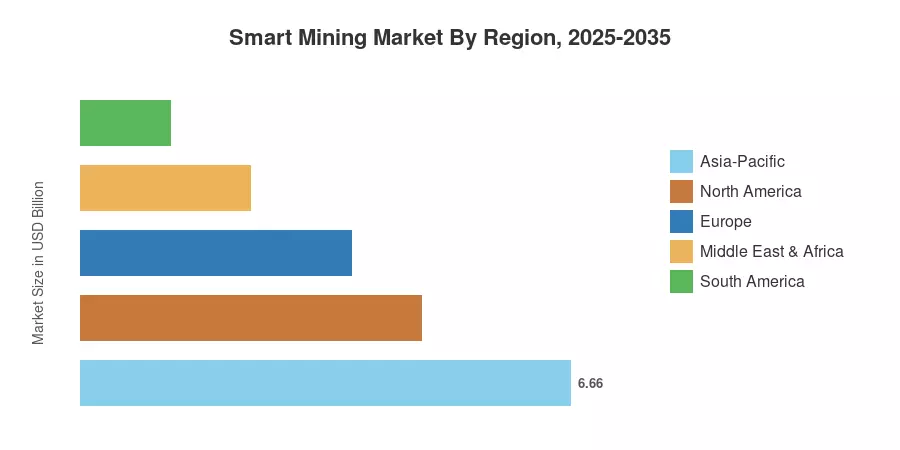
Asia-Pacific commands roughly 38.0% of global Smart Mining Market revenue, driven by China's coal-to-critical-minerals pivot and India's newly announced National Mineral Policy digitization incentives. The Middle East & Africa region is the fastest-growing geography, advancing at a 13.2% CAGR as Saudi Arabia and the UAE channel Vision 2030 investment into phosphate and gold operations. North America retains the second-largest share at 26.5%, anchored by autonomous truck deployments across the Pilbara-style open-pit copper and gold complexes in Nevada and British Columbia [5][6]. The coming decade promises deeper convergence between energy management, digital twins, and autonomous drilling — reshaping how the Smart Mining Market creates value across the extraction lifecycle.


Key Report Takeaways

• By Solution

  • Smart control systems held 43.1% of the Smart Mining Market in 2025, reflecting pervasive adoption of real-time process optimization across flotation and comminution circuits.
  • Autonomous haulage and drilling solutions are forecast to register a 13.6% CAGR through 2035, outpacing every other solution category as OEMs scale their retrofit kits.

• By Service Type

  • System integration captured 51.4% of revenue in 2025, underscoring the complexity of connecting legacy SCADA networks to cloud analytics stacks.
  • Managed services represent the fastest-expanding service line, projected to grow at a 12.9% CAGR through 2035.

• By Mining Type

  • Surface operations contributed 69.1% of the Smart Mining Market in 2025, where open-pit scale economics favour GPS-guided autonomous trucks.
  • Underground automation is advancing at a 12.5% CAGR as ventilation-on-demand and tele-remote drilling gain regulatory backing.

• By Technology

  • IoT platforms secured a 46.2% share of the Smart Mining Market in 2025, powered by edge-computing gateways that reduce cloud-dependency in remote sites.
  • AI and analytics represent the fastest-growing technology segment with a 13.1% CAGR through 2035.

• By Region

  • Asia-Pacific led with 38.0% of 2025 Smart Mining Market revenue, while the Middle East & Africa region is on track for a 13.2% CAGR through 2035.
  • North America contributed USD 4.64 Billion in 2025, supported by Inflation Reduction Act incentives for critical-mineral processing.


Market Size and Forecast (2021–2035)

Market Research Future derives historical values from audited company filings, customs-trade databases, and proprietary primary surveys with 450+ mine-site technology managers. Forecast projections layer bottom-up demand models — segmented by solution, service, mining type, technology, and geography — onto macro-capital-expenditure trackers published by the World Mining Congress and regional geological surveys [1].
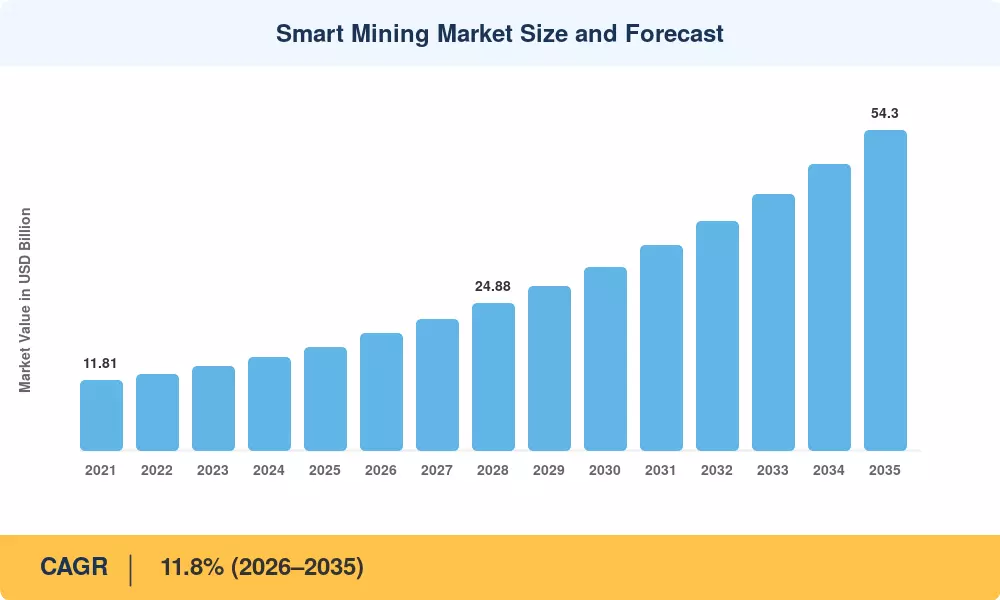
Smart Mining Market Size and Forecast
Our Impact
Enabled $4.3B Revenue Impact for Fortune 500 and Leading Multinationals
Partnering with 2000+ Global Organizations Each Year
30K+ Citations by Top-Tier Firms in the Industry

Driver Impact Analysis

Driver ~% Impact on CAGR Geographic Relevance Impact Timeline
Autonomous haulage fleet expansion 2.8 Global Short-term (≤2 yr)
Critical-mineral supply-chain mandates 2.2 North America, Europe Medium-term (2–4 yr)
Private 5G and edge connectivity 1.9 Asia-Pacific, Oceania Short-term (≤2 yr)
Predictive-maintenance cost savings 1.5 Global Medium-term (2–4 yr)
ESG disclosure and emissions caps 1.3 Europe, South America Long-term (≥4 yr)
Digital-twin and simulation platforms 1.0 North America, Europe Medium-term (2–4 yr)
Energy-transition mineral demand 0.9 Middle East, Africa Long-term (≥4 yr)


Autonomous Haulage Fleet Expansion

By late 2024, Caterpillar's MineStar Command system had transported more than 4.5 billion autonomous tonnes, while Komatsu's FrontRunner fleet had grown to 230 trucks across five continents. The economic argument is compelling: Rio Tinto's Pilbara operations reported a 15% reduction in per-tonne haulage costs following full autonomous deployment, with equipment utilization exceeding 92%, compared to the industry average of 78% for manned trucks [3]. This single driver reshapes the Smart Mining Market capex profile by reducing payback timeframes from four years to about thirty months.


Critical-Mineral Supply-Chain Mandates

The U.S. Inflation Reduction Act provided USD 700 million in incentives for domestic vital mineral processing, whereas the European vital Raw Materials Act established a 10% domestic extraction objective for 2030. To achieve traceability and carbon-intensity requirements included in procurement contracts [8][14], miners must use digitalized extraction — ore-sorting algorithms, real-time grade monitoring, and automated sampling.


Private 5G and Edge Connectivity

South Africa's Harmony Gold and Chile's Codelco each commissioned private 5G networks in 2024, joining Australia's Newcrest (now part of Newmont) in deploying sub-10-millisecond connectivity underground. The investment case rests on a 40% reduction in unplanned downtime when edge-computing nodes process vibration and thermal data locally rather than routing it to distant cloud servers [4]. This connectivity layer is foundational for the Smart Mining Market because it unlocks every downstream analytics application.

Predictive-Maintenance Cost Savings

The 2024 Mining Digital Maturity Survey found that mines running predictive-maintenance platforms reduced unplanned equipment failures by 35% and cut maintenance budgets by 18–22%. Sandvik's OptiMine suite and ABB's Ability platform both monetize this value stream through subscription-based licensing, creating recurring revenue models that reinforce the Smart Mining Market transition from capital to operating expenditure [9][13].


Restraints Impact Analysis

The restraint percentages below represent directional headwinds estimated through industry expert panels and validated against capital-approval cycle data from 120 mining companies globally.

Restraint ~% Impact on CAGR Geographic Relevance Impact Timeline
Integration complexity with legacy OT –1.4 Global Medium-term (2–4 yr)
Cybersecurity exposure –1.1 North America, Europe Short-term (≤2 yr)
Skilled workforce shortage –0.9 Africa, South America Long-term (≥4 yr)
Extended payback cycles for mid-tier miners –0.7 Global Medium-term (2–4 yr)
Data sovereignty and cross-border restrictions –0.5 Asia-Pacific, MEA Long-term (≥4 yr)


Integration Complexity with Legacy OT

Most mines use a mishmash of programmable logic controllers, proprietary SCADA protocols, and vendor-locked dispatch software that has been implemented over the course of two or three decades. A 2024 evaluation indicated that integration expenses add 25-40% to the headline price of a smart-mining platform because brownfield sites necessitate custom middleware, protocol translators, and physical rewiring of sensor loops [16]. This friction is especially affecting the Smart Mining Market in regions where fleet ages surpass fifteen years.


Cybersecurity Exposure

The Australian Cyber Security Centre observed a 62% year-over-year rise in reported breaches targeting mining operational technology in 2024, with ransomware groups taking advantage of the convergence of IT and OT networks. Insurance premiums for cyber-physical mining events increased by 30% during the same period, imposing a recurring cost burden that mid-tier operators struggle to bear [17]. These hazards impede board-level clearance for cloud-connected designs that support the Smart Mining Market.


Skilled Workforce Shortage

The International Labour Organization estimates a global deficit of 180,000 data engineers, automation technicians, and process-control specialists within the mining sector by 2028. In Sub-Saharan Africa and parts of South America, the gap is particularly acute; universities graduate fewer than 2,000 mining-technology specialists annually against projected demand for 12,000 [18].


Smart Mining Market Opportunities

Underground Autonomy as a Safety Dividend

Regulatory bodies in Canada, Australia, and Sweden are tightening permissible exposure limits for diesel particulate matter and silica dust underground. Autonomous load-haul-dump vehicles and tele-remote drilling rigs eliminate human presence from the most hazardous zones, converting safety compliance into a technology-procurement trigger. Mines that adopt these platforms report 45% fewer lost-time injuries, creating a measurable return that shortens capital-approval timelines[12].

Data Monetization through Ore-Body Intelligence

Geological survey data, drill-core imagery, and blast-fragmentation analytics generated by smart platforms hold value well beyond a single mine's life. Operators that anonymize and pool geospatial data can license it to exploration-stage juniors, mineral-rights investors, and equipment OEMs seeking training sets for machine-learning models. This data-as-a-service model introduces a recurring revenue layer that transforms the Smart Mining Market cost centre into a profit centre[11].

Emerging-Market Electrification Demand

Sub-Saharan Africa holds an estimated 30% of the world's critical-mineral reserves, yet fewer than 8% of its active mines use any form of sensor-based ore sorting or automated ventilation. The African Union's 2024 Mining Vision 2063 roadmap commits member states to digital-first licensing requirements for new concessions, opening a greenfield addressable market for the Smart Mining Market that incumbents in mature geographies cannot replicate[10].

Platform-as-a-Service for Mid-Tier Miners

Cloud-hosted, pay-per-use analytics platforms lower the entry barrier for miners producing fewer than 5 million tonnes annually. Vendors like Newtrax (Sandvik) and MiPlan now offer modular subscriptions that avoid the four-year payback cycles that have historically excluded smaller operators. This platform economics shift broadens the Smart Mining Market addressable base by an estimated 3,500 mid-tier mines globally[13].

Energy Management and Decarbonization Analytics

Scope 1 and Scope 2 emissions reporting is becoming a listing requirement on major stock exchanges. Smart-energy modules that optimize ventilation fans, conveyor belts, and grinding mills can reduce site electricity consumption by 12–18%, delivering both cost savings and carbon-credit generation. The dual incentive structure makes decarbonization analytics one of the highest-ROI entry points into the Smart Mining Market[14].


Smart Mining Market Future Outlook

Autonomous Operations at Scale

By 2030, the International Energy Agency projects that autonomous haulage will account for 35% of total surface-mine material movement globally, up from 12% in 2025. The economic tipping point arrives when retrofit kits for existing truck fleets drop below USD 300,000 per unit, a threshold that Caterpillar and Komatsu are both targeting in their 2027 product roadmaps. Underground autonomy will follow a slower curve but reach commercial viability for load-haul-dump cycles by 2032 [3][15].

Platform Economics and Subscription Models

The Smart Mining Market is shifting from capital-heavy, bespoke integrations toward platform-as-a-service models where miners pay monthly per connected asset. This transition mirrors the industrial-software arc seen in manufacturing and oil and gas, and it compresses vendor revenue-recognition cycles while expanding the addressable market to thousands of mid-tier operators. By 2035, Market Research Future estimates that subscription-based analytics will represent 28% of total Smart Mining Market software revenue [13].

Electrification and Energy-Transition Minerals

According to the report forecasts the global demand for lithium will triple between 2025 and 2035, while cobalt and nickel requirements for battery cathodes will rise 80% over the same window. Each tonne of incremental mineral demand requires extraction infrastructure that is increasingly digital by default — ore-sorting sensors, automated assay labs, and AI-driven water-recycling circuits. The electrification supercycle therefore acts as a structural demand multiplier for the Smart Mining Market [2][14].

ESG Reporting and Carbon-Intensity Metrics

The International Sustainability Standards Board's IFRS S2 disclosure framework, effective for mining companies from fiscal year 2026, requires granular Scope 1 and Scope 2 emissions reporting at the asset level. Meeting these requirements cost-effectively depends on smart-energy-management modules embedded in mine-operations centres. Companies that deploy integrated energy-and-production dashboards will capture carbon credits while demonstrating compliance, creating a dual-incentive feedback loop that sustains long-run Smart Mining Market investment [14][19].


Smart Mining Market Segmentation

By Solution

Segment Primary Metric Primary Demand Driver
Smart Control Systems 43.1% share (2025) Real-time process optimization across comminution and flotation
Smart Asset Management USD 5.57 Billion (2025) Predictive-maintenance ROI for heavy mobile equipment
Autonomous Haulage & Drilling CAGR 13.6% (2026–2035) OEM retrofit kits and regulatory safety mandates


Smart control systems dominate the Smart Mining Market because they sit at the convergence of process engineering and data science. Modern control platforms ingest thousands of sensor feeds — particle size, reagent dosage, slurry density — and adjust plant parameters in real time, delivering 4–6% improvements in recovery rates that translate directly to revenue. Smart asset management trails closely; its value proposition centres on extending the useful life of haul trucks and shovels whose replacement cost can exceed USD 5 Million per unit. Autonomous haulage and drilling, while smaller in absolute terms, represent the highest-growth vector as OEMs shift from selling trucks to selling outcomes measured in cost-per-tonne [3][9].

By Service Type

Segment Primary Metric Primary Demand Driver
System Integration 51.4% share (2025) Brownfield IT-OT convergence complexity
Consulting Services USD 3.19 Billion (2025) Digital-maturity assessments and roadmap design
Engineering & Maintenance CAGR 11.2% (2026–2035) Ongoing calibration and firmware lifecycle management
Managed Services CAGR 12.9% (2026–2035) Cloud-hosted, pay-per-use operations centres


System integration remains the largest service category in the Smart Mining Market because connecting legacy operational technology to modern cloud architectures demands specialized middleware, protocol translation, and rigorous cybersecurity hardening. Managed services, by contrast, represent the frontier: remote operations centres staffed by vendor engineers can monitor multiple mine sites simultaneously, reducing on-site headcount requirements and making smart-mining capabilities accessible to operators in talent-scarce geographies [13][16].

By Mining Type

Segment Primary Metric Primary Demand Driver
Surface (Open-Pit) Mining 69.1% share (2025) GPS-guided autonomous truck economics
Underground Mining CAGR 12.5% (2026–2035) Ventilation-on-demand and tele-remote safety mandates


Surface operations lead the Smart Mining Market in absolute terms because open-pit geometries favour line-of-sight GPS guidance and high-bandwidth wireless connectivity, both prerequisites for autonomous haulage. Underground mining, while smaller, is catching up as millimetre-wave mesh networks and LiDAR-based simultaneous localization and mapping enable reliable automation in confined, GPS-denied environments [4][12].

By Technology

Segment Primary Metric Primary Demand Driver
IoT Platforms 46.2% share (2025) Edge gateways reducing cloud dependency at remote sites
Robotics & Automation USD 4.26 Billion (2025) Autonomous drilling rigs and robotic inspection vehicles
AI & Analytics CAGR 13.1% (2026–2035) Ore-grade prediction and energy-optimization algorithms


IoT platforms anchor the Smart Mining Market technology stack because every downstream application — from predictive maintenance to autonomous dispatch — depends on reliable, low-latency sensor data. AI and analytics are growing fastest because they convert that raw data into actionable decisions: ore-grade prediction models, energy-load balancing algorithms, and geotechnical-risk classifiers that reduce dilution and improve blast-fragmentation outcomes [4][11].

Regional Market Share Analysis

Region Primary Metric Primary Investment Themes
Asia-Pacific 38.0% share (2025) Coal-to-critical-minerals transition, state-led digitization
North America USD 4.64 Billion (2025) IRA critical-mineral grants, autonomous open-pit fleets
Europe 21.0% share (2025) EU CRM Act, underground safety regulations
South America 7.0% share (2025) Copper expansion in Chile and Peru
Middle East & Africa 13.2% CAGR (2026–2035) Vision 2030 mining diversification, greenfield concessions
Total USD 17.52 Billion (2025)

The Smart Mining Market spans five major regions, each shaped by distinct mineral endowments, regulatory climates, and infrastructure maturity levels [5][6].


North America

Country Primary Metric Key Driver
US 68.3% of regional share Inflation Reduction Act mineral processing incentives
Canada 23.7% of regional share Ontario and Quebec autonomous-mining regulations
Mexico CAGR 12.4% Lithium nationalization and processing modernization


North America's Smart Mining Market benefits from a mature regulatory framework that simultaneously mandates emissions reduction and incentivizes domestic mineral extraction. The U.S. Department of Energy's 2024 Critical Minerals Strategy earmarked USD 500 Million for sensor-equipped processing facilities, while Natural Resources Canada expanded its Mine Innovation Program with CAD 120 Million in matching grants for autonomous systems through 2028 [5][8].

Europe

Country Primary Metric Key Driver
Germany CAGR 11.3% Industry 4.0 mining-technology exports
UK 14.2% of regional share North Sea mineral licensing digitization
France USD 0.49 Billion (2025) Battery-metals refining automation
Italy CAGR 10.8% Marble and aggregate quarry modernization
Spain 9.1% of regional share Andalusia copper and zinc corridor
Nordic Countries 22.5% of regional share Autonomous underground operations in Sweden and Finland
Russia USD 0.38 Billion (2025) Cold-climate tele-remote drilling deployments
Rest of Europe CAGR 10.6% Varied mineral endowments


The European Smart Mining Market is heavily shaped by the EU Critical Raw Materials Act, which mandates that 40% of annual consumption be processed domestically by 2030. Nordic nations lead in underground autonomy: Boliden's Garpenberg mine in Sweden operates fully tele-remote production drilling, and LKAB's Kiruna expansion uses digital twins to plan the city relocation above its expanding ore body [6][14].

Asia-Pacific

Country Primary Metric Key Driver
China 42.1% of regional share State-mandated coal-mine intelligence upgrades
India CAGR 13.4% National Mineral Policy digitization targets
Japan USD 0.71 Billion (2025) Robotics and automation technology exports
South Korea CAGR 11.9% Battery-supply-chain traceability requirements
ASEAN 11.8% of regional share Nickel and bauxite processing modernization
Rest of Asia-Pacific CAGR 10.7% Mongolia, Kazakhstan open-pit automation


Asia-Pacific dominates the Smart Mining Market because China's National Mine Safety Administration mandated intelligent upgrades for all coal mines producing above 600,000 tonnes annually by 2027, a directive covering more than 3,800 operations. India's Ministry of Mines launched a USD 340 Million digital mining initiative in 2024, targeting real-time production monitoring across 200 public-sector mines within three years [5][10].

South America

Country Primary Metric Key Driver
Brazil 52.3% of regional share Iron-ore and niobium digital operations
Argentina CAGR 12.6% Lithium-triangle brine extraction automation
Rest of South America USD 0.35 Billion (2025) Chile and Peru copper corridor digitization


South America's contribution to the Smart Mining Market centres on the copper and lithium belts that stretch from northern Chile through Argentina's Salta province. Codelco committed USD 1.2 Billion to its Digital Codelco programme, targeting a 20% productivity gain across its seven active divisions by 2028. The programme integrates predictive-maintenance platforms with autonomous truck dispatch across the Chuquicamata and Radomiro Tomic complexes [10].

Middle East & Africa

Country Primary Metric Key Driver
Saudi Arabia 34.8% of regional share Ma'aden expansion and Vision 2030 mining targets
UAE CAGR 14.1% Sovereign fund diversification into mining technology
South Africa USD 0.32 Billion (2025) Platinum group metals tele-remote operations
Egypt CAGR 12.7% Gold-mining concession modernization
Rest of MEA 21.4% of regional share DRC cobalt, Zambia copper digitization


The Middle East & Africa region leads Smart Mining Market growth because of greenfield advantages: new concessions can embed smart infrastructure from day one rather than retrofitting legacy systems. Saudi Arabia's Ma'aden approved a USD 2.6 Billion expansion in 2024 that includes fully autonomous phosphate processing lines, while South Africa's Minerals Council launched a ZAR 800 Million modernization fund targeting platinum-group-metal producers transitioning from conventional stoping to mechanized cut-and-fill methods [6][15].


Smart Mining Market By Region, 2025-2035

Competitive Benchmarking

The Smart Mining Market exhibits medium concentration, with the top five vendors capturing an estimated 35–42% of global revenue. The Herfindahl-Hirschman Index sits in the 800–1,100 range, characteristic of an oligopolistic core surrounded by a long tail of specialized analytics, robotics, and connectivity providers. Competition increasingly centres on platform breadth — vendors that can offer integrated fleet management, process control, and energy optimization from a single contract win disproportionate share versus point-solution specialists.

Company Est. Revenue Share Range Key Offerings for Smart Mining Market Strategic Positioning
Caterpillar Inc. ~8–11% MineStar Command autonomous haulage, Cat Connect fleet analytics Integrated OEM with largest installed autonomous fleet
Komatsu Ltd. ~7–10% FrontRunner AHS, Modular Mining dispatch systems Autonomous haulage pioneer with 230+ truck deployments
Sandvik AB ~6–9% AutoMine, OptiMine analytics, Newtrax IoT Underground automation leader with subscription SaaS pivot
Hexagon AB ~5–8% HxGN MineOperate, fleet management, drill guidance Geospatial and safety-system specialist
Epiroc AB ~4–7% Rig Control System, 6th Sense platform, Mobilaris Rock-drilling autonomy with strong underground focus
ABB Ltd. ~4–6% ABB Ability MineOptimize, electrification, process control Electrification-plus-digital integrated value proposition
Hitachi Construction Machinery ~3–5% Wenco fleet management, ConSite predictive maintenance Asia-Pacific fleet analytics stronghold
Siemens AG ~3–5% MindSphere industrial IoT, SIMINE process automation Cross-industry digital-twin platform leverage
Rockwell Automation ~2–4% Plex MES, FactoryTalk analytics adapted for mining Industrial-automation portfolio extended to extractives
Cisco Systems ~2–3% Industrial networking, private 5G infrastructure, cybersecurity Connectivity backbone provider for smart-mine architectures
Trimble Inc. ~2–3% Machine-control and positioning systems for surface mining Precision-guidance specialist with survey-grade accuracy


Recent News & Developments

  • October 2025: Komatsu and BHP agreed to deploy 30 more autonomous haul trucks at Jimblebar, increasing the driverless fleet to 95 units and aiming for a 20% decrease in transport costs by mid-2026.
  • September 2025:Hexagon paid USD 78 million for MineSense Technologies, which included in-flight ore-sorting sensors that reduced energy use by 12-18%.
  • August 2025: SAP unveiled its Sustainability Control Tower for Mining, a cloud platform that automates ESG reporting in accordance with new ISSB requirements.
  • July 2025: Cisco collaborated with Newmont to establish private 5G networks at three North American gold mines, providing real-time video analytics and augmented-reality maintenance.


Smart Mining Market Report Scope

Parameter Detail
Market Scope Smart Mining Market — solutions, services, mining types, technologies
Study Period 2021–2035
CAGR (Forecast) 11.8% (2026–2035)
Market Size (2025) USD 17.52 Billion
Market Size (2035) USD 54.30 Billion
Fastest Growing Segment AI & Analytics (CAGR 13.1%)
Fastest Growing Region Middle East & Africa (CAGR 13.2%)
Companies Profiled 11
Valuation Currency USD Billion


FAQs

How do autonomous haulage systems affect mine-site insurance premiums?
Insurers typically reduce premiums by 10–18% for fully autonomous fleets because collision and operator-injury claims decline sharply [17]. Mines must demonstrate certified cybersecurity controls to qualify for these discounts.
What is the typical payback period for a smart-mining platform at a mid-tier operation?
Mid-tier mines producing 2–5 million tonnes annually generally see payback in 30–42 months when combining predictive maintenance with fleet optimization [9]. Subscription-based platforms can shorten this to under 24 months.
Which connectivity standard — private 5G or Wi-Fi 6 — is better suited for underground mines?
Private 5G excels in latency-critical applications like collision avoidance and tele-remote drilling, while Wi-Fi 6 costs less for non-real-time monitoring [4]. Most greenfield underground sites deploy 5G as the primary backbone.
How do mining companies protect smart-mine networks from ransomware attacks?
Leading operators segment IT and OT networks with unidirectional gateways and deploy behavioural analytics that flag anomalous traffic patterns [17]. Regular tabletop exercises and OT-specific incident-response plans are now standard practice.
Can legacy truck fleets be retrofitted for autonomous operation, or must operators buy new equipment?
Caterpillar and Komatsu both offer retrofit kits for trucks less than ten years old, at roughly 35–45% of a new-truck cost [3]. Retrofits typically require 8–12 weeks of downtime per unit.
What role do digital twins play in mine-closure planning and environmental remediation?
Digital twins simulate post-closure water flows, tailings stability, and revegetation scenarios, reducing remediation cost overruns by an estimated 20% [11]. Regulators in Australia now accept twin-based closure models as part of formal mine-closure submissions.
How are carbon credits generated through smart-energy-management modules in mining?
Energy-optimization algorithms reduce electricity consumption by 12–18%, and the verified emissions reductions qualify for voluntary carbon credits under standards like Gold Standard [14]. Revenue from credits offsets 8–15% of the platform's annual licence cost.    
Author
Author
Author Profile
Apoorva Priyadarshi LinkedIn
Research Analyst
With 4+ years of experience in Market Intelligence and Strategic Research, Apoorv specializes in ICT, Semiconductor, and BFSI markets. Combining strong analytical capabilities with a deep understanding of technology-driven industries, he focuses on delivering data-driven insights that support strategic decision-making. With a background in technology and business research, Apoorv has contributed to numerous global market studies, competitive landscape analyses, and opportunity assessments across sectors such as semiconductors, digital banking, cybersecurity, and telecommunications.
Download Free Sample

Kindly complete the form below to receive a free sample of this Report

Download PDF ×

We do not share your information with anyone. However, we may send you emails based on your report interest from time to time. You may contact us at any time to opt-out.
















