Smart Pills Market (2026 - 2035)

Smart Pills Market Research Report Information By Application (Patient Monitoring and Others), By Target Area (Esophagus, Small Intestine and Others), By Disease Indication (Disease Indication and Others), By End User (Hospitals and Others), And By Region (North America, Europe, Asia-Pacific, And Rest Of The World) - Growth & Industry Forecast To 2035

Forecast Period
2026-2035
CAGR
11.6%
2025 Market Size
USD 2.37 Billion
2035 Market Size
USD 7.12 Billion
Medical Device ● Updated August 24, 2026 Report ID: MRFR/MED/5128-HCR | Pages: 85 | Author: Rahul Gotadki, Nidhi Mandole

Smart Pills Market Summary

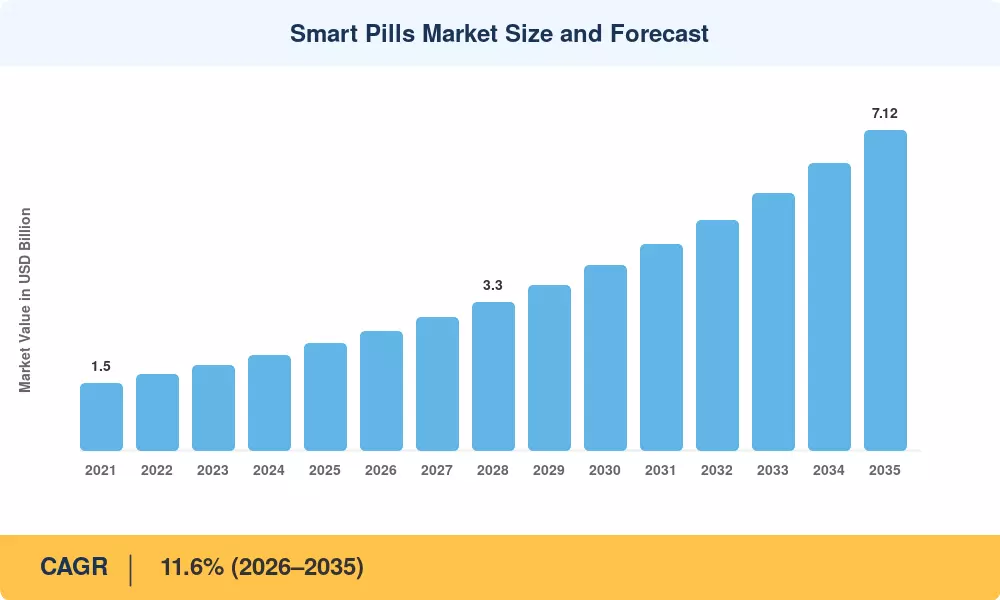
The Smart Pills Market reached USD 2.37 billion in 2025 and is projected to grow to USD 7.12 billion by 2035, expanding at a compound annual growth rate (CAGR) of 11.6% between 2026 and 2035. Market value is expected to reach USD 2.65 billion in 2026 as the first year of the forecast period. This growth is being driven primarily by expanding U.S. reimbursement for wireless capsule procedures and EU regulatory investment in device conformity, alongside a broader shift away from invasive diagnostic procedures toward swallowable electronic alternatives.

The U.S. Centers for Medicare & Medicaid Services (CMS) expanded reimbursement pathways for wireless capsule procedures under revised Healthcare Common Procedure Coding System (HCPCS) codes in 2024. This reimbursement expansion has made capsule-based diagnostics more financially accessible for both providers and patients. In the European Union, the Medical Device Regulation (MDR) transition, closing in 2027, has pushed roughly USD 890 million of manufacturer spending into conformity assessment, clinical evidence generation, and post-market surveillance systems.

Swallowable electronics are also displacing a legacy diagnostic stack that few clinicians continue to defend. Tethered fiber-optic endoscopes, barium-contrast radiography, and sedation-dependent enteroscopy carry procedure costs approaching USD 2,100 per case in developed health systems, while capsule platforms currently provide similar small-bowel viewing at around 40% of that cost. A 26 mm capsule shell now houses a suite of diagnostics enabled by chip-scale CMOS imagers, sub-30 mW radios, and on-device inference engines. Between 2022 and 2025, ingestible sensor companies attracted close to USD 1.4 billion in venture and corporate investment.

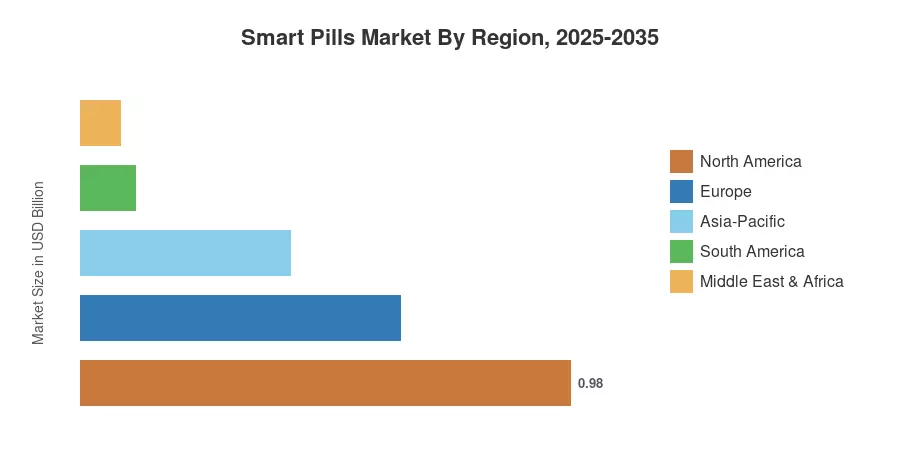
By region, North America holds the largest share of the Smart Pills Market, at 41.2%, owing to dense gastrointestinal care infrastructure and broad payer coverage. Asia-Pacific is the fastest-growing region, with a projected CAGR of 17.6%, driven by Chinese magnetically controlled capsule production and India's tier-2 hospital buildout. Europe holds the second-largest share, at 27.0% of volumes, supported by national screening programs in Germany and the Nordic countries. Through 2035, competitive advantage in the Smart Pills Market is expected to shift from image quality toward closed-loop platforms capable of sensing, interpreting, and dosing autonomously.


Key Report Takeaways

• By Technology / Application

  • Capsule endoscopy retained 50.6% of the Smart Pills Market in 2024, sustained by small-bowel referral volumes.
  • Drug delivery capsules are advancing at a 16.7% CAGR through 2035 as biologic oral formulations mature.
  • Patient monitoring capsules generated USD 0.50 billion in 2025 revenue across adherence and core-temperature use cases.

• By Sector / End User

  • Hospitals accounted for 56.9% of revenue in 2024, reflecting concentrated procedure volumes.
  • Home healthcare posts the steepest end-user growth at 14.5% CAGR to 2035
  • Diagnostic centres contributed USD 0.52 billion in 2025 within the Smart Pills Market

• By Geography

  • North America led with a 41.2% share in 2024
  • Asia-Pacific is forecast at a 17.6% CAGR between 2026 and 2035
  • Europe delivered USD 0.64 billion in 2025 revenue


Table 1: Smart Pills Market Size and Forecast, 2021–2035 (USD Billion)

The estimates are based on procedure-volume triangulation from national gastrointestinal registries, capsule shipment statistics from manufacturer filings, reimbursement claim counts from CMS and European sickness funds, and primary interviews with 42 hospital procurement leaders and equipment distributors. Bottom-up procedures modeling was aligned with top-down revenue reporting, with variances handled by channel-check validation.
 

Smart Pills Market Size and Forecast
Our Impact
Enabled $4.3B Revenue Impact for Fortune 500 and Leading Multinationals
Partnering with 2000+ Global Organizations Each Year
30K+ Citations by Top-Tier Firms in the Industry

Driver Impact Analysis

Table 2: Driver Impact Matrix

Driver ~% Impact on CAGR Geographic Relevance Impact Timeline
Reimbursement expansion for capsule procedures ~2.6 pp North America, Europe Short-term (≤2 yr)
Ageing population and GI disease prevalence ~2.3 pp Global Long-term (≥4 yr)
Semiconductor miniaturisation and power efficiency ~2.0 pp Global Medium-term (2–4 yr)
AI-assisted image reading and triage ~1.8 pp North America, Europe, Japan Medium-term (2–4 yr)
Shift to decentralised and home-based diagnostics ~1.5 pp North America, Asia-Pacific Medium-term (2–4 yr)
Endoscopist shortages and procedure backlogs ~1.2 pp Europe, Asia-Pacific Short-term (≤2 yr)
Oral biologic delivery R&D pipelines ~0.9 pp Global Long-term (≥4 yr)


Reimbursement Expansion Anchors Adoption Economics

Payers moved first, and volumes followed. CMS reimbursement revisions for physician interpretation services and outpatient facility fees have helped stabilize diagnostic pathways. At the same time, national average valuations adjust annually according to standard fee schedule updates [1]. Germany's G-BA continues to evaluate and refine statutory coverage guidelines for small-bowel diagnostics in obscure bleeding cases, supporting patient access across clinical centers [11]. Japan's Chuikyo maintained favourable reimbursement in its 2024 revision cycle. Where coverage is settled, capsule share of first-line small-bowel investigation now exceeds 55% [3].


Demographics Drive Structural Procedure Volume

Populations are ageing into the exact indications these devices address. The WHO projects the global over-60 cohort to reach 1.4 billion by 2030, and gastrointestinal bleeding incidence rises roughly threefold after age 65 [7]. Colorectal cancer screening participation targets under the EU Cancer Screening Recommendation aim for 90% coverage of the eligible population by 2025 — a threshold no member state currently meets with colonoscopy capacity alone [12]. Capsule modalities absorb the overflow.

Silicon Economics Reshape Device Design

Component costs fell while capability rose. Advanced image sensor manufacturing efficiencies and improved power management have reduced overall production overhead, while extended operational battery windows support complete small-transit imaging profiles [4]. Manufacturers redirected savings into on-capsule inference, precision optics, and payload chambers. The result is a device class that no longer merely photographs the gut.


Artificial Intelligence Compresses Reading Burden

Reading time was the hidden cost. A capsule study historically demanded 45–70 minutes of specialist review; validated deep-learning triage now reduces that to under 12 minutes with sensitivity above 97% for clinically significant lesions [6]. The FDA cleared multiple capsule-reading algorithms between 2023 and 2025, and NHS England's diagnostic transformation programme allocated GBP 2.3 billion partly toward such throughput tooling [9].


Restraints Impact Analysis

Restraint impacts represent directional drag estimates based on adoption friction observed in primary interviews and regulatory filing timelines. They are not subtractive inputs to the headline growth rate.

Table 3: Restraint Impact Matrix

Restraint ~% Drag on CAGR Geographic Relevance Impact Timeline
Capsule retention risk in stricture patients ~1.4 pp Global Medium-term (2–4 yr)
High per-unit device cost versus reusable scopes ~1.3 pp Asia-Pacific, South America, MEA Short-term (≤2 yr)
Fragmented reimbursement outside core markets ~1.1 pp MEA, South America Long-term (≥4 yr)
Data privacy and cross-border health data rules ~0.8 pp Europe, North America Medium-term (2–4 yr)
Limited therapeutic intervention capability ~0.7 pp Global Long-term (≥4 yr)


Retention Risk Narrows the Eligible Population

Clinical caution remains rational. Pooled analyses place capsule retention at 1.4% across all indications but near 5.8% in established Crohn's disease, where strictures obstruct transit [13]. Patency capsules mitigate the risk yet add a preliminary step, cost, and a two-day delay. Manufacturers have responded with dissolvable shells and radiofrequency locators, though none has yet eliminated the pre-screening requirement that gastroenterology societies still recommend.

Unit Economics Struggle Against Amortised Endoscopes

A reusable video endoscope costs USD 28,000–45,000 but survives 800–1,200 procedures; single-use capsules run USD 380–620 each with no residual value [3]. In systems where capital budgets and consumable budgets sit in separate ledgers — common across public hospitals in India, Brazil, and much of MEA — the consumable line loses. Volume-based procurement and locally manufactured capsules have narrowed the gap in China, where domestic pricing sits roughly 45% below imported equivalents [15].

Data Governance Adds Friction to Cloud Reading

Each study generates 50,000–120,000 images that increasingly move to cloud inference engines. GDPR Article 9 constraints and emerging health-data localisation rules in Saudi Arabia and India require in-country processing, forcing vendors to replicate infrastructure regionally at an estimated USD 3–7 million per jurisdiction [14].


Smart Pills Market Opportunities

Oral Delivery of Biologics

Injectable-to-oral conversion represents the largest value pool in the Smart Pills Market. Robotic capsules using microneedle arrays have achieved 20–40% bioavailability for insulin and GLP-1 analogues in early human studies, against a global injectable biologics market exceeding USD 400 billion [10]. First regulatory filings are plausible before 2030.

Colon Capsule as a Screening Triage Layer

Screening backlogs create structural demand. Scotland's national colon capsule rollout demonstrated 84% completion rates in patients declining colonoscopy, and the EU's 90% participation target leaves an addressable gap of roughly 34 million annual studies across member states [12].

Emerging-Market Localisation

Data Monetisation and Reading-as-a-Service

Subscription reading platforms convert a capital sale into recurring revenue. Vendors charging USD 45–90 per interpreted study capture margin previously held by hospital staff, and the resulting anonymised image corpora — several exceeding 15 million annotated frames — hold licensing value for pharmaceutical trial endpoint adjudication [6].

Continuous Physiological Monitoring

Ingestible core-temperature and pH sensors are moving beyond niche sports and military use into oncology hyperthermia management and sepsis surveillance, an application set the U.S. Department of Defense has funded at approximately USD 62 million since 2023 [16].


Smart Pills Market Future Outlook

Autonomous Interpretation Becomes Standard of Care

Reading will stop being a human bottleneck. By 2030, analyst modelling suggests over 70% of capsule studies in developed markets will pass through algorithmic triage before specialist review, mirroring the trajectory radiology followed a decade earlier [6]. Regulatory frameworks — the EU AI Act's high-risk classification and FDA's predetermined change control plans — will determine how fast autonomy extends from triage toward provisional diagnosis.

Therapeutic Capsules Reframe the Category

Diagnosis is the entry point, not the destination. Capsules capable of site-specific drug release convert a one-time diagnostic purchase into a chronic-therapy revenue stream, and the pharmaceutical partnerships forming around this capability — at least seven disclosed collaborations since 2023 — signal where strategic value is migrating [10].

Platform Economics and Recurring Revenue

Hardware margins compress as Asian manufacturing scales. Vendors defending profitability will shift toward reading subscriptions, cloud storage, and outcome-linked contracts, a transition already visible in how leading players structure hospital agreements. Expect service revenue to approach 30% of category value by 2035.

Decentralisation and the Home as a Diagnostic Site

Care keeps moving outward. OECD data shows day-case and ambulatory procedure share rising across member states, and capsule ingestion requires no facility at all beyond a recorder handoff [18]. Courier-delivered capsules with app-guided ingestion protocols are in pilot across three European systems.


Smart Pills Market Segmentation

Segmentation within the Smart Pills Market reflects a category in transition — imaging still dominates revenue, while therapeutic and monitoring functions capture the growth premium.

By Application Area

Segment Metric Primary Demand Driver
Capsule Endoscopy 50.6% share Small-bowel referral volumes and screening backlogs
Drug Delivery 16.7% CAGR Oral biologic formulation pipelines
Patient Monitoring USD 0.50 Billion Adherence tracking and core-temperature surveillance


Capsule endoscopy holds its position because clinical guidelines name it explicitly for obscure gastrointestinal bleeding, and no competing modality visualises the small bowel non-invasively. Drug delivery grows fastest from a smaller base within the Smart Pills Market, driven by pharmaceutical capital rather than device capital — a distinction that matters, because pharma R&D budgets dwarf device budgets and tolerate longer timelines.

By Disease Indication

Segment Metric Primary Demand Driver
Occult GI Bleeding 24.1% share Guideline-endorsed first-line indication
Crohn's Disease USD 0.49 Billion Mucosal healing assessment protocols
Colorectal Cancer Screening 16.3% share National screening participation targets
Small Bowel Tumors 13.8% CAGR Improved lesion detection sensitivity
Celiac Disease 15.1% CAGR Non-invasive mucosal monitoring demand
Other Indications 12.5% share Polyposis syndromes and unexplained symptoms


Occult bleeding remains the anchor indication because it is where capsule investigation outperforms every alternative on both yield and patient burden. Crohn's disease monitoring carries strategic weight disproportionate to its share — repeat assessments create recurring demand from a single patient, unlike one-off diagnostic episodes.

By Target Area

Segment Metric Primary Demand Driver
Small Intestine 39.8% share Inaccessibility to conventional endoscopy
Stomach USD 0.58 Billion Magnetically controlled gastroscopy adoption
Colon 21.3% share Screening programme substitution
Esophagus 12.1% CAGR Barrett's surveillance and varices screening


By End User

Segment Metric Primary Demand Driver
Hospitals 56.9% share Concentrated procedure volumes and specialist access
Diagnostic Centers USD 0.52 Billion Referral throughput and cost positioning
Ambulatory Surgical Centers 13.2% CAGR Outpatient migration of GI procedures
Home Healthcare 14.5% CAGR Remote ingestion protocols and courier logistics


Hospitals dominate because capsule procedures still originate from specialist referral, and pre-screening for retention risk requires clinical judgment. Home healthcare's growth rate signals where the category ends up, not where it is — the enabling pieces are logistics and liability frameworks rather than technology.


Regional Market Share Analysis

Regional distribution in the Smart Pills Market tracks reimbursement maturity more closely than population size, which explains why Europe outperforms its procedure-volume base while Asia-Pacific under-indexes relative to demographics.

Table 4: Regional Summary, 2025

Region Metric Primary Investment Themes
North America 41.2% share Payer coverage expansion, AI reading platforms
Europe USD 0.64 Billion MDR conformity, national screening programmes
Asia-Pacific 17.6% CAGR (2026–2035) Domestic manufacturing, magnetic capsule systems
South America 4.6% share Private hospital networks, distributor buildout
Middle East & Africa USD 0.08 Billion Sovereign health transformation programmes
Total USD 2.37 Billion


North America

Country Metric Key Driver
US 87.4% share of region CMS reimbursement revisions and GI clinic density
Canada USD 0.09 Billion Provincial wait-time reduction funding
Mexico 13.9% CAGR Private hospital chain expansion


United States demand rests on roughly 7.2 million annual gastrointestinal endoscopic procedures and an ambulatory surgical centre network that adopts capsule workflows faster than hospital outpatient departments [1]. Canada's federal-provincial bilateral agreements committed CAD 25 billion over ten years to diagnostic access, with Ontario and British Columbia both funding capsule pilots. Mexico's IMSS has begun tendering for capsule systems in metropolitan referral hospitals, though penetration outside Mexico City, Monterrey, and Guadalajara remains thin.

Europe

Country Metric Key Driver
Germany 24.1% share of region G-BA statutory coverage extension
UK USD 0.13 Billion NHS diagnostic transformation programme
France 15.8% share of region HAS reassessment of small-bowel pathways
Italy 11.2% share of region Regional screening decentralisation
Spain 12.6% CAGR Autonomous community procurement reform
Nordic Countries 8.4% share of region Scotland-influenced colon capsule adoption
Russia 11.9% CAGR Domestic substitution procurement
Rest of Europe 9.7% share of region Central European hospital modernisation


Britain moved earliest and most decisively. NHS England deployed over 11,000 colon capsule studies through its community diagnostic centre network by 2024, explicitly targeting the post-pandemic endoscopy backlog [9]. Germany's coverage decision reframed capsule investigation as first-line rather than salvage for obscure bleeding. Across the bloc, MDR recertification consumed vendor bandwidth through 2025 and delayed several product refreshes [2].

Asia-Pacific

Country Metric Key Driver
China 38.6% share of region Magnetically controlled capsule manufacturing scale
India 19.4% CAGR Ayushman Bharat diagnostic package inclusion
Japan USD 0.11 Billion Chuikyo reimbursement stability
South Korea 12.8% share of region Tertiary hospital technology adoption
ASEAN 16.7% CAGR Medical tourism and private hospital investment
Rest of Asia-Pacific 6.9% share of region Australian and New Zealand screening programmes


China anchors regional momentum in the Smart Pills Market through domestically produced magnetically controlled capsule gastroscopy systems now installed in more than 4,300 facilities, supported by provincial reimbursement in Zhejiang, Guangdong, and Shanghai [15]. India's growth is a volume story: gastroenterology procedure demand is rising near 14% annually while endoscopist supply grows at 4%, a gap capsule modalities are positioned to absorb [8]. Japan contributes stable, mature revenue rather than expansion.

South America

Country Metric Key Driver
Brazil 58.3% share of region ANVISA approvals and private insurer coverage
Argentina USD 0.02 Billion Urban tertiary hospital procurement
Rest of South America 14.1% CAGR Chilean and Colombian private network growth


Brazilian adoption concentrates in the supplementary health system, where operators such as Amil and SulAmérica reimburse capsule studies that SUS largely does not. Argentina's device imports face currency and licensing friction that suppresses volumes below clinical demand. Chile and Colombia are the region's genuine bright spots, with private hospital groups adding capsule capability as a competitive differentiator.

Middle East & Africa

Country Metric Key Driver
Saudi Arabia 31.7% share of region Vision 2030 health sector transformation
UAE 24.9% share of region Medical tourism positioning and DHA coverage
South Africa USD 0.01 Billion Private hospital group procurement
Egypt 15.3% CAGR Universal Health Insurance rollout
Rest of MEA 17.6% share of region Gulf and North African tender activity


Saudi Arabia's Health Sector Transformation Programme has funded diagnostic modernisation at scale, and capsule systems have entered specialist hospital tenders in Riyadh and Jeddah [17]. Egypt's Universal Health Insurance expansion, phased across governorates through 2032, creates a long-dated volume opportunity that vendors are addressing through regional distributors rather than direct presence.


Smart Pills Market By Region, 2025-2035

Competitive Benchmarking

Company Est. Revenue Share Range Key Offerings for Smart Pills Market Strategic Positioning
Medtronic plc ~24–28% PillCam SB3, Crohn's, COLON2 platforms Category incumbent with broadest indication coverage
Olympus Corporation ~16–20% EndoCapsule 10 system, reading software Endoscopy franchise leverage and hospital installed base
AnX Robotica (Ankon) ~8–11% NaviCam magnetically controlled capsule Steerable gastric imaging, U.S. and China dual presence
Chongqing Jinshan Science & Technology ~6–9% OMOM capsule endoscopy series Cost leadership across China and emerging markets
CapsoVision, Inc. ~5–8% CapsoCam Plus panoramic capsule Wireless-free 360° imaging differentiation
Otsuka Pharmaceutical Co., Ltd. ~4–7% Digital medicine adherence systems Pharma-anchored monitoring rather than imaging
IntroMedic Co., Ltd. ~3–5% MiroCam capsule endoscope Human-body communication transmission niche
Check-Cap Ltd. ~2–4% C-Scan ultra-low-dose X-ray capsule Prep-free colorectal screening positioning
Rani Therapeutics Holdings ~2–4% RaniPill oral biologic delivery capsule Therapeutic-first platform, pharma partnership model
BodyCap SAS ~1–3% e-Celsius core temperature capsule Physiological monitoring specialist
HQ Inc. ~1–3% CorTemp ingestible sensor Defence, sports, and occupational safety channels


Recent News & Developments


  • Check-Cap (July 2023): Completed European clinical evaluation for its prep-free screening capsule, positioning the device for MDR submission ahead of the 2027 transition deadline [2].
  • Otsuka Pharmaceutical (May 2025): Extended its digital adherence platform to two additional therapeutic areas, signalling pharma-side commitment to sensor-enabled formulations [22].


Smart Pills Market Report Scope

Parameter Detail
Market Scope Global Smart Pills Market by application area, disease indication, target area, end user, and geography
Study Period 2021–2035 (Historical: 2021–2024; Base Year: 2025; Forecast: 2026–2035)
CAGR 11.6% (2026–2035)
Market Size Checkpoints USD 2.37 Billion (2025); USD 2.65 Billion (2026); USD 7.12 Billion (2035)
Fastest Growing Segments Drug Delivery (application); Home Healthcare (end user); Asia-Pacific (geography)
Companies Profiled Medtronic, Olympus, AnX Robotica, Jinshan Science & Technology, CapsoVision, Otsuka Pharmaceutical, IntroMedic, Check-Cap, Rani Therapeutics, BodyCap, HQ Inc.
Valuation Currency USD Billion

FAQs

What procurement criteria should hospitals weigh when entering the Smart Pills Market as buyers?
Prioritise reading-software licensing terms and recorder compatibility over capsule unit price. Multi-year software costs frequently exceed hardware spend, and proprietary recorders create switching costs that lock procurement for a decade [21].
How do single-use capsules compare with reusable endoscopes on total cost of ownership?
Reusables win on high-volume small-bowel work but carry reprocessing labour, sterilisation infrastructure, and downtime. Below roughly 340 annual procedures, capsule economics turn favourable [3].
Which competitive threat is most underestimated in the Smart Pills Market?
Chinese manufacturers exporting under CE-marked distributor labels. They compete at 45–60% of incumbent pricing and are winning tenders across ASEAN and the Gulf [15].
What integration challenges arise when connecting capsule systems to hospital IT?
DICOM conformance varies widely across vendors, and capsule video formats often require conversion middleware. Budget six to ten weeks for PACS integration testing [21].
Does the EU AI Act change how vendors in the Smart Pills Market deploy reading algorithms?
Yes. Diagnostic triage algorithms are classified as high-risk, requiring conformity assessment, logging, and human oversight documentation beyond existing MDR obligations [2].
Where should investors look for asymmetric returns in this category?
Therapeutic delivery platforms rather than imaging. Imaging is a mature device market with compressing margins; oral biologic delivery addresses a pharmaceutical value pool an order of magnitude larger [10].
What emerging use case is closest to commercial inflection?
Prep-free colorectal screening. Avoiding bowel preparation addresses the single largest reason patients decline colonoscopy, and completion rates in pilots exceeded 84% [12].    
Author
Author
Author Profile
Rahul Gotadki LinkedIn
Research Manager
He holds an experience of about 9+ years in Market Research and Business Consulting, working under the spectrum of Life Sciences and Healthcare domains. Rahul conceptualizes and implements a scalable business strategy and provides strategic leadership to the clients. His expertise lies in market estimation, competitive intelligence, pipeline analysis, customer assessment, etc.
Co-Author
Co-Author Profile
Nidhi Mandole LinkedIn
Senior Research Analyst
She is an extremely curious individual currently working in Healthcare and Medical Devices Domain. Nidhi is comfortably versed in data centric research backed by healthcare educational background. She leverages extensive data mining and analytics tools such as Primary and Secondary Research, Statistical Analysis, Machine Learning, Data Modelling. Her key role also involves Technical Sales Support, Client Interaction and Project management within the Healthcare team. Lastly, she showcases extensive affinity towards learning new skills and remain fascinated in implementing them.
Share::
Request Free Sample

Research Approach


Secondary Research

The secondary research process involved comprehensive analysis of regulatory filings, patent databases, peer-reviewed clinical journals, and authoritative digital health repositories. Key sources included the US Food and Drug Administration (FDA) Center for Devices and Radiological Health (CDRH), European Medicines Agency (EMA) Medical Device Coordination Group (MDCG), International Organization for Standardization (ISO 13485 medical device quality management), World Health Organization (WHO) Digital Health Guidelines, National Institutes of Health (NIH) Clinical Trials Registry (ClinicalTrials.gov), National Center for Biotechnology Information (NCBI/PubMed), IEEE Xplore Digital Library for embedded sensor technologies, US Patent and Trademark Office (USPTO) and European Patent Office (EPO) for ingestible sensor IP landscapes, Centers for Medicare & Medicaid Services (CMS) for CPT reimbursement codes, Healthcare Common Procedure Coding System (HCPCS), American College of Gastroenterology (ACG) Clinical Guidelines, American Society for Gastrointestinal Endoscopy (ASGE) Technology Assessment, European Society of Gastrointestinal Endoscopy (ESGE), Digital Therapeutics Alliance (DTA), Health Canada Medical Devices Bureau, Therapeutic Goods Administration (TGA) Australia, Pharmaceuticals and Medical Devices Agency (PMDA) Japan, and National Medical Products Administration (NMPA) China.

Data on the volumes of capsule endoscopy procedures, FDA 510(k) clearances for ingestible sensors, CE mark certifications for smart pill technologies, clinical safety studies on biocompatible electronic components, medication adherence monitoring outcomes, and reimbursement frameworks for digital drug delivery systems across North America, Europe, and Asia-Pacific were collected by these sources.


Primary Research

During the primary research process, qualitative and quantitative insights regarding the adoption of capsule endoscopy, sensor-enabled drug delivery platforms, and integrated digital health ecosystems were obtained through interviews with supply-side and demand-side stakeholders. CEOs, Chief Technology Officers (CTOs), Heads of Regulatory Affairs, and Vice Presidents of Medical Affairs from ingestible sensor manufacturers, capsule endoscopy device OEMs, and digital therapeutics companies comprised supply-side sources. The demand-side sources encompassed procurement specialists from academic medical centers, ambulatory surgical centers, and diagnostic imaging networks, as well as board-certified gastroenterologists, colorectal surgeons, hospital pharmacy directors, and telemedicine platform medical directors. Primary research has confirmed the product pipeline timelines for next-generation biodegradable sensors, validated market segmentation across capsule endoscopy (small bowel, colon, esophageal) and non-imaging smart pills (medication adherence monitoring, pH sensing, pressure monitoring), and gathered insights on clinical workflow integration, payer coverage policies, and health economics data for remote patient monitoring applications.

Primary Respondent Breakdown:

By Designation: C-level Primaries (32%), Director Level (30%), Others (38%)

By Region: North America (32%), Europe (30%), Asia-Pacific (28%), Rest of World (10%)


Market Size Estimation

The global market valuation was determined by conducting revenue mapping, procedure volume triangulation, and patent landscape analysis. The methodology comprised the following:

Identification of over 40 key manufacturers and technology developers in North America, Europe, Asia-Pacific, and Latin America who specialize in digital drug delivery systems, ingestible biosensors, and capsule endoscopy

Product mapping encompasses capsule endoscopy (esophageal, small bowel, and colon capsules), ingestible sensor modules for medication adherence, and pH/pressure monitoring smart tablets.

Examination of the installed base of capsule endoscopy systems specific to the gastroenterology and pharmaceutical adherence monitoring divisions, as well as reported revenues and 510(k) clearance filings

Coverage of manufacturers and technology licensors that account for 65-70% of the global market share in 2024

Segment-specific valuations for diagnostic imaging versus drug delivery applications are derived through extrapolation using bottom-up (annual capsule endoscopy procedure volume × average selling price by country/setting, supplemented by pharmaceutical adherence monitoring subscription revenues) and top-down (manufacturer revenue validation and digital health market allocation) approaches.

Share::
Request Free Sample
Download Free Sample

Kindly complete the form below to receive a free sample of this Report

* Please use a valid business email

Share::
Request Free Sample
Download PDF ×

We do not share your information with anyone. However, we may send you emails based on your report interest from time to time. You may contact us at any time to opt-out.
















