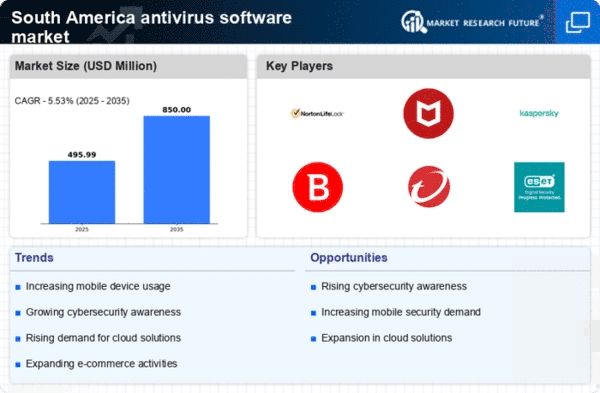
The antivirus software market in South America is characterized by a dynamic competitive landscape, driven by increasing cyber threats and a growing demand for robust security solutions. Key players such as NortonLifeLock (US), McAfee (US), and Kaspersky (RU) are strategically positioned to leverage innovation and regional expansion to enhance their market presence. NortonLifeLock (US) focuses on integrating advanced AI technologies into its offerings, aiming to provide proactive threat detection. Meanwhile, McAfee (US) emphasizes partnerships with local firms to tailor its solutions to regional needs, thereby enhancing customer engagement. Kaspersky (RU) adopts a dual strategy of innovation and education, promoting cybersecurity awareness while continuously updating its software to counter emerging threats. Collectively, these strategies contribute to a competitive environment that is increasingly reliant on technological advancement and localized solutions.
In terms of business tactics, companies are increasingly localizing their operations to better serve the South American market. This includes optimizing supply chains and establishing regional offices to enhance customer support. The market structure appears moderately fragmented, with several players vying for market share, yet the influence of major companies remains substantial. The collective actions of these key players shape the competitive dynamics, as they strive to differentiate themselves through unique offerings and localized strategies.
In October 2025, Kaspersky (RU) announced a partnership with a leading South American telecommunications provider to enhance cybersecurity for small and medium-sized enterprises (SMEs). This strategic move is significant as it not only expands Kaspersky's reach but also addresses the specific security needs of SMEs, a segment that is often under-protected. By leveraging the telecommunications provider's existing customer base, Kaspersky positions itself as a trusted partner in the region, potentially increasing its market share.
In September 2025, NortonLifeLock (US) launched a new suite of products specifically designed for the South American market, incorporating local languages and compliance with regional regulations. This initiative reflects a growing trend towards customization in software solutions, allowing NortonLifeLock to cater to the unique needs of South American consumers. The strategic importance of this launch lies in its potential to enhance customer loyalty and brand recognition in a competitive landscape.
In August 2025, McAfee (US) unveiled a new cloud-based security solution aimed at addressing the rising threats associated with remote work. This development is particularly relevant in the context of South America, where remote work has become increasingly prevalent. By focusing on cloud security, McAfee not only meets current market demands but also positions itself as a forward-thinking leader in the antivirus sector, likely attracting a broader customer base.
As of November 2025, the competitive trends in the antivirus software market are increasingly defined by digitalization, sustainability, and the integration of AI technologies. Strategic alliances are becoming more prevalent, as companies recognize the value of collaboration in enhancing their service offerings. Looking ahead, competitive differentiation is expected to evolve, shifting from price-based competition to a focus on innovation, technological advancement, and supply chain reliability. This transition suggests that companies that prioritize these areas will likely gain a competitive edge in the rapidly evolving landscape.












Leave a Comment