×
Request Free Sample ×

Kindly complete the form below to receive a free sample of this Report

* Please use a valid business email

Leading companies partner with us for data-driven Insights

clients tt-cursor
Hero Background

South America Condom Market

ID: MRFR/HC/43677-HCR
200 Pages
Garvit Vyas
October 2025

South America Condom Market Research Report By Material Type (Latex Condoms, Non-latex Condoms), By Product (Male Condoms, Female Condoms), andBy Distribution Channel (Mass Merchandisers, Drug Stores, E-commerce)- Forecast to 2035

Share:
Download PDF ×

We do not share your information with anyone. However, we may send you emails based on your report interest from time to time. You may contact us at any time to opt-out.

South America Condom Market Infographic
Purchase Options

South America Condom Market Summary

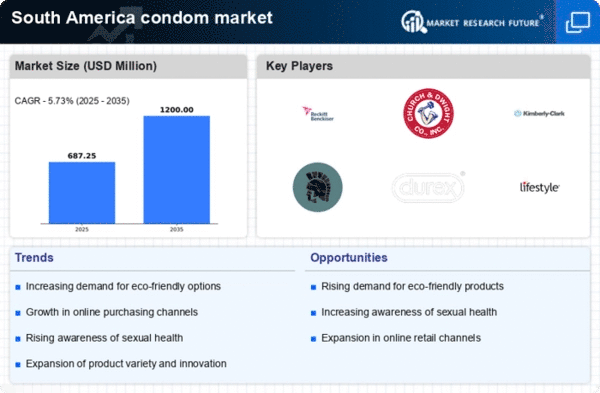
As per MRFR analysis, the South America condom market Size was estimated at 650.0 USD Million in 2024. The South America condom market is projected to grow from 687.25 USD Million in 2025 to 1200.0 USD Million by 2035, exhibiting a compound annual growth rate (CAGR) of 5.73% during the forecast period 2025 - 2035.

Key Market Trends & Highlights

The South America condom market is experiencing robust growth driven by heightened awareness and innovation.

  • Brazil remains the largest market for condoms in South America, reflecting a strong cultural emphasis on sexual health.
  • Mexico is emerging as the fastest-growing region, indicating a shift towards increased acceptance of sexual wellness products.
  • There is a notable rise in e-commerce platforms, enhancing accessibility and convenience for consumers in both regions.
  • Key market drivers include rising demand for safe sex practices and government initiatives supporting sexual health education.

Market Size & Forecast

2024 Market Size 650.0 (USD Million)
2035 Market Size 1200.0 (USD Million)
CAGR (2025 - 2035) 5.73%

Major Players

Reckitt Benckiser (GB), Church & Dwight (US), Kimberly-Clark (US), Trojan (US), Durex (GB), LifeStyles (AU), Skyn (US), Crown (JP), Pasante (GB)

South America Condom Market Trends

The condom market in South America is currently experiencing a dynamic evolution, driven by various socio-economic factors and changing consumer preferences. The region's increasing awareness regarding sexual health and the importance of safe practices has led to a notable rise in demand for condoms. This shift is further influenced by educational campaigns and government initiatives aimed at promoting responsible sexual behavior. As a result, manufacturers are adapting their strategies to cater to a more informed consumer base, which appears to be seeking a diverse range of products that not only ensure safety but also enhance pleasure and intimacy. Moreover, the condom market is witnessing a surge in innovation, with companies introducing new materials and designs to meet the evolving needs of consumers. This trend is indicative of a broader movement towards personalization in sexual health products. Additionally, the rise of e-commerce platforms is facilitating greater accessibility to a variety of condom brands, allowing consumers to make informed choices from the comfort of their homes. The interplay of these factors suggests a promising outlook for the condom market in South America, as it continues to adapt to the changing landscape of consumer demands and preferences.

Increased Awareness of Sexual Health

There is a growing recognition of the importance of sexual health in South America, leading to heightened demand for condoms. Educational initiatives and government campaigns are playing a crucial role in promoting safe sex practices, which in turn drives market growth.

Product Innovation and Variety

Manufacturers are increasingly focusing on innovation within the condom market, introducing new materials, textures, and designs. This trend reflects a shift towards catering to diverse consumer preferences, enhancing both safety and pleasure.

E-commerce Growth

The rise of online shopping platforms is transforming how consumers access condoms. E-commerce provides greater convenience and privacy, allowing individuals to explore a wider range of products and brands, thus expanding market reach.

South America Condom Market Drivers

Government Initiatives and Support

Government initiatives aimed at promoting sexual health and responsible behavior are playing a crucial role in shaping the condom market in South America. Various countries have implemented programs that provide free or subsidized condoms to the public, particularly targeting high-risk populations. These initiatives not only enhance accessibility but also encourage the normalization of condom use. For instance, Brazil's Ministry of Health has reported distributing millions of condoms annually, which has contributed to a significant increase in usage rates. Such government support is expected to continue fostering a favorable environment for market expansion, potentially leading to a 10% increase in overall sales in the next few years.

Rising Demand for Safe Sex Practices

The increasing awareness regarding sexually transmitted infections (STIs) and unintended pregnancies is driving the demand for safe sex practices across South America. Educational campaigns and health initiatives have contributed to a cultural shift towards prioritizing sexual health. As a result, the condom market is experiencing a notable uptick in sales, with estimates suggesting a growth rate of approximately 8% annually. This heightened focus on safe sex is particularly evident among younger demographics, who are more likely to seek out reliable contraceptive methods. Furthermore, public health policies promoting condom use as a primary preventive measure against STIs are likely to bolster market growth in the coming years.

Cultural Shifts Towards Sexual Wellness

Cultural attitudes towards sexual wellness are evolving in South America, with a growing acceptance of discussing sexual health openly. This shift is influencing consumer behavior and driving the condom market towards greater acceptance and usage of condoms. As societal norms change, individuals are more inclined to prioritize their sexual health, leading to increased purchases of condoms. Market data indicates that regions with higher levels of sexual education and awareness are witnessing a surge in condom sales, with some areas reporting growth rates exceeding 12%. This cultural transformation is likely to continue, further solidifying the role of condoms as a staple in sexual health.

Influence of E-commerce on Accessibility

The rise of e-commerce platforms is transforming the way consumers access condoms in South America. Online shopping offers a discreet and convenient option for purchasing sexual health products, which is particularly appealing to younger consumers. The condom market is benefiting from this trend, with online sales projected to grow by 20% over the next few years. E-commerce not only enhances accessibility but also allows for a wider variety of products to be available to consumers. As more individuals turn to online platforms for their purchasing needs, the market is likely to see a significant shift in sales dynamics, further driving overall growth.

Technological Advancements in Product Development

Technological advancements in the development of condoms are significantly impacting the condom market in South America. Innovations such as ultra-thin materials, enhanced durability, and the introduction of various textures and flavors are attracting a broader consumer base. These advancements not only improve user experience but also address concerns regarding comfort and effectiveness. Market Research Future indicates that products featuring innovative designs are witnessing a 15% increase in sales compared to traditional options. As manufacturers continue to invest in research and development, the introduction of new products is expected to stimulate market growth and cater to diverse consumer preferences.


Market Segment Insights

By Material Type: Latex (Largest) vs. Non-latex (Fastest-Growing)

In the South America condom market, latex condoms dominate the landscape, consistently capturing a significant share due to their widespread acceptance and reliability. Non-latex condoms, while accounting for a smaller portion of the market, are gaining traction as consumer preferences shift towards alternative materials that cater to specific needs. The growing awareness about skin sensitivity and allergies contributes to the increasing demand for non-latex options, indicating a diversifying market landscape. The growth trends for both segments reveal promising dynamics. Latex condoms are expected to maintain their stronghold, bolstered by established manufacturing practices and consumer trust. However, non-latex condoms are projected as the fastest-growing segment, driven by rising health awareness and a focus on personalization in sexual health products. Enhanced marketing and wider availability of innovative non-latex options further support their rapid adoption, signifying a notable shift in consumer preferences.

Condoms: Latex (Dominant) vs. Non-latex (Emerging)

Latex condoms are the dominant force in the segment, known for their elasticity, strength, and cost-effectiveness, making them a preferred choice among consumers. Their market presence is supported by traditional marketing channels and strong brand loyalty. Conversely, non-latex condoms are emerging as a viable alternative, often made from materials such as polyurethane or polyisoprene. They cater to individuals with latex allergies or sensitivities, reflecting a growing trend towards inclusivity in sexual health. As they become more mainstream, non-latex options are gaining visibility through targeted advertising and health-focused campaigns, fostering consumer trust and expanding their market share.

By Product: Male Condoms (Largest) vs. Female Condoms (Fastest-Growing)

In the South America condom market, male condoms hold the largest share, dominating the segment significantly due to consumer familiarity and brand loyalty. The prevalence of male condoms in traditional and modern retail outlets contributes to their leading position, making them the preferred choice among consumers. Female condoms, while holding a smaller market share, are gaining traction due to increased awareness and promotion of female sexual health and autonomy. The growth trends for this segment indicate a rising acceptance of female condoms fueled by campaigns aimed at enhancing female empowerment and targeted marketing strategies that educate consumers about their benefits. Furthermore, innovations in design and material are making female condoms more appealing, as they are increasingly seen as a viable and effective alternative to male condoms. As the market continues to evolve, both segments are likely to contribute to overall growth based on changing consumer preferences and educational initiatives.

Condoms: Male (Dominant) vs. Female (Emerging)

Male condoms are characterized by their widespread availability, brand recognition, and established consumer trust, making them the dominant product in this segment. They are often available in various sizes, textures, and materials, catering to diverse consumer preferences. The male condom segment benefits from significant marketing efforts and partnerships with organizations promoting safe sex. In contrast, female condoms are emerging as a viable option, particularly for those seeking greater control over their contraceptive choices. Although historically less popular, the rise in educational programs and advocacy for women's health is driving awareness and acceptance. Female condoms offer unique benefits such as reduced reliance on partners for contraceptive use, promoting increased interest and potential market share growth.

By Distribution Channel: E-commerce (Largest) vs. Drug Stores (Fastest-Growing)

In the South America condom market, the distribution of condom sales across various channels reveals that E-commerce has emerged as the largest player, capturing significant market share. Mass Merchandizers and Drug Stores also hold valuable portions of the market, but E-commerce's convenience and accessibility push it to the forefront. Drug Stores, while smaller in size compared to E-commerce, are now finding their footing as vital points of sale, especially among consumers seeking reliable and trusted purchasing environments. Growth trends for these distribution channels indicate a robust shift toward online purchasing, with the E-commerce segment continuing to thrive amid changing consumer behavior. Factors such as increasing smartphone penetration and widespread internet access are driving this growth. On the other hand, Drug Stores are adapting by enhancing their product offerings and marketing strategies to attract more customers, making this channel the fastest-growing within the market. Mass Merchandizers maintain steady sales, but competition from online platforms poses challenges.

E-commerce: Dominant vs. Drug Stores: Emerging

E-commerce platforms in the South America condom market are dominating due to their ability to offer a wide range of products with the convenience of home delivery. This channel appeals particularly to younger demographics who prioritize discretion and accessibility. The ease of online comparison shopping also allows consumers to make informed choices. Conversely, Drug Stores, while traditionally a stronghold for condom sales, are now emerging as a competitive force by revitalizing their in-store experiences and emphasizing health and wellness. By focusing on customer trust and product availability, Drug Stores are strategically positioning themselves to capture an increasing share of health-conscious consumers, ultimately driving growth in this segment.

Get more detailed insights about South America Condom Market

Regional Insights

Brazil : Leading Market Share and Growth

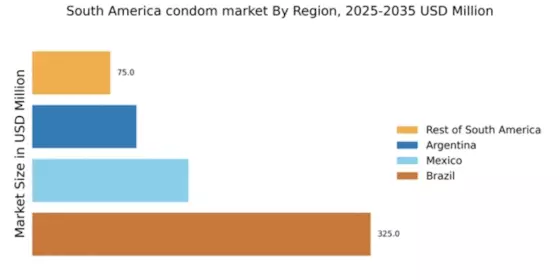
Brazil holds a commanding market share of 43.3% in South America, valued at $325.0 million. Key growth drivers include increasing awareness of sexual health, government initiatives promoting safe sex, and a rising youth population. Demand trends show a shift towards premium products, with consumers favoring brands that offer enhanced features. Regulatory policies support the distribution of condoms through public health campaigns, while infrastructure improvements facilitate wider access to retail outlets.

Mexico : Growing Demand and Awareness

Mexico accounts for 20% of the South American condom market, valued at $150.0 million. The growth is driven by increasing awareness of sexually transmitted infections (STIs) and government campaigns promoting safe sex. Consumption patterns indicate a rising preference for flavored and ultra-thin condoms. Regulatory support includes initiatives to distribute condoms in schools and public health facilities, enhancing accessibility and awareness.

Argentina : Cultural Shifts and Market Dynamics

Argentina represents 13.3% of the South American market, valued at $100.0 million. Key growth drivers include changing cultural attitudes towards sexual health and increased availability of diverse product offerings. Demand trends show a preference for eco-friendly and organic options. Government initiatives focus on sexual education and STI prevention, contributing to a more informed consumer base.

Rest of South America : Varied Demand Across Regions

The Rest of South America holds a market share of 10% at $75.0 million. Growth is uneven, with countries like Chile and Colombia showing increasing demand due to urbanization and improved health education. Regulatory frameworks vary, impacting market dynamics. Local players often dominate, but international brands are gaining traction. The competitive landscape is characterized by a mix of established and emerging brands, catering to diverse consumer preferences.

South America Condom Market Regional Image

Key Players and Competitive Insights

The condom market in South America is characterized by a competitive landscape that is increasingly shaped by innovation, sustainability, and digital transformation. Key players such as Reckitt Benckiser (GB), Church & Dwight (US), and Durex (GB) are actively pursuing strategies that emphasize product differentiation and market penetration. Reckitt Benckiser (GB) has focused on expanding its product line to include eco-friendly options, which aligns with the growing consumer demand for sustainable products. Church & Dwight (US) has been enhancing its digital marketing efforts to engage younger consumers, while Durex (GB) continues to leverage its strong brand equity to introduce innovative products that cater to diverse consumer preferences. Collectively, these strategies contribute to a dynamic competitive environment where adaptability and consumer-centric approaches are paramount.
In terms of business tactics, companies are increasingly localizing manufacturing to reduce costs and improve supply chain efficiency. This trend is particularly evident in the moderately fragmented market structure of South America, where local production can enhance responsiveness to regional consumer needs. The collective influence of key players is significant, as they not only compete on product offerings but also on their ability to optimize operations and enhance customer engagement through localized strategies.

In October 2025, Reckitt Benckiser (GB) announced the launch of a new line of biodegradable condoms, marking a significant step towards sustainability in the condom market. This initiative is likely to resonate with environmentally conscious consumers and could set a new standard for product offerings in the region. The strategic importance of this move lies in its potential to capture a growing segment of the market that prioritizes eco-friendly products, thereby enhancing brand loyalty and market share.

In September 2025, Church & Dwight (US) unveiled a comprehensive digital marketing campaign aimed at promoting its Trojan brand among younger demographics. This campaign utilizes social media platforms and influencer partnerships to create a more relatable brand image. The strategic significance of this initiative is evident in its potential to engage a demographic that is increasingly influenced by digital content, thereby driving sales and brand awareness in a competitive market.

In August 2025, Durex (GB) expanded its product range to include a new line of ultra-thin condoms designed for enhanced sensitivity. This product launch is indicative of the company's commitment to innovation and consumer satisfaction. The strategic importance of this move lies in its ability to attract consumers seeking a more intimate experience, thereby differentiating Durex from competitors and reinforcing its market leadership.

As of November 2025, current trends in the condom market are heavily influenced by digitalization, sustainability, and the integration of advanced technologies. Strategic alliances among companies are becoming increasingly common, as they seek to leverage each other's strengths to enhance product offerings and market reach. The competitive landscape is shifting from a focus on price-based competition to one that emphasizes innovation, technology, and supply chain reliability. This evolution suggests that companies that prioritize these aspects will likely emerge as leaders in the market, setting the stage for a more differentiated and consumer-focused future.

Key Companies in the South America Condom Market market include

Industry Developments

The South America Condom Market has witnessed notable developments recently. In September 2023, Durex launched a new organic latex condom line in Brazil, targeting the burgeoning demand for eco-friendly products among health-conscious consumers. Okamoto Industries, recognizing the rising usage of premium condom segments, has expanded its production facility in Argentina, aiming to meet local and regional needs for high-quality latex products. Additionally, Reckitt Benckiser reported a 15% growth in its Latin American segment attributed to increased demand for condom brands such as Durex and Trojan during the pandemic recovery phase.

In terms of acquisitions, no significant mergers involving key players like Skyn, Piper's, Trustex, First Choice, Church, and Dwight, or Glyde Health were publicly announced in the last few months related to South America. However, the overall market valuation for condom brands in South America has seen an upswing, driven by a combination of innovative marketing strategies and growing awareness around sexual health. This has catalyzed competitive dynamics, with brands like Billy Boy and Crown Condoms also introducing new promotional campaigns to increase their market share in various South American countries.

Future Outlook

South America Condom Market Future Outlook

The Condom Market in South America is projected to grow at a 5.73% CAGR from 2024 to 2035, driven by increasing awareness of sexual health and innovative product offerings.

New opportunities lie in:

  • Expansion of e-commerce platforms for direct-to-consumer sales.
  • Development of eco-friendly condom materials to attract environmentally conscious consumers.
  • Partnerships with healthcare providers for distribution in clinics and hospitals.

By 2035, the market is expected to achieve robust growth, reflecting evolving consumer preferences and increased accessibility.

Market Segmentation

South America Condom Market Product Outlook

  • Male Condoms
  • Female Condoms

South America Condom Market Material Type Outlook

  • Latex Condoms
  • Non-latex Condoms

South America Condom Market Distribution Channel Outlook

  • Mass Merchandizers
  • Drug Stores
  • E-commerce

Report Scope

MARKET SIZE 2024650.0(USD Million)
MARKET SIZE 2025687.25(USD Million)
MARKET SIZE 20351200.0(USD Million)
COMPOUND ANNUAL GROWTH RATE (CAGR)5.73% (2024 - 2035)
REPORT COVERAGERevenue Forecast, Competitive Landscape, Growth Factors, and Trends
BASE YEAR2024
Market Forecast Period2025 - 2035
Historical Data2019 - 2024
Market Forecast UnitsUSD Million
Key Companies Profiled["Reckitt Benckiser (GB)", "Church & Dwight (US)", "Kimberly-Clark (US)", "Trojan (US)", "Durex (GB)", "LifeStyles (AU)", "Skyn (US)", "Crown (JP)", "Pasante (GB)"]
Segments CoveredMaterial Type, Product, Distribution Channel
Key Market OpportunitiesEmerging demand for eco-friendly condoms driven by sustainability trends and consumer awareness.
Key Market DynamicsRising consumer awareness and demand for sustainable condom options drive innovation in the South American condom market.
Countries CoveredBrazil, Mexico, Argentina, Rest of South America

Leave a Comment

FAQs

What is the expected market size of the South America Condom Market in 2024?

The South America Condom Market is expected to be valued at 648.0 million USD in 2024.

What is the projected market size by 2035?

By 2035, the South America Condom Market is anticipated to reach a value of 1655.28 million USD.

What is the expected compound annual growth rate (CAGR) for the South America Condom Market?

The market is projected to achieve a CAGR of 8.9% from 2025 to 2035.

Which segment of the market holds significant value in 2024?

Latex Condoms are valued at 408.0 million USD, while Non-latex Condoms are valued at 240.0 million USD in 2024.

What is the expected market size for Latex Condoms by 2035?

The market size for Latex Condoms is expected to reach 1040.0 million USD by 2035.

What is the anticipated market value for Non-latex Condoms by 2035?

Non-latex Condoms are projected to be valued at 615.28 million USD by 2035.

Who are the key players in the South America Condom Market?

Major players include Skyn, Okamoto Industries, Reckitt Benckiser, Durex, and Church & Dwight among others.

What are the growth drivers for the South America Condom Market?

Factors such as increasing awareness about sexual health and the rise of innovative products are driving market growth.

How are trends in the market expected to evolve by 2035?

Emerging trends focus on eco-friendly materials and innovative condom designs catering to diverse consumer preferences.
What challenges does the South America Condom Market currently face?

Challenges include cultural taboos surrounding condom use and competition from alternative contraceptive methods.

Download Free Sample

Kindly complete the form below to receive a free sample of this Report

Compare Licence

×
Features License Type
Single User Multiuser License Enterprise User
Price $4,950 $5,950 $7,250
Maximum User Access Limit 1 User Upto 10 Users Unrestricted Access Throughout the Organization
Free Customization
Direct Access to Analyst
Deliverable Format
Platform Access
Discount on Next Purchase 10% 15% 15%
Printable Versions