Download Free Sample
Kindly complete the form below to receive a free sample of this Report
South America Dental Services Market Research Report By Service Type (Preventive Services, Restorative Services, Orthodontic Services, Cosmetic Dentistry, Oral Surgery), By End User (Individuals, Institutions, Dental Clinics, Hospitals), By Insurance Coverage (Private Insurance, Public Insurance, Out-of-Pocket Payment), By Age Group (Children, Adults, Elderly) and By Regional (Brazil, Mexico, Argentina, Rest of South America) -Forecast to 2035
As per Market Research Future analysis, the South America dental services market size was estimated at 47.39 USD Billion in 2024. The South America dental services market is projected to grow from 49.67 USD Billion in 2025 to 79.39 USD Billion by 2035, exhibiting a compound annual growth rate (CAGR) of 4% during the forecast period 2025 - 2035
The South America dental services market is experiencing a transformative shift towards preventive care and technological integration.
| 2024 Market Size | 47.39 (USD Billion) |
| 2035 Market Size | 79.39 (USD Billion) |
| CAGR (2025 - 2035) | 4.8% |
Aspen Dental (US), Heartland Dental (US), Pacific Dental Services (US), Smile Brands (US), Dental Care Alliance (US), Western Dental (US), Great Expressions Dental Centers (US), MB2 Dental Solutions (US)
Our Impact
Enabled $4.3B Revenue Impact for Fortune 500 and Leading Multinationals
Partnering with 2000+ Global Organizations Each Year
30K+ Citations by Top-Tier Firms in the Industry
The dental services market in South America is currently experiencing a notable transformation, driven by various factors including increased awareness of oral health and advancements in technology. The region's population is becoming more conscious of the importance of dental care, leading to a rise in demand for preventive services and cosmetic procedures. Additionally, the integration of digital technologies, such as tele-dentistry and advanced imaging techniques, is reshaping how dental services are delivered. This shift not only enhances patient experience but also improves treatment outcomes, suggesting a promising future for the sector. Moreover, the dental services market is witnessing a growing trend towards the establishment of dental chains and franchises. These entities are expanding their reach across urban and rural areas, making dental care more accessible to a broader audience. The competitive landscape is evolving, with an emphasis on quality service and patient satisfaction. As the market continues to develop, it appears that collaboration between public and private sectors may play a crucial role in addressing the challenges faced by the dental services market, particularly in underserved regions. Overall, the outlook remains optimistic as stakeholders adapt to changing consumer preferences and technological advancements.
There is an increasing focus on preventive dental care within the market. Patients are becoming more aware of the benefits of regular check-ups and cleanings, which may lead to a decrease in more severe dental issues. This trend suggests a shift towards maintaining oral health rather than solely addressing problems as they arise.
The incorporation of advanced technologies is transforming service delivery in the dental services market. Innovations such as digital imaging, CAD/CAM systems, and tele-dentistry are enhancing diagnostic accuracy and treatment efficiency. This trend indicates a potential for improved patient outcomes and satisfaction.
The growth of dental franchises is notable, as these entities are expanding their presence across various regions. This trend may enhance accessibility to dental care, particularly in underserved areas, and foster competition that could lead to improved service quality and affordability.
The dental services market in South America is witnessing a surge in demand for cosmetic dentistry. As disposable incomes rise, more individuals are willing to invest in aesthetic dental procedures such as teeth whitening, veneers, and orthodontics. This trend is particularly pronounced among younger demographics, who prioritize appearance and self-image. Market data indicates that the cosmetic dentistry segment is expected to grow at a CAGR of 10% over the next five years. This growth is likely to be fueled by advancements in dental technology and materials, making procedures more accessible and affordable. Consequently, the expansion of cosmetic services is becoming a significant driver in the dental services market.
The expansion of the middle-class population in South America is playing a pivotal role in shaping the dental services market. As more individuals attain higher income levels, they are increasingly able to afford dental care, which was previously considered a luxury. This demographic shift is expected to drive a rise in demand for both routine and specialized dental services. Market analysis indicates that the middle-class segment is projected to grow by 25% in the next five years, which could lead to a substantial increase in dental service utilization. This trend suggests that dental practices may need to adapt their offerings to meet the evolving needs of a more affluent consumer base, thereby influencing the overall landscape of the dental services market.
The dental services market in South America is experiencing a notable shift due to rising awareness regarding oral health. Educational campaigns and initiatives by health organizations have led to a greater understanding of the importance of dental hygiene. This heightened awareness is reflected in the increasing demand for preventive services, which are projected to grow by approximately 15% over the next five years. As consumers become more informed, they are more likely to seek regular dental check-ups and treatments, thereby driving growth in the dental services market. Furthermore, the emphasis on oral health is influencing public policies, which may lead to increased funding for dental health programs, further bolstering the industry.
The integration of advanced technologies in dental practices is transforming the dental services market in South America. Innovations such as 3D printing, digital imaging, and tele-dentistry are enhancing the efficiency and effectiveness of dental treatments. For instance, 3D printing is revolutionizing the production of dental prosthetics, reducing costs and turnaround times. Additionally, tele-dentistry is expanding access to dental care, particularly in remote areas where traditional services may be limited. As these technologies become more prevalent, they are likely to attract a broader patient base, thereby contributing to the growth of the dental services market. The adoption of such technologies may also improve patient outcomes and satisfaction.
The demographic shift towards an aging population in South America is significantly impacting the dental services market. As the population ages, there is a corresponding increase in dental health issues, such as periodontal disease and tooth loss, which require professional intervention. Data suggests that the elderly population is expected to grow by 20% over the next decade, leading to a higher demand for specialized dental services tailored to older adults. This trend presents opportunities for dental practices to expand their service offerings and cater to the unique needs of this demographic. Consequently, the aging population is emerging as a crucial driver in the dental services market.
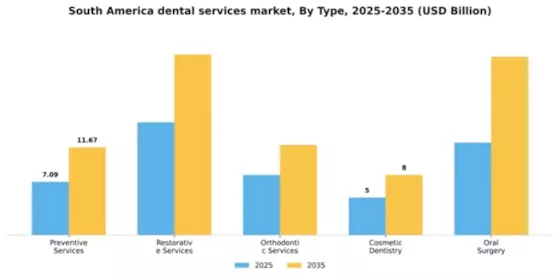
In the South America dental services market, preventive services hold the largest market share, primarily driven by the increasing awareness of oral health among the population. These services, which include routine check-ups and cleanings, are essential in reducing oral diseases, thus reinforcing their predominant position in the market. Conversely, orthodontic services are gaining momentum as the fastest-growing sector, reflecting a shift towards aesthetic treatments and improving dental alignment, especially among younger demographics.
Growth trends indicate a rising demand for both preventive and orthodontic services due to changing consumer attitudes and the pursuit of better oral aesthetics. The growth of preventive services is supported by healthcare initiatives aimed at promoting oral hygiene, while orthodontic services are being propelled by advancements in dental technologies and products, such as clear aligners. This combined growth illustrates the evolving landscape of dental care preferences, emphasizing a blend of health and aesthetics in treatment choices.
Preventive Services: Dominant vs. Orthodontic Services: Emerging
Preventive services are characterized by their focus on maintaining oral health and preventing disease, which resonates strongly with consumers looking for long-term solutions to dental issues. These services include routine procedures such as cleanings, exams, and fluoride treatments, and they appeal to a broad demographic. In contrast, orthodontic services are emerging rapidly due to their alignment with aesthetic preferences. These services often target younger populations seeking improvements in tooth appearance and alignment. As technologies evolve, such as the introduction of invisible braces, orthodontic services are becoming increasingly accessible and appealing. The balance between these segments illustrates the dynamic nature of dental care priorities, with preventive measures ensuring health stability while orthodontics addresses cosmetic desires.
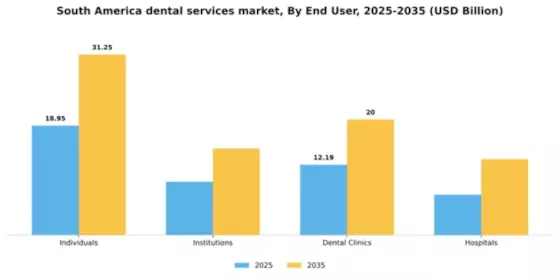
In the South America dental services market, the distribution of market share among end users highlights that dental clinics hold the largest share due to their accessibility and focused services. Institutions, while representing a smaller portion of the market, are gaining traction as more healthcare systems integrate dental care into their offerings, reflecting a shift in how dental services are consumed.
Growth trends in the end user segment indicate a significant rise in demand for dental services among individuals, driven by increased awareness of oral health and accessibility to dental care. Institutions are emerging as a key player, propelled by governmental initiatives and collaborations with private entities to enhance dental service provision, thus fostering a more inclusive health approach across the region.
Dental Clinics (Dominant) vs. Institutions (Emerging)
Dental clinics represent the dominant force in the South America dental services market, characterized by specialized services, a high patient turnover, and the ability to adapt quickly to emerging dental trends. With a strong establishment in urban areas, they provide a wide range of treatments, attracting individuals seeking convenience and quality care. On the other hand, institutions are seen as an emerging segment, increasingly recognized for their role in public health. They tend to focus on broader health initiatives, integrating dental care into routine health services, thus enhancing patient outreach and promoting holistic care. This duality in market dynamics indicates a balanced growth trajectory, catering to both individual consumer needs and institutional partnerships.
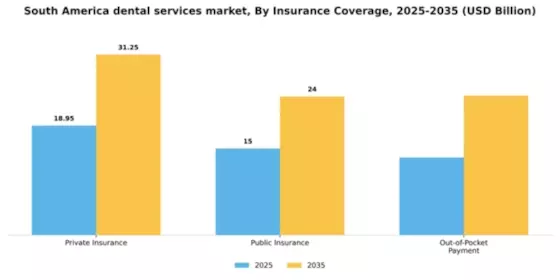
The market for insurance coverage in the dental services sector is primarily dominated by private insurance, which accounts for the largest share. This segment attracts a diverse customer base, providing a range of services with the assurance of cost coverage. Public insurance follows, representing a smaller but important portion of the market. Out-of-pocket payment, while less conventional, plays a significant role for individuals seeking immediate or specialized dental services that are not covered by insurance.
Growth trends indicate a shift towards out-of-pocket payment options, particularly in urban areas where individuals prefer quicker access to dental services without the constraints of insurance. Factors driving this growth include rising income levels and increasing awareness of oral health. As private insurance continues to hold a substantial market share, the flexibility of out-of-pocket payments is becoming an appealing option for many consumers.
Private Insurance (Dominant) vs. Out-of-Pocket Payment (Emerging)
Private insurance remains the dominant player in the insurance coverage segment, characterized by a wide range of plans that cater to diverse dental needs. This segment often provides comprehensive coverage including routine check-ups, orthodontics, and specialized treatments, which resonate well with customers seeking consistent dental care. On the other hand, out-of-pocket payment is emerging as a flexible alternative, especially appealing to individuals who prioritize immediate treatment options. This segment allows patients to bypass insurance limitations, enabling them to select services tailored specifically to their needs. As consumers become more health-conscious and seek efficient solutions, this model is gaining traction, fostering a dynamic shift in how dental services are financed.
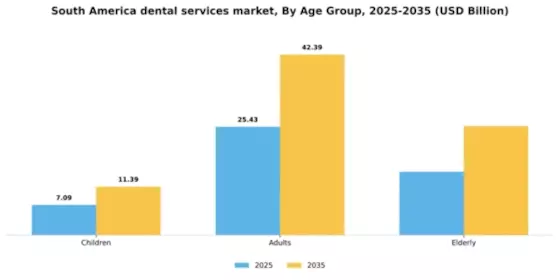
In the South America dental services market, the largest segment is Adults, who account for a significant portion of the overall market share. Children also represent a key demographic but with a smaller share compared to Adults, while the Elderly segment is emerging as a distinct category due to increasing awareness of dental health among older populations.
Recent trends indicate that the Elderly segment is experiencing the fastest growth driven by factors such as the aging population and heightened recognition of the necessity for dental care. Advances in technology and increased accessibility to dental services are enhancing the attractiveness of dental treatments for Elderly individuals, leading to a notable expansion in this segment.
Adults: Dominant vs. Elderly: Emerging
The Adults segment is characterized by a stable demand for a wide range of dental services, including preventive care, restorations, and cosmetic procedures. Adults typically require regular dental check-ups and maintenance due to lifestyle factors, which sustain their dominant position in the market. On the other hand, the Elderly segment is emerging, fueled by a growing elderly population that is actively seeking dental solutions to enhance their quality of life. This segment often presents unique needs, such as specialized treatments and geriatric care, and is increasingly targeted by dental service providers. The contrast between these segments highlights a diverse market where adaptability and targeted services are vital.
Get more detailed insights about South America Dental Services Market Request Free Sample
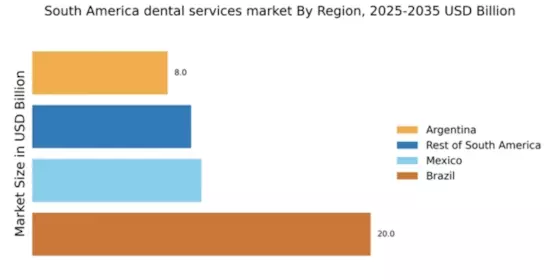
Brazil holds a commanding 20.0% market share in South America's dental services sector, valued at approximately $3 billion. Key growth drivers include a rising middle class, increased awareness of oral health, and government initiatives promoting dental care accessibility. Demand trends show a shift towards preventive care and cosmetic dentistry, supported by regulatory policies that encourage private sector investment in healthcare infrastructure. The Brazilian government has also launched programs to improve dental education and training, enhancing service quality across the nation. Key markets include São Paulo, Rio de Janeiro, and Brasília, where urbanization and population density drive demand. The competitive landscape features major players like Aspen Dental and Heartland Dental, alongside local providers. The business environment is characterized by a mix of public and private services, with a growing trend towards tele-dentistry and digital solutions. The sector is also influenced by the increasing prevalence of dental insurance, making services more accessible to a broader population.
Mexico accounts for a 10.0% share of the South American dental services market, valued at around $1.5 billion. The growth is fueled by an increasing demand for affordable dental care, particularly among the lower and middle-income populations. Government initiatives aimed at enhancing healthcare access and the rise of dental tourism are also significant contributors. Regulatory frameworks are evolving to support private investments in dental clinics, while urban areas see a surge in demand for cosmetic procedures. Key cities like Mexico City, Guadalajara, and Monterrey are pivotal markets, showcasing a competitive landscape with both local and international players. Major companies such as Smile Brands and Western Dental are establishing a strong presence. The local market dynamics are influenced by a growing awareness of dental health, leading to increased consumption of preventive services. The business environment is favorable, with a mix of public health initiatives and private sector growth driving innovation in service delivery.
Argentina holds an 8.0% share of the South American dental services market, valued at approximately $1.2 billion. The market is driven by a growing emphasis on oral health awareness and the demand for specialized dental services. Economic challenges have led to increased interest in affordable dental care options, with government policies aimed at improving healthcare access. Regulatory measures are being implemented to enhance service quality and encourage private sector participation in dental care. Key markets include Buenos Aires, Córdoba, and Rosario, where the competitive landscape features both local clinics and international players. Companies like Dental Care Alliance are expanding their footprint in the region. The local market dynamics are shaped by economic fluctuations, impacting consumer spending on dental services. However, the increasing prevalence of dental insurance is fostering a more favorable business environment, allowing for greater access to essential dental care services.
The Rest of South America represents a 9.39% share of the dental services market, valued at around $1.4 billion. This sub-region is characterized by diverse market dynamics, with varying levels of dental care access and awareness. Key growth drivers include urbanization, rising disposable incomes, and government initiatives aimed at improving healthcare infrastructure. Regulatory frameworks are gradually evolving to support the expansion of dental services, particularly in underserved areas. Countries like Chile, Colombia, and Peru are key markets, each with unique competitive landscapes. Local players dominate, but international companies are beginning to enter the market. The business environment is influenced by local healthcare policies and the increasing demand for preventive and cosmetic dental services. The sector is also seeing innovations in tele-dentistry and mobile dental clinics, catering to remote populations.
The dental services market in South America is characterized by a competitive landscape that is increasingly shaped by innovation, strategic partnerships, and regional expansion. Key players such as Aspen Dental (US), Heartland Dental (US), and Smile Brands (US) are actively pursuing growth strategies that emphasize digital transformation and enhanced patient experiences. These companies are not only focusing on expanding their service offerings but are also investing in technology to streamline operations and improve patient engagement, thereby collectively enhancing the competitive environment.The market structure appears moderately fragmented, with a mix of large and small players vying for market share. Companies are employing various business tactics, such as localizing services to meet regional demands and optimizing supply chains to reduce costs. This competitive structure allows for a diverse range of services, catering to different segments of the population, while the influence of major players helps to set industry standards and drive innovation.
In October Aspen Dental (US) announced the launch of a new telehealth platform aimed at increasing access to dental care in underserved areas. This strategic move is significant as it not only addresses the growing demand for remote healthcare solutions but also positions Aspen Dental as a leader in integrating technology into traditional dental practices. By enhancing accessibility, the company is likely to attract a broader patient base, thereby strengthening its market position.
In September Heartland Dental (US) expanded its partnership with a leading dental technology firm to enhance its digital patient management systems. This collaboration is crucial as it reflects Heartland's commitment to leveraging technology to improve operational efficiency and patient satisfaction. By investing in advanced digital solutions, Heartland Dental is poised to streamline its processes, which may lead to increased patient retention and operational scalability.
In August Smile Brands (US) launched a new initiative focused on sustainability within its operations, aiming to reduce its carbon footprint by 30% over the next five years. This initiative not only aligns with global sustainability trends but also appeals to environmentally conscious consumers. By prioritizing sustainable practices, Smile Brands is likely to differentiate itself in a competitive market, potentially attracting a new demographic of eco-aware patients.
As of November the dental services market is witnessing a shift towards digitalization, with trends such as AI integration and telehealth becoming increasingly prevalent. Strategic alliances among companies are shaping the landscape, fostering innovation and enhancing service delivery. The competitive differentiation is expected to evolve from traditional price-based competition to a focus on technological advancements, patient-centric services, and supply chain reliability. This transition indicates a future where companies that prioritize innovation and sustainability may gain a competitive edge.






The South America Dental Services Market has witnessed several significant developments recently. In June 2023, Sorridents announced the opening of new clinics aimed at expanding their market reach in Brazil, catering to increasing dental care demands. Smile Direct Club has also increased its presence in the region, launching promotional campaigns targeted at younger demographics seeking affordable orthodontic solutions. In terms of mergers and acquisitions, Odontoclinic completed a strategic acquisition of Dentalmais in July 2023, further strengthening its foothold in the competitive landscape of Brazilian dental services.
Moreover, in September 2023, OdontoPrev reported a significant rise in market valuation, attributing the 15% increase to its innovative digital service offerings and expanding customer base, enhancing overall client satisfaction. The ongoing developments indicate a rising trend towards accessibility and enhancement of dental care services across South America, with companies like Clinica Santa Maria and OdontoCompany investing in technology to improve service delivery. Over the past two years, advancements in tele-dentistry and financing options for dental services have notably transformed the market context, responding directly to evolving customer needs and preferences in a rapidly changing healthcare environment.
The Dental Services Market is projected to grow at a 4.8% CAGR from 2025 to 2035, driven by technological advancements, increasing oral health awareness, and expanding access to care.
New opportunities lie in:
By 2035, the market is expected to achieve robust growth, reflecting evolving consumer needs and technological integration.
| MARKET SIZE 2024 | 47.39(USD Billion) |
| MARKET SIZE 2025 | 49.67(USD Billion) |
| MARKET SIZE 2035 | 79.39(USD Billion) |
| COMPOUND ANNUAL GROWTH RATE (CAGR) | 4.8% (2025 - 2035) |
| REPORT COVERAGE | Revenue Forecast, Competitive Landscape, Growth Factors, and Trends |
| BASE YEAR | 2024 |
| Market Forecast Period | 2025 - 2035 |
| Historical Data | 2019 - 2024 |
| Market Forecast Units | USD Billion |
| Key Companies Profiled | Aspen Dental (US), Heartland Dental (US), Pacific Dental Services (US), Smile Brands (US), Dental Care Alliance (US), Western Dental (US), Great Expressions Dental Centers (US), MB2 Dental Solutions (US) |
| Segments Covered | Type, End User, Insurance Coverage, Age Group |
| Key Market Opportunities | Integration of tele-dentistry and AI-driven diagnostics enhances access in the dental services market. |
| Key Market Dynamics | Rising demand for advanced dental technologies drives competitive dynamics in South America's dental services market. |
| Countries Covered | Brazil, Mexico, Argentina, Rest of South America |
The overall market valuation of dental services was $47.39 Billion in 2024.
The projected market valuation for dental services is $79.39 Billion by 2035.
The expected CAGR for the dental services market during the forecast period 2025 - 2035 is 4.8%.
Restorative Services had the highest valuation in 2024 at $15.0 Billion.
The projected value for Preventive Services is $11.67 Billion by 2035.
The market for Orthodontic Services is expected to grow to $12.0 Billion by 2035.
The valuation of the dental services market for Individuals was $18.95 Billion in 2024.
The projected value for Public Insurance coverage is $24.0 Billion by 2035.
Adults are expected to have the highest market value at $42.39 Billion by 2035.
Key players in the dental services market include Aspen Dental, Heartland Dental, and Pacific Dental Services.


Kindly complete the form below to receive a free sample of this Report

“This is really good guys. Excellent work on a tight deadline. I will continue to use you going forward and recommend you to others. Nice job”


“Thanks. It’s been a pleasure working with you, please use me as reference with any other Intel employees.”


“Thanks for sending the report it gives us a good global view of the Betaïne market.”


“Thank you, this will be very helpful for OQS.”


“We found the report very insightful! we found your research firm very helpful. I'm sending this email to secure our future business.”


“I am very pleased with how market segments have been defined in a relevant way for my purposes (such as "Portable Freezers & refrigerators" and "last-mile"). In general the report is well structured. Thanks very much for your efforts.”


“I have been reading the first document or the study, ,the Global HVAC and FP market report 2021 till 2026. Must say, good info! I have not gone in depth at all parts, but got a good indication of the data inside!”


“We got the report in time, we really thank you for your support in this process. I also thank to all of your team as they did a great job.”


“The Automotive 48V ECU Components Procurement Intelligence Study” was a complex project, but the Market Research Future (MRFR) team handled it with quality, agility, and customer-centricity. They delivered all requested data on time and within the agreed scope. The team, including Shubhendra Anand and Rahul Gotadki, was always readily available to clarify questions and swiftly implement necessary adjustments, driving the project to a successful conclusion within a very demanding timeframe.
I would also like to specifically commend Akshay Agarwal for his responsiveness and support at every stage—from our initial inquiry on May 6th through to final delivery on June 18th. His dedication made the entire process seamless.”



