×
Request Free Sample ×

Kindly complete the form below to receive a free sample of this Report

* Please use a valid business email

Leading companies partner with us for data-driven Insights

clients tt-cursor
Hero Background

South America Extended Detection Response Market

ID: MRFR/ICT/58274-HCR
200 Pages
Aarti Dhapte
October 2025

South America Extended Detection and Response Market Research Report By Offering (Solutions, Services), By Deployment Mode (On-premises, Cloud), By Organization Size (Large Enterprises, SMEs), By Vertical (BFSI, Government, Manufacturing, Energy and Utilities, Healthcare, Retail and eCommerce, IT and ITes, Other Verticals), and By Regional (Brazil, Mexico, Argentina, Rest of South America)- Forecast to 2035

Share:
Download PDF ×

We do not share your information with anyone. However, we may send you emails based on your report interest from time to time. You may contact us at any time to opt-out.

South America Extended Detection Response Market Infographic
Purchase Options

South America Extended Detection Response Market Summary

As per MRFR analysis, the South America extended detection-response market Size was estimated at 214.37 USD Million in 2024. The South America extended detection-response market is projected to grow from 256.41 USD Million in 2025 to 1537.32 USD Million by 2035, exhibiting a compound annual growth rate (CAGR) of 19.61% during the forecast period 2025 - 2035.

Key Market Trends & Highlights

The South America extended detection-response market is experiencing robust growth driven by increasing cybersecurity investments and regulatory compliance demands.

  • Brazil remains the largest market for extended detection-response solutions, reflecting a strong commitment to cybersecurity.
  • Mexico is emerging as the fastest-growing region, indicating a rising demand for advanced security measures.
  • The integration of AI and machine learning technologies is transforming the landscape of cybersecurity solutions across the region.
  • Rising cyber threats and growing awareness of cybersecurity are key drivers propelling market expansion in South America.

Market Size & Forecast

2024 Market Size 214.37 (USD Million)
2035 Market Size 1537.32 (USD Million)
CAGR (2025 - 2035) 19.61%

Major Players

CrowdStrike (US), Microsoft (US), SentinelOne (US), Palo Alto Networks (US), Sophos (GB), McAfee (US), Trend Micro (JP), FireEye (US), Cisco (US)

South America Extended Detection Response Market Trends

The extended detection-response market in South America is currently experiencing notable growth, driven by an increasing awareness of cybersecurity threats among businesses and government entities. Organizations are recognizing the necessity of advanced security measures to protect sensitive data and maintain operational integrity. This heightened focus on security is prompting investments in sophisticated detection and response solutions, which are essential for identifying and mitigating potential threats in real-time. Furthermore, the rise of digital transformation initiatives across various sectors is contributing to the demand for comprehensive security frameworks that can adapt to evolving cyber risks. In addition, regulatory pressures are influencing the adoption of extended detection-response solutions. Governments in South America are implementing stricter data protection laws, compelling organizations to enhance their cybersecurity posture. This regulatory environment is fostering a culture of compliance, where businesses are increasingly seeking solutions that not only address immediate security concerns but also align with legal requirements. As a result, the extended detection-response market is poised for continued expansion, with a focus on innovative technologies and strategic partnerships that enhance overall security capabilities.

Increased Investment in Cybersecurity

Organizations are allocating more resources towards advanced security solutions, recognizing the critical need for robust protection against cyber threats. This trend reflects a broader commitment to safeguarding sensitive information and ensuring business continuity.

Regulatory Compliance Driving Demand

Stricter data protection regulations are prompting businesses to adopt extended detection-response solutions. Compliance with these laws is becoming a priority, leading to increased investments in security technologies that meet legal standards.

Integration of AI and Machine Learning

The incorporation of artificial intelligence and machine learning into extended detection-response solutions is gaining traction. These technologies enhance threat detection capabilities, enabling organizations to respond more effectively to emerging cyber risks.

South America Extended Detection Response Market Drivers

Rising Cyber Threats

The extended detection-response market in South America is experiencing growth due to the increasing frequency and sophistication of cyber threats. Organizations are facing a surge in ransomware attacks, phishing schemes, and data breaches, which necessitate robust security measures. In 2025, it is estimated that cybercrime could cost businesses in the region upwards of $150 billion annually. This alarming trend compels companies to invest in advanced detection and response solutions to safeguard their digital assets. As a result, the extended detection-response market is likely to see a significant uptick in demand as businesses prioritize cybersecurity to mitigate risks and protect sensitive information.

Growing Awareness of Cybersecurity

There is a notable increase in awareness regarding cybersecurity among businesses in South America, which is positively influencing the extended detection-response market. Companies are beginning to recognize the potential financial and reputational damage that cyber incidents can inflict. This heightened awareness is prompting organizations to allocate more resources towards cybersecurity initiatives. In 2025, it is projected that spending on cybersecurity solutions in the region will reach approximately $10 billion, reflecting a growth rate of around 12% annually. Consequently, the extended detection-response market is poised to benefit from this trend as organizations seek comprehensive solutions to enhance their security posture.

Regulatory Pressures and Compliance

Regulatory pressures are significantly impacting the extended detection-response market in South America. Governments are implementing stricter regulations regarding data protection and cybersecurity, compelling organizations to enhance their security measures. Compliance with regulations such as the General Data Protection Regulation (GDPR) and local data protection laws is becoming increasingly critical. Failure to comply can result in substantial fines and legal repercussions. In 2025, it is anticipated that compliance-related spending in the cybersecurity sector will increase by 20%, driving demand for extended detection-response solutions. This trend indicates that the extended detection-response market will likely see growth as organizations strive to meet regulatory requirements and protect sensitive data.

Demand for Integrated Security Solutions

The extended detection-response market in South America is being driven by the demand for integrated security solutions that provide comprehensive protection against cyber threats. Organizations are increasingly seeking solutions that combine various security functions, such as endpoint detection, network monitoring, and threat intelligence, into a single platform. This trend is indicative of a shift towards a more holistic approach to cybersecurity. In 2025, the market for integrated security solutions is expected to grow by 15%, highlighting the potential for the extended detection-response market to capitalize on this demand. As businesses strive for efficiency and effectiveness in their security strategies, the integration of multiple security capabilities becomes essential.

Shift to Remote Work and Digital Transformation

The shift to remote work and ongoing digital transformation initiatives are contributing to the growth of the extended detection-response market in South America. As organizations adapt to new work environments, they are increasingly reliant on digital tools and cloud services, which can introduce new vulnerabilities. This transition necessitates enhanced security measures to protect remote access points and sensitive data. In 2025, it is projected that remote work will account for 30% of the workforce in the region, further emphasizing the need for robust cybersecurity solutions. Consequently, the extended detection-response market is likely to expand as businesses seek to secure their digital infrastructures in this evolving landscape.

Market Segment Insights

By Offering: Solutions (Largest) vs. Services (Fastest-Growing)

The market share distribution within the offering segment reveals the significant domination of solutions, accounting for the largest share. This segment has proven to be essential as organizations increasingly invest in advanced technologies to enhance their security posture. Conversely, services are emerging rapidly, capturing robust attention due to their ability to complement solutions and provide tailored support to clients. Growth trends indicate that while solutions continue to lead the market, services are witnessing the highest growth rates. Factors such as rising cyber threats and the increasing complexity of IT environments are driving demand for both offerings. Organizations are prioritizing comprehensive service packages that allow for quick response capabilities, thereby enhancing the overall effectiveness of their detection and response strategies.

Solutions: Software (Dominant) vs. Services: Managed (Emerging)

In the offering segment, software solutions are recognized as the dominant force, primarily due to their pivotal role in automating and streamlining detection-response processes. These solutions provide comprehensive features that empower organizations to identify threats more efficiently. On the other hand, managed services are emerging as a critical component to address specific client needs, offering expert guidance and operational support. This growing trend reflects a shift towards outsourcing security operations, allowing businesses to leverage specialized expertise while focusing on their core operations. The synergy between software solutions and managed services is poised to strengthen the efficacy of cybersecurity frameworks across various sectors.

By Deployment Mode: Cloud (Largest) vs. On-premises (Fastest-Growing)

In the market, the deployment mode has shown a distinct distribution in market share, with cloud solutions taking a prominent lead due to their flexibility and scalability. Organizations are increasingly opting for cloud-based solutions, which provide ease of access and integration with existing systems, outpacing the traditional on-premises approach in adoption rates. The growth trends reveal a marked shift towards cloud deployment types as companies seek to enhance their operational efficiency and reduce infrastructure costs. On-premises deployment, while currently smaller in market share, is noted as the fastest-growing choice due to security concerns and regulatory requirements prompting businesses to retain critical data within their premises. Pioneering technologies and evolving client needs are shaping these dynamic trends in deployment modes.

Deployment: Cloud (Dominant) vs. On-premises (Emerging)

In the South America extended detection-response market, cloud deployment is regarded as the dominant force, favored for its cost-effectiveness and rapid scalability. The increasing demand for IT agility among businesses fuels cloud adoption, allowing organizations to leverage advanced security solutions with minimal infrastructure investment. Conversely, on-premises solutions, while still emerging, cater to enterprises with stringent security requirements and compliance mandates. This approach offers enhanced data control and customization, though it may involve higher capital expenditure. As cybersecurity threats evolve, both deployment modes are expected to coexist, enabling users to choose based on their unique operational needs, thereby enriching the overall market landscape.

By Organization Size: Large Enterprises (Largest) vs. SMEs (Fastest-Growing)

In the South America extended detection-response market, Large Enterprises hold a significant share due to their robust security needs and resources for implementing sophisticated detection-response solutions. These organizations typically have greater budgets and a stronger focus on innovation, which contributes to their dominant position in the market. On the other hand, SMEs are gradually capturing market share as they increasingly recognize the importance of threat detection and response in safeguarding their operations. The growth trends for these segments reveal that while Large Enterprises continue to expand their security capabilities, SMEs are emerging as the fastest-growing segment. This rapid growth is driven by the rising awareness of cyber threats and the affordability of targeted solutions for smaller businesses. Additionally, increased regulatory requirements are pushing SMEs to invest in extended detection-response capabilities, thereby fueling their market expansion.

Large Enterprises (Dominant) vs. SMEs (Emerging)

Large Enterprises in the South America extended detection-response market are characterized by their extensive IT infrastructure and comprehensive security approaches. These organizations prioritize advanced detection capabilities, often leveraging cutting-edge technologies to minimize risks and enhance operational resilience. Conversely, SMEs are recognized as an emerging segment actively seeking tailored detection-response solutions that suit their budget constraints. As these businesses adopt cloud-based services and increase their digital footprint, they are becoming more vulnerable to cyber threats, prompting a rush to implement effective defense mechanisms. Consequently, SMEs are quickly evolving, attracted by the promise of improving their security posture without substantial overhead.

By Vertical: BFSI (Largest) vs. Healthcare (Fastest-Growing)

In the South America extended detection-response market, the BFSI sector emerges as the largest contributor to market share, leveraging the high value of financial data and the increasing threats aimed at this industry. Following BFSI, the healthcare sector is rapidly evolving, where the need for enhanced security measures has garnered significant attention and investment, notably due to the surge in digital health solutions. Currently, the healthcare vertical is identified as the fastest-growing segment in this market. This growth is driven by an increasing reliance on digital records and telehealth platforms, which necessitate robust security frameworks. Additionally, government regulations mandating stringent data protection for healthcare organizations are propelling demand for advanced detection and response solutions to safeguard sensitive patient information.

BFSI (Dominant) vs. Healthcare (Emerging)

The BFSI sector remains the dominant force in the market, primarily because of the extensive data management requirements and regulatory pressures unique to financial services. Institutions in this vertical prioritize advanced threat detection and rapid response capabilities to ensure compliance and protect customer assets. Conversely, the healthcare sector, labeled as the emerging player, is quickly adapting to the challenges of modern cybersecurity threats. With increasing investments in technology, healthcare organizations are focusing on implementing effective detection and response strategies to secure patient data amidst growing digital health initiatives, striving to achieve a balance between innovation and security.

Get more detailed insights about South America Extended Detection Response Market

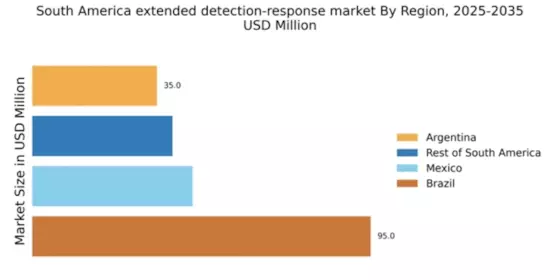
Regional Insights

Brazil : Unmatched Growth and Investment

Key markets include São Paulo, Rio de Janeiro, and Brasília, where major players like CrowdStrike, Microsoft, and Palo Alto Networks have established a strong presence. The competitive landscape is characterized by rapid innovation and a focus on tailored solutions for various sectors, including finance and healthcare. Local dynamics favor partnerships between tech firms and government agencies, fostering a collaborative environment. The growing emphasis on cloud security and IoT applications further drives market expansion.

Mexico : Growing Demand and Investment

Key markets include Mexico City, Guadalajara, and Monterrey, where companies like Microsoft and Cisco are making significant inroads. The competitive landscape features a mix of local and international players, with a focus on innovative solutions tailored to specific industry needs. The business environment is evolving, with a growing emphasis on compliance and risk management. Sectors such as finance, healthcare, and manufacturing are increasingly adopting advanced cybersecurity measures to protect sensitive data.

Argentina : Regulatory Support and Market Growth

Key markets include Buenos Aires, Córdoba, and Mendoza, where major players like McAfee and Trend Micro are actively competing. The competitive landscape is marked by a mix of local startups and established international firms, fostering innovation and collaboration. The business environment is improving, with a focus on compliance and risk management. Sectors such as finance, healthcare, and government are increasingly investing in cybersecurity solutions to safeguard sensitive information.

Rest of South America : Varied Growth Across Regions

Key markets include Santiago (Chile), Bogotá (Colombia), and Lima (Peru), where local and international players are vying for market share. The competitive landscape is diverse, with varying levels of investment and innovation across countries. Major players like FireEye and Sophos are establishing a presence, but local firms are also emerging. The business environment is influenced by regional economic conditions, with sectors such as finance and telecommunications leading the way in adopting advanced cybersecurity measures.

South America Extended Detection Response Market Regional Image

Key Players and Competitive Insights

The extended detection-response market in South America is characterized by a dynamic competitive landscape, driven by increasing cybersecurity threats and the growing need for integrated security solutions. Major players such as CrowdStrike (US), Microsoft (US), and Palo Alto Networks (US) are strategically positioned to leverage their technological advancements and market presence. CrowdStrike (US) focuses on cloud-native solutions, emphasizing AI-driven threat detection, while Microsoft (US) integrates its security offerings with its extensive cloud services, enhancing its value proposition. Palo Alto Networks (US) adopts a comprehensive approach, combining advanced threat intelligence with robust incident response capabilities, thereby shaping a competitive environment that prioritizes innovation and customer-centric solutions.

Key business tactics within this market include localizing operations and optimizing supply chains to enhance responsiveness to regional demands. The competitive structure appears moderately fragmented, with several players vying for market share. However, the collective influence of key players like Microsoft (US) and CrowdStrike (US) suggests a trend towards consolidation, as these companies seek to expand their footprint through strategic partnerships and acquisitions.

In October 2025, CrowdStrike (US) announced a partnership with a leading South American telecommunications provider to enhance its threat intelligence capabilities. This collaboration is expected to bolster CrowdStrike's local presence and provide tailored solutions to address specific regional cybersecurity challenges. Such strategic alliances are crucial for enhancing service delivery and expanding market reach in a competitive landscape.

In September 2025, Microsoft (US) launched a new suite of security tools specifically designed for small and medium-sized enterprises (SMEs) in South America. This initiative reflects Microsoft's commitment to democratizing access to advanced cybersecurity solutions, thereby positioning itself as a leader in the region. By catering to the unique needs of SMEs, Microsoft (US) is likely to capture a significant share of this underserved market segment.

In August 2025, Palo Alto Networks (US) acquired a local cybersecurity firm specializing in threat detection and response. This acquisition not only strengthens Palo Alto's technological capabilities but also enhances its understanding of regional market dynamics. Such strategic moves indicate a trend towards localized solutions that resonate with the specific needs of South American businesses.

As of November 2025, the competitive trends in the extended detection-response market are increasingly defined by digitalization, AI integration, and a focus on sustainability. Strategic alliances are becoming pivotal in shaping the current landscape, as companies recognize the need for collaborative approaches to tackle complex cybersecurity challenges. Looking ahead, competitive differentiation is likely to evolve from traditional price-based strategies to a focus on innovation, technological advancement, and supply chain reliability, underscoring the importance of agility and responsiveness in a rapidly changing market.

Key Companies in the South America Extended Detection Response Market market include

Industry Developments

By confirming Cortex XDR's robust feature set, vision, and worldwide R&D investment scale, Palo Alto Networks was named a Leader in the 2024 Forrester WaveTM for Extended Detection and Response Platforms, strengthening global distinctiveness, including South American deployment strategy.

With its unified security platform, which includes Defender XDR, Microsoft Sentinel, and Security Copilot, Microsoft greatly improved its XDR capabilities by facilitating unified detection and response processes across cloud and endpoint. This change represents a purposeful consolidation strategy preferred by Latin American firms and fills in SOC capacity shortfalls.

By collaborating with regional distributors, CrowdStrike extended Falcon XDR throughout South America in the middle of 2024, offering enterprise and managed services providers in Brazil and the surrounding nations AI-native detection, endpoint telemetry integration, and response orchestration.

Despite the lack of explicit public announcements after 2023, other vendors including as Fortinet, Check Point, and Trend Micro continue to offer active XDR capabilities in the area through local partners and SOC programs.

Future Outlook

South America Extended Detection Response Market Future Outlook

The extended detection-response market is projected to grow at a 19.61% CAGR from 2024 to 2035, driven by increasing cyber threats, regulatory compliance, and technological advancements.

New opportunities lie in:

  • Development of AI-driven threat detection platforms
  • Integration of extended detection-response with IoT security solutions
  • Expansion of managed detection and response services for SMEs

By 2035, the market is expected to achieve substantial growth, positioning itself as a leader in cybersecurity solutions.

Market Segmentation

South America Extended Detection Response Market Offering Outlook

  • Solutions
  • Services

South America Extended Detection Response Market Vertical Outlook

  • BFSI
  • Government
  • Manufacturing
  • Energy and Utilities
  • Healthcare
  • Retail and eCommerce
  • IT and ITes
  • Other Verticals

South America Extended Detection Response Market Deployment Mode Outlook

  • On-premises
  • Cloud

South America Extended Detection Response Market Organization Size Outlook

  • Large Enterprises
  • SMEs

Report Scope

MARKET SIZE 2024214.37(USD Million)
MARKET SIZE 2025256.41(USD Million)
MARKET SIZE 20351537.32(USD Million)
COMPOUND ANNUAL GROWTH RATE (CAGR)19.61% (2024 - 2035)
REPORT COVERAGERevenue Forecast, Competitive Landscape, Growth Factors, and Trends
BASE YEAR2024
Market Forecast Period2025 - 2035
Historical Data2019 - 2024
Market Forecast UnitsUSD Million
Key Companies Profiled["CrowdStrike (US)", "Microsoft (US)", "SentinelOne (US)", "Palo Alto Networks (US)", "Sophos (GB)", "McAfee (US)", "Trend Micro (JP)", "FireEye (US)", "Cisco (US)"]
Segments CoveredOffering, Deployment Mode, Organization Size, Vertical
Key Market OpportunitiesIntegration of artificial intelligence enhances threat detection in the extended detection-response market.
Key Market DynamicsRising demand for advanced cybersecurity solutions drives growth in the extended detection-response market across South America.
Countries CoveredBrazil, Mexico, Argentina, Rest of South America

Leave a Comment

FAQs

What is the expected market size of the South America Extended Detection and Response Market in 2024?

The South America Extended Detection and Response Market is expected to be valued at 209.3 million USD in 2024.

What will be the projected market size in 2035?

The market is projected to reach approximately 8157.8 million USD by the year 2035.

What is the expected compound annual growth rate (CAGR) of the market from 2025 to 2035?

The South America Extended Detection and Response Market is expected to grow at a CAGR of 39.514% from 2025 to 2035.

Which country is anticipated to hold the largest market share in 2024?

Brazil is expected to dominate the market, valued at 60.0 million USD in 2024.

What will be the market value for services in the year 2035?

The market value for services is forecasted to reach approximately 4872.8 million USD by 2035.

Who are the key players in the South America Extended Detection and Response Market?

Major players include Cisco, LogRhythm, Sumo Logic, CrowdStrike, and Palo Alto Networks among others.

What is the market size for solutions in 2024?

The market size for solutions is expected to be valued at 85.0 million USD in the year 2024.

How much is the Rest of South America region valued at in 2024?

The Rest of South America region is valued at 74.3 million USD in 2024.

What is the projected market value for Mexico in 2035?

Mexico's market value is expected to reach approximately 1870.0 million USD by 2035.

What are the anticipated growth drivers for the South America Extended Detection and Response Market?

Growth drivers include increasing cyber threats and the heightened demand for advanced security solutions.

Download Free Sample

Kindly complete the form below to receive a free sample of this Report

Compare Licence

×
Features License Type
Single User Multiuser License Enterprise User
Price $4,950 $5,950 $7,250
Maximum User Access Limit 1 User Upto 10 Users Unrestricted Access Throughout the Organization
Free Customization
Direct Access to Analyst
Deliverable Format
Platform Access
Discount on Next Purchase 10% 15% 15%
Printable Versions