×
Request Free Sample ×

Kindly complete the form below to receive a free sample of this Report

Leading companies partner with us for data-driven Insights

clients tt-cursor
Hero Background

South America Generative AI in Media and Entertainment Market

ID: MRFR/ICT/55695-HCR
200 Pages
Garvit Vyas
October 2025

South America Generative AI in Media and Entertainment Market Research Report: By Offerings (Solution, Services), By Technology (Natural Language Program, Digital Twin, Natural Language Generation, Large Language Models, Others), By Application (Gaming, Film and Television, Advertising and Marketing, Music and Sound Production, Automatic Dubbing and Subtitling, Chatbots and Virtual Assistants, Others) andBy Regional (Brazil, Mexico, Argentina, Rest of South America) - Forecast to 2035

Share:
Download PDF ×

We do not share your information with anyone. However, we may send you emails based on your report interest from time to time. You may contact us at any time to opt-out.

South America Generative AI in Media and Entertainment Market Infographic
Purchase Options

South America Generative AI in Media and Entertainment Market Summary

As per MRFR analysis, the South America generative ai-in-media-and-entertainment market size was estimated at 14020.92 USD Million in 2024. The South America generative ai-in-media-and-entertainment market is projected to grow from 16288.1 USD Million in 2025 to 72914.76 USD Million by 2035, exhibiting a compound annual growth rate (CAGR) of 16.17% during the forecast period 2025 - 2035.

Key Market Trends & Highlights

The South America generative AI-in-media-and-entertainment market is experiencing robust growth driven by technological advancements and evolving consumer preferences.

  • Brazil leads the South American market, showcasing a strong adoption of AI tools in media production.
  • Mexico emerges as the fastest-growing region, reflecting a burgeoning interest in interactive experiences.
  • Collaboration between tech and creative industries is becoming increasingly prevalent, fostering innovation in content creation.
  • Rising demand for personalized content and advancements in AI technology are key drivers propelling market expansion.

Market Size & Forecast

2024 Market Size 14020.92 (USD Million)
2035 Market Size 72914.76 (USD Million)

Major Players

OpenAI (US), Google (US), Adobe (US), NVIDIA (US), Microsoft (US), IBM (US), Meta (US), Amazon (US)

South America Generative AI in Media and Entertainment Market Trends

the generative AI in media and entertainment market in South America is currently experiencing a transformative phase, driven by advancements in artificial intelligence technologies. This evolution appears to be reshaping various sectors, including film, music, and gaming. The integration of generative AI tools is enabling creators to enhance their storytelling capabilities, streamline production processes, and personalize content for diverse audiences. As a result, there is a growing interest among local companies to adopt these innovative solutions, which may lead to increased competitiveness in the regional market. Furthermore, the collaboration between tech firms and creative industries seems to be fostering a vibrant ecosystem that encourages experimentation and innovation. In addition, the regulatory landscape in South America is evolving to accommodate the rapid growth of the generative ai-in-media-and-entertainment market. Governments are beginning to recognize the potential economic benefits of this technology, which could lead to supportive policies and funding initiatives. This shift may encourage more startups and established companies to invest in AI-driven projects, ultimately contributing to the region's cultural and economic development. As the market continues to mature, it is likely that South America will emerge as a significant player in the global generative AI landscape, attracting attention from international investors and collaborators.

Increased Adoption of AI Tools

There is a noticeable trend towards the adoption of AI tools among media and entertainment companies in South America. These tools are being utilized to enhance content creation, improve audience engagement, and optimize production workflows. As local businesses recognize the advantages of generative AI, they are increasingly integrating these technologies into their operations.

Collaboration Between Tech and Creative Industries

A growing collaboration between technology firms and creative industries is evident in the region. This partnership is fostering innovation, as tech companies provide the necessary infrastructure and expertise to support creative endeavors. Such collaborations are likely to lead to the development of unique content that resonates with local audiences.

Evolving Regulatory Frameworks

The regulatory environment surrounding the generative ai-in-media-and-entertainment market is evolving. Governments in South America are beginning to implement policies that support the growth of AI technologies. This shift may create a more favorable landscape for investment and development, encouraging companies to explore new opportunities.

South America Generative AI in Media and Entertainment Market Drivers

Advancements in AI Technology

Technological advancements in AI are significantly influencing the generative ai-in-media-and-entertainment market in South America. Innovations in machine learning algorithms and natural language processing are enabling creators to produce high-quality content more efficiently. For instance, the introduction of advanced neural networks has improved the ability to generate realistic graphics and sound, which is crucial for the entertainment industry. Reports indicate that the market for AI-driven tools in content creation is projected to grow by 25% annually, driven by these technological improvements. As a result, media companies are increasingly adopting these tools to enhance production quality and reduce costs, thereby positioning themselves competitively in the market. This trend suggests a robust future for the generative ai-in-media-and-entertainment market as technology continues to evolve.

Increased Investment in Digital Media

the generative AI in media and entertainment market in South America is witnessing a significant increase in investment in digital media platforms. As traditional media consumption declines, companies are reallocating resources towards digital channels, which are more conducive to the integration of generative AI technologies. Recent data indicates that investment in digital media has risen by 40% over the past year, with a substantial portion directed towards AI-enhanced content creation and distribution. This influx of capital is fostering innovation and enabling media companies to experiment with new formats and interactive experiences. As a result, the generative ai-in-media-and-entertainment market is likely to benefit from this trend, as businesses seek to capitalize on the growing digital landscape and the opportunities it presents.

Emergence of New Distribution Channels

The emergence of new distribution channels is reshaping the generative ai-in-media-and-entertainment market in South America. With the rise of streaming services and social media platforms, content creators are exploring innovative ways to reach audiences. Generative AI plays a pivotal role in this transformation by enabling the rapid production of content tailored for various platforms. For example, short-form videos and interactive storytelling are gaining traction, appealing to younger demographics. This shift is reflected in a 20% increase in content consumption on digital platforms, indicating a shift in viewer preferences. As media companies adapt to these new channels, the generative ai-in-media-and-entertainment market is poised for growth, driven by the need for agile content creation and distribution strategies.

Rising Demand for Personalized Content

The generative ai-in-media-and-entertainment market in South America is experiencing a notable surge in demand for personalized content. As consumers increasingly seek tailored experiences, media companies are leveraging generative AI to create unique narratives and interactive experiences. This trend is reflected in a 30% increase in investments in AI-driven content creation tools across the region. By utilizing generative AI, companies can analyze viewer preferences and generate content that resonates with specific demographics, enhancing viewer engagement and satisfaction. This shift towards personalization not only improves user experience but also drives revenue growth, as advertisers are more inclined to invest in platforms that offer targeted content. Consequently, the generative AI in media and entertainment market is likely to expand as businesses adapt to these evolving consumer expectations.

Growing Interest in Interactive Experiences

There is a growing interest in interactive experiences within the generative ai-in-media-and-entertainment market in South America. Consumers are increasingly drawn to immersive content that allows for active participation, such as video games and interactive films. This trend is prompting media companies to invest in generative AI technologies that facilitate the creation of engaging, user-driven narratives. Recent surveys suggest that 70% of consumers prefer interactive content over traditional formats, highlighting a shift in entertainment consumption. As a result, the generative ai-in-media-and-entertainment market is likely to expand as companies innovate to meet this demand, creating experiences that captivate audiences and foster deeper connections with the content.

Market Segment Insights

By Offering: Solution (Largest) vs. Services (Fastest-Growing)

In the South America generative ai-in-media-and-entertainment market, the offering segment displays a clear distribution of market share between solutions and services. Solutions hold the largest share, capturing significant attention from various media and entertainment players due to their ability to enhance user experience and streamline content creation processes. On the other hand, services are steadily gaining traction as companies recognize the importance of integrating generative AI capabilities into their operations, lending to an evolving market dynamic. The growth trends in this sector suggest that while solutions remain dominant, services are poised for rapid expansion. Key drivers of this growth include increasing demand for personalized content, advancements in generative AI technologies, and the ongoing digital transformation in the entertainment industry. As businesses seek innovative approaches to engage audiences, services, especially those that offer customized solutions, are becoming crucial for competitive advantage.

Solution: Dominant vs. Services: Emerging

The 'Solution' offering in the South America generative ai-in-media-and-entertainment market is characterized by robust technological frameworks that enable organizations to automate content creation and improve operational efficiencies. Solutions encompass a wide array of applications, from content generation to automated editing tools that enhance creativity. Conversely, the 'Services' offering is emerging as an essential component for businesses looking to harness the potential of generative AI. These services include consulting, integration, and support tailored to individual company needs, facilitating smooth transitions to AI-driven capabilities. As companies strive to leverage AI for content personalization and user engagement, the services market is experiencing a notable surge, driven by customization demands and strategic collaborations.

By Technology: Natural Language Generation (Largest) vs. Large Language Models (Fastest-Growing)

The natural language generation segment holds the largest market share among the technology segment values, indicating its strong foothold in applications ranging from content creation to automated customer interactions. In contrast, large language models are witnessing the fastest growth, driven by increasing investments in AI research and deployment across various media and entertainment platforms, transforming user experiences and creativity. The growth trends in this segment are primarily propelled by advancements in AI technology and the rising demand for personalized and engaging content. With users seeking more sophisticated interactions, businesses are increasingly adopting solutions that leverage natural language programs and digital twins. This shift not only enhances operational efficiency but also fosters innovation in content generation, paving the way for new applications and audience engagement methods.

Technology: Natural Language Generation (Dominant) vs. Large Language Models (Emerging)

Natural language generation is positioned as a dominant force in the technology segment, enabling organizations to automate content creation and enhance user experience. Its applications are diverse, spanning customer support, marketing content, and interactive storytelling. On the other hand, large language models are emerging rapidly, characterized by their ability to understand and generate human-like text. They represent a significant leap in AI capabilities, influencing how content is consumed and created. As the demand for high-quality, relatable content grows, both segments are expected to play pivotal roles in shaping the future of media and entertainment.

By Application: Gaming (Largest) vs. Film and Television (Fastest-Growing)

The South America generative ai-in-media-and-entertainment market is predominantly driven by the gaming sector, which commands the largest share among application segment values. Following closely are film and television, advertising and marketing, music and sound production, automatic dubbing and subtitling, chatbots and virtual assistants, and others, which collectively reflect a diverse ecosystem. The gaming industry's extensive growth is supported by increasing consumer engagement and technological advancements, which enable more immersive experiences. Looking ahead, the film and television sector is recognized as the fastest-growing area, propelled by rising demand for content creation, localization, and enhanced viewer experiences through AI-driven solutions. Key growth drivers include rapid advancements in AI technologies, increasing availability of data, and the need for personalized and adaptive media solutions that cater to evolving consumer preferences. These trends create significant opportunities for companies operating within these application segments, fueling competitive dynamics across the market.

Gaming (Dominant) vs. Film and Television (Emerging)

The gaming sector stands as the dominant force in the South America market, characterized by robust engagement metrics and a strong presence of AI technologies, which enhance game design and user interaction. It leverages generative AI for creating dynamic content, adapting gameplay based on player behavior, and optimizing user experiences. Conversely, the film and television segment is emerging rapidly, influenced by a surge in content production and distribution, where generative AI is employed for scriptwriting, visual effects, and automated editing processes. The use of AI in this domain aids filmmakers and producers in streamlining workflows while improving the quality and creativity of content. Together, these two segments illustrate the dynamic interplay between established dominance and fast-paced innovation.

Get more detailed insights about South America Generative AI in Media and Entertainment Market

Regional Insights

Brazil : A Hub for Innovation and Growth

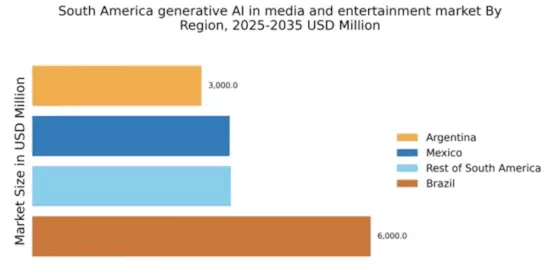
Brazil holds a commanding market share of 40% in the generative AI sector, valued at $6000.0 million. Key growth drivers include a burgeoning tech ecosystem, increased investment in digital infrastructure, and a rising demand for AI-driven content creation. Government initiatives, such as the National AI Strategy, aim to foster innovation and support startups. The regulatory environment is becoming more favorable, encouraging the adoption of AI technologies across various sectors.

Mexico : Emerging Market with High Potential

Mexico captures a 22% market share in the generative AI space, valued at $3500.0 million. The growth is driven by increasing digital media consumption and a vibrant startup culture. Demand for AI in entertainment and advertising is on the rise, supported by government initiatives promoting digital transformation. The regulatory framework is evolving, with policies aimed at enhancing data protection and fostering innovation in AI applications.

Argentina : Cultural Hub Embraces Technology

Argentina holds a 20% market share in the generative AI market, valued at $3000.0 million. The growth is fueled by a strong cultural emphasis on media and entertainment, alongside increasing investment in technology. Local demand for AI-driven solutions in film and music is rising, supported by government incentives for tech startups. The regulatory landscape is adapting to facilitate AI integration, promoting a favorable business environment for innovation.

Rest of South America : Varied Growth Across Regions

The Rest of South America accounts for an 18% market share in the generative AI sector, valued at $3520.92 million. Growth drivers include diverse cultural markets and increasing internet penetration. Demand for AI applications in local media and entertainment is growing, with various governments implementing supportive policies. Infrastructure development is uneven, but urban centers are seeing significant investment in digital technologies.

South America Generative AI in Media and Entertainment Market Regional Image

Key Players and Competitive Insights

The generative ai-in-media-and-entertainment market is currently characterized by a dynamic competitive landscape, driven by rapid technological advancements and increasing demand for innovative content creation. Key players such as OpenAI (US), Google (US), and Adobe (US) are strategically positioned to leverage their technological prowess and extensive resources. OpenAI (US) focuses on developing cutting-edge AI models that enhance creative processes, while Google (US) emphasizes integrating AI into its existing platforms to streamline content generation. Adobe (US) is enhancing its suite of creative tools with AI capabilities, thereby fostering a more efficient workflow for creators. Collectively, these strategies contribute to a competitive environment that prioritizes innovation and user-centric solutions.

In terms of business tactics, companies are increasingly localizing their operations to better cater to regional markets, optimizing supply chains to enhance efficiency, and forming strategic partnerships to bolster their technological capabilities. The market appears moderately fragmented, with a mix of established players and emerging startups vying for market share. The collective influence of these key players shapes the competitive structure, as they continuously adapt to evolving consumer preferences and technological advancements.

In October 2025, OpenAI (US) announced a partnership with a leading South American media conglomerate to develop localized AI tools tailored for regional content creators. This strategic move is likely to enhance OpenAI's presence in the region, allowing it to tap into the growing demand for personalized content solutions. By collaborating with local entities, OpenAI (US) not only strengthens its market position but also gains valuable insights into regional trends and preferences.

In September 2025, Google (US) launched a new AI-driven platform aimed at streamlining video production for content creators in South America. This initiative is significant as it reflects Google's commitment to enhancing the creative process through technology. By providing tools that simplify video editing and production, Google (US) positions itself as a leader in the generative AI space, potentially attracting a broader user base and fostering innovation within the industry.

In August 2025, Adobe (US) unveiled a series of AI enhancements to its Creative Cloud suite, specifically targeting the needs of South American artists and designers. This development underscores Adobe's strategy to remain at the forefront of creative technology by continuously evolving its offerings. The integration of AI features not only improves user experience but also reinforces Adobe's competitive edge in a market that increasingly values efficiency and creativity.

As of November 2025, the competitive trends within the generative ai-in-media-and-entertainment market are heavily influenced by digitalization, sustainability, and the integration of AI technologies. Strategic alliances are becoming increasingly vital, as companies recognize the importance of collaboration in driving innovation. Looking ahead, it is anticipated that competitive differentiation will shift from traditional price-based strategies to a focus on technological innovation, enhanced user experiences, and reliable supply chains. This evolution suggests a market that values creativity and efficiency, positioning companies that prioritize these elements for future success.

Key Companies in the South America Generative AI in Media and Entertainment Market market include

Industry Developments

Recent developments in the South America Generative AI in Media and Entertainment Market indicate a growing interest and investment in AI technologies by major companies such as Meta, Google, and Microsoft, focused on enhancing content creation and user experience. In September 2023, Meta announced partnerships with local content creators to boost AI-driven personalized content distribution across South America. Additionally, Aiva Technologies and Adobe have been collaborating with Brazilian artists to integrate AI in music and art, promoting cultural resonance while exploring new artistic expressions.

Moreover, NVIDIA's recent investment in a tech startup in Argentina aims to expand GPU capabilities for generative AI applications in film and gaming. A notable merger occurred in August 2023, when OpenAI's technology was integrated into IBM's cloud services, which will benefit South American enterprises seeking advanced AI solutions. Over the past couple of years, there has been significant market growth due to increasing demand for digital content, with projections indicating a valuation increase driven by innovations in AI-enabled storytelling and production processes.

This surge is primarily fueled by a vibrant startup ecosystem across South America, fostering a climate of innovation and creativity in media and entertainment.

Future Outlook

South America Generative AI in Media and Entertainment Market Future Outlook

the generative AI in media and entertainment market is projected to grow at a 16.17% CAGR from 2024 to 2035, driven by technological advancements and increasing content demand.

New opportunities lie in:

  • Development of AI-driven content personalization platforms
  • Integration of generative AI in live event production
  • Creation of subscription-based AI content generation services

By 2035, the market is expected to achieve substantial growth and innovation.

Market Segmentation

South America Generative AI in Media and Entertainment Market Offering Outlook

  • Solution
  • Services

South America Generative AI in Media and Entertainment Market Technology Outlook

  • Natural Language Program
  • Digital Twin
  • Natural Language Generation
  • Large Language Models
  • Others

South America Generative AI in Media and Entertainment Market Application Outlook

  • Gaming
  • Film and Television
  • Advertising and Marketing
  • Music and Sound Production
  • Automatic Dubbing and Subtitling
  • Chatbots and Virtual Assistants
  • Others

Report Scope

MARKET SIZE 2024 14020.92(USD Million)
MARKET SIZE 2025 16288.1(USD Million)
MARKET SIZE 2035 72914.76(USD Million)
COMPOUND ANNUAL GROWTH RATE (CAGR) 16.17% (2024 - 2035)
REPORT COVERAGE Revenue Forecast, Competitive Landscape, Growth Factors, and Trends
BASE YEAR 2024
Market Forecast Period 2025 - 2035
Historical Data 2019 - 2024
Market Forecast Units USD Million
Key Companies Profiled ["OpenAI (US)", "Google (US)", "Adobe (US)", "NVIDIA (US)", "Microsoft (US)", "IBM (US)", "Meta (US)", "Amazon (US)"]
Segments Covered Offering, Technology, Application
Key Market Opportunities Integration of generative AI tools enhances content creation efficiency and personalization in the generative ai-in-media-and-entertainment market.
Key Market Dynamics Rising demand for personalized content drives innovation in generative AI technologies within South America's media and entertainment sector.
Countries Covered Brazil, Mexico, Argentina, Rest of South America

Leave a Comment

FAQs

What is the expected market size of the South America Generative AI in Media and Entertainment Market in 2024?

The South America Generative AI in Media and Entertainment Market is expected to be valued at 19.62 USD Billion in 2024.

What will be the market size in 2035 for the South America Generative AI in Media and Entertainment Market?

In 2035, the market is expected to reach a value of 1028.19 USD Billion.

What is the Compound Annual Growth Rate (CAGR) for the South America Generative AI in Media and Entertainment Market during the forecast period of 2025 to 2035?

The expected CAGR for the market is 43.319% from 2025 to 2035.

Which region is projected to have the largest market share in the South America Generative AI in Media and Entertainment Market by 2035?

Brazil is projected to hold the largest market share, valued at 202.76 USD Billion in 2035.

What are the predicted market values for Argentina in the South America Generative AI in Media and Entertainment Market in 2024 and 2035?

Argentina's market value is expected to be 2.3 USD Billion in 2024 and 98.74 USD Billion in 2035.

Who are the key players in the South America Generative AI in Media and Entertainment Market?

Major competitors include Meta, Aiva Technologies, Adobe, Google, DeepMind, NVIDIA, Microsoft, and Amazon.

What will be the market value for the South America Generative AI in Media and Entertainment Market's solution segment in 2035?

The solution segment is expected to be valued at 450.0 USD Billion in 2035.

What is the expected growth rate for the services segment of the South America Generative AI in Media and Entertainment Market from 2024 to 2035?

The services segment is projected to grow from 11.12 USD Billion in 2024 to 578.19 USD Billion in 2035.

What are the expected challenges and opportunities in the South America Generative AI in Media and Entertainment Market?

The market presents opportunities due to technological advancements but faces challenges from rapid competition and regulatory changes.

How is the market for the Rest of South America expected to evolve from 2024 to 2035?

The Rest of South America is projected to grow from 9.62 USD Billion in 2024 to 586.18 USD Billion in 2035.

Download Free Sample

Kindly complete the form below to receive a free sample of this Report

Compare Licence

×
Features License Type
Single User Multiuser License Enterprise User
Price $4,950 $5,950 $7,250
Maximum User Access Limit 1 User Upto 10 Users Unrestricted Access Throughout the Organization
Free Customization
Direct Access to Analyst
Deliverable Format
Platform Access
Discount on Next Purchase 10% 15% 15%
Printable Versions