Download Free Sample
Kindly complete the form below to receive a free sample of this Report
South America Glioblastoma Multiforme Market Research Report By Treatment Type (Surgery, Radiation Therapy, Chemotherapy, Immunotherapy, Tumor Treating Field (TTF) Therapy, Others), By End User (Hospitals and Clinics, Ambulatory Surgical Centers, Others) andBy Regional (Brazil, Mexico, Argentina, Rest of South America) - Growth & Industry Forecast 2025 To 2035
As per Market Research Future analysis, the South America glioblastoma multiforme market Size was estimated at 147.05 $ Million in 2024. The South America glioblastoma multiforme market is projected to grow from 159.83 $ Million in 2025 to 367.58 $ Million by 2035, exhibiting a compound annual growth rate (CAGR) of 8.6% during the forecast period 2025 - 2035
The South America glioblastoma multiforme market is experiencing notable growth driven by increased awareness and advancements in treatment.
| 2024 Market Size | 147.05 (USD Million) |
| 2035 Market Size | 367.58 (USD Million) |
| CAGR (2025 - 2035) | 8.69% |
Bristol-Myers Squibb (US), Merck & Co (US), Roche (CH), Novartis (CH), Eli Lilly and Company (US), Amgen (US), AstraZeneca (GB), Pfizer (US), Bayer (DE)
Our Impact
Enabled $4.3B Revenue Impact for Fortune 500 and Leading Multinationals
Partnering with 2000+ Global Organizations Each Year
30K+ Citations by Top-Tier Firms in the Industry
The glioblastoma multiforme market in South America is currently experiencing notable developments, driven by a combination of increasing incidence rates and advancements in treatment options. The region has seen a rise in awareness regarding this aggressive form of brain cancer, which has led to enhanced diagnostic capabilities and improved patient outcomes. Furthermore, the collaboration between healthcare providers and research institutions appears to be fostering innovation in therapeutic approaches, including targeted therapies and immunotherapies. This collaborative environment may contribute to a more robust pipeline of treatment options, potentially benefiting patients across South America. In addition, the glioblastoma multiforme market is influenced by the growing investment in healthcare infrastructure within South America. Governments are prioritizing cancer care, which may lead to better access to cutting-edge treatments and clinical trials. The increasing focus on personalized medicine also suggests a shift towards more tailored therapeutic strategies, which could enhance treatment efficacy. Overall, the glioblastoma multiforme market is poised for growth, with a focus on improving patient care and outcomes in the region.
The glioblastoma multiforme market is witnessing a surge in incidence rates across South America. This increase is accompanied by heightened awareness among healthcare professionals and the public, leading to earlier diagnosis and intervention. As awareness campaigns gain traction, more patients are likely to seek medical attention, which could drive demand for innovative treatment options.
Recent advancements in treatment modalities are shaping the glioblastoma multiforme market. The introduction of targeted therapies and immunotherapies is providing new avenues for patient management. These innovative approaches may offer improved survival rates and quality of life, reflecting a shift towards more effective treatment strategies.
Investment in healthcare infrastructure is playing a crucial role in the glioblastoma multiforme market. Governments in South America are increasingly prioritizing cancer care, which may enhance access to advanced treatments and clinical trials. This focus on infrastructure development could facilitate better patient outcomes and foster a more supportive environment for research and innovation.
Patient advocacy groups are playing an increasingly vital role in the glioblastoma multiforme market in South America. These organizations are raising awareness about the disease and pushing for better treatment options and funding for research. Their efforts have led to increased visibility of glioblastoma multiforme, which may result in more patients seeking diagnosis and treatment. In recent years, advocacy campaigns have successfully influenced policy changes, leading to improved access to care and funding for clinical trials. This heightened awareness and advocacy are likely to drive demand for innovative therapies, thereby expanding the glioblastoma multiforme market. The collaboration between patients, healthcare providers, and policymakers is essential for fostering an environment that prioritizes research and treatment advancements.
The glioblastoma multiforme market in South America is experiencing a surge in research funding, which is crucial for developing innovative therapies. Governments and private organizations are allocating substantial resources to support clinical trials and research initiatives. For instance, Brazil has seen a 30% increase in funding for cancer research over the past few years. This financial support is likely to accelerate the discovery of new treatment options and improve patient outcomes. Furthermore, collaborations between academic institutions and pharmaceutical companies are becoming more common, fostering an environment conducive to innovation. As a result, the glioblastoma multiforme market is poised for growth, driven by the potential for novel therapies that could significantly alter the treatment landscape.
Regulatory bodies in South America are increasingly supportive of the glioblastoma multiforme market, facilitating the approval of new therapies. Streamlined regulatory processes and expedited review pathways are encouraging pharmaceutical companies to invest in the development of innovative treatments. For instance, Brazil's National Health Surveillance Agency has implemented measures to accelerate the approval of breakthrough therapies, which could significantly impact patient access to new treatments. This supportive regulatory environment is likely to foster a more dynamic market, as companies are incentivized to bring novel therapies to market more quickly. As a result, the glioblastoma multiforme market is expected to expand, driven by the introduction of effective new treatment options.
The glioblastoma multiforme market in South America is benefiting from technological advancements in diagnostic tools. Innovations such as advanced imaging techniques and molecular profiling are enhancing the accuracy of glioblastoma multiforme diagnoses. These technologies enable earlier detection and more personalized treatment approaches, which are crucial for improving patient outcomes. For example, the introduction of MRI techniques has improved the detection rate of glioblastoma multiforme by approximately 25%. As diagnostic capabilities continue to evolve, the market is likely to see an increase in the number of patients diagnosed and treated, thereby driving growth. Furthermore, the integration of artificial intelligence in diagnostics may streamline processes and reduce costs, making advanced care more accessible.
The glioblastoma multiforme market in South America is witnessing increased collaboration between public and private sectors. Partnerships between government agencies, research institutions, and pharmaceutical companies are becoming more prevalent, aimed at addressing the challenges posed by glioblastoma multiforme. These collaborations often focus on sharing resources, knowledge, and expertise to accelerate research and development efforts. For example, joint initiatives have been established to fund clinical trials and improve treatment accessibility. This collaborative approach is likely to enhance the overall landscape of the glioblastoma multiforme market, as it fosters innovation and ensures that patients have access to the latest therapies. The synergy between public and private entities is essential for driving progress in the fight against this aggressive form of cancer.
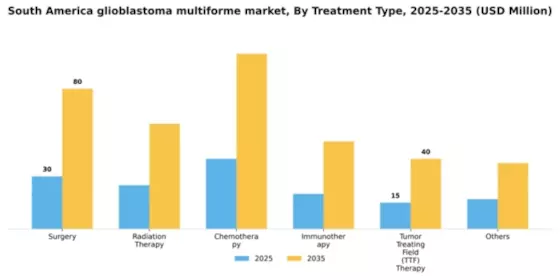
In the treatment type segment, surgery remains the largest value, capturing a significant share due to its critical role in initial tumor management. Radiation therapy and chemotherapy closely follow, contributing to comprehensive treatment strategies, while immunotherapy and Tumor Treating Fields (TTF) therapy are gradually enhancing their presence. Other treatments are also significant, reflecting diverse approaches used in patient care.
The growth trends within this segment indicate a robust shift towards less invasive and more targeted therapies. The increasing adoption of immunotherapy and TTF therapy showcases the market's response to the need for novel treatment approaches. This evolution in treatment paradigms is driven by advancements in research, favorable regulatory conditions, and heightened awareness among healthcare providers regarding the efficacy of emerging therapies.
Surgery (Dominant) vs. Chemotherapy (Emerging)
Surgery is a dominant treatment option in this segment, as it directly addresses the tumor and has seen evolving techniques to improve outcomes and minimize recovery time. On the other hand, chemotherapy is considered an emerging treatment, gaining traction as new regimens and combinations show promise in prolonging survival and enhancing quality of life for patients. The role of chemotherapy is expanding with the development of targeted agents that complement surgical efforts. Both treatment modalities reflect the importance of integrated approaches in managing glioblastoma multiforme, as they contribute to overall patient care while adapting to evolving clinical guidelines.
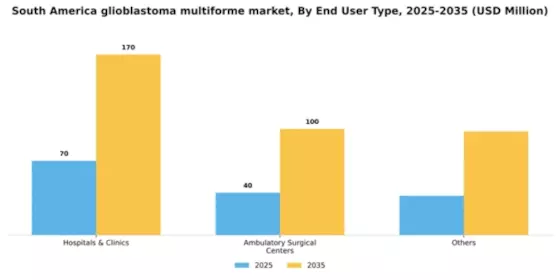
In the South America glioblastoma multiforme market, Hospitals & Clinics comprise the largest segment, accounting for a significant share of the overall market. This dominance is attributed to their established infrastructure, access to advanced diagnostic and treatment technologies, and the presence of specialized medical professionals. Ambulatory Surgical Centers and Others, while smaller in comparison, show increasing engagement in the treatment of glioblastoma, thus diversifying end-user distribution across the market.
Growth trends indicate an increasing preference for outpatient settings, particularly Ambulatory Surgical Centers, which have become the fastest-growing segment due to their cost-effectiveness and convenience for patients. The rise in minimally invasive surgical techniques and advancements in technology are key drivers, enhancing patient outcomes and reshaping healthcare delivery in the region. With ongoing developments, new treatment facilities are emerging, catering to the growing patient population diagnosed with glioblastoma multiforme.
Hospitals & Clinics (Dominant) vs. Ambulatory Surgical Centers (Emerging)
Hospitals & Clinics are the dominant players in the South America glioblastoma multiforme market, characterized by comprehensive treatment options, multidisciplinary care teams, and substantial investment in research and development. These institutions are essential in managing complex cases, offering a full spectrum of services from diagnosis to rehabilitation. On the other hand, Ambulatory Surgical Centers are emerging as a vital alternative, focusing on outpatient surgical procedures with a strong emphasis on efficiency and patient comfort. Their growth is driven by increasing healthcare costs, the demand for faster recovery times, and patient preferences for non-hospital settings, making them a significant component of the evolving healthcare landscape.
Get more detailed insights about South America Glioblastoma Multiforme Market Request Free Sample
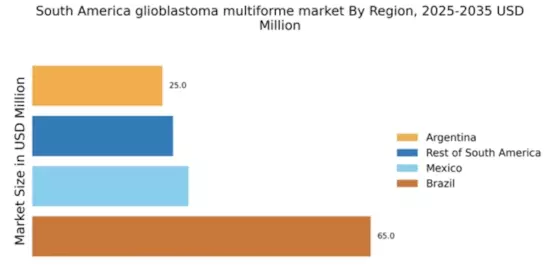
Key markets include São Paulo, Rio de Janeiro, and Minas Gerais, where major hospitals and research institutions are located. The competitive landscape features significant players like Roche, Novartis, and Bristol-Myers Squibb, which have established a strong presence. Local dynamics are characterized by a mix of public and private healthcare systems, with increasing collaboration between government and pharmaceutical companies. The oncology sector is particularly vibrant, with ongoing clinical trials and research initiatives.
Key markets include Mexico City, Guadalajara, and Monterrey, where healthcare facilities are expanding. The competitive landscape features major players like Merck & Co and Pfizer, which are actively investing in local partnerships. The business environment is improving, with a focus on innovation and research. The oncology sector is gaining traction, with increasing clinical trials and collaborations with international organizations to enhance treatment options.
Key markets include Buenos Aires, Córdoba, and Mendoza, where healthcare facilities are increasingly adopting advanced treatment protocols. The competitive landscape features players like Eli Lilly and Amgen, which are focusing on local partnerships. The business environment is characterized by a mix of public and private healthcare systems, with ongoing efforts to enhance research and development in oncology. The sector is evolving, with a focus on improving patient outcomes through innovative therapies.
Key markets include Chile, Colombia, and Peru, each with distinct healthcare landscapes. The competitive landscape features a mix of local and international players, including AstraZeneca and Bayer, which are expanding their presence. Local dynamics vary, with some countries experiencing rapid growth while others face economic challenges. The oncology sector is gaining attention, with increasing investments in research and development to address local healthcare needs.
The glioblastoma multiforme market in South America is characterized by a competitive landscape that is increasingly shaped by innovation, strategic partnerships, and regional expansion. Key players such as Bristol-Myers Squibb (US), Roche (CH), and Novartis (CH) are actively pursuing strategies that emphasize research and development, aiming to enhance treatment efficacy and patient outcomes. Bristol-Myers Squibb (US) has focused on immunotherapy advancements, while Roche (CH) is leveraging its expertise in personalized medicine to tailor therapies for glioblastoma patients. Novartis (CH) appears to be concentrating on expanding its portfolio through acquisitions and collaborations, thereby enhancing its market presence and operational capabilities.The business tactics employed by these companies include localizing manufacturing and optimizing supply chains to ensure timely delivery of therapies. The market structure is moderately fragmented, with several players vying for market share, yet the collective influence of these key companies is substantial. Their strategies not only enhance their competitive positioning but also contribute to a more dynamic market environment, where innovation and operational efficiency are paramount.
In October Roche (CH) announced a strategic partnership with a leading biotechnology firm to co-develop a novel targeted therapy for glioblastoma. This collaboration is expected to accelerate the development timeline and enhance the therapeutic options available to patients. The strategic importance of this partnership lies in Roche's commitment to advancing personalized medicine, which could significantly improve treatment outcomes in this challenging disease area.
In September Novartis (CH) launched a new clinical trial for its investigational drug aimed at recurrent glioblastoma. This initiative underscores the company's focus on addressing unmet medical needs and expanding its therapeutic offerings. The trial's outcomes could potentially reshape treatment protocols and establish Novartis as a leader in innovative glioblastoma therapies.
In August Bristol-Myers Squibb (US) reported positive results from a Phase III trial of its immunotherapy treatment for glioblastoma, leading to plans for regulatory submission. This development is crucial as it not only validates the company's research efforts but also positions it favorably in a competitive market where effective therapies are in high demand.
As of November the glioblastoma multiforme market is witnessing trends that emphasize digitalization, sustainability, and the integration of artificial intelligence in drug development. Strategic alliances are increasingly shaping the competitive landscape, allowing companies to pool resources and expertise. Looking ahead, competitive differentiation is likely to evolve from traditional price-based strategies to a focus on innovation, technological advancements, and supply chain reliability, reflecting a broader shift in the pharmaceutical industry.



Recent developments in the South America Glioblastoma Multiforme Market include significant research advancements and increasing clinical trial activities, attracting attention from major pharmaceutical companies. AstraZeneca, Roche, Merck, and others are focusing on innovative therapies, with a marked increase in investment in Research and Development to enhance treatment options. Notably, in September 2023, Genentech announced a partnership with local research institutions in Brazil to advance its studies on targeted therapies for Glioblastoma. Furthermore, there have been no major mergers or acquisitions reported among the specified companies in the region recently.
However, the market has seen valuation growth due to heightened demand for effective therapies, driven by increasing incidence rates and improved diagnosis capabilities across South America. Estimates suggest that the market is projected to grow significantly, fostering interest from companies such as Celgene and Bristol Myers Squibb, who have expanded their regional presence through targeted marketing efforts. Additionally, the emphasis on collaboration between pharmaceutical companies and local health authorities has been a significant trend over the past few years, enhancing the overall treatment landscape for Glioblastoma Multiforme in South America.
The Glioblastoma Multiforme Market is projected to grow at an 8.69% CAGR from 2025 to 2035, driven by advancements in treatment options and increasing patient awareness.
New opportunities lie in:
By 2035, the market is expected to achieve substantial growth, reflecting enhanced treatment modalities and patient engagement.
| MARKET SIZE 2024 | 147.05(USD Million) |
| MARKET SIZE 2025 | 159.83(USD Million) |
| MARKET SIZE 2035 | 367.58(USD Million) |
| COMPOUND ANNUAL GROWTH RATE (CAGR) | 8.69% (2025 - 2035) |
| REPORT COVERAGE | Revenue Forecast, Competitive Landscape, Growth Factors, and Trends |
| BASE YEAR | 2024 |
| Market Forecast Period | 2025 - 2035 |
| Historical Data | 2019 - 2024 |
| Market Forecast Units | USD Million |
| Key Companies Profiled | Bristol-Myers Squibb (US), Merck & Co (US), Roche (CH), Novartis (CH), Eli Lilly and Company (US), Amgen (US), AstraZeneca (GB), Pfizer (US), Bayer (DE) |
| Segments Covered | Treatment Type, End User Type |
| Key Market Opportunities | Advancements in targeted therapies and immunotherapies present growth opportunities in the glioblastoma multiforme market. |
| Key Market Dynamics | Rising demand for innovative therapies drives competition in the glioblastoma multiforme market across South America. |
| Countries Covered | Brazil, Mexico, Argentina, Rest of South America |
The market valuation for glioblastoma multiforme in South America was $147.05 Million in 2024.
The projected market valuation for glioblastoma multiforme is $367.58 Million by 2035.
The expected CAGR for the glioblastoma multiforme market during the forecast period 2025 - 2035 is 8.69%.
Chemotherapy had the highest valuation in the glioblastoma multiforme market, ranging from $40.0 Million to $100.0 Million.
The projected valuations for surgery in the glioblastoma multiforme market are expected to range from $30.0 Million to $80.0 Million by 2035.
Key players in the glioblastoma multiforme market include Bristol-Myers Squibb, Merck & Co, Roche, Novartis, Eli Lilly and Company, Amgen, AstraZeneca, Pfizer, and Bayer.
The valuation range for radiation therapy in the glioblastoma multiforme market is between $25.0 Million and $60.0 Million.
Ambulatory surgical centers contribute to the glioblastoma multiforme market with a valuation range of $40.0 Million to $100.0 Million.
The valuation range for immunotherapy in the glioblastoma multiforme market is between $20.0 Million and $50.0 Million.
The glioblastoma multiforme market in South America is expected to experience a growth trend, with a projected valuation increase to $367.58 Million by 2035.



Kindly complete the form below to receive a free sample of this Report

“This is really good guys. Excellent work on a tight deadline. I will continue to use you going forward and recommend you to others. Nice job”


“Thanks. It’s been a pleasure working with you, please use me as reference with any other Intel employees.”


“Thanks for sending the report it gives us a good global view of the Betaïne market.”


“Thank you, this will be very helpful for OQS.”


“We found the report very insightful! we found your research firm very helpful. I'm sending this email to secure our future business.”


“I am very pleased with how market segments have been defined in a relevant way for my purposes (such as "Portable Freezers & refrigerators" and "last-mile"). In general the report is well structured. Thanks very much for your efforts.”


“I have been reading the first document or the study, ,the Global HVAC and FP market report 2021 till 2026. Must say, good info! I have not gone in depth at all parts, but got a good indication of the data inside!”


“We got the report in time, we really thank you for your support in this process. I also thank to all of your team as they did a great job.”


“The Automotive 48V ECU Components Procurement Intelligence Study” was a complex project, but the Market Research Future (MRFR) team handled it with quality, agility, and customer-centricity. They delivered all requested data on time and within the agreed scope. The team, including Shubhendra Anand and Rahul Gotadki, was always readily available to clarify questions and swiftly implement necessary adjustments, driving the project to a successful conclusion within a very demanding timeframe.
I would also like to specifically commend Akshay Agarwal for his responsiveness and support at every stage—from our initial inquiry on May 6th through to final delivery on June 18th. His dedication made the entire process seamless.”



