South America HMI Software Market
South America HMI Software Market Summary
As per Market Research Future analysis, the South America hmi software market Size was estimated at 329.87 USD Million in 2024. The South America hmi software market is projected to grow from 355.6 USD Million in 2025 to 753.6 USD Million by 2035, exhibiting a compound annual growth rate (CAGR) of 7% during the forecast period 2025 - 2035
Key Market Trends & Highlights
The South America HMI software market is experiencing robust growth driven by technological advancements and increasing industrial automation.
- Brazil remains the largest market for HMI software, reflecting a strong demand for automation solutions.
- Mexico is emerging as the fastest-growing region, indicating a shift towards advanced manufacturing technologies.
- There is a notable trend towards the integration of IoT technologies, enhancing connectivity and data exchange.
- Rising industrial automation and government initiatives are key drivers propelling market expansion.
Market Size & Forecast
| 2024 Market Size | 329.87 (USD Million) |
| 2035 Market Size | 753.6 (USD Million) |
| CAGR (2025 - 2035) | 7.8% |
Major Players
Siemens (DE), Schneider Electric (FR), Rockwell Automation (US), Honeywell (US), Mitsubishi Electric (JP), Emerson Electric (US), ABB (CH), General Electric (US), Advantech (TW)
South America HMI Software Market Trends
The hmi software market in South America is currently experiencing a notable evolution, driven by advancements in technology and increasing demand for automation across various industries. The region's manufacturing sector, in particular, is embracing these innovations to enhance operational efficiency and improve productivity. As companies seek to optimize their processes, the integration of hmi software solutions is becoming more prevalent, facilitating real-time monitoring and control of machinery. This trend is further supported by the growing emphasis on Industry 4.0, which encourages the adoption of smart manufacturing practices. Moreover, the rising awareness of the benefits associated with hmi software is prompting organizations to invest in these systems. The ability to visualize data and streamline operations is appealing to businesses aiming to remain competitive in a rapidly changing market. Additionally, the increasing focus on sustainability and energy efficiency is likely to drive further adoption of hmi solutions, as they can contribute to reducing waste and optimizing resource usage. As the hmi software market continues to expand, it appears poised to play a crucial role in the modernization of South America's industrial landscape.
Increased Adoption of Cloud-Based Solutions
The trend towards cloud-based hmi software solutions is gaining traction in South America. Organizations are increasingly recognizing the advantages of cloud technology, such as scalability, flexibility, and cost-effectiveness. This shift allows for easier access to data and improved collaboration among teams, ultimately enhancing operational efficiency.
Integration with IoT Technologies
The integration of hmi software with Internet of Things (IoT) technologies is becoming more prevalent. This convergence enables real-time data collection and analysis, allowing businesses to make informed decisions quickly. The synergy between hmi systems and IoT devices is likely to enhance automation and improve overall productivity.
Focus on User Experience and Interface Design
There is a growing emphasis on user experience and interface design within the hmi software market. Companies are prioritizing intuitive and user-friendly interfaces to facilitate easier interaction with systems. This focus on design is expected to improve user satisfaction and reduce training time for employees.
South America HMI Software Market Drivers
Rising Industrial Automation
The hmi software market in South America is experiencing a notable surge due to the increasing trend of industrial automation across various sectors. Industries such as manufacturing, oil and gas, and mining are adopting automated processes to enhance efficiency and reduce operational costs. This shift is likely to drive the demand for advanced hmi software solutions that facilitate real-time monitoring and control of industrial processes. According to recent data, the automation market in South America is projected to grow at a CAGR of approximately 8% over the next five years, indicating a robust opportunity for hmi software providers to cater to this expanding market. As companies seek to optimize their operations, the integration of hmi software becomes essential for achieving seamless automation and improved productivity.
Emergence of Smart Manufacturing
The concept of smart manufacturing is gaining traction in South America, significantly impacting the hmi software market. As industries transition towards more intelligent and interconnected manufacturing processes, the demand for sophisticated hmi software solutions is likely to increase. Smart manufacturing emphasizes the use of advanced technologies such as AI, machine learning, and IoT, which require hmi software that can seamlessly integrate with these systems. This shift is expected to enhance operational efficiency, reduce downtime, and improve overall productivity. The hmi software market is poised to benefit from this trend, as manufacturers seek solutions that enable them to harness the full potential of smart technologies. The anticipated growth in smart manufacturing initiatives may lead to a compound annual growth rate of approximately 9% in the hmi software market over the next few years.
Increased Focus on Cybersecurity
As the hmi software market in South America expands, the focus on cybersecurity is becoming increasingly critical. With the rise of interconnected systems and the Internet of Things (IoT), the potential for cyber threats has escalated. Industries are prioritizing the protection of their operational technology (OT) environments, leading to a heightened demand for hmi software that incorporates robust cybersecurity measures. Companies are investing in solutions that not only provide operational efficiency but also ensure the integrity and security of their systems. This trend is likely to drive innovation within the hmi software market, as providers develop solutions that address these security concerns. The market may see a significant shift towards cybersecurity-enhanced hmi software, reflecting the growing awareness of the importance of safeguarding industrial operations.
Growing Demand for Data Analytics
The increasing emphasis on data-driven decision-making is propelling the hmi software market in South America. Companies are recognizing the value of data analytics in optimizing operations and enhancing productivity. Hmi software solutions that incorporate advanced analytics capabilities allow users to visualize and interpret data effectively, leading to informed decision-making. This trend is particularly evident in sectors such as manufacturing and energy, where real-time data analysis is crucial for operational success. The hmi software market is likely to see a rise in demand for solutions that offer robust data analytics features, as organizations strive to leverage data for competitive advantage. As a result, the market is expected to witness a growth rate of around 7% annually, driven by the need for enhanced data utilization.
Government Initiatives and Regulations
Government initiatives aimed at promoting technological advancements in South America are significantly influencing the hmi software market. Various countries in the region are implementing regulations that encourage the adoption of smart technologies in industries. For instance, Brazil's government has introduced policies to support the modernization of manufacturing processes, which includes the integration of hmi software solutions. These initiatives not only enhance operational efficiency but also align with sustainability goals. The hmi software market stands to benefit from these regulatory frameworks, as they create a conducive environment for innovation and investment. Furthermore, the potential for public-private partnerships in technology development may further stimulate market growth, making it a pivotal driver in the region.
Market Segment Insights
By Deployment: On-Premises (Largest) vs. Cloud (Fastest-Growing)
In the South America hmi software market, the deployment segment is predominantly represented by the On-Premises model, which holds the largest share compared to Cloud solutions. This distribution reveals a preference for local installations among users who prioritize control and security over accessibility and flexibility. However, the Cloud deployment model is gaining traction, showcasing a growing inclination towards remote access and scalable solutions that cater to the evolving needs of businesses. The growth trends within this segment indicate a significant shift as businesses increasingly adopt Cloud solutions for their operational flexibility. Drivers for this change include the rising demand for remote working capabilities, cost efficiency, and rapid technological advancements that enhance cloud-based functionalities. The ongoing digital transformation in industries is also pushing organizations to reconsider their deployment strategies, favoring solutions that offer greater agility and reduced time-to-market.
On-Premises (Dominant) vs. Cloud (Emerging)
The On-Premises deployment model remains the dominant choice in the South America hmi software market, favored for its robustness and security, allowing organizations to maintain full control over their software environment. It is particularly appreciated by industries that require stringent compliance and data privacy measures. Conversely, the Cloud deployment model emerges as a flexible alternative, appealing to small and medium enterprises that seek cost-effective solutions with easy scalability. While still a developing segment, Cloud options are rapidly evolving with enhancements in security protocols and integration capabilities, making them more attractive to organizations looking for innovative ways to streamline operations and embrace the digital landscape.
By Configuration: Stand-Alone HMI (Largest) vs. Embedded HMI (Fastest-Growing)
In the South America hmi software market, the market share distribution among the configuration segment values shows Stand-Alone HMI as the dominant force. This segment has gained significant traction due to its flexibility and ability to operate independently of other systems. In contrast, Embedded HMI is rapidly gaining ground as a preferred solution among manufacturers looking for integrated solutions, though it currently holds a smaller share compared to Stand-Alone HMI. The growth trends for these segment values indicate a solid demand for both stand-alone and embedded solutions. The increasing complexity of industrial processes and the rising need for automation are primary drivers for the Embedded HMI segment, which is witnessing a swift expansion. Meanwhile, Stand-Alone HMI remains essential for industries that prioritize modular and user-friendly interfaces, ensuring a steady presence in the market as technology evolves.
HMI Configuration: Stand-Alone (Dominant) vs. Embedded (Emerging)
Stand-Alone HMI is characterized by its independence and ease of installation, making it the preferred choice for many industries that require straightforward operation without reliance on network connectivity. This has allowed it to solidify its place in environments where robust performance and user-centric design are critical. Conversely, Embedded HMI represents a growing trend of integration within machinery and equipment, offering compact solutions that save space while enhancing functionality. Its emergence is driven by the demand for more sophisticated and connected systems in manufacturing, which favors embedded solutions due to their ability to streamline operations and reduce costs.
By End-User Type: BFSI (Largest) vs. Healthcare (Fastest-Growing)
The South America hmi software market displays a diverse distribution among its end-user segments, with the BFSI sector commanding the largest share. This dominance is attributed to the industry's growing need for advanced software solutions to enhance customer interactions, streamline operations, and ensure regulatory compliance. Other segments, such as Government and IT & Telecom, also contribute significantly, although not as prominently as BFSI. Meanwhile, Healthcare is gaining traction, propelled by the increased digitization and need for efficient patient management systems. Growth trends indicate a robust future for the hmi software market, particularly within the Healthcare sector, which is the fastest-growing segment. Factors driving this rise include an increased focus on telemedicine, healthcare automation, and the demand for integrated management systems. The BFSI sector continues to innovate to retain its market position, integrating more digital solutions to meet evolving customer expectations. As industries adapt to technological advancements, the hmi software solutions are becoming integral to operational efficiency across all segments.
BFSI: Dominant vs. Healthcare: Emerging
The BFSI segment remains a dominant force in the South America hmi software market, characterized by its large-scale adoption of solutions that facilitate transaction processing, data management, and customer relationship enhancement. This segment's robust infrastructure and regulatory requirements drive continuous investment in hmi software to improve efficiency and compliance. Conversely, the Healthcare segment is emerging rapidly, spurred by the increasing adoption of digital health solutions, electronic health records, and telehealth services. This segment focuses on enhancing patient care and operational efficiency, making it a vital area for the future of hmi software, as more healthcare providers seek innovative ways to improve service delivery and patient engagement.
Regional Insights
Brazil : Leading Market Share and Growth
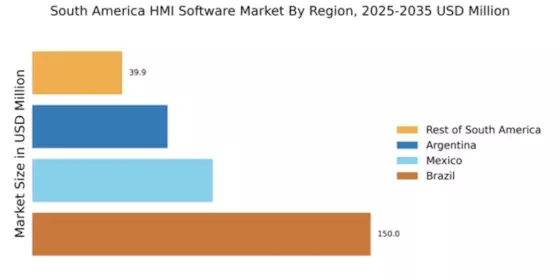
Brazil holds a commanding market share of 150.0, representing a significant portion of the South American HMI software market. Key growth drivers include the rapid industrialization and modernization of manufacturing processes, alongside government initiatives aimed at enhancing automation in various sectors. The demand for advanced HMI solutions is driven by the increasing need for efficiency and productivity in industries such as automotive, food and beverage, and pharmaceuticals. Regulatory policies promoting digital transformation further bolster this trend, supported by ongoing infrastructure development projects.
Mexico : Growth in Industrial Automation
Mexico's HMI software market is valued at 80.0, showcasing a robust growth trajectory. The country's strategic location and trade agreements, such as the USMCA, facilitate access to advanced technologies and foster demand for HMI solutions. Key growth drivers include the automotive and electronics sectors, which are increasingly adopting automation technologies. Government initiatives aimed at boosting manufacturing capabilities and enhancing workforce skills are also pivotal in shaping market dynamics, alongside a growing emphasis on sustainability and energy efficiency.
Argentina : Resilience in HMI Software Adoption
Argentina's HMI software market is valued at 60.0, reflecting steady growth despite economic challenges. The demand for HMI solutions is driven by the need for improved operational efficiency in sectors like agriculture, food processing, and energy. Government policies aimed at promoting technological innovation and investment in infrastructure are crucial for market expansion. Additionally, the increasing focus on digital transformation in manufacturing processes is fostering a favorable environment for HMI adoption, supported by local initiatives to enhance industrial capabilities.
Rest of South America : Varied Growth Across Regions
The Rest of South America accounts for a market value of 39.87, characterized by diverse economic conditions and varying levels of industrialization. Key growth drivers include the expansion of mining, agriculture, and energy sectors, which are increasingly adopting HMI solutions to enhance operational efficiency. Local governments are implementing policies to attract foreign investment and promote technological advancements, creating opportunities for market players. The competitive landscape features both global and local companies, with a focus on tailored solutions for specific industry needs.
Key Players and Competitive Insights
Key Companies in the South America HMI Software Market include
Industry Developments
The South America HMI Software Market has seen notable developments recently, especially with a focus on technological advancements and market expansion. Companies such as Schneider Electric and Honeywell are increasingly adopting Artificial Intelligence and data analytics to enhance user experience and operational efficiency. In recent months, the market observed growth in content delivery and increased integration of Internet of Things (IoT) technologies, reflecting a shift toward more interconnected systems. Mergers and acquisitions are pivotal, with General Electric acquiring software solutions from MAPS in March 2023, aimed at bolstering its automation capabilities in the region.

Rockwell Automation announced a significant partnership with Inductive Automation to leverage advanced HMI technologies in April 2023, further stimulating competition. Additionally, Siemens has launched new cloud-based HMI offerings that align with Industry 4.0 trends in Brazil, showing a positive trajectory for market participants. Over the past two to three years, the emphasis on sustainable and efficient solutions has driven significant investments, especially in the automotive and manufacturing sectors, as South American countries seek to modernize their infrastructure.
These developments indicate a robust growth rate in the HMI Software Market, supported by regional governmental initiatives aimed at technological adoption and smart manufacturing integration.
Future Outlook
South America HMI Software Market Future Outlook
The HMI software market is projected to grow at a 7.8% CAGR from 2025 to 2035, driven by automation, IoT integration, and demand for user-friendly interfaces.
New opportunities lie in:
- Development of AI-driven predictive maintenance tools
- Expansion into mobile HMI applications for remote monitoring
- Integration of augmented reality features for enhanced user interaction
By 2035, the market is expected to achieve substantial growth, driven by technological advancements and increased adoption.
Market Segmentation
South America HMI Software Market Deployment Outlook
- On-Premises
- Cloud
South America HMI Software Market Configuration Outlook
- Stand-Alone HMI
- Embedded HMI
South America HMI Software Market End-User Type Outlook
- BFSI
- IT & Telecom
- Government
- Healthcare
- Manufacturing
- Others
Report Scope
| MARKET SIZE 2024 | 329.87(USD Million) |
| MARKET SIZE 2025 | 355.6(USD Million) |
| MARKET SIZE 2035 | 753.6(USD Million) |
| COMPOUND ANNUAL GROWTH RATE (CAGR) | 7.8% (2025 - 2035) |
| REPORT COVERAGE | Revenue Forecast, Competitive Landscape, Growth Factors, and Trends |
| BASE YEAR | 2024 |
| Market Forecast Period | 2025 - 2035 |
| Historical Data | 2019 - 2024 |
| Market Forecast Units | USD Million |
| Key Companies Profiled | Siemens (DE), Schneider Electric (FR), Rockwell Automation (US), Honeywell (US), Mitsubishi Electric (JP), Emerson Electric (US), ABB (CH), General Electric (US), Advantech (TW) |
| Segments Covered | Deployment, Configuration, End-User Type |
| Key Market Opportunities | Integration of artificial intelligence in hmi software enhances user experience and operational efficiency. |
| Key Market Dynamics | Rising demand for automation in manufacturing drives growth in the HMI software market across South America. |
| Countries Covered | Brazil, Mexico, Argentina, Rest of South America |
FAQs
What was the market valuation of the HMI software market in 2024?
The market valuation of the HMI software market was 329.87 $ Million in 2024.
What is the projected market valuation for the HMI software market in 2035?
The projected market valuation for the HMI software market is 753.6 $ Million in 2035.
What is the expected CAGR for the HMI software market during the forecast period 2025 - 2035?
The expected CAGR for the HMI software market during the forecast period 2025 - 2035 is 7.8 %.
Which companies are considered key players in the HMI software market?
Key players in the HMI software market include Siemens, Schneider Electric, Rockwell Automation, Honeywell, Mitsubishi Electric, Emerson Electric, ABB, General Electric, and Advantech.
What are the two main deployment segments in the HMI software market?
The two main deployment segments in the HMI software market are On-Premises, valued at 150.0 - 350.0 $ Million, and Cloud, valued at 179.87 - 403.6 $ Million.
What are the configuration segments for HMI software and their valuations?
The configuration segments for HMI software include Stand-Alone HMI, valued at 164.93 - 377.16 $ Million, and Embedded HMI, valued at 164.94 - 376.44 $ Million.
Which end-user types are driving the HMI software market?
End-user types driving the HMI software market include Manufacturing, valued at 90.0 - 200.0 $ Million, Healthcare, valued at 60.0 - 140.0 $ Million, and IT & Telecom, valued at 50.0 - 120.0 $ Million.
How does the HMI software market's growth in South America compare to other regions?
While specific comparisons to other regions are not provided, the HMI software market in South America is poised for growth, with a projected valuation increase to 753.6 $ Million by 2035.
What is the potential impact of technological advancements on the HMI software market?
Technological advancements may enhance the capabilities of HMI software, potentially leading to increased adoption across various sectors, including manufacturing and healthcare.
How are the key players positioned in the HMI software market?
Key players like Siemens and Schneider Electric appear to be well-positioned in the HMI software market, leveraging their extensive experience and technological expertise.
Kindly complete the form below to receive a free sample of this Report
Customer Stories
“This is really good guys. Excellent work on a tight deadline. I will continue to use you going forward and recommend you to others. Nice job”
“Thanks. It’s been a pleasure working with you, please use me as reference with any other Intel employees.”
“Thanks for sending the report it gives us a good global view of the Betaïne market.”
“Thank you, this will be very helpful for OQS.”
“We found the report very insightful! we found your research firm very helpful. I'm sending this email to secure our future business.”
“I am very pleased with how market segments have been defined in a relevant way for my purposes (such as "Portable Freezers & refrigerators" and "last-mile"). In general the report is well structured. Thanks very much for your efforts.”
“I have been reading the first document or the study, ,the Global HVAC and FP market report 2021 till 2026. Must say, good info! I have not gone in depth at all parts, but got a good indication of the data inside!”
“We got the report in time, we really thank you for your support in this process. I also thank to all of your team as they did a great job.”