Download Free Sample
Kindly complete the form below to receive a free sample of this Report
South America Human Papillomavirus Market Research Report By Type (Vaccine, Diagnostic Test, Therapeutics), By Indication (Cervical Cancer, Anal Cancer, Oropharyngeal Cancer, Genital Warts), By End User (Hospitals, Specialty Clinics, Diagnostic Laboratories, Research Institutions), By Distribution Channel (Direct Sales, Distributors, E-commerce) and By Regional (Brazil, Mexico, Argentina, Rest of South America) -Forecast to 2035
As per Market Research Future analysis, the Human Papilloma-virus market size was estimated at 283.45 USD Million in 2024. The South America human papilloma-virus market is projected to grow from 307.46 USD Million in 2025 to 693.4 USD Million by 2035, exhibiting a compound annual growth rate (CAGR) of 8.4% during the forecast period 2025 - 2035
The South America human papilloma-virus market is experiencing robust growth driven by increased vaccination initiatives and rising awareness.
| 2024 Market Size | 283.45 (USD Million) |
| 2035 Market Size | 693.4 (USD Million) |
| CAGR (2025 - 2035) | 8.47% |
The human papilloma-virus market in South America is currently experiencing notable developments, driven by increasing awareness of HPV-related health issues and the importance of vaccination. Governments across the region are implementing initiatives to promote HPV vaccination, particularly among adolescents, which is expected to enhance market growth. Additionally, the rising incidence of HPV-related cancers, such as cervical cancer, has prompted healthcare providers to prioritize preventive measures. This focus on prevention is likely to lead to a greater demand for vaccines and screening programs, thereby shaping the market landscape. Moreover, the collaboration between public health organizations and private sectors appears to be strengthening the infrastructure for HPV prevention and treatment. Educational campaigns aimed at informing the population about HPV and its potential consequences are gaining traction. These efforts may contribute to a more informed public, ultimately leading to increased vaccination rates and early detection of HPV-related conditions. As a result, the human papilloma-virus market is poised for growth, reflecting a shift towards proactive healthcare strategies in South America.
Governments in South America are intensifying efforts to promote HPV vaccination among young populations. This trend is characterized by public health campaigns aimed at educating communities about the benefits of vaccination, which may lead to higher uptake rates and improved public health outcomes.
There is a growing recognition of the health risks associated with HPV, particularly its link to various cancers. This heightened awareness is driving demand for screening and preventive measures, suggesting a shift in healthcare priorities within the region.
Partnerships between governmental bodies and private organizations are becoming more prevalent in the human papilloma-virus market. These collaborations are likely to enhance resource allocation for vaccination programs and educational initiatives, potentially leading to improved health outcomes.
The increasing healthcare expenditure in South America is a pivotal driver for the human papilloma-virus market. Governments and private sectors are allocating more funds towards healthcare initiatives, which includes vaccination programs and awareness campaigns. In 2025, healthcare spending in the region is projected to reach approximately $1.5 trillion, reflecting a growth rate of around 5% annually. This financial commitment is likely to enhance access to HPV vaccines and screening services, thereby potentially reducing the incidence of HPV-related diseases. The human papilloma-virus market stands to benefit significantly from this trend, as improved funding can lead to better healthcare infrastructure and increased availability of preventive measures.
Regulatory bodies in South America are increasingly supporting vaccination initiatives against HPV, which is likely to bolster the human papilloma-virus market. Recent policies have been introduced to facilitate the approval and distribution of HPV vaccines, making them more accessible to the population. For instance, several countries have implemented national immunization programs that include HPV vaccination for adolescents. This regulatory support is crucial, as it not only encourages vaccine uptake but also fosters public trust in vaccination efforts. The human papilloma-virus market is expected to thrive under these favorable regulatory conditions, potentially leading to higher vaccination rates and reduced HPV prevalence.
The rising incidence of HPV-related cancers in South America is a significant driver for the human papilloma-virus market. Data indicates that cervical cancer, primarily caused by HPV, remains a leading cause of cancer-related deaths among women in the region. In 2025, it is estimated that there will be over 50,000 new cases of cervical cancer annually in South America. This alarming trend is likely to heighten awareness and urgency surrounding HPV prevention strategies, including vaccination and screening. Consequently, the human papilloma-virus market may experience increased demand for vaccines and diagnostic tools as healthcare providers and patients seek to mitigate the risks associated with HPV.
Educational campaigns and community outreach programs are becoming increasingly prevalent in South America, serving as a vital driver for the human papilloma-virus market. These initiatives aim to inform the public about the risks associated with HPV and the benefits of vaccination. By engaging communities through workshops, seminars, and social media, health organizations are fostering a culture of prevention. In 2025, it is anticipated that such campaigns will reach over 30 million individuals across the region, significantly impacting public perception and acceptance of HPV vaccination. The human papilloma-virus market is likely to benefit from this heightened awareness, as more individuals may seek vaccination and screening services.
Partnerships with non-governmental organizations (NGOs) are emerging as a crucial driver for the human papilloma-virus market in South America. These collaborations often focus on enhancing access to HPV vaccines and educational resources, particularly in underserved communities. NGOs play a vital role in mobilizing resources and expertise, which can lead to more effective vaccination campaigns. In 2025, it is projected that partnerships with NGOs will facilitate the distribution of over 5 million HPV vaccine doses in the region. This collaborative approach not only strengthens the human papilloma-virus market but also ensures that vulnerable populations receive the necessary preventive care.
In the South America Human Papilloma Virus Market, the application segment is primarily driven by Vaccination, which holds the largest market share. Vaccination initiatives have escalated, supported by governmental and non-governmental organizations focusing on reducing HPV prevalence and associated diseases. Screening services, on the other hand, are recognized as the fastest-growing segment, as increasing awareness of HPV-related health issues stimulates demand for early detection and management solutions. Growing healthcare expenditures and a proactive approach towards preventive healthcare are driving the expansion of this segment. The rise in HPV vaccination programs and campaigns contributes to Vaccination's stature as the dominant segment. Meanwhile, innovations in screening technologies and methods play a pivotal role in enhancing the accessibility and efficiency of screening processes, signifying its rapid growth.
Vaccination: Dominant vs. Screening: Emerging
Vaccination in the South America human papilloma virus market is characterized by widespread initiatives aimed at protecting against HPV, making it the dominant factor in this segment. Government policies promoting HPV vaccination, along with public awareness campaigns, strengthen its market position. In contrast, Screening is considered an emerging segment; its rise is fueled by a demand for preventative healthcare and early intervention strategies. As education and awareness about HPV spread, more individuals seek screening services. Technological advancements, such as self-sampling kits and more accurate testing methods, are enhancing screening efficiency and penetration in rural regions, thus significantly contributing to its growth within the market.
In the South America human papilloma virus (HPV) market, hospitals represent the largest share, attributed to their comprehensive capabilities in managing and treating HPV-related health issues. Clinics follow closely, offering accessible services and preventive measures against HPV, which are becoming increasingly popular in urban areas. Diagnostic laboratories and research institutions also play significant roles in HPV management, providing essential testing and research, though they hold smaller market shares compared to hospitals and clinics. The growth trends in this segment are fueled by increasing awareness of HPV and its associated risks, including cervical cancer. Hospitals benefit from established patient care pathways and advanced treatment protocols, while clinics are emerging as fast-growing entities, driven by their focus on preventative care. Research institutions are integral in developing innovative treatments, and pharmaceutical companies are supporting these advancements, paving the way for a more robust market presence across these varied end uses.
Clinics (Dominant) vs. Diagnostic Laboratories (Emerging)
Clinics in the South America HPV market serve as the dominant force, providing essential services that cater to preventive measures and routine screenings for HPV, appealing particularly to younger demographics. They facilitate easy access for patients seeking consultations and preventive treatments, making them vital in managing public health concerns. In contrast, diagnostic laboratories are emerging as critical players, focusing on advanced screening and testing technologies that ensure accurate HPV detection. Their role is becoming increasingly significant amidst a growing emphasis on early diagnosis and treatment of HPV-related conditions. The collaborative efforts between clinics and diagnostic laboratories are enhancing patient outcomes and fostering a comprehensive approach to HPV management across South America.
The South America human papilloma virus (HPV) market exhibits notable segmentation across various demographics. Within age groups, individuals aged 18 to 30 represent the largest share, as they are more susceptible to HPV-related infections and play a crucial role in vaccination initiatives. Conversely, the gender demographic shows a marked increase, especially among young women who are becoming increasingly aware of the benefits of HPV vaccination and screening. This evolving awareness contributes to a dynamic distribution across gender lines in HPV prevalence.
Age Group: 18-30 (Dominant) vs. Gender: Female (Emerging)
The age group of 18-30 is a dominant force in the South America HPV market due to heightened susceptibility and prioritization of vaccination efforts. This segment is characterized by higher engagement in healthcare initiatives, making them crucial for driving vaccination campaigns. On the other hand, the female demographic is emerging rapidly, propelled by increased awareness of HPV risks and vaccination benefits. Campaigns focusing on female health, education, and accessible healthcare services further enhance their growth in the market. Collectively, these segments illustrate the shifting landscape of HPV awareness and treatment in the region.
In the South America human papilloma virus (HPV) market, the distribution channel dynamics reveal the dominance of Healthcare Providers, accounting for a significant portion of service delivery. This segment thrives on trust and direct patient interaction, essential in the healthcare sector, while Public Health Programs also play a crucial role by enhancing awareness and accessibility across different demographics. Online Sales are gradually gaining traction, appealing to a younger, tech-savvy audience seeking convenience and discretion.
Healthcare Providers (Dominant) vs. Online Sales (Emerging)
Healthcare Providers serve as the dominant channel in the South America HPV market, leveraging established patient relationships and ongoing care paradigms. They not only facilitate vaccinations but also engage in educational initiatives, crucial for awareness and prevention. Conversely, Online Sales are emerging, reflecting shifting consumer behaviors toward purchasing health-related products digitally. This segment is characterized by its agility in marketing strategies and the convenience it offers, particularly during a time when remote healthcare solutions are on the rise. The interplay between these channels illustrates a market evolving towards a balanced approach of traditional and modern methods of healthcare delivery.
In the South America human papilloma virus market, the distribution of the product types is diverse, with vaccines leading in market share. Vaccines play a crucial role in HPV prevention, significantly outpacing other product types. Diagnostic kits, on the other hand, have been gaining traction as awareness of HPV testing increases, capturing more of the market due to the rising emphasis on early detection and prevention strategies. As public health initiatives grow, the focus on these product types becomes more pronounced. The growth trends among these segment values reveal a complex landscape. Vaccines, while dominant, are facing challenges from emerging diagnostic kits, which are becoming integral to public health strategies. This shift is driven by increasing awareness among healthcare providers about the importance of HPV testing. Additionally, government health policies are promoting the adoption of diagnostic kits, thus contributing to their impressive growth rates in the region. As the market evolves, both segments are expected to play pivotal roles in HPV management and prevention.
Vaccines (Dominant) vs. Diagnostic Kits (Emerging)
Vaccines represent the dominant segment in the South America human papilloma virus market, largely due to comprehensive immunization programs implemented by health authorities across the region. These vaccines are essential for preventing HPV infections and their associated diseases, including cervical cancer. The broad acceptance and integration of HPV vaccines into national health programs have cemented their market position. Conversely, diagnostic kits are emerging rapidly, fueled by an increased focus on preventive healthcare. These kits provide valuable tools for early detection of HPV, enabling timely interventions. Their significance is heightened by the growing awareness among the population and healthcare providers about HPV risks, thus establishing diagnostic kits as critical components in the fight against HPV.
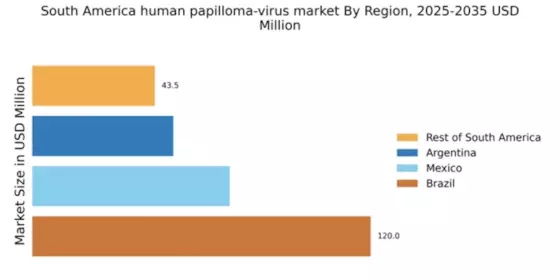
Brazil holds a commanding market share of 120.0, representing a significant portion of the South American HPV market. Key growth drivers include increasing awareness of HPV-related health issues, government vaccination initiatives, and a rising incidence of HPV-related cancers. Regulatory policies, such as the National Immunization Program, support widespread vaccination efforts. Additionally, Brazil's advanced healthcare infrastructure facilitates access to HPV vaccines and treatments, driving consumption patterns upward.
Mexico accounts for a market share of 70.0, reflecting a growing demand for HPV vaccines and treatments. Key growth drivers include increasing public health campaigns and partnerships with international organizations to enhance vaccine accessibility. The government has implemented initiatives to integrate HPV vaccination into routine healthcare, which is expected to boost consumption. The urban centers of Mexico City and Guadalajara are pivotal markets, showcasing a competitive landscape with major players like Merck & Co and Pfizer.
Argentina's HPV market is valued at 50.0, driven by government-led vaccination programs and rising public awareness. The Ministry of Health has prioritized HPV vaccination, leading to increased uptake among adolescents. Demand trends indicate a shift towards preventive healthcare, with a focus on reducing HPV-related diseases. Key markets include Buenos Aires and Córdoba, where healthcare infrastructure supports vaccine distribution. Major players like GlaxoSmithKline and Sanofi are actively involved, enhancing competition in the sector.
The Rest of South America holds a market share of 43.45, characterized by diverse healthcare needs and varying levels of HPV awareness. Growth drivers include regional health initiatives and collaborations with NGOs to improve vaccine access. Demand trends vary significantly, with urban areas showing higher consumption rates. Key markets include Santiago in Chile and Lima in Peru, where local players and international firms like AstraZeneca and Roche compete. The business environment is evolving, with increasing investments in healthcare infrastructure.
The human papilloma-virus market in South America is characterized by a dynamic competitive landscape, driven by increasing awareness of HPV-related health issues and the growing demand for vaccination. Key players such as Merck & Co (US), GlaxoSmithKline (GB), and Pfizer (US) are actively engaged in strategies that emphasize innovation and regional expansion. Merck & Co (US) has positioned itself as a leader in HPV vaccination with its Gardasil product, focusing on enhancing accessibility through partnerships with local health authorities. GlaxoSmithKline (GB) is also making strides by investing in educational campaigns to promote vaccination, thereby shaping the competitive environment through increased consumer engagement and awareness.The market structure appears moderately fragmented, with several players vying for market share. Companies are adopting various business tactics, such as localizing manufacturing to reduce costs and optimize supply chains. This approach not only enhances operational efficiency but also allows for quicker responses to regional market demands. The collective influence of these key players is significant, as they work to establish a robust presence in the market while navigating regulatory challenges and competition from emerging firms.
In October Pfizer (US) announced a strategic partnership with a leading South American healthcare provider to enhance the distribution of its HPV vaccine. This collaboration is expected to improve vaccine accessibility in underserved regions, reflecting Pfizer's commitment to addressing public health challenges. The strategic importance of this partnership lies in its potential to significantly increase vaccination rates, thereby contributing to the overall reduction of HPV-related diseases in the region.
In September GlaxoSmithKline (GB) launched a new digital platform aimed at educating healthcare professionals about HPV and the importance of vaccination. This initiative is crucial as it not only positions GlaxoSmithKline as a thought leader in the field but also fosters stronger relationships with healthcare providers. By leveraging digital tools, the company enhances its outreach and engagement, which may lead to increased vaccination uptake.
In August Merck & Co (US) expanded its clinical trial program for its HPV vaccine in Brazil, focusing on diverse populations. This move underscores Merck's dedication to understanding the vaccine's efficacy across different demographics, which is vital for tailoring public health strategies. The expansion of clinical trials may also pave the way for regulatory approvals and market growth in the region.
As of November current trends in the human papilloma-virus market are increasingly defined by digitalization, sustainability, and the integration of artificial intelligence in healthcare solutions. Strategic alliances among key players are shaping the competitive landscape, fostering innovation and collaboration. The shift from price-based competition to a focus on technological advancements and supply chain reliability is evident. Companies are likely to differentiate themselves through innovative solutions and enhanced service delivery, which may ultimately lead to improved health outcomes in the region.






The South America Human Papillomavirus Market has recently been influenced by significant developments involving major pharmaceutical companies. In August 2023, AstraZeneca announced a strategic partnership with Roche to enhance the distribution of cervical cancer treatments across Brazil and Argentina, reflecting the increasing focus on HPV-related health issues. Additionally, in September 2023, Hologic expanded its Women's Health division within South America, introducing advanced diagnostic tools aimed at improving HPV screening processes, particularly in underserved regions.
Genomic Health has observed a slight uptick in the adoption of its testing services in South American countries, attributed to increasing awareness and education regarding HPV and its associated risks. Furthermore, Merck and Co. revealed plans in July 2023 to increase investment in vaccine production facilities in Brazil, aiming to bolster local manufacturing capacities and supply chains in response to rising HPV vaccine demand. The market has seen continuous growth in valuations, driven by enhanced vaccination efforts, government initiatives promoting HPV prevention, and an overall increase in healthcare spending in the region.
These developments are shaping a more proactive approach to addressing HPV-related health concerns in South America.
The Human Papilloma Virus Market is projected to grow at an 8.47% CAGR from 2025 to 2035, driven by increased vaccination rates, rising awareness, and advancements in diagnostic technologies.
New opportunities lie in:
By 2035, the market is expected to achieve substantial growth, reflecting enhanced prevention and treatment strategies.
| MARKET SIZE 2024 | 283.45(USD Million) |
| MARKET SIZE 2025 | 307.46(USD Million) |
| MARKET SIZE 2035 | 693.4(USD Million) |
| COMPOUND ANNUAL GROWTH RATE (CAGR) | 8.47% (2025 - 2035) |
| REPORT COVERAGE | Revenue Forecast, Competitive Landscape, Growth Factors, and Trends |
| BASE YEAR | 2024 |
| Market Forecast Period | 2025 - 2035 |
| Historical Data | 2019 - 2024 |
| Market Forecast Units | USD Million |
| Key Companies Profiled | Merck & Co (US), GlaxoSmithKline (GB), Pfizer (US), Sanofi (FR), Bristol-Myers Squibb (US), AstraZeneca (GB), Novartis (CH), Roche (CH) |
| Segments Covered | Type, Indication, End User, Distribution Channel |
| Key Market Opportunities | Emerging vaccine technologies and increased awareness drive growth in the human papilloma-virus market. |
| Key Market Dynamics | Rising vaccination rates and regulatory support drive growth in the human papilloma-virus market across South America. |
| Countries Covered | Brazil, Mexico, Argentina, Rest of South America |
As of 2024, the market valuation was 0.567 USD Billion.
The market is expected to reach a valuation of 1.32 USD Billion by 2035.
The market is projected to grow at a CAGR of 8.0% from 2025 to 2035.
Key players include Merck & Co., GlaxoSmithKline, Sanofi, Bristol-Myers Squibb, Pfizer, AstraZeneca, Novartis, Roche, and Bayer.
The main application segments include Vaccination, Screening, Therapeutics, Education and Awareness, and Research and Development.
In 2024, the Vaccination segment was valued at 0.227 USD Billion.
The Screening segment is projected to grow from 0.135 USD Billion in 2024 to 0.32 USD Billion by 2035.
Primary end-use segments include Hospitals, Clinics, Diagnostic Laboratories, Research Institutions, and Pharmaceutical Companies.
The Therapeutics segment was valued at 0.075 USD Billion in 2024.
The distribution channel segment is anticipated to grow, with Pharmacies increasing from 0.2 USD Billion in 2024 to 0.4 USD Billion by 2035.


Kindly complete the form below to receive a free sample of this Report

“This is really good guys. Excellent work on a tight deadline. I will continue to use you going forward and recommend you to others. Nice job”


“Thanks. It’s been a pleasure working with you, please use me as reference with any other Intel employees.”


“Thanks for sending the report it gives us a good global view of the Betaïne market.”


“Thank you, this will be very helpful for OQS.”


“We found the report very insightful! we found your research firm very helpful. I'm sending this email to secure our future business.”


“I am very pleased with how market segments have been defined in a relevant way for my purposes (such as "Portable Freezers & refrigerators" and "last-mile"). In general the report is well structured. Thanks very much for your efforts.”


“I have been reading the first document or the study, ,the Global HVAC and FP market report 2021 till 2026. Must say, good info! I have not gone in depth at all parts, but got a good indication of the data inside!”


“We got the report in time, we really thank you for your support in this process. I also thank to all of your team as they did a great job.”


“The Automotive 48V ECU Components Procurement Intelligence Study” was a complex project, but the Market Research Future (MRFR) team handled it with quality, agility, and customer-centricity. They delivered all requested data on time and within the agreed scope. The team, including Shubhendra Anand and Rahul Gotadki, was always readily available to clarify questions and swiftly implement necessary adjustments, driving the project to a successful conclusion within a very demanding timeframe.
I would also like to specifically commend Akshay Agarwal for his responsiveness and support at every stage—from our initial inquiry on May 6th through to final delivery on June 18th. His dedication made the entire process seamless.”



