Download Free Sample
Kindly complete the form below to receive a free sample of this Report
South America Kidney Cyst Market Research Report By Type (Simple Kidney Cyst, Complex Kidney Cyst, Polycystic Kidney Disease), By Diagnosis Method (Ultrasound, CT Scan, MRI, X-ray), By Treatment Method (Surgery, Medication, Observation), By End Use (Hospitals, Clinics, Research Laboratories) and By Regional (Brazil, Mexico, Argentina, Rest of South America) - Growth & Industry Forecast 2025 To 2035
As per Market Research Future analysis, the South America kidney cyst market size was estimated at 205.0 USD Million in 2024. The South America kidney cyst market is projected to grow from 217.34 USD Million in 2025 to 390.0 USD Million by 2035, exhibiting a compound annual growth rate (CAGR) of 6.0% during the forecast period 2025 - 2035
The South America kidney cyst market is experiencing notable growth driven by technological advancements and increasing health awareness.
| 2024 Market Size | 205.0 (USD Million) |
| 2035 Market Size | 390.0 (USD Million) |
| CAGR (2025 - 2035) | 6.02% |
The kidney cyst market in South America is currently experiencing notable developments, driven by a combination of increasing awareness regarding kidney health and advancements in diagnostic technologies. The prevalence of kidney cysts, particularly among the aging population, has prompted healthcare providers to enhance their diagnostic capabilities. This trend is further supported by government initiatives aimed at improving healthcare access and education, which may lead to earlier detection and better management of kidney-related conditions. As a result, the market appears poised for growth, with a focus on innovative treatment options and patient-centered care. Moreover, the rising incidence of chronic kidney diseases in South America is likely to influence the kidney cyst market significantly. Healthcare systems are adapting to address these challenges, potentially leading to increased investments in research and development. The integration of telemedicine and digital health solutions may also play a crucial role in expanding access to care, particularly in remote areas. Overall, the kidney cyst market seems to be on a trajectory of expansion, driven by a combination of technological advancements and a growing emphasis on preventive healthcare measures.
Recent innovations in imaging technologies, such as ultrasound and CT scans, are enhancing the ability to detect kidney cysts more accurately. These advancements are likely to improve patient outcomes by facilitating timely interventions.
Efforts by health authorities to raise awareness about kidney health are contributing to a greater understanding of kidney cysts. Educational campaigns may lead to more individuals seeking medical advice, thereby increasing diagnosis rates.
The growing prevalence of chronic kidney diseases in South America is expected to impact the kidney cyst market. This trend may drive demand for effective management strategies and treatment options.
The aging population in South America is a crucial driver for the kidney cyst market. As individuals age, the likelihood of developing kidney-related issues, including cysts, increases. According to demographic data, the population aged 65 and older is projected to reach approximately 12% by 2030. This demographic shift suggests a rising demand for diagnostic and therapeutic solutions related to kidney cysts. Healthcare providers are likely to focus on this segment, leading to increased investments in research and development. Consequently, the kidney cyst market may experience growth as healthcare systems adapt to the needs of an older population, emphasizing early detection and management of kidney cysts.
The rising prevalence of obesity in South America is emerging as a notable driver for the kidney cyst market. Obesity is associated with various health complications, including kidney diseases, which can lead to the formation of cysts. Current statistics indicate that obesity rates in South America have increased by approximately 30% over the last decade. This trend is likely to contribute to a higher incidence of kidney-related issues, prompting a greater need for diagnostic and therapeutic interventions. As healthcare providers recognize the link between obesity and kidney health, the kidney cyst market may see an uptick in demand for targeted treatments and preventive measures.
The increase in healthcare expenditure across South America is a significant driver for the kidney cyst market. Governments and private sectors are investing more in healthcare infrastructure, which includes diagnostic and treatment facilities for kidney-related conditions. Reports indicate that healthcare spending in several South American countries has risen by over 5% annually. This trend suggests that more resources will be allocated to address kidney health, including the management of cysts. As healthcare systems improve, access to necessary treatments and technologies will likely enhance, leading to a more robust kidney cyst market. This increased funding may also facilitate research initiatives aimed at better understanding and treating kidney cysts.
Recent advancements in imaging technologies, such as ultrasound and MRI, are significantly impacting the kidney cyst market in South America. Enhanced imaging techniques allow for more accurate diagnosis and monitoring of kidney cysts, which is essential for effective treatment planning. The adoption of these technologies is expected to increase, driven by the need for precise and non-invasive diagnostic methods. As healthcare facilities upgrade their imaging capabilities, the market for kidney cyst management is likely to expand. Furthermore, the cost of imaging procedures has decreased, making them more accessible to a broader population, thereby potentially increasing the number of diagnosed cases and subsequent treatments in the kidney cyst market.
There is a growing emphasis on preventive healthcare in South America, which is positively influencing the kidney cyst market. As awareness of chronic diseases rises, healthcare systems are shifting towards preventive measures, including regular screenings for kidney health. This proactive approach is likely to lead to earlier detection of kidney cysts, thereby improving patient outcomes. Initiatives aimed at educating the public about kidney health are becoming more prevalent, potentially increasing the number of individuals seeking medical advice. Consequently, this trend may drive demand for diagnostic services and treatments within the kidney cyst market, as more people become aware of the importance of monitoring their kidney health.
The market share distribution among the segment values shows that Simple Kidney Cysts account for a significant portion, reflecting their common nature and prevalence in the population. In contrast, Polycystic Kidney Disease is gaining attention due to increasing awareness and diagnoses, showcasing an emerging trend in the market. Complex Kidney Cysts, while relevant, hold a smaller market share compared to these other two segments.
Growth trends indicate a rising demand for effective treatments and management options for kidney cysts, particularly driven by an aging population and enhanced diagnostic techniques. The increasing incidence of lifestyle-related diseases is also contributing to the growth of the Polycystic Kidney Disease segment. As healthcare evolves, there is a shift towards more comprehensive care strategies, impacting all three segment values favorably.
Simple Kidney Cyst (Dominant) vs. Complex Kidney Cyst (Emerging)
Simple Kidney Cysts are recognized as the dominant segment in the South America kidney cyst market, characterized by their frequent occurrence and straightforward management options. Patients often do not require extensive treatment, leading to higher patient turnover in healthcare settings. In contrast, Complex Kidney Cysts represent an emerging segment that, although less common, require more nuanced diagnostic and treatment approaches. As awareness increases around renal health, both segments are expected to maintain their significance, but the complexity of cases related to Complex Kidney Cysts provides a unique growth avenue, highlighting the need for specialized care and innovation in treatment technology.
In the Diagnosis Method segment, Ultrasound holds the largest market share due to its cost-effectiveness and widespread availability across medical facilities. It is often the first line of investigation for kidney cysts, enabling quick diagnosis without exposure to radiation. In contrast, CT Scan has seen significant adoption, driven by its ability to provide detailed anatomical information, thus increasing its share among specialists and hospitals. The trend of preferring non-invasive and imaging techniques ensures that both methods maintain considerable roles in the market.
Growth trends in this segment are influenced by advancements in imaging technologies and an increasing incidence of kidney-related diseases in the region. The emphasis on early diagnosis and better patient outcomes pushes medical practitioners towards adopting sophisticated imaging techniques such as CT scans and MRIs. This shift supports the rising demand for these methods, positioning them as critical tools in the evolving landscape of kidney cyst diagnosis in South America.
Ultrasound (Dominant) vs. CT Scan (Emerging)
Ultrasound serves as the dominant method for diagnosing kidney cysts, appreciated for its non-invasive nature, ease of use, and affordability. Health professionals often rely on it as a preliminary assessment tool, ensuring patient comfort while delivering effective results. On the other hand, the CT Scan represents an emerging segment that is gaining traction among clinicians due to its precision and ability to provide comprehensive visualizations of kidney structures. With technological advancements enhancing imaging quality and reducing scan times, CT scans are increasingly becoming a preferred choice for more in-depth evaluations, particularly in complex cases. As both methods evolve, they cater to distinct patient needs, ensuring a holistic approach to kidney health.
In the treatment method segment for kidney cysts, Surgery holds the largest market share due to its effectiveness as a curative approach, preferred in cases of symptomatic and complicated cysts. Medication and Observation follow, with Medication growing rapidly as patients seek less invasive options. Observation is utilized in asymptomatic cases, contributing to a well-rounded distribution of treatment choices.
The growth trends in this segment are primarily driven by advancements in surgical techniques and increased patient awareness regarding kidney health. Additionally, as more individuals are diagnosed with kidney cysts, the demand for varied treatment options rises. The shift towards Medication as a less invasive alternative continues to attract attention, indicating evolving patient preferences and healthcare approaches.
Surgery: Curative Option (Dominant) vs. Medication: Emerging Alternative (Emerging)
Surgery remains the dominant treatment method for kidney cysts, particularly for patients experiencing complications or significant symptoms. Its established efficacy and the development of minimally invasive techniques have solidified its position in the market. Conversely, Medication is gaining traction as an emerging treatment option, with patients increasingly opting for non-surgical management. This shift is fueled by a growing inclination towards outpatient care, coupled with innovations in pharmacological treatments that offer promising symptom relief while minimizing risks associated with surgery. The dual presence of these treatment options highlights the evolving landscape of kidney cyst management in the region.
The South America kidney cyst market reveals a significant distribution of market share among its end-use segments. Hospitals dominate this space due to their comprehensive medical facilities and the high volume of patients requiring diagnosis and treatment for kidney cysts. Clinics, while smaller in share compared to hospitals, are gaining traction, particularly for outpatient procedures and early diagnosis, appealing to a different demographic of patients seeking more accessible care.
In recent years, there's been a discernible shift towards clinics, which are evolving into the fastest-growing segment. This trend is driven by increased patient awareness regarding kidney health, coupled with technological advancements that facilitate cyst detection and management in outpatient settings. Additionally, the growing preference for less invasive treatments has propelled clinics into the spotlight, enabling them to cater to an emerging market for kidney cyst care.
Hospitals: Dominant vs. Clinics: Emerging
Hospitals are recognized as the dominant force in the South America kidney cyst market, equipped with advanced technology, specialized staff, and the ability to manage complex cases. Their extensive resources make them the go-to for patients with severe conditions, ensuring high-quality care and comprehensive treatment options. On the other hand, clinics are emerging rapidly in this landscape, providing accessible, cost-effective, and less invasive solutions for kidney cyst management. With a focus on outpatient services and early diagnosis, clinics are catering to a growing population seeking convenience and efficiency. This dynamic interplay between hospitals and clinics is reshaping the treatment paradigm, offering patients varied choices for their healthcare needs.
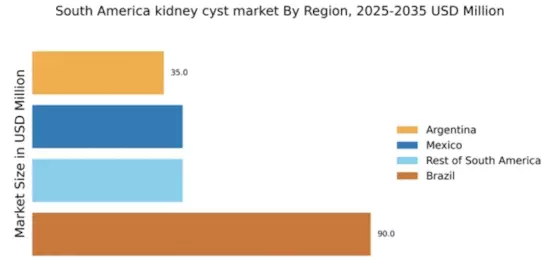
Brazil holds a commanding 90.0% market share in the kidney cyst market, driven by increasing healthcare investments and a growing aging population. Key growth drivers include advancements in medical technology, government initiatives to improve healthcare access, and rising awareness of kidney health. Regulatory policies favoring innovation and infrastructure development further bolster market demand, with a focus on urban centers like São Paulo and Rio de Janeiro.
Mexico accounts for a 40.0% share in the kidney cyst market, with significant growth potential driven by rising healthcare awareness and improved access to medical services. Demand trends indicate a shift towards minimally invasive procedures, supported by government health initiatives aimed at chronic disease management. The regulatory environment is evolving to facilitate faster approvals for new treatments, enhancing market dynamics.
Argentina holds a 35.0% market share in the kidney cyst sector, characterized by steady growth despite economic challenges. Key growth drivers include healthcare reforms aimed at improving patient access and the introduction of innovative treatment options. Demand is influenced by urbanization trends in cities like Buenos Aires and Córdoba, where healthcare facilities are expanding to meet rising needs. Regulatory policies are adapting to support new technologies in the healthcare sector.
The Rest of South America collectively holds a 40.0% market share in the kidney cyst market, with diverse healthcare needs across countries like Chile, Colombia, and Peru. Key growth drivers include increasing healthcare investments and regional collaborations to enhance medical infrastructure. Demand patterns vary significantly, influenced by local economic conditions and healthcare policies. The competitive landscape features both local and international players, adapting to regional market dynamics.
The competitive dynamics within the kidney cyst market in South America reflect a landscape characterized by innovation and strategic partnerships. Key growth drivers include an increasing prevalence of kidney-related disorders, advancements in imaging technologies, and a growing emphasis on patient-centric care. Major players such as Fresenius Medical Care (DE), Baxter International (US), and Medtronic (US) are actively shaping this environment through their operational focuses. Fresenius Medical Care (DE) emphasizes innovation in dialysis solutions, while Baxter International (US) is enhancing its product portfolio through strategic acquisitions. Medtronic (US) is leveraging digital health technologies to improve patient outcomes, collectively fostering a competitive atmosphere that prioritizes technological advancement and patient care.In terms of business tactics, companies are increasingly localizing manufacturing to reduce costs and optimize supply chains. The market structure appears moderately fragmented, with several key players exerting influence over specific segments. This fragmentation allows for niche players to thrive, while larger companies leverage their resources to capture market share through strategic initiatives. The collective influence of these key players is shaping a competitive environment that encourages innovation and responsiveness to market demands.
In October Fresenius Medical Care (DE) announced a partnership with a local healthcare provider to enhance access to its dialysis services across South America. This strategic move is likely to improve patient access to essential treatments, thereby strengthening Fresenius's market position. The partnership underscores the importance of localized strategies in addressing regional healthcare challenges and expanding service delivery.
In September Baxter International (US) launched a new line of imaging products specifically designed for kidney diagnostics. This introduction not only enhances Baxter's product offerings but also positions the company as a leader in advanced imaging solutions. The strategic importance of this launch lies in its potential to capture a larger share of the diagnostic market, particularly as healthcare providers seek more efficient and accurate diagnostic tools.
In August Medtronic (US) unveiled a digital health platform aimed at improving the management of kidney diseases. This platform integrates AI-driven analytics to provide personalized treatment recommendations. The strategic significance of this initiative is profound, as it aligns with the growing trend towards digitalization in healthcare, potentially transforming patient management and engagement in the kidney cyst market.
As of November current trends in the kidney cyst market are increasingly defined by digitalization, sustainability, and the integration of AI technologies. Strategic alliances are becoming pivotal in shaping the competitive landscape, enabling companies to pool resources and expertise. Looking ahead, competitive differentiation is likely to evolve from traditional price-based competition towards a focus on innovation, technological advancements, and supply chain reliability. This shift suggests that companies prioritizing these elements will be better positioned to thrive in an increasingly complex market.

The South America Kidney Cyst Market has seen significant developments recently, particularly with a growing emphasis on innovative treatment methodologies. Companies such as DaVita Inc. and Fresenius Medical Care continue to expand their dialysis services to cater to the increasing patient population with kidney-related issues. In June 2023, Otsuka Pharmaceutical announced advancements in its Research and Development initiatives focused on renal health, reflecting the escalating demand for effective therapeutic options in the region.
Furthermore, a notable acquisition took place in July 2023, when Amgen acquired a smaller biotech firm to enhance its capabilities in treating kidney disorders, signifying a strategic move to fortify its market position. The market valuation has been positively influenced by expanding healthcare infrastructure in countries such as Brazil and Argentina, leading to better access to renal care solutions.
Over the past two years, significant investments in biotechnology, particularly by companies like Eli Lilly and Company and Roche, have also contributed to advancements in kidney cyst management, ensuring that the region is becoming a pivotal area for ongoing renal health innovations.
The Kidney Cyst Market is projected to grow at a 6.02% CAGR from 2025 to 2035, driven by increasing prevalence and advancements in diagnostic technologies.
New opportunities lie in:
By 2035, the kidney cyst market is expected to achieve substantial growth and innovation.
| MARKET SIZE 2024 | 205.0(USD Million) |
| MARKET SIZE 2025 | 217.34(USD Million) |
| MARKET SIZE 2035 | 390.0(USD Million) |
| COMPOUND ANNUAL GROWTH RATE (CAGR) | 6.02% (2025 - 2035) |
| REPORT COVERAGE | Revenue Forecast, Competitive Landscape, Growth Factors, and Trends |
| BASE YEAR | 2024 |
| Market Forecast Period | 2025 - 2035 |
| Historical Data | 2019 - 2024 |
| Market Forecast Units | USD Million |
| Key Companies Profiled | Fresenius Medical Care (DE), Baxter International (US), Medtronic (US), Siemens Healthineers (DE), GE Healthcare (US), Philips Healthcare (NL), Johnson & Johnson (US), Abbott Laboratories (US) |
| Segments Covered | Type, Diagnosis Method, Treatment Method, End-Use |
| Key Market Opportunities | Emerging diagnostic technologies enhance early detection and treatment options in the kidney cyst market. |
| Key Market Dynamics | Rising prevalence of kidney cysts drives demand for advanced diagnostic and treatment solutions in South America. |
| Countries Covered | Brazil, Mexico, Argentina, Rest of South America |
The overall market valuation for the kidney cyst market was $205.0 Million in 2024.
The projected market valuation for 2035 is $390.0 Million.
The expected CAGR for the kidney cyst market during the forecast period 2025 - 2035 is 6.02%.
In 2024, the Simple Kidney Cyst had the highest valuation at $85.0 Million.
The projected valuation for the Complex Kidney Cyst segment by 2035 is $130.0 Million.
The Ultrasound diagnosis method generated the highest revenue in 2024, amounting to $60.0 Million.
The expected revenue for the Surgery treatment method by 2035 is $100.0 Million.
In 2024, hospitals had a market valuation of $82.0 Million, compared to clinics at $61.0 Million.
Fresenius Medical Care is recognized for its leadership in the kidney cyst market.
The projected revenue for the Observation treatment method by 2035 is $160.0 Million.


Kindly complete the form below to receive a free sample of this Report

“This is really good guys. Excellent work on a tight deadline. I will continue to use you going forward and recommend you to others. Nice job”


“Thanks. It’s been a pleasure working with you, please use me as reference with any other Intel employees.”


“Thanks for sending the report it gives us a good global view of the Betaïne market.”


“Thank you, this will be very helpful for OQS.”


“We found the report very insightful! we found your research firm very helpful. I'm sending this email to secure our future business.”


“I am very pleased with how market segments have been defined in a relevant way for my purposes (such as "Portable Freezers & refrigerators" and "last-mile"). In general the report is well structured. Thanks very much for your efforts.”


“I have been reading the first document or the study, ,the Global HVAC and FP market report 2021 till 2026. Must say, good info! I have not gone in depth at all parts, but got a good indication of the data inside!”


“We got the report in time, we really thank you for your support in this process. I also thank to all of your team as they did a great job.”


“The Automotive 48V ECU Components Procurement Intelligence Study” was a complex project, but the Market Research Future (MRFR) team handled it with quality, agility, and customer-centricity. They delivered all requested data on time and within the agreed scope. The team, including Shubhendra Anand and Rahul Gotadki, was always readily available to clarify questions and swiftly implement necessary adjustments, driving the project to a successful conclusion within a very demanding timeframe.
I would also like to specifically commend Akshay Agarwal for his responsiveness and support at every stage—from our initial inquiry on May 6th through to final delivery on June 18th. His dedication made the entire process seamless.”



