Download Free Sample
Kindly complete the form below to receive a free sample of this Report
South America Lip Augmentation Market Research Report By Type of Procedure (Injectable Fillers, Fat Grafting, Implants), By Material Used (Hyaluronic Acid, Collagen, Silicone, Autologous Fat, PMMA), By Application (Cosmetic Enhancement, Reconstructive Surgery, Medical Treatments), By End Use (Clinics, Hospitals, Beauty Salons, Home Care) and By Regional (Brazil, Mexico, Argentina, Rest of South America) - Growth & Industry Forecast 2025 To 2035
As per Market Research Future analysis, the South America lip augmentation market Size was estimated at 314.87 USD Million in 2024. The South America lip augmentation market is projected to grow from 341.44 USD Million in 2025 to 767.4 USD Million by 2035, exhibiting a compound annual growth rate (CAGR) of 8.4% during the forecast period 2025 - 2035
The South America lip augmentation market is experiencing robust growth driven by evolving consumer preferences and technological advancements.
| 2024 Market Size | 314.87 (USD Million) |
| 2035 Market Size | 767.4 (USD Million) |
| CAGR (2025 - 2035) | 8.44% |
Allergan (US), Revance Therapeutics (US), Medytox (KR), Galderma (CH), Ipsen (FR), Hugel (KR), Sientra (US), Medytox (KR), Hyaluronic Acid (US)
Our Impact
Enabled $4.3B Revenue Impact for Fortune 500 and Leading Multinationals
Partnering with 2000+ Global Organizations Each Year
30K+ Citations by Top-Tier Firms in the Industry
The lip augmentation market is experiencing notable growth in South America, driven by increasing consumer interest in aesthetic enhancements. This trend appears to be influenced by a rising awareness of beauty standards and the desire for fuller lips, which are often associated with youthfulness and attractiveness. The availability of various procedures, including dermal fillers and surgical options, contributes to the market's expansion. Additionally, social media platforms play a significant role in shaping perceptions and driving demand, as individuals seek to emulate the looks of influencers and celebrities. As a result, the market is likely to see a diverse range of offerings catering to different preferences and budgets. Moreover, the regulatory environment in South America is evolving, with governments implementing guidelines to ensure safety and efficacy in cosmetic procedures. This regulatory framework may enhance consumer confidence, potentially leading to increased participation in the lip augmentation market. Furthermore, advancements in technology and techniques are likely to improve the outcomes of these procedures, making them more appealing to a broader audience. Overall, the lip augmentation market in South America seems poised for continued growth, reflecting changing beauty ideals and consumer behaviors.
There is a growing preference for non-surgical lip augmentation methods, such as hyaluronic acid fillers. These options are perceived as less invasive and offer quicker recovery times, appealing to a wider demographic. As consumers become more informed about the benefits and risks, the demand for these procedures is likely to increase.
Social media platforms are significantly impacting beauty trends, with many individuals seeking to replicate the looks of popular influencers. This trend is driving interest in lip augmentation, as users share their experiences and results online. The visibility of these procedures on social media may encourage more people to consider enhancements.
The regulatory landscape surrounding cosmetic procedures is becoming more stringent in South America. Governments are implementing guidelines to ensure the safety and efficacy of lip augmentation treatments. This focus on regulation may enhance consumer trust and encourage participation in the market.
The increase in disposable income among South American consumers is a critical factor influencing the lip augmentation market. As economic conditions improve, individuals are more willing to invest in personal aesthetics and cosmetic procedures. This trend is particularly pronounced in emerging markets within the region, where rising incomes correlate with a growing middle class. Market analysis indicates that spending on cosmetic procedures, including lip augmentation, has increased by approximately 20% over the past two years. This financial capability allows more individuals to consider lip augmentation as a viable option, thereby driving growth in the lip augmentation market.
The growing awareness of aesthetic procedures among the South American population appears to be a significant driver for the lip augmentation market. As individuals become more conscious of their appearance, the demand for cosmetic enhancements, including lip augmentation, is likely to rise. This trend is particularly evident in urban areas where beauty standards are heavily influenced by media portrayals. According to recent data, the aesthetic market in South America is projected to grow at a CAGR of approximately 8% over the next five years. This increasing aesthetic awareness is expected to propel the lip augmentation market, as more individuals seek to enhance their facial features and boost their self-esteem.
The influence of celebrity endorsements on beauty trends is a notable driver for the lip augmentation market in South America. As public figures openly discuss their cosmetic procedures, including lip augmentation, they contribute to normalizing these enhancements. This visibility can lead to increased interest and inquiries about lip augmentation services among the general population. Social media platforms serve as a powerful tool for celebrities to showcase their enhanced features, further driving demand. The lip augmentation market is likely to benefit from this trend, as more individuals seek to emulate their favorite celebrities, leading to a potential increase in procedures performed.
Technological innovations in lip augmentation techniques are transforming the landscape of the lip augmentation market in South America. The introduction of advanced fillers and minimally invasive procedures has made lip augmentation more accessible and appealing to a broader audience. For instance, the use of hyaluronic acid fillers has gained popularity due to their safety profile and reversible nature. As these technologies continue to evolve, they are likely to attract a larger clientele, contributing to market growth. Furthermore, the increasing availability of training programs for practitioners ensures that more professionals are equipped to perform these procedures, thereby enhancing the overall quality and safety of the lip augmentation market.
Cultural shifts in South America are increasingly favoring cosmetic enhancements, which is likely to impact the lip augmentation market positively. Traditionally, beauty standards in the region have emphasized fuller lips, and this trend is becoming more mainstream. As societal norms evolve, more individuals are embracing cosmetic procedures as a means of self-expression. This cultural acceptance is reflected in the rising number of clinics offering lip augmentation services. Market data suggests that the demand for lip fillers has surged by approximately 15% in the last year alone, indicating a robust growth trajectory for the lip augmentation market in South America.
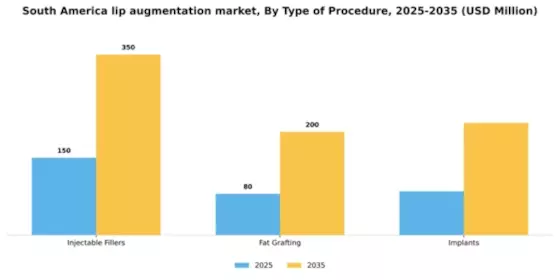
In the lip augmentation market, Injectable Fillers hold the largest market share, as they are widely preferred due to their immediate results and minimal recovery time. This segment appeals to a broad demographic, contributing significantly to overall market dynamics. Fat Grafting, although currently smaller in market share, is gaining traction as a natural alternative, attracting a niche audience looking for longer-lasting results.
Growth trends indicate a rising demand for non-surgical procedures, driven by increasing awareness and acceptance of aesthetic treatments. Factors such as advancements in formulation technology and enhanced safety profiles are propelling the Injectable Fillers segment forward, while Fat Grafting is experiencing growth fueled by consumer desire for more organic and natural enhancement methods. As aesthetic preferences evolve, these segments are likely to see continued growth over the coming years.
Injectable Fillers (Dominant) vs. Fat Grafting (Emerging)
Injectable Fillers are establishing themselves as the dominant force within the lip augmentation landscape, characterized by their convenience and immediate aesthetic outcomes. They encompass a range of products, including hyaluronic acid-based fillers, which are favored for their reversibility and safety. As techniques improve and formulations evolve, this segment has maintained its stronghold by continually meeting consumer expectations. Conversely, Fat Grafting is viewed as an emerging segment that appeals to those seeking more permanent results through natural fat transfer techniques. Although it currently represents a smaller market share, the increasing preference for sustainable beauty practices positions it as a compelling alternative, allowing practitioners to address customer desires for holistic enhancements.
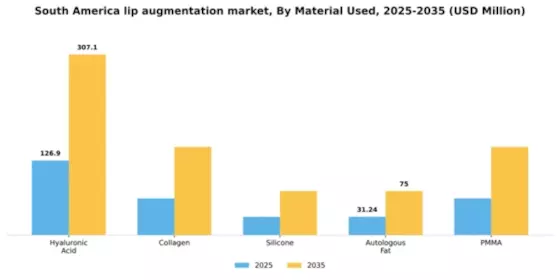
The distribution of market share among various materials used for lip augmentation reveals that Hyaluronic Acid holds the largest share due to its biocompatibility and minimal side effects. Other materials like Collagen and Silicone also have notable representation, but they face challenges in preference and regulatory scrutiny. Autologous Fat, while traditionally used, is gaining traction due to advancements in techniques that enhance its effectiveness, making it a growing choice among practitioners.
Growth trends in the segment are driven by increasing consumer awareness and demand for lip enhancement procedures. Hyaluronic Acid remains the dominant player due to its ease of use and natural look, while Autologous Fat is emerging as a fast-growing alternative driven by its organic appeal. Factors such as changing beauty standards and the rise of social media influence also play a significant role in shaping these trends, pushing the market towards safer and more effective options.
Hyaluronic Acid (Dominant) vs. Autologous Fat (Emerging)
Hyaluronic Acid is the dominant material in the lip augmentation segment, appreciated for its versatility, safety, and temporary results. Its gel-like properties allow for precise injection and a natural appearance, making it a preferred choice among both patients and practitioners. On the other hand, Autologous Fat is emerging as a viable alternative, offering the advantage of using the body's own tissues, thereby reducing the risk of allergic reactions. This method, although more complex, is increasingly favored for its long-lasting results and minimal side effects. As techniques improve, Autologous Fat is steadily gaining acceptance in the market, catering to consumers seeking natural, sustainable augmentation methods.
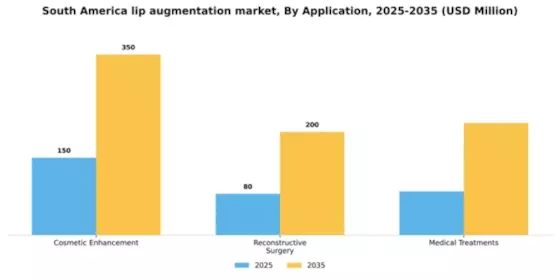
In the South America lip augmentation market, the application segment is predominantly led by Cosmetic Enhancement, which captures the largest market share. This category reflects the growing demand for aesthetic improvements among consumers, driven by factors such as increased disposable income, social media influence, and a shift towards self-image enhancement. Following closely, Reconstructive Surgery is gaining traction as a significant portion of the market, as it caters to individuals seeking corrective procedures due to accidents or congenital conditions.
The growth trends within these applications show a noticeable rise in Cosmetic Enhancement procedures as preferences for fuller lips and enhanced facial features become mainstream. Meanwhile, the Reconstructive Surgery segment is witnessing the fastest growth, fueled by advances in surgical techniques and an increasing acceptance of medical intervention for physical restoration. This growth is further supported by rising awareness of the psychological benefits of aesthetic procedures and broader accessibility through improved healthcare services.
Cosmetic Enhancement: Dominant vs. Reconstructive Surgery: Emerging
Cosmetic Enhancement is characterized by its widespread popularity and strong consumer interest, dominating the application segment of lip augmentation. This segment includes various procedures aimed at enhancing aesthetic appeal, making it the first choice among clients seeking beauty improvements. Conversely, Reconstructive Surgery, while emerging, is positioned to capture a significant share of the market due to its critical role in helping individuals restore their physical appearance after trauma or congenital issues. The increasing recognition of the importance of mental health related to physical appearance drives demand in this segment, as patients seek solutions that not only enhance their beauty but also address functional and psychological needs.
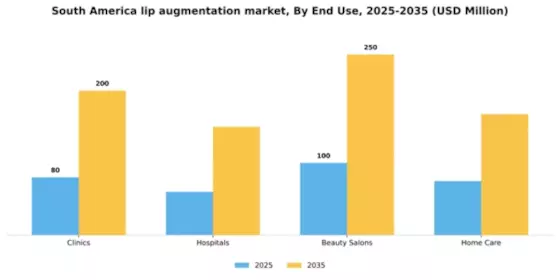
In the lip augmentation segment, clinics hold the largest share due to their focus on specialized cosmetic procedures, attracting a clientele seeking professional enhancement. Hospitals also contribute significantly, offering medical-grade procedures that ensure safety and efficacy. Beauty salons, while smaller in market share, are gaining traction as more consumers opt for less invasive and more affordable options. Home care products, though niche, appeal to those desiring convenience and privacy in their beauty routines.
Growth trends indicate that beauty salons are the fastest-growing segment, driven by a rising acceptance of non-surgical enhancements and increasing consumer awareness. Clinics continue to expand their services and incorporate advanced technologies, thereby enhancing customer experience. The home care segment is benefiting from innovations in DIY kits, enabling users to experiment with lip augmentation at home, further diversifying the market landscape.
Clinics (Dominant) vs. Beauty Salons (Emerging)
Clinics play a dominant role in the South American lip augmentation market by providing professional, high-quality services, thus instilling confidence among clients who prioritize results and safety. Their established reputation and specialized expertise make them the go-to choice for many. Conversely, beauty salons represent an emerging option, gaining popularity due to their accessibility and affordability. They cater to a younger demographic interested in enhancing their appearance with less invasive techniques. Both segments reflect a growing trend towards individualized beauty experiences, catering to diverse consumer preferences while emphasizing both professional care and convenience.
Get more detailed insights about South America Lip Augmentation Market Request Free Sample
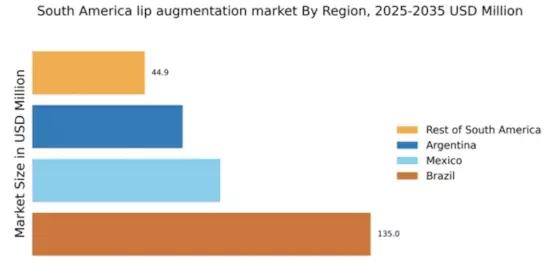
Brazil holds a commanding market share of 135.0, representing a significant portion of South America's lip augmentation sector. Key growth drivers include a rising demand for cosmetic procedures, influenced by cultural trends favoring enhanced aesthetics. Regulatory policies are supportive, with the Brazilian Health Regulatory Agency (ANVISA) ensuring safety standards. The country's robust healthcare infrastructure and increasing number of aesthetic clinics further bolster market growth.
Mexico's lip augmentation market is valued at 75.0, showcasing a growing interest in cosmetic enhancements. Factors driving this growth include a youthful population and increasing disposable income, leading to higher spending on beauty treatments. Regulatory frameworks are evolving, with the Federal Commission for Protection against Sanitary Risk (COFEPRIS) overseeing product safety. The market is characterized by a rise in aesthetic clinics, particularly in urban areas.
Argentina's lip augmentation market is valued at 60.0, reflecting steady growth in cosmetic procedures. The demand is driven by cultural acceptance of aesthetic enhancements and a growing middle class willing to invest in beauty. Regulatory bodies like the National Administration of Drugs, Foods and Medical Devices (ANMAT) ensure compliance and safety. The market is supported by a network of clinics in major cities such as Buenos Aires and Córdoba, enhancing accessibility.
The Rest of South America accounts for a market value of 44.87, with diverse dynamics influencing growth. Factors such as varying economic conditions and cultural attitudes towards cosmetic procedures create unique challenges. Regulatory environments differ significantly, impacting market entry for international players. Key cities like Santiago and Lima are emerging markets, with local clinics gaining traction. The competitive landscape includes both global and regional players, adapting to local preferences.
The lip augmentation market in South America is characterized by a dynamic competitive landscape, driven by increasing consumer demand for aesthetic procedures and advancements in product offerings. Key players such as Allergan (US), Galderma (CH), and Revance Therapeutics (US) are strategically positioned to leverage innovation and regional expansion. Allergan (US) focuses on enhancing its product portfolio through continuous research and development, while Galderma (CH) emphasizes partnerships with local clinics to improve service delivery. Revance Therapeutics (US) appears to be concentrating on digital transformation initiatives to enhance customer engagement, collectively shaping a competitive environment that prioritizes innovation and accessibility.In terms of business tactics, companies are increasingly localizing manufacturing to reduce costs and improve supply chain efficiency. The market structure is moderately fragmented, with several players vying for market share. This fragmentation allows for diverse offerings, yet the collective influence of major companies like Allergan (US) and Galderma (CH) remains significant, as they set industry standards and drive consumer expectations.
In October Allergan (US) announced the launch of a new hyaluronic acid-based filler specifically designed for lip augmentation, which is expected to enhance patient satisfaction through longer-lasting results. This strategic move not only reinforces Allergan's commitment to innovation but also positions the company to capture a larger share of the growing market, as consumers increasingly seek effective and durable solutions.
In September Galderma (CH) entered into a partnership with a leading aesthetic clinic chain in Brazil, aiming to expand its distribution network and improve access to its products. This collaboration is strategically important as it allows Galderma to tap into the burgeoning Brazilian market, which is witnessing a surge in demand for lip augmentation procedures, thereby enhancing its competitive positioning in the region.
In November Revance Therapeutics (US) unveiled a new digital platform designed to streamline the patient consultation process for lip augmentation. This initiative reflects a broader trend towards digitalization in the aesthetic industry, enabling Revance to enhance customer experience and engagement. By integrating technology into its service offerings, the company is likely to differentiate itself in a crowded market, appealing to tech-savvy consumers seeking convenience and efficiency.
As of November current competitive trends indicate a shift towards digitalization, sustainability, and the integration of artificial intelligence in product development and customer engagement. Strategic alliances are increasingly shaping the landscape, allowing companies to pool resources and expertise. Looking ahead, competitive differentiation is expected to evolve from traditional price-based competition to a focus on innovation, technological advancements, and supply chain reliability, as companies strive to meet the sophisticated demands of consumers.
Recent developments in the South America Lip Augmentation Market reveal a growing trend marked by increased demand for cosmetic procedures, particularly among younger demographics seeking enhanced aesthetic features. Companies like Allergan and Galderma are expanding their presence through new product launches and marketing initiatives tailored to regional preferences. In March 2023, Merz Pharmaceuticals announced the introduction of a new hyaluronic acid-based filler specifically designed for Brazilian consumers, aligning with local beauty standards. Additionally, Medytox is partnering with local distributors to enhance its market share for botulinum toxin products used in lip enhancement.
In terms of Mergers and Acquisitions, Ipsen completed the acquisition of a botulinum toxin product line in February 2023, strengthening its portfolio in South America. Furthermore, the Hyaluronic Acid Manufacturers Association conducted a summit in July 2022 to address regulatory challenges and promote the growth of lip augmentation procedures across the continent. The market growth is also fueled by increasingly accessible cosmetic clinics and rising disposable incomes in countries like Brazil and Argentina, leading to a significant increase in the value of the lip augmentation market.
The Lip Augmentation Market is projected to grow at an 8.44% CAGR from 2025 to 2035, driven by increasing aesthetic awareness and technological advancements.
New opportunities lie in:
By 2035, the market is expected to achieve substantial growth, reflecting evolving consumer preferences.
| MARKET SIZE 2024 | 314.87(USD Million) |
| MARKET SIZE 2025 | 341.44(USD Million) |
| MARKET SIZE 2035 | 767.4(USD Million) |
| COMPOUND ANNUAL GROWTH RATE (CAGR) | 8.44% (2025 - 2035) |
| REPORT COVERAGE | Revenue Forecast, Competitive Landscape, Growth Factors, and Trends |
| BASE YEAR | 2024 |
| Market Forecast Period | 2025 - 2035 |
| Historical Data | 2019 - 2024 |
| Market Forecast Units | USD Million |
| Key Companies Profiled | Allergan (US), Revance Therapeutics (US), Medytox (KR), Galderma (CH), Ipsen (FR), Hugel (KR), Sientra (US), Medytox (KR), Hyaluronic Acid (US) |
| Segments Covered | Type of Procedure, Material Used, Application, End Use |
| Key Market Opportunities | Emergence of innovative fillers and minimally invasive techniques enhances growth potential in the lip augmentation market. |
| Key Market Dynamics | Rising consumer demand for minimally invasive procedures drives innovation in lip augmentation techniques across South America. |
| Countries Covered | Brazil, Mexico, Argentina, Rest of South America |
The overall market valuation for lip augmentation was $314.87 Million in 2024.
The projected market valuation for lip augmentation is $767.4 Million by 2035.
The expected CAGR for the lip augmentation market during the forecast period 2025 - 2035 is 8.44%.
In 2024, the type of procedure with the highest valuation was Injectable Fillers, valued at $350.0 Million.
Key materials used in lip augmentation include Hyaluronic Acid, Collagen, Silicone, Autologous Fat, and PMMA.
The valuation of Hyaluronic Acid in 2024 was $126.94 Million.
The Cosmetic Enhancement application segment is expected to grow significantly, with a valuation projected at $350.0 Million by 2035.
The market valuation for beauty salons in 2024 was $100.0 Million.
Key players in the lip augmentation market include Allergan, Revance Therapeutics, Medytox, Galderma, Ipsen, Hugel, Sientra, and Hyaluronic Acid.
The projected valuation for fat grafting procedures is $200.0 Million by 2035.


Kindly complete the form below to receive a free sample of this Report

“This is really good guys. Excellent work on a tight deadline. I will continue to use you going forward and recommend you to others. Nice job”


“Thanks. It’s been a pleasure working with you, please use me as reference with any other Intel employees.”


“Thanks for sending the report it gives us a good global view of the Betaïne market.”


“Thank you, this will be very helpful for OQS.”


“We found the report very insightful! we found your research firm very helpful. I'm sending this email to secure our future business.”


“I am very pleased with how market segments have been defined in a relevant way for my purposes (such as "Portable Freezers & refrigerators" and "last-mile"). In general the report is well structured. Thanks very much for your efforts.”


“I have been reading the first document or the study, ,the Global HVAC and FP market report 2021 till 2026. Must say, good info! I have not gone in depth at all parts, but got a good indication of the data inside!”


“We got the report in time, we really thank you for your support in this process. I also thank to all of your team as they did a great job.”


“The Automotive 48V ECU Components Procurement Intelligence Study” was a complex project, but the Market Research Future (MRFR) team handled it with quality, agility, and customer-centricity. They delivered all requested data on time and within the agreed scope. The team, including Shubhendra Anand and Rahul Gotadki, was always readily available to clarify questions and swiftly implement necessary adjustments, driving the project to a successful conclusion within a very demanding timeframe.
I would also like to specifically commend Akshay Agarwal for his responsiveness and support at every stage—from our initial inquiry on May 6th through to final delivery on June 18th. His dedication made the entire process seamless.”



