×
Request Free Sample ×

Kindly complete the form below to receive a free sample of this Report

Leading companies partner with us for data-driven Insights

clients tt-cursor
Hero Background

South America M2M Communication Market

ID: MRFR/ICT/60659-HCR
200 Pages
Aarti Dhapte
October 2025

South America M2M Communication Market Research Report By Application (Telematics, Smart Grids, Healthcare, Industrial Automation, Smart Cities), By Connectivity Technology (Cellular, Satellite, Wi-Fi, Bluetooth, LPWAN), By Type (Hardware, Software, Connectivity Services), By End Use (Automotive, Healthcare, Manufacturing, Utilities, Retail) and By Regional (Brazil, Mexico, Argentina, Rest of South America)- Forecast to 2035

Share:
Download PDF ×

We do not share your information with anyone. However, we may send you emails based on your report interest from time to time. You may contact us at any time to opt-out.

South America M2M Communication Market Infographic
Purchase Options

South America M2M Communication Market Summary

As per MRFR analysis, the South America m2m communication market size was estimated at 3917.0 USD Million in 2024. The South America m2m communication market is projected to grow from 4074.86 USD Million in 2025 to 6052.0 USD Million by 2035, exhibiting a compound annual growth rate (CAGR) of 4.03% during the forecast period 2025 - 2035.

Key Market Trends & Highlights

The South America m2m communication market is experiencing robust growth driven by technological advancements and increasing demand across various sectors.

  • Brazil remains the largest market for m2m communication, showcasing a strong adoption in agriculture and smart city initiatives.
  • Mexico is emerging as the fastest-growing region, with significant investments in smart transportation solutions and healthcare applications.
  • The expansion of the IoT ecosystem is facilitating the integration of m2m communication across diverse industries, enhancing operational efficiency.
  • Key market drivers include the rising demand for smart cities and the enhancement of industrial automation, which are propelling market growth.

Market Size & Forecast

2024 Market Size 3917.0 (USD Million)
2035 Market Size 6052.0 (USD Million)

Major Players

AT&T (US), Verizon (US), Vodafone (GB), Telefónica (ES), Deutsche Telekom (DE), Orange (FR), T-Mobile (US), China Mobile (CN), China Telecom (CN)

South America M2M Communication Market Trends

The m2m communication market in South America is currently experiencing a notable evolution, driven by the increasing demand for automation and connectivity across various sectors. Industries such as agriculture, transportation, and healthcare are increasingly adopting m2m solutions to enhance operational efficiency and improve service delivery. This trend appears to be fueled by the growing need for real-time data exchange and remote monitoring capabilities, which are essential for optimizing processes and reducing costs. Furthermore, the expansion of mobile networks and the advent of IoT technologies are likely to play a crucial role in shaping the future landscape of this market. In addition, regulatory frameworks in South America are evolving to support the growth of m2m communication. Governments are recognizing the potential benefits of these technologies in driving economic development and improving public services. As a result, initiatives aimed at fostering innovation and investment in m2m solutions are being implemented. This supportive environment may encourage more businesses to explore m2m applications, thereby contributing to the overall growth of the market. The interplay between technological advancements and regulatory support suggests a promising outlook for the m2m communication market in the region.

Increased Adoption in Agriculture

The m2m communication market is witnessing heightened interest from the agricultural sector. Farmers are increasingly utilizing m2m technologies for precision farming, which allows for better resource management and crop monitoring. This trend indicates a shift towards more sustainable practices, as m2m solutions enable farmers to optimize water usage and reduce waste.

Growth in Smart Transportation Solutions

There is a rising trend towards the implementation of smart transportation systems within the m2m communication market. This includes the integration of m2m technologies in logistics and fleet management, enhancing route optimization and vehicle tracking. Such advancements are likely to improve efficiency and reduce operational costs for transportation companies.

Expansion of Healthcare Applications

The healthcare sector is increasingly leveraging m2m communication for remote patient monitoring and telemedicine services. This trend suggests a growing recognition of the importance of real-time health data in improving patient outcomes. As healthcare providers adopt these technologies, the m2m communication market is expected to expand significantly in this domain.

South America M2M Communication Market Drivers

Expansion of IoT Ecosystem

The m2m communication market in South America is poised for growth due to the expansion of the Internet of Things (IoT) ecosystem. With an estimated 30 billion connected devices expected by 2025, the demand for seamless communication between these devices is paramount. M2M communication serves as the backbone of IoT, enabling devices to communicate and share data effectively. This trend is particularly evident in sectors such as agriculture, where smart farming solutions are gaining traction. The m2m communication market is likely to benefit from the increasing integration of IoT solutions across various sectors, leading to enhanced operational efficiencies and new business models.

Rising Demand for Smart Cities

The m2m communication market in South America is experiencing a notable surge due to the increasing demand for smart city initiatives. Urbanization is accelerating, with over 80% of the population projected to reside in urban areas by 2030. This urban shift necessitates advanced communication technologies to manage resources efficiently. M2M communication facilitates real-time data exchange, enhancing public services such as waste management, traffic control, and energy distribution. The investment in smart infrastructure is expected to reach approximately $100 billion by 2025, indicating a robust growth trajectory for the m2m communication market. As municipalities seek to improve living standards and operational efficiency, the integration of m2m solutions becomes imperative.

Growing Focus on Energy Management

The m2m communication market in South America is increasingly influenced by the growing focus on energy management. As energy consumption rises, there is a pressing need for efficient energy solutions. M2M communication enables real-time monitoring and management of energy resources, facilitating the integration of renewable energy sources. The market for smart meters is projected to grow by 15% annually, reflecting the rising demand for energy efficiency. This trend is likely to drive the m2m communication market as utilities and consumers seek to optimize energy usage and reduce costs.

Enhancement of Industrial Automation

The m2m communication market in South America is significantly driven by the enhancement of industrial automation. Industries are increasingly adopting automation technologies to improve productivity and reduce operational costs. The manufacturing sector, in particular, is projected to grow at a CAGR of 8% from 2025 to 2030, with m2m communication playing a crucial role in connecting machines and systems. This connectivity allows for real-time monitoring and predictive maintenance, which can lead to a reduction in downtime and maintenance costs. As companies strive for operational excellence, the m2m communication market is likely to see substantial investments in automation technologies, further propelling its growth.

Government Initiatives and Regulations

Government initiatives and regulations are playing a pivotal role in shaping the m2m communication market in South America. Various countries are implementing policies to promote digital transformation and enhance connectivity. For instance, Brazil's National Broadband Plan aims to expand internet access, which is crucial for m2m applications. Additionally, regulatory frameworks are being established to ensure data security and privacy, fostering a conducive environment for m2m communication. The m2m communication market is likely to see increased investments as governments collaborate with private sectors to develop smart solutions, thereby driving market growth.

Market Segment Insights

By Application: Telematics (Largest) vs. Smart Cities (Fastest-Growing)

In the South America m2m communication market, Telematics holds the largest share among the application segments, driven by an increase in the demand for connected vehicles and advanced vehicle tracking solutions. Smart Grids and Industrial Automation also contribute significantly, reflecting the growing emphasis on efficient energy management and automation solutions across industries. Healthcare applications are emerging as vital, particularly in telemedicine and remote monitoring systems that cater to the rising health concerns and the need for continuous patient care. Growth trends indicate that Smart Cities are becoming the fastest-growing segment, fueled by urbanization, government initiatives, and the increasing adoption of IoT technologies. The focus on sustainable infrastructure and innovative city management solutions is driving investments in Smart Grids and Industrial Automation as well. Telematics continues to evolve with enhancements in communication technologies, paving the way for new applications and opportunities in logistics and transportation sectors.

Telematics (Dominant) vs. Smart Cities (Emerging)

Telematics is the dominant force in the application segment, characterized by advanced tracking systems and real-time data analytics that cater to the transportation industry. Its robust infrastructure and established market players contribute to its leading position, providing rich insights into vehicle performance, safety, and efficiency. In contrast, Smart Cities represent an emerging segment, gaining momentum as governments and city planners prioritize digital transformation. This sector focuses on integrating IoT solutions for efficient resource management, traffic control, and enhanced public services. Both segments exhibit unique characteristics; Telematics is rooted in automotive advancements, while Smart Cities strive to create smarter, more sustainable urban environments.

By Connectivity Technology: Cellular (Largest) vs. LPWAN (Fastest-Growing)

In the South America m2m communication market, Cellular technology holds the largest market share due to its established infrastructure and reliability in mobile connectivity. This dominance is further supported by the growing demand for mobile data across various industries, including transportation and healthcare, where reliable communication is crucial. In contrast, LPWAN is becoming increasingly significant as it caters to specific use cases requiring low data rates and extended battery life, thus carving out its niche in rural and remote areas. The growth trends in this segment are influenced by the rising adoption of IoT devices, which rely heavily on seamless connectivity technologies. Cellular technology continues to benefit from technological advancements, while LPWAN is driven by innovations aimed at enhancing connectivity in hard-to-reach locations. Furthermore, the push for smart cities and industrial automation is propelling both segments forward, as they play a critical role in the infrastructure of connected environments.

Cellular: Dominant vs. LPWAN: Emerging

Cellular technology's dominance in the South America m2m communication market stems from its robust infrastructure and ability to support high data transmission rates, making it suitable for applications such as fleet management and telehealth solutions. This technology is widely recognized for its reliability and speed, catering to various industries. On the other hand, LPWAN is emerging as a key player, particularly for IoT applications that require long-range connectivity with minimal power consumption. Its low operational costs and capacity to support a multitude of connected devices make it attractive for applications such as smart agriculture and utility monitoring. As LPWAN grows, it serves as an essential complement to cellular services, allowing for diverse connectivity solutions that cater to distinct market needs.

By Type: Hardware (Largest) vs. Software (Fastest-Growing)

Within the Type segment, Hardware accounts for a significant share of the market, positioning itself as the largest contributor to revenue and usage. It typically includes devices such as routers and communication hardware, which are foundational for m2m communication networks. Meanwhile, Software, while holding a smaller market share, is on the rise, driven by advancements in data management and analytics solutions that enhance connectivity and operational efficiency. The growth trends in this segment reveal that the Software sector is rapidly becoming a key player, as businesses increasingly rely on software solutions for automation and data processing. Connectivity Services also illustrate promising growth, particularly as demand for seamless connections and IoT solutions escalates. As technology evolves, companies in South America are prioritizing investments in software development to stay competitive, leading to a surge in its growth trajectory.

Hardware (Dominant) vs. Software (Emerging)

In the South America m2m communication market, Hardware is regarded as the dominant force, providing the essential infrastructure for communication systems. This segment includes networking devices that ensure reliable data transmission across various applications. On the other hand, Software is seen as an emerging player, gaining momentum as organizations seek innovative solutions to optimize operations. The increasing complexity of m2m applications necessitates advanced software tools for better management and analytics. As both segments evolve, synergy between Hardware and Software will play a crucial role in driving market expansion, fostering opportunities for integration and innovation in the region.

By End Use: Healthcare (Largest) vs. Automotive (Fastest-Growing)

The m2m communication market in South America exhibits diverse end use cases, with the healthcare sector leading the share significantly, driven by the demand for telehealth services and connected medical devices. Following closely, the automotive industry is gaining momentum with an increasing number of connected vehicles, showcasing the pivotal role of technology in enhancing safety and efficiency. In terms of growth trends, the healthcare sector continues to expand due to the rising need for remote patient monitoring and health management solutions. Conversely, the automotive segment is experiencing rapid growth as manufacturers increasingly adopt smart technology and connectivity features, making it the fastest-growing sector in m2m communication. This shift is further encouraged by government initiatives promoting intelligent transportation systems.

Healthcare (Dominant) vs. Automotive (Emerging)

The healthcare sector in m2m communication stands out as the dominant player, characterized by innovative solutions that promote patient care and streamline medical processes. The integration of IoT devices, such as wearables and telehealth platforms, facilitates real-time data exchange, significantly enhancing patient outcomes. On the other hand, the automotive sector is emerging swiftly, driven by advancements in connected vehicle technology and the push for smarter mobility solutions. The industry's focus on safety, navigation, and infotainment systems positions it as a critical area for future investments, with increased connectivity likely to redefine traditional automotive experiences.

Get more detailed insights about South America M2M Communication Market

Regional Insights

Brazil : Strong Growth Driven by Innovation

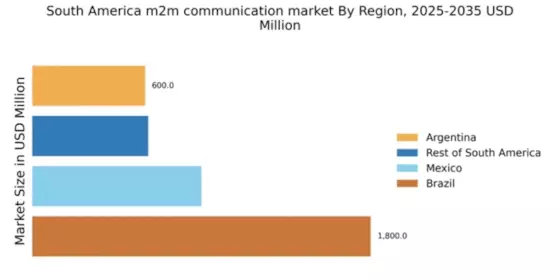
Brazil holds a dominant position in the South American M2M communication market, accounting for 1800.0 million, representing approximately 45.5% of the total market share. Key growth drivers include the rapid expansion of IoT applications, government initiatives promoting digital transformation, and increasing demand for smart city solutions. Regulatory policies are becoming more favorable, with the government investing in infrastructure to support connectivity and industrial development, particularly in urban areas.

Mexico : Emerging Opportunities in Connectivity

Mexico's M2M communication market is valued at 900.0 million, capturing about 22.5% of the South American market. The growth is driven by the increasing adoption of connected devices in sectors like agriculture and transportation. Demand trends show a shift towards automation and real-time data analytics. Government initiatives, such as the National Digital Strategy, aim to enhance connectivity and support the development of smart industries, fostering a conducive environment for M2M solutions.

Argentina : Focus on Agriculture and Industry

Argentina's M2M communication market is valued at 600.0 million, representing 15% of the South American market. The growth is primarily driven by the agricultural sector's increasing reliance on precision farming technologies and IoT solutions. Demand for M2M applications is rising, supported by government policies aimed at enhancing digital infrastructure. The local market is characterized by a growing interest in smart agriculture and industrial automation, with significant investments in connectivity solutions.

Rest of South America : Regional Variations and Opportunities

The Rest of South America holds a market value of 617.0 million, accounting for 17% of the overall market. Growth drivers include varying levels of technological adoption across countries, with some regions focusing on energy management and others on logistics. Demand trends are influenced by local industries, such as mining in Chile and agriculture in Colombia. The competitive landscape features both local and international players, with a focus on tailored solutions for specific sectors.

South America M2M Communication Market Regional Image

Key Players and Competitive Insights

The m2m communication market in South America is characterized by a dynamic competitive landscape, driven by rapid technological advancements and increasing demand for connectivity across various sectors. Key players such as AT&T (US), Telefónica (ES), and Vodafone (GB) are strategically positioned to leverage their extensive networks and innovative solutions. AT&T (US) focuses on enhancing its IoT capabilities, while Telefónica (ES) emphasizes regional expansion and partnerships to bolster its service offerings. Vodafone (GB) is also investing in digital transformation initiatives, which collectively shape a competitive environment that is increasingly reliant on technological innovation and strategic collaborations.

In terms of business tactics, companies are localizing manufacturing and optimizing supply chains to enhance operational efficiency. The market appears moderately fragmented, with several key players exerting influence over specific segments. This fragmentation allows for niche players to emerge, yet the collective strength of major companies like AT&T (US) and Telefónica (ES) ensures that they maintain a significant foothold in the market.

In October 2025, AT&T (US) announced a partnership with a leading South American logistics firm to enhance its IoT solutions for supply chain management. This strategic move is likely to improve operational efficiencies for businesses in the region, showcasing AT&T's commitment to providing tailored solutions that meet local market needs. Such partnerships may also facilitate the integration of advanced analytics and real-time data capabilities, further solidifying AT&T's competitive edge.

In September 2025, Telefónica (ES) launched a new m2m communication platform aimed at small and medium-sized enterprises (SMEs) in South America. This initiative appears to be a strategic response to the growing demand for affordable and scalable IoT solutions among SMEs. By focusing on this segment, Telefónica is likely to capture a significant market share, enhancing its overall service portfolio and reinforcing its position as a market leader.

In August 2025, Vodafone (GB) expanded its IoT network coverage in Brazil, which is expected to enhance connectivity for various industries, including agriculture and transportation. This expansion indicates Vodafone's strategic focus on tapping into the burgeoning IoT market in Brazil, where demand for reliable connectivity solutions is on the rise. Such initiatives may not only improve Vodafone's market presence but also contribute to the overall growth of the m2m communication ecosystem in the region.

As of November 2025, current trends in the m2m communication market include a strong emphasis on digitalization, sustainability, and the integration of artificial intelligence (AI) into operational frameworks. Strategic alliances among key players are shaping the competitive landscape, fostering innovation and collaboration. Looking ahead, it seems that competitive differentiation will increasingly pivot from price-based strategies to a focus on technological innovation, supply chain reliability, and the ability to deliver customized solutions that meet the evolving needs of businesses in South America.

Key Companies in the South America M2M Communication Market market include

Industry Developments

Recent developments in the South America M2M Communication Market indicate significant growth, driven by escalating demands in sectors such as agriculture, manufacturing, and smart cities initiatives. Notably, in July 2023, Aeris Communications expanded its operations within Brazil, enhancing connectivity solutions critical for IoT applications in various industries. Additionally, Movistar, Orange, and Claro are intensifying their efforts in providing robust M2M solutions, responding to an increased demand for real-time data and analytics in urban environments. In terms of mergers and acquisitions, in August 2023, Cisco announced its acquisition of a regional IoT services provider, strengthening its foothold in the region's growing M2M sector. 

Notably, Gemalto and Vodafone have been collaborating extensively to integrate secure communication technologies, showcasing the importance of cybersecurity in M2M communication. The market valuation for major players like Siemens and Huawei has been on the rise, reflecting the increased investment in infrastructure and digital transformation strategies. The South American M2M Communication Market has witnessed substantial advancements over the past two to three years, with the proliferation of connectivity solutions, particularly in the automotive and logistics sectors, facilitating smarter operations across the continent.

Future Outlook

South America M2M Communication Market Future Outlook

The M2M Communication Market is projected to grow at a 4.03% CAGR from 2024 to 2035, driven by advancements in IoT, increased connectivity, and demand for automation.

New opportunities lie in:

  • Development of smart agriculture solutions leveraging IoT sensors for real-time data analysis.
  • Expansion of telemedicine platforms utilizing m2m communication for remote patient monitoring.
  • Implementation of smart city infrastructure projects integrating m2m technologies for efficient resource management.

By 2035, the m2m communication market is expected to be robust, driven by innovative applications and increased adoption.

Market Segmentation

South America M2M Communication Market Type Outlook

  • Hardware
  • Software
  • Connectivity Services

South America M2M Communication Market End Use Outlook

  • Automotive
  • Healthcare
  • Manufacturing
  • Utilities
  • Retail

South America M2M Communication Market Application Outlook

  • Telematics
  • Smart Grids
  • Healthcare
  • Industrial Automation
  • Smart Cities

South America M2M Communication Market Connectivity Technology Outlook

  • Cellular
  • Satellite
  • Wi-Fi
  • Bluetooth
  • LPWAN

Report Scope

MARKET SIZE 20243917.0(USD Million)
MARKET SIZE 20254074.86(USD Million)
MARKET SIZE 20356052.0(USD Million)
COMPOUND ANNUAL GROWTH RATE (CAGR)4.03% (2024 - 2035)
REPORT COVERAGERevenue Forecast, Competitive Landscape, Growth Factors, and Trends
BASE YEAR2024
Market Forecast Period2025 - 2035
Historical Data2019 - 2024
Market Forecast UnitsUSD Million
Key Companies Profiled["AT&T (US)", "Verizon (US)", "Vodafone (GB)", "Telefónica (ES)", "Deutsche Telekom (DE)", "Orange (FR)", "T-Mobile (US)", "China Mobile (CN)", "China Telecom (CN)"]
Segments CoveredApplication, Connectivity Technology, Type, End Use
Key Market OpportunitiesIntegration of advanced IoT solutions enhances efficiency in the m2m communication market.
Key Market DynamicsRising demand for smart agriculture solutions drives growth in the m2m communication market across South America.
Countries CoveredBrazil, Mexico, Argentina, Rest of South America

Leave a Comment

FAQs

What is the expected market size of the South America M2M Communication Market in 2024?

The South America M2M Communication Market is expected to be valued at 4.57 USD Billion in 2024.

What is the projected CAGR for the South America M2M Communication Market from 2025 to 2035?

The South America M2M Communication Market is expected to grow at a CAGR of 5.747% from 2025 to 2035.

Which region is expected to dominate the South America M2M Communication Market?

Brazil is anticipated to hold the largest market share within the South America M2M Communication Market.

What will be the market size of Telematics in the South America M2M Communication Market by 2035?

Telematics is projected to be valued at 2.2 USD Billion in the South America M2M Communication Market by 2035.

Who are the key players in the South America M2M Communication Market?

Major players in the market include Gemalto, Aeris Communications, Movistar, and Orange among others.

What is the expected market size for Smart Grids in 2024?

The market size for Smart Grids in the South America M2M Communication Market is expected to be 0.9 USD Billion in 2024.

How much is the Rest of South America region projected to grow by 2035?

The Rest of South America region is estimated to reach a market size of 3.79 USD Billion by 2035.

What will be the market value for Industrial Automation by 2035?

The market for Industrial Automation in the South America M2M Communication Market is expected to reach 2.0 USD Billion by 2035.

What challenges does the South America M2M Communication Market currently face?

The market faces challenges due to regulatory hurdles and varying technological standards across different regions.

What are the expected growth figures for the Healthcare application in 2024?

In 2024, the Healthcare application in the South America M2M Communication Market is expected to be valued at 0.8 USD Billion.

Download Free Sample

Kindly complete the form below to receive a free sample of this Report

Compare Licence

×
Features License Type
Single User Multiuser License Enterprise User
Price $4,950 $5,950 $7,250
Maximum User Access Limit 1 User Upto 10 Users Unrestricted Access Throughout the Organization
Free Customization
Direct Access to Analyst
Deliverable Format
Platform Access
Discount on Next Purchase 10% 15% 15%
Printable Versions