Download Free Sample
Kindly complete the form below to receive a free sample of this Report
South America Meningococcal Vaccines Market Research Report: Size, Share, Trend Analysis By Vaccine Type (Monovalent Vaccines, Multivalent Vaccines, Conjugate Vaccines), By Age Group (Infants, Children, Adolescents, Adults), By Administration Route (Intramuscular, Subcutaneous, Oral), By Distribution Channel (Hospitals, Clinics, Pharmacies) and By Regional (Brazil, Mexico, Argentina, Rest of South America) - Growth Outlook & Industry Forecast 2025 To 2035
As per analysis, the South America Meningococcal Vaccines Market is projected to grow from USD 459.0 Million in 2024 to USD 669.0 Million by 2035, exhibiting a compound annual growth rate (CAGR) of 3.48% during the forecast period (2025 - 2035).
The South America Meningococcal Vaccines Market is poised for growth driven by increased government initiatives and rising disease incidence.
| 2024 Market Size | 459.0 (USD Million) |
| 2035 Market Size | 669.0 (USD Million) |
| CAGR (2025 - 2035) | 3.48% |
Pfizer (US), GlaxoSmithKline (GB), Sanofi (FR), Merck & Co. (US), Novartis (CH), Baxter International (US), Serum Institute of India (IN), Biological E. Limited (IN)
Our Impact
Enabled $4.3B Revenue Impact for Fortune 500 and Leading Multinationals
Partnering with 2000+ Global Organizations Each Year
30K+ Citations by Top-Tier Firms in the Industry
The South America Meningococcal Vaccines Market is currently experiencing a notable evolution, driven by increasing awareness of meningococcal diseases and the importance of vaccination. Governments across the region are prioritizing immunization programs, which are crucial in combating the spread of these infections. This heightened focus on public health initiatives appears to be fostering a more robust infrastructure for vaccine distribution and accessibility. Furthermore, collaboration between public health authorities and private sector entities seems to be enhancing the overall effectiveness of vaccination campaigns, thereby potentially increasing coverage rates among vulnerable populations. In addition, the South America Meningococcal Vaccines Market is likely to benefit from advancements in vaccine technology. Innovations in formulation and delivery methods may lead to more effective vaccines that are easier to administer. This could result in improved acceptance and uptake among the population. Moreover, ongoing research and development efforts in the region suggest a commitment to addressing the unique epidemiological challenges posed by meningococcal diseases. As a result, the market is poised for growth, with a focus on ensuring that vaccines are not only available but also tailored to meet the specific needs of South American countries.
The South America Meningococcal Vaccines Market is witnessing advancements in vaccine technologies, which may enhance the efficacy and safety of meningococcal vaccines. Innovations such as conjugate vaccines and novel delivery systems are being explored to improve immunogenicity and reduce the number of doses required for effective protection. These technological advancements could lead to increased acceptance of meningococcal vaccination among the population, as healthcare providers advocate for the latest developments in vaccine science. As these emerging technologies gain traction, the South America Meningococcal Vaccines Market is expected to expand, driven by the promise of more effective and user-friendly vaccination options.
The South America Meningococcal Vaccines Market benefits from robust government vaccination programs aimed at controlling the spread of meningococcal disease. Countries like Chile and Colombia have implemented national immunization schedules that include meningococcal vaccines, ensuring widespread access to these critical preventive measures. The Pan American Health Organization supports these initiatives, emphasizing the importance of vaccination in reducing morbidity and mortality associated with meningococcal infections. As governments allocate resources to enhance vaccination coverage, the South America Meningococcal Vaccines Market is likely to see increased uptake of vaccines, contributing to overall public health improvements in the region.
There is a growing awareness of meningococcal disease and its potential consequences among the South American population. Public health campaigns and educational initiatives are being launched to inform communities about the importance of vaccination. This heightened awareness is particularly evident in urban areas, where healthcare access is more prevalent. As individuals become more informed about the risks associated with meningococcal infections, the demand for vaccines is expected to rise. The South America Meningococcal Vaccines Market stands to benefit from this trend, as increased public knowledge translates into higher vaccination rates and a more proactive approach to disease prevention.
The South America Meningococcal Vaccines Market is experiencing a notable increase in the incidence of meningococcal disease, particularly among adolescents and young adults. Countries such as Brazil and Argentina have reported higher rates of infection, prompting health authorities to prioritize vaccination programs. The World Health Organization indicates that the burden of meningococcal disease remains significant in the region, with outbreaks occurring sporadically. This rising incidence is likely to drive demand for meningococcal vaccines, as public health campaigns aim to mitigate the impact of these infections. Consequently, the South America Meningococcal Vaccines Market is poised for growth as governments and healthcare providers respond to the urgent need for effective vaccination strategies.
The South America Meningococcal Vaccines Market is bolstered by collaborations with international health organizations, which provide technical support and funding for vaccination initiatives. Partnerships with entities such as the World Health Organization and the Pan American Health Organization facilitate the sharing of best practices and resources, enhancing the effectiveness of vaccination campaigns. These collaborations often lead to the introduction of new vaccines and improved distribution strategies, ultimately increasing access to meningococcal vaccines across the region. As these partnerships continue to evolve, the South America Meningococcal Vaccines Market is likely to experience growth driven by enhanced vaccine availability and public health infrastructure.
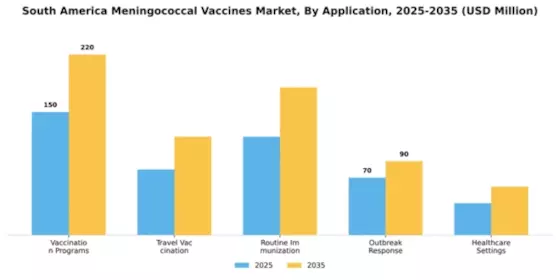
The South America Meningococcal Vaccines Market is characterized by key applications including Vaccination Programs, Travel Vaccination, Routine Immunization, Outbreak Response, and Healthcare Settings. Among these, Vaccination Programs represent the largest segment, reflecting extensive government and organizational support aimed at preventing the spread of meningococcal disease. Travel Vaccination is rapidly gaining momentum, driven by increasing international travel and heightened awareness of health risks among travelers, thus making it the fastest-growing segment in the market. The growth trends within this market segment are influenced by various factors including rising incidences of meningococcal disease and the proactive measures taken by health authorities. Travel Vaccination is experiencing a notable surge, primarily due to awareness campaigns emphasizing its importance for travelers, while Vaccination Programs continue to benefit from governmental initiatives that encourage immunization. Overall, these dynamics are setting a robust foundation for the expansion of the South America Meningococcal Vaccines Market.
Vaccination Programs (Dominant) vs. Travel Vaccination (Emerging)
Vaccination Programs serve as the dominant application in the South America Meningococcal Vaccines Market, fueled by strong governmental and international health organization endorsements. These programs are systematically integrated into public health policies, promoting widespread immunization to curb the incidence of meningococcal diseases. Meanwhile, Travel Vaccination is emerging as a crucial segment owing to the growing number of international travelers who require vaccinations before departing. The rising concern for personal health in foreign countries propels demand, creating a vibrant niche market focused on traveler-specific vaccines. Both segments are vital, yet distinct; Vaccination Programs target community health on a larger scale, while Travel Vaccination serves an individual need, reflecting different strategies and outreach.
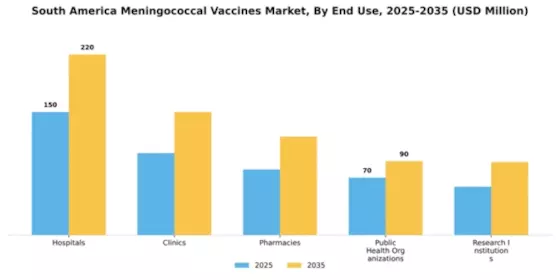
In the South America Meningococcal Vaccines Market, hospitals account for the largest share, primarily due to their essential role in vaccination programs and treatment facilities. Clinics follow as a significant segment, catering to outpatient services but are less dominant compared to hospitals. Pharmacies and research institutions hold smaller, yet crucial shares, contributing to the overall accessibility and innovation in vaccine distribution and studies. Public health organizations, while relatively smaller, are rapidly expanding their influence as vaccination efforts increase across the region.
Hospitals (Dominant) vs. Clinics (Emerging)
Hospitals are the dominant players in the Meningococcal Vaccines Market due to their comprehensive patient care capabilities and critical role in infectious disease management. They serve as the primary vaccination sites, benefitting from more extensive resources and infrastructure. In contrast, clinics represent an emerging segment, appealing to patients seeking quick, accessible services. While they are growing in importance, especially in urban areas, they still rely on hospitals for more severe cases. The overall trend in this sector reflects a push for vaccine accessibility, where hospitals provide extensive vaccination campaigns, thus enhancing community health outcomes.
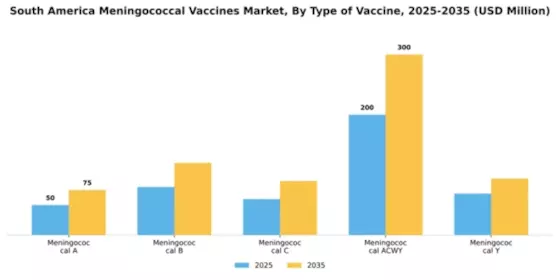
In the South America Meningococcal Vaccines Market, the distribution of market share among vaccine types reveals that Meningococcal A holds the largest share, due to its established use in vaccination programs across various countries. In contrast, Meningococcal B is rapidly gaining traction, reflecting an increase in awareness and immunization efforts aimed at this strain, leading to a shift in market dynamics.
Meningococcal A (Dominant) vs. Meningococcal B (Emerging)
Meningococcal A currently stands as the dominant player in the vaccination landscape, primarily due to its effectiveness in preventing outbreaks that pose significant public health risks. This vaccine is integrated into national immunization schedules, ensuring consistent demand. On the other hand, Meningococcal B is an emerging player in this segment, gaining momentum from increasing epidemiological evidence pointing to its critical role in combating prevalent infections. This surge is supported by enhanced health initiatives targeting at-risk populations and growing investment in vaccine education and distribution, positioning Meningococcal B as a rising contender in the market.
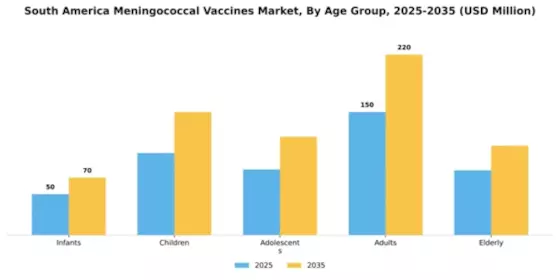
In the South America Meningococcal Vaccines Market, the age segment distribution indicates that Infants represent the largest share due to the increased awareness of vaccine-preventable diseases and recommendations by health authorities. Following Infants, Children and Adolescents also contribute significantly to the market, as immunization programs targeting these groups expand. Meanwhile, Adults have a minor share, but awareness campaigns are gradually increasing their involvement in vaccination programs, while the Elderly segment is gaining attention but currently holds a smaller market share. Growth trends indicate a shift towards younger demographics, particularly Infants, as parents become more informed about the health benefits of vaccinations. The rising incidence of meningococcal disease in older populations is creating a push for vaccinations among the Elderly, labeling it as the fastest-growing segment. This trend is supported by government policies emphasizing vaccination in all age groups, aiming to enhance community health and combat outbreaks.
Infants (Dominant) vs. Elderly (Emerging)
Infants represent the dominant segment in the South America Meningococcal Vaccines Market, primarily driven by proactive healthcare policies and increased parental awareness regarding the importance of early vaccination. This age group benefits from national immunization schedules, which prioritize vaccinations at infancy. In contrast, the Elderly segment, though emerging, is increasingly recognized for its healthcare needs, especially concerning meningococcal disease, as the population ages and health authorities begin to identify the necessity of vaccinating older adults. Efforts to educate this demographic about the risks associated with meningococcal disease are gradually leading to a rise in vaccination uptake, making them a crucial area for future growth.
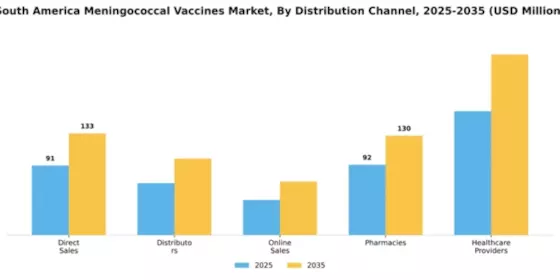
In the South America Meningococcal Vaccines Market, the distribution of sales channels shows a significant reliance on direct sales, which commands the largest share of the market. This channel allows manufacturers to engage directly with healthcare providers, ensuring better control over the distribution process and fostering closer relationships with clients. On the other hand, pharmacies represent a rapidly expanding segment, gradually increasing their market share through improved accessibility and awareness among the general population.
Direct Sales (Dominant) vs. Pharmacies (Emerging)
Direct sales are a dominant force in the South America Meningococcal vaccines distribution landscape, as this approach enables pharmaceutical companies to maintain a robust connection with healthcare providers and governmental health organizations. By leveraging direct sales, companies are positioned to offer tailored solutions to healthcare systems, building trust and reliability. Conversely, pharmacies are emerging as a vital component of distribution, motivated by rising vaccination rates and public health initiatives. Their role is growing as they become more integrated into vaccination campaigns and increasingly provide customer-facing services that enhance accessibility to meningococcal vaccines, leading to their rapid rise in importance.
Get more detailed insights about South America Meningococcal Vaccines Market Request Free Sample
Brazil holds a commanding market share of 210.0, representing a significant portion of the South American Meningococcal vaccines market. Key growth drivers include increasing awareness of vaccine-preventable diseases, government initiatives promoting immunization, and a robust healthcare infrastructure. The demand for Meningococcal vaccines is bolstered by rising incidences of meningitis and a proactive approach from health authorities. Regulatory policies favoring vaccine accessibility further enhance market potential, supported by ongoing industrial development in biopharmaceuticals.
Mexico's Meningococcal vaccines market is valued at 90.0, reflecting a growing awareness of public health. Key growth drivers include government campaigns aimed at increasing vaccination rates and partnerships with international organizations to improve healthcare access. Demand trends indicate a rising consumption of vaccines among younger populations, driven by educational initiatives. Regulatory frameworks are evolving to support vaccine distribution, enhancing the overall healthcare landscape.
Argentina's market for Meningococcal vaccines stands at 75.0, with steady growth attributed to government-led immunization programs. Key growth drivers include increased funding for public health initiatives and a focus on preventive healthcare. Demand trends show a rising preference for combination vaccines, reflecting changing consumption patterns. Regulatory policies are becoming more favorable, with initiatives aimed at improving vaccine accessibility and affordability for the population.
The Rest of South America accounts for a market value of 84.0, characterized by diverse healthcare systems and varying demand for Meningococcal vaccines. Key growth drivers include regional health initiatives and collaborations with international health organizations. Demand trends vary significantly, influenced by local disease prevalence and healthcare infrastructure. Regulatory policies are inconsistent, impacting market dynamics and access to vaccines across different countries.
The Meningococcal Vaccines Market in South America is characterized by a dynamic competitive landscape, driven by increasing awareness of meningococcal diseases and the necessity for vaccination programs. Key players such as Pfizer (US), GlaxoSmithKline (GB), and Sanofi (FR) are at the forefront, each employing distinct strategies to enhance their market presence. Pfizer (US) focuses on innovation and research, particularly in developing next-generation vaccines, while GlaxoSmithKline (GB) emphasizes strategic partnerships to expand its distribution networks. Sanofi (FR) is actively pursuing regional expansion, aiming to penetrate underserved markets, which collectively shapes a competitive environment that is both collaborative and competitive.
The business tactics employed by these companies include localizing manufacturing to reduce costs and optimize supply chains, which is particularly crucial in a region where logistical challenges can impede access to vaccines. The market structure appears moderately fragmented, with several players vying for market share, yet the influence of major companies remains substantial. This competitive structure fosters an environment where innovation and strategic partnerships are essential for success.
In December 2025, Pfizer (US) announced a collaboration with local health authorities to enhance vaccination outreach in rural areas of Brazil. This initiative is significant as it not only addresses accessibility issues but also aligns with the company's commitment to public health, potentially increasing its market share in a region with high disease prevalence.
In November 2025, GlaxoSmithKline (GB) launched a new marketing campaign aimed at educating the public about the importance of meningococcal vaccination, particularly targeting adolescents. This strategic move is crucial as it seeks to bolster vaccination rates, thereby enhancing the company's reputation and market position in South America.
In October 2025, Sanofi (FR) expanded its manufacturing capabilities in Argentina, which is indicative of its long-term commitment to the region. This expansion is likely to improve supply chain efficiency and reduce costs, allowing Sanofi to offer competitive pricing while maintaining product quality.
As of January 2026, current trends in the Meningococcal Vaccines Market include a strong emphasis on digitalization and sustainability, with companies increasingly integrating AI technologies to streamline operations and enhance vaccine development processes. Strategic alliances are becoming more prevalent, as companies recognize the value of collaboration in addressing public health challenges. Looking ahead, competitive differentiation is expected to evolve, shifting from price-based competition to a focus on innovation, technological advancements, and supply chain reliability, which will be pivotal in meeting the growing demand for effective vaccination solutions.


Recent developments in the South America Meningococcal Vaccines Market have been significant, particularly in response to increasing incidences of meningococcal diseases across the region. In October 2023, GlaxoSmithKline announced an initiative to enhance vaccine accessibility in Brazil, translating into a 15% growth in market valuation for their meningococcal vaccine. Meanwhile, in July 2023, Pfizer Inc. partnered with various regional health authorities to bolster immunization programs across countries like Argentina and Chile, addressing public health concerns related to meningococcal infections.
Additionally, a noteworthy acquisition took place in September 2023, where Merck & Co. acquired a small biotech firm that focuses on innovative vaccination technologies, expanding their portfolio. The Serum Institute of India, in August 2023, also revealed plans to increase production capacity for meningococcal vaccines to meet rising demands in the region. Furthermore, significant public health campaigns aiming to boost vaccination rates have been launched by regional governments, aiming to mitigate outbreaks effectively. These initiatives and partnerships reflect an overall strengthening of the market as companies respond to the critical health needs of South America.
The South America Meningococcal Vaccines Market is projected to grow at a 3.48% CAGR from 2025 to 2035, driven by increasing vaccination awareness and government initiatives.
New opportunities lie in:
By 2035, the market is expected to achieve robust growth, enhancing public health outcomes.
| MARKET SIZE 2024 | 459.0(USD Million) |
| MARKET SIZE 2025 | 476.6(USD Million) |
| MARKET SIZE 2035 | 669.0(USD Million) |
| COMPOUND ANNUAL GROWTH RATE (CAGR) | 3.48% (2024 - 2035) |
| REPORT COVERAGE | Revenue Forecast, Competitive Landscape, Growth Factors, and Trends |
| BASE YEAR | 2024 |
| Market Forecast Period | 2025 - 2035 |
| Historical Data | 2019 - 2024 |
| Market Forecast Units | USD Million |
| Key Companies Profiled | Pfizer (US), GlaxoSmithKline (GB), Sanofi (FR), Merck & Co. (US), Novartis (CH), Baxter International (US), Serum Institute of India (IN), Biological E. Limited (IN) |
| Segments Covered | Application, End Use, Type of Vaccine, Age Group, Distribution Channel |
| Key Market Opportunities | Increasing demand for innovative meningococcal vaccines driven by rising awareness and regulatory support in South America. |
| Key Market Dynamics | Rising demand for meningococcal vaccines driven by increased awareness and regional health initiatives in South America. |
| Countries Covered | Brazil, Mexico, Argentina, Rest of South America |
The projected market valuation for the South America Meningococcal Vaccines Market is expected to reach 669.0 USD Million by 2035.
The market valuation for the South America Meningococcal Vaccines Market was 459.0 USD Million in 2024.
The expected CAGR for the South America Meningococcal Vaccines Market during the forecast period 2025 - 2035 is 3.48%.
Key players in the South America Meningococcal Vaccines Market include Pfizer, GlaxoSmithKline, Sanofi, Merck & Co., Novartis, Baxter International, Serum Institute of India, and Biological E. Limited.
The main applications of meningococcal vaccines in South America include Vaccination Programs, Travel Vaccination, Routine Immunization, Outbreak Response, and Healthcare Settings.
Hospitals contributed 150.0 to 220.0 USD Million to the South America Meningococcal Vaccines Market, indicating their significant role in vaccine distribution.
The market size for meningococcal ACWY vaccines in South America ranges from 200.0 to 300.0 USD Million.
The age group of adults shows the highest market potential, with a valuation ranging from 150.0 to 220.0 USD Million.
Distribution channels for meningococcal vaccines in South America include Direct Sales, Distributors, Online Sales, Pharmacies, and Healthcare Providers.
The market size for routine immunization of meningococcal vaccines in South America ranges from 120.0 to 180.0 USD Million.


Kindly complete the form below to receive a free sample of this Report

“This is really good guys. Excellent work on a tight deadline. I will continue to use you going forward and recommend you to others. Nice job”


“Thanks. It’s been a pleasure working with you, please use me as reference with any other Intel employees.”


“Thanks for sending the report it gives us a good global view of the Betaïne market.”


“Thank you, this will be very helpful for OQS.”


“We found the report very insightful! we found your research firm very helpful. I'm sending this email to secure our future business.”


“I am very pleased with how market segments have been defined in a relevant way for my purposes (such as "Portable Freezers & refrigerators" and "last-mile"). In general the report is well structured. Thanks very much for your efforts.”


“I have been reading the first document or the study, ,the Global HVAC and FP market report 2021 till 2026. Must say, good info! I have not gone in depth at all parts, but got a good indication of the data inside!”


“We got the report in time, we really thank you for your support in this process. I also thank to all of your team as they did a great job.”


“The Automotive 48V ECU Components Procurement Intelligence Study” was a complex project, but the Market Research Future (MRFR) team handled it with quality, agility, and customer-centricity. They delivered all requested data on time and within the agreed scope. The team, including Shubhendra Anand and Rahul Gotadki, was always readily available to clarify questions and swiftly implement necessary adjustments, driving the project to a successful conclusion within a very demanding timeframe.
I would also like to specifically commend Akshay Agarwal for his responsiveness and support at every stage—from our initial inquiry on May 6th through to final delivery on June 18th. His dedication made the entire process seamless.”



