×
Request Free Sample ×

Kindly complete the form below to receive a free sample of this Report

* Please use a valid business email

Leading companies partner with us for data-driven Insights

clients tt-cursor
Hero Background

South America Metal Forging Market

ID: MRFR/CnM/47513-HCR
111 Pages
Chitranshi Jaiswal
October 2025

South America Metal Forging Market Research Report: By Raw Material (Steel, Aluminum, Magnesium, Nickel-Based Alloys, Titanium, Other), By Type (Closed-die Forging, Open-die Forging, Others), By End-use (Automotive, Aerospace & Defense, Aircraft Engine, Others, Power, Building & Construction, Oil & Gas, Metalworking) and By Regional (Brazil, Mexico, Argentina, Rest of South America) - Forecast to 2035.

Share:
Download PDF ×

We do not share your information with anyone. However, we may send you emails based on your report interest from time to time. You may contact us at any time to opt-out.

South America Metal Forging Market Infographic
Purchase Options

South America Metal Forging Market Summary

As per MRFR analysis, the South America metal forging market Size was estimated at 9.5 USD Billion in 2024. The South America metal forging market is projected to grow from 10.27 USD Billion in 2025 to 22.5 USD Billion by 2035, exhibiting a compound annual growth rate (CAGR) of 8.15% during the forecast period 2025 - 2035.

Key Market Trends & Highlights

The South America metal forging market is experiencing robust growth driven by technological advancements and increasing demand across various sectors.

  • Brazil remains the largest market for metal forging in South America, showcasing a steady demand across multiple industries.
  • Mexico is emerging as the fastest-growing region, with significant investments in manufacturing and automotive sectors.
  • Sustainability initiatives are becoming increasingly important, influencing production processes and material selection in the metal forging industry.
  • Key market drivers include infrastructure development and automotive industry growth, which are propelling demand for forged components.

Market Size & Forecast

2024 Market Size 9.5 (USD Billion)
2035 Market Size 22.5 (USD Billion)
CAGR (2025 - 2035) 8.15%

Major Players

Thyssenkrupp AG (DE), Alcoa Corporation (US), Aubert & Duval (FR), Precision Castparts Corp (US), Forged Solutions Group (GB), Fletcher International (AU), Bharat Forge Limited (IN), Nippon Steel Corporation (JP), Shaanxi Blower (CN)

South America Metal Forging Market Trends

The metal forging market in South America is currently experiencing a dynamic evolution, driven by various factors including industrial growth and technological advancements. Countries within the region are increasingly investing in infrastructure projects, which in turn boosts demand for forged components used in construction and manufacturing. The automotive sector also plays a crucial role, as manufacturers seek to enhance vehicle performance and safety through high-quality forged parts. Furthermore, the rising emphasis on sustainability is prompting companies to adopt eco-friendly practices, thereby influencing production methods and material selection. In addition, the metal forging market is witnessing a shift towards automation and digitalization. This trend is likely to improve efficiency and reduce operational costs, making it an attractive option for manufacturers. The integration of advanced technologies such as artificial intelligence and robotics is expected to enhance precision in forging processes. As the market continues to adapt to these changes, stakeholders must remain vigilant to emerging opportunities and challenges that may arise in this evolving landscape.

Sustainability Initiatives

The metal forging market is increasingly focusing on sustainability initiatives. Companies are adopting eco-friendly practices to minimize environmental impact. This includes using recycled materials and implementing energy-efficient processes. Such efforts not only align with global sustainability goals but also appeal to environmentally conscious consumers.

Technological Advancements

Technological advancements are reshaping the metal forging market. The integration of automation and digital tools enhances production efficiency and precision. Manufacturers are investing in advanced machinery and software to streamline operations, which may lead to reduced costs and improved product quality.

Growing Automotive Demand

The automotive sector is a significant driver of the metal forging market. As vehicle manufacturers seek to improve performance and safety, the demand for high-quality forged components is rising. This trend is likely to continue as the industry evolves, with a focus on lightweight materials and innovative designs.

South America Metal Forging Market Drivers

Mining Sector Growth

The mining sector in South America is a significant driver for the metal forging market, given the region's rich mineral resources. As mining operations expand, the demand for durable and reliable forged components, such as drill bits and machinery parts, is increasing. In 2025, the mining industry is expected to generate revenues exceeding $100 billion, with a substantial portion directed towards the procurement of forged materials. This growth is indicative of the metal forging market's potential to capitalize on the mining sector's needs, as manufacturers focus on producing high-quality, resilient products that can withstand the harsh conditions of mining operations. The synergy between these two industries suggests a promising outlook for the metal forging market in South America.

Energy Sector Expansion

The expansion of the energy sector in South America, particularly in renewable energy, is driving the metal forging market. As countries strive to meet their energy needs sustainably, investments in wind, solar, and hydroelectric power are increasing. These energy projects require specialized forged components, such as turbine blades and structural supports, which are essential for efficient energy production. In 2025, the renewable energy sector is expected to account for over 30% of the total energy mix in the region, creating a substantial demand for forged materials. This trend suggests that the metal forging market will benefit from the growing emphasis on sustainable energy solutions, as manufacturers adapt to meet the specific requirements of this evolving sector.

Aerospace Industry Demand

The aerospace industry in South America is emerging as a vital driver for the metal forging market. With the region's growing focus on aviation and space exploration, there is an increasing need for high-performance forged components. Aircraft manufacturers require lightweight yet strong materials for airframes and engines, which are often produced through forging processes. In 2025, the aerospace sector is anticipated to grow by 5% annually, leading to heightened demand for specialized forged products. This trend indicates that the metal forging market will play a crucial role in supporting the aerospace supply chain, as manufacturers strive to meet the stringent quality and performance standards required in this highly regulated sector.

Automotive Industry Growth

The automotive industry in South America is experiencing notable growth, which serves as a significant driver for the metal forging market. With an increasing number of automotive manufacturers establishing operations in the region, the demand for forged components is on the rise. In 2025, the automotive sector is projected to contribute approximately $50 billion to the South American economy, with a substantial portion allocated to the procurement of forged parts. These components are critical for enhancing vehicle performance and safety. As the automotive market continues to expand, the metal forging market is likely to see increased orders for high-strength forged materials, thereby fostering innovation and competitiveness among local manufacturers.

Infrastructure Development

The ongoing infrastructure development in South America is a crucial driver for the metal forging market. Governments are investing heavily in transportation, energy, and construction projects, which require high-quality forged components. For instance, the construction of new highways and bridges necessitates durable materials, leading to increased demand for forged steel and aluminum products. In 2025, the region's infrastructure spending is projected to reach approximately $200 billion, indicating a robust growth trajectory. This surge in infrastructure projects not only boosts the demand for metal forging but also encourages local manufacturers to enhance their production capabilities. Consequently, the metal forging market is likely to experience significant growth as it aligns with the broader economic development goals of South American nations.
Market Segment Insights

By Raw Material: Steel (Largest) vs. Aluminum (Fastest-Growing)

The Raw Material segment in the metal forging landscape primarily comprises Steel, Aluminum, Magnesium, Nickel-Based Alloys, Titanium, and Others. Among these, Steel commands the largest market share due to its extensive application and versatility. Aluminum, however, is emerging as a significant contender, benefiting from a surge in demand driven by its lightweight properties and recyclability, which appeal to modern manufacturing processes. Growth trends in this segment are influenced by advancements in material technology and the increasing emphasis on energy efficiency in production. Steel is favored for its strength and durability, while Aluminum is on a rapid growth path due to its cost-effectiveness and sustainability features. As industries strive for lightweight solutions, Aluminum is set to capture a larger share, driving substantial shifts in the market dynamics.

Steel (Dominant) vs. Aluminum (Emerging)

Steel remains the dominant material in the metal forging segment due to its wide range of applications across various industries, including automotive, construction, and machinery manufacturing. Its strength and ability to withstand high temperatures make it a preferred choice for heavy-duty applications. In contrast, Aluminum is rapidly emerging as a viable alternative thanks to its lightweight properties and excellent corrosion resistance, making it ideal for sectors where weight reduction is critical. The increased focus on sustainability is further accelerating the shift towards Aluminum, as it is more environmentally friendly in terms of production and recycling. As a result, both Steel and Aluminum are poised to play pivotal roles in shaping the future of metal forging.

By Type: Closed-die Forging (Largest) vs. Open-die Forging (Fastest-Growing)

In the metal forging sector, Closed-die Forging holds the largest market share due to its high efficiency and ability to create complex shapes with precision. This method is preferred in various industries such as automotive and aerospace, contributing significantly to the overall market landscape. Open-die Forging, while having a smaller share, is gaining traction for its flexibility and ability to handle larger components, appealing to industries with specialized requirements. Growth trends in the market indicate that while Closed-die Forging remains dominant, Open-die Forging is emerging rapidly, driven by increasing demand for customized solutions and lightweight materials. The technological advancements and rising investments in manufacturing capabilities are further accelerating the growth of these segments. Factors such as the push for sustainability and energy efficiency also play a crucial role in shaping the preferences for these forging types.

Closed-die Forging (Dominant) vs. Open-die Forging (Emerging)

Closed-die Forging is characterized by its ability to produce high-quality, intricate shapes, making it the preferred choice for mass production in the automotive and aerospace sectors. Its consistency and reduced material waste position it strongly in the market. On the other hand, Open-die Forging is recognized for its versatility in crafting larger components, often used in industries requiring bespoke solutions. This segment is currently experiencing growth due to the demand for specialized parts, allowing it to emerge as a competitive player in the forging landscape. Both methods are essential, but Closed-die Forging continues to maintain a significant lead in terms of market preference.

By End-use Industry: Automotive (Largest) vs. Aerospace & Defense (Fastest-Growing)

In the South America metal forging market, the automotive sector holds the largest market share among various end-use industries, driven by the region's expanding automotive manufacturing capabilities and increasing vehicle production. Other notable segments include aerospace, power, and building & construction, which collectively represent significant portions of the market but fall short compared to automotive. Growth trends indicate that while the automotive segment remains dominant, the aerospace & defense sector is emerging as the fastest-growing end-use industry. Factors such as rising defense budgets, increased air travel, and expanded aerospace manufacturing capabilities contribute to this growth. Additionally, investments in power generation and oil & gas sectors further bolster the demand for forged metal products in these industries.

Automotive (Dominant) vs. Aerospace & Defense (Emerging)

The automotive sector is characterized by its vast array of forged components, including gears, crankshafts, and chassis parts, which are essential for vehicle performance and safety. This dominance is supported by strong collaboration between metal forging companies and automakers, leading to innovative designs and improved manufacturing processes. In contrast, the aerospace & defense industry, although smaller in total volume, presents substantial opportunities with high-value components requiring advanced forging techniques. This emerging segment is witnessing a significant surge in demand for lightweight and durable forged materials that enhance aircraft efficiency and military applications. Both sectors operate with precise quality standards, shaping the competitive landscape of metal forging.

Get more detailed insights about South America Metal Forging Market

Regional Insights

Brazil : Leading Market with Robust Growth

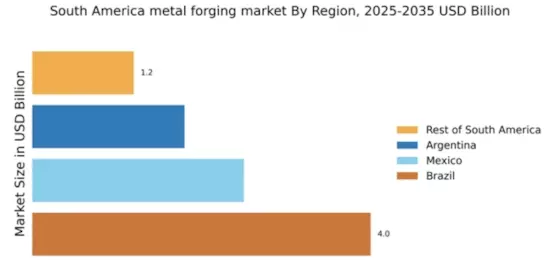
Brazil holds a commanding 4.0% market share in South America's metal forging sector, driven by a booming automotive and aerospace industry. Key growth drivers include increased demand for high-strength materials and government initiatives promoting industrial modernization. Regulatory policies favoring local production and investment in infrastructure, such as roads and ports, further enhance market potential. The country's rich mineral resources also support the forging industry, ensuring a steady supply of raw materials.

Mexico : Growth Fueled by Automotive Sector

With a 2.5% market share, Mexico's metal forging market is rapidly expanding, primarily due to the automotive sector's robust demand. The country benefits from a skilled labor force and proximity to the U.S. market, driving exports. Government initiatives aimed at enhancing manufacturing capabilities and infrastructure improvements, particularly in states like Guanajuato and Puebla, are pivotal. The rise of electric vehicles is also shaping consumption patterns, pushing for innovative forging solutions.

Argentina : Steady Growth Amid Challenges

Argentina's metal forging market, holding a 1.8% share, is characterized by steady growth despite economic challenges. Key drivers include local demand for agricultural machinery and energy sector components. Government policies aimed at boosting local manufacturing and reducing import tariffs are fostering a more favorable business environment. Infrastructure projects in Buenos Aires and Córdoba are also enhancing industrial capabilities, supporting market expansion.

Rest of South America : Emerging Markets with Unique Needs

The Rest of South America, with a 1.2% market share, presents diverse opportunities in the metal forging sector. Countries like Chile and Colombia are witnessing growth driven by mining and construction industries. Local governments are implementing policies to attract foreign investment and improve infrastructure, which is crucial for market development. The competitive landscape includes both local and international players, adapting to sector-specific demands in various industries.

South America Metal Forging Market Regional Image

Key Players and Competitive Insights

The competitive dynamics within the metal forging market in South America are characterized by a blend of innovation, strategic partnerships, and regional expansion. Key growth drivers include the increasing demand for high-performance materials in automotive and aerospace sectors, alongside a push towards sustainable manufacturing practices. Major players such as Thyssenkrupp AG (Germany), Alcoa Corporation (US), and Bharat Forge Limited (India) are actively shaping the landscape through their strategic positioning. Thyssenkrupp AG (Germany) focuses on digital transformation and sustainability, aiming to enhance operational efficiency and reduce carbon emissions. Alcoa Corporation (US) emphasizes innovation in aluminum forging technologies, while Bharat Forge Limited (India) is expanding its footprint through strategic acquisitions and partnerships to bolster its market presence in South America.

The market structure appears moderately fragmented, with a mix of established players and emerging companies vying for market share. Key business tactics include localizing manufacturing to reduce lead times and optimize supply chains, which is crucial in meeting the growing demand for customized solutions. The collective influence of these key players fosters a competitive environment where innovation and operational excellence are paramount.

In September 2025, Thyssenkrupp AG (Germany) announced a partnership with a leading South American automotive manufacturer to develop advanced lightweight components. This collaboration is strategically significant as it aligns with the growing trend towards lightweight materials in the automotive industry, potentially enhancing Thyssenkrupp's market position and driving revenue growth in the region.

In October 2025, Alcoa Corporation (US) unveiled a new aluminum forging facility in Brazil, aimed at increasing production capacity and meeting the rising demand for sustainable materials. This investment underscores Alcoa's commitment to innovation and sustainability, positioning the company to capitalize on the growing market for eco-friendly products.

In August 2025, Bharat Forge Limited (India) completed the acquisition of a local forging company in Argentina, enhancing its operational capabilities and market reach. This strategic move is likely to strengthen Bharat Forge's competitive edge by providing access to new customers and expanding its product offerings in the region.

As of November 2025, current trends in the metal forging market are increasingly defined by digitalization, sustainability, and the integration of artificial intelligence. Strategic alliances are becoming more prevalent, as companies seek to leverage complementary strengths to enhance their competitive positioning. The shift from price-based competition to a focus on innovation, technology, and supply chain reliability is evident, suggesting that future differentiation will hinge on the ability to adapt to these evolving market dynamics.

Key Companies in the South America Metal Forging Market market include

Industry Developments

The South America Metal Forging Market has been witnessing dynamic developments recently. Usiminas has been strengthening its footprint by expanding production capabilities, while ArcelorMittal is actively investing in sustainable practices and modernization. In terms of mergers and acquisitions, in January 2023, FCA US LLC announced its plan to acquire a significant stake in a local metal forging company to enhance supply chain efficiency.

Gerdau also reported an acquisition deal in March 2023, focusing on a smaller firm in the region to meet rising demand. These developments reflect a growing market valuation and increased competition as companies adapt to local and global demands while addressing sustainability and technological advancements.

Notably, in August 2022, Ferrostaal expanded its operations in Brazil, reinforcing its market presence. Additionally, Aceros El Puerto and Metalsa have reported notable growth figures amidst high demand in the automotive sector, indicating a recovery in regional manufacturing activities.

The integration of advanced technologies is also reshaping the market landscape, promoting innovation within the operations of companies like Tupy and Siderurgica del Peru. These trends collectively indicate a robust and evolving South America Metal Forging Market driven by strategic investments and sustained consumer demand.

Future Outlook

South America Metal Forging Market Future Outlook

The metal forging market is projected to grow at an 8.15% CAGR from 2024 to 2035, driven by rising demand in automotive and aerospace sectors, along with technological advancements.

New opportunities lie in:

  • Investment in automated forging technologies to enhance production efficiency.
  • Development of lightweight forged components for electric vehicles.
  • Expansion into renewable energy sector with specialized forging solutions.

By 2035, the market is expected to achieve robust growth, positioning itself as a leader in innovative forging solutions.

Market Segmentation

South America Metal Forging Market Type Outlook

  • Closed-die Forging
  • Open-die Forging
  • Others

South America Metal Forging Market Raw Material Outlook

  • Steel
  • Aluminum
  • Magnesium
  • Nickel-Based Alloys
  • Titanium
  • Others

South America Metal Forging Market End-use Industry Outlook

  • Automotive
  • Aerospace & Defense
  • Power
  • Building & Construction
  • Oil & Gas
  • Metalworking
  • Others

Report Scope

MARKET SIZE 20249.5(USD Billion)
MARKET SIZE 202510.27(USD Billion)
MARKET SIZE 203522.5(USD Billion)
COMPOUND ANNUAL GROWTH RATE (CAGR)8.15% (2024 - 2035)
REPORT COVERAGERevenue Forecast, Competitive Landscape, Growth Factors, and Trends
BASE YEAR2024
Market Forecast Period2025 - 2035
Historical Data2019 - 2024
Market Forecast UnitsUSD Billion
Key Companies Profiled["Thyssenkrupp AG (DE)", "Alcoa Corporation (US)", "Aubert & Duval (FR)", "Precision Castparts Corp (US)", "Forged Solutions Group (GB)", "Fletcher International (AU)", "Bharat Forge Limited (IN)", "Nippon Steel Corporation (JP)", "Shaanxi Blower (CN)"]
Segments CoveredRaw Material, Type, End-use Industry
Key Market OpportunitiesAdoption of advanced automation technologies enhances efficiency in the metal forging market.
Key Market DynamicsRising demand for lightweight materials drives innovation and competition in the metal forging market.
Countries CoveredBrazil, Mexico, Argentina, Rest of South America

Leave a Comment

FAQs

What is the expected market size of the South America Metal Forging Market in 2024?

The South America Metal Forging Market is expected to be valued at 8.75 USD Billion in 2024.

What will be the market value of the South America Metal Forging Market in 2035?

By 2035, the market is projected to grow to 19.41 USD Billion.

What is the expected compound annual growth rate (CAGR) for the South America Metal Forging Market from 2025 to 2035?

The market is expected to witness a CAGR of 7.51% during the forecast period.

Which region holds the largest market share in the South America Metal Forging Market?

Brazil is anticipated to hold the largest market share, valued at 3.0 USD Billion in 2024.

What is the projected market size for Steel in the South America Metal Forging Market by 2035?

The market for Steel is expected to reach 8.71 USD Billion by 2035.

Who are the major players in the South America Metal Forging Market?

Key players include Usiminas, FCA US LLC, ArcelorMittal, and Gerdau.

What is the expected market size for Aluminum in the South America Metal Forging Market by 2035?

The market for Aluminum is projected to grow to 4.56 USD Billion by 2035.

How much will the South America Metal Forging Market be valued for Nickel-Based Alloys in 2024?

The market value for Nickel-Based Alloys is expected to be 1.1 USD Billion in 2024.

What is the projected market growth rate for Argentina in the South America Metal Forging Market by 2035?

Argentina's market is anticipated to grow to 3.5 USD Billion by 2035.

What are the anticipated growth drivers for the South America Metal Forging Market?

Key growth drivers include rising demand across various end-use industries like automotive and aerospace.

Download Free Sample

Kindly complete the form below to receive a free sample of this Report

Compare Licence

×
Features License Type
Single User Multiuser License Enterprise User
Price $4,950 $ $7,250
Maximum User Access Limit 1 User Upto 10 Users Unrestricted Access Throughout the Organization
Free Customization
Direct Access to Analyst
Deliverable Format
Platform Access
Discount on Next Purchase 10% 15% 15%
Printable Versions