Download Free Sample
Kindly complete the form below to receive a free sample of this Report
South America Mortuary Refrigerator Market Research Report By Product Type (positive temperature, negative temperature), By Application (corpses storage, forensic investigation), By End User (forensic labs, research and academic, funeral homes) and By Regional (Brazil, Mexico, Argentina, Rest of South America) - Growth & Industry Forecast 2025 To 2035
As per Market Research Future analysis, the South America mortuary refrigerator market Size was estimated at 9.35 USD Million in 2024. The South America mortuary refrigerator market is projected to grow from 9.71 USD Million in 2025 to 14.18 USD Million by 2035, exhibiting a compound annual growth rate (CAGR) of 3.8% during the forecast period 2025 - 2035
The South America mortuary refrigerator market is experiencing notable growth driven by technological advancements and changing cultural practices.
| 2024 Market Size | 9.35 (USD Million) |
| 2035 Market Size | 14.18 (USD Million) |
| CAGR (2025 - 2035) | 3.86% |
The mortuary refrigerator market in South America is currently experiencing a notable evolution, driven by various factors including technological advancements and changing consumer preferences. The demand for efficient and reliable refrigeration solutions in mortuary services is increasing, as facilities seek to enhance their operational capabilities. This trend is further influenced by the growing awareness of the importance of proper body preservation, which is essential for both ethical considerations and public health. As a result, manufacturers are focusing on developing innovative products that meet the specific needs of the region, ensuring compliance with local regulations and standards. In addition, the market appears to be benefiting from an increase in funeral service providers who are investing in modern equipment to improve service quality. This shift is likely to foster competition among suppliers, leading to better pricing and enhanced product offerings. Furthermore, the integration of energy-efficient technologies is becoming a priority, as stakeholders aim to reduce operational costs while minimizing environmental impact. Overall, the mortuary refrigerator market is poised for growth, reflecting broader trends in the funeral industry and the increasing emphasis on quality and sustainability.
The mortuary refrigerator market is witnessing a surge in technological innovations, with manufacturers introducing advanced cooling systems that enhance efficiency and reliability. These innovations often include features such as digital temperature controls and energy-efficient designs, which are becoming increasingly important for service providers aiming to optimize their operations.
There is a growing emphasis on sustainability within the mortuary refrigerator market, as stakeholders seek to adopt eco-friendly practices. This trend includes the use of environmentally responsible materials and energy-efficient refrigeration systems, which not only reduce carbon footprints but also appeal to a more environmentally conscious consumer base.
The mortuary refrigerator market is influenced by stringent regulations governing body storage and preservation. Compliance with these regulations is essential for service providers, prompting them to invest in high-quality refrigeration solutions that meet local standards. This focus on regulatory adherence is likely to shape purchasing decisions and drive market growth.
The rising mortality rates in South America are a crucial driver for the mortuary refrigerator market. As populations age and healthcare challenges persist, the demand for efficient body storage solutions is likely to increase. In 2025, the mortality rate in several South American countries is projected to rise by approximately 1.5% annually. This trend necessitates the expansion of mortuary facilities, which in turn drives the need for advanced refrigeration systems. The mortuary refrigerator market must adapt to these demographic changes by providing reliable and efficient refrigeration solutions to meet the growing demand.
Cultural shifts in funeral practices across South America are influencing the mortuary refrigerator market. As families increasingly opt for cremation and alternative burial methods, the need for efficient body storage solutions remains critical. The mortuary refrigerator market must adapt to these evolving preferences by offering versatile refrigeration options that cater to diverse cultural needs. In 2025, it is estimated that around 30% of funerals will involve cremation, necessitating reliable refrigeration for bodies awaiting cremation. This shift presents both challenges and opportunities for market players to innovate and meet changing consumer demands.
Technological innovations are transforming the mortuary refrigerator market in South America. Advances in refrigeration technology, such as energy-efficient systems and smart monitoring solutions, are becoming increasingly important. These innovations not only enhance the performance of mortuary refrigerators but also reduce operational costs for funeral homes and mortuaries. In 2025, it is anticipated that the adoption of energy-efficient models will increase by 25%, driven by both economic and environmental considerations. The market must continue to evolve by integrating cutting-edge technologies to meet the demands of modern mortuary practices.
Urbanization in South America is accelerating, leading to increased demand for mortuary services and facilities. As cities expand, the need for modern mortuary infrastructure becomes more pressing. The mortuary refrigerator market is poised to benefit from this trend, as urban areas require advanced refrigeration systems to accommodate the rising number of deceased individuals. In 2025, urban centers are expected to see a 3% increase in the establishment of new mortuary facilities, further driving the demand for specialized refrigeration solutions. This urban growth presents opportunities for manufacturers to innovate and enhance their product offerings.
Regulatory changes in South America are shaping the mortuary refrigerator market. Governments are implementing stricter guidelines regarding the storage and handling of deceased bodies, necessitating compliance from mortuary facilities. In 2025, it is expected that new regulations will require enhanced refrigeration standards, pushing mortuary operators to invest in advanced refrigeration systems. This regulatory landscape creates a demand for high-quality mortuary refrigerators that meet compliance requirements. As a result, manufacturers must focus on developing products that not only comply with regulations but also offer superior performance and reliability.
In the South America mortuary refrigerator market, the Positive Temperature segment holds the largest market share, indicating a strong preference for units that maintain a slightly elevated temperature suitable for certain embalming processes. This segment caters primarily to funeral homes that utilize these refrigerators for short-term storage and display purposes, reinforcing its market dominance. On the other hand, the Negative Temperature segment is gaining traction, appealing to facilities that require long-term preservation of remains, thereby rapidly increasing its footprint in the market as more entities recognize the advantages of these systems in maintaining optimal preservation standards.
The growth trends in this segment are evident as advancements in refrigeration technology and increased investment in cold storage infrastructure elevate the appeal of Negative Temperature units. Factors such as changing consumer preferences towards environmentally sustainable options and the mounting demand for improved preservation solutions contribute to its rapid expansion. Additionally, the integration of smart technologies for temperature monitoring and control within Negative Temperature units further boosts their attractiveness, leading to a competitive edge against traditional Positive Temperature models.
Positive Temperature (Dominant) vs. Negative Temperature (Emerging)
The Positive Temperature segment is considered the dominant player in the South America mortuary refrigerator scenario, primarily due to its functionality and relevance in short-term storage solutions utilized by many funeral homes. These refrigerators operate within a controlled thermal range to satisfy specific requirements for temporary storage during viewing or memorial services. Conversely, the Negative Temperature segment, while emerging, presents significant advantages for long-term preservation strategies essential for medical and forensic applications. This segment caters to a niche market where the demand for advanced preservation methods is growing, stimulated by increasing awareness of health standards and regulatory requirements. As both segments evolve, the interplay between tradition and innovation shapes the strategies adopted by suppliers and users alike.
The market share distribution in the application segment illustrates that corpses storage accounts for a significant portion, solidifying its position as the largest segment in South America. This widespread preference is fueled by the increasing demand for reliable storage options in mortuary practices. Meanwhile, forensic investigation, though smaller in market share, is gaining traction as advanced forensic methodologies require specialized refrigeration solutions.
Growth trends in this segment are marked by an increasing emphasis on public health standards and advancements in forensic science. The demand for corpses storage continues to rise due to the escalating number of deaths and the need for efficient body preservation. Conversely, the forensic investigation segment is being driven by the growth of criminal investigations and the need for preserving evidence effectively, positioning it as the fastest-growing area within the market.
Corpses Storage (Dominant) vs. Forensic Investigation (Emerging)
Corpses storage is the dominant force in the application segment, characterized by its established infrastructure and widespread acceptance in mortuaries across the region. These refrigerators are designed for long-term storage, ensuring body preservation under optimal conditions. On the other hand, forensic investigation represents an emerging segment that caters specifically to the needs of law enforcement and forensic teams. These specialized units are equipped with features that facilitate the analysis of bodies and evidence collection, making them essential for modern investigative practices. As technology advances in both fields, the distinction between standard mortuary storage and forensic needs becomes increasingly pronounced, indicating a dynamic shift in market focus.
In the segment of end-users, Funeral Homes account for the largest portion of the market due to their essential role in post-mortem services. With a strong foothold in the distribution of mortuary refrigerators, these facilities typically require units that ensure both reliability and efficient temperature control. Forensic Labs, while making up a smaller share, represent a significant growth opportunity as advancements in forensic science drive increased demand for specialized refrigeration solutions.
Growth trends in this segment are heavily driven by the increasing awareness of the importance of proper refrigeration in mortuary practices. The rising number of deaths, coupled with evolving forensic methodologies, has led to heightened requirements in Hospitals and Clinics as well. Additionally, Research and Academics sectors are also expanding their needs for reliable mortuary refrigeration, supporting both educational and practical applications within the market.
Funeral Homes (Dominant) vs. Forensic Labs (Emerging)
Funeral Homes dominate the end-user segment as they possess the highest demand for mortuary refrigerators, relying on these units for providing crucial services to grieving families. The essential nature of their operations, combined with steady operational requirements, keeps them at the forefront of market share. Conversely, Forensic Labs represent an emerging category characterized by their increasing reliance on advanced refrigeration solutions. The evolution of forensic science and the need for sophisticated preservation methods for evidence contribute to the fastest growth in this segment, indicating a shift towards more specialized and technically advanced refrigeration options.
Key markets include São Paulo, Rio de Janeiro, and Brasília, where the concentration of hospitals and funeral homes is high. The competitive landscape features major players like Thermo Fisher Scientific and Stryker, which have established a strong presence. Local dynamics are shaped by the need for compliance with health regulations and the demand for high-quality refrigeration solutions. The funeral services sector is increasingly adopting advanced technologies, enhancing the overall business environment.
Key markets include Mexico City, Guadalajara, and Monterrey, where the demand for advanced refrigeration solutions is on the rise. The competitive landscape features players like A.M.A. H. K. and Frigid Units, which are expanding their market presence. Local dynamics are influenced by cultural practices surrounding death and funerals, leading to a demand for high-quality refrigeration solutions. The funeral services sector is increasingly adopting modern technologies to meet consumer expectations.
Key markets include Buenos Aires, Córdoba, and Rosario, where the concentration of funeral homes is significant. The competitive landscape features major players like Kugler and B Medical Systems, which are adapting to local market needs. Local dynamics are shaped by cultural attitudes towards death and the increasing demand for quality services. The funeral services sector is evolving, with a growing emphasis on technology and quality in refrigeration solutions.
Key markets include countries like Chile, Colombia, and Peru, each with unique cultural practices influencing demand. The competitive landscape is fragmented, with local players and some international companies like Elekta and Hoshizaki making inroads. Local dynamics are influenced by economic conditions and varying regulatory environments, leading to a diverse range of applications in the funeral services sector. The need for quality refrigeration solutions is growing as urbanization continues.
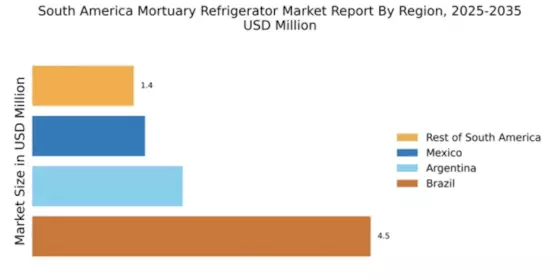
The mortuary refrigerator market in South America is characterized by a competitive landscape that is increasingly shaped by innovation, strategic partnerships, and regional expansion. Key players such as Thermo Fisher Scientific (US), B Medical Systems (LU), and Stryker (US) are actively enhancing their market positions through various strategic initiatives. For instance, Thermo Fisher Scientific (US) focuses on technological advancements in refrigeration solutions, aiming to improve efficiency and reliability in mortuary applications. Meanwhile, B Medical Systems (LU) emphasizes sustainability in its product offerings, aligning with the growing demand for environmentally friendly solutions. Stryker (US) is leveraging its extensive distribution network to penetrate deeper into emerging markets, thereby enhancing its competitive edge.The business tactics employed by these companies reflect a trend towards localizing manufacturing and optimizing supply chains to better serve regional markets. The competitive structure of the market appears moderately fragmented, with several players vying for market share. However, the collective influence of major companies is significant, as they set benchmarks for quality and innovation that smaller firms often strive to meet.
In August Thermo Fisher Scientific (US) announced the launch of a new line of mortuary refrigerators designed with advanced temperature control technology. This strategic move is likely to enhance their product portfolio and cater to the increasing demand for precision in temperature management, which is critical in mortuary applications. The introduction of this technology may position Thermo Fisher as a leader in innovation within the sector.
In September B Medical Systems (LU) entered into a partnership with a local distributor in Brazil to expand its market reach. This collaboration is strategically important as it allows B Medical Systems to leverage local expertise and distribution channels, potentially increasing its market penetration in a region that is witnessing a rise in demand for reliable mortuary refrigeration solutions. Such partnerships may also facilitate quicker response times to customer needs, enhancing overall service delivery.
In October Stryker (US) completed the acquisition of a regional competitor, which is expected to bolster its market presence in South America. This acquisition not only expands Stryker's product offerings but also enhances its operational capabilities in the region. The strategic importance of this move lies in the potential for increased market share and the ability to offer a more comprehensive suite of products to customers.
As of November the competitive trends in the mortuary refrigerator market are increasingly defined by digitalization, sustainability, and the integration of artificial intelligence (AI) in product offerings. Strategic alliances are becoming more prevalent, as companies recognize the value of collaboration in enhancing innovation and market responsiveness. Looking ahead, it appears that competitive differentiation will evolve from traditional price-based competition to a focus on technological innovation, supply chain reliability, and sustainability. This shift may redefine the parameters of success in the market, compelling companies to invest in advanced technologies and sustainable practices to maintain their competitive edge.




In recent months, the South America Mortuary Refrigerator Market has seen significant developments, particularly with companies such as Carrier, Pelton and Crane, and Thermo Fisher Scientific making strides in technological advancements and product offerings. The rising demand for efficient and high-capacity mortuary refrigeration solutions has propelled growth, particularly in Brazil and Argentina, as the regions face increasing mortality rates amid ongoing health crises. Notably, in September 2023, Thermo Fisher Scientific announced a new line of eco-friendly mortuary refrigerators designed to reduce energy consumption and environmental impact, catering to regulatory shifts favoring sustainability in South America.
The market has also been affected by the trend of consolidation, with reports in July 2023 highlighting a strategic partnership between Frigidaire and Haier aimed at enhancing their product distribution and service reach across the continent. The overall market valuation is positively influenced by growing investments and innovations in healthcare infrastructure, with industry projections indicating a continued uptrend in demand for these specialized refrigeration solutions, driven largely by urbanization and the modernization of mortuary services in the region.
The Mortuary Refrigerator Market is projected to grow at 3.86% CAGR from 2025 to 2035, driven by increasing demand for advanced preservation technologies and rising mortality rates.
New opportunities lie in:
By 2035, the market is expected to achieve substantial growth, driven by innovation and evolving consumer needs.
| MARKET SIZE 2024 | 9.35(USD Million) |
| MARKET SIZE 2025 | 9.71(USD Million) |
| MARKET SIZE 2035 | 14.18(USD Million) |
| COMPOUND ANNUAL GROWTH RATE (CAGR) | 3.86% (2025 - 2035) |
| REPORT COVERAGE | Revenue Forecast, Competitive Landscape, Growth Factors, and Trends |
| BASE YEAR | 2024 |
| Market Forecast Period | 2025 - 2035 |
| Historical Data | 2019 - 2024 |
| Market Forecast Units | USD Million |
| Key Companies Profiled | Thermo Fisher Scientific (US), A.M.A. H. K. (DE), Frigid Units (US), Kugler (DE), B Medical Systems (LU), Stryker (US), Elekta (SE), Hoshizaki (JP) |
| Segments Covered | Product Type, Application, End-User |
| Key Market Opportunities | Adoption of energy-efficient mortuary refrigerators driven by sustainability trends and regulatory compliance. |
| Key Market Dynamics | Rising demand for advanced mortuary refrigeration solutions driven by regulatory standards and evolving consumer preferences in South America. |
| Countries Covered | Brazil, Mexico, Argentina, Rest of South America |
The overall market valuation was $9.35 Million in 2024.
The projected market valuation for 2035 is $14.18 Million.
The expected CAGR for the market during the forecast period 2025 - 2035 is 3.86%.
Key players include Thermo Fisher Scientific (US), A.M.A. H. K. (DE), Frigid Units (US), Kugler (DE), B Medical Systems (LU), Stryker (US), Elekta (SE), and Hoshizaki (JP).
The two main product types are Positive Temperature and Negative Temperature units.
The market valuation for Positive Temperature units was $3.74 Million in 2024.
The projected market valuation for Negative Temperature units by 2035 is $8.62 Million.
The primary applications are Corpses Storage and Forensic Investigation.
The market valuation for Corpses Storage was $5.61 Million in 2024.
End-users include forensic labs, research and academics, funeral homes, hospitals and clinics, and others.


Kindly complete the form below to receive a free sample of this Report

“This is really good guys. Excellent work on a tight deadline. I will continue to use you going forward and recommend you to others. Nice job”


“Thanks. It’s been a pleasure working with you, please use me as reference with any other Intel employees.”


“Thanks for sending the report it gives us a good global view of the Betaïne market.”


“Thank you, this will be very helpful for OQS.”


“We found the report very insightful! we found your research firm very helpful. I'm sending this email to secure our future business.”


“I am very pleased with how market segments have been defined in a relevant way for my purposes (such as "Portable Freezers & refrigerators" and "last-mile"). In general the report is well structured. Thanks very much for your efforts.”


“I have been reading the first document or the study, ,the Global HVAC and FP market report 2021 till 2026. Must say, good info! I have not gone in depth at all parts, but got a good indication of the data inside!”


“We got the report in time, we really thank you for your support in this process. I also thank to all of your team as they did a great job.”


“The Automotive 48V ECU Components Procurement Intelligence Study” was a complex project, but the Market Research Future (MRFR) team handled it with quality, agility, and customer-centricity. They delivered all requested data on time and within the agreed scope. The team, including Shubhendra Anand and Rahul Gotadki, was always readily available to clarify questions and swiftly implement necessary adjustments, driving the project to a successful conclusion within a very demanding timeframe.
I would also like to specifically commend Akshay Agarwal for his responsiveness and support at every stage—from our initial inquiry on May 6th through to final delivery on June 18th. His dedication made the entire process seamless.”



