×
Request Free Sample ×

Kindly complete the form below to receive a free sample of this Report

* Please use a valid business email

Leading companies partner with us for data-driven Insights

clients tt-cursor
Hero Background

South America Multimodal Ui Market

ID: MRFR/ICT/62762-HCR
200 Pages
Aarti Dhapte
October 2025

South America Multimodal UI Market Research Report By Component (Hardware, Software, Services), By Technology (Voice Recognition, Text Input, Gesture Recognition, Visual, Others), By End User Vertical (Automotive, Healthcare, Entertainment, IT & Telecommunication, Retail, Others), and By Regional (Brazil, Mexico, Argentina, Rest of South America)- Forecast to 2035

Share:
Download PDF ×

We do not share your information with anyone. However, we may send you emails based on your report interest from time to time. You may contact us at any time to opt-out.

South America Multimodal Ui Market Infographic
Purchase Options

South America Multimodal Ui Market Summary

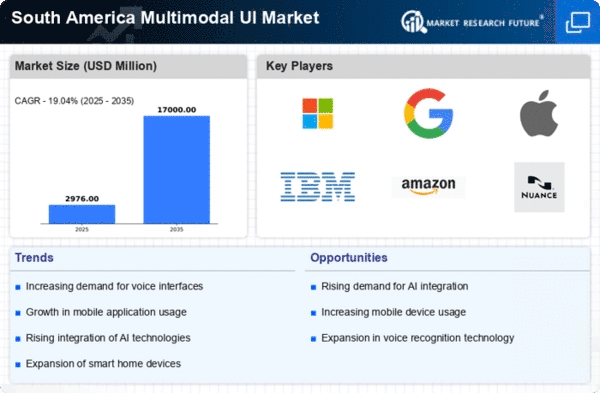
As per MRFR analysis, the The multimodal UI market size was estimated at 2500.0 USD Million in 2024. The multimodal ui market is projected to grow from 2976.0 USD Million in 2025 to 17000.0 USD Million by 2035, exhibiting a compound annual growth rate (CAGR) of 19.04% during the forecast period 2025 - 2035.

Key Market Trends & Highlights

The South America multimodal UI market is experiencing dynamic growth driven by technological advancements and user-centric innovations.

  • The rise of voice-activated interfaces is transforming user interactions across various platforms.
  • Integration of local languages is becoming essential to cater to diverse user demographics in Brazil and Mexico.
  • A strong focus on user-centric design is enhancing the overall user experience and engagement.
  • Technological advancements in AI and growing mobile device penetration are key drivers propelling market expansion.

Market Size & Forecast

2024 Market Size 2500.0 (USD Million)
2035 Market Size 17000.0 (USD Million)
CAGR (2025 - 2035) 19.04%

Major Players

Microsoft (US), Google (US), Apple (US), IBM (US), Amazon (US), Nuance Communications (US), Samsung Electronics (KR), Facebook (US), Alibaba Group (CN)

South America Multimodal Ui Market Trends

The multimodal ui market in South America is currently experiencing a notable evolution, driven by advancements in technology and changing consumer preferences. As digital interactions become increasingly complex, the demand for interfaces that seamlessly integrate various modes of communication is on the rise. This shift is influenced by the growing penetration of smartphones and the internet, which facilitates diverse user interactions across platforms. Furthermore, the region's unique cultural dynamics necessitate tailored solutions that cater to local languages and user behaviors, thereby enhancing user experience and engagement. In addition, the multimodal ui market is likely to benefit from increased investments in artificial intelligence and machine learning technologies. These innovations enable more intuitive and responsive interfaces, allowing users to interact through voice, touch, and visual inputs. As businesses recognize the importance of providing a cohesive user experience, the integration of multimodal capabilities into applications and services is becoming a strategic priority. This trend suggests a promising future for the market, as companies strive to meet the evolving demands of consumers in South America.

Rise of Voice-Activated Interfaces

The adoption of voice-activated interfaces is gaining traction in the multimodal ui market. This trend is largely driven by the increasing use of smart devices and virtual assistants, which allow users to interact hands-free. As consumers seek convenience and efficiency, businesses are integrating voice recognition technologies into their applications, enhancing accessibility and user engagement.

Integration of Local Languages

The incorporation of local languages into multimodal interfaces is becoming essential in South America. This trend reflects the region's linguistic diversity and the need for personalized user experiences. By offering interfaces that support multiple languages, companies can better connect with their audiences, fostering greater user satisfaction and loyalty.

Focus on User-Centric Design

User-centric design principles are increasingly influencing the development of multimodal interfaces. This trend emphasizes understanding user needs and preferences, leading to more intuitive and engaging experiences. As businesses prioritize user feedback and usability testing, the multimodal ui market is likely to see enhanced products that resonate with local consumers.

South America Multimodal Ui Market Drivers

Increased Focus on Accessibility

The emphasis on accessibility in technology is becoming a significant driver for the multimodal ui market in South America. As awareness of inclusivity grows, businesses are recognizing the importance of designing interfaces that cater to users with diverse needs, including those with disabilities. The multimodal ui market is responding by creating solutions that integrate various input methods, ensuring that applications are usable by a broader audience. In 2025, it is estimated that around 15% of the population in South America will have some form of disability, underscoring the necessity for accessible design. This demographic shift is likely to compel companies to invest in multimodal interfaces that enhance usability and foster inclusivity, ultimately driving growth in the multimodal ui market.

Technological Advancements in AI

The rapid evolution of artificial intelligence (AI) technologies is a pivotal driver for the multimodal ui market in South America. Enhanced machine learning algorithms and natural language processing capabilities are enabling more sophisticated user interactions. As AI becomes increasingly integrated into applications, the demand for multimodal interfaces that can seamlessly combine voice, touch, and visual inputs is likely to rise. In 2025, the AI market in South America is projected to reach approximately $5 billion, indicating a robust growth trajectory. This growth is expected to fuel investments in multimodal ui solutions, as businesses seek to leverage AI to improve user experiences and operational efficiency. Consequently, the multimodal ui market is poised to benefit significantly from these technological advancements, as companies strive to create more intuitive and responsive interfaces.

Growing Mobile Device Penetration

The proliferation of mobile devices across South America is a crucial factor driving the multimodal ui market. With smartphone penetration exceeding 80% in several countries, users are increasingly accustomed to interacting with applications through various modalities. This trend necessitates the development of multimodal interfaces that can accommodate diverse input methods, such as voice commands, touch gestures, and visual displays. The mobile app market in South America is expected to surpass $10 billion by 2026, highlighting the potential for multimodal ui solutions to enhance user engagement and satisfaction. As consumers demand more versatile and accessible applications, the multimodal ui market is likely to experience substantial growth, prompting developers to innovate and adapt their offerings to meet evolving user preferences.

Rising Demand for Enhanced User Experiences

The increasing expectation for superior user experiences is a driving force behind the multimodal ui market in South America. As competition intensifies across various sectors, businesses are compelled to differentiate themselves through innovative user interfaces. Multimodal solutions that combine voice, touch, and visual elements are seen as essential for creating engaging and intuitive experiences. Market Research Future indicates that companies prioritizing user experience can achieve up to 60% higher customer satisfaction rates. This trend is prompting investments in multimodal ui technologies, as organizations strive to meet consumer demands for seamless interactions. The multimodal ui market is thus positioned to thrive as businesses recognize the value of enhancing user experiences to foster loyalty and drive growth.

Government Initiatives Supporting Digital Transformation

Government initiatives aimed at promoting digital transformation are significantly influencing the multimodal ui market in South America. Various countries are implementing policies to enhance digital infrastructure and encourage the adoption of advanced technologies. These initiatives are likely to create a conducive environment for the growth of multimodal interfaces, as public and private sectors collaborate to improve service delivery. For instance, investments in smart city projects are expected to exceed $20 billion by 2027, which will likely include the integration of multimodal ui solutions. As governments prioritize digital innovation, the multimodal ui market stands to benefit from increased funding and support, facilitating the development of cutting-edge interfaces that cater to the needs of modern users.


Market Segment Insights

By Component: Software (Largest) vs. Hardware (Fastest-Growing)

In the South America multimodal ui market, the component segment reveals a diverse distribution of market share among hardware, software, and services. Software stands out as the largest contributor to the market, capitalizing on the increasing demand for integration and user-friendly interfaces. Meanwhile, hardware is positioned as a key player, being essential for the effective implementation of software solutions, while services provide necessary support and customization to enhance user experience. Growth trends indicate that the software sector will continue to benefit from the rise in digital transformations across industries, with companies increasingly adopting advanced multimodal interfaces. The hardware segment, however, is identified as the fastest-growing, driven by technological advancements and the need for more robust infrastructure. Services, although vital, are expected to grow at a steady pace, emphasizing value-added solutions to meet customer needs.

Software (Dominant) vs. Hardware (Emerging)

Software represents the dominant component in this market segment, characterized by its ability to enhance connectivity and user engagement through innovative applications and platforms. It addresses the evolving needs of users, leading to a sustained demand for modernization and upgrades. In contrast, hardware, while currently emerging, is rapidly catching up due to the increased dependency on advanced technologies such as AI and IoT. The integration of higher-performing hardware units is critical for optimizing software functionalities, thus creating a synergy that propels both segments forward. As industries continue to invest in digital infrastructure, the hardware segment is poised to expand significantly, driven by strategic partnerships between tech providers and hardware manufacturers.

By Technology: Voice Recognition (Largest) vs. Gesture Recognition (Fastest-Growing)

In the South America multimodal ui market, the market share distribution reveals that Voice Recognition is the largest segment, dominating the landscape due to its widespread adoption across various applications. Following closely, Text Input and Gesture Recognition are also significant contributors, while Visual and Others segments account for smaller shares. The exploration of user preferences indicates a clear inclination towards hands-free and voice-activated solutions. As the region witnesses technological advancements, Gesture Recognition is emerging as the fastest-growing segment. Increased investments in AI and machine learning, coupled with the rising demand for intuitive user interfaces, are driving this growth. The convergence of technology in smart devices and the gaming industry further propels the adoption of gesture-based controls, reflecting a shift towards more interactive and engaging user experiences.

Technology: Voice Recognition (Dominant) vs. Gesture Recognition (Emerging)

Voice Recognition technology is characterized by its ability to provide seamless and hands-free interaction, making it highly desirable in sectors like telecommunications and automotive. It leads the market due to its versatility and ease of use, significantly enhancing user experience. Meanwhile, Gesture Recognition is gaining momentum as an emerging technology, appealing to tech-savvy consumers looking for innovative interaction methods. This segment is marked by rapid development, with advancements in sensor technology and machine learning algorithms enabling accurate gesture detection. The competitive landscape indicates both segments are vital, yet they cater to different user preferences, with Voice Recognition focusing on practical applications while Gesture Recognition edges towards futuristic interfaces.

By End Use Vertical: Automotive (Largest) vs. Healthcare (Fastest-Growing)

The End Use Vertical segment exhibits a diverse distribution of market shares, with Automotive leading as the largest segment. It accounts for a substantial portion of the market due to the growing demand for integrated logistics in vehicle transport. Healthcare follows as a significant segment, driven by the increasing need for efficient supply chain solutions in the delivery of medical supplies. The Entertainment sector is also notable, leveraging multimodal transport for the effective distribution of content and equipment. In terms of growth trends, the Healthcare segment is identified as the fastest-growing due to the surge in telehealth services and medical logistics driven by recent global challenges. The Automotive sector shows steady growth, supported by advancements in technology and a shift towards sustainable transport solutions. Retail and IT & Telecommunication sectors are emerging as influential players, focusing on enhancing customer experiences through improved logistics efficiency. The continuous evolution of these sectors indicates a vibrant market landscape within the End Use Vertical segment.

Automotive: Dominant vs. Healthcare: Emerging

The Automotive segment remains dominant within the End Use Vertical, characterized by robust logistics networks and a strong reliance on multimodal transportation solutions. This segment includes the transport of vehicles and automotive parts, requiring timely and efficient logistics to meet consumer demands. On the other hand, the Healthcare segment is recognized as emerging, driven by trends in telemedicine and the increasing complexity of healthcare supply chains. It focuses on the distribution of critical medical supplies, pharmaceuticals, and equipment, necessitating innovative solutions to ensure timely delivery. Both segments highlight the need for adaptive logistics strategies that respond to the fast-paced changes in their respective industries.

Get more detailed insights about South America Multimodal Ui Market

Regional Insights

Brazil : Strong Growth Driven by Innovation

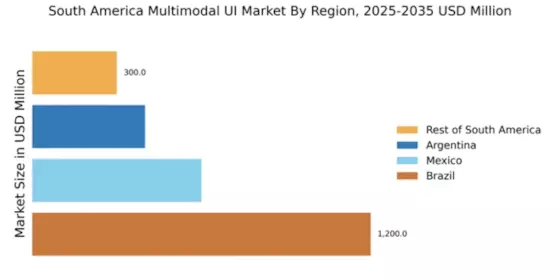
Brazil holds a commanding 40% market share in South America, valued at $1200.0 million. Key growth drivers include a burgeoning tech ecosystem, increasing smartphone penetration, and government initiatives promoting digital transformation. Demand trends show a shift towards integrated user experiences, with consumers favoring seamless interactions across devices. Regulatory support, such as the General Data Protection Law (LGPD), fosters a secure environment for tech investments, while infrastructure improvements enhance connectivity and accessibility.

Mexico : Emerging Hub for Tech Solutions

Mexico captures a 30% market share in the multimodal UI sector, valued at $600.0 million. The growth is fueled by rising internet accessibility and a young, tech-savvy population. Demand for user-friendly interfaces is increasing, particularly in e-commerce and mobile applications. Government initiatives, such as the National Digital Strategy, aim to enhance digital literacy and infrastructure, supporting the tech industry's expansion.

Argentina : Innovation Amid Economic Challenges

Argentina holds a 20% market share, valued at $400.0 million in the multimodal UI market. Key growth drivers include a strong focus on innovation and a vibrant startup ecosystem. Demand for advanced user interfaces is rising, particularly in fintech and e-learning sectors. Government policies aimed at fostering technology adoption, such as tax incentives for tech startups, are crucial for market growth despite economic volatility.

Rest of South America : Emerging Markets with Unique Needs

The Rest of South America accounts for a 10% market share, valued at $300.0 million. Growth is driven by increasing mobile device usage and a demand for localized solutions. Countries like Chile and Colombia are emerging as key players, with government support for tech innovation. The competitive landscape features both local startups and international giants, creating a dynamic business environment tailored to regional needs.

South America Multimodal Ui Market Regional Image

Key Players and Competitive Insights

The multimodal UI market in South America is characterized by a dynamic competitive landscape, driven by rapid technological advancements and increasing consumer demand for integrated user experiences. Major players such as Microsoft (US), Google (US), and Amazon (US) are strategically positioned to leverage their extensive resources and innovative capabilities. Microsoft (US) focuses on enhancing its Azure cloud services, integrating AI-driven multimodal interfaces to improve user engagement. Google (US) emphasizes its AI and machine learning technologies to create seamless interactions across devices, while Amazon (US) is expanding its Alexa ecosystem to include more multimodal functionalities, thereby enhancing its competitive edge. Collectively, these strategies foster a competitive environment that prioritizes innovation and user-centric solutions.

Key business tactics within this market include localizing manufacturing and optimizing supply chains to better serve regional demands. The competitive structure appears moderately fragmented, with several key players exerting influence over market dynamics. This fragmentation allows for niche players to emerge, yet the dominance of established companies like IBM (US) and Apple (US) remains evident, as they continue to invest in research and development to maintain their market positions.

In October 2025, Microsoft (US) announced a partnership with local tech firms to develop tailored multimodal solutions for South American markets. This strategic move is significant as it not only enhances Microsoft's local presence but also allows for the customization of its offerings to meet specific regional needs, thereby increasing its market share. Such partnerships are likely to strengthen Microsoft's competitive position by fostering innovation and responsiveness to local consumer preferences.

In September 2025, Google (US) launched a new multimodal interface for its Google Assistant, designed specifically for the South American market. This initiative is crucial as it reflects Google's commitment to enhancing user experience through localized features, which may lead to increased user adoption and engagement. By focusing on regional customization, Google positions itself as a leader in the integration of AI technologies within everyday applications.

In August 2025, Amazon (US) expanded its Alexa platform to include support for multiple languages and dialects prevalent in South America. This strategic enhancement is vital for capturing a broader audience and improving user interaction. By addressing linguistic diversity, Amazon not only strengthens its market presence but also sets a precedent for other companies to follow in terms of inclusivity and user engagement.

As of November 2025, current trends in the multimodal UI market are heavily influenced by digitalization, sustainability, and the integration of AI technologies. Strategic alliances among key players are shaping the competitive landscape, fostering innovation and collaboration. The shift from price-based competition to a focus on technological advancement and supply chain reliability is evident. Companies are likely to differentiate themselves through innovative solutions that enhance user experience, suggesting a future where competitive advantage hinges on the ability to adapt and innovate in response to evolving consumer expectations.

Key Companies in the South America Multimodal Ui Market market include

Industry Developments

In 2025, the South American multimodal user interface market is expected to grow significantly as businesses in the IT, retail, and finance sectors embrace AI-driven interfaces. SAP SE and Oracle extended their multimodal AI solutions to Argentina and Brazil in January 2025, incorporating text, gesture, and voice inputs into enterprise platforms to improve workflow automation.

In Chile and Colombia, Google and Microsoft had implemented multimodal cloud-based applications by February 2025, providing business intelligence solutions such as visual identification and voice-activated analytics. In order to facilitate simultaneous gesture, touch, and speech control in interactive media projects, Adobe Systems launched multimodal design tools for creative professionals.

Salesforce and Zoho Corporation improved CRM procedures by combining audio and visual analytics when they introduced multimodal user interfaces (UIs) for customer engagement platforms in Uruguay and Peru in March 2025. HubSpot improved marketing automation workflows by implementing comparable integrations.

Multimodal UI was incorporated by IBM and ServiceNow into IT service management and support systems in South American businesses by April 2025, enabling quicker problem solving and more user-friendly interfaces.These projects, which connect AI technologies with useful workplace applications to improve productivity, customer experience, and digital transformation activities, are a reflection of South America's increasing embrace of multimodal user interfaces.

South America Multimodal UI

Future Outlook

South America Multimodal Ui Market Future Outlook

The Multimodal UI Market is projected to grow at a 19.04% CAGR from 2024 to 2035, driven by technological advancements, increased consumer demand, and enhanced user experiences.

New opportunities lie in:

  • Development of AI-driven voice recognition systems for seamless interaction.
  • Integration of augmented reality features in mobile applications.
  • Expansion of multimodal interfaces in automotive infotainment systems.

By 2035, the multimodal UI market is expected to achieve substantial growth and innovation.

Market Segmentation

South America Multimodal Ui Market Component Outlook

  • Hardware
  • Software
  • Services

South America Multimodal Ui Market Technology Outlook

  • Voice Recognition
  • Text Input
  • Gesture Recognition
  • Visual
  • Others

South America Multimodal Ui Market End Use Vertical Outlook

  • Automotive
  • Healthcare
  • Entertainment
  • IT & Telecommunication
  • Retail
  • Others

Report Scope

MARKET SIZE 20242500.0(USD Million)
MARKET SIZE 20252976.0(USD Million)
MARKET SIZE 203517000.0(USD Million)
COMPOUND ANNUAL GROWTH RATE (CAGR)19.04% (2024 - 2035)
REPORT COVERAGERevenue Forecast, Competitive Landscape, Growth Factors, and Trends
BASE YEAR2024
Market Forecast Period2025 - 2035
Historical Data2019 - 2024
Market Forecast UnitsUSD Million
Key Companies Profiled["Microsoft (US)", "Google (US)", "Apple (US)", "IBM (US)", "Amazon (US)", "Nuance Communications (US)", "Samsung Electronics (KR)", "Facebook (US)", "Alibaba Group (CN)"]
Segments CoveredComponent, Technology, End Use Vertical
Key Market OpportunitiesIntegration of voice and gesture recognition technologies enhances user experience in the multimodal ui market.
Key Market DynamicsRising demand for intuitive interfaces drives innovation in multimodal user interaction technologies across South America.
Countries CoveredBrazil, Mexico, Argentina, Rest of South America

Leave a Comment

FAQs

What is the expected market size of the South America Multimodal UI Market for the year 2024?

The South America Multimodal UI Market is expected to be valued at 1.65 billion USD in the year 2024.

What is the projected market value of the South America Multimodal UI Market by the year 2035?

By the year 2035, the South America Multimodal UI Market is projected to reach a value of 9.85 billion USD.

What is the compound annual growth rate (CAGR) for the South America Multimodal UI Market from 2025 to 2035?

The CAGR for the South America Multimodal UI Market from 2025 to 2035 is expected to be 17.622 percent.

Which region is expected to have the largest market share in the South America Multimodal UI Market in 2024?

Brazil is expected to hold the largest market share in the South America Multimodal UI Market, valued at 0.45 billion USD in 2024.

What will be the market size of the software component in the South America Multimodal UI Market by 2035?

The software component of the South America Multimodal UI Market is projected to reach a size of 4.5 billion USD by 2035.

Which company is considered a key player in the South America Multimodal UI Market?

Oracle is recognized as one of the major players in the South America Multimodal UI Market.

How much is the market for services projected to be valued at in 2035?

The market for services in the South America Multimodal UI Market is expected to be valued at 2.6 billion USD by 2035.

What is the expected market growth rate for Argentina in the South America Multimodal UI Market by 2035?

The market in Argentina is projected to grow to 1.5 billion USD by 2035.

What is one of the main growth drivers for the South America Multimodal UI Market?

One of the main growth drivers for the market is the increasing demand for enhanced user experiences across various digital platforms.

What is the expected market size for the rest of South America in 2024?

The market size for the rest of South America is expected to be 0.6 billion USD in 2024.

Download Free Sample

Kindly complete the form below to receive a free sample of this Report

Compare Licence

×
Features License Type
Single User Multiuser License Enterprise User
Price $4,950 $5,950 $7,250
Maximum User Access Limit 1 User Upto 10 Users Unrestricted Access Throughout the Organization
Free Customization
Direct Access to Analyst
Deliverable Format
Platform Access
Discount on Next Purchase 10% 15% 15%
Printable Versions