×
Request Free Sample ×

Kindly complete the form below to receive a free sample of this Report

* Please use a valid business email

Leading companies partner with us for data-driven Insights

clients tt-cursor
Hero Background

South America Natural Language Processing Market

ID: MRFR/ICT/56262-HCR
200 Pages
Aarti Dhapte
October 2025

South America Natural Language Processing Market Research Report By Technology (Auto-coding, Text analytics, Pattern & Image recognition, Speech analytics), By Type (Rule-based, Statistical, Hybrid), By Deployment (On-Cloud, On-Premise), By Service (Integration, Consulting & maintenance), By Vertical (Healthcare, Retail Sector, Media & Entertainment) and By Regional (Brazil, Mexico, Argentina, Rest of South America)- Forecast to 2035

Share:
Download PDF ×

We do not share your information with anyone. However, we may send you emails based on your report interest from time to time. You may contact us at any time to opt-out.

South America Natural Language Processing Market Infographic
Purchase Options

South America Natural Language Processing Market Summary

As per MRFR analysis, the South America natural language-processing market size was estimated at 5.5 USD Billion in 2024. The South America natural language-processing market is projected to grow from 5.69 USD Billion in 2025 to 8.0 USD Billion by 2035, exhibiting a compound annual growth rate (CAGR) of 3.46% during the forecast period 2025 - 2035.

Key Market Trends & Highlights

The South America natural language-processing market is experiencing robust growth driven by technological advancements and regional demands.

  • Brazil remains the largest market for natural language processing solutions, showcasing a strong inclination towards AI-driven technologies.
  • Mexico is emerging as the fastest-growing region, reflecting a heightened interest in multilingual capabilities and local talent development.
  • Investment in local startups is on the rise, indicating a shift towards fostering innovation within the natural language processing landscape.
  • Key market drivers include the rising demand for customer support automation and the expansion of e-commerce platforms, which are significantly shaping market dynamics.

Market Size & Forecast

2024 Market Size 5.5 (USD Billion)
2035 Market Size 8.0 (USD Billion)
CAGR (2025 - 2035) 3.46%

Major Players

Google (US), Microsoft (US), IBM (US), Amazon (US), Facebook (US), Baidu (CN), Salesforce (US), SAP (DE), NVIDIA (US)

South America Natural Language Processing Market Trends

The natural language-processing market in South America is currently experiencing notable growth, driven by advancements in artificial intelligence and machine learning technologies. Organizations across various sectors are increasingly adopting these solutions to enhance customer engagement, streamline operations, and improve decision-making processes. The demand for automated language processing tools is rising, as businesses seek to leverage data-driven insights to gain a competitive edge. Furthermore, the proliferation of digital communication channels is prompting companies to invest in natural language-processing capabilities to better understand and respond to customer needs. In addition, the region's diverse linguistic landscape presents both challenges and opportunities for the natural language-processing market. Companies are focusing on developing solutions that cater to multiple languages and dialects, which could potentially expand their market reach. As the technology matures, it appears that the natural language-processing market will continue to evolve, with innovations likely to emerge that address specific regional requirements. This dynamic environment suggests a promising future for stakeholders involved in this sector, as they adapt to the changing demands of consumers and businesses alike.

Increased Adoption of AI-driven Solutions

Organizations in South America are increasingly integrating AI-driven natural language-processing solutions into their operations. This trend is largely motivated by the need for enhanced customer service and operational efficiency. Companies are recognizing the potential of these technologies to automate routine tasks, analyze customer feedback, and provide personalized experiences.

Focus on Multilingual Capabilities

Given the linguistic diversity in South America, there is a growing emphasis on developing natural language-processing tools that support multiple languages and dialects. This focus allows businesses to cater to a broader audience and ensures that language barriers do not hinder customer engagement.

Investment in Local Talent and Startups

The natural language-processing market is witnessing increased investment in local talent and startups. This trend reflects a commitment to fostering innovation within the region, as companies seek to harness local expertise to create tailored solutions that address specific market needs.

South America Natural Language Processing Market Drivers

Expansion of E-commerce Platforms

The natural language-processing market in South America is significantly influenced by the rapid expansion of e-commerce platforms. As online shopping becomes increasingly prevalent, businesses are leveraging natural language-processing technologies to improve user experience and optimize search functionalities. The e-commerce sector in the region is expected to reach $100 billion by 2026, creating a substantial opportunity for natural language-processing applications. Enhanced product recommendations, personalized marketing, and efficient customer interactions are becoming essential components of e-commerce strategies. Consequently, the natural language-processing market is poised for growth as companies seek to harness these technologies to gain a competitive edge in the burgeoning online marketplace.

Growing Interest in Sentiment Analysis

The natural language-processing market in South America is witnessing a growing interest in sentiment analysis, particularly among businesses seeking to understand consumer behavior. Companies are increasingly utilizing natural language-processing tools to analyze customer feedback, social media interactions, and product reviews. This trend is driven by the need for data-driven decision-making and the desire to enhance brand reputation. The sentiment analysis segment within the natural language-processing market is projected to grow by 30% over the next few years. As organizations recognize the value of understanding public sentiment, investments in natural language-processing technologies are expected to rise, leading to more sophisticated analytical capabilities.

Integration of NLP in Healthcare Solutions

The integration of natural language-processing technologies in healthcare solutions is emerging as a vital driver for the natural language-processing market in South America. Healthcare providers are increasingly adopting NLP tools to streamline patient interactions, manage electronic health records, and enhance diagnostic processes. The healthcare sector is projected to invest over $1 billion in AI technologies by 2027, with a significant portion allocated to natural language-processing applications. This trend reflects a growing recognition of the potential for NLP to improve patient outcomes and operational efficiency. As the natural language-processing market evolves, the healthcare sector is likely to become a key contributor to its growth.

Rising Demand for Customer Support Automation

The natural language-processing market in South America experiences a notable surge in demand for customer support automation. Businesses increasingly recognize the efficiency and cost-effectiveness of AI-driven chatbots and virtual assistants. According to recent data, the market for customer service automation in the region is projected to grow at a CAGR of 25% over the next five years. This growth is driven by the need for 24/7 customer engagement and the ability to handle multiple inquiries simultaneously. Companies are investing in natural language-processing technologies to enhance customer satisfaction and streamline operations. As a result, the natural language-processing market is witnessing a transformation, with organizations prioritizing automated solutions to meet evolving consumer expectations.

Government Initiatives for Digital Transformation

Government initiatives aimed at digital transformation are playing a crucial role in shaping the natural language-processing market in South America. Various countries in the region are implementing policies to promote technological innovation and digital literacy. For instance, Brazil's government has allocated $500 million to support tech startups, fostering an environment conducive to the development of natural language-processing solutions. These initiatives not only encourage investment in the natural language-processing market but also stimulate collaboration between public and private sectors. As governments prioritize digital infrastructure, the demand for advanced language technologies is likely to increase, further propelling market growth.

Market Segment Insights

By Technology: Auto-coding (Largest) vs. Speech analytics (Fastest-Growing)

The market share distribution for the technology segment in the natural language-processing market shows Auto-coding as the largest contributing factor, significantly surpassing other sub-segments. Text analytics, while important, holds a smaller share compared to Auto-coding and Speech analytics, which is gaining traction sharply due to advancements and increased adoption. Pattern & Image recognition also holds a crucial position but is not at the forefront as Auto-coding and Speech analytics. Growth trends in the technology segment are being propelled by the ongoing digital transformation across industries. The acceleration in AI integration has prompted businesses to seek efficient solutions, making Speech analytics the fastest-growing area. Furthermore, the demand for real-time data processing and insights is fuelling innovations in Auto-coding, enabling enhanced operational efficiency, which remains central to its dominance.

Technology: Auto-coding (Dominant) vs. Speech analytics (Emerging)

Auto-coding stands out as a dominant force in the technology segment due to its efficiency in automating coding processes, which appeals to businesses looking to streamline operations. Its established presence in organizations aids in its market strength. On the other hand, Speech analytics is emerging rapidly, capturing attention through its ability to analyze voice data, providing valuable insights for customer interactions. This technology is becoming increasingly relevant as companies seek to enhance customer experiences. While Auto-coding is preferred for its reliability and established capabilities, Speech analytics is gaining momentum by addressing a growing need for dynamic engagement in the customer service sector.

By Type: Rule-based (Largest) vs. Hybrid (Fastest-Growing)

The market share distribution in the Type segment reveals that Rule-based approaches dominate in South America, securing the largest portion of the market. Their established methodologies and reliability make them a preferred choice among numerous enterprises, particularly in sectors that require high accuracy and interpretability. Conversely, Hybrid models are gaining traction, appealing to businesses seeking a blend of speed and effectiveness in language processing, thus contributing to a shifting landscape in market preferences. Growth trends indicate that while Rule-based systems remain vital, the increasing complexity of language tasks drives demand for Hybrid models. These models leverage the strengths of both Rule-based and Statistical methods, making them ideal for diverse applications. As organizations seek innovative solutions, the efficiency and adaptability of Hybrid approaches position them as the fastest-growing segment, reflecting the dynamic evolution of technology in the region.

Rule-based (Dominant) vs. Hybrid (Emerging)

Rule-based systems are characterized by their reliance on pre-defined grammatical rules and lexicons, which contribute to their dominance in the market. These models excel in tasks requiring precise language interpretation and are often favored in traditional sectors such as finance and healthcare. On the other hand, Hybrid systems represent an emerging trend, combining the structured nature of Rule-based models with the statistical flexibility of data-driven approaches. This fusion allows for greater adaptability and accuracy in processing complex linguistic tasks. The increasing integration of AI technologies fuels the growth of Hybrid methodologies, making them increasingly sought after by organizations aiming to enhance their natural language processing capabilities.

By Service: Consulting & Maintenance (Largest) vs. Integration (Fastest-Growing)

The Service segment in the natural language-processing market displays distinct divisions, with Consulting & Maintenance claiming the largest share. Organizations increasingly prioritize these services to ensure effective implementation and ongoing support of NLP technologies, which has solidified the position of Consulting & Maintenance as a staple within the segment. On the other hand, Integration services are emerging rapidly, reflecting the growing demand for cohesive NLP solutions across various platforms. Growth trends reveal a significant uptick in businesses seeking integrated NLP solutions to enhance operational efficiency. Companies are recognizing that seamless integration facilitates better data utilization and drives innovation. Moreover, emerging technologies and increasing investments in AI are propelling the Integration segment towards the forefront, establishing it as the fastest-growing value within the Service segment, as organizations strive for advanced capabilities and improved user experiences.

Consulting & Maintenance (Dominant) vs. Integration (Emerging)

Consulting & Maintenance forms the backbone of the Service segment, offering essential support for NLP implementations. This value encompasses strategy formulation, system installation, and ongoing maintenance services, thus enhancing user experience and system efficiency. As firms increasingly adopt sophisticated NLP tools, the need for expert consulting and consistent maintenance becomes paramount. In contrast, the rising prominence of Integration services reflects a shift towards holistic solutions. Businesses are gravitating towards platforms that ensure compatibility among different NLP tools, driving demand for Integration services. Both values exhibit unique characteristics, with Consulting & Maintenance demonstrating stability while Integration shows robust dynamics, propelling its emergence within the evolving landscape.

By Deployment: On-Premise (Largest) vs. On-Demand (Fastest-Growing)

In the segment, On-Premise holds the largest market share, as many organizations prefer to have their natural language-processing systems installed locally due to data security and privacy concerns. This traditional deployment method allows for more control over the resources and infrastructure, which aligns with the needs of sectors that handle sensitive information. Conversely, On-Demand services have been gaining traction, appealing particularly to smaller businesses and startups that prefer a cost-effective, scalable solution with lower initial investment requirements. The growth trends within the Deployment segment indicate a significant shift towards On-Demand solutions, with businesses seeking flexibility, ease of access, and reduced operational overhead. Factors driving this trend include the rising adoption of cloud technologies, the need for businesses to adapt to dynamic market demands, and the growing preference for subscription-based models that minimize upfront costs. This environment fosters innovation and accessibility, making On-Demand the fastest-growing deployment method in the region.

On-Premise (Dominant) vs. On-Demand (Emerging)

The On-Premise deployment method is characterized by its control and security advantages, proving to be the dominant choice for larger enterprises. These organizations often require stringent compliance with data regulations, making On-Premise an appealing solution. In contrast, On-Demand solutions are emerging rapidly, designed to cater to the agility requirements of businesses in a digital economy. They offer flexibility, allowing users to scale services according to demand, which is particularly attractive to SMEs that cannot invest heavily in infrastructure. This dichotomy reflects a market that is evolving, with established players focusing on robust, secure systems while new entrants favor scalable, cost-effective models.

By Vertical: Healthcare (Largest) vs. Retail Sector (Fastest-Growing)

The market share distribution among the vertical segments reveals that Healthcare leads significantly, driven by the increasing need for improved patient outcomes and operational efficiencies. The Retail Sector, while smaller in comparison, is rapidly growing as businesses look to enhance customer experiences through advanced analytics and personalized marketing strategies. Growth trends in the Healthcare segment are primarily influenced by technological advancements and the increasing adoption of AI-driven solutions. In contrast, the Retail Sector is experiencing a surge due to the heightened demand for smart shopping solutions and the integration of NLP for better customer engagement. Both segments are benefiting from the overall shift towards digital transformation in their respective fields.

Healthcare: Dominant vs. Retail Sector: Emerging

The Healthcare segment is characterized by its robust investment in AI and machine learning, facilitating advancements in diagnostic tools, patient interaction, and administrative processes. With a strong focus on data security and compliance, this segment leads the market by addressing the critical needs of healthcare providers and patients alike. In comparison, the Retail Sector represents an emerging player, leveraging natural language-processing technologies to refine customer interactions and optimize inventory management. This segment is focused on enhancing the overall shopping experience through personalized services and targeted marketing, thereby rapidly gaining traction and increasing its market presence.

Get more detailed insights about South America Natural Language Processing Market

Regional Insights

Brazil : Dynamic Innovations Drive Demand

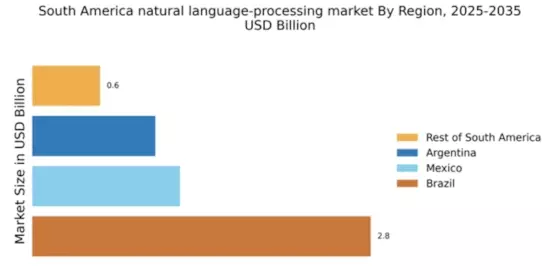
Brazil holds a commanding 2.75 market share in the South American NLP sector, driven by a burgeoning tech ecosystem and increasing investments in AI. Key growth drivers include government initiatives promoting digital transformation, alongside a rising demand for automated customer service solutions. The Brazilian government has implemented favorable regulatory policies to encourage innovation, while infrastructure improvements in major cities like São Paulo and Rio de Janeiro support industrial development.

Mexico : Emerging Tech Hub in Latin America

With a market share of 1.2, Mexico is rapidly establishing itself as a key player in the NLP landscape. The growth is fueled by increasing investments in technology startups and a strong demand for language processing solutions in sectors like e-commerce and customer service. Government initiatives aimed at enhancing digital literacy and technology adoption are also pivotal in shaping market dynamics, alongside a growing infrastructure for tech development.

Argentina : Innovation and Investment Surge

Argentina's NLP market, valued at 1.0, is experiencing significant growth driven by a vibrant startup ecosystem and increasing foreign investments. The demand for NLP applications in finance and healthcare is on the rise, supported by government policies that promote technological innovation. The local market is characterized by a strong emphasis on data privacy regulations, which shape the development of NLP solutions tailored to local needs.

Rest of South America : Untapped Potential Across Borders

The Rest of South America, with a market share of 0.55, presents a diverse landscape for NLP development. Countries like Chile and Colombia are beginning to invest in AI technologies, driven by a growing awareness of the benefits of NLP in various sectors. However, regulatory frameworks and infrastructure challenges remain hurdles. The competitive landscape is fragmented, with local startups emerging alongside established global players, creating a unique business environment.

South America Natural Language Processing Market Regional Image

Key Players and Competitive Insights

The natural language-processing market in South America is characterized by a dynamic competitive landscape, driven by rapid technological advancements and increasing demand for AI-driven solutions. Major players such as Google (US), Microsoft (US), and IBM (US) are strategically positioned to leverage their extensive resources and expertise in AI and machine learning. These companies focus on innovation and regional expansion, aiming to enhance their service offerings and capture a larger market share. Their collective strategies foster a competitive environment that encourages continuous improvement and adaptation to local market needs.

Key business tactics employed by these companies include localizing their services and optimizing supply chains to better serve the South American market. The competitive structure appears moderately fragmented, with several key players influencing market dynamics. This fragmentation allows for a variety of solutions tailored to specific regional demands, while also presenting challenges in terms of maintaining consistent quality and service levels across diverse markets.

In October 2025, Google (US) announced the launch of a new AI-driven language model specifically designed for Spanish and Portuguese, targeting the growing demand for localized solutions in South America. This strategic move is significant as it not only enhances Google's product offerings but also positions the company as a leader in addressing the unique linguistic needs of the region, potentially increasing its market share.

In September 2025, Microsoft (US) expanded its partnership with local tech firms to enhance its natural language-processing capabilities. This collaboration aims to integrate regional dialects and cultural nuances into its AI models, thereby improving user experience and engagement. Such partnerships are crucial for Microsoft as they allow the company to tap into local expertise and foster innovation tailored to South American consumers.

In August 2025, IBM (US) unveiled a new initiative focused on sustainability in AI development, emphasizing the importance of ethical AI practices. This initiative is particularly relevant in the context of increasing scrutiny over AI technologies and their environmental impact. By prioritizing sustainability, IBM not only differentiates itself from competitors but also aligns with the growing consumer demand for responsible technology solutions.

As of November 2025, current trends in the natural language-processing market include a strong emphasis on digitalization, sustainability, and the integration of AI across various sectors. Strategic alliances are increasingly shaping the competitive landscape, enabling companies to pool resources and expertise. Looking ahead, it appears that competitive differentiation will evolve from traditional price-based competition to a focus on innovation, technological advancement, and supply chain reliability. This shift may redefine how companies position themselves in the market, emphasizing the importance of delivering unique, high-quality solutions that meet the specific needs of South American consumers.

Key Companies in the South America Natural Language Processing Market market include

Industry Developments

Recent developments in the South America Natural Language Processing Market have shown a trend toward increased investment and advancements in technology. Companies like Salesforce and Oracle are expanding their offerings to enhance customer experiences through improved language understanding abilities. In September 2023, Verint Systems announced strategic collaborations aimed at bolstering their analytics capabilities in Brazil, fostering a higher level of personalized customer interaction. 

Meanwhile, Microsoft and Google are actively working on AI-driven solutions tailored for the regional market, addressing unique linguistic challenges prevalent in South America. A significant merger in April 2023 involved Amazon acquiring a local AI startup focused on language processing, enhancing Amazon's capabilities in the region. Likewise, IBM announced partnerships with educational institutions in South America to support local talent development in natural language technologies. 

The growth of the South America Natural Language Processing Market has been robust, with a reported increase in its valuation contributing to the broader tech ecosystem. Over the last two years, ongoing investments in R&D by companies such as SAP and IBM have spurred innovation, further driving market evolution and responsiveness to consumer needs.


Future Outlook

South America Natural Language Processing Market Future Outlook

The natural language-processing market is projected to grow at a 3.46% CAGR from 2024 to 2035, driven by advancements in AI, increased data generation, and demand for automation.

New opportunities lie in:

  • Development of AI-driven customer support chatbots for e-commerce platforms.
  • Integration of NLP in healthcare for patient data analysis and management.
  • Creation of localized language models for regional businesses to enhance communication.

By 2035, the market is expected to be robust, driven by innovative applications and increasing adoption across various sectors.

Market Segmentation

South America Natural Language Processing Market Type Outlook

  • Rule-based
  • Statistical
  • Hybrid

South America Natural Language Processing Market Service Outlook

  • Integration
  • Consulting & maintenance

South America Natural Language Processing Market Vertical Outlook

  • Healthcare
  • Retail Sector
  • Media & Entertainment

South America Natural Language Processing Market Deployment Outlook

  • On-Premise
  • On-Demand

South America Natural Language Processing Market Technology Outlook

  • Auto-coding
  • Text analytics
  • Pattern & Image recognition
  • Speech analytics

Report Scope

MARKET SIZE 2024 5.5(USD Billion)
MARKET SIZE 2025 5.69(USD Billion)
MARKET SIZE 2035 8.0(USD Billion)
COMPOUND ANNUAL GROWTH RATE (CAGR) 3.46% (2024 - 2035)
REPORT COVERAGE Revenue Forecast, Competitive Landscape, Growth Factors, and Trends
BASE YEAR 2024
Market Forecast Period 2025 - 2035
Historical Data 2019 - 2024
Market Forecast Units USD Billion
Key Companies Profiled ["Google (US)", "Microsoft (US)", "IBM (US)", "Amazon (US)", "Facebook (US)", "Baidu (CN)", "Salesforce (US)", "SAP (DE)", "NVIDIA (US)"]
Segments Covered Technology, Type, Service, Deployment, Vertical
Key Market Opportunities Integration of advanced AI-driven solutions in local languages enhances accessibility in the natural language-processing market.
Key Market Dynamics Rising demand for automated customer support solutions drives innovation in the natural language-processing market.
Countries Covered Brazil, Mexico, Argentina, Rest of South America

Leave a Comment

FAQs

What is the expected market size of the South America Natural Language Processing Market by 2024?

The South America Natural Language Processing Market is expected to be valued at 5.5 USD Billion by 2024.

What will be the market value of the South America Natural Language Processing Market in 2035?

In 2035, the South America Natural Language Processing Market is anticipated to reach 82.7 USD Billion.

What is the projected CAGR for the South America Natural Language Processing Market between 2025 and 2035?

The projected CAGR for the South America Natural Language Processing Market from 2025 to 2035 is 27.942%.

Which region holds the largest market share in the South America Natural Language Processing Market by 2024?

Brazil holds the largest market share in the South America Natural Language Processing Market, valued at 1.5 USD Billion in 2024.

What is the market value for the Auto-coding segment in the South America Natural Language Processing Market for 2024?

The Auto-coding segment is valued at 1.1 USD Billion in the South America Natural Language Processing Market for the year 2024.

What are the expected market values for Speech analytics in the South America Natural Language Processing Market by 2035?

The Speech analytics segment is projected to reach 26.2 USD Billion in the South America Natural Language Processing Market by 2035.

Who are some of the key players in the South America Natural Language Processing Market?

Key players in the South America Natural Language Processing Market include Salesforce, Oracle, SAP, Google, and Microsoft.

What will be the market value of Text analytics by 2035 in the South America Natural Language Processing Market?

The market value for Text analytics in the South America Natural Language Processing Market is expected to be 22.0 USD Billion by 2035.

How much is the Rest of South America region projected to be worth in the South America Natural Language Processing Market by 2035?

The Rest of South America region is anticipated to be valued at 31.9 USD Billion in the South America Natural Language Processing Market by 2035.

What is the expected value for the Pattern & Image recognition segment in the South America Natural Language Processing Market by 2024?

The Pattern & Image recognition segment is valued at 1.2 USD Billion in the South America Natural Language Processing Market for the year 2024.

Download Free Sample

Kindly complete the form below to receive a free sample of this Report

Compare Licence

×
Features License Type
Single User Multiuser License Enterprise User
Price $4,950 $5,950 $7,250
Maximum User Access Limit 1 User Upto 10 Users Unrestricted Access Throughout the Organization
Free Customization
Direct Access to Analyst
Deliverable Format
Platform Access
Discount on Next Purchase 10% 15% 15%
Printable Versions