Download Free Sample
Kindly complete the form below to receive a free sample of this Report
South America Personalized Medicine Market Research Report By Product Outlook (Personalized Medicine Diagnostics, Personalized Medicine Therapeutics, Personalized Medical Care, Personalized Nutrition and Wellness), By Application Outlook (Oncology, CNS, Immunology, Respiratory, Others), and By End-User Outlook (Hospitals, Diagnostic Centers, Research Academic Institutes, Others) -Forecast to 2035
As per Market Research Future analysis, the South America personalized medicine market size was estimated at 59.67 USD Billion in 2024. The South America personalized medicine market is projected to grow from 63.19 USD Billion in 2025 to 112.14 USD Billion by 2035, exhibiting a compound annual growth rate (CAGR) of 5% during the forecast period 2025 - 2035
The South America personalized medicine market is experiencing robust growth driven by technological advancements and increasing healthcare investments.
| 2024 Market Size | 59.67 (USD Billion) |
| 2035 Market Size | 112.14 (USD Billion) |
| CAGR (2025 - 2035) | 5.9% |
the personalized medicine market is experiencing notable growth in South America, driven by advancements in biotechnology and an increasing emphasis on tailored healthcare solutions. This region is witnessing a shift towards more individualized treatment approaches, which are designed to cater to the unique genetic profiles of patients. As healthcare providers and pharmaceutical companies invest in research and development, the landscape is evolving to incorporate innovative therapies that promise improved patient outcomes. Furthermore, the rising prevalence of chronic diseases necessitates a more precise approach to treatment, thereby propelling the demand for personalized medicine. In addition, regulatory frameworks in South America are gradually adapting to support the integration of personalized medicine into mainstream healthcare. Governments are recognizing the potential benefits of these tailored therapies, which could lead to more effective treatments and reduced healthcare costs in the long run. Collaborations between public and private sectors are becoming increasingly common, fostering an environment conducive to innovation. As the market continues to mature, it appears poised for further expansion, with a focus on enhancing accessibility and affordability of personalized treatments for diverse populations across the region.
Recent developments in genomic technologies are significantly influencing the personalized medicine market. Innovations such as next-generation sequencing are enabling more accurate genetic profiling, which in turn facilitates the creation of targeted therapies. This trend is particularly relevant in South America, where local research institutions are increasingly collaborating with international partners to enhance their capabilities in genomics.
Investment in healthcare infrastructure is crucial for the advancement of personalized medicine. In South America, governments and private entities are channeling resources into modernizing healthcare facilities and expanding access to advanced diagnostic tools. This trend is likely to improve the delivery of personalized treatments, making them more accessible to a broader segment of the population.
The rising burden of chronic diseases in South America is prompting a shift towards personalized medicine as a viable solution. Healthcare providers are increasingly adopting tailored treatment plans that consider individual patient characteristics, which may lead to better management of conditions such as diabetes and cardiovascular diseases. This focus on chronic disease management is expected to drive further growth in the personalized medicine market.
Government initiatives aimed at promoting personalized medicine are playing a crucial role in shaping the market landscape in South America. Various countries in the region are implementing policies to support research and development in genomics and biotechnology. For instance, funding programs and tax incentives for companies engaged in personalized medicine research are becoming more prevalent. These initiatives not only foster innovation but also encourage collaboration between public and private sectors. As a result, the personalized medicine market is expected to benefit from increased investment, potentially reaching a valuation of $5 billion by 2030.
The increasing prevalence of chronic diseases in South America is driving the demand for tailored therapies within the personalized medicine market. As healthcare providers seek to improve patient outcomes, there is a noticeable shift towards treatments that consider individual genetic profiles. This trend is particularly evident in oncology, where personalized therapies have shown to enhance efficacy and reduce adverse effects. According to recent estimates, the personalized medicine market in South America is projected to grow at a CAGR of approximately 12% from 2025 to 2030. This growth is indicative of a broader recognition of the need for customized treatment plans that align with patients' unique biological characteristics.
Innovations in diagnostic technologies are significantly impacting the personalized medicine market in South America. Enhanced genomic sequencing techniques and biomarker identification methods are enabling healthcare professionals to make more informed decisions regarding treatment options. These advancements facilitate the early detection of diseases and the identification of specific patient subgroups that may benefit from targeted therapies. As a result, the market is witnessing a surge in the adoption of precision diagnostics, which is expected to account for nearly 30% of the overall personalized medicine market by 2030. This shift underscores the importance of accurate diagnostics in tailoring treatment strategies.
The collaboration between academic institutions and the pharmaceutical industry is emerging as a key driver for the personalized medicine market in South America. Research partnerships are facilitating the translation of scientific discoveries into clinical applications, thereby accelerating the development of innovative therapies. These collaborations often focus on the identification of genetic markers and the development of targeted treatments. As a result, the personalized medicine market is expected to see a significant influx of novel therapies, with projections indicating that new product launches could increase by 25% over the next five years. This synergy between academia and industry is vital for advancing personalized medicine initiatives.
There is a notable increase in awareness among healthcare professionals regarding the benefits of personalized medicine in South America. Medical practitioners are increasingly recognizing the potential of tailored treatments to improve patient outcomes and reduce healthcare costs. This growing awareness is leading to enhanced training programs and educational initiatives focused on genomics and personalized therapies. As healthcare providers become more knowledgeable about the advantages of personalized medicine, the market is likely to experience accelerated growth. It is estimated that by 2030, approximately 40% of healthcare professionals in the region will be actively engaged in personalized medicine practices.
In the South America personalized medicine market, Personalized Medicine Diagnostics holds the largest share, showcasing the critical role of diagnostic tools in tailored healthcare solutions. This segment benefits from increasing healthcare expenditures and heightened awareness among patients regarding personalized treatment options, leading to a more significant adoption rate in clinical settings. In contrast, Personalized Medicine Therapeutics has emerged as the fastest-growing segment, fueled by advancements in genetic research and the rising prevalence of chronic diseases requiring customized therapeutic approaches.
The growth trends within this segment are driven by technological innovations, expanding access to genetic testing, and a surge in demand for individualized treatment plans. Additionally, collaborations between biotech firms and healthcare providers are boosting the development and availability of personalized therapeutics. The increasing focus on preventive healthcare further propels this growth, as patients seek more effective treatment pathways tailored to their unique genetic profiles.
Personalized Medicine Diagnostics (Dominant) vs. Personalized Medicine Therapeutics (Emerging)
Personalized Medicine Diagnostics is characterized by its essential role in identifying disease predispositions and guiding treatment choices. It includes advanced technologies such as genomic sequencing and biomarker discovery, positioning itself as a vital component in the healthcare landscape. In contrast, Personalized Medicine Therapeutics is emerging swiftly, focusing on tailoring treatment regimens based on individual genetic profiles and responses to various drugs. This segment is gaining traction due to the shift toward precision medicine, where the efficacy of drug therapies is maximized by aligning them with specific patient demographics and genetic markers. Both segments, while distinct, contribute significantly to transforming healthcare practices in South America.
In the Application segment, Oncology emerges as the largest contributor, reflecting a significant focus on cancer treatment solutions that leverage personalized medicine. Following closely are CNS and Immunology, demonstrating healthy market shares. Respiratory applications hold a small yet important role, while the 'Others' category includes niche therapies. This distribution highlights the variation in healthcare needs across different therapeutic areas, with Oncology taking a commanding lead in market presence.
Growth trends indicate that the demand for personalized medicine in the CNS segment is accelerating, driven by advancements in genomics and targeted therapies. Innovations in drug development tailored for individual responses are expected to catapult this segment as the fastest-growing. Additionally, increasing investment in research and a greater emphasis on individualized healthcare are fueling expansion across all areas, pointing towards a robust future for personalized applications.
Oncology (Dominant) vs. CNS (Emerging)
Oncology continues to dominate the application landscape in personalized medicine, driven by extensive research and tailored treatment plans that enhance patient outcomes. This segment benefits from cutting-edge technologies that assess genetic profiles, allowing for bespoke therapies aimed at specific cancer types. In contrast, the CNS segment, while currently smaller, is regarded as an emerging force. Innovations such as biologics and targeted therapies are gaining traction, transforming treatment approaches for neurological disorders. With the rise in mental health awareness and the ongoing research in personalized approaches to CNS diseases, this segment is poised for significant growth, making it an area of interest for stakeholders in the personalized medicine landscape.
In the personalized medicine market, Hospitals hold the largest share among end-users, showcasing a significant demand for tailored treatment solutions, primarily due to their integration of advanced technologies and patient-centered care approaches. Conversely, Diagnostic Centers, while smaller in overall market share, are rapidly gaining traction as consumers increasingly seek precision diagnostics to inform personalized treatment plans. Both segments are crucial to the growth of personalized medicine in the region.
Growth trends within these segments indicate an increasing focus on personalized approaches to healthcare, driven by advancements in genomics and biotechnology. Hospitals are investing in tailored therapies, while Diagnostic Centers are expanding capabilities in genetic testing and biomarker analysis. This dual trajectory indicates that as patient awareness rises, supported by technological innovation, the landscape of healthcare delivery is set for transformative changes across these end-user categories.
Hospitals (Dominant) vs. Diagnostic Centers (Emerging)
Hospitals stand as a dominant force in the personalized medicine market, characterized by their extensive resources and capacity to implement advanced treatment protocols. They are well-equipped to adopt personalized therapies, investing substantially in clinical trials and research that align with patients' genetic profiles. On the other hand, Diagnostic Centers are emerging as essential players, focusing on precision diagnostics that enable tailored therapies. With increasing investments in state-of-the-art diagnostic technologies, these centers are vital in facilitating targeted treatments and enhancing treatment efficacy. Together, these segments illustrate the evolving dynamics of healthcare delivery, where personalized approaches are becoming central to effective patient management.
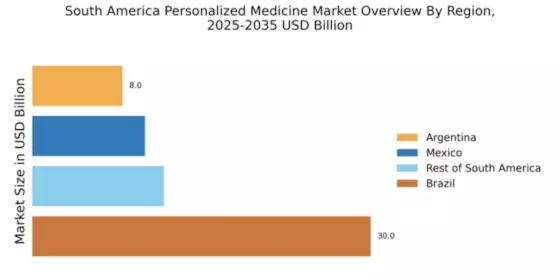
Brazil holds a dominant 30.0% market share in South America's personalized medicine sector, driven by increasing healthcare investments and a growing aging population. Key growth drivers include advancements in genomics and biotechnology, alongside supportive government initiatives aimed at enhancing healthcare access. Regulatory frameworks are evolving to facilitate faster approvals for personalized therapies, while infrastructure improvements in urban centers bolster distribution and accessibility.
With a 10.0% market share, Mexico is rapidly emerging in the personalized medicine landscape. Growth is fueled by increasing investments in healthcare technology and a rising demand for tailored therapies. The government has implemented regulatory reforms to streamline the approval process for new treatments, enhancing market dynamics. Additionally, the expansion of healthcare infrastructure in urban areas supports the distribution of personalized medicine solutions.
Argentina accounts for an 8.0% share in the personalized medicine market, characterized by a focus on localized healthcare solutions. The growth is driven by increasing awareness of genetic testing and personalized therapies among healthcare providers and patients. Government initiatives are promoting research and development in biotechnology, while regulatory bodies are working to ensure the safety and efficacy of new treatments. The market is also supported by collaborations between local universities and pharmaceutical companies.
The Rest of South America holds an 11.67% market share in personalized medicine, showcasing diverse opportunities across different countries. Growth is driven by varying healthcare needs and increasing investments in biotechnology. Regulatory environments differ significantly, with some countries adopting more progressive policies to encourage innovation. Infrastructure development is uneven, impacting market access and distribution channels for personalized therapies.
The personalized medicine market in South America is characterized by a dynamic competitive landscape, driven by advancements in genomics, biotechnology, and a growing emphasis on tailored healthcare solutions. Key players such as Roche (CH), Thermo Fisher Scientific (US), and Novartis (CH) are at the forefront, leveraging their extensive research capabilities and innovative product pipelines. Roche (CH) focuses on integrating diagnostics with therapeutics, enhancing patient outcomes through precision medicine. Meanwhile, Thermo Fisher Scientific (US) emphasizes its role in providing comprehensive genomic solutions, which are crucial for personalized treatment strategies. Novartis (CH) is actively pursuing partnerships to expand its reach in the region, particularly in oncology, where personalized therapies are gaining traction. Collectively, these strategies foster a competitive environment that prioritizes innovation and collaboration.In terms of business tactics, companies are increasingly localizing manufacturing and optimizing supply chains to enhance efficiency and responsiveness to market demands. The competitive structure of the market appears moderately fragmented, with several players vying for market share. However, the influence of major companies is substantial, as they set industry standards and drive technological advancements that smaller firms often follow.
In October Roche (CH) announced a strategic partnership with a local biotech firm to develop personalized therapies for chronic diseases prevalent in South America. This collaboration is expected to enhance Roche's capabilities in tailoring treatments to the genetic profiles of local populations, thereby improving patient outcomes and expanding its market presence. The strategic importance of this move lies in its potential to address unmet medical needs in the region, aligning with global trends towards personalized healthcare.
In September Novartis (CH) launched a new initiative aimed at increasing access to its personalized medicine portfolio in underserved areas of South America. This initiative includes educational programs for healthcare professionals and partnerships with local health authorities. The significance of this initiative is twofold: it not only broadens patient access to innovative therapies but also strengthens Novartis's reputation as a leader in responsible healthcare practices.
In August Thermo Fisher Scientific (US) unveiled a new genomic sequencing platform tailored for the South American market, designed to facilitate rapid and cost-effective genetic testing. This development is crucial as it enhances the company's competitive edge by providing healthcare providers with the tools necessary for implementing personalized medicine strategies. The introduction of this platform indicates a shift towards more accessible genomic technologies, which could significantly impact patient care in the region.
As of November current trends in the personalized medicine market include a pronounced focus on digitalization, sustainability, and the integration of artificial intelligence (AI) in research and development processes. Strategic alliances are increasingly shaping the competitive landscape, enabling companies to pool resources and expertise. Looking ahead, competitive differentiation is likely to evolve from traditional price-based competition to a focus on innovation, technological advancements, and the reliability of supply chains. This shift underscores the importance of adaptability and forward-thinking strategies in maintaining a competitive edge in the personalized medicine market.




The South America Personalized Medicine Market has witnessed significant developments recently, including a focus on expanding genetic testing and targeted therapies in countries like Brazil and Argentina. In June 2023, Dasa announced the acquisition of a local biotechnology firm, enhancing its capabilities in genomics and personalized healthcare solutions.
Additionally, the growth of Laboratorio Farmaceutico Fagron has been notable, as the company reported an increase in its market valuation due to the adoption of innovative drug delivery systems tailored to individual patient needs. Grupo Sabin and Fleury Group have also made strides in advancing laboratory services, improving access to personalized diagnostics across the region. The market's expansion has been fueled by a growing emphasis on precision medicine as a cornerstone of healthcare policy in South America, with ministries in various countries advocating for the integration of personalized healthcare in public health agendas.
In the last 2-3 years, there has been a notable increase in public and private investments in biotechnology research and development, driving advancements in personalized treatments and diagnostics across South America.
The Personalized Medicine Market is projected to grow at a 5.9% CAGR from 2025 to 2035, driven by advancements in genomics, increased healthcare spending, and rising demand for tailored therapies.
New opportunities lie in:
By 2035, the personalized medicine market will achieve substantial growth and innovation.
| MARKET SIZE 2024 | 59.67(USD Billion) |
| MARKET SIZE 2025 | 63.19(USD Billion) |
| MARKET SIZE 2035 | 112.14(USD Billion) |
| COMPOUND ANNUAL GROWTH RATE (CAGR) | 5.9% (2025 - 2035) |
| REPORT COVERAGE | Revenue Forecast, Competitive Landscape, Growth Factors, and Trends |
| BASE YEAR | 2024 |
| Market Forecast Period | 2025 - 2035 |
| Historical Data | 2019 - 2024 |
| Market Forecast Units | USD Billion |
| Key Companies Profiled | Roche (CH), Thermo Fisher Scientific (US), Illumina (US), Novartis (CH), GSK (GB), Pfizer (US), AbbVie (US), Bristol-Myers Squibb (US), Amgen (US) |
| Segments Covered | Product, Application, End-User |
| Key Market Opportunities | Emergence of advanced genomic technologies enhances tailored therapies in the personalized medicine market. |
| Key Market Dynamics | Rising demand for tailored therapies drives innovation and competition in the personalized medicine market. |
| Countries Covered | Brazil, Mexico, Argentina, Rest of South America |
The overall market valuation for personalized medicine in South America was $59.67 Billion in 2024.
The projected market valuation for personalized medicine in South America is $112.14 Billion by 2035.
The expected CAGR for the South America personalized medicine market during the forecast period 2025 - 2035 is 5.9%.
Key players in the South America personalized medicine market include Roche, Thermo Fisher Scientific, Illumina, Novartis, GSK, Pfizer, AbbVie, Bristol-Myers Squibb, and Amgen.
The valuation of personalized medicine diagnostics in 2024 was $10.0 Billion.
The projected valuation for personalized medicine therapeutics is $45.0 Billion by 2035.
The personalized nutrition and wellness segment is expected to grow to $24.14 Billion by 2035.
The market size for oncology applications in 2024 was $20.0 Billion.
The projected market size for hospitals as end-users of personalized medicine is $38.0 Billion by 2035.
The valuation of the immunology application segment in 2024 was $12.0 Billion.



Kindly complete the form below to receive a free sample of this Report

“This is really good guys. Excellent work on a tight deadline. I will continue to use you going forward and recommend you to others. Nice job”


“Thanks. It’s been a pleasure working with you, please use me as reference with any other Intel employees.”


“Thanks for sending the report it gives us a good global view of the Betaïne market.”


“Thank you, this will be very helpful for OQS.”


“We found the report very insightful! we found your research firm very helpful. I'm sending this email to secure our future business.”


“I am very pleased with how market segments have been defined in a relevant way for my purposes (such as "Portable Freezers & refrigerators" and "last-mile"). In general the report is well structured. Thanks very much for your efforts.”


“I have been reading the first document or the study, ,the Global HVAC and FP market report 2021 till 2026. Must say, good info! I have not gone in depth at all parts, but got a good indication of the data inside!”


“We got the report in time, we really thank you for your support in this process. I also thank to all of your team as they did a great job.”


“The Automotive 48V ECU Components Procurement Intelligence Study” was a complex project, but the Market Research Future (MRFR) team handled it with quality, agility, and customer-centricity. They delivered all requested data on time and within the agreed scope. The team, including Shubhendra Anand and Rahul Gotadki, was always readily available to clarify questions and swiftly implement necessary adjustments, driving the project to a successful conclusion within a very demanding timeframe.
I would also like to specifically commend Akshay Agarwal for his responsiveness and support at every stage—from our initial inquiry on May 6th through to final delivery on June 18th. His dedication made the entire process seamless.”



