×
Request Free Sample ×

Kindly complete the form below to receive a free sample of this Report

* Please use a valid business email

Leading companies partner with us for data-driven Insights

clients tt-cursor
Hero Background

South America Scoliosis Treatment Market

ID: MRFR/HC/49178-HCR
200 Pages
Rahul Gotadki
October 2025

South America Scoliosis Treatment Market Research Report By Disease (Infantile Idiopathic Scoliosis, Adolescent Idiopathic Scoliosis), By Product (Cervical Thoracic Lumbar Sacral Orthosis (CTLSO), Thoracolumbosacral Orthosis (TLSO), Lumbosacral Orthosis (LSO)), By Distribution Channel (Hospitals & Clinics, Retail Pharmacies, Online Pharmacies) and By Regional (Brazil, Mexico, Argentina, Rest of South America)-Forecast to 2035

Share:
Download PDF ×

We do not share your information with anyone. However, we may send you emails based on your report interest from time to time. You may contact us at any time to opt-out.

South America Scoliosis Treatment Market Infographic
Purchase Options

South America Scoliosis Treatment Market Summary

As per MRFR analysis, the South America scoliosis treatment market size was estimated at 17.19 USD Billion in 2024. The South America scoliosis treatment market is projected to grow from 19.15 USD Billion in 2025 to 56.38 USD Billion by 2035, exhibiting a compound annual growth rate (CAGR) of 11.4% during the forecast period 2025 - 2035.

Key Market Trends & Highlights

The South America scoliosis treatment market is experiencing notable growth driven by technological advancements and increased awareness.

  • Brazil remains the largest market for scoliosis treatment, reflecting a robust healthcare infrastructure.
  • Mexico is emerging as the fastest-growing region, indicating a rising demand for effective scoliosis solutions.
  • There is a marked increase in awareness and education regarding scoliosis, leading to more patients seeking treatment.
  • The growing incidence of scoliosis and technological innovations in treatment are key drivers propelling market expansion.

Market Size & Forecast

2024 Market Size 17.19 (USD Billion)
2035 Market Size 56.38 (USD Billion)
CAGR (2025 - 2035) 11.4%

Major Players

Medtronic (US), Stryker (US), NuVasive (US), Zimmer Biomet (US), DePuy Synthes (US), Orthofix Medical (US), Globus Medical (US), K2M Group Holdings (US)

South America Scoliosis Treatment Market Trends

The scoliosis treatment market in South America is currently experiencing notable developments, driven by a combination of increasing awareness and advancements in medical technology. Healthcare providers are increasingly focusing on early diagnosis and intervention, which appears to be crucial in managing scoliosis effectively. This shift is likely influenced by a growing understanding of the condition's long-term implications on health and quality of life. Furthermore, the integration of innovative treatment options, such as bracing and surgical interventions, is becoming more prevalent, suggesting a positive trajectory for patient outcomes. In addition, the role of rehabilitation services is gaining prominence within the scoliosis treatment market. Physical therapy and specialized exercise programs are being recognized for their potential to enhance mobility and reduce discomfort. This trend indicates a holistic approach to treatment, where non-invasive methods complement surgical options. As healthcare systems in South America continue to evolve, the emphasis on comprehensive care strategies may lead to improved patient satisfaction and overall effectiveness in managing scoliosis.

Rising Awareness and Education

There is a growing emphasis on educating both healthcare professionals and the public about scoliosis. This trend is likely to enhance early detection and treatment options, potentially leading to better patient outcomes.

Advancements in Treatment Technologies

Innovative technologies in bracing and surgical techniques are emerging, which may improve the effectiveness of scoliosis treatments. These advancements could lead to more personalized treatment plans for patients.

Increased Focus on Rehabilitation

Rehabilitation services are becoming more integral to the scoliosis treatment process. This trend suggests a shift towards non-invasive therapies, which may complement traditional treatment methods and improve patient recovery.

South America Scoliosis Treatment Market Drivers

Growing Incidence of Scoliosis

The increasing prevalence of scoliosis in South America is a critical driver for the scoliosis treatment market. Recent studies indicate that approximately 2-3% of the population may be affected by this condition, leading to a heightened demand for effective treatment options. As awareness of scoliosis rises, more individuals are seeking medical advice and intervention, which in turn propels the market forward. The growing incidence is particularly notable among adolescents, where early detection and treatment are essential. This trend suggests that healthcare providers and institutions are likely to invest more in scoliosis treatment solutions, thereby expanding the market landscape. Furthermore, the rising number of orthopedic specialists focusing on scoliosis management is expected to enhance treatment accessibility, contributing to market growth.

Government Initiatives and Funding

Government initiatives aimed at improving healthcare infrastructure are significantly influencing the scoliosis treatment market in South America. Various countries in the region are allocating funds to enhance orthopedic care and promote awareness about spinal disorders. For instance, public health campaigns are being launched to educate the population about scoliosis, encouraging early diagnosis and treatment. Additionally, government funding for research and development in scoliosis treatment is on the rise, which could lead to innovative therapies and improved patient outcomes. This financial support is crucial, as it not only aids in the development of new treatment options but also ensures that existing therapies are accessible to a broader segment of the population. The potential for increased investment in healthcare infrastructure may further stimulate market growth.

Technological Innovations in Treatment

Technological advancements play a pivotal role in shaping the scoliosis treatment market in South America. Innovations such as 3D imaging and computer-assisted surgery are revolutionizing how scoliosis is diagnosed and treated. These technologies not only improve the accuracy of assessments but also enhance surgical outcomes, leading to shorter recovery times for patients. The introduction of minimally invasive surgical techniques has also gained traction, appealing to both patients and healthcare providers. As a result, the market is witnessing an influx of new treatment modalities that are more effective and less invasive. The financial implications are noteworthy, as the adoption of these technologies can lead to increased healthcare costs, but they also promise better long-term outcomes, which may justify the investment.

Rising Demand for Non-Invasive Treatments

The scoliosis treatment market is experiencing a shift towards non-invasive treatment options, driven by patient preferences and advancements in therapeutic techniques. Many patients are increasingly seeking alternatives to surgical interventions, which can be daunting and carry inherent risks. Non-invasive treatments, such as bracing and physical therapy, are gaining popularity due to their effectiveness in managing scoliosis without the need for surgery. This trend is particularly evident among younger patients and their families, who often prefer to explore conservative management options first. The market is likely to see a rise in the availability of innovative bracing solutions that are more comfortable and aesthetically pleasing. As a result, the demand for non-invasive treatments is expected to grow, influencing the overall dynamics of the scoliosis treatment market.

Increased Collaboration Among Healthcare Providers

Collaboration among healthcare providers is emerging as a significant driver in the scoliosis treatment market in South America. Multidisciplinary approaches involving orthopedic surgeons, physiotherapists, and rehabilitation specialists are becoming more common, leading to comprehensive care for scoliosis patients. This collaborative model not only enhances treatment outcomes but also fosters knowledge sharing and best practices among professionals. As healthcare systems evolve, the integration of various specialties is likely to improve patient management and streamline treatment protocols. Furthermore, such collaborations may lead to the development of standardized treatment guidelines, which could enhance the quality of care provided. The potential for improved patient outcomes through collaborative efforts is expected to positively impact the market landscape.

Market Segment Insights

By Disease: Adolescent Idiopathic Scoliosis (Largest) vs. Infantile Idiopathic Scoliosis (Fastest-Growing)

In the South America scoliosis treatment market, Adolescent Idiopathic Scoliosis currently holds the largest share, dominating the segment due to its higher prevalence and increased awareness among healthcare professionals. This condition typically affects adolescents during their growth spurts, leading to a greater focus on treatment options and patient management strategies within this demographic. Conversely, Infantile Idiopathic Scoliosis is emerging as the fastest-growing segment, driven by advancements in early detection and intervention. Increased parental awareness and the integration of new technologies for treatment are contributing significantly to the growth of this segment. Healthcare providers are recognizing the importance of addressing this condition at an early stage, ensuring better outcomes for the affected children.

Adolescent Idiopathic Scoliosis (Dominant) vs. Infantile Idiopathic Scoliosis (Emerging)

Adolescent Idiopathic Scoliosis has established itself as the dominant force in the scoliosis treatment landscape, primarily affecting individuals between the ages of 10 and 18. This segment is characterized by a higher incidence rate, which necessitates targeted treatment strategies and awareness campaigns to ensure timely interventions. With a range of treatment options available, including bracing and surgical interventions, the market continually evolves to meet patient needs. On the other hand, Infantile Idiopathic Scoliosis is positioned as an emerging segment, gaining traction due to improved screening processes and the emphasis on early treatment. This shift highlights the importance of proactive management, as early intervention can lead to significantly better long-term outcomes.

By Product: Cervical Thoracic Lumbar Sacosis (CTLSO) (Largest) vs. Thoracolumbosacral Orthosis (TLSO) (Fastest-Growing)

In the Product segment of the scoliosis treatment market, Cervical Thoracic Lumbar Orthosis (CTLSO) holds the largest market share, reflecting its established use and acceptance among practitioners in the region. Meanwhile, Thoracolumbosacral Orthosis (TLSO) is emerging as the fastest-growing option, driven by increasing awareness and advancements in orthopedic technology that favor the design and functionality of TLSOs compared to other products. The growth trend of TLSOs can be attributed to the rising prevalence of scoliosis among the younger population and the increasing incidences of obesity, which exacerbate spinal issues. Health care providers are focusing more on patient-centered approaches, leading to an increase in tailored orthotic solutions, particularly for TLSOs. This shift towards more customized treatment plans is anticipated to fuel further growth in this product category as demand escalates for innovative and adaptive solutions for scoliosis patients.

Cervical Thoracic Lumbar Orthosis (CTLSO) (Dominant) vs. Thoracolumbosacral Orthosis (TLSO) (Emerging)

Cervical Thoracic Lumbar Orthosis (CTLSO) serves as a dominant product in scoliosis treatment due to its versatility and comprehensive support for various spinal regions. It is particularly favored for its ability to address complex scoliosis cases, ensuring effective spinal alignment while mitigating discomfort. In contrast, Thoracolumbosacral Orthosis (TLSO) stands out as an emerging product, gaining traction for its design that accommodates multiple levels of spinal support and ease of use. As advancements in materials and design optimize the function of TLSOs, they are increasingly viewed as preferred options for both patients and clinicians seeking effective scoliosis solutions.

By Distribution Channel: Hospitals & Clinics (Largest) vs. Online Pharmacies (Fastest-Growing)

In the distribution channel segment, Hospitals & Clinics command the largest share, playing a crucial role in delivering scoliosis treatment services. This segment benefits from established trust and comprehensive care capabilities, appealing to patients seeking immediate and expert attention. Retail Pharmacies also hold a significant portion of the market, providing convenient access to treatment resources, although they are challenged by the growing popularity of online alternatives. The growth trends in the distribution channel segment are significantly influenced by the increasing adoption of digital health solutions and the rising convenience of Online Pharmacies. The pandemic has accelerated the shift towards online purchasing, making this channel the fastest-growing. Additionally, advancements in telehealth and improved delivery logistics further support the expansion of online options, changing the landscape of scoliosis treatment access.

Hospitals & Clinics (Dominant) vs. Online Pharmacies (Emerging)

Hospitals & Clinics are recognized as the dominant force within the distribution channels for scoliosis treatment, primarily due to their extensive infrastructure and ability to offer specialized care. They provide a wide range of treatment options, including surgical interventions and personalized therapy plans, thus ensuring comprehensive patient management. Conversely, Online Pharmacies are emerging as a crucial and rapidly growing alternative, appealing to tech-savvy consumers and those seeking convenience. This segment caters to a growing demand for accessible health products, including braces and medications, allowing patients to shop from the comfort of their homes while benefiting from competitive pricing and a broader selection.

Get more detailed insights about South America Scoliosis Treatment Market

Regional Insights

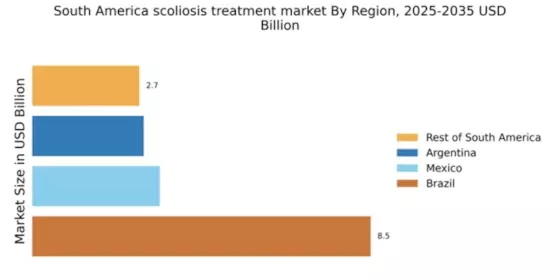
Brazil : Strong Demand and Growth Drivers

Brazil holds a dominant market share of 8.5% in the South American scoliosis treatment sector, driven by increasing awareness of spinal disorders and advancements in medical technology. The growing elderly population and rising healthcare expenditure are significant growth drivers. Government initiatives aimed at improving healthcare access and regulatory support for innovative treatments further enhance market potential. Additionally, Brazil's robust healthcare infrastructure supports the distribution and availability of scoliosis treatment options.

Mexico : Increasing Awareness and Accessibility

Mexico accounts for a 3.2% share of the scoliosis treatment market in South America, with a growing demand for effective treatment solutions. Key growth drivers include rising awareness of scoliosis among the population and increased investment in healthcare infrastructure. Regulatory policies are becoming more favorable, promoting the adoption of advanced medical technologies. The demand for scoliosis treatments is also supported by a younger demographic increasingly seeking corrective procedures.

Argentina : Focus on Innovative Solutions

Argentina's scoliosis treatment market holds a 2.8% share, characterized by a steady increase in demand for innovative treatment options. Key growth drivers include a rising prevalence of spinal disorders and government initiatives aimed at enhancing healthcare services. The market is witnessing a shift towards minimally invasive surgical techniques, reflecting changing consumption patterns. Regulatory frameworks are adapting to support new technologies, fostering a conducive environment for market growth.

Rest of South America : Varied Demand Across Regions

The Rest of South America represents a 2.69% share in the scoliosis treatment market, with diverse demand driven by varying healthcare needs across countries. Key growth factors include increasing healthcare investments and a focus on improving patient access to treatment. Regulatory policies are evolving, encouraging the introduction of new medical technologies. The market dynamics are influenced by local healthcare systems and economic conditions, creating unique opportunities for growth.

South America Scoliosis Treatment Market Regional Image

Key Players and Competitive Insights

The scoliosis treatment market in South America is characterized by a competitive landscape that is increasingly shaped by innovation, strategic partnerships, and regional expansion. Key players such as Medtronic (US), Stryker (US), and NuVasive (US) are actively pursuing strategies that emphasize technological advancements and enhanced patient outcomes. Medtronic (US), for instance, has focused on integrating advanced robotics into its surgical solutions, which appears to enhance precision and reduce recovery times. Meanwhile, Stryker (US) has been investing in digital health technologies, suggesting a commitment to improving surgical workflows and patient monitoring, thereby positioning itself as a leader in the digital transformation of healthcare. These strategies collectively foster a dynamic environment where competition is not solely based on pricing but increasingly on the quality and efficacy of treatment solutions.

In terms of business tactics, companies are localizing manufacturing and optimizing supply chains to better serve the South American market. This approach not only reduces costs but also enhances responsiveness to local demands. The market structure is moderately fragmented, with several players vying for market share, yet the influence of major companies remains substantial. The collective actions of these key players indicate a trend towards consolidation, where strategic alliances and partnerships are likely to play a pivotal role in shaping future market dynamics.

In October 2025, NuVasive (US) announced a strategic partnership with a leading South American hospital network to enhance its distribution capabilities and improve access to its innovative scoliosis treatment solutions. This move is significant as it not only expands NuVasive's footprint in the region but also aligns with its goal of increasing patient access to advanced surgical options. Such partnerships may facilitate quicker adoption of new technologies and improve overall patient outcomes in the region.

In September 2025, Orthofix Medical (US) launched a new line of minimally invasive surgical instruments specifically designed for scoliosis correction. This product introduction is noteworthy as it reflects the company's commitment to innovation and addresses the growing demand for less invasive treatment options. By focusing on developing advanced surgical tools, Orthofix Medical (US) positions itself to capture a larger share of the market, particularly among surgeons seeking to improve patient recovery times and surgical success rates.

In August 2025, Globus Medical (US) expanded its operations in Brazil by establishing a new manufacturing facility aimed at producing its advanced spinal implants locally. This strategic move is indicative of a broader trend towards regional manufacturing, which not only reduces logistical costs but also enhances supply chain reliability. By localizing production, Globus Medical (US) is likely to improve its competitive edge in the South American market, responding more effectively to local needs and preferences.

As of November 2025, the competitive trends in the scoliosis treatment market are increasingly defined by digitalization, sustainability, and the integration of artificial intelligence (AI) into treatment protocols. Strategic alliances are becoming more prevalent, as companies recognize the value of collaboration in driving innovation and improving patient care. Looking ahead, it appears that competitive differentiation will evolve from traditional price-based competition to a focus on technological innovation, enhanced patient outcomes, and supply chain reliability. This shift suggests that companies that prioritize research and development, alongside strategic partnerships, will likely emerge as leaders in the evolving landscape.

Key Companies in the South America Scoliosis Treatment Market market include

Industry Developments

Recent developments in the South America Scoliosis Treatment Market have shown a steady growth trajectory, reflected in the increasing market valuation for companies such as NuVasive, Boston Scientific, and Medtronic. In June 2023, Medtronic launched a new surgical solution for scoliosis correction in Brazil, marking a significant entry into the country's evolving medical landscape. Additionally, in March 2023, Stryker introduced advanced imaging systems aimed at optimizing scoliosis surgeries across various South American countries. The demand for innovative treatment options is rising, driven by a higher awareness of scoliosis management and the increasing incidence rates across the region.

In terms of mergers and acquisitions, Global Med announced an acquisition of a local medical device distributor in Brazil in April 2023 to enhance its market penetration and product availability. This move is bolstered by ongoing collaborations with local healthcare providers for improved patient outcomes. The South American market is also seeing increased investment in Research and Development as companies aim to tailor products to meet the specific needs of regional patients. Overall, developments within recent years highlight a growing focus on enhancing treatment accessibility and surgical options throughout South America.

Future Outlook

South America Scoliosis Treatment Market Future Outlook

The Scoliosis Treatment Market is projected to grow at 11.4% CAGR from 2024 to 2035, driven by technological advancements, increasing awareness, and rising healthcare expenditure.

New opportunities lie in:

  • Development of telehealth platforms for remote consultations and monitoring.
  • Investment in innovative brace technologies utilizing smart materials.
  • Expansion of outpatient surgical centers to enhance accessibility and reduce costs.

By 2035, the scoliosis treatment market is expected to achieve substantial growth and innovation.

Market Segmentation

South America Scoliosis Treatment Market Disease Outlook

  • Infantile Idiopathic Scoliosis
  • Adolescent Idiopathic Scoliosis

South America Scoliosis Treatment Market Product Outlook

  • Cervical Thoracic Lumbar Sacral Orthosis (CTLSO)
  • Thoracolumbosacral Orthosis (TLSO)
  • Lumbosacral Orthosis (LSO)

South America Scoliosis Treatment Market Distribution Channel Outlook

  • Hospitals & Clinics
  • Retail Pharmacies
  • Online Pharmacies

Report Scope

MARKET SIZE 202417.19(USD Billion)
MARKET SIZE 202519.15(USD Billion)
MARKET SIZE 203556.38(USD Billion)
COMPOUND ANNUAL GROWTH RATE (CAGR)11.4% (2024 - 2035)
REPORT COVERAGERevenue Forecast, Competitive Landscape, Growth Factors, and Trends
BASE YEAR2024
Market Forecast Period2025 - 2035
Historical Data2019 - 2024
Market Forecast UnitsUSD Billion
Key Companies Profiled["Medtronic (US)", "Stryker (US)", "NuVasive (US)", "Zimmer Biomet (US)", "DePuy Synthes (US)", "Orthofix Medical (US)", "Globus Medical (US)", "K2M Group Holdings (US)"]
Segments CoveredDisease, Product, Distribution Channel
Key Market OpportunitiesEmergence of innovative non-invasive therapies and personalized treatment plans in the scoliosis treatment market.
Key Market DynamicsRising demand for innovative scoliosis treatments drives competition and regulatory adaptations in South America.
Countries CoveredBrazil, Mexico, Argentina, Rest of South America

Leave a Comment

FAQs

What is the expected market size of the South America Scoliosis Treatment Market for the year 2024?

The South America Scoliosis Treatment Market is expected to be valued at 17.19 USD Billion in the year 2024.

What will the South America Scoliosis Treatment Market be valued at by 2035?

By 2035, the South America Scoliosis Treatment Market is projected to reach a value of 56.39 USD Billion.

What is the expected compound annual growth rate (CAGR) for the South America Scoliosis Treatment Market from 2025 to 2035?

The expected CAGR for the South America Scoliosis Treatment Market from 2025 to 2035 is 11.404%.

Which region is projected to have the largest market share in the South America Scoliosis Treatment Market by 2035?

Brazil is projected to have the largest market share in the South America Scoliosis Treatment Market by reaching 16.5 USD Billion by 2035.

How much is the market for Infantile Idiopathic Scoliosis expected to be worth in 2035?

The market for Infantile Idiopathic Scoliosis is expected to be valued at 16.78 USD Billion by 2035.

What was the market value of Adolescent Idiopathic Scoliosis in 2024?

The market value of Adolescent Idiopathic Scoliosis in 2024 was 12.19 USD Billion.

Who are the key players in the South America Scoliosis Treatment Market?

Key players in the South America Scoliosis Treatment Market include NuVasive, Boston Scientific, Medtronic, and Stryker.

Which countries are included in the South America Scoliosis Treatment Market analysis?

The South America Scoliosis Treatment Market analysis includes Brazil, Mexico, Argentina, and the Rest of South America.

How is the South America Scoliosis Treatment Market segmented by region for 2024?

In 2024, the South America Scoliosis Treatment Market is segmented as 5.0 USD Billion for Brazil, 4.5 USD Billion for Mexico, 3.0 USD Billion for Argentina, and 4.69 USD Billion for the Rest of South America.

What are the growth drivers for the South America Scoliosis Treatment Market?

The growth drivers for the South America Scoliosis Treatment Market include increasing awareness, advancements in treatment technology, and a growing patient population.

Download Free Sample

Kindly complete the form below to receive a free sample of this Report

Compare Licence

×
Features License Type
Single User Multiuser License Enterprise User
Price $4,950 $5,950 $7,250
Maximum User Access Limit 1 User Upto 10 Users Unrestricted Access Throughout the Organization
Free Customization
Direct Access to Analyst
Deliverable Format
Platform Access
Discount on Next Purchase 10% 15% 15%
Printable Versions