×
Request Free Sample ×

Kindly complete the form below to receive a free sample of this Report

* Please use a valid business email

Leading companies partner with us for data-driven Insights

clients tt-cursor
Hero Background

South Korea Business Rules Management System Market

ID: MRFR/ICT/57517-HCR
200 Pages
Aarti Dhapte
February 2026

South Korea Business Rules Management System Market Size, Share and Trends Analysis Report By Deployment Type (Cloud-Based, On-Premises, Hybrid), By Application (Finance, Telecommunications, Healthcare, Retail, Manufacturing), By End User (Small and Medium Enterprises, Large Enterprises, Government) and By Component (Software, Services)-Forecast to 2035

Share:
Download PDF ×

We do not share your information with anyone. However, we may send you emails based on your report interest from time to time. You may contact us at any time to opt-out.

South Korea Business Rules Management System Market Infographic
Purchase Options

South Korea Business Rules Management System Market Summary

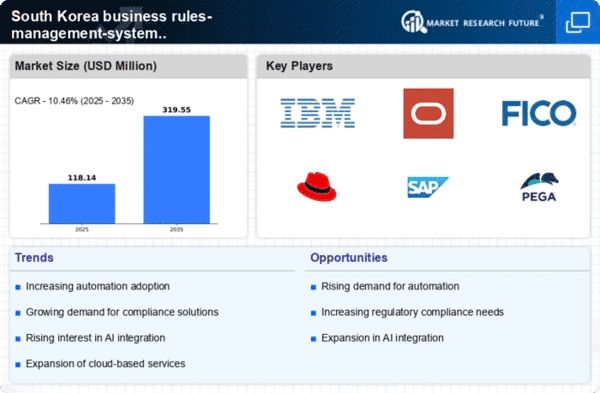
As per Market Research Future analysis, the South Korea business rules-management-system. size. was estimated at 106.95 USD Million in 2024. The South Korea business rules-management-system. is projected to grow from 118.14 USD Million in 2025 to 319.55 USD Million by 2035, exhibiting a compound annual growth rate (CAGR) of 10.4% during the forecast period 2025 - 2035

Key Market Trends & Highlights

The South Korea business rules-management-system. is experiencing robust growth driven by automation and AI integration.

  • The market is witnessing increased adoption of automation technologies across various sectors.
  • Integration of AI technologies is becoming a pivotal trend, enhancing decision-making processes.
  • Regulatory compliance focus is intensifying, particularly in the finance and healthcare segments.
  • Rising demand for operational efficiency and growing complexity of business regulations are key drivers of market expansion.

Market Size & Forecast

2024 Market Size 106.95 (USD Million)
2035 Market Size 319.55 (USD Million)
CAGR (2025 - 2035) 10.46%

Major Players

IBM (US), Oracle (US), FICO (US), Red Hat (US), SAP (DE), Pegasystems (US), TIBCO Software (US), InRule Technology (US)

Our Impact
Enabled $4.3B Revenue Impact for Fortune 500 and Leading Multinationals
Partnering with 2000+ Global Organizations Each Year
30K+ Citations by Top-Tier Firms in the Industry

South Korea Business Rules Management System Market Trends

The business rules-management-system market in South Korea is currently experiencing a notable evolution, driven by the increasing demand for automation and efficiency in various sectors. Organizations are recognizing the necessity of implementing robust systems that can streamline decision-making processes and enhance operational agility. This shift is largely influenced by the growing complexity of business environments, where rapid changes necessitate adaptable solutions. As a result, companies are investing in technologies that facilitate the management of business rules, allowing for quicker responses to market dynamics and regulatory requirements. Moreover, the integration of artificial intelligence and machine learning into business rules-management systems is becoming more prevalent. These technologies enable organizations to analyze vast amounts of data, leading to more informed decision-making. The South Korean government is also promoting digital transformation initiatives, which further supports the adoption of advanced business rules-management systems. This environment fosters innovation and encourages businesses to leverage technology for competitive advantage. Overall, the landscape appears promising, with a clear trajectory towards more sophisticated and efficient systems that can meet the evolving needs of the market.

Increased Adoption of Automation

There is a growing trend towards the adoption of automation within the business rules-management-system market. Organizations are increasingly recognizing the benefits of automating decision-making processes, which leads to improved efficiency and reduced operational costs. This shift is particularly evident in sectors such as finance and manufacturing, where rapid decision-making is crucial.

Integration of AI Technologies

The integration of artificial intelligence technologies into business rules-management systems is becoming more pronounced. AI enhances the capabilities of these systems by enabling advanced data analysis and predictive modeling. This trend allows organizations to make more informed decisions and adapt quickly to changing market conditions.

Regulatory Compliance Focus

There is a heightened focus on regulatory compliance within the business rules-management-system market. As regulations become more complex, organizations are seeking systems that can help them navigate compliance requirements effectively. This trend is driving demand for solutions that offer robust rule management and reporting capabilities.

South Korea Business Rules Management System Market Drivers

Shift Towards Cloud-Based Solutions

The shift towards cloud-based solutions is reshaping the business rules-management-system market in South Korea. Organizations are increasingly adopting cloud technologies to enhance scalability, flexibility, and cost-effectiveness. Cloud-based business rules-management systems allow for easier updates and maintenance, reducing the burden on IT resources. Recent market analysis reveals that the adoption of cloud solutions can lead to a 15% decrease in IT operational costs. This trend indicates a growing preference for cloud-based systems as businesses seek to leverage the benefits of cloud computing while ensuring that their rules management processes remain efficient and effective.

Increased Focus on Customer Experience

In the competitive landscape of South Korea, enhancing customer experience has become a priority for many organizations. The business rules-management-system market is witnessing growth as companies seek to leverage rules management to personalize customer interactions and improve service delivery. By automating decision-making processes, businesses can respond more effectively to customer needs and preferences. Data indicates that organizations utilizing business rules-management systems can see a 20% increase in customer satisfaction scores. This driver suggests that the integration of customer-centric strategies through effective rules management is crucial for businesses aiming to retain and attract customers in a rapidly changing market.

Rising Demand for Operational Efficiency

The business rules-management-system market in South Korea is experiencing a notable surge in demand for operational efficiency. Organizations are increasingly recognizing the need to streamline processes and reduce operational costs. This trend is driven by the competitive landscape, where companies strive to enhance productivity and minimize errors. According to recent data, businesses that implement effective rules management can achieve up to 30% reduction in operational costs. As a result, the adoption of business rules-management systems is becoming essential for organizations aiming to optimize their workflows and improve decision-making processes. This driver indicates a shift towards more agile and responsive business models, which is likely to shape the future of the business rules-management-system market in South Korea.

Growing Complexity of Business Regulations

The complexity of business regulations in South Korea is a significant driver for the business rules-management-system market. As regulatory frameworks evolve, organizations face challenges in ensuring compliance with various laws and standards. This complexity necessitates the implementation of robust rules management systems to automate compliance processes and mitigate risks. Recent statistics suggest that companies investing in business rules-management systems can reduce compliance-related costs by approximately 25%. This trend highlights the importance of having a flexible and adaptive rules management framework that can quickly respond to regulatory changes, thereby enhancing the overall governance and risk management strategies within organizations.

Technological Advancements in Data Analytics

Technological advancements in data analytics are significantly influencing the business rules-management-system market in South Korea. As organizations increasingly rely on data-driven insights, the need for sophisticated rules management systems that can analyze and interpret large volumes of data becomes apparent. These systems enable businesses to make informed decisions based on real-time data analysis, thereby enhancing operational agility. Recent findings indicate that companies employing advanced analytics in conjunction with business rules-management systems can improve decision-making speed by up to 40%. This driver underscores the importance of integrating cutting-edge analytics capabilities into rules management to stay competitive in the evolving market landscape.


Market Segment Insights

By Deployment Type: Cloud-Based (Largest) vs. On-Premises (Fastest-Growing)

In the South Korea business rules-management-system market, the share distribution among deployment types reveals that Cloud-Based solutions dominate due to their scalability and flexibility. This segment's benefits align well with businesses looking for agile solutions, giving it a strong lead over On-Premises and Hybrid options. On the other hand, On-Premises is experiencing rapid growth as organizations with stringent data security and compliance requirements are increasingly drawn to this option, facilitating its surge in adoption. The growth of these deployment types is largely driven by evolving business needs and technological advancements. Cloud-Based systems continue to thrive as they offer cost-efficiency and ease of integration, attracting a broad range of businesses. Meanwhile, the fastest growth of On-Premises deployment can be attributed to rising concerns over data privacy and the need for customized solutions. Hybrid models also show promise as businesses seek balance, but they do not match the explosive growth of On-Premises.

Cloud-Based (Dominant) vs. On-Premises (Emerging)

Cloud-Based deployment is characterized by its flexibility, allowing businesses to scale their operations seamlessly without the need for extensive infrastructure investments. This deployment type appeals to companies aiming for rapid growth and innovation, as it facilitates real-time updates and access to advanced features. In contrast, On-Premises solutions are gaining traction due to their capacity to provide enhanced security and control over sensitive data. Organizations that face regulatory pressures are increasingly gravitating towards On-Premises systems, recognizing their ability to offer customized configurations that meet specific enterprise needs. Together, these deployment types define the competitive landscape of the South Korea business rules-management-system market, with Cloud-Based leading and On-Premises emerging as a strong contender.

By Application: Finance (Largest) vs. Healthcare (Fastest-Growing)

In the South Korea business rules-management-system market, Finance has emerged as the largest segment, showcasing strong demand driven by the increasing need for compliance and risk management. Telecommunications follows closely, with substantial growth as companies integrate advanced technology solutions. Healthcare and Retail are also witnessing notable engagement, driven by the need for efficient operations and improved service delivery. Manufacturing is growing steadily, supported by operational efficiency initiatives. The growth trends within these segments indicate a shift towards automation and AI-driven solutions, making the Healthcare segment the fastest-growing. The demand for real-time analytics and improved decision-making processes in Finance is steady. Retail is enhancing customer experiences through personalized services, while Manufacturing is focused on smart factories to boost productivity. The evolving regulatory landscape continues to bolster these sectors' requirements for rules management systems.

Finance: Dominant vs. Healthcare: Emerging

The Finance segment stands out in the South Korea business rules-management-system market, characterized by its robust adoption of compliance frameworks and risk management strategies. Financial institutions are increasingly leveraging these systems to automate processes and ensure regulatory adherence, leading to significant operational efficiencies. Conversely, the Healthcare segment is emerging rapidly, spurred by a rising demand for digital health solutions and patient management systems. Innovations such as telemedicine and AI diagnostics are driving this growth, positioning Healthcare as a crucial area for future investments. As regulations around healthcare data and patient privacy become more stringent, the demand for efficient rules management systems is likely to rise, enhancing the relevance of this segment.

By End User: Large Enterprises (Largest) vs. Small and Medium Enterprises (Fastest-Growing)

The South Korea business rules-management-system market exhibits a diverse distribution among its end users, with large enterprises commanding the largest share. This segment benefits from robust infrastructure, significant budgets, and a broader need for automation and compliance. Conversely, small and medium enterprises are rapidly catching up, fueled by increasing digital transformation initiatives aimed at enhancing operational efficiencies and agility. Growth trends indicate that while large enterprises continue to dominate the market, small and medium enterprises are the fastest-growing segment. Key drivers for growth in this sector include escalating demand for agile business processes, the rise of cloud-based solutions, and government incentives aimed at digitizing these businesses. The increasing focus on regulatory compliance is also propelling adoption among these enterprises, making them key players moving forward.

Large Enterprises: Dominant vs. Small and Medium Enterprises: Emerging

Large enterprises in the South Korea business rules-management-system market are characterized by their substantial resources and established presences across various industries. They typically have sophisticated needs that demand comprehensive solutions for automating complex business processes, thereby ensuring compliance and efficiency. Their market dominance is driven by the ability to invest in advanced technologies, coupled with a focused approach to optimizing operational workflows. On the other hand, small and medium enterprises are emerging as vital competitors in this space. They are increasingly adopting business rules management systems to enhance agility and response times in their operations. The rapid digital transformation within this segment is also supported by lower-cost solutions that cater specifically to their unique challenges, making them attractive to vendors seeking to penetrate this growing market.

By Component: Software (Largest) vs. Services (Fastest-Growing)

In the South Korea business rules-management-system market, the distribution of market share between software and services shows that software holds the largest share due to its critical role in automating business processes and enhancing decision-making capabilities. This strong position is primarily driven by organizations seeking efficient solutions to manage complex rules and data, thus establishing a significant foothold in the market. Conversely, the services segment is recognized as the fastest-growing component within the South Korea business rules-management-system market. This growth is attributed to increasing demand for implementation and consulting services that support organizations in adapting to evolving business needs effectively. As companies prioritize agility and compliance, the reliance on specialized services to integrate and optimize business rules is set to rise, reinforcing its growth trajectory.

Software: Dominant vs. Services: Emerging

Software is the dominant component in the South Korea business rules-management-system market, characterized by its robust capabilities in streamlining operations and enabling better governance through advanced algorithmic rules management. It is widely adopted across various industries as businesses recognize the necessity for automated systems that enhance efficiency and accuracy in decision-making processes. In contrast, services represents the emerging segment, focusing on tailored consulting, training, and support. With a rising number of companies prioritizing strategic implementations, there is a notable shift towards utilizing services for customization and ongoing adjustment of business rules, highlighting the need for expert guidance in navigating complex regulatory environments and ensuring optimal system performance.

Get more detailed insights about South Korea Business Rules Management System Market

Key Players and Competitive Insights

The business rules-management-system market in South Korea is characterized by a dynamic competitive landscape, driven by the increasing demand for automation and efficiency in business processes. Key players such as IBM (US), Oracle (US), and SAP (DE) are strategically positioned to leverage their technological expertise and extensive resources. IBM (US) focuses on innovation through its cloud-based solutions, while Oracle (US) emphasizes its comprehensive suite of applications that integrate seamlessly with existing systems. SAP (DE) is enhancing its offerings by investing in AI and machine learning capabilities, which collectively shape a competitive environment that prioritizes technological advancement and customer-centric solutions.
The market structure appears moderately fragmented, with several players vying for market share. Key business tactics include localizing services to meet regional demands and optimizing supply chains to enhance operational efficiency. The collective influence of these major companies fosters a competitive atmosphere where agility and responsiveness to market changes are paramount. This competitive structure encourages continuous improvement and innovation, as companies strive to differentiate themselves in a crowded marketplace.
In October 2025, IBM (US) announced a strategic partnership with a leading South Korean telecommunications provider to enhance its cloud services. This collaboration aims to deliver tailored solutions that address the unique needs of local businesses, thereby strengthening IBM's foothold in the region. The strategic importance of this partnership lies in its potential to accelerate digital transformation initiatives among South Korean enterprises, positioning IBM as a key player in the local market.
In September 2025, Oracle (US) launched a new version of its business rules management system, incorporating advanced AI capabilities. This release is designed to improve decision-making processes for organizations by providing real-time insights and predictive analytics. The introduction of these features is significant as it aligns with the growing trend of AI integration in business operations, allowing Oracle to maintain its competitive edge and attract a broader customer base.
In August 2025, SAP (DE) expanded its operations in South Korea by establishing a new innovation center focused on developing industry-specific solutions. This initiative reflects SAP's commitment to understanding local market dynamics and delivering customized offerings. The establishment of this center is strategically important as it enhances SAP's ability to innovate and respond to the specific needs of South Korean businesses, thereby solidifying its market position.
As of November 2025, current competitive trends indicate a strong emphasis on digitalization, sustainability, and AI integration. Strategic alliances are increasingly shaping the landscape, as companies recognize the value of collaboration in driving innovation. Looking ahead, competitive differentiation is likely to evolve from traditional price-based competition to a focus on technological innovation, supply chain reliability, and the ability to deliver tailored solutions that meet the unique demands of the market.

Key Companies in the South Korea Business Rules Management System Market include

Industry Developments

In recent developments in the South Korea Business Rules Management System Market, companies such as Pega Systems, SAP, and Appian are experiencing increased adoption of their solutions as organizations seek to streamline operations and enhance decision-making processes.

In October 2023, HCL Technologies launched an advanced AI-driven platform aimed at optimizing business rules management for local enterprises. Additionally, there has been notable growth in the market valuation of SAS Institute and TIBCO Software due to increased digital transformation initiatives fueled by the government’s emphasis on smart technologies.

A significant acquisition occurred in September 2023 when Oracle acquired a leading local software firm, enhancing its capabilities in the regional Business Rules Management landscape. This acquisition aligns with the South Korean government's initiative to bolster its software industry and promotes the digitization of key sectors.

The market has seen a steady increase in investment, influenced by a growing demand for effective business process automation in various industries, further accelerated by changes in consumer behavior and regulatory requirements in South Korea over the past two years. Companies like IBM and Software AG are scaling their operations to meet these demands, reflecting a robust business ecosystem within the region.


Future Outlook

South Korea Business Rules Management System Market Future Outlook

The business rules-management-system market in South Korea is projected to grow at a 10.46% CAGR from 2025 to 2035, driven by digital transformation and regulatory compliance needs.

New opportunities lie in:

  • Integration of AI-driven analytics for enhanced decision-making capabilities.
  • Development of industry-specific rule engines to cater to niche markets.
  • Expansion of cloud-based solutions for scalable and flexible business operations.

By 2035, the market is expected to achieve substantial growth, reflecting evolving business needs.

Market Segmentation

South Korea Business Rules Management System Market End User Outlook

  • Small and Medium Enterprises
  • Large Enterprises
  • Government

South Korea Business Rules Management System Market Component Outlook

  • Software
  • Services

South Korea Business Rules Management System Market Application Outlook

  • Finance
  • Telecommunications
  • Healthcare
  • Retail
  • Manufacturing

South Korea Business Rules Management System Market Deployment Type Outlook

  • Cloud-Based
  • On-Premises
  • Hybrid

Report Scope

MARKET SIZE 2024 106.95(USD Million)
MARKET SIZE 2025 118.14(USD Million)
MARKET SIZE 2035 319.55(USD Million)
COMPOUND ANNUAL GROWTH RATE (CAGR) 10.46% (2025 - 2035)
REPORT COVERAGE Revenue Forecast, Competitive Landscape, Growth Factors, and Trends
BASE YEAR 2024
Market Forecast Period 2025 - 2035
Historical Data 2019 - 2024
Market Forecast Units USD Million
Key Companies Profiled IBM (US), Oracle (US), FICO (US), Red Hat (US), SAP (DE), Pegasystems (US), TIBCO Software (US), InRule Technology (US)
Segments Covered Deployment Type, Application, End User, Component
Key Market Opportunities Integration of artificial intelligence enhances decision-making in the business rules-management-system market.
Key Market Dynamics Rising demand for automation drives innovation in business rules-management-systems across various industries in South Korea.
Countries Covered South Korea
Leave a Comment

FAQs

What is the expected market size of the South Korea Business Rules Management System Market in 2024?

The South Korea Business Rules Management System Market is expected to be valued at 85.34 million USD in 2024.

What is the projected market size for the South Korea Business Rules Management System Market by 2035?

By 2035, the market is expected to reach a value of 193.1 million USD.

What is the expected compound annual growth rate (CAGR) for the South Korea Business Rules Management System Market from 2025 to 2035?

The market is anticipated to grow at a CAGR of 7.706% from 2025 to 2035.

Which deployment type is expected to dominate the South Korea Business Rules Management System Market by 2035?

The Cloud-Based deployment type is projected to dominate the market with a valuation of 67.0 million USD by 2035.

What is the market size forecast for the On-Premises deployment type in the South Korea Business Rules Management System Market by 2035?

The On-Premises deployment type is expected to reach a market size of 50.0 million USD by 2035.

Which major players are operating in the South Korea Business Rules Management System Market?

Key players in the market include Pega Systems, SAP, Appian, TIBCO Software, SAS Institute, and others.

What is the anticipated value for the Hybrid deployment type in the South Korea Business Rules Management System Market by 2035?

The Hybrid deployment type is projected to achieve a value of 76.1 million USD by 2035.

What are the growth expectations for the South Korea Business Rules Management System Market in light of current regional trends?

The market is expected to grow significantly due to increasing automation and demand for streamlined business processes.

What challenges does the South Korea Business Rules Management System Market currently face?

Challenges include integrating complex regulations and ensuring compliance in various industries.

How does the growth of technology influence the South Korea Business Rules Management System Market?

The proliferation of advanced technologies is driving the demand for more efficient business rules management solutions.

Download Free Sample

Kindly complete the form below to receive a free sample of this Report

Compare Licence

×
Features License Type
Single User Multiuser License Enterprise User
Price $4,950 $5,950 $7,250
Maximum User Access Limit 1 User Upto 10 Users Unrestricted Access Throughout the Organization
Free Customization
Direct Access to Analyst
Deliverable Format
Platform Access
Discount on Next Purchase 10% 15% 15%
Printable Versions