×
Request Free Sample ×

Kindly complete the form below to receive a free sample of this Report

* Please use a valid business email

Leading companies partner with us for data-driven Insights

clients tt-cursor
Hero Background

South Korea Mobile Analytics Market

ID: MRFR/ICT/59511-HCR
200 Pages
Aarti Dhapte
October 2025

South Korea Mobile Analytics Market Research Report By Type (Mobile Advertisement, Advertisement Analytics, In-App Behavioral Analytics), By Organization Size (Small & Medium Enterprises, Large Enterprises) and By Vertical (Media & Entertainment, Retail & E-commerce)-Forecast to 2035

Share:
Download PDF ×

We do not share your information with anyone. However, we may send you emails based on your report interest from time to time. You may contact us at any time to opt-out.

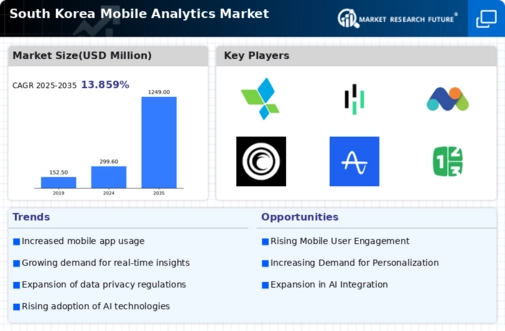
South Korea Mobile Analytics Market Infographic
Purchase Options

South Korea Mobile Analytics Market Summary

As per MRFR analysis, the South Korea mobile analytics market Size was estimated at 262.15 USD Million in 2024. The South Korea mobile analytics market is projected to grow from 306.35 USD Million in 2025 to 1455.0 USD Million by 2035, exhibiting a compound annual growth rate (CAGR) of 16.86% during the forecast period 2025 - 2035.

Key Market Trends & Highlights

The South Korea mobile analytics market is experiencing robust growth driven by technological advancements and evolving consumer preferences.

  • The market is witnessing an increased focus on user privacy, influencing analytics strategies across sectors.
  • Integration of AI and machine learning technologies is becoming prevalent, enhancing data analysis capabilities.
  • Real-time data processing is gaining traction, allowing businesses to respond swiftly to consumer behavior changes.
  • Rising mobile penetration rates and growing demand for personalization are key drivers propelling market expansion.

Market Size & Forecast

2024 Market Size 262.15 (USD Million)
2035 Market Size 1455.0 (USD Million)
CAGR (2025 - 2035) 16.86%

Major Players

Google (US), Adobe (US), Mixpanel (US), Flurry (US), Localytics (US), Countly (TR), App Annie (US), Heap (US), Kochava (US)

South Korea Mobile Analytics Market Trends

The mobile analytics market in South Korea is currently experiencing a dynamic evolution, driven by the rapid adoption of mobile technologies and the increasing reliance on data-driven decision-making. Businesses across various sectors are recognizing the value of mobile analytics in enhancing customer engagement and optimizing operational efficiency. As mobile device usage continues to rise, organizations are leveraging analytics tools to gain insights into user behavior, preferences, and trends. This shift towards data-centric strategies is fostering a competitive landscape where companies strive to harness the power of analytics to improve their services and products. Moreover, the regulatory environment in South Korea is evolving to support the growth of the mobile analytics market. Government initiatives aimed at promoting digital transformation and innovation are encouraging businesses to invest in advanced analytics solutions. The emphasis on data privacy and security is also shaping the market, as companies must navigate compliance requirements while utilizing analytics tools. As a result, the mobile analytics market is poised for continued growth, with organizations increasingly prioritizing data analytics as a core component of their business strategies.

Increased Focus on User Privacy

The mobile analytics market is witnessing a heightened emphasis on user privacy and data protection. With growing concerns regarding data breaches and misuse, companies are adopting more stringent measures to ensure compliance with regulations. This trend is likely to influence the development of analytics tools that prioritize user consent and transparency.

Integration of AI and Machine Learning

The integration of artificial intelligence and machine learning technologies into mobile analytics tools is becoming more prevalent. These advanced technologies enable businesses to analyze vast amounts of data more efficiently, uncovering patterns and insights that were previously difficult to detect. This trend is expected to enhance predictive analytics capabilities.

Real-Time Data Processing

There is a noticeable shift towards real-time data processing within the mobile analytics market. Organizations are increasingly seeking solutions that allow them to analyze data as it is generated, facilitating quicker decision-making and more responsive strategies. This trend reflects the demand for agility in a fast-paced business environment.

South Korea Mobile Analytics Market Drivers

Evolving Consumer Behavior

In South Korea, the mobile analytics market is significantly influenced by the evolving behavior of consumers. With a growing preference for mobile shopping and digital services, businesses are increasingly reliant on mobile analytics to track user journeys and preferences. Recent data suggests that over 70% of South Korean consumers engage in mobile commerce, highlighting the necessity for companies to understand their target audience better. This shift in consumer behavior drives the demand for sophisticated analytics tools that can provide insights into purchasing patterns and user engagement. The mobile analytics market is thus adapting to these changes, offering solutions that enable businesses to tailor their offerings to meet the specific needs of mobile users. As consumer expectations continue to evolve, the ability to analyze mobile data effectively becomes crucial for maintaining competitive advantage.

Rising Mobile Penetration Rates

The mobile analytics market in South Korea is experiencing growth driven by the increasing penetration of mobile devices. As of 2025, mobile device penetration in South Korea is estimated to reach approximately 95%, indicating a robust user base for mobile applications. This surge in mobile usage compels businesses to adopt mobile analytics solutions to better understand user behavior and preferences. Companies are leveraging these insights to enhance user engagement and optimize marketing strategies. The mobile analytics market is thus positioned to benefit from this trend, as organizations seek to harness data to drive decision-making processes. Furthermore, the proliferation of smartphones and tablets has led to a significant rise in mobile app downloads, further fueling the demand for analytics tools that can provide actionable insights into user interactions.

Growing Demand for Personalization

The mobile analytics market in South Korea is increasingly driven by the growing demand for personalized user experiences. As consumers expect tailored content and services, businesses are turning to mobile analytics to gain insights into user preferences and behaviors. Data indicates that personalized marketing can lead to conversion rates that are 6 times higher than non-personalized approaches. This trend compels companies to invest in mobile analytics solutions that enable them to analyze user data effectively and deliver customized experiences. The mobile analytics market is thus adapting to meet this demand, offering tools that facilitate the segmentation of users and the delivery of targeted content. As personalization becomes a key differentiator in the competitive landscape, the ability to leverage mobile analytics for this purpose is likely to become increasingly critical.

Increased Investment in Marketing Technologies

In South Korea, there is a notable trend of increased investment in marketing technologies, which is significantly benefiting the mobile analytics market. Businesses are recognizing the importance of data-driven marketing strategies, leading to a surge in the adoption of mobile analytics tools. Recent statistics indicate that marketing technology spending in South Korea is projected to grow by over 20% annually, reflecting a strong commitment to leveraging data for improved customer engagement. The mobile analytics market is thus positioned to capitalize on this trend, as companies seek to integrate analytics into their marketing efforts. This investment not only enhances the effectiveness of marketing campaigns but also provides valuable insights into consumer behavior, enabling businesses to refine their strategies and achieve better outcomes.

Government Initiatives Supporting Digital Transformation

The South Korean government is actively promoting digital transformation across various sectors, which is positively impacting the mobile analytics market. Initiatives aimed at enhancing the digital economy are encouraging businesses to adopt advanced analytics solutions. For instance, government funding and support for technology startups have led to increased innovation in mobile analytics tools. As a result, the mobile analytics market is witnessing a surge in the development of new technologies that facilitate data collection and analysis. This governmental push not only fosters a conducive environment for growth but also encourages businesses to invest in mobile analytics to remain competitive. The anticipated growth in the digital economy is expected to further drive the demand for analytics solutions, as organizations seek to leverage data for strategic decision-making.


Market Segment Insights

By Type: Mobile Advertisement & Advertisement Analytics (Largest) vs. In-App Behavioral Analytics (Fastest-Growing)

The South Korea mobile analytics market displays a dynamic landscape where Mobile Advertisement & Advertisement Analytics leads in market share. This segment asserts its prominence as businesses leverage targeted advertising to reach consumers effectively, accounting for a significant portion of overall market income. In contrast, In-App Behavioral Analytics is rapidly gaining traction, highlighting a shift towards understanding user interaction and engagement within mobile applications. Growth trends in the South Korea mobile analytics market indicate that the demand for real-time insights and user-centered data is driving the expansion of both segments. Factors such as increased smartphone penetration, the rise of mobile applications, and evolving consumer behaviors are propelling In-App Behavioral Analytics as the fastest-growing segment. Companies are investing heavily in analyzing in-app data to refine marketing strategies and enhance user experiences, fueling competition between both segments.

Mobile Advertisement & Advertisement Analytics (Dominant) vs. In-App Behavioral Analytics (Emerging)

Mobile Advertisement & Advertisement Analytics serves as the dominant force in the South Korea mobile analytics market, characterized by its focus on performance tracking and ROI measurement for marketing campaigns. As businesses increasingly allocate budgets to digital advertising, this segment benefits from robust advertising technologies and strategies. In contrast, In-App Behavioral Analytics is emerging as a crucial player, driven by its capacity to deliver insights into user behavior patterns. This analytics sub-field emphasizes data collection and interpretation to optimize app functionalities. Both segments showcase unique characteristics that propel their market positions, with the former being critical for advertisers and the latter appealing to app developers seeking to enhance user engagement.

By Organization Size: Small & Medium Enterprises (Largest) vs. Large Enterprises (Fastest-Growing)

In the South Korea mobile analytics market, Small & Medium Enterprises (SMEs) hold the largest share, driven by their agility and the increasing need for data-driven decision-making. Their reliance on mobile analytics to optimize business operations and improve customer engagement is evident, as SMEs are rapidly adopting these technologies to stay competitive in a digitally transforming landscape. In contrast, Large Enterprises show robust growth, fueled by their substantial investments in technology and resources to leverage big data insights. This surge is evident as they enhance their operational efficiencies and strategies through advanced mobile analytics solutions. The growth trends indicate that while SMEs dominate the current market share, Large Enterprises are emerging as the fastest-growing segment due to their extensive budgets and technology infrastructures. The drive for digital transformation and enhanced customer experiences are key growth drivers for both segments. Furthermore, as SMEs continue to embrace mobile analytics for business intelligence, they are also expanding their capabilities, which presents competitive challenges to larger organizations that must innovate continually to maintain their market position.

Small & Medium Enterprises: Dominant vs. Large Enterprises: Emerging

Small & Medium Enterprises (SMEs) are characterized by their nimble operations and quick adaptability to market changes, which enables them to leverage mobile analytics effectively. Their dominant position in the South Korea mobile analytics market stems from the growing recognition of data-driven strategies to enhance customer experiences and streamline operations. Smaller firms often benefit from lower entry barriers and tailored solutions designed to fit their unique needs. On the other hand, Large Enterprises are categorized as the emerging segment due to their rapid adoption of advanced technologies. Through significant investments in mobile analytics capabilities, they are focusing on big data analytics and AI-driven insights to transform business models and foster innovation at scale.

By Vertical: Media & Entertainment (Largest) vs. Retail & E-commerce (Fastest-Growing)

In the South Korea mobile analytics market, the Media & Entertainment segment holds the largest share, driven by a surge in demand for mobile content and streaming services. Following closely is the Retail & E-commerce segment, which, although smaller, is rapidly gaining traction as more consumers shift to online shopping channels. Looking at growth trends, the Media & Entertainment segment benefits from an increasingly mobile-first consumer base, leading to higher engagement rates. On the other hand, Retail & E-commerce is experiencing the fastest growth due to the rise of mobile shopping apps and enhanced mobile payment systems, catering to the evolving consumer preferences for convenience and speed.

Media & Entertainment: Dominant vs. Retail & E-commerce: Emerging

The Media & Entertainment segment is the dominant player in the South Korea mobile analytics market, characterized by strong engagement and increased user activity driven by mobile video streaming, social media, and gaming. It reflects the trends of content consumption shifting towards mobile platforms, with brands increasingly investing in targeted advertising and personalized content. Conversely, the Retail & E-commerce segment, while emerging, is making significant strides as more consumers adopt mobile shopping. With advancements in technology and convenience in mobile payments, e-commerce platforms are tailoring their offerings to engage users effectively, reflecting a growing reliance on mobile analytics for understanding consumer behavior.

Get more detailed insights about South Korea Mobile Analytics Market

Key Players and Competitive Insights

The mobile analytics market in South Korea is characterized by a dynamic competitive landscape, driven by rapid technological advancements and increasing demand for data-driven decision-making. Key players such as Google (US), Adobe (US), and Mixpanel (US) are at the forefront, leveraging their extensive resources to innovate and enhance their service offerings. Google (US) focuses on integrating AI capabilities into its analytics tools, thereby enabling businesses to derive deeper insights from user data. Adobe (US), on the other hand, emphasizes its comprehensive suite of marketing solutions, which includes robust analytics features that cater to a diverse clientele. Mixpanel (US) positions itself as a leader in user engagement analytics, providing businesses with tools to track user interactions in real-time, thus shaping a competitive environment that prioritizes customer experience and engagement.

The business tactics employed by these companies reflect a strategic emphasis on localization and supply chain optimization. The market structure appears moderately fragmented, with several players vying for market share while also collaborating through partnerships and integrations. This collective influence of key players fosters a competitive atmosphere where innovation and customer-centric solutions are paramount, allowing companies to differentiate themselves in a crowded marketplace.

In October 2025, Google (US) announced the launch of its enhanced analytics platform, which integrates machine learning algorithms to provide predictive insights for businesses. This strategic move is likely to solidify Google's position as a leader in the mobile analytics space, as it enables clients to anticipate user behavior and tailor their marketing strategies accordingly. The integration of AI not only enhances the platform's capabilities but also aligns with the growing trend of data-driven decision-making in the industry.

In September 2025, Adobe (US) expanded its partnership with a leading South Korean telecommunications company to offer localized analytics solutions tailored to the unique needs of the regional market. This collaboration is significant as it allows Adobe (US) to deepen its market penetration and enhance its service offerings, thereby addressing the specific challenges faced by businesses in South Korea. Such strategic alliances are indicative of a broader trend where companies seek to leverage local expertise to enhance their competitive edge.

In August 2025, Mixpanel (US) introduced a new feature that allows businesses to conduct cohort analysis with greater precision, enabling them to segment users based on behavior patterns. This development is crucial as it empowers companies to refine their marketing strategies and improve user retention rates. By focusing on user engagement and providing actionable insights, Mixpanel (US) continues to position itself as a vital player in the mobile analytics market.

As of November 2025, the competitive trends in the mobile analytics market are increasingly defined by digitalization, sustainability, and the integration of AI technologies. Strategic alliances among key players are shaping the landscape, fostering innovation and enhancing service delivery. The shift from price-based competition to a focus on technological advancement and supply chain reliability is evident, suggesting that future competitive differentiation will hinge on the ability to innovate and adapt to evolving market demands.

Key Companies in the South Korea Mobile Analytics Market market include

Industry Developments

The South Korea Mobile Analytics Market has seen significant developments recently, particularly with major players like Appsflyer, Heap, Matomo, and Localytics actively enhancing their service offerings. Growth in mobile app usage in South Korea has led to an increased demand for analytics solutions that can provide insights into user behavior and engagement.

In July 2023, Amplitude expanded its presence in South Korea, focusing on providing deeper analytics capabilities tailored to local businesses, while Adobe continues to strengthen its cloud solutions to support mobile app developers. Notably, Flurry, part of Verizon, has been reporting increased adoption among small and medium enterprises in the region, contributing to overall market growth.

The mobile analytics segment is also witnessing an uptick due to the robust digital landscape in South Korea, with the government promoting smart technology adoption across various industries. Mergers and acquisitions remain noteworthy, though no recent significant mergers involving the aforementioned companies have been recorded in reliable sources. This dynamic environment indicates a healthy evolution of the market, catering to diverse needs.

Future Outlook

South Korea Mobile Analytics Market Future Outlook

The Mobile Analytics Market is projected to grow at 16.86% CAGR from 2024 to 2035, driven by increased mobile device usage, data-driven decision-making, and advancements in AI technologies.

New opportunities lie in:

  • Development of AI-driven predictive analytics tools for mobile applications.
  • Integration of real-time data visualization platforms for enhanced user engagement.
  • Expansion of mobile analytics services tailored for e-commerce businesses.

By 2035, the mobile analytics market is expected to achieve substantial growth and innovation.

Market Segmentation

South Korea Mobile Analytics Market Type Outlook

  • Mobile Advertisement & Advertisement Analytics
  • In-App Behavioral Analytics

South Korea Mobile Analytics Market Vertical Outlook

  • Media & Entertainment
  • Retail & E-commerce

South Korea Mobile Analytics Market Organization Size Outlook

  • Small & Medium Enterprises
  • Large Enterprises

Report Scope

MARKET SIZE 2024 262.15(USD Million)
MARKET SIZE 2025 306.35(USD Million)
MARKET SIZE 2035 1455.0(USD Million)
COMPOUND ANNUAL GROWTH RATE (CAGR) 16.86% (2024 - 2035)
REPORT COVERAGE Revenue Forecast, Competitive Landscape, Growth Factors, and Trends
BASE YEAR 2024
Market Forecast Period 2025 - 2035
Historical Data 2019 - 2024
Market Forecast Units USD Million
Key Companies Profiled Google (US), Adobe (US), Mixpanel (US), Flurry (US), Localytics (US), Countly (TR), App Annie (US), Heap (US), Kochava (US)
Segments Covered Type, Organization Size, Vertical
Key Market Opportunities Integration of artificial intelligence in mobile analytics enhances user experience and data-driven decision-making.

Key Market Dynamics Rising demand for data-driven insights fuels competition among mobile analytics providers in South Korea.
Countries Covered South Korea

Leave a Comment

FAQs

What is the expected market size of the South Korea Mobile Analytics Market in 2024?

In 2024, the South Korea Mobile Analytics Market is expected to be valued at 299.6 million USD.

How fast is the South Korea Mobile Analytics Market expected to grow from 2025 to 2035?

The market is projected to have a CAGR of 13.859% from 2025 to 2035.

What will be the market size of the South Korea Mobile Analytics Market in 2035?

By 2035, the South Korea Mobile Analytics Market is anticipated to reach a value of 1249.0 million USD.

Which sub-segment is expected to have the highest value in 2035 within the South Korea Mobile Analytics Market?

The Mobile Advertisement segment is expected to be valued at 425.0 million USD in 2035.

What is the projected value of the Advertisement Analytics segment in 2035?

The Advertisement Analytics segment is expected to be valued at 380.0 million USD in 2035.

What will the In-App Behavioral Analytics segment be valued at in 2035?

The In-App Behavioral Analytics segment is projected to reach 444.0 million USD in 2035.

Who are the major players in the South Korea Mobile Analytics Market?

Key players in the market include Appsflyer, Heap, Matomo, Localytics, Flurry, Naver, Amplitude, Adobe, Countly, Branch, Google, Segment, Kakao, Mixpanel, and IBM.

What are the driving factors for growth in the South Korea Mobile Analytics Market?

The growth is driven by increased mobile advertising and the rising need for in-app analytics.

What impact does the current global scenario have on the South Korea Mobile Analytics Market?

The current global scenario presents both opportunities and challenges, influencing investment and strategic direction in the market.

What was the value of the Mobile Advertisement segment in 2024?

The Mobile Advertisement segment was valued at 100.0 million USD in 2024.

Download Free Sample

Kindly complete the form below to receive a free sample of this Report

Compare Licence

×
Features License Type
Single User Multiuser License Enterprise User
Price $4,950 $5,950 $7,250
Maximum User Access Limit 1 User Upto 10 Users Unrestricted Access Throughout the Organization
Free Customization
Direct Access to Analyst
Deliverable Format
Platform Access
Discount on Next Purchase 10% 15% 15%
Printable Versions