×
Hero Background
English
Chinese
French
Japanese
Korean
German
Spanish

Soy Based Chemicals Market Share

ID: MRFR/CnM/0499-HCR
140 Pages
Anshula Mandaokar
October 2025

Soy-Based Chemicals Market Research Report Information by Type (Soy Oil, Fatty Acid, Polyols, Soy Waxes, Methyl Soyate, Isoflavones and others), Application (Paper, Food & Beverages, Cosmetic and Personal Care, Plastic and Polymers, Biofuel and others) and Region - Forecast till 2035

Share:
Download PDF ×

We do not share your information with anyone. However, we may send you emails based on your report interest from time to time. You may contact us at any time to opt-out.

Soy Based Chemicals Market Infographic
Purchase Options

Market Share

Soy Based Chemicals Market Share Analysis

The Soy-Based Chemicals Market, a large bio-based chemicals market, uses a variety of market share positioning methods to establish a strong presence in a competitive landscape. A main strategy is to highlight soy-based compounds' eco-friendliness and inexhaustibility. Companies in this sector emphasize using soy as a sustainable feedstock for chemicals, polymers, and glues. These companies attract new customers and gain market share by positioning themselves as prominent proponents of bio-based alternatives.

Development and technological advancements affect Soy-Based Chemicals market share. To boost soy-based synthetic production productivity, cleanliness, and flexibility, companies innovate. Innovative extraction and maturation methods, atomic modification methods, and soy-based chemical applications may be created. By staying ahead of mechanical progress, companies may fulfill customers' changing needs and lead in providing cutting-edge solutions, increasing their market share.

Another crucial mechanism involves coordinated activities and partnerships with buyer product manufacturers, rural associations, and exploration organizations. Shaping alliances allows companies to share assets, access complementary skills, and address obstacles in the emergence and reception of soy-based synthetic arrangements. These organizations promote industry standards and allow market pioneers to shape the market. Companies strengthen their market position and gain an edge through collaboration, increasing market share.

Maintenance and eco-friendly practices are crucial to Soy-Based Chemicals market share. Organizations that promote sustainable purchasing, production, and bio-based solutions attract naturally aware customers and organizations. This method supports the global focus on maintainability and positions companies as industry leaders, increasing their market share.

Market share is affected by effective marketing and communication of soy-based chemical benefits. Companies that effectively communicate their goods' benefits, such as reduced petroleum use, carbon footprint, and biodegradability, can stand out in a competitive market. Establishing a character's strengths like reliability, adaptability, and manageability builds customer trust and loyalty, increasing market share.

Geological extension and item contribution expansion are key Soy-Based Chemicals market share positioning factors. Organizations investigate local and corporate opportunities to capitalize on the growing need for affordable choices. This recalls approaching new markets with a focus on green innovations and establishing a strong presence in high-reception regions. Growing their market reach allows companies to capitalize on varied customer bases and adapt to changing market factors, gaining market share.

Author
Anshula Mandaokar
Team Lead - Research

Anshula Mandaokar holds an academic degree in Chemical Engineering and has been contributing to the field for more than 5 years. She has expertise in Market Research and Business Consulting and serves as a Team Lead for a reputed Market Research firm under the Chemicals and Materials domain spectrum. She has worked on multiple projects, generating explicit results in a quick turnaround time. Her understanding of data interpretation justifies her role as a leader.

Leave a Comment

FAQs

At what CAGR is the soy-based chemicals market projected to grow during the forecast period?

The soy-based chemicals market is projected to grow at a 6.50% CAGR between 2025-2035.

What are the major applications of soy-based chemicals?

Some of the major applications of soy-based chemicals include biofuel, plastic and polymers, cosmetic & personal care, food & beverages, and paper.

What are the key factors driving the soy-based chemicals market?

Consumers shift to soy oils and better performance characteristics is adding market growth.

Which factors may limit the soy-based chemicals market growth?

Allergies from soybean and availability of substitutes may limit market growth.

Who are the key players profiled in the soy-based chemicals market?

Key players profiled in the soy-based chemicals market include Elevance Renewable Sciences, Inc. (US), Eco Safety Products (US), Vertec BioSolvents (US), LANXESS (Germany), Cargill Inc. (US), Ag Processing Inc. (US), Bunge Limited (US), BioBased Technologies LLC (US), Archer Daniels Midland Company (US), and Dow (US).

Market Summary

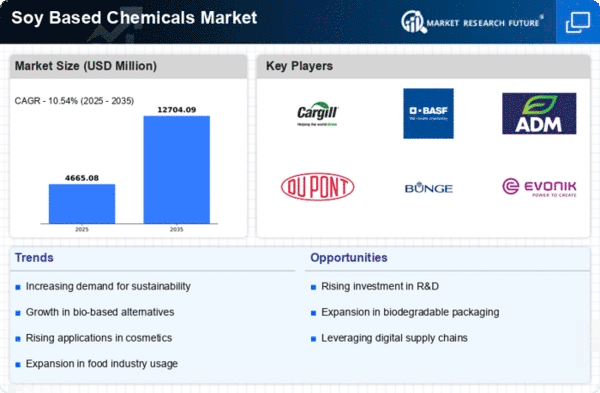
As per MRFR analysis, the Soy Based Chemicals Market Size was estimated at 4220.26 USD Million in 2024. The Soy Based Chemicals industry is projected to grow from 4664.97 USD Million in 2025 to 12704.09 USD Million by 2035, exhibiting a compound annual growth rate (CAGR) of 10.54 during the forecast period 2025 - 2035.

Key Market Trends & Highlights

The Soy Based Chemicals Market is experiencing robust growth driven by sustainability and innovation.

  • The market is characterized by a strong sustainability focus, influencing product development and consumer preferences.
  • Technological advancements in soy processing are enhancing the efficiency and quality of soy-based chemicals.
  • North America remains the largest market, while Asia-Pacific is emerging as the fastest-growing region for soy-based applications.
  • Rising demand for biodegradable products and government incentives for sustainable practices are key drivers propelling market expansion.

Market Size & Forecast

2024 Market Size 4220.26 (USD Million)
2035 Market Size 12704.09 (USD Million)
CAGR (2025 - 2035) 10.54%
Largest Regional Market Share in 2024 North America

Major Players

<p>Cargill (US), BASF (DE), Archer Daniels Midland (US), DuPont (US), Bunge (US), Evonik Industries (DE), NatureWorks (US), Genomatica (US), Soy Technologies (US)</p>

Market Trends

The Soy Based Chemicals Market is currently experiencing a notable transformation, driven by increasing environmental awareness and a shift towards sustainable alternatives. This market encompasses a diverse range of products derived from soybeans, including bioplastics, surfactants, and solvents. As industries seek to reduce their carbon footprint, the demand for soy-based chemicals appears to be on the rise. Companies are increasingly investing in research and development to innovate and enhance the performance of these bio-based products, which may lead to broader applications across various sectors such as automotive, construction, and consumer goods. Moreover, the regulatory landscape is evolving, with governments worldwide implementing stricter environmental regulations. This trend encourages manufacturers to adopt eco-friendly practices and explore renewable resources. The Soy Based Chemicals Market seems poised for growth as consumers and businesses alike prioritize sustainability. The potential for soy-based chemicals to replace petroleum-based products is becoming more apparent, suggesting a shift in market dynamics that could redefine industry standards in the coming years. As the market matures, collaboration between stakeholders, including farmers, manufacturers, and policymakers, will likely play a crucial role in shaping its future.

Sustainability Focus

The emphasis on sustainability is increasingly influencing the Soy Based Chemicals Market. As consumers become more environmentally conscious, there is a growing preference for products that are derived from renewable resources. This trend is prompting manufacturers to innovate and develop soy-based alternatives that align with eco-friendly practices.

Technological Advancements

Technological advancements are playing a pivotal role in enhancing the efficiency and performance of soy-based chemicals. Innovations in processing techniques and formulations are enabling the production of higher-quality products, which may expand their applicability across various industries, including packaging and personal care.

Regulatory Support

Regulatory support for sustainable practices is shaping the landscape of the Soy Based Chemicals Market. Governments are increasingly implementing policies that promote the use of bio-based materials, which could provide a favorable environment for the growth of soy-based products. This support may encourage investment and development in the sector.

Soy Based Chemicals Market Market Drivers

Market Growth Projections

The Global Soy Based Chemicals Market Industry is poised for substantial growth, with projections indicating a market value of 33.2 USD Billion in 2024 and an anticipated increase to 58.9 USD Billion by 2035. This growth trajectory suggests a compound annual growth rate of 5.35% from 2025 to 2035, reflecting the increasing adoption of soy-based products across various sectors. The market dynamics are influenced by factors such as rising consumer demand for sustainable alternatives, supportive government policies, and technological advancements in production processes. These projections underscore the potential for soy-based chemicals to play a pivotal role in the transition towards a more sustainable economy.

Consumer Awareness and Preferences

Consumer awareness regarding the environmental impact of products is reshaping the Global Soy Based Chemicals Market Industry. As individuals become more discerning about their purchasing choices, there is a growing preference for products that are derived from renewable resources. This shift in consumer behavior is prompting manufacturers to reformulate products using soy-based chemicals, which are perceived as safer and more sustainable. The increasing demand for eco-friendly products is likely to drive market growth, as companies strive to align their offerings with consumer expectations. This trend not only enhances brand loyalty but also positions soy-based chemicals as a viable alternative in the competitive market landscape.

Government Initiatives and Support

Government initiatives play a crucial role in the expansion of the Global Soy Based Chemicals Market Industry. Policies promoting the use of bio-based materials are being implemented worldwide, encouraging manufacturers to adopt soy-based alternatives. For instance, subsidies and tax incentives for biofuel production have been introduced in several countries, fostering growth in the soy chemical sector. Such support not only enhances the economic viability of soy-based products but also aligns with global sustainability goals. As a result, the market is expected to witness a compound annual growth rate of 5.35% from 2025 to 2035, reflecting the positive impact of governmental policies on industry growth.

Rising Demand for Sustainable Products

The Global Soy Based Chemicals Market Industry experiences a notable surge in demand for sustainable and eco-friendly products. As consumers become increasingly aware of environmental issues, industries are shifting towards renewable resources. Soy-based chemicals, derived from soybeans, offer a biodegradable alternative to petroleum-based products. This transition is reflected in the projected market value of 33.2 USD Billion in 2024, indicating a robust growth trajectory. Companies are investing in soy-based formulations to meet regulatory standards and consumer preferences, thereby enhancing their market presence. The emphasis on sustainability is likely to drive innovation and expand the application of soy-based chemicals across various sectors.

Expanding Applications Across Industries

The versatility of soy-based chemicals is a driving force behind the growth of the Global Soy Based Chemicals Market Industry. These chemicals find applications in diverse sectors such as agriculture, automotive, and personal care. For instance, soy-based surfactants are increasingly used in cleaning products, while soy-based adhesives are gaining traction in the construction industry. This broad applicability not only enhances market penetration but also encourages cross-industry collaborations. As industries seek to replace conventional materials with sustainable alternatives, the demand for soy-based chemicals is expected to rise, contributing to the overall market growth and reinforcing its position in the global economy.

Technological Advancements in Production

Technological advancements are significantly influencing the Global Soy Based Chemicals Market Industry by enhancing production efficiency and product quality. Innovations in extraction and processing techniques have led to higher yields and lower production costs for soy-based chemicals. For example, advancements in enzymatic processes allow for the conversion of soy oil into various chemical derivatives with improved performance characteristics. This not only boosts the competitiveness of soy-based products against traditional petrochemicals but also expands their application range. As the industry evolves, these technological improvements are likely to attract more investments, further propelling the market towards its projected value of 58.9 USD Billion by 2035.

Market Segment Insights

By Application: Adhesives (Largest) vs. Coatings (Fastest-Growing)

<p>The Soy Based Chemicals Market showcases a diverse application segment, with adhesives leading the market due to their versatile usage in various industries, including furniture and automotive. This sector benefits from increasing demands for environmentally friendly products, positioning adhesives as a dominant player within the segment. Coatings, on the other hand, are gaining momentum as industries shift towards sustainable alternatives, making this the fastest-growing sector in the market. Factors such as technological advancements and a push for low-VOC (volatile organic compounds) options are fueling the growth of soy-based coatings.</p>

<p>Adhesives (Dominant) vs. Foams (Emerging)</p>

<p>Adhesives hold a pivotal position in the soy-based chemicals market, owing to their extensive applications across construction, packaging, and automotive sectors. These products are favored for their eco-friendly attributes and strong bonding capabilities, appealing to manufacturers aiming for sustainability. Emerging segments like foams are making significant strides, especially in insulation and packaging applications, where soy-based foams provide biodegradable alternatives. As environmental regulations tighten, the foam segment is poised for growth, attracting investments and innovations that enhance performance. This dynamic interplay between dominant adhesives and emerging foams reflects the evolving landscape of the soy-based chemicals market.</p>

By End Use: Automotive (Largest) vs. Agriculture (Fastest-Growing)

<p>In the Soy Based Chemicals Market, the end use segment shows significant diversity across its applications. The automotive sector leads as the largest segment, primarily driven by the demand for sustainable materials in manufacturing. Meanwhile, agriculture follows closely, leveraging soy-based chemicals for biofuels and plant-based products, aligning with global sustainability initiatives. Other segments such as construction, consumer goods, and personal care play essential roles but contribute less significantly to the overall market share than automotive and agriculture. Looking at growth trends, the agricultural sector is emerging as the fastest-growing segment within the market. Increasing awareness of sustainable practices among consumers and businesses is driving the demand for eco-friendly agricultural inputs. Furthermore, the automotive industry, while being the largest, continues to innovate with soy-based solutions to meet regulatory standards, providing a stable growth outlook. With the rise in sustainability efforts, both segments are poised for continued evolution in their respective fields.</p>

<p>Automotive (Dominant) vs. Agriculture (Emerging)</p>

<p>The automotive segment in the Soy Based Chemicals Market stands out as a dominant force, primarily utilizing soy-based materials for a range of applications, including interior components and fuel additives. This segment capitalizes on the growing trend towards sustainable manufacturing practices, making it appealing to a wide array of manufacturers focused on reducing their carbon footprint. Furthermore, innovations in bio-based plastics and materials that replace traditional petroleum-based options contribute to its robust market position. In contrast, the agriculture segment is labeled as emerging but is rapidly gaining momentum. It focuses on the use of soy-based chemicals in agrochemicals, plant nutrition, and soil health, resonating with the increasing global emphasis on organic farming and sustainable agricultural practices. Innovations in biotechnology and the expansion of biopesticides are key drivers for this segment, making it one of the most dynamic areas within the soy-based landscape.</p>

By Type: Soy Protein (Largest) vs. Soy Lecithin (Fastest-Growing)

<p>The soy-based chemicals market is characterized by a diverse range of products, with soy protein commanding the largest share among them. Soy protein holds a significant position due to its applications in various sectors such as food, beverages, and cosmetics. Following soy protein, soy lecithin is emerging as a strong contender, driven by its multifunctional properties and increasing demand in food products as an emulsifier and stabilizer. Growth trends in the soy-based chemicals market reveal a promising future, particularly for soy lecithin, which is registering rapid expansion. This is attributed to the rising preference for plant-based ingredients among consumers, alongside the health benefits associated with soy products. As more industries adopt soy-based alternatives, factors such as sustainability and clean-label trends further fuel the growth of soy lecithin and other soy derivatives.</p>

<p>Soy Protein (Dominant) vs. Soy Isoflavones (Emerging)</p>

<p>Soy protein has established itself as the dominant player in the soy-based chemicals market due to its rich nutritional profile and versatility in various applications such as protein supplements and meat alternatives. In contrast, soy isoflavones are gaining traction as an emerging segment, primarily driven by their perceived health benefits, including antioxidant properties and hormonal balance support. Both components are essential in catering to health-conscious consumers, with soy protein leading the charge in mainstream markets while soy isoflavones carve out a niche in dietary supplements and functional foods. The increasing awareness of plant-based nutrition is paving the way for both segments to thrive, but soy protein’s established reputation solidifies its dominant status.</p>

By Form: Liquid (Largest) vs. Powder (Fastest-Growing)

<p>In the Soy Based Chemicals Market, the distribution of market share among various forms reveals that liquid soy-based chemicals hold the largest share, benefitting from their diverse applications across industries such as food, agriculture, and personal care. Solid, powder, and granular forms also contribute to the market, with solid forms being utilized in specialized applications like adhesives and building materials, while granular forms have niche applications. Overall, the liquid form continues to dominate significantly due to its versatility and ease of use in formulations. The growth trends in the Soy Based Chemicals Market indicate a rising demand for powdered and granular forms, driven by their application in sustainable products and eco-friendly substitutes. As consumers become more environmentally conscious, the demand for sustainable soy-based powders is expected to increase rapidly. Key drivers include innovations in processing technology, which enhance the stability and performance of these forms, positioning them for significant growth in the coming years.</p>

<p>Liquid (Dominant) vs. Granular (Emerging)</p>

<p>Liquid soy-based chemicals are currently the dominant form due to their extensive use in a wide range of applications, from food emulsifiers to agricultural sprays. Their ability to dissolve in various solvents makes them highly versatile, allowing manufacturers to create stable formulations across different industries. In contrast, granular forms of soy-based chemicals are emerging as important players, particularly in applications requiring sustained release or controlled delivery. Granular forms are increasingly favored in specialty areas such as biofertilizers and slow-release nutrient systems, where their physical properties enhance the effectiveness of the product and appeal to environmentally-conscious consumers.</p>

By Source: Organic Soybeans (Largest) vs. Genetically Modified Soybeans (Fastest-Growing)

<p>In the Soy Based Chemicals Market, the source segment is primarily categorized into organic soybeans, conventional soybeans, and genetically modified soybeans. Organic soybeans hold the largest market share due to the growing consumer preference for natural and environmentally friendly products. In contrast, conventional soybeans have experienced steady demand, but their market presence is waning as sustainability trends gain momentum. Genetically modified soybeans, while representing a smaller share, are rapidly growing as they offer enhanced traits and yield potential.</p>

<p>Organic Soybeans (Dominant) vs. Genetically Modified Soybeans (Emerging)</p>

<p>Organic soybeans are recognized as the dominant source in the Soy Based Chemicals Market, appealing to eco-conscious consumers and manufacturers seeking organic inputs. They signify quality and sustainability, driving their extensive use in various applications. On the other hand, genetically modified soybeans are emerging due to advancements in biotechnology, improving their efficiency and adaptability in diverse climates. Although they face scrutiny regarding safety and environmental impact, their rapid adoption is supported by agricultural innovations and the rising demand for higher yields. This dynamic reflects the evolving landscape of the market, where both sources cater to differing consumer preferences and industry needs.</p>

Get more detailed insights about Soy-Based Chemicals Market Research Report - Global Forecast till 2035

Regional Insights

North America : Market Leader in Soy Chemicals

North America leads the Soy Based Chemicals market, holding a significant share of 2110.13 million in 2024. The region's growth is driven by increasing demand for sustainable and bio-based products, supported by favorable regulations promoting green chemistry. The rise in consumer awareness regarding environmental issues further fuels this demand, making North America a pivotal player in the global market. The United States is the primary contributor, with key players like Cargill, Archer Daniels Midland, and DuPont dominating the landscape. These companies are investing heavily in R&D to innovate and expand their product offerings. The competitive environment is characterized by strategic partnerships and collaborations aimed at enhancing market reach and sustainability initiatives, solidifying North America's position as a leader in the soy chemicals sector.

Europe : Emerging Market with Regulations

Europe's Soy Based Chemicals market is valued at 1266.16 million, driven by stringent regulations favoring sustainable practices. The European Union's Green Deal and various national policies encourage the adoption of bio-based chemicals, enhancing market growth. The increasing focus on reducing carbon footprints and promoting circular economy principles further supports the demand for soy-based products in the region. Leading countries like Germany, France, and the Netherlands are at the forefront, with major players such as BASF and Evonik Industries actively participating in the market. The competitive landscape is marked by innovation and sustainability, with companies investing in eco-friendly technologies and processes. This commitment to sustainability positions Europe as a significant player in The Soy Based Chemicals.

Asia-Pacific : Growing Demand in Emerging Economies

The Asia-Pacific region, with a market size of 703.07 million, is witnessing rapid growth in the Soy Based Chemicals sector. This growth is fueled by increasing industrialization, urbanization, and a rising awareness of sustainable products among consumers. Countries like China and India are leading the charge, supported by government initiatives promoting bio-based alternatives to traditional chemicals, which are expected to drive market expansion significantly. The competitive landscape is evolving, with both local and international players vying for market share. Companies such as NatureWorks and Genomatica are establishing a presence in the region, focusing on innovative solutions tailored to local needs. The increasing investment in R&D and collaborations with local firms are key strategies to enhance market penetration and meet the growing demand for soy-based products in Asia-Pacific.

Middle East and Africa : Emerging Market with Potential

The Middle East and Africa region, valued at 131.9 million, presents emerging opportunities in the Soy Based Chemicals market. The growth is driven by increasing awareness of sustainable practices and the need for alternative raw materials in various industries. Governments are beginning to recognize the importance of bio-based chemicals, leading to supportive policies that encourage investment in this sector. Countries like South Africa and the UAE are showing potential for growth, with local companies exploring soy-based alternatives. The competitive landscape is still developing, with a mix of local and international players entering the market. As the region continues to embrace sustainability, the demand for soy-based chemicals is expected to rise, creating new avenues for growth and innovation.

Key Players and Competitive Insights

The Soy Based Chemicals Market is currently characterized by a dynamic competitive landscape, driven by increasing demand for sustainable and bio-based products. Key players are actively engaging in innovation and strategic partnerships to enhance their market positioning. Companies such as Cargill (US), BASF (DE), and Archer Daniels Midland (US) are at the forefront, focusing on product development and regional expansion to capture emerging opportunities. Their collective strategies not only foster competition but also contribute to the overall growth of the market, as they seek to meet the evolving needs of consumers and industries alike.

In terms of business tactics, companies are increasingly localizing manufacturing and optimizing supply chains to enhance efficiency and reduce costs. The market structure appears moderately fragmented, with several key players exerting significant influence. This fragmentation allows for a variety of competitive strategies, as companies strive to differentiate themselves through innovation and sustainability initiatives.

In November 2025, Cargill (US) announced a partnership with a leading biotechnology firm to develop advanced soy-based bioplastics. This strategic move is expected to bolster Cargill's position in the sustainable materials sector, aligning with global trends towards reducing plastic waste. The collaboration may enhance their product offerings and expand their market reach, reflecting a growing emphasis on sustainability in the industry.

In October 2025, BASF (DE) unveiled a new line of soy-based surfactants aimed at the personal care market. This launch signifies BASF's commitment to innovation and sustainability, as these products are designed to be biodegradable and derived from renewable resources. The introduction of these surfactants could potentially reshape consumer preferences, as more brands seek eco-friendly ingredients in their formulations.

In September 2025, Archer Daniels Midland (US) expanded its production capacity for soy-based chemicals in South America. This expansion is indicative of ADM's strategy to capitalize on the growing demand for bio-based products in emerging markets. By increasing production capabilities, ADM is likely positioning itself to better serve regional customers and enhance its competitive edge in the global market.

As of December 2025, current competitive trends in the Soy Based Chemicals Market are heavily influenced by digitalization, sustainability, and the integration of AI technologies. Strategic alliances are becoming increasingly vital, as companies recognize the need to collaborate in order to innovate and meet consumer demands. Looking ahead, competitive differentiation is expected to evolve, shifting from price-based competition to a focus on innovation, technology, and supply chain reliability. This transition underscores the importance of sustainable practices and advanced technologies in shaping the future of the market.

Key Companies in the Soy Based Chemicals Market market include

Industry Developments

July 2021-Nua, a women’s wellness company introduces Uplift, an advanced nutrition drink mix range for women, which helps replenish the vital minerals and vitamins during periods. Backed by extensive research, the nourishing drink mix has ingredients like soy isoflavones, Vitamin B, C, D, along with L-Theanine, Magnesium, inulin, and grape seed extract.

November 2021-Archer Daniels Midland Company ADM has acquired a renowned European developer of non-GMO soy ingredients, called Sojaprotein. This move will be part of ADM’s efforts to foster the alternative protein segment to cater to the escalating preference for plant-based foods as well as beverages in Europe. This acquisition will be accretive to the brand’s nutrition segment. Other significant investments include setting up of a soy protein unit in Brazil, a joint venture with PlantPlus Foods, partnerships with Air Protein, and a pea protein plant in North Dakota.

June 2022: Eco Safety, Inc Acquires Soy Technologies, LLC to Expand its Bio-Based Coatings and Methylene Chloride Alternatives - Renewably Sourced Bio-based Intermediates for Safer Paints, Stains, Sealers and R&D Advancements to Create Non Toxic Paint Strippers With Better Efficacy.Eco Safety, Inc dba Eco Safety Products (ESP) announces it has acquired Soy Technologies, LLC a Lexington, Ky based specialty chemical manufacturer. The acquisition includes all remaining brands and intellectual property of the company.

The purchased operations and existing products will be manufactured at the ESP facility in Phoenix, Arizona and/or with the current toll blending partner to meet national high output retail chain requirements.The transfer of orders, operations, packaging, and raw material inventory has begun and production to fulfill customer orders is expected to commence by the middle of July. “This is an extremely desirable strategic fit with our growing bio-based chemical technologies used to make non-toxic, eco-friendly paints, stains, sealers, coatings, and cleaning chemicals.

With the emerging demand for all industries to adopt safer chemistry, this acquisition allows us to produce bio-based intermediates that can be added to various chemical formulations to improve their ecological profile and performance".

Target Audience

    • Soy-based chemicals manufacturers
    • Raw material suppliers
    • Distributors and suppliers of soy-based chemicals
    • Potential investors
    • Research institutes
    • Government bodies

Future Outlook

Soy Based Chemicals Market Future Outlook

<p>The Soy Based Chemicals Market is projected to grow at a 10.54% CAGR from 2024 to 2035, driven by sustainability trends, regulatory support, and technological advancements.</p>

New opportunities lie in:

  • <p>Development of bio-based surfactants for personal care products.</p>
  • <p>Expansion into biodegradable packaging solutions for consumer goods.</p>
  • <p>Investment in R&D for high-performance soy-based polymers.</p>

<p>By 2035, the market is expected to solidify its position as a leader in sustainable chemical solutions.</p>

Market Segmentation

Soy Based Chemicals Market Form Outlook

  • Liquid
  • Solid
  • Powder
  • Granular

Soy Based Chemicals Market Type Outlook

  • Soy Protein
  • Soy Oil
  • Soy Lecithin
  • Soy Flour
  • Soy Isoflavones

Soy Based Chemicals Market Source Outlook

  • Organic Soybeans
  • Conventional Soybeans
  • Genetically Modified Soybeans

Soy Based Chemicals Market End Use Outlook

  • Automotive
  • Construction
  • Consumer Goods
  • Agriculture
  • Personal Care

Soy Based Chemicals Market Application Outlook

  • Adhesives
  • Coatings
  • Plastics
  • Surfactants
  • Foams

Report Scope

MARKET SIZE 20244220.26(USD Million)
MARKET SIZE 20254664.97(USD Million)
MARKET SIZE 203512704.09(USD Million)
COMPOUND ANNUAL GROWTH RATE (CAGR)10.54% (2024 - 2035)
REPORT COVERAGERevenue Forecast, Competitive Landscape, Growth Factors, and Trends
BASE YEAR2024
Market Forecast Period2025 - 2035
Historical Data2019 - 2024
Market Forecast UnitsUSD Million
Key Companies ProfiledCargill (US), BASF (DE), Archer Daniels Midland (US), DuPont (US), Bunge (US), Evonik Industries (DE), NatureWorks (US), Genomatica (US), Soy Technologies (US)
Segments CoveredApplication, End Use, Type, Form, Source
Key Market OpportunitiesGrowing demand for sustainable alternatives drives innovation in the Soy Based Chemicals Market.
Key Market DynamicsRising demand for sustainable products drives innovation and competition in the Soy Based Chemicals Market.
Countries CoveredNorth America, Europe, APAC, South America, MEA

FAQs

At what CAGR is the soy-based chemicals market projected to grow during the forecast period?

The soy-based chemicals market is projected to grow at a 6.50% CAGR between 2025-2035.

What are the major applications of soy-based chemicals?

Some of the major applications of soy-based chemicals include biofuel, plastic and polymers, cosmetic &amp; personal care, food &amp; beverages, and paper.

What are the key factors driving the soy-based chemicals market?

Consumers shift to soy oils and better performance characteristics is adding market growth.

Which factors may limit the soy-based chemicals market growth?

Allergies from soybean and availability of substitutes may limit market growth.

Who are the key players profiled in the soy-based chemicals market?

Key players profiled in the soy-based chemicals market include Elevance Renewable Sciences, Inc. (US), Eco Safety Products (US), Vertec BioSolvents (US), LANXESS (Germany), Cargill Inc. (US), Ag Processing Inc. (US), Bunge Limited (US), BioBased Technologies LLC (US), Archer Daniels Midland Company (US), and Dow (US).

  1. Executive Summary
  2. Market Introduction
    1. Market Definition
    2. Scope of the
      1. Research
      2. Assumptions & Limitations
    3. Study
    4. Objectives
    5. Markets Structure
    6. Key Takeaways
  3. Market Research Methodology
    1. Research Process
    2. Primary Research
    3. Secondary Research
    4. Market Size Estimation
    5. Forecast Model
  4. Market Dynamics of the Global Soy-Based
    1. Chemicals Market
    2. Introduction
    3. Drivers
    4. Restraints
    5. Opportunities
    6. Challenges
    7. Trends/Technology
  5. Market Factor Analysis of the Global Soy-Based Chemicals
    1. Market
    2. Supply Chain Analysis
      1. Raw Material Suppliers
      2. Distributors/Retailers/Wholesalers/E-Commerce
      3. End User
      4. Bargaining
      5. Bargaining Power
      6. Threat of Substitutes
      7. Intensity of Competitive Rivalry
    3. Manufacturers/Producers
    4. Porter’s Five Forces Analysis
    5. Threat of New Entrants
    6. Power of Buyers
    7. of Suppliers
    8. Pricing Analysis
  6. Global Soy-Based Chemicals Market,
    1. by Type
    2. Introduction
    3. Soy Oil
      1. Market Estimates
      2. Market Estimates & Forecast,
    4. & Forecast, 2020−2027
    5. by Region, 2020−2027
    6. Fatty Acid
      1. Market Estimates & Forecast,
      2. Market Estimates & Forecast, by Region, 2020−2027
    7. Polyols
      1. Market
    8. Market Estimates & Forecast, 2020−2027
    9. Estimates & Forecast, by Region, 2020−2027
    10. Soy
      1. Market Estimates
      2. Market Estimates & Forecast,
    11. Waxes
    12. & Forecast, 2020−2027
    13. by Region, 2020−2027
    14. Methyl Soyate
      1. Market Estimates & Forecast,
      2. Market Estimates & Forecast, by Region, 2020−2027
    15. Isoflavones
      1. Market Estimates & Forecast, 2020−2027
  7. Market Estimates & Forecast, by Region, 2020−2027
    1. Others
    2. Estimates & Forecast, 2020−2027
    3. Forecast, by Region, 2020−2027
  8. Market
  9. Market Estimates &
  10. Global Soy-Based
  11. Chemicals Market, by Application
    1. Introduction
      1. Market Estimates & Forecast, 2020−2027
      2. Market Estimates & Forecast, by Region, 2020−2027
      3. Market Estimates & Forecast, 2020−2027
      4. Market Estimates & Forecast, by Region, 2020−2027
      5. Market Estimates & Forecast,
      6. Market Estimates & Forecast, by Region, 2020−2027
    2. Paper
    3. Food and Beverages
    4. Cosmetic and Personal Care
    5. Plastic and Polymers
      1. Market Estimates
      2. Market Estimates & Forecast,
    6. & Forecast, 2020−2027
    7. by Region, 2020−2027
    8. Bio-Fuel
      1. Market Estimates
    9. Market Estimates & Forecast, 2020−2027
    10. & Forecast, by Region, 2020−2027
    11. Others
      1. Market Estimates & Forecast, 2020−2027
  12. Market Estimates & Forecast, by Region, 2020−2027
  13. Global Soy-Based Chemicals Market, by Region
    1. Introduction
    2. North America
      1. Market Estimates &
      2. Market Estimates & Forecast,
      3. Market Estimates & Forecast,
      4. US
      5. Canada
    3. Forecast, 2020−2027
    4. by Type, 2020−2027
    5. by Application, 2020−2027
    6. & Forecast, by Type, 2020−2027
    7. Market Estimates & Forecast, 2020−2027
  14. Market Estimates & Forecast, by Application, 2020−2027
    1. Europe
    2. & Forecast, by Type, 2020−2027
    3. Forecast, by Type, 2020−2027
    4. by Type, 2020−2027
  15. Market Estimates & Forecast,
  16. Market Estimates & Forecast, by Type,
  17. Market Estimates & Forecast, by Application,
  18. Germany
  19. Market Estimates & Forecast, 2020−2027
  20. Market Estimates
  21. Market Estimates & Forecast, by Application, 2020−2027
  22. France
  23. Market Estimates & Forecast, 2020−2027
  24. Market Estimates &
  25. Market Estimates & Forecast, by Application, 2020−2027
  26. Italy
  27. Market Estimates & Forecast, 2020−2027
  28. Market Estimates & Forecast,
  29. Market Estimates & Forecast, by Application, 2020−2027
    1. Spain
    2. Market Estimates & Forecast, 2020−2027
    3. & Forecast, by Application, 2020−2027
    4. UK
    5. & Forecast, 2020−2027
    6. Forecast, by Application, 2020−2027
    7. & Forecast, 2020−2027
    8. Forecast, by Application, 2020−2027
    9. Forecast, 2020−2027
    10. Forecast, by Application, 2020−2027
    11. of Europe
    12. Market Estimates & Forecast, 2020−2027
  30. Market Estimates & Forecast, by Type,2020−2027
  31. Market Estimates
  32. Market Estimates
  33. Market Estimates & Forecast, by Type,2020−2027
  34. Market Estimates &
  35. Russia
  36. Market Estimates
  37. Market Estimates & Forecast, by Type,2020−2027
  38. Market Estimates &
  39. Poland
  40. Market Estimates &
  41. Market Estimates & Forecast, by Type, 2020−2027
  42. Market Estimates &
  43. Rest
  44. Market Estimates & Forecast, by Type,
  45. Market Estimates & Forecast, by Application, 2020−2027
    1. Asia-Pacific
    2. & Forecast, by Type, 2020−2027
  46. Market Estimates & Forecast,
  47. Market Estimates & Forecast, by Type,
  48. Market Estimates & Forecast, by Application,
  49. China
  50. Market Estimates & Forecast, 2020−2027
  51. Market Estimates
  52. Market Estimates & Forecast, by Application,
  53. India
  54. Market Estimates & Forecast,
  55. Market Estimates & Forecast, by Type, 2020−2027
    1. by Application, 2020−2027
    2. & Forecast, 2020−2027
    3. & Forecast, by Application, 2020−2027
    4. Australia & New Zealand
    5. & Forecast, by Type, 2020−2027
    6. & Forecast, 2020−2027
    7. & Forecast, by Application, 2020−2027
  56. Market Estimates & Forecast,
  57. Japan
  58. Market Estimates
  59. Market Estimates & Forecast, by Type, 2020−2027
  60. Market Estimates
  61. Market Estimates & Forecast, 2020−2027
  62. Market Estimates
  63. Market Estimates & Forecast, by Application,
  64. Rest of Asia-Pacific
  65. Market Estimates
  66. Market Estimates & Forecast, by Type, 2020−2027
  67. Market Estimates
    1. Middle East & Africa
      1. Market Estimates & Forecast, 2020−2027
  68. Market Estimates & Forecast, by Type, 2020−2027
  69. Market Estimates & Forecast, by Application, 2020−2027
    1. Market Estimates & Forecast, 2020−2027
    2. & Forecast, by Application, 2020−2027
    3. & Forecast, 2020−2027
    4. Forecast, by Application, 2020−2027
    5. Africa
    6. Market Estimates & Forecast, 2020−2027
    7. & Forecast, by Application, 2020−2027
    8. Turkey
    9. Estimates & Forecast, 2020−2027
    10. & Forecast, by Application, 2020−2027
    11. of Middle East & Africa
    12. Forecast, by Type, 2020−2027
    13. Forecast, 2020−2027
    14. by Type, 2020−2027
    15. by Application, 2020−2027
    16. Forecast, 2020−2027
    17. Forecast, by Application, 2020−2027
    18. & Forecast, 2020−2027
    19. Forecast, by Application, 2020−2027
    20. & Forecast, 2020−2027
    21. Forecast, by Application, 2020−2027
    22. of Latin America
    23. Market Estimates & Forecast, 2020−2027
  70. GCC
  71. Market Estimates & Forecast, by Type, 2020−2027
  72. Market Estimates
  73. Israel
  74. Market Estimates
  75. Market Estimates & Forecast, by Type, 2020−2027
  76. Market Estimates &
  77. North
  78. Market Estimates & Forecast, by Type, 2020−2027
  79. Market Estimates
  80. Market
  81. Market Estimates & Forecast, by Type, 2020−2027
  82. Market Estimates
  83. Rest
  84. Market Estimates & Forecast, 2020−2027
  85. Market Estimates &
  86. Market Estimates & Forecast, by Application, 2020−2027
    1. Latin America
      1. Market Estimates &
      2. Market Estimates & Forecast,
      3. Market Estimates & Forecast,
      4. Brazil
      5. Argentina
      6. Mexico
      7. Rest
  87. Market Estimates & Forecast, by Application, 2020−2027
    1. Company Landscape
    2. Introduction
    3. Market Strategy
    4. Key Development Analysis (Expansion/Mergers & Acquisitions/Joint Ventures/New
    5. Product Development/Agreements/Investments)
  88. Company
    1. Profiles
    2. Dow
      1. Company Overview
      2. Financial Updates
      3. Key Developments
      4. SWOT Analysis
    3. Product/Business Segment Overview
    4. Strategy
    5. Archer
      1. Company Overview
      2. Financial Updates
      3. Key Developments
      4. SWOT Analysis
    6. Daniels Midland Company
    7. Product/Business Segment Overview
    8. Strategy
    9. BioBased
      1. Financial Updates
      2. Product/Business Segment Overview
      3. Strategy
      4. SWOT Analysis
      5. Financial Updates
      6. Product/Business Segment Overview
      7. Strategy
      8. SWOT Analysis
      9. Financial Updates
      10. Product/Business Segment Overview
      11. Strategy
      12. SWOT Analysis
      13. Company Overview
      14. Strategy
      15. Key Developments
    10. Technologies LLC
    11. Company Overview
    12. Key Developments
    13. Bunge Limited
    14. Company Overview
    15. Key Developments
    16. Ag Processing Inc.
    17. Company Overview
    18. Key Developments
    19. Cargill Inc.
    20. Financial Updates
    21. Product/Business Segment Overview
    22. SWOT Analysis
    23. LANXESS
      1. Financial Updates
      2. Product/Business Segment Overview
      3. Strategy
      4. SWOT Analysis
      5. Company Overview
      6. Financial Updates
      7. Key Developments
      8. SWOT Analysis
      9. Company Overview
      10. Strategy
      11. Key Developments
    24. Company Overview
    25. Key Developments
    26. Vertec BioSolvents
    27. Product/Business Segment Overview
    28. Strategy
    29. Eco Safety Products
    30. Financial Updates
    31. Product/Business Segment Overview
    32. SWOT Analysis
    33. Elevance Renewable Sciences, Inc.
      1. Financial Updates
      2. Product/Business Segment Overview
      3. Strategy
      4. SWOT Analysis
    34. Company Overview
    35. Key Developments
  89. Conclusion
  90. LIST OF TABLES
  91. Global Soy-Based Chemicals Market: by Region,
  92. North America: Soy-Based Chemicals
  93. Market, by Country, 2020−2027
  94. Europe: Soy-Based
  95. Chemicals Market, by Country, 2020−2027
  96. Asia-Pacific:
    1. Soy-Based Chemicals Market. by Country, 2020−2027
    2. Table 5
  97. Middle East & Africa: Soy-Based Chemicals Market, by Country, 2020−2027
  98. Latin America: Soy-Based Chemicals Market, by Country,
  99. Global Soy-Based Chemicals Type Market,
    1. by Regions, 2020−2027
  100. North America: Soy-Based
  101. Chemicals Type Market, by Country, 2020−2027
  102. Europe:
  103. Soy-Based Chemicals Type Market, by Country, 2020−2027
    1. Table10
  104. Asia-Pacific: Soy-Based Chemicals Type Market, by Country, 2020−2027
    1. Table11 Middle East & Africa: Soy-Based Chemicals Type Market,
    2. by Country, 2020−2027
    3. Table12 Latin America: Soy-Based
  105. Chemicals Type Market, by Country, 2020−2027
    1. Table13 Global
  106. Soy-Based Chemicals Application Market, by Regions, 2020−2027
    1. Table14
  107. North America: Soy-Based Chemicals Application Market, by Country, 2020−2027
  108. Table15 Europe: Soy-Based Chemicals Application Market, by Country,
    1. Table16 Asia-Pacific: Soy-Based Chemicals
  109. Application Market, by Country, 2020−2027
    1. Table17 Middle
  110. East & Africa: Soy-Based Chemicals Application Market, by Country, 2020−2027
    1. Table18 Latin America: Soy-Based Chemicals by Application Market,
    2. by Country, 2020-2027
    3. Table19 Global Type Market, by
    4. Region, 2020−2027
    5. Table20 Global Application Market,
    6. by Region, 2020−2027
    7. Table21 North America: Soy-Based
  111. Chemicals Market, by Country, 2020−2027
    1. Table22 North
  112. America: Soy-Based Chemicals Market, by Type, 2020−2027
    1. Table23
  113. North America: Soy-Based Chemicals Market, by Application, 2020−2027
  114. Table24 Europe: Soy-Based Chemicals Market, by Country, 2020−2027
  115. Table25 Europe: Soy-Based Chemicals Market, by Type, 2020−2027
  116. Table26 Europe: Soy-Based Chemicals Market, by Application,
    1. Table27 Asia-Pacific: Soy-Based Chemicals
  117. Market, by Country, 2020−2027
    1. Table28 Asia-Pacific:
  118. Soy-Based Chemicals Market, by Type, 2020−2027
    1. Table29 Asia-Pacific:
  119. Soy-Based Chemicals Market, by Application, 2020−2027
    1. Table30
  120. Middle East & Africa: Soy-Based Chemicals Market, by Country, 2020−2027
    1. Table31 Middle East & Africa: Soy-Based Chemicals Market,
    2. by Type, 2020−2027
    3. Table32 Middle East &
  121. Africa: Soy-Based Chemicals Market, by Application, 2020−2027
    1. Table33
  122. Latin America: Soy-Based Chemicals Market, by Country, 2020−2027
  123. Table34 Latin America: Soy-Based Chemicals Market, by Type,
    1. Table35 Latin America: Soy-Based Chemicals
  124. Market, by Application, 2020−2027
  125. LIST OF FIGURES
  126. Global Soy-Based Chemicals Market Segmentation
    1. FIGURE
  127. Forecast Research Methodology
  128. Five Forces
    1. Analysis of Global Soy-Based Chemicals Market
  129. Value
    1. Chain of Global Soy-Based Chemicals Market
  130. Global Soy-Based
  131. Chemicals Market, 2020−2027, by Country, 2020
  132. Share
  133. of Global Soy-Based Chemicals Market, by Country, 2020−2027
    1. FIGURE 7
  134. Global Soy-Based Chemicals Market Size, by Type, 2020
    1. FIGURE 8
  135. Share of Global Soy-Based Chemicals Market, by Type, 2020−2027
  136. Global Soy-Based Chemicals Market Size, by Application,
  137. FIGURE10 Share of Global Soy-Based Chemicals Market, by Application,

Soy-Based Chemicals Market Segmentation

Market Segmentation Overview

  • Detailed segmentation data will be available in the full report
  • Comprehensive analysis by multiple parameters
  • Regional and country-level breakdowns
  • Market size forecasts by segment
Infographic

Free Sample Request

Kindly complete the form below to receive a free sample of this Report

Get Free Sample

Customer Strories

Compare Licence

×
Features License Type
Single User Multiuser License Enterprise User
Price $4,950 $5,950 $7,250
Maximum User Access Limit 1 User Upto 10 Users Unrestricted Access Throughout the Organization
Free Customization
Direct Access to Analyst
Deliverable Format
Platform Access
Discount on Next Purchase 10% 15% 15%
Printable Versions