×
Hero Background
English
Chinese
French
Japanese
Korean
German
Spanish

Space Food Market Trends

ID: MRFR/FnB/11016-HCR
128 Pages
Snehal Singh
October 2025

Space Food Market Research Report Information By Food Form and Processing (Freeze-Dried, Dehydrated, Irradiated, Thermostabilized, and Bioregenerative), By Packaging and Preservation (Vacuum-Sealing, Modified Atmosphere Packaging and Controlled Temperature Storage), By Nutritional Composition (Macronutrient and Micronutrient) And By Region (North America, Europe, Asia-Pacific, And Rest Of The World) –Market Forecast Till 2035

Share:
Download PDF ×

We do not share your information with anyone. However, we may send you emails based on your report interest from time to time. You may contact us at any time to opt-out.

Space Food Market Infographic
Purchase Options

Market Trends

Key Emerging Trends in the Space Food Market

A change is happening in the space food industry because of developing customer inclinations, mechanical headways, and an expanded spotlight on feasible space investigation. The market is putting huge significance on modified sustenance and culinary variety for space explorers, recognizing the criticality of saving their psychological and actual prosperity all through extended missions. Using progressed bundling and 3D printing, organizations are offering redid indulgences. Various asset effective creation strategies and manageable systems are being coordinated into the space food market with an end goal to decrease waste and dependence on Earth-bound sources. Aeroponics and aquaculture are being created as microgravity crop development advancements that give space travellers feeding food while likewise adding to ecological manageability. Need is given to reciprocal protein sources and privately obtained fixings, as per the supportability goals of room missions. The union between privately owned businesses and public space organizations impacts the space food market pattern by speeding up the advancement of imaginative culinary innovations for space investigation and empowering development. Financially roused by the significance of room the travel industry and satellite sending, privately owned businesses put resources into exploration to foster effective food combinations. Innovation impacts space food market patterns by adjusting safeguarding, quality, and wellbeing techniques. Illumination and freeze-drying innovations have progressed to deliver food things that are light, proficient, and rack stable. By exploring creative fixings and culinary techniques, space food choices are described by an amicable mix of dietary benefit, gustatory allure, and straightforward entry for space travellers. Space food market patterns are being moulded by purchaser driven approaches and social inclinations. This is because of the way that different missions require the convenience of dietary limitations, strict contemplations, and social inclinations. Associations are fostering different dietary decisions to oblige the fluctuated inclinations and tastes of space explorers, subsequently working on their wellbeing while on missions. Customized sustenance, manageability, mechanical developments, cooperative associations, and purchaser driven approaches portray the space food industry. As mankind explores the universe, these patterns invigorate market development, making ready for space travellers to devour food options that are stronger, differentiated, and manageable.


Author
Snehal Singh
Assistant Manager - Research

High acumen in analyzing complex macro & micro markets with more than 6 years of work experience in the field of market research. By implementing her analytical skills in forecasting and estimation into market research reports, she has expertise in Packaging, Construction, and Equipment domains. She handles a team size of 20-25 resources and ensures smooth running of the projects, associated marketing activities, and client servicing.

Leave a Comment

FAQs

What is the projected market valuation of the Space Food Market by 2035?

The Space Food Market is projected to reach a valuation of 2.064 USD Billion by 2035.

What was the market valuation of the Space Food Market in 2024?

In 2024, the Space Food Market was valued at 0.576 USD Billion.

What is the expected CAGR for the Space Food Market during the forecast period 2025 - 2035?

The expected CAGR for the Space Food Market during the forecast period 2025 - 2035 is 12.3%.

Which companies are considered key players in the Space Food Market?

Key players in the Space Food Market include NASA, SpaceX, Blue Origin, Lockheed Martin, and Boeing.

What are the main segments of the Space Food Market based on food form and processing?

The main segments include Freeze-Dried, Dehydrated, Irradiated, Thermostabilized, and Bioregenerative food forms.

How much was the Freeze-Dried segment valued at in 2024?

The Freeze-Dried segment was valued at 0.1728 USD Billion in 2024.

Market Summary

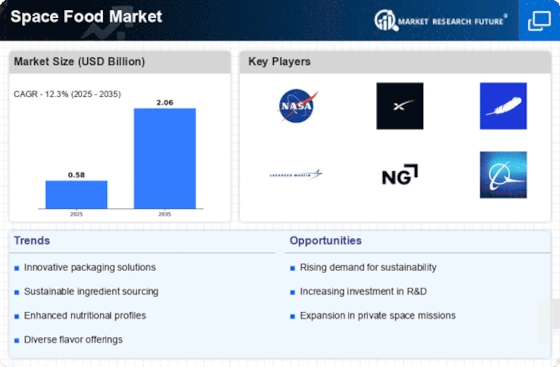
As per MRFR analysis, the Space Food Market Size was estimated at 0.576 USD Billion in 2024. The Space Food industry is projected to grow from 0.6469 in 2025 to 2.064 by 2035, exhibiting a compound annual growth rate (CAGR) of 12.3 during the forecast period 2025 - 2035.

Key Market Trends & Highlights

The Space Food Market is poised for growth driven by sustainability and technological advancements.

  • North America remains the largest market for space food, driven by extensive space missions and research initiatives.
  • The Asia-Pacific region is emerging as the fastest-growing market, fueled by increasing investments in space exploration and tourism.
  • Freeze-dried food products dominate the market, while dehydrated food segments are experiencing rapid growth due to evolving consumer preferences.
  • Key market drivers include the rising number of space missions and the growing interest in space tourism, which are propelling innovations in food preservation technologies.

Market Size & Forecast

2024 Market Size 0.576 (USD Billion)
2035 Market Size 2.064 (USD Billion)
CAGR (2025 - 2035) 12.3%
Largest Regional Market Share in 2024 North America

Major Players

<p>NASA (US), SpaceX (US), Blue Origin (US), Lockheed Martin (US), Northrop Grumman (US), Boeing (US), Thales Alenia Space (FR), Airbus (FR), MRE (US), AstroNautic (US)</p>

Market Trends

The Space Food Market is currently experiencing a transformative phase, driven by advancements in food technology and the increasing interest in space exploration. As nations and private entities invest in space missions, the demand for nutritious, safe, and palatable food options for astronauts is rising. This market is characterized by a diverse range of products, including freeze-dried meals, snacks, and beverages, all designed to withstand the unique challenges of space travel. The emphasis on sustainability and health is also becoming more pronounced, as stakeholders seek to develop food solutions that not only meet the physiological needs of astronauts but also align with broader environmental goals. Moreover, the Space Food Market is likely to witness innovations in packaging and preservation techniques, which could enhance the shelf life and quality of space food. Collaborations between food scientists, nutritionists, and aerospace engineers appear to be fostering a more integrated approach to food development. As the industry evolves, it may also explore the potential of growing food in space, which could revolutionize how sustenance is provided during long-duration missions. Overall, the Space Food Market is poised for growth, reflecting the dynamic interplay between technology, health, and the future of human exploration beyond Earth.

Sustainability Initiatives

The Space Food Market is increasingly focusing on sustainable practices, with an emphasis on reducing waste and utilizing eco-friendly materials. This trend reflects a broader commitment to environmental stewardship, as stakeholders recognize the importance of minimizing the ecological footprint of space missions.

Nutritional Advancements

There is a growing emphasis on enhancing the nutritional profile of space food. Innovations in food science are leading to the development of meals that not only meet caloric needs but also provide essential vitamins and minerals, thereby supporting the health and well-being of astronauts during missions.

Technological Integration

The integration of advanced technologies in food preparation and preservation is becoming more prevalent. Techniques such as 3D printing and smart packaging are being explored to improve the quality and variety of food available in space, potentially transforming the dining experience for astronauts.

Space Food Market Market Drivers

Increased Space Missions

The Space Food Market is experiencing a surge in demand due to the increasing number of space missions planned by various space agencies and private companies. With organizations like NASA and SpaceX announcing ambitious plans for lunar and Martian exploration, the need for specialized food products that can sustain astronauts during extended missions is paramount. It is estimated that the market for space food could reach USD 1.5 billion by 2027, driven by the necessity for high-quality, nutritious, and shelf-stable food options. This trend indicates a growing recognition of the importance of food technology in ensuring the health and performance of astronauts, thereby propelling the Space Food Market forward.

Health and Wellness Trends

The Space Food Market is increasingly influenced by the global health and wellness trends that prioritize nutritional value and dietary preferences. As consumers become more health-conscious, there is a growing expectation for space food to meet these standards. This trend is reflected in the development of space food products that are not only nutritious but also cater to specific dietary needs, such as vegan or gluten-free options. The market is projected to grow at a CAGR of 5% through 2028, indicating a robust demand for health-oriented space food solutions. This evolution suggests that the Space Food Market must adapt to these changing consumer preferences to remain competitive.

Growing Interest in Space Tourism

The Space Food Market is poised for growth as interest in space tourism escalates. Companies such as Blue Origin and Virgin Galactic are developing commercial space travel experiences, which necessitate the provision of safe and palatable food options for tourists. As the market for space tourism is projected to reach USD 3 billion by 2030, the demand for innovative space food products tailored to non-professional astronauts is likely to increase. This shift not only opens new avenues for food manufacturers but also encourages advancements in food preservation and packaging technologies, thereby enhancing the overall appeal of the Space Food Market.

Technological Innovations in Food Preservation

The Space Food Market is benefiting from advancements in food preservation technologies, which are crucial for ensuring the longevity and safety of food consumed in space. Techniques such as freeze-drying and vacuum sealing are becoming more sophisticated, allowing for the creation of lightweight, nutrient-dense food products that can withstand the rigors of space travel. As these technologies evolve, they not only enhance the quality of space food but also reduce waste, which is a critical factor in space missions. The integration of these innovations is likely to drive the Space Food Market towards more sustainable practices, aligning with broader environmental goals.

Collaborations Between Space Agencies and Food Companies

The Space Food Market is witnessing an increase in collaborations between space agencies and food manufacturers, aimed at developing specialized food products for space missions. These partnerships leverage the expertise of food scientists and technologists to create meals that meet the unique challenges of space travel. For instance, NASA has been working with various food companies to enhance the nutritional profile and palatability of space food. Such collaborations not only foster innovation but also ensure that the food provided to astronauts is safe and enjoyable. This trend indicates a promising future for the Space Food Market, as it aligns with the growing emphasis on quality and safety in space missions.

Market Segment Insights

By Food Form and Processing: Freeze-Dried (Largest) vs. Dehydrated (Fastest-Growing)

<p>The Space Food Market has seen a diversified approach in food form and processing, with freeze-dried food holding the largest market share due to its long shelf life and nutrient retention. Dehydrated food is gaining momentum, reflecting a growing preference for lightweight and easily packable food options that meet the unique needs of space missions. These segments benefit from advancements in technology, ensuring food quality and longevity during space travels.</p>

<p>Freeze-Dried (Dominant) vs. Dehydrated (Emerging)</p>

<p>Freeze-dried food is currently the dominant force in the Space Food Market, celebrated for its exceptional preservation qualities that lock in flavor and nutrients while ensuring minimal weight, making it ideal for long missions. On the other hand, dehydrated food is emerging rapidly, appealing to astronauts' and space agencies' needs for practical and portable meal solutions. While freeze-drying requires sophisticated technology, dehydrating is relatively energy-efficient, and both options complement each other in meeting the nutritional demands of space travel.</p>

By Packaging and Preservation: Vacuum-Sealing (Largest) vs. Modified Atmosphere Packaging (Fastest-Growing)

<p>The packaging and preservation segment of the Space Food Market showcases a diverse distribution among its key components. Vacuum-sealing holds a significant share, dominating the market landscape with its effectiveness in extending shelf life and maintaining food quality during space missions. Modified Atmosphere Packaging (MAP) follows closely behind, but its unique ability to enhance flavor and nutritional value while ensuring safety makes it the fastest-growing segment in recent years. Controlled Temperature Storage, while essential, ranks lower in share, serving a more supportive role by maintaining optimal conditions for other packaging methods.</p>

<p>Vacuum-Sealing (Dominant) vs. Modified Atmosphere Packaging (Emerging)</p>

<p>Vacuum-sealing stands out as the dominant method in the Space Food Market due to its ability to eliminate air and moisture, thereby significantly enhancing the preservation of food products for long-duration missions. This method ensures that astronauts receive nutrient-rich and flavorful meals, preventing spoilage and wastage. On the other hand, Modified Atmosphere Packaging is emerging rapidly, appealing to the increasing demand for fresher and more palatable options in space. By modifying the gases surrounding the food, MAP effectively slows down spoilage and maintains quality, positioning itself as a vital competitor to vacuum-sealing in the quest for more advanced and enjoyable space food solutions.</p>

By Nutritional Composition: Macronutrients (Largest) vs. Micronutrients (Fastest-Growing)

<p>In the Space Food Market, the Nutritional Composition segment reveals a significant distribution between macronutrients and micronutrients. Macronutrients, including proteins, carbohydrates, and fats, account for the largest portion of nutrients provided to astronauts, ensuring energy supply and sustaining bodily functions during missions. Conversely, micronutrients play a critical role in supporting immune function and preventing deficiencies, although they represent a smaller share by volume in space food formulations. The ongoing emphasis on health and sustainability drives the demand for high-quality and diverse micro ingredient profiles in space diet planning.</p>

<p>Nutritional Composition: Macronutrients (Dominant) vs. Micronutrients (Emerging)</p>

<p>Macronutrients are characterized by their essential role in providing the energy necessary for astronauts during long-duration space missions. With a focus on maintaining muscle mass and overall health, macronutrient formulations tend to be optimized for both caloric density and digestibility. On the other hand, micronutrients are rapidly becoming an emerging focal point as mission planners recognize their importance in enhancing health and performance in microgravity conditions. The increasing incorporation of micronutrient-rich ingredients reflects a growing awareness of the nutritional needs of astronauts to combat potential deficiencies and maintain peak physical and mental functioning while in space.</p>

Get more detailed insights about Space Food Market Research Report – Forecast till 2035

Regional Insights

North America : Innovation and Leadership Hub

North America is the largest market for space food, accounting for approximately 60% of the global share. The region's growth is driven by significant investments in space exploration, advancements in food technology, and increasing demand for long-duration space missions. Regulatory support from NASA and other agencies further catalyzes market expansion, ensuring safety and nutritional standards are met. The United States leads the space food market, with key players like NASA, SpaceX, and Boeing driving innovation. The competitive landscape is characterized by collaborations between government agencies and private companies, enhancing product development. The presence of established firms and emerging startups fosters a dynamic environment, ensuring a steady supply of advanced space food solutions.

Europe : Emerging Market with Potential

Europe is rapidly emerging as a significant player in the space food market, holding approximately 25% of the global share. The growth is fueled by increasing investments in space missions by the European Space Agency (ESA) and national governments. Regulatory frameworks are evolving to support innovation in food technology, ensuring that products meet the nutritional needs of astronauts during long missions. Leading countries in this region include France and Germany, where companies like Thales Alenia Space and Airbus are pivotal. The competitive landscape is marked by collaborations between aerospace firms and food technology companies, enhancing product offerings. The focus on sustainability and health in food production is driving innovation, positioning Europe as a key player in the future of space food.

Asia-Pacific : Rapidly Growing Market

Asia-Pacific is witnessing rapid growth in the space food market, accounting for about 10% of the global share. The region's expansion is driven by increasing government investments in space exploration and collaborations with private companies. Countries like Japan and China are at the forefront, focusing on developing advanced food technologies to support their space missions. Regulatory frameworks are being established to ensure food safety and quality for astronauts. Japan and China are leading the charge in this market, with organizations like JAXA and various private firms contributing to innovation. The competitive landscape is evolving, with a mix of established aerospace companies and new entrants focusing on space food solutions. The emphasis on research and development is expected to drive further growth in the coming years.

Middle East and Africa : Emerging Opportunities Ahead

The Middle East and Africa region is in the nascent stages of developing its space food market, currently holding around 5% of the global share. Growth is driven by increasing interest in space exploration and investments from governments aiming to enhance their capabilities. Initiatives by countries like the UAE are fostering a supportive environment for innovation in space food technology, with regulatory frameworks being established to ensure safety and quality. The UAE is leading the way in this region, with significant investments in space missions and collaborations with international space agencies. The competitive landscape is characterized by emerging startups and partnerships with established firms, focusing on developing sustainable and nutritious food solutions for space missions. As the region continues to invest in space exploration, the demand for space food is expected to grow significantly.

Key Players and Competitive Insights

Leading market players are investing heavily in research and development in order to expand their product lines, which will help the Space Food Market grow even more. Market players are also undertaking a variety of strategic activities to spread their footprint, with important market developments including mergers and acquisitions, new product launches, contractual agreements, higher investments, and collaboration with other organizations. To spread and survive in a more competitive and rising market climate, the Space Food industry must offer cost-effective items.

Manufacturing locally to minimize the operational costs is one of the key business tactics used by the manufacturers in the Space Food industry to benefit the clients and increase the market sector. In recent years, the Space Food industry has offered some of the most significant advantages to the space industry. Major players in the Space Food Market, including NASA, European Space Agency, Roscosmos, SpaceX, Blue Origin, Boeing, Lockheed Martin, Northrop Grumman Corporation, Orbital ATK, ISSpresso, BeeHex, NanoRacks, JAXA, AEB, and others, are trying to increase market demand by investing in the research and development operations.

Orbital Technologies, also known as Orbital Corporation, is an Australian company that specializes in the development and manufacture of engines, propulsion systems, and engine management systems for unmanned aerial vehicles (UAVs), unmanned aircraft systems (UAS), and other applications. Orbital Technologies has collaborated with industry partners and government organizations to advance their technologies and explore new opportunities in the engine and propulsion sector. In April 2023, Orbital Technologies announced a partnership with 3D Systems to develop and test a new 3D printer for food production in space.

Orbital Technologies is a company that develops and sells 3D printers for microgravity environments. 3D Systems is a leading offerer of 3D printing solutions. This partnership will help to develop a new and innovative way to produce food in space.

Zero-G Kitchen is a company with the goal of developing appliances and systems for cooking and preparing food in the unique environment of microgravity, particularly for astronauts on space missions. Zero-G Kitchen aims to make space cuisine more varied and appealing, offering astronauts not only essential sustenance but also a taste of home and familiar meals during their missions. Their work highlights the importance of culinary innovation in enhancing the quality of life for astronauts in space. In March 2023, Zero-G Kitchen announced a partnership with Kellogg's to develop and test new space-friendly foods.

Zero-G Kitchen is a company that develops and sells space-friendly foods. Kellogg's is a leading food company. This partnership will help to develop new and tasty food options for astronauts on long-duration space missions.

Key Companies in the Space Food Market market include

Industry Developments

May 2023: Helios Biosciences was acquired by Axiom Space, a commercial spaceflight company. Helios Biosciences is a leading developer of food production systems for space. This acquisition will help Axiom Space to develop and provide sustainable food solutions for astronauts on long-duration space missions.

May 2023: Space Garden announced a partnership with NASA to develop and test a new system for growing plants in space. Space Garden is a company that develops and sells aeroponic growing systems. This partnership will help NASA to develop a reliable and sustainable food production system for astronauts on long-duration space missions.

May 2023: Meal Source Technologies announced the launch of its new line of space food products. The new line of products includes a different nutritious and shelf-stable meals that are designed to meet the needs of astronauts on long-duration space missions.

Future Outlook

Space Food Market Future Outlook

<p>The Space Food Market is projected to grow at a 12.3% CAGR from 2024 to 2035, driven by advancements in food technology, increased space missions, and growing consumer interest in space exploration.</p>

New opportunities lie in:

  • <p>Development of personalized nutrition plans for astronauts</p>
  • <p>Expansion of sustainable packaging solutions for space food</p>
  • <p>Investment in research for long-duration space food preservation</p>

<p>By 2035, the Space Food Market is expected to be robust, driven by innovation and increased demand.</p>

Market Segmentation

Space Food Market Nutritional Composition Outlook

  • Macronutrient
  • Micronutrient

Space Food Market Food Form and Processing Outlook

  • Freeze-Dried
  • Dehydrated
  • Irradiated
  • Thermostabilized
  • Bioregenerative

Space Food Market Packaging and Preservation Outlook

  • Vacuum-Sealing
  • Modified Atmosphere Packaging
  • Controlled Temperature Storage

Report Scope

MARKET SIZE 20240.576(USD Billion)
MARKET SIZE 20250.6469(USD Billion)
MARKET SIZE 20352.064(USD Billion)
COMPOUND ANNUAL GROWTH RATE (CAGR)12.3% (2024 - 2035)
REPORT COVERAGERevenue Forecast, Competitive Landscape, Growth Factors, and Trends
BASE YEAR2024
Market Forecast Period2025 - 2035
Historical Data2019 - 2024
Market Forecast UnitsUSD Billion
Key Companies ProfiledMarket analysis in progress
Segments CoveredMarket segmentation analysis in progress
Key Market OpportunitiesAdvancements in sustainable packaging technologies enhance the Space Food Market's growth potential.
Key Market DynamicsTechnological advancements in food preservation and packaging enhance the viability of space food for long-duration missions.
Countries CoveredNorth America, Europe, APAC, South America, MEA

FAQs

What is the projected market valuation of the Space Food Market by 2035?

The Space Food Market is projected to reach a valuation of 2.064 USD Billion by 2035.

What was the market valuation of the Space Food Market in 2024?

In 2024, the Space Food Market was valued at 0.576 USD Billion.

What is the expected CAGR for the Space Food Market during the forecast period 2025 - 2035?

The expected CAGR for the Space Food Market during the forecast period 2025 - 2035 is 12.3%.

Which companies are considered key players in the Space Food Market?

Key players in the Space Food Market include NASA, SpaceX, Blue Origin, Lockheed Martin, and Boeing.

What are the main segments of the Space Food Market based on food form and processing?

The main segments include Freeze-Dried, Dehydrated, Irradiated, Thermostabilized, and Bioregenerative food forms.

How much was the Freeze-Dried segment valued at in 2024?

The Freeze-Dried segment was valued at 0.1728 USD Billion in 2024.

  1. SECTION I: EXECUTIVE SUMMARY AND KEY HIGHLIGHTS
    1. EXECUTIVE SUMMARY
      1. Market Overview
      2. Key Findings
      3. Market Segmentation
      4. Competitive Landscape
      5. Challenges and Opportunities
      6. Future Outlook
  2. SECTION II: SCOPING, METHODOLOGY AND MARKET STRUCTURE
    1. MARKET INTRODUCTION
      1. Definition
      2. Scope of the study
    2. RESEARCH METHODOLOGY
      1. Overview
      2. Data Mining
      3. Secondary Research
      4. Primary Research
      5. Forecasting Model
      6. Market Size Estimation
      7. Data Triangulation
      8. Validation
  3. SECTION III: QUALITATIVE ANALYSIS
    1. MARKET DYNAMICS
      1. Overview
      2. Drivers
      3. Restraints
      4. Opportunities
    2. MARKET FACTOR ANALYSIS
      1. Value chain Analysis
      2. Porter's Five Forces Analysis
      3. COVID-19 Impact Analysis
  4. SECTION IV: QUANTITATIVE ANALYSIS
    1. Food, Beverages & Nutrition, BY Food Form and Processing (USD Billion)
      1. Freeze-Dried
      2. Dehydrated
      3. Irradiated
      4. Thermostabilized
      5. Bioregenerative
    2. Food, Beverages & Nutrition, BY Packaging and Preservation (USD Billion)
      1. Vacuum-Sealing
      2. Modified Atmosphere Packaging
      3. Controlled Temperature Storage
    3. Food, Beverages & Nutrition, BY Nutritional Composition (USD Billion)
      1. Macronutrient
      2. Micronutrient
    4. Food, Beverages & Nutrition, BY Region (USD Billion)
      1. North America
      2. Europe
      3. APAC
      4. South America
      5. MEA
  5. SECTION V: COMPETITIVE ANALYSIS
    1. Competitive Landscape
      1. Overview
      2. Competitive Analysis
      3. Market share Analysis
      4. Major Growth Strategy in the Food, Beverages & Nutrition
      5. Competitive Benchmarking
      6. Leading Players in Terms of Number of Developments in the Food, Beverages & Nutrition
      7. Key developments and growth strategies
      8. Major Players Financial Matrix
    2. Company Profiles
      1. NASA (US)
      2. SpaceX (US)
      3. Blue Origin (US)
      4. Lockheed Martin (US)
      5. Northrop Grumman (US)
      6. Boeing (US)
      7. Thales Alenia Space (FR)
      8. Airbus (FR)
      9. MRE (US)
      10. AstroNautic (US)
    3. Appendix
      1. References
      2. Related Reports
  6. LIST OF FIGURES
    1. MARKET SYNOPSIS
    2. NORTH AMERICA MARKET ANALYSIS
    3. US MARKET ANALYSIS BY FOOD FORM AND PROCESSING
    4. US MARKET ANALYSIS BY PACKAGING AND PRESERVATION
    5. US MARKET ANALYSIS BY NUTRITIONAL COMPOSITION
    6. CANADA MARKET ANALYSIS BY FOOD FORM AND PROCESSING
    7. CANADA MARKET ANALYSIS BY PACKAGING AND PRESERVATION
    8. CANADA MARKET ANALYSIS BY NUTRITIONAL COMPOSITION
    9. EUROPE MARKET ANALYSIS
    10. GERMANY MARKET ANALYSIS BY FOOD FORM AND PROCESSING
    11. GERMANY MARKET ANALYSIS BY PACKAGING AND PRESERVATION
    12. GERMANY MARKET ANALYSIS BY NUTRITIONAL COMPOSITION
    13. UK MARKET ANALYSIS BY FOOD FORM AND PROCESSING
    14. UK MARKET ANALYSIS BY PACKAGING AND PRESERVATION
    15. UK MARKET ANALYSIS BY NUTRITIONAL COMPOSITION
    16. FRANCE MARKET ANALYSIS BY FOOD FORM AND PROCESSING
    17. FRANCE MARKET ANALYSIS BY PACKAGING AND PRESERVATION
    18. FRANCE MARKET ANALYSIS BY NUTRITIONAL COMPOSITION
    19. RUSSIA MARKET ANALYSIS BY FOOD FORM AND PROCESSING
    20. RUSSIA MARKET ANALYSIS BY PACKAGING AND PRESERVATION
    21. RUSSIA MARKET ANALYSIS BY NUTRITIONAL COMPOSITION
    22. ITALY MARKET ANALYSIS BY FOOD FORM AND PROCESSING
    23. ITALY MARKET ANALYSIS BY PACKAGING AND PRESERVATION
    24. ITALY MARKET ANALYSIS BY NUTRITIONAL COMPOSITION
    25. SPAIN MARKET ANALYSIS BY FOOD FORM AND PROCESSING
    26. SPAIN MARKET ANALYSIS BY PACKAGING AND PRESERVATION
    27. SPAIN MARKET ANALYSIS BY NUTRITIONAL COMPOSITION
    28. REST OF EUROPE MARKET ANALYSIS BY FOOD FORM AND PROCESSING
    29. REST OF EUROPE MARKET ANALYSIS BY PACKAGING AND PRESERVATION
    30. REST OF EUROPE MARKET ANALYSIS BY NUTRITIONAL COMPOSITION
    31. APAC MARKET ANALYSIS
    32. CHINA MARKET ANALYSIS BY FOOD FORM AND PROCESSING
    33. CHINA MARKET ANALYSIS BY PACKAGING AND PRESERVATION
    34. CHINA MARKET ANALYSIS BY NUTRITIONAL COMPOSITION
    35. INDIA MARKET ANALYSIS BY FOOD FORM AND PROCESSING
    36. INDIA MARKET ANALYSIS BY PACKAGING AND PRESERVATION
    37. INDIA MARKET ANALYSIS BY NUTRITIONAL COMPOSITION
    38. JAPAN MARKET ANALYSIS BY FOOD FORM AND PROCESSING
    39. JAPAN MARKET ANALYSIS BY PACKAGING AND PRESERVATION
    40. JAPAN MARKET ANALYSIS BY NUTRITIONAL COMPOSITION
    41. SOUTH KOREA MARKET ANALYSIS BY FOOD FORM AND PROCESSING
    42. SOUTH KOREA MARKET ANALYSIS BY PACKAGING AND PRESERVATION
    43. SOUTH KOREA MARKET ANALYSIS BY NUTRITIONAL COMPOSITION
    44. MALAYSIA MARKET ANALYSIS BY FOOD FORM AND PROCESSING
    45. MALAYSIA MARKET ANALYSIS BY PACKAGING AND PRESERVATION
    46. MALAYSIA MARKET ANALYSIS BY NUTRITIONAL COMPOSITION
    47. THAILAND MARKET ANALYSIS BY FOOD FORM AND PROCESSING
    48. THAILAND MARKET ANALYSIS BY PACKAGING AND PRESERVATION
    49. THAILAND MARKET ANALYSIS BY NUTRITIONAL COMPOSITION
    50. INDONESIA MARKET ANALYSIS BY FOOD FORM AND PROCESSING
    51. INDONESIA MARKET ANALYSIS BY PACKAGING AND PRESERVATION
    52. INDONESIA MARKET ANALYSIS BY NUTRITIONAL COMPOSITION
    53. REST OF APAC MARKET ANALYSIS BY FOOD FORM AND PROCESSING
    54. REST OF APAC MARKET ANALYSIS BY PACKAGING AND PRESERVATION
    55. REST OF APAC MARKET ANALYSIS BY NUTRITIONAL COMPOSITION
    56. SOUTH AMERICA MARKET ANALYSIS
    57. BRAZIL MARKET ANALYSIS BY FOOD FORM AND PROCESSING
    58. BRAZIL MARKET ANALYSIS BY PACKAGING AND PRESERVATION
    59. BRAZIL MARKET ANALYSIS BY NUTRITIONAL COMPOSITION
    60. MEXICO MARKET ANALYSIS BY FOOD FORM AND PROCESSING
    61. MEXICO MARKET ANALYSIS BY PACKAGING AND PRESERVATION
    62. MEXICO MARKET ANALYSIS BY NUTRITIONAL COMPOSITION
    63. ARGENTINA MARKET ANALYSIS BY FOOD FORM AND PROCESSING
    64. ARGENTINA MARKET ANALYSIS BY PACKAGING AND PRESERVATION
    65. ARGENTINA MARKET ANALYSIS BY NUTRITIONAL COMPOSITION
    66. REST OF SOUTH AMERICA MARKET ANALYSIS BY FOOD FORM AND PROCESSING
    67. REST OF SOUTH AMERICA MARKET ANALYSIS BY PACKAGING AND PRESERVATION
    68. REST OF SOUTH AMERICA MARKET ANALYSIS BY NUTRITIONAL COMPOSITION
    69. MEA MARKET ANALYSIS
    70. GCC COUNTRIES MARKET ANALYSIS BY FOOD FORM AND PROCESSING
    71. GCC COUNTRIES MARKET ANALYSIS BY PACKAGING AND PRESERVATION
    72. GCC COUNTRIES MARKET ANALYSIS BY NUTRITIONAL COMPOSITION
    73. SOUTH AFRICA MARKET ANALYSIS BY FOOD FORM AND PROCESSING
    74. SOUTH AFRICA MARKET ANALYSIS BY PACKAGING AND PRESERVATION
    75. SOUTH AFRICA MARKET ANALYSIS BY NUTRITIONAL COMPOSITION
    76. REST OF MEA MARKET ANALYSIS BY FOOD FORM AND PROCESSING
    77. REST OF MEA MARKET ANALYSIS BY PACKAGING AND PRESERVATION
    78. REST OF MEA MARKET ANALYSIS BY NUTRITIONAL COMPOSITION
    79. KEY BUYING CRITERIA OF FOOD, BEVERAGES & NUTRITION
    80. RESEARCH PROCESS OF MRFR
    81. DRO ANALYSIS OF FOOD, BEVERAGES & NUTRITION
    82. DRIVERS IMPACT ANALYSIS: FOOD, BEVERAGES & NUTRITION
    83. RESTRAINTS IMPACT ANALYSIS: FOOD, BEVERAGES & NUTRITION
    84. SUPPLY / VALUE CHAIN: FOOD, BEVERAGES & NUTRITION
    85. FOOD, BEVERAGES & NUTRITION, BY FOOD FORM AND PROCESSING, 2024 (% SHARE)
    86. FOOD, BEVERAGES & NUTRITION, BY FOOD FORM AND PROCESSING, 2024 TO 2035 (USD Billion)
    87. FOOD, BEVERAGES & NUTRITION, BY PACKAGING AND PRESERVATION, 2024 (% SHARE)
    88. FOOD, BEVERAGES & NUTRITION, BY PACKAGING AND PRESERVATION, 2024 TO 2035 (USD Billion)
    89. FOOD, BEVERAGES & NUTRITION, BY NUTRITIONAL COMPOSITION, 2024 (% SHARE)
    90. FOOD, BEVERAGES & NUTRITION, BY NUTRITIONAL COMPOSITION, 2024 TO 2035 (USD Billion)
    91. BENCHMARKING OF MAJOR COMPETITORS
  7. LIST OF TABLES
    1. LIST OF ASSUMPTIONS
    2. North America MARKET SIZE ESTIMATES; FORECAST
      1. BY FOOD FORM AND PROCESSING, 2025-2035 (USD Billion)
      2. BY PACKAGING AND PRESERVATION, 2025-2035 (USD Billion)
      3. BY NUTRITIONAL COMPOSITION, 2025-2035 (USD Billion)
    3. US MARKET SIZE ESTIMATES; FORECAST
      1. BY FOOD FORM AND PROCESSING, 2025-2035 (USD Billion)
      2. BY PACKAGING AND PRESERVATION, 2025-2035 (USD Billion)
      3. BY NUTRITIONAL COMPOSITION, 2025-2035 (USD Billion)
    4. Canada MARKET SIZE ESTIMATES; FORECAST
      1. BY FOOD FORM AND PROCESSING, 2025-2035 (USD Billion)
      2. BY PACKAGING AND PRESERVATION, 2025-2035 (USD Billion)
      3. BY NUTRITIONAL COMPOSITION, 2025-2035 (USD Billion)
    5. Europe MARKET SIZE ESTIMATES; FORECAST
      1. BY FOOD FORM AND PROCESSING, 2025-2035 (USD Billion)
      2. BY PACKAGING AND PRESERVATION, 2025-2035 (USD Billion)
      3. BY NUTRITIONAL COMPOSITION, 2025-2035 (USD Billion)
    6. Germany MARKET SIZE ESTIMATES; FORECAST
      1. BY FOOD FORM AND PROCESSING, 2025-2035 (USD Billion)
      2. BY PACKAGING AND PRESERVATION, 2025-2035 (USD Billion)
      3. BY NUTRITIONAL COMPOSITION, 2025-2035 (USD Billion)
    7. UK MARKET SIZE ESTIMATES; FORECAST
      1. BY FOOD FORM AND PROCESSING, 2025-2035 (USD Billion)
      2. BY PACKAGING AND PRESERVATION, 2025-2035 (USD Billion)
      3. BY NUTRITIONAL COMPOSITION, 2025-2035 (USD Billion)
    8. France MARKET SIZE ESTIMATES; FORECAST
      1. BY FOOD FORM AND PROCESSING, 2025-2035 (USD Billion)
      2. BY PACKAGING AND PRESERVATION, 2025-2035 (USD Billion)
      3. BY NUTRITIONAL COMPOSITION, 2025-2035 (USD Billion)
    9. Russia MARKET SIZE ESTIMATES; FORECAST
      1. BY FOOD FORM AND PROCESSING, 2025-2035 (USD Billion)
      2. BY PACKAGING AND PRESERVATION, 2025-2035 (USD Billion)
      3. BY NUTRITIONAL COMPOSITION, 2025-2035 (USD Billion)
    10. Italy MARKET SIZE ESTIMATES; FORECAST
      1. BY FOOD FORM AND PROCESSING, 2025-2035 (USD Billion)
      2. BY PACKAGING AND PRESERVATION, 2025-2035 (USD Billion)
      3. BY NUTRITIONAL COMPOSITION, 2025-2035 (USD Billion)
    11. Spain MARKET SIZE ESTIMATES; FORECAST
      1. BY FOOD FORM AND PROCESSING, 2025-2035 (USD Billion)
      2. BY PACKAGING AND PRESERVATION, 2025-2035 (USD Billion)
      3. BY NUTRITIONAL COMPOSITION, 2025-2035 (USD Billion)
    12. Rest of Europe MARKET SIZE ESTIMATES; FORECAST
      1. BY FOOD FORM AND PROCESSING, 2025-2035 (USD Billion)
      2. BY PACKAGING AND PRESERVATION, 2025-2035 (USD Billion)
      3. BY NUTRITIONAL COMPOSITION, 2025-2035 (USD Billion)
    13. APAC MARKET SIZE ESTIMATES; FORECAST
      1. BY FOOD FORM AND PROCESSING, 2025-2035 (USD Billion)
      2. BY PACKAGING AND PRESERVATION, 2025-2035 (USD Billion)
      3. BY NUTRITIONAL COMPOSITION, 2025-2035 (USD Billion)
    14. China MARKET SIZE ESTIMATES; FORECAST
      1. BY FOOD FORM AND PROCESSING, 2025-2035 (USD Billion)
      2. BY PACKAGING AND PRESERVATION, 2025-2035 (USD Billion)
      3. BY NUTRITIONAL COMPOSITION, 2025-2035 (USD Billion)
    15. India MARKET SIZE ESTIMATES; FORECAST
      1. BY FOOD FORM AND PROCESSING, 2025-2035 (USD Billion)
      2. BY PACKAGING AND PRESERVATION, 2025-2035 (USD Billion)
      3. BY NUTRITIONAL COMPOSITION, 2025-2035 (USD Billion)
    16. Japan MARKET SIZE ESTIMATES; FORECAST
      1. BY FOOD FORM AND PROCESSING, 2025-2035 (USD Billion)
      2. BY PACKAGING AND PRESERVATION, 2025-2035 (USD Billion)
      3. BY NUTRITIONAL COMPOSITION, 2025-2035 (USD Billion)
    17. South Korea MARKET SIZE ESTIMATES; FORECAST
      1. BY FOOD FORM AND PROCESSING, 2025-2035 (USD Billion)
      2. BY PACKAGING AND PRESERVATION, 2025-2035 (USD Billion)
      3. BY NUTRITIONAL COMPOSITION, 2025-2035 (USD Billion)
    18. Malaysia MARKET SIZE ESTIMATES; FORECAST
      1. BY FOOD FORM AND PROCESSING, 2025-2035 (USD Billion)
      2. BY PACKAGING AND PRESERVATION, 2025-2035 (USD Billion)
      3. BY NUTRITIONAL COMPOSITION, 2025-2035 (USD Billion)
    19. Thailand MARKET SIZE ESTIMATES; FORECAST
      1. BY FOOD FORM AND PROCESSING, 2025-2035 (USD Billion)
      2. BY PACKAGING AND PRESERVATION, 2025-2035 (USD Billion)
      3. BY NUTRITIONAL COMPOSITION, 2025-2035 (USD Billion)
    20. Indonesia MARKET SIZE ESTIMATES; FORECAST
      1. BY FOOD FORM AND PROCESSING, 2025-2035 (USD Billion)
      2. BY PACKAGING AND PRESERVATION, 2025-2035 (USD Billion)
      3. BY NUTRITIONAL COMPOSITION, 2025-2035 (USD Billion)
    21. Rest of APAC MARKET SIZE ESTIMATES; FORECAST
      1. BY FOOD FORM AND PROCESSING, 2025-2035 (USD Billion)
      2. BY PACKAGING AND PRESERVATION, 2025-2035 (USD Billion)
      3. BY NUTRITIONAL COMPOSITION, 2025-2035 (USD Billion)
    22. South America MARKET SIZE ESTIMATES; FORECAST
      1. BY FOOD FORM AND PROCESSING, 2025-2035 (USD Billion)
      2. BY PACKAGING AND PRESERVATION, 2025-2035 (USD Billion)
      3. BY NUTRITIONAL COMPOSITION, 2025-2035 (USD Billion)
    23. Brazil MARKET SIZE ESTIMATES; FORECAST
      1. BY FOOD FORM AND PROCESSING, 2025-2035 (USD Billion)
      2. BY PACKAGING AND PRESERVATION, 2025-2035 (USD Billion)
      3. BY NUTRITIONAL COMPOSITION, 2025-2035 (USD Billion)
    24. Mexico MARKET SIZE ESTIMATES; FORECAST
      1. BY FOOD FORM AND PROCESSING, 2025-2035 (USD Billion)
      2. BY PACKAGING AND PRESERVATION, 2025-2035 (USD Billion)
      3. BY NUTRITIONAL COMPOSITION, 2025-2035 (USD Billion)
    25. Argentina MARKET SIZE ESTIMATES; FORECAST
      1. BY FOOD FORM AND PROCESSING, 2025-2035 (USD Billion)
      2. BY PACKAGING AND PRESERVATION, 2025-2035 (USD Billion)
      3. BY NUTRITIONAL COMPOSITION, 2025-2035 (USD Billion)
    26. Rest of South America MARKET SIZE ESTIMATES; FORECAST
      1. BY FOOD FORM AND PROCESSING, 2025-2035 (USD Billion)
      2. BY PACKAGING AND PRESERVATION, 2025-2035 (USD Billion)
      3. BY NUTRITIONAL COMPOSITION, 2025-2035 (USD Billion)
    27. MEA MARKET SIZE ESTIMATES; FORECAST
      1. BY FOOD FORM AND PROCESSING, 2025-2035 (USD Billion)
      2. BY PACKAGING AND PRESERVATION, 2025-2035 (USD Billion)
      3. BY NUTRITIONAL COMPOSITION, 2025-2035 (USD Billion)
    28. GCC Countries MARKET SIZE ESTIMATES; FORECAST
      1. BY FOOD FORM AND PROCESSING, 2025-2035 (USD Billion)
      2. BY PACKAGING AND PRESERVATION, 2025-2035 (USD Billion)
      3. BY NUTRITIONAL COMPOSITION, 2025-2035 (USD Billion)
    29. South Africa MARKET SIZE ESTIMATES; FORECAST
      1. BY FOOD FORM AND PROCESSING, 2025-2035 (USD Billion)
      2. BY PACKAGING AND PRESERVATION, 2025-2035 (USD Billion)
      3. BY NUTRITIONAL COMPOSITION, 2025-2035 (USD Billion)
    30. Rest of MEA MARKET SIZE ESTIMATES; FORECAST
      1. BY FOOD FORM AND PROCESSING, 2025-2035 (USD Billion)
      2. BY PACKAGING AND PRESERVATION, 2025-2035 (USD Billion)
      3. BY NUTRITIONAL COMPOSITION, 2025-2035 (USD Billion)
    31. PRODUCT LAUNCH/PRODUCT DEVELOPMENT/APPROVAL
    32. ACQUISITION/PARTNERSHIP

Space Food Food Market Segmentation

Space Food Food Form and Processing Outlook (USD Billion, 2018-2032)

  • Freeze-Dried
  • Dehydrated
  • Irradiated
  • Thermostabilized
  • Bioregenerative

Space Food Packaging and Preservation Outlook (USD Billion, 2018-2032)

  • Vacuum-Sealing
  • Modified Atmosphere Packaging
  • Controlled Temperature Storage

Space Food Nutritional Composition Outlook (USD Billion, 2018-2032)

  • Macronutrient
  • Micronutrient

Space Food Regional Outlook (USD Billion, 2018-2032)

  • North America Outlook (USD Billion, 2018-2032)

    • North America Space Food by Food Form and Processing
      • Freeze-Dried
      • Dehydrated
      • Irradiated
      • Thermostabilized
      • Bioregenerative
    • North America Space Food by Packaging and Preservation
      • Vacuum-Sealing
      • Modified Atmosphere Packaging
      • Controlled Temperature Storage
    • North America Space Food by Nutritional Composition
      • Macronutrient
      • Micronutrient
    • US Outlook (USD Billion, 2018-2032)

    • US Space Food by Food Form and Processing
      • Freeze-Dried
      • Dehydrated
      • Irradiated
      • Thermostabilized
      • Bioregenerative
    • US Space Food by Packaging and Preservation
      • Vacuum-Sealing
      • Modified Atmosphere Packaging
      • Controlled Temperature Storage
    • US Space Food by Nutritional Composition
      • Macronutrient
      • Micronutrient
    • CANADA Outlook (USD Billion, 2018-2032)

    • CANADA Space Food by Food Form and Processing
      • Freeze-Dried
      • Dehydrated
      • Irradiated
      • Thermostabilized
      • Bioregenerative
    • CANADA Space Food by Packaging and Preservation
      • Vacuum-Sealing
      • Modified Atmosphere Packaging
      • Controlled Temperature Storage
    • CANADA Space Food by Nutritional Composition
      • Macronutrient
      • Micronutrient
  • Europe Outlook (USD Billion, 2018-2032)

    • Europe Space Food by Food Form and Processing
      • Freeze-Dried
      • Dehydrated
      • Irradiated
      • Thermostabilized
      • Bioregenerative
    • Europe Space Food by Packaging and Preservation
      • Vacuum-Sealing
      • Modified Atmosphere Packaging
      • Controlled Temperature Storage
    • Europe Space Food by Nutritional Composition
      • Macronutrient
      • Micronutrient
    • Germany Outlook (USD Billion, 2018-2032)

    • Germany Space Food by Food Form and Processing
      • Freeze-Dried
      • Dehydrated
      • Irradiated
      • Thermostabilized
      • Bioregenerative
    • Germany Space Food by Packaging and Preservation
      • Vacuum-Sealing
      • Modified Atmosphere Packaging
      • Controlled Temperature Storage
    • Germany Space Food by Nutritional Composition
      • Macronutrient
      • Micronutrient
    • France Outlook (USD Billion, 2018-2032)

    • France Space Food by Food Form and Processing
      • Freeze-Dried
      • Dehydrated
      • Irradiated
      • Thermostabilized
      • Bioregenerative
    • France Space Food by Packaging and Preservation
      • Vacuum-Sealing
      • Modified Atmosphere Packaging
      • Controlled Temperature Storage
    • France Space Food by Nutritional Composition
      • Macronutrient
      • Micronutrient
    • UK Outlook (USD Billion, 2018-2032)

    • UK Space Food by Food Form and Processing
      • Freeze-Dried
      • Dehydrated
      • Irradiated
      • Thermostabilized
      • Bioregenerative
    • UK Space Food by Packaging and Preservation
      • Vacuum-Sealing
      • Modified Atmosphere Packaging
      • Controlled Temperature Storage
    • UK Space Food by Nutritional Composition
      • Macronutrient
      • Micronutrient
    • ITALY Outlook (USD Billion, 2018-2032)

    • ITALY Space Food by Food Form and Processing
      • Freeze-Dried
      • Dehydrated
      • Irradiated
      • Thermostabilized
      • Bioregenerative
    • ITALY Space Food by Packaging and Preservation
      • Vacuum-Sealing
      • Modified Atmosphere Packaging
      • Controlled Temperature Storage
    • ITALY Space Food by Nutritional Composition
      • Macronutrient
      • Micronutrient
    • SPAIN Outlook (USD Billion, 2018-2032)

    • Spain Space Food by Food Form and Processing
      • Freeze-Dried
      • Dehydrated
      • Irradiated
      • Thermostabilized
      • Bioregenerative
    • Spain Space Food by Packaging and Preservation
      • Vacuum-Sealing
      • Modified Atmosphere Packaging
      • Controlled Temperature Storage
    • Spain Space Food by Nutritional Composition
      • Macronutrient
      • Micronutrient
    • Rest Of Europe Outlook (USD Billion, 2018-2032)

    • Rest Of Europe Space Food by Food Form and Processing
      • Freeze-Dried
      • Dehydrated
      • Irradiated
      • Thermostabilized
      • Bioregenerative
    • REST OF EUROPE Space Food by Packaging and Preservation
      • Vacuum-Sealing
      • Modified Atmosphere Packaging
      • Controlled Temperature Storage
    • REST OF EUROPE Space Food by Nutritional Composition
      • Macronutrient
      • Micronutrient
  • Asia-Pacific Outlook (USD Billion, 2018-2032)

    • Asia-Pacific Space Food by Food Form and Processing
      • Freeze-Dried
      • Dehydrated
      • Irradiated
      • Thermostabilized
      • Bioregenerative
    • Asia-Pacific Space Food by Packaging and Preservation
      • Vacuum-Sealing
      • Modified Atmosphere Packaging
      • Controlled Temperature Storage
    • Asia-Pacific Space Food by Nutritional Composition
      • Macronutrient
      • Micronutrient
    • China Outlook (USD Billion, 2018-2032)

    • China Space Food by Food Form and Processing
      • Freeze-Dried
      • Dehydrated
      • Irradiated
      • Thermostabilized
      • Bioregenerative
    • China Space Food by Packaging and Preservation
      • Vacuum-Sealing
      • Modified Atmosphere Packaging
      • Controlled Temperature Storage
    • China Space Food by Nutritional Composition
      • Macronutrient
      • Micronutrient
    • Japan Outlook (USD Billion, 2018-2032)

    • Japan Space Food by Food Form and Processing
      • Freeze-Dried
      • Dehydrated
      • Irradiated
      • Thermostabilized
      • Bioregenerative
    • Japan Space Food by Packaging and Preservation
      • Vacuum-Sealing
      • Modified Atmosphere Packaging
      • Controlled Temperature Storage
    • Japan Space Food by Nutritional Composition
      • Macronutrient
      • Micronutrient
    • India Outlook (USD Billion, 2018-2032)

    • India Space Food by Food Form and Processing
      • Freeze-Dried
      • Dehydrated
      • Irradiated
      • Thermostabilized
      • Bioregenerative
    • India Space Food by Packaging and Preservation
      • Vacuum-Sealing
      • Modified Atmosphere Packaging
      • Controlled Temperature Storage
    • India Space Food by Nutritional Composition
      • Macronutrient
      • Micronutrient
    • Australia Outlook (USD Billion, 2018-2032)

    • Australia Space Food by Food Form and Processing
      • Freeze-Dried
      • Dehydrated
      • Irradiated
      • Thermostabilized
      • Bioregenerative
    • Australia Space Food by Packaging and Preservation
      • Vacuum-Sealing
      • Modified Atmosphere Packaging
      • Controlled Temperature Storage
    • Australia Space Food by Nutritional Composition
      • Macronutrient
      • Micronutrient
    • Rest of Asia-Pacific Outlook (USD Billion, 2018-2032)

    • Rest of Asia-Pacific Space Food by Food Form and Processing
      • Freeze-Dried
      • Dehydrated
      • Irradiated
      • Thermostabilized
      • Bioregenerative
    • Rest of Asia-Pacific Space Food by Packaging and Preservation
      • Vacuum-Sealing
      • Modified Atmosphere Packaging
      • Controlled Temperature Storage
    • Rest of Asia-Pacific Space Food by Nutritional Composition
      • Macronutrient
      • Micronutrient
  • Rest of the World Outlook (USD Billion, 2018-2032)

    • Rest of the World Space Food by Food Form and Processing
      • Freeze-Dried
      • Dehydrated
      • Irradiated
      • Thermostabilized
      • Bioregenerative
    • Rest of the World Space Food by Packaging and Preservation
      • Vacuum-Sealing
      • Modified Atmosphere Packaging
      • Controlled Temperature Storage
    • Rest of the World Space Food by Nutritional Composition
      • Macronutrient
      • Micronutrient
    • Middle East Outlook (USD Billion, 2018-2032)

    • Middle East Space Food by Food Form and Processing
      • Freeze-Dried
      • Dehydrated
      • Irradiated
      • Thermostabilized
      • Bioregenerative
    • Middle East Space Food by Packaging and Preservation
      • Vacuum-Sealing
      • Modified Atmosphere Packaging
      • Controlled Temperature Storage
    • Middle East Space Food by Nutritional Composition
      • Macronutrient
      • Micronutrient
    • Africa Outlook (USD Billion, 2018-2032)

    • Africa Space Food by Food Form and Processing
      • Freeze-Dried
      • Dehydrated
      • Irradiated
      • Thermostabilized
      • Bioregenerative
    • Africa Space Food by Packaging and Preservation
      • Vacuum-Sealing
      • Modified Atmosphere Packaging
      • Controlled Temperature Storage
    • Africa Space Food by Nutritional Composition
      • Macronutrient
      • Micronutrient
    • Latin America Outlook (USD Billion, 2018-2032)

    • Latin America Space Food by Food Form and Processing
      • Freeze-Dried
      • Dehydrated
      • Irradiated
      • Thermostabilized
      • Bioregenerative
    • Latin America Space Food by Packaging and Preservation
      • Vacuum-Sealing
      • Modified Atmosphere Packaging
      • Controlled Temperature Storage
    • Latin America Space Food by Nutritional Composition
      • Macronutrient
      • Micronutrient
Infographic

Free Sample Request

Kindly complete the form below to receive a free sample of this Report

Get Free Sample

Customer Strories

Compare Licence

×
Features License Type
Single User Multiuser License Enterprise User
Price $4,950 $5,950 $7,250
Maximum User Access Limit 1 User Upto 10 Users Unrestricted Access Throughout the Organization
Free Customization
Direct Access to Analyst
Deliverable Format
Platform Access
Discount on Next Purchase 10% 15% 15%
Printable Versions