×
Request Free Sample ×

Kindly complete the form below to receive a free sample of this Report

* Please use a valid business email

Leading companies partner with us for data-driven Insights

clients tt-cursor
Hero Background

Spain Used Serviceable Material Market

ID: MRFR/AD/42740-HCR
128 Pages
Sejal Akre
October 2025

Spain Used Serviceable Material (USM) Market Research Report: By Product Type (Engine, Components, Airframe), By Provider Type (OEM, Non-OEM), and By Aircraft Type (Narrow Body, Wide Body, Turboprop)- Forecast to 2035

Share:
Download PDF ×

We do not share your information with anyone. However, we may send you emails based on your report interest from time to time. You may contact us at any time to opt-out.

Spain Used Serviceable Material Market Infographic
Purchase Options

Spain Used Serviceable Material Market Summary

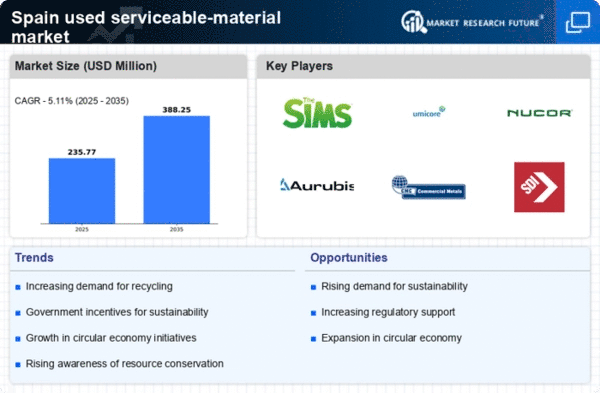
As per MRFR analysis, the used serviceable-material market size was estimated at 224.31 USD Million in 2024. The used serviceable-material market is projected to grow from 235.77 USD Million in 2025 to 388.25 USD Million by 2035, exhibiting a compound annual growth rate (CAGR) of 5.11% during the forecast period 2025 - 2035.

Key Market Trends & Highlights

The Spain used serviceable-material market is trending towards sustainability and technological innovation.

  • Sustainability initiatives are driving a shift towards the adoption of used serviceable materials across various industries.
  • Technological advancements in material processing are enhancing the efficiency and quality of recycled materials.
  • The largest segment in the market is construction materials, while the fastest-growing segment is electronic waste recycling.
  • Rising demand for cost-effective solutions and growing environmental awareness are key drivers propelling market growth.

Market Size & Forecast

2024 Market Size 224.31 (USD Million)
2035 Market Size 388.25 (USD Million)
CAGR (2025 - 2035) 5.11%

Major Players

Sims Limited (AU), Umicore (BE), Nucor Corporation (US), Aurubis AG (DE), Commercial Metals Company (US), Steel Dynamics Inc. (US), KGHM Polska Miedz S.A. (PL), Metalloinvest Holding Company (RU)

Spain Used Serviceable Material Market Trends

The used serviceable-material market in Spain is currently experiencing a notable transformation, driven by increasing awareness of sustainability and resource efficiency. This shift is reflected in the growing demand for recycled and refurbished materials across various industries. Companies are increasingly recognizing the economic benefits of utilizing used materials, which not only reduces costs but also minimizes environmental impact. As a result, there is a rising trend towards circular economy practices, where materials are reused and repurposed rather than discarded. This trend is likely to continue as businesses and consumers alike prioritize eco-friendly solutions. Moreover, regulatory frameworks in Spain are evolving to support the used serviceable-material market. Government initiatives aimed at promoting recycling and reducing waste are becoming more prevalent. These policies encourage businesses to adopt sustainable practices, thereby enhancing the market's growth potential. The collaboration between public and private sectors is fostering innovation in material recovery and recycling technologies. As these developments unfold, the market is expected to expand, offering new opportunities for stakeholders involved in the supply chain of used materials.

Sustainability Initiatives

The emphasis on sustainability is reshaping the used serviceable-material market. Companies are increasingly adopting practices that prioritize the reuse of materials, driven by both consumer demand and regulatory pressures. This trend is likely to enhance the market's growth as businesses seek to align with eco-friendly standards.

Technological Advancements

Innovations in recycling technologies are playing a crucial role in the evolution of the used serviceable-material market. Enhanced processes for material recovery are improving efficiency and quality, making it more feasible for businesses to incorporate used materials into their operations.

Regulatory Support

Government policies in Spain are increasingly supportive of the used serviceable-material market. Initiatives aimed at reducing waste and promoting recycling are encouraging businesses to engage in sustainable practices, thereby fostering a more robust market environment.

Spain Used Serviceable Material Market Drivers

Growing Environmental Awareness

Environmental consciousness among consumers and businesses is significantly impacting the used serviceable-material market. In Spain, there is a notable shift towards sustainable practices, with many organizations adopting circular economy principles. This trend is reflected in the increasing preference for used materials, which are perceived as more environmentally friendly. The used serviceable-material market benefits from this heightened awareness, as it aligns with the goals of reducing waste and conserving resources. Reports indicate that approximately 70% of Spanish consumers are willing to choose products made from recycled materials, further driving the demand for used serviceable materials.

Government Incentives for Recycling

Government initiatives aimed at promoting recycling and the use of recycled materials are playing a crucial role in the used serviceable-material market. In Spain, various policies and incentives have been introduced to encourage businesses to adopt sustainable practices. These measures include tax breaks and subsidies for companies that utilize used materials in their operations. The used serviceable-material market is likely to benefit from these supportive policies, as they create a favorable environment for growth. As a result, the market is projected to expand, with an estimated increase of 10% in the adoption of recycled materials by 2026.

Increased Focus on Supply Chain Resilience

The emphasis on supply chain resilience is influencing the used serviceable-material market. In Spain, businesses are recognizing the vulnerabilities in traditional supply chains and are turning to used materials as a means of mitigating risks. By incorporating used serviceable materials, companies can reduce dependency on new raw materials, which are often subject to price volatility. The used serviceable-material market is likely to see a rise in demand as organizations prioritize supply chain stability. This trend may lead to a projected growth of 12% in the market as firms seek to enhance their operational resilience through diversified sourcing strategies.

Rising Demand for Cost-Effective Solutions

The increasing need for cost-effective solutions in various industries is driving the used serviceable-material market. Companies are seeking to reduce operational costs while maintaining quality, leading to a surge in demand for used materials. In Spain, the construction and manufacturing sectors are particularly influenced by this trend, as they look for ways to optimize budgets. The used serviceable-material market is expected to see a growth rate of approximately 8% annually as businesses prioritize financial efficiency. This shift not only supports economic sustainability but also encourages the recycling and repurposing of materials, aligning with broader environmental goals.

Technological Innovations in Material Processing

Advancements in technology are transforming the way used materials are processed and utilized, thereby impacting the used serviceable-material market. In Spain, innovations such as improved sorting and recycling technologies are enhancing the efficiency of material recovery. This progress allows for higher quality used materials to enter the market, making them more appealing to manufacturers. The used serviceable-material market is experiencing a shift as these technologies reduce costs and improve the overall quality of recycled products. It is anticipated that the integration of new technologies could lead to a 15% increase in the availability of high-grade used materials by 2027.


Market Segment Insights

By Product: Engine (Largest) vs. Components (Fastest-Growing)

In the Spain used serviceable-material market, the product segment is characterized by its diverse offerings, with engines holding the largest share, reflecting their critical role in various applications. Components are emerging as a significant player due to their essential nature in maintenance and repair, capturing attention in the marketplace. The competitive landscape sees these segments vying for prominence, driven by operational efficiency and reliability demands from users. Growth trends indicate that while engine products remain dominant, components are witnessing rapid adoption fueled by increasing serviceability needs and a shift towards sustainable practices. The demand for reliable and efficient serviceable materials enhances the focus on these segments, with technological advancements propelling value and functionality, making components a vital area for future investment and growth in the market.

Engine (Dominant) vs. Components (Emerging)

Engines are positioned as the dominant segment in the Spain used serviceable-material market, largely due to their pivotal importance in the performance of various machinery and vehicles. Their extensive use across different sectors is a testament to their reliability and efficiency. Conversely, components are seen as an emerging segment, increasingly becoming critical as they encompass a wide array of parts necessary for the operation and maintenance of machinery. This includes everything from small parts to larger assemblies, indicating a trend towards modular maintenance solutions. The drive for sustainability also enhances the appeal of both segments, as users seek to optimize their operational costs while ensuring compliance with evolving standards.

By Provider Type: OEM (Largest) vs. Non-OEM (Fastest-Growing)

The market share distribution in the provider type segment reveals that OEMs dominate the Spain used serviceable-material market, capturing a significant portion of the overall sales. With their established reputation for quality and reliability, OEM providers are the preferred choice for many businesses. In contrast, Non-OEM providers, while smaller in market share, have begun to carve out a niche by offering cost-effective alternatives, attracting customers seeking budget-friendly options. Growth trends indicate that while the OEM segment remains strong, the Non-OEM segment is experiencing rapid expansion. This can be attributed to the increasing demand for more affordable serviceable materials, particularly among smaller enterprises and startups. Additionally, the improving quality of Non-OEM offerings has led to a shift in consumer perception, making this segment an exciting area for future growth.

Provider Type: OEM (Dominant) vs. Non-OEM (Emerging)

OEMs are characterized by their longstanding reputation for high-quality serviceable materials, often favored by larger businesses that prioritize reliability and performance. They typically offer products that meet stringent industry standards, making them a go-to option for companies looking for assurance in their materials. Conversely, Non-OEM providers are emerging as significant players in the market, appealing to price-sensitive customers who are willing to compromise on brand for cost savings. These providers are increasingly recognized for their improved product quality, allowing them to gain market traction and challenge the dominance of OEMs.

By Aircraft Type: Narrow Body (Largest) vs. Turboprop (Fastest-Growing)

In the Spain used serviceable-material market, the distribution among aircraft types reveals that Narrow Body aircraft dominate with the largest market share, driven by their operational efficiency and widespread use in both domestic and international routes. Wide Body aircraft hold a significant share, catering primarily to long-haul travel, while Turboprop aircraft represent a smaller segment, yet they are gaining traction in regional services due to their lower operational costs and adaptability. Growth trends indicate that Narrow Body jets will continue to lead the market, bolstered by increasing demand for cost-effective short-haul flights. On the other hand, Turboprop aircraft are emerging as the fastest-growing segment, spurred by rising regional air travel and the need for efficient services in less accessible areas, highlighting a shift towards optimizing operations in various aircraft types.

Narrow Body (Dominant) vs. Turboprop (Emerging)

Narrow Body aircraft are characterized by their single aisle design, allowing for a higher passenger capacity on shorter flights. This segment is favored by low-cost carriers, making it the dominant force in the Spain used serviceable-material market. Conversely, Turboprop aircraft, with their twin-engine and propeller design, offer an emerging alternative for regional air services. Their capability to operate on shorter runways and lower fuel consumption makes them highly attractive in various operational scenarios, showcasing a growing trend towards efficiency and sustainability in aviation.

Get more detailed insights about Spain Used Serviceable Material Market

Key Players and Competitive Insights

The used serviceable-material market in Spain exhibits a dynamic competitive landscape, characterized by a blend of established players and emerging innovators. Key growth drivers include increasing demand for recycled materials, stringent environmental regulations, and a growing emphasis on sustainability. Major companies such as Sims Limited (AU), Umicore (BE), and Aurubis AG (DE) are strategically positioned to leverage these trends. Sims Limited (AU) focuses on innovation in recycling technologies, while Umicore (BE) emphasizes its commitment to sustainable practices and circular economy principles. Aurubis AG (DE) is enhancing its operational efficiency through digital transformation initiatives, collectively shaping a competitive environment that prioritizes sustainability and technological advancement.

In terms of business tactics, companies are increasingly localizing manufacturing and optimizing supply chains to enhance responsiveness to market demands. The market structure appears moderately fragmented, with several key players exerting considerable influence. This fragmentation allows for a diverse range of offerings, yet the collective strategies of major companies create a competitive dynamic that encourages innovation and efficiency.

In October 2025, Sims Limited (AU) announced a partnership with a local Spanish firm to enhance its recycling capabilities, aiming to increase the recovery rates of valuable metals. This strategic move is significant as it not only expands Sims' operational footprint in Spain but also aligns with the growing demand for sustainable practices in the region. The partnership is expected to bolster Sims' competitive edge by improving its resource recovery processes and reducing environmental impact.

In September 2025, Umicore (BE) launched a new initiative focused on the development of advanced recycling technologies specifically tailored for the automotive sector. This initiative is crucial as it positions Umicore at the forefront of the transition towards electric vehicles, which require specialized recycling processes for batteries. By investing in this technology, Umicore is likely to enhance its market share and reinforce its reputation as a leader in sustainable materials.

In August 2025, Aurubis AG (DE) unveiled a comprehensive digital strategy aimed at optimizing its production processes through AI and data analytics. This strategic action is indicative of a broader trend towards digitalization within the industry, suggesting that Aurubis is keen to enhance operational efficiency and reduce costs. The integration of AI technologies may provide Aurubis with a competitive advantage by enabling more precise forecasting and inventory management.

As of November 2025, current competitive trends in the used serviceable-material market are increasingly defined by digitalization, sustainability, and the integration of AI technologies. Strategic alliances among key players are shaping the landscape, fostering innovation and collaboration. Looking ahead, competitive differentiation is likely to evolve from traditional price-based competition towards a focus on innovation, technological advancements, and supply chain reliability. Companies that successfully navigate these trends will likely emerge as leaders in the market.

Key Companies in the Spain Used Serviceable Material Market market include

Industry Developments

The Spain Used Serviceable Material Market (USM) Market has witnessed notable developments recently, with several companies such as GreenCycle, Recycling System, and Zero Waste expanding their service offerings to meet growing sustainability demands.

As of October 2023, there has been increased focus on recycling technologies, with companies enhancing their capabilities to process a wider range of materials. Additionally, the market saw the launch of innovative recycling programs led by Ecoparc de Progrés, which aim to increase recycling rates in urban areas.

In September 2023, SAGE Serveis announced a strategic alliance with R3 Recycling and Reuse to improve waste management solutions across Spain, enhancing operational efficiency and minimizing landfill dependence.

During 2022, Sierra Recycling and Papelera del Mediterráneo were recognized for their advancements in circular economy practices, underscoring the shift towards sustainable waste management.

Market valuation has been positively impacted by these developments, recording an upward trend due to increased investments in recycling infrastructure, contributing to Spain’s commitment to the European Union's waste reduction goals.

Future Outlook

Spain Used Serviceable Material Market Future Outlook

The Used Serviceable Material Market in Spain is projected to grow at 5.11% CAGR from 2024 to 2035, driven by sustainability initiatives and increasing demand for cost-effective solutions.

New opportunities lie in:

  • Expansion of reverse logistics networks for efficient material recovery.
  • Development of digital platforms for material exchange and sales.
  • Investment in automated sorting technologies to enhance processing efficiency.

By 2035, the market is expected to achieve robust growth, positioning itself as a leader in sustainable material management.

Market Segmentation

Spain Used Serviceable Material Market Product Outlook

  • Engine
  • Components
  • Airframe

Spain Used Serviceable Material Market Aircraft Type Outlook

  • Narrow Body
  • Wide Body
  • Turboprop

Spain Used Serviceable Material Market Provider Type Outlook

  • OEM
  • Non-OEM

Report Scope

MARKET SIZE 2024 224.31(USD Million)
MARKET SIZE 2025 235.77(USD Million)
MARKET SIZE 2035 388.25(USD Million)
COMPOUND ANNUAL GROWTH RATE (CAGR) 5.11% (2024 - 2035)
REPORT COVERAGE Revenue Forecast, Competitive Landscape, Growth Factors, and Trends
BASE YEAR 2024
Market Forecast Period 2025 - 2035
Historical Data 2019 - 2024
Market Forecast Units USD Million
Key Companies Profiled Sims Limited (AU), Umicore (BE), Nucor Corporation (US), Aurubis AG (DE), Commercial Metals Company (US), Steel Dynamics Inc. (US), KGHM Polska Miedz S.A. (PL), Metalloinvest Holding Company (RU)
Segments Covered Product, Provider Type, Aircraft Type
Key Market Opportunities Growing demand for sustainable practices drives innovation in the used serviceable-material market.
Key Market Dynamics Rising demand for sustainable practices drives growth in the used serviceable-material market amid regulatory shifts.
Countries Covered Spain

Leave a Comment

FAQs

What is the market size of the Spain Used Serviceable Material (USM) Market in 2024?

The Spain Used Serviceable Material (USM) Market is expected to be valued at 224.32 million USD in 2024.

What is the projected market value of the Spain Used Serviceable Material (USM) Market by 2035?

By 2035, the market is expected to reach a value of 347.52 million USD.

What is the expected CAGR for the Spain Used Serviceable Material (USM) Market from 2025 to 2035?

The market is anticipated to grow at a CAGR of 4.06 percent from 2025 to 2035.

Which product type has the highest market value in 2024 within the Spain Used Serviceable Material (USM) Market?

The 'Engine' product type is expected to have the highest value at 80.0 million USD in 2024.

What is the expected market value for the 'Components' segment by 2035?

The 'Components' segment is projected to reach 110.0 million USD by 2035.

Who are the major players in the Spain Used Serviceable Material (USM) Market?

Key players in the market include GreenCycle, Recycling System, Zero Waste, and among others.

What will be the market value for the 'Airframe' segment in 2024?

The 'Airframe' segment is expected to be valued at 74.32 million USD in 2024.

What are the growth drivers for the Spain Used Serviceable Material (USM) Market?

Key drivers include the increasing demand for sustainability and the recycling of materials.

What key trends are expected to shape the Spain Used Serviceable Material (USM) Market in the coming years?

Emerging trends include a focus on sustainable practices and advancements in recycling technology.

How has the market for Spain Used Serviceable Material (USM) grown in recent years?

The market has seen steady growth owing to heightened awareness and regulatory support for recycling initiatives.

Download Free Sample

Kindly complete the form below to receive a free sample of this Report

Compare Licence

×
Features License Type
Single User Multiuser License Enterprise User
Price $4,950 $5,950 $7,250
Maximum User Access Limit 1 User Upto 10 Users Unrestricted Access Throughout the Organization
Free Customization
Direct Access to Analyst
Deliverable Format
Platform Access
Discount on Next Purchase 10% 15% 15%
Printable Versions