Speaker Market (2025 - 2035)

Speaker Market Size, Share and Research Report By Application (Home Audio, Commercial, Portable Speakers, Professional Audio, Car Audio), By Speaker Type (Floor standing Speakers, Bookshelf Speakers, In-Ceiling Speakers, Subwoofers, Sound bars), By Connectivity (Wired, Wireless, Bluetooth, Wi-Fi, Multi-Room Wireless), By End Use (Residential, Commercial, Industrial) and By Regional (North America, Europe, South America, Asia Pacific, Middle East and Africa) - Industry Forecast Till 2035
ID: MRFR/SEM/17315-HCR
200 Pages
Aarti Dhapte, Aarti Dhapte
Last Updated: July 10, 2026
Speaker Market
Market Size
Forecast Period2025-2035
CAGR (2025-2035)10.5%
2025 Market SizeUSD 58.72 Billion
2035 Market SizeUSD 159.35 Billion
Key Players
Harman International
Bose Corporation
Sony Corporation
Sonos Inc.
Apple Inc.
Amazon.com Inc.
Opportunities
  • AI-Powered Acoustic Personalization
  • Emerging Market Urbanization
  • Speaker-as-a-Service and Subscription Audio Models

Speaker Market Summary

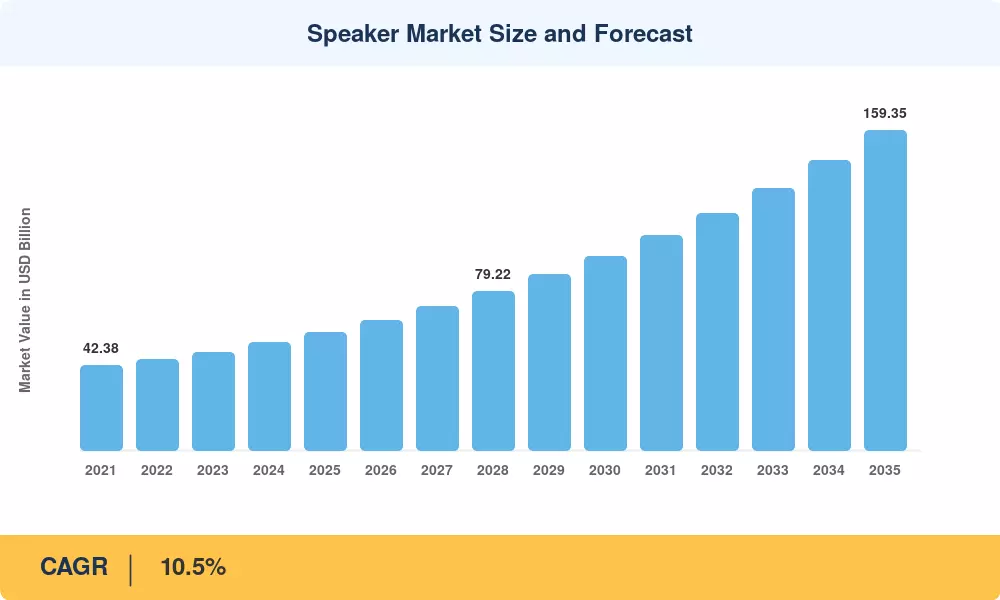
The global Speaker Market reached an estimated USD 58.72 Billion in 2025, positioning the industry for a forecast trajectory that begins at USD 64.88 Billion in 2026 and climbs to USD 159.35 Billion by 2035, registering a CAGR of 10.5% across the forecast window. Two catalysts anchor this expansion: the acceleration of voice-activated smart home ecosystems — with global smart speaker installed bases crossing 320 million units in 2024 [1] — and sustained consumer investment in premium audio driven by spatial-audio standards such as Dolby Atmos and Sony 360 Reality Audio [2].

A generational shift in audio hardware is underway. Legacy wired bookshelf and tower configurations are steadily giving way to compact wireless soundbar architectures, multi-room mesh systems, and AI-integrated smart speakers capable of acting as central hubs for IoT devices. The Bluetooth Special Interest Group reported that audio device shipments with LE Audio support grew 35% year-over-year in 2024, signaling a structural migration toward low-energy, high-resolution wireless codecs [3]. Manufacturers are responding with product lines that fuse voice assistant intelligence, adaptive room calibration, and lossless streaming into form factors designed for both portability and home installation.

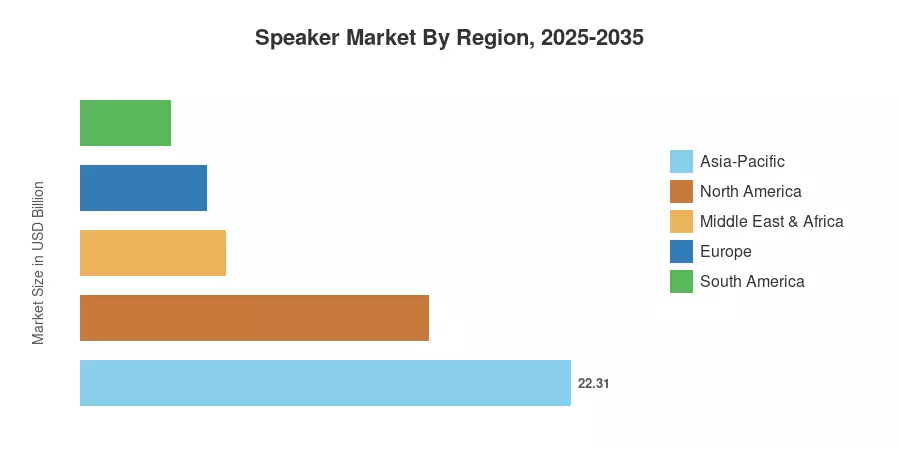
Asia-Pacific commands the largest share of the Speaker Market at approximately 38%, buoyed by high smartphone penetration in China and India, plus rising disposable incomes in Southeast Asian economies. The region is also the fastest-growing, projecting a CAGR of 12.1% through 2035. North America holds roughly a 27% share, anchored by mature smart-home adoption and premium audio spending. Europe accounts for about 22%, driven by automotive audio integration and home renovation cycles. As streaming content volumes continue to surge globally, the Speaker Market stands positioned for a decade of broad-based expansion across geographies and product categories.

Key Report Takeaways

• By Type

  • Soundbars captured approximately 38% of the Speaker Market in 2025, driven by television audio replacement trends and slim-profile design advantages.
  • The outdoor speaker segment is projected to grow at a CAGR of 12.8% through 2035, fueled by hospitality venue upgrades and residential outdoor living investments.
  • Subwoofer demand continues to accelerate in the Speaker Market, with the segment valued at USD 12.92 Billion in 2025.

• By Application

  • Home entertainment remains the dominant application in the Speaker Market, representing 42% of total revenues in 2025.
  • Automotive audio applications are growing at a CAGR of 11.6%, reflecting the integration of premium audio suites into electric vehicle cabins.

• By Region

  • Asia-Pacific leads the Speaker Market with a regional valuation of USD 22.31 Billion in 2025.
  • North America's Speaker Market is characterized by a 10.3% CAGR, supported by smart speaker refresh cycles and premium soundbar adoption.
  • Europe holds approximately 22% of the global Speaker Market share, with automotive OEM audio partnerships acting as a primary growth engine.


Speaker Market Size and Forecast (2021–2035)

Market Research Future's proprietary sizing model integrates primary interviews with OEM executives, distributor sell-through data, customs trade databases, and third-party shipment trackers. Historical figures (2021–2024) are validated against public financial disclosures from leading manufacturers, while forecast projections (2026–2035) incorporate regression-adjusted demand drivers including streaming subscriber growth, smart-home penetration curves, and construction-spending indices.
Speaker Market Size and Forecast
Our Impact
Enabled $4.3B Revenue Impact for Fortune 500 and Leading Multinationals
Partnering with 2000+ Global Organizations Each Year
30K+ Citations by Top-Tier Firms in the Industry

Driver Impact Analysis

Driver ~% Impact on CAGR Geographic Relevance Impact Timeline
Smart speaker & voice assistant integration 2.8% Global Short-term (≤2 yr)
Streaming platform proliferation 2.2% North America, Europe Short-term (≤2 yr)
Wireless codec evolution (LE Audio, LC3) 1.8% Global Medium-term (2–4 yr)
Automotive premium audio integration 1.5% Europe, Asia-Pacific Medium-term (2–4 yr)
Smart home & IoT ecosystem expansion 1.2% North America, Asia-Pacific Long-term (≥4 yr)
Spatial audio content creation boom 0.7% Global Medium-term (2–4 yr)
Urbanization & residential construction 0.5% Asia-Pacific, South America Long-term (≥4 yr)

Smart Speaker and Voice Assistant Adoption

From novelty devices to household infrastructure, voice-controlled speakers have evolved. By the end of 2024, Amazon reported that more than 500 million Alexa-enabled devices had been sold worldwide, with Echo-family speakers being the most popular product category [1]. The competition between Apple's HomePod line and Google's Nest Hub ecosystem has intensified, resulting in a decrease in average selling prices and an expansion of the addressable user base. This price democratization is attracting first-time consumers in India and Southeast Asia to the Speaker Market at a rate that exceeds 20% annually.

Streaming Content Proliferation

Global music streaming subscribers surpassed 700 million in 2024 across platforms including Spotify, Apple Music, and Amazon Music [8]. The parallel growth of video streaming — Netflix, Disney+, and regional OTT services — has amplified consumer dissatisfaction with built-in television speakers, creating a structural pull toward external soundbar and surround-system purchases in the Speaker Market.

Wireless Codec and Connectivity Standards

The Bluetooth SIG's ratification of LE Audio with the LC3 codec enables true wireless stereo multi-stream capabilities by delivering higher audio quality at reduced bitrates [3]. Wi-Fi 6E and Thread connectivity are concurrently transforming multi-room speaker architectures, enabling whole-home audio ecosystems to operate with a sub-20ms latency. The friction barrier for consumers transitioning from single-speaker setups to distributed audio networks is diminished by these protocol enhancements.

Automotive Premium Audio Expansion

Electric vehicle manufacturers are embedding premium branded audio systems as standard or near-standard features to differentiate cabin experiences. Harman International reported a 28% increase in automotive audio contract wins during 2024, with partnerships spanning Stellantis, Hyundai, and BMW [5]. As global EV sales are projected to reach 30 million units by 2030, the automotive channel represents a durable and high-margin growth vector for the Speaker Market.

Restraints Impact Analysis

The restraint impact percentages below are directional estimates of each factor's drag on the overall CAGR. These figures are not simple subtractions from the headline growth rate; mitigating strategies and market adaptations moderate actual impact.

Restraint ~% Impact on CAGR Geographic Relevance Impact Timeline
Commoditization & price erosion –1.4% Global Short-term (≤2 yr)
Raw material & semiconductor cost inflation –1.0% Global Medium-term (2–4 yr)
Smartphone speaker quality improvements –0.8% Asia-Pacific Long-term (≥4 yr)
Counterfeit & gray-market products –0.5% Asia-Pacific, South America Medium-term (2–4 yr)
E-waste regulation compliance costs –0.3% Europe Long-term (≥4 yr)


Commoditization and Average Selling Price Erosion

An influx of white-label and budget Bluetooth speakers — particularly from Shenzhen-based manufacturers — has compressed average selling prices in the sub-USD 50 segment by roughly 12% between 2022 and 2024 [10]. This pricing pressure squeezes margins for established brands and forces product differentiation through software features, brand partnerships, and material premiums rather than core audio performance alone.

Semiconductor Supply Constraints

Speaker systems increasingly depend on specialized digital signal processing chips, amplifier ICs, and wireless SoCs. The global semiconductor shortage that peaked in 2022 has eased but not fully resolved, with lead times for audio-class amplifier chips still running 14–18 weeks as of mid-2025. These constraints periodically limit production volumes and raise bill-of-materials costs across the Speaker Market.

Built-in Smartphone Audio Improvements

Smartphone OEMs continue to invest in built-in speaker arrays, with flagship devices from Apple and Samsung featuring multi-driver stereo configurations that approach the output quality of entry-level portable speakers [12]. This narrows the perceived value gap that historically drove separate speaker purchases among casual listeners.

Speaker Market Opportunities

AI-Powered Acoustic Personalization

On-device machine learning is enabling speakers to calibrate output in real time based on room geometry, ambient noise, and listener preferences. Sonos demonstrated its Trueplay auto-tuning across its entire product line in 2024, while Amazon's Echo Studio added head-related transfer function profiling for spatial audio [6]. Companies that embed adaptive acoustic intelligence will capture premium pricing power in the Speaker Market.

Emerging Market Urbanization

Rapid urbanization across India, Indonesia, and Nigeria is generating tens of millions of new middle-class households with disposable income earmarked for consumer electronics. India alone added 8.4 million broadband connections in Q1 2025, expanding the addressable base for streaming-connected speakers [7]. Localized product strategies — compact, affordable, and multilingual — offer a greenfield growth corridor for the Speaker Market.

Speaker-as-a-Service and Subscription Audio Models

Hardware-software bundling models are gaining traction, where consumers pay monthly subscriptions that include speaker hardware, extended warranties, and premium streaming access. Sonos and Bose have piloted subscription programs that increase customer lifetime value by 2.5–3× compared to one-time purchases [15]. This recurring-revenue shift could reshape competitive dynamics in the Speaker Market.

Commercial Venue and Hospitality Retrofit Cycle

Post-pandemic recovery has triggered a global wave of hospitality and commercial venue renovations. The American Hotel & Lodging Association projected USD 28 billion in U.S. hotel renovation spending for 2025, with in-room and lobby audio systems ranking among the top guest-experience upgrades [16]. This B2B channel offers margin profiles 15–20% above consumer retail for the Speaker Market.

Automotive Electrification Audio Integration

As internal combustion engine noise disappears from EV cabins, the demand for immersive in-car audio experiences intensifies. Premium audio brands are securing design-in partnerships at the vehicle platform level, embedding speakers into structural components like headrests and A-pillars [5]. This creates a high-barrier, long-cycle revenue stream for Speaker Market participants.

Speaker Market Future Outlook

AI and Generative Audio Integration

Generative AI will reshape the Speaker Market by enabling real-time content creation, dynamic sound design, and conversational interfaces that go far beyond today's command-and-response models. By 2028, speakers equipped with on-device large language models are expected to handle complex multi-turn conversations, proactive notifications, and personalized audio content curation without cloud dependency [6]. This evolution transforms speakers from passive playback devices into active household intelligence hubs.

Platform Economics and Ecosystem Lock-In

The Speaker Market is increasingly governed by platform dynamics, where hardware margins matter less than ecosystem retention. Apple, Amazon, and Google subsidize speaker hardware to anchor users within their content, commerce, and smart-home platforms. By 2030, an estimated 70% of smart speaker purchases will be influenced by existing ecosystem allegiance rather than standalone audio quality [19], rewarding companies that build interoperable yet sticky product families.

Sustainability and Circular Design Mandates

By 2028, speaker manufacturers will be obligated to publish repairability scores, provide spare parts for a minimum of seven years, and meet recycled-material thresholds in accordance with the EU's Ecodesign Regulation and comparable frameworks in South Korea and Japan [14]. These mandates will increase compliance costs while simultaneously establishing competitive moats for brands that invest early in modular designs and take-back programs, thereby reshaping product development throughout the Speaker Market.


Spatial Audio and Immersive Experience Standards

By the early 2030s, a unified immersive audio standard will be established through the convergence of spatial audio codecs (Dolby Atmos, Sony 360 Reality Audio, MPEG-H) with head-tracking and room-mapping technologies. Apple's implementation of spatial audio across its complete hardware lineup has already expedited the availability of content, with more than 10,000 Dolby Atmos tracks being added to Apple Music on a monthly basis as of 2025 [2]. As immersive audio transitions from a premium differentiator to a baseline consumer expectation, the Speaker Market is poised to benefit.


Speaker Market Segmentation

By Type

Segment Key Metric Primary Demand Driver
Soundbars 38% share (2025) Television audio replacement, compact form factor
Outdoor CAGR 12.8% Residential outdoor living, hospitality venues
Subwoofers USD 12.92 Billion (2025) Home theater and gaming demand
In-Wall CAGR 11.3% New construction, custom installation market


Soundbars dominate the Speaker Market by type, accounting for the largest single product category. The segment's growth is driven by the widening gap between ultra-thin television speaker quality and consumer audio expectations; a 2024 CTA survey found that 61% of soundbar purchasers cited "TV audio inadequacy" as their primary motivation [4]. Premium soundbars from Sonos, Bose, and Samsung now incorporate upfiring drivers and rear satellite speakers that simulate surround sound without the complexity of traditional multi-speaker setups.

The outdoor speaker segment is gaining momentum as residential consumers invest in backyard and patio entertainment zones. Weather-resistant designs rated IP67 or higher, paired with solar charging capabilities, are expanding the addressable use case from seasonal to year-round installation. The commercial outdoor channel — restaurants, resorts, theme parks — contributes roughly 35% of segment revenue and is accelerating as hospitality operators refresh post-pandemic guest experiences [16].

By Connectivity

Segment Key Metric Primary Demand Driver
Wireless 62% share (2025) Bluetooth/Wi-Fi convenience, multi-room systems
Wired CAGR 6.4% Professional/audiophile installations, legacy systems


Wireless connectivity accounts for the majority of Speaker Market revenues, a share that continues to expand as LE Audio, AirPlay 2, and Chromecast protocols reduce the latency and quality trade-offs that historically favored wired connections. Wired speakers retain a defensible niche in professional audio, recording studios, and high-end audiophile applications where absolute signal integrity remains non-negotiable.

By Distribution Channel

Segment Key Metric Primary Demand Driver
Offline 55% share (2025) In-store audio demos, specialist retailers
Online CAGR 13.5% E-commerce expansion, D2C brand channels


Offline channels still lead in absolute terms, largely because speakers benefit from in-person audition experiences that build purchase confidence. Online distribution is growing rapidly, however, with Amazon, Best Buy's e-commerce platform, and brand-direct websites collectively gaining approximately 2 percentage points of channel share annually. The online channel's growth trajectory suggests it will surpass offline by 2031 within the Speaker Market.

By Application

Segment Key Metric Primary Demand Driver
Home Entertainment 42% share (2025) Streaming consumption, home theater builds
Commercial Spaces USD 12.92 Billion (2025) Hospitality, retail, and corporate audio
Automotive CAGR 11.6% EV cabin audio, branded OEM partnerships
Office 16% share (2025) Conferencing systems, hybrid workplace audio


Home entertainment continues to generate the largest share of Speaker Market application revenues, supported by the global proliferation of streaming video and music platforms. Consumers are allocating a growing portion of discretionary electronics budgets toward audio upgrades that complement large-format displays. The automotive application segment is the fastest growing, driven by the transition to electric vehicles where silent powertrains create both the need and the acoustic headroom for immersive in-cabin audio [5].


Regional Market Share Analysis

Region Key Metric Primary Investment Themes
Asia-Pacific 38% share (2025) Smart speaker adoption, smartphone ecosystem, manufacturing scale
North America USD 15.85 Billion (2025) Premium audio, smart home refresh, streaming
Europe CAGR 9.8% (2026–2035) Automotive audio, sustainability regulation
South America USD 4.11 Billion (2025) Urban expansion, e-commerce growth
Middle East & Africa CAGR 11.2% (2026–2035) Hospitality construction, digital infrastructure
Total USD 58.72 Billion (2025)


North America

Country Key Metric Key Driver
United States 78% of regional share Smart speaker saturation, premium soundbar adoption
Canada CAGR 9.7% Bilingual voice assistant demand
Mexico USD 1.14 Billion (2025) Growing middle class, e-commerce expansion


The North American Speaker Market benefits from the world's highest smart speaker penetration rate, with approximately 42% of U.S. households owning at least one smart speaker device as of 2024 [1]. Replacement and upgrade cycles — particularly the transition from first-generation Echo and Google Home units to spatial-audio-capable models — sustain volume demand even in a mature installed base. The United States accounts for the vast majority of regional revenues, supported by robust retail infrastructure and high per-capita entertainment spending.

Europe

Country Key Metric Key Driver
Germany 24% of regional share Automotive OEM audio partnerships
United Kingdom CAGR 10.1% Premium home audio culture
France USD 1.89 Billion (2025) Multi-room residential audio trend
Italy 9% of regional share Hospitality and retail audio
Spain CAGR 9.4% Tourism venue upgrades
Nordic Countries USD 1.05 Billion (2025) Design-led premium speaker brands
Russia 5% of regional share Domestic smart speaker ecosystem (Yandex)
Rest of Europe CAGR 9.2% EU sustainability mandates


The European Speaker Market is shaped by two intersecting forces: Germany's automotive audio supply chain — where Harman, Bose, and Bang & Olufsen maintain deep OEM integration — and the EU's Ecodesign for Sustainable Products Regulation, which imposes repairability and material-efficiency requirements on consumer electronics from 2026 [14]. The UK remains Europe's largest consumer audio market by revenue, with premium brands commanding higher average selling prices than in any other European country.

Asia-Pacific

Country Key Metric Key Driver
China 44% of regional share Manufacturing base, domestic smart speaker brands
India CAGR 14.2% Rising broadband, affordable smart speakers
Japan USD 2.68 Billion (2025) Audiophile culture, aging-population accessible audio
South Korea 12% of regional share Samsung/LG ecosystem integration
ASEAN CAGR 13.1% Urbanization, mobile-first streaming
Rest of Asia-Pacific USD 1.34 Billion (2025) Developing retail and e-commerce channels


Asia-Pacific dominates the global Speaker Market in both production and consumption. China's manufacturing ecosystem centered in Guangdong province produces an estimated 65% of the world's speaker units, while domestic brands like Xiaomi, Baidu (Xiaodu), and Tmall Genie compete aggressively in the sub-USD 30 smart speaker tier [17]. India represents the fastest-growing individual country market, with Amazon and Google investing heavily in Hindi and regional-language voice assistant capabilities to unlock rural and semi-urban demand.

South America

Country Key Metric Key Driver
Brazil 62% of regional share Largest consumer electronics market in region
Argentina CAGR 10.8% Growing e-commerce speaker sales
Rest of South America USD 0.78 Billion (2025) Gradual smart speaker localization


Brazil's Speaker Market is propelled by a large and youthful population with strong affinity for music consumption and social media content creation. Mercado Libre and Amazon Brazil have expanded online speaker availability to secondary and tertiary cities, while local payment infrastructure such as Pix instant payments lowers purchase friction. The broader South American market remains under-penetrated relative to global averages, presenting a multi-year growth runway.

Middle East & Africa

Country Key Metric Key Driver
Saudi Arabia 28% of regional share Vision 2030 entertainment investments
UAE CAGR 12.5% Hospitality and luxury residential audio
South Africa USD 0.42 Billion (2025) Expanding retail infrastructure
Egypt 11% of regional share Population-driven consumer electronics demand
Rest of MEA CAGR 10.4% Digital infrastructure buildout


The Middle East & Africa Speaker Market is being reshaped by mega-project construction cycles in Saudi Arabia and the UAE, where commercial venues, entertainment complexes, and luxury residences incorporate integrated audio systems at scale. Saudi Arabia's NEOM project alone has allocated significant procurement budgets for immersive audio installations across its planned entertainment districts [18]. Africa's growth is more nascent but structurally supported by mobile-first digital adoption and expanding FM-to-streaming migration.


Speaker Market By Region, 2025-2035

Competitive Benchmarking

The Speaker Market exhibits low-to-moderate concentration, with an estimated HHI below 800 and the top five companies collectively controlling approximately 35–40% of global revenues. The competitive field spans diversified technology conglomerates (Samsung, Apple, Amazon), pure-play audio brands (Bose, Sonos, Bang & Olufsen), and regional volume manufacturers. Competition is stratified by price tier, with premium brands competing on audio fidelity and ecosystem integration while mass-market players compete on price and distribution reach.

Company Est. Revenue Share Range Key Offerings for Speaker Market Strategic Positioning
Harman International (Samsung) ~8–11% JBL portable/home speakers, Harman Kardon premium, automotive audio suites Vertically integrated across consumer and automotive channels
Bose Corporation ~6–9% Soundbars, portable speakers, home theater systems, noise-canceling headphones Premium brand equity, proprietary acoustic engineering
Sony Corporation ~5–8% Wireless speakers, soundbars, high-resolution audio products Cross-ecosystem synergy with PlayStation, Bravia, and Sony Music
Sonos Inc. ~4–6% Multi-room wireless systems, soundbars, architectural speakers Software-led platform with subscription potential
Apple Inc. ~4–6% HomePod, HomePod Mini Ecosystem lock-in via AirPlay, Siri, Apple Music spatial audio
Amazon.com Inc. ~5–7% Echo family, Echo Studio Voice-first platform strategy, aggressive pricing for market share
Bang & Olufsen ~2–4% Beosound, Beolab premium speakers Ultra-premium positioning, design-centric differentiation
Sennheiser Electronic ~2–3% AMBEO soundbars, professional monitor speakers Professional-grade audio heritage, Dolby Atmos soundbar leadership
LG Electronics ~3–5% Soundbars, XBOOM portable speakers Display-audio bundle strategy, Meridian audio partnership
Yamaha Corporation ~2–4% AV receivers, soundbars, networked speakers MusicCast whole-home ecosystem, pro-audio credibility

Recent News & Developments

  • Sonos (October 2024): Launched the Sonos Arc Ultra soundbar featuring Sound Motion transducer technology co-developed with Mayht, delivering 9.1.4-channel spatial audio from a single bar. The product expanded Sonos's premium positioning in the Speaker Market. [20]
  • Amazon (September 2024): Introduced the Echo Hub with an integrated speaker array designed as a centralized smart home control panel, extending the Echo speaker ecosystem into wall-mounted form factors. [1]
  • Bang & Olufsen (November 2024): Partnered with Ferrari to develop a bespoke in-car audio system for the Ferrari 12Cilindri, featuring 21 custom-designed speakers. [22]
  • JBL / Harman (February 2025): Expanded the JBL Authentics heritage speaker line with the Authentics 500, incorporating Dolby Atmos Music playback and multi-assistant voice control. [2]

Speaker Market Report Scope

Parameter Detail
Market Scope Global Speaker Market across consumer, commercial, and automotive applications
Study Period 2021–2035
Historical Period 2021–2024
Base Year 2025
Forecast Period 2026–2035
CAGR (2026–2035) 10.5%
Market Size (2025) USD 58.72 Billion
Market Size (2035) USD 159.35 Billion
Fastest Growing Segment Outdoor speakers (by type); Online (by distribution channel)
Companies Profiled 10 (Harman, Bose, Sony, Sonos, Apple, Amazon, Bang & Olufsen, Sennheiser, LG, Yamaha)
Valuation Currency USD Billion


FAQs

What acoustic standards should procurement teams evaluate when selecting commercial-grade speakers?
Look for IEC 60268-5 compliance for performance benchmarking and AES/EBU digital audio standards for installation compatibility. IP-rated enclosures (IP55+) are essential for outdoor or high-humidity commercial environments [14].
How does the LE Audio Bluetooth standard differ from Classic Bluetooth for speaker applications?
LE Audio uses the LC3 codec, delivering equivalent quality at half the bitrate of SBC while enabling multi-stream broadcast audio. It supports Auracast public sharing, a feature unavailable on Classic Bluetooth [3].
What total cost of ownership considerations apply to multi-room speaker installations?
Beyond hardware, budget for networking infrastructure, acoustic treatment, and annual firmware management. Multi-room systems typically add 15–20% in ancillary costs above the speaker hardware price alone [15].
How are speaker manufacturers addressing right-to-repair regulatory pressures?
Leading brands are publishing repairability scores and designing modular driver assemblies with replaceable components. The EU requires spare-part availability for seven years from end-of-sale under the 2024 Ecodesign Regulation [14].
What role does speaker placement optimization software play in premium home installations?
Room-correction algorithms like Dirac Live and Audyssey measure acoustic reflections via calibration microphones, then apply DSP filters to compensate. These tools reduce acoustic treatment costs by 30–40% versus passive solutions [6].
How do private-label speakers from retailers impact brand-name manufacturers?
Private-label products from Amazon Basics and Best Buy's Insignia brand compress entry-tier margins by 10–15%. Brand manufacturers respond by shifting portfolios toward mid-premium and premium tiers [10].
What warranty and support structures differentiate the Speaker Market's top vendors?
Premium brands typically offer 2–5-year warranties with dedicated support, while mass-market brands offer 1 year. Extended warranty attach rates average 22% for speakers priced above USD 300 [4].    
Author
Author
Author Profile
Aarti Dhapte LinkedIn
AVP - Research
A consulting professional focused on helping businesses navigate complex markets through structured research and strategic insights. I partner with clients to solve high-impact business problems across market entry strategy, competitive intelligence, and opportunity assessment. Over the course of my experience, I have led and contributed to 100+ market research and consulting engagements, delivering insights across multiple industries and geographies, and supporting strategic decisions linked to $500M+ market opportunities. My core expertise lies in building robust market sizing, forecasting, and commercial models (top-down and bottom-up), alongside deep-dive competitive and industry analysis. I have played a key role in shaping go-to-market strategies, investment cases, and growth roadmaps, enabling clients to make confident, data-backed decisions in dynamic markets.
Co-Author
Co-Author Profile
Aarti Dhapte LinkedIn
AVP - Research
A consulting professional focused on helping businesses navigate complex markets through structured research and strategic insights. I partner with clients to solve high-impact business problems across market entry strategy, competitive intelligence, and opportunity assessment. Over the course of my experience, I have led and contributed to 100+ market research and consulting engagements, delivering insights across multiple industries and geographies, and supporting strategic decisions linked to $500M+ market opportunities. My core expertise lies in building robust market sizing, forecasting, and commercial models (top-down and bottom-up), alongside deep-dive competitive and industry analysis. I have played a key role in shaping go-to-market strategies, investment cases, and growth roadmaps, enabling clients to make confident, data-backed decisions in dynamic markets.

Research Approach


Secondary Research

The secondary research process involved comprehensive analysis of regulatory databases, peer-reviewed engineering journals, electronics industry publications, and authoritative technology organizations. Key sources included the US Federal Communications Commission (FCC), European Telecommunications Standards Institute (ETSI), Institute of Electrical and Electronics Engineers (IEEE), International Electrotechnical Commission (IEC), Audio Engineering Society (AES), Consumer Technology Association (CTA), National Institute of Standards and Technology (NIST), International Trade Administration (ITA), World Intellectual Property Organization (WIPO), OECD Digital Economy Outlook, UNIDO Industrial Statistics Database, and national electronics manufacturing associations from key markets including China Electronics Standardization Institute (CESI), Japan Electronics and Information Technology Industries Association (JEITA), and Korea Electronics Association (KEA).

Shipment figures, regulatory certification data, acoustic research studies, consumer electronics trends, and competitive landscape analysis for wireless audio systems, smart speakers, professional audio equipment, and car speaker technologies were gathered from these sources.


Primary Research

In order to gather both qualitative and quantitative insights, supply-side and demand-side stakeholders were interviewed during the primary research process. CEOs, VPs of Product Development, heads of acoustic engineering, and supply chain directors from semiconductor suppliers, speaker manufacturers, and audio technology OEMs were examples of supply-side sources. Chief audio engineers, retail category managers, commercial AV integrators, automotive audio procurement leads, and consumer electronics distributors from specialty audio retailers, big-box electronics chains, pro-audio rental firms, and vehicle OEMs were examples of demand-side suppliers. In addition to confirming product development roadmaps and validating market segmentation, primary research provided information on pricing strategies, distribution channel dynamics, and patterns of technology adoption.

Primary Respondent Breakdown:

By Designation: C-level Primaries (32%), Director Level (31%), Others (37%)

By Region: North America (32%), Europe (30%), Asia-Pacific (33%), Rest of World (5%)


Market Size Estimation

Unit shipment analysis and revenue mapping were used to get the global market valuation. The methodology comprised:

Finding more than fifty important manufacturers in North America, Europe, Asia-Pacific, and Latin America

Product mapping for professional monitors, floor-standing speakers, sound bars, portable Bluetooth speakers, smart speakers, and car audio systems

Examination of reported and projected yearly income for speaker hardware portfolios

Coverage of producers accounting for 75–80% of the world market in 2024

Extrapolation of segment-specific valuations utilizing top-down (manufacturer revenue validation) and bottom-up (unit shipping volume × ASP by country/segment) methods

Download Free Sample

Kindly complete the form below to receive a free sample of this Report

Download PDF ×

We do not share your information with anyone. However, we may send you emails based on your report interest from time to time. You may contact us at any time to opt-out.