×
Request Free Sample ×

Kindly complete the form below to receive a free sample of this Report

* Please use a valid business email

Leading companies partner with us for data-driven Insights

clients tt-cursor
Hero Background

Stainless Steel Cable Ties Market

ID: MRFR/CnM/5543-CR
154 Pages
Anshula Mandaokar
December 2018

Stainless-Steel Cable Ties Market by Type (uncoated stainless-steel cable ties and coated stainless-steel cable ties), By Application (transportation, oil & gas exploration, marine, chemicals, mining, construction, electronics, others) and Region (North America, Europe, Asia Pacific, The Middle East & Africa (MEA), Latin America) - Forecast till 2035

Share:
Download PDF ×

We do not share your information with anyone. However, we may send you emails based on your report interest from time to time. You may contact us at any time to opt-out.

Stainless Steel Cable Ties Market Infographic
Purchase Options

Stainless Steel Cable Ties Market Summary

As per MRFR analysis, the Stainless Steel Cable Ties Market Size was estimated at 14.17 USD Million in 2024. The Stainless Steel Cable Ties industry is projected to grow from 14.77 in 2025 to 22.3 by 2035, exhibiting a compound annual growth rate (CAGR) of 4.21 during the forecast period 2025 - 2035.

Key Market Trends & Highlights

The Stainless Steel Cable Ties Market is experiencing robust growth driven by industrial demand and technological advancements.

  • The market is witnessing rising demand in industrial applications, particularly in North America, which remains the largest market.
  • Sustainability is becoming a focal point, influencing production methods and material choices across the industry.
  • Technological advancements in manufacturing processes are enhancing the efficiency and quality of stainless steel cable ties.
  • Key drivers include the rising demand in the construction sector and the growth in renewable energy projects, particularly in the Asia-Pacific region.

Market Size & Forecast

2024 Market Size 14.17 (USD Million)
2035 Market Size 22.3 (USD Million)
CAGR (2025 - 2035) 4.21%

Major Players

HellermannTyton (DE), Panduit (US), Thomas & Betts (US), Cable Tie Express (GB), Avery Dennison (US), 3M (US), TE Connectivity (CH), KSS (US), Molex (US)

Stainless Steel Cable Ties Market Trends

The Stainless Steel Cable Ties Market is currently experiencing a notable evolution, driven by various factors that influence demand and supply dynamics. The increasing emphasis on durability and reliability in fastening solutions has led to a growing preference for stainless steel cable ties over traditional alternatives. Industries such as construction, automotive, and telecommunications are recognizing the advantages of these ties, which offer superior strength and resistance to environmental factors. As a result, manufacturers are focusing on innovation and product development to cater to the diverse needs of end-users, thereby enhancing their competitive edge in the market. Moreover, sustainability concerns are prompting companies to adopt eco-friendly practices in their production processes. The Stainless Steel Cable Ties Market appears to be aligning with global trends towards reducing environmental impact, as stainless steel is recyclable and has a longer lifespan compared to plastic counterparts. This shift not only meets regulatory requirements but also resonates with consumers who prioritize sustainable products. Consequently, the market is poised for growth as stakeholders adapt to changing preferences and technological advancements, indicating a promising future for stainless steel cable ties in various applications.

Rising Demand in Industrial Applications

The Stainless Steel Cable Ties Market is witnessing an increase in demand from industrial sectors. Industries such as manufacturing and energy are utilizing these ties for their robust performance in harsh environments. This trend suggests a shift towards more reliable fastening solutions that can withstand extreme conditions.

Focus on Sustainability

There is a growing emphasis on sustainability within the Stainless Steel Cable Ties Market. Manufacturers are increasingly adopting eco-friendly practices, as stainless steel is recyclable and has a lower environmental impact compared to plastic. This trend indicates a broader movement towards sustainable materials in various industries.

Technological Advancements in Production

Innovations in production techniques are shaping the Stainless Steel Cable Ties Market. Advanced manufacturing processes are enhancing the quality and efficiency of these products. This trend may lead to improved performance characteristics, making stainless steel cable ties more appealing to a wider range of applications.

Stainless Steel Cable Ties Market Drivers

Market Growth Projections

The Global Stainless Steel Cable Ties Market Industry is projected to experience robust growth over the next decade. With an anticipated market value of 1250 USD Million in 2024, the industry is set to expand significantly, reaching approximately 2750 USD Million by 2035. This growth trajectory suggests a compound annual growth rate of 7.43% from 2025 to 2035, indicating a strong demand for stainless steel cable ties across various sectors. Factors such as increased industrialization, technological advancements, and a focus on sustainability are likely to drive this growth, positioning the market for continued success.

Increased Focus on Sustainability

The Global Stainless Steel Cable Ties Market Industry is witnessing a shift towards sustainable practices, prompting manufacturers to adopt eco-friendly materials. Stainless steel, known for its recyclability and longevity, aligns with the growing emphasis on reducing environmental impact. Companies are increasingly prioritizing sustainable sourcing and production methods, which could attract environmentally conscious consumers. This trend may contribute to the market's expansion, as the demand for sustainable products continues to rise. The industry's commitment to sustainability is likely to enhance its reputation and foster long-term growth.

Expansion of Renewable Energy Sector

The Global Stainless Steel Cable Ties Market Industry is benefiting from the expansion of the renewable energy sector. As the world shifts towards sustainable energy sources, the need for reliable fastening solutions in solar and wind energy installations increases. Stainless steel cable ties are essential for securing cables and components in these systems, ensuring durability and safety. The growth of renewable energy projects globally is likely to drive demand for stainless steel cable ties, contributing to the market's projected value of 2750 USD Million by 2035. This trend underscores the ties' versatility and importance in modern energy solutions.

Rising Demand in Construction Sector

The Global Stainless Steel Cable Ties Market Industry experiences a notable surge in demand driven by the construction sector. As urbanization accelerates, the need for durable and corrosion-resistant materials becomes paramount. Stainless steel cable ties are increasingly utilized in various applications, including securing electrical wiring and plumbing systems. This trend is reflected in the projected market value, which is expected to reach 1250 USD Million in 2024. The construction industry's growth, particularly in emerging economies, is likely to bolster the demand for stainless steel cable ties, thereby enhancing their market presence.

Growing Demand in Automotive Applications

The Global Stainless Steel Cable Ties Market Industry is experiencing increased demand from the automotive sector, where these ties are utilized for securing components and wiring. The automotive industry's shift towards lightweight materials and enhanced safety features drives the need for reliable fastening solutions. Stainless steel cable ties offer superior strength and resistance to environmental factors, making them ideal for automotive applications. As the automotive market continues to expand, the demand for stainless steel cable ties is expected to rise, further solidifying their role in this critical industry.

Technological Advancements in Manufacturing

Technological innovations in manufacturing processes are significantly impacting the Global Stainless Steel Cable Ties Market Industry. Advanced production techniques, such as automated machinery and precision engineering, enhance the quality and efficiency of stainless steel cable ties. These advancements allow for the creation of ties with improved tensile strength and durability, catering to diverse applications across various sectors. As manufacturers invest in technology, the market is poised for growth, with projections indicating a compound annual growth rate of 7.43% from 2025 to 2035. This technological evolution is likely to redefine industry standards.
Market Segment Insights

By Application: Electrical (Largest) vs. Automotive (Fastest-Growing)

The Stainless Steel Cable Ties Market is segmented by application, with the Electrical sector holding the largest market share. This is primarily due to the increasing demand for secure and durable fastening solutions in electrical installations, where cable management is critical. Segments such as Automotive, Construction, Aerospace, and Marine are also significant contributors, but they trail behind the electrical application in terms of market share. The dominance of the Electrical segment is further bolstered by stringent safety regulations and the growing trend towards automation in electrical systems. In contrast, the Automotive segment is experiencing rapid growth, driven by the rising production of vehicles and the increasing complexity of automotive wiring and harness systems. The push for electric vehicles has further propelled the demand for high-performance fastening solutions, thus positioning the automotive sector as one of the fastest-growing applications for stainless steel cable ties. As industries strive for improved safety, efficiency, and competitiveness, cable ties will continue to be central to these developments, particularly in the automotive space.

Electrical (Dominant) vs. Automotive (Emerging)

The Electrical application segment is characterized by its significant reliance on stainless steel cable ties for optimal cable management, offering high resistance to corrosion and heat. This positions it as the dominant force in the market, catering to electricians and industrial applications that prioritize durability and safety. The electrical sector's demand is fueled by advancements in technology and infrastructure upgrades. Meanwhile, the Automotive segment is emerging due to increasing vehicle production and a shift towards more complex electronic systems. The growing prevalence of hybrid and electric vehicles is driving the need for reliable fastening solutions that can withstand harsher operating conditions. As a result, while the Electrical application remains the leading segment, the Automotive application is rapidly evolving to capture a more significant share of the market.

By End Use: Industrial (Largest) vs. Commercial (Fastest-Growing)

In the Stainless Steel Cable Ties Market, the industrial segment holds the largest market share due to its extensive application across various manufacturing sectors. Industrial users, including those in automotive, aerospace, and heavy machinery, prefer stainless steel cable ties for their durability and reliability. In contrast, the commercial segment is experiencing rapid growth, driven by increasing construction activities and the demand for robust electrical installations in commercial properties. This growth is indicative of the broader trends towards high-quality materials in commercial applications.

Commercial: Emerging vs. Telecommunications: Dominant

The commercial segment of stainless steel cable ties is characterized by a surge in demand, spurred by the growth of the construction industry and the need for efficient cable management solutions in office and retail spaces. Emerging as a significant player, commercial applications increasingly favor these durable ties for securing cables in electrical installations. On the other hand, the telecommunications segment, considered dominant in the market, utilizes stainless steel cable ties extensively to manage and organize cabling pathways. The need for reliable communication infrastructure has solidified its position, highlighting a dichotomy between the emerging potential of commercial applications and the established presence of telecommunications.

By Material Type: 304 Stainless Steel (Largest) vs. 316 Stainless Steel (Fastest-Growing)

In the Stainless Steel Cable Ties Market, the 304 stainless steel segment holds the largest market share due to its widespread use in various applications, particularly in industries that require moderate resistance to corrosion and high tensile strength. The popularity of 304 stainless steel cable ties stems from their balanced properties, making them suitable for tasks ranging from construction to electrical and automotive, thus commanding a significant portion of the overall market. Conversely, the 316 stainless steel segment is rapidly gaining traction and is recognized as the fastest-growing segment in the market. This growth is driven by its enhanced corrosion resistance properties, especially in marine and chemical environments, making it increasingly preferred for specific applications that demand higher durability and longevity. The rising demand for such high-performance materials is propelling the 316 segment forward, indicating a shift in user preference toward quality and reliability in critical applications.

304 Stainless Steel (Dominant) vs. 410 Stainless Steel (Emerging)

The 304 stainless steel cable ties are the dominant force in the market, distinguished by their great versatility, moderate corrosion resistance, and excellent mechanical properties. They are predominantly used in general industrial applications and provide reliable performance across various environments. In contrast, 410 stainless steel cable ties are emerging in the market due to their unique blend of strength and affordability. While they are less corrosion-resistant compared to 304 and 316 options, they are preferred in applications where exposure to moisture is minimal. The increasing focus on cost-effective solutions in the industry is helping the 410 stainless steel segment gain recognition, enabling it to carve out a niche within the competitive landscape.

By Size: Medium (Largest) vs. Small (Fastest-Growing)

The market for stainless steel cable ties is significantly influenced by size, with the medium segment commanding the largest share. This is primarily due to its versatile applications in various industries, including construction and manufacturing. As businesses increasingly recognize the utility of medium-sized cable ties for securing cables and bundling materials, demand continues to rise, solidifying its position in the market. In terms of growth trends, the small segment of stainless steel cable ties is showing remarkable potential as the fastest-growing value. The increasing adoption of compact designs in electronics and automotive applications drives this growth. Moreover, the trend toward lightweight and space-efficient solutions has further propelled the demand for small cable ties, making it a key area for market expansion.

Cable Ties: Medium (Dominant) vs. Small (Emerging)

Medium-sized stainless steel cable ties are characterized by their robust construction, allowing them to securely bind larger bundles of cables, making them the preferred choice for industrial applications. They are particularly favored in sectors that demand heavy-duty performance and durability. On the other hand, small stainless steel cable ties, while emerging, are gaining traction due to the shift toward more compact and efficient designs in consumer electronics and automotive industries. These ties offer flexibility and versatility, catering to niche applications where space is a constraint. As both segments evolve, they underscore the diverse needs of the market, with each providing unique benefits to different user groups.

By Packaging Type: Bulk Packaging (Largest) vs. Retail Packaging (Fastest-Growing)

The Stainless Steel Cable Ties Market is witnessing a diverse distribution of market share among various packaging types, where Bulk Packaging significantly dominates. This segment appeals to industrial clients and large-scale users who require ties in large quantities for various applications. Retail Packaging, on the other hand, is increasingly favored by retail outlets, catering to consumers looking for easily accessible and ready-to-use products, which positions it as a rapidly growing segment within the market. As the demand for stainless steel cable ties rises due to their applications in diverse industries such as construction, automotive, and electrical, the packaging preferences are evolving. Factors like convenience, product visibility, and consumer purchasing behavior are driving the growth of Retail Packaging. The shift towards e-commerce and online purchasing is further propelling this trend, illustrating the importance of versatile packaging solutions to meet customer needs in a competitive market.

Bulk Packaging (Dominant) vs. Retail Packaging (Emerging)

Bulk Packaging is characterized by its capability to offer stainless steel cable ties in large volumes, ideal for institutional buyers and industries. This packaging type emphasizes cost-effectiveness and utility, attracting sectors that value efficiency and sustainability. Retail Packaging caters to smaller, individual buyers, focusing on ease of use and visibility on shelves, making it attractive for end consumers. The emerging trend towards environmentally friendly packaging solutions is prompting Retail Packaging to innovate and adopt sustainable materials, while Bulk Packaging maintains its strength by serving the vast industrial market with reliable supplies. Both segments are vital, yet their strategic directions differ, with Bulk Packaging fostering bulk transactions while Retail Packaging adapts to changing consumer preferences.

Get more detailed insights about Stainless Steel Cable Ties Market

Regional Insights

North America : Market Leader in Innovation

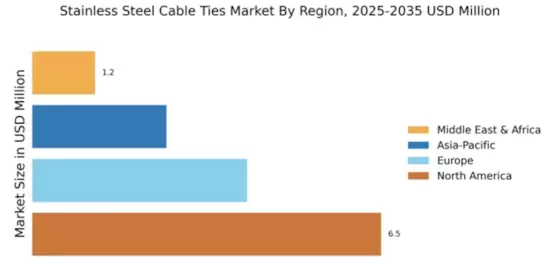
North America is poised to maintain its leadership in the stainless steel cable ties market, holding a significant market share of 6.5 in 2024. The region's growth is driven by increasing demand from various sectors, including construction, automotive, and electronics. Regulatory support for sustainable materials and safety standards further catalyzes market expansion, as companies seek durable and reliable fastening solutions. The competitive landscape in North America is robust, featuring key players such as Panduit, 3M, and TE Connectivity. These companies leverage advanced manufacturing technologies and innovative designs to meet the diverse needs of their customers. The presence of a well-established supply chain and strong distribution networks enhances market accessibility, ensuring that high-quality stainless steel cable ties are readily available across various industries.

Europe : Emerging Market with Growth Potential

Europe's stainless steel cable ties market is projected to grow, with a market size of 4.0 in 2024. The region benefits from stringent regulations promoting the use of high-quality materials in industrial applications. Increasing investments in infrastructure and renewable energy projects are driving demand for durable fastening solutions, positioning Europe as a key player in the global market. Leading countries such as Germany, France, and the UK are at the forefront of this growth, supported by major manufacturers like HellermannTyton and Avery Dennison. The competitive landscape is characterized by innovation and sustainability, with companies focusing on eco-friendly products. The European market is expected to witness increased collaboration among manufacturers to enhance product offerings and meet evolving customer demands.

Asia-Pacific : Rapid Growth in Emerging Economies

The Asia-Pacific region is witnessing a surge in demand for stainless steel cable ties, with a market size of 2.5 in 2024. This growth is fueled by rapid industrialization, urbanization, and increasing investments in infrastructure projects. Countries like China and India are leading this trend, driven by their expanding manufacturing sectors and a growing emphasis on quality and safety standards in industrial applications. The competitive landscape in Asia-Pacific is evolving, with both local and international players vying for market share. Companies such as KSS and Molex are establishing a strong presence, focusing on innovation and cost-effective solutions. As the region continues to develop, the demand for reliable and durable fastening solutions is expected to rise, further enhancing market opportunities for key players.

Middle East and Africa : Emerging Market with Unique Challenges

The Middle East and Africa (MEA) region presents unique opportunities in the stainless steel cable ties market, with a market size of 1.17 in 2024. The growth is driven by increasing infrastructure development and a rising focus on industrial safety standards. Governments are investing in various sectors, including construction and energy, which is expected to boost demand for durable fastening solutions in the region. Countries like South Africa and the UAE are leading the charge, with a growing number of local manufacturers entering the market. The competitive landscape is characterized by a mix of established players and new entrants, focusing on innovation and quality. As the region continues to develop, the demand for stainless steel cable ties is anticipated to grow, providing significant opportunities for market expansion.

Key Players and Competitive Insights

The Stainless Steel Cable Ties Market is characterized by a competitive landscape that is increasingly shaped by innovation, sustainability, and strategic partnerships. Key players such as HellermannTyton (DE), Panduit (US), and 3M (US) are actively pursuing strategies that enhance their market positioning. For instance, HellermannTyton (DE) has focused on expanding its product range to include eco-friendly options, which aligns with the growing demand for sustainable materials. Meanwhile, Panduit (US) has been investing in digital transformation initiatives to streamline operations and improve customer engagement, thereby enhancing its competitive edge. Collectively, these strategies indicate a market that is not only competitive but also responsive to evolving consumer preferences and regulatory pressures.

In terms of business tactics, companies are increasingly localizing manufacturing to reduce lead times and optimize supply chains. This approach appears to be particularly effective in a moderately fragmented market where agility can provide a significant advantage. The competitive structure is influenced by the presence of both established players and emerging companies, which collectively drive innovation and pricing strategies. As such, the market dynamics suggest a blend of competition and collaboration, with key players leveraging their strengths to capture market share.

In November 2025, 3M (US) announced the launch of a new line of stainless steel cable ties designed specifically for high-temperature applications. This strategic move not only diversifies their product offerings but also positions 3M (US) as a leader in specialized solutions, catering to industries such as aerospace and automotive. The introduction of these high-performance ties is likely to enhance their market share in sectors that demand reliability under extreme conditions.

In October 2025, TE Connectivity (CH) revealed a partnership with a leading automotive manufacturer to supply custom stainless steel cable ties for electric vehicles. This collaboration underscores TE Connectivity's (CH) commitment to innovation and sustainability, as electric vehicles increasingly require specialized components. By aligning with a major player in the automotive sector, TE Connectivity (CH) is poised to capitalize on the growing demand for electric vehicle infrastructure, thereby strengthening its market position.

In September 2025, Avery Dennison (US) expanded its manufacturing capabilities in Europe to meet the rising demand for stainless steel cable ties in the region. This expansion not only enhances their production capacity but also reduces shipping times, which is crucial in a market that values efficiency. The strategic decision to localize production reflects a broader trend among manufacturers to adapt to regional market needs and improve supply chain resilience.

As of December 2025, the competitive trends in the Stainless Steel Cable Ties Market are increasingly defined by digitalization, sustainability, and the integration of advanced technologies such as AI. Strategic alliances are becoming more prevalent, as companies recognize the value of collaboration in driving innovation and enhancing product offerings. Looking ahead, it is anticipated that competitive differentiation will evolve from traditional price-based competition to a focus on innovation, technology integration, and supply chain reliability. This shift suggests that companies that prioritize these aspects will likely emerge as leaders in the market.

Key Companies in the Stainless Steel Cable Ties Market market include

Industry Developments

Bharti Airtel has joined the SEA-ME-WE-6 undersea cable consortium in an effort to expand its high-speed global network capacity in order to service India's rapidly rising digital economy. Airtel has announced that it will be a "significant investor" in the SEA-ME-WE-6 cable system, anchoring 20% of the total investment in the line, which will go live in 2025. The SEA-ME-WE-6 consortium's other 12 members will connect Singapore and France, making it one of the world's largest undersea cable systems.

The BestNet Cable Cubby from Eurotech Technologies combines AV control, communication, and AC power. The table-top flush mount Cable Cubby enclosures provide continuous network, phone, VGA, microphone, HDMI output, USB, and 3.5 audio access. Where many, distributed table-top cable connections are required, the BestNet Cable Cubby enclosures are suitable for boardrooms, educational institutions, the hospitality industry, and big training facilities.

Intended Audience:

    • Manufactures
    • Aftermarket suppliers
    • Potential Investors
    • Regional Manufacturers’ Associations
    • Plastics Scraps Suppliers
    • Traders, Distributors, and Suppliers of Stainless-Steel Cable Ties
    • Government & Regional Agencies and Research Organizations

Future Outlook

Stainless Steel Cable Ties Market Future Outlook

The Stainless Steel Cable Ties Market is projected to grow at a 4.21% CAGR from 2024 to 2035, driven by increasing demand in construction and automotive sectors.

New opportunities lie in:

  • Expansion into renewable energy sectors with specialized cable ties.
  • Development of eco-friendly stainless steel options to attract sustainability-focused clients.
  • Integration of smart technology in cable ties for enhanced tracking and management.

By 2035, the market is expected to solidify its position as a key player in industrial fastening solutions.

Market Segmentation

Stainless Steel Cable Ties Market Size Outlook

  • Small
  • Medium
  • Large
  • Extra Large

Stainless Steel Cable Ties Market End Use Outlook

  • Industrial
  • Commercial
  • Residential
  • Telecommunications
  • Utilities

Stainless Steel Cable Ties Market Application Outlook

  • Electrical
  • Automotive
  • Construction
  • Aerospace
  • Marine

Stainless Steel Cable Ties Market Material Type Outlook

  • 304 Stainless Steel
  • 316 Stainless Steel
  • 410 Stainless Steel
  • 430 Stainless Steel

Stainless Steel Cable Ties Market Packaging Type Outlook

  • Bulk Packaging
  • Retail Packaging
  • Custom Packaging

Report Scope

MARKET SIZE 202414.17(USD Million)
MARKET SIZE 202514.77(USD Million)
MARKET SIZE 203522.3(USD Million)
COMPOUND ANNUAL GROWTH RATE (CAGR)4.21% (2024 - 2035)
REPORT COVERAGERevenue Forecast, Competitive Landscape, Growth Factors, and Trends
BASE YEAR2024
Market Forecast Period2025 - 2035
Historical Data2019 - 2024
Market Forecast UnitsUSD Million
Key Companies ProfiledHellermannTyton (DE), Panduit (US), Thomas & Betts (US), Cable Tie Express (GB), Avery Dennison (US), 3M (US), TE Connectivity (CH), KSS (US), Molex (US)
Segments CoveredApplication, End Use, Material Type, Size, Packaging Type
Key Market OpportunitiesGrowing demand for durable fastening solutions in industrial applications drives Stainless Steel Cable Ties Market expansion.
Key Market DynamicsRising demand for durable fastening solutions drives innovation and competition in the stainless steel cable ties market.
Countries CoveredNorth America, Europe, APAC, South America, MEA

Market Highlights

Author
Anshula Mandaokar
Team Lead - Research

Anshula Mandaokar holds an academic degree in Chemical Engineering and has been contributing to the field for more than 5 years. She has expertise in Market Research and Business Consulting and serves as a Team Lead for a reputed Market Research firm under the Chemicals and Materials domain spectrum. She has worked on multiple projects, generating explicit results in a quick turnaround time. Her understanding of data interpretation justifies her role as a leader.

Leave a Comment

FAQs

At what CAGR is the Stainless-Steel Cable Ties Market predicted to grow during the forecast period?

Stainless-Steel Cable Ties Market is predicted to grow at 3.12% through forecast period of 2025-2035.

What is the forecast period of Stainless-Steel Cable Ties Market research report?

The forecast period for Stainless-Steel Cable Ties Market research report is 2025-2035.

Which region will lead the global Stainless-Steel Cable Ties Market?

Global Stainless-Steel Cable Ties Market is dominated by APAC region.

Download Free Sample

Kindly complete the form below to receive a free sample of this Report

Compare Licence

×
Features License Type
Single User Multiuser License Enterprise User
Price $4,950 $5,950 $7,250
Maximum User Access Limit 1 User Upto 10 Users Unrestricted Access Throughout the Organization
Free Customization
Direct Access to Analyst
Deliverable Format
Platform Access
Discount on Next Purchase 10% 15% 15%
Printable Versions