Download Free Sample
Kindly complete the form below to receive a free sample of this Report
Sterilization Equipment Maintenance and MRO Services Market Research Report: Size, Share, Trend Analysis By End Use Outlook (Hospitals, Clinics, Pharmaceutical Companies, Research Institutions, Food and Beverage Industry) By Application Outlook (Healthcare, Pharmaceutical, Laboratory, Food Processing, Research) By Service Type Outlook (Preventive Maintenance, Corrective Maintenance, Calibration Services, Validation Services, Training Services) By Equipment Type Outlook (Autoclaves, Ethylene Oxide Sterilizers, Dry Heat Sterilizers, Chemical Sterilizers, Radiation Sterilizers), By Region (North America, Europe, APAC, South America, MEA) - Growth Outlook & Industry Forecast To 2035
As per MRFR analysis, the Sterilization Equipment Maintenance and MRO Services Market was estimated at 4.5 USD Billion in 2024. The sterilization equipment maintenance and MRO services industry is projected to grow from 4.7 in 2025 to 7.2 by 2035, exhibiting a compound annual growth rate (CAGR) of 4.37% during the forecast period 2025 - 2035.
The Sterilization Equipment Maintenance and MRO Services Market is poised for substantial growth driven by regulatory compliance and technological advancements.
| 2024 Market Size | 4.5 (USD Billion) |
| 2035 Market Size | 7.2 (USD Billion) |
| CAGR (2025 - 2035) | 4.37% |
STERIS (US), Getinge (SE), Ecolab (US), 3M (US), Belimed (CH), MediClean (US), Advanced Sterilization Products (US), Tuttnauer (IL), Sotera Health (US)
Our Impact
Enabled $4.3B Revenue Impact for Fortune 500 and Leading Multinationals
Partnering with 2000+ Global Organizations Each Year
30K+ Citations by Top-Tier Firms in the Industry
The Sterilization Equipment Maintenance and MRO Services Market is currently experiencing a notable evolution, driven by the increasing emphasis on healthcare quality and safety. As healthcare facilities strive to meet stringent regulatory standards, the demand for reliable maintenance and repair operations has surged. This market appears to be characterized by a growing awareness of the importance of sterilization processes in preventing infections and ensuring patient safety. Consequently, organizations are investing in comprehensive maintenance programs to enhance the longevity and efficiency of their sterilization equipment. Moreover, technological advancements are likely to play a pivotal role in shaping the future of the Sterilization Equipment Maintenance and MRO Services Market. Innovations in automation and data analytics may facilitate predictive maintenance strategies, allowing healthcare providers to anticipate equipment failures before they occur. This proactive approach not only minimizes downtime but also optimizes operational efficiency. As the market continues to evolve, collaboration between equipment manufacturers and service providers could emerge as a key strategy to address the complexities of maintenance and repair, ultimately enhancing service delivery in healthcare settings.
The Sterilization Equipment Maintenance and MRO Services Market is witnessing a heightened focus on regulatory compliance. Healthcare facilities are increasingly required to adhere to strict guidelines, which necessitates regular maintenance and servicing of sterilization equipment. This trend indicates a shift towards more structured maintenance protocols to ensure compliance with health and safety standards.
The integration of advanced technologies into sterilization processes is becoming more prevalent. Automation and data analytics are being utilized to enhance maintenance practices, allowing for real-time monitoring and predictive maintenance. This trend suggests that the market is moving towards more efficient and effective service delivery, potentially reducing operational costs.
There is a noticeable trend towards outsourcing maintenance and repair services within the Sterilization Equipment Maintenance and MRO Services Market. Healthcare organizations are increasingly recognizing the benefits of partnering with specialized service providers. This shift may allow facilities to focus on core operations while ensuring that their sterilization equipment is maintained to the highest standards.
The Sterilization Equipment Maintenance and MRO Services Market is experiencing growth due to the increasing healthcare expenditure across various regions. As healthcare facilities invest more in advanced sterilization technologies, the demand for maintenance and repair services rises correspondingly. In recent years, healthcare spending has seen a notable uptick, with many countries allocating larger budgets to improve hospital infrastructure and patient safety. This trend is likely to continue, as facilities recognize the importance of maintaining sterilization equipment to ensure compliance with health regulations. The investment in sterilization equipment not only enhances operational efficiency but also mitigates risks associated with infection control, thereby driving the need for reliable maintenance services.
The Sterilization Equipment Maintenance and MRO Services Market is witnessing a trend towards the outsourcing of maintenance services by healthcare facilities. Many organizations are recognizing the benefits of partnering with specialized service providers to manage their sterilization equipment maintenance needs. Outsourcing allows healthcare facilities to focus on their core operations while ensuring that their sterilization processes are managed by experts. This trend is driven by the need for cost efficiency and access to advanced technical expertise. As facilities seek to optimize their operational efficiency, the demand for outsourced maintenance services is expected to grow. This shift may lead to an increase in the number of service providers entering the market, thereby enhancing competition and service quality.
The Sterilization Equipment Maintenance and MRO Services Market is propelled by an increased focus on infection control within healthcare settings. With rising awareness of healthcare-associated infections, hospitals and clinics are prioritizing the maintenance of sterilization equipment to ensure effective disinfection processes. This heightened emphasis on infection control has led to stricter regulatory requirements, compelling healthcare facilities to invest in regular maintenance and servicing of their sterilization equipment. According to recent data, the market for sterilization services is projected to expand as healthcare providers seek to enhance patient safety and comply with evolving standards. Consequently, the demand for maintenance services is expected to rise, as facilities strive to uphold high levels of hygiene and safety.
The Sterilization Equipment Maintenance and MRO Services Market is significantly influenced by technological advancements in sterilization methods. Innovations such as low-temperature sterilization and automated systems are becoming increasingly prevalent, necessitating specialized maintenance services to ensure optimal performance. As these technologies evolve, the complexity of the equipment increases, which may require more sophisticated maintenance solutions. The integration of smart technologies, such as IoT-enabled devices, allows for real-time monitoring and predictive maintenance, thereby enhancing the efficiency of sterilization processes. This trend suggests that as facilities adopt advanced sterilization technologies, the demand for expert maintenance services will likely grow, creating opportunities for service providers in the market.
The Sterilization Equipment Maintenance and MRO Services Market is benefiting from the growth of the pharmaceutical and biotechnology sectors. As these industries expand, the need for sterilization processes becomes increasingly critical to ensure product safety and efficacy. Pharmaceutical manufacturers are required to adhere to stringent regulations regarding sterilization, which necessitates regular maintenance of sterilization equipment. The rising number of biopharmaceutical products entering the market further amplifies this demand, as companies seek to maintain compliance with industry standards. This trend indicates that as the pharmaceutical and biotechnology sectors continue to flourish, the corresponding need for maintenance and repair services for sterilization equipment will likely increase, presenting opportunities for service providers.
The Sterilization Equipment Maintenance and MRO Services Market reveals that the healthcare sector commands the largest share, driven by a continuous need for sterility in hospitals and clinics. This significant demand arises from stringent regulations regarding infection control and prevention, ensuring that sterilization processes are consistently maintained. Conversely, the laboratory segment, while currently smaller, is emerging rapidly as laboratories expand their capabilities and the need for more complex sterilization processes increases. Research and development in laboratories often necessitate precise and reliable sterilization methods to ensure the integrity of experiments and tests. Growth trends indicate a robust trajectory for both sectors driven by technological advancements and regulatory changes. The healthcare sector is focusing on integrating smart technologies to enhance sterilization effectiveness, leading to better patient outcomes and reduced operational costs. In contrast, the laboratory segment is experiencing a surge in automation and innovation, spurred by the expanding scope of research in life sciences. Collectively, these trends reflect a shifting market landscape where both segments are poised for substantial growth in the coming years.
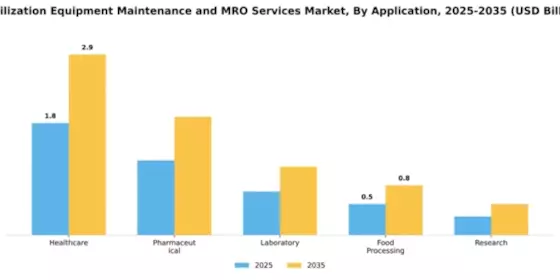
Healthcare (Dominant) vs. Laboratory (Emerging)
In the Sterilization Equipment Maintenance and MRO Services Market, the healthcare sector stands as the dominant application, characterized by its extensive infrastructure, compliance requirements, and a longstanding emphasis on patient safety. Hospitals and clinics invest significantly in the upkeep of sterilization equipment due to the critical nature of their operations. In contrast, the laboratory sector represents an emerging application area, driven by rapid research advancements and the need for precision in sterilization protocols. As laboratories adopt more sophisticated sterilization methods—including advanced technologies such as ethylene oxide and gamma irradiation—they are increasingly recognized for their role in ensuring sample integrity and reliable test outcomes. The contrasting dynamics between these two segments highlight the healthcare sector's established presence and the laboratory segment's potential for exponential growth.
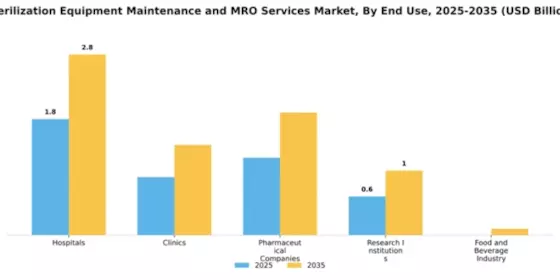
The Sterilization Equipment Maintenance and MRO Services Market showcases a diverse range of end users, with hospitals commanding the largest share due to their extensive use of sterilization equipment in surgical and emergency procedures. Clinics follow closely behind, benefitting from increasing patient footfall and the rising demand for outpatient services that require rigorous sterilization protocols. Other notable end users include pharmaceutical companies, research institutions, and the food and beverage industry, which contribute to the market as essential players in maintaining sterilization standards across various applications.
Hospitals (Dominant) vs. Clinics (Emerging)
Hospitals represent the dominant force in the Sterilization Equipment Maintenance and MRO Services Market, largely due to the critical need for maintaining high standards of sterilization for patient safety and operational efficiency. These facilities invest heavily in robust sterilization processes, which not only comply with regulatory requirements but also enhance patient outcomes. In contrast, clinics are emerging as a key segment within the market, driven by an increase in non-invasive procedures and outpatient care. As clinics expand their services and patient base, they prioritize effective sterilization solutions, making them a rapidly growing segment in this industry.
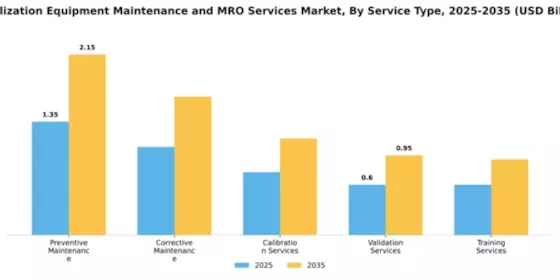
The Sterilization Equipment Maintenance and MRO Services Market exhibits a diverse distribution of service types, with preventive maintenance being the largest segment. Preventive maintenance is favored for its ability to mitigate operational downtime and enhance equipment longevity. In contrast, corrective maintenance, though smaller, has seen growing adoption as organizations aim to reduce response times to equipment failures, ensuring operational efficiency. Calibration and validation services are also critical, supporting compliance and quality assurance across the sterilization landscape, while training services provide essential knowledge ensuring that staff are equipped to operate and maintain equipment effectively. Growth trends in this market are largely driven by increasing regulatory requirements for sterilization standards, compelling healthcare facilities to invest in comprehensive maintenance strategies. Preventive maintenance is benefiting from a proactive approach to maintenance, capturing the largest market share due to its cost-saving advantages. Meanwhile, the rising complexity of sterilization processes has propelled corrective maintenance to become the fastest-growing segment, as businesses recognize the need to swiftly address issues to maintain operational continuity. The demand for calibration and validation services remains steady, underpinned by ongoing advancements in sterilization technologies that require precise adjustments and verifications. Training services are increasingly prioritized to ensure staff remain proficient in the latest protocols, driving growth across all segments.
Preventive Maintenance (Dominant) vs. Calibration Services (Emerging)
Preventive maintenance stands out as the dominant service type in the sterilization equipment maintenance market, characterized by its systematic approach to routine inspections and timely interventions. This proactive measure not only enhances equipment operability and reduces the likelihood of malfunctions, but also ensures compliance with health regulations, making it a vital component for healthcare facilities. Calibration services, on the other hand, represent an emerging segment, gaining traction as organizations recognize the importance of precision in sterilization processes. Although currently smaller in market share, calibration services play a critical role in maintaining the accuracy of sterilization equipment. This segment is poised for growth due to increasing technological advancements and a heightened focus on quality assurance in sterilization practices, thereby reinforcing the overall safety and efficacy of healthcare operations.
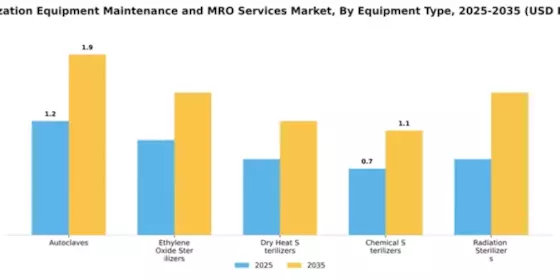
The Sterilization Equipment Maintenance and MRO Services Market showcases a diverse array of equipment types, with autoclaves leading significantly in market share. Their proven efficacy in sterilization across various industries, particularly in healthcare settings, underpins their dominance. Ethylene oxide sterilizers, while currently smaller in market share, are swiftly gaining traction due to their effectiveness in sterilizing heat-sensitive medical devices and instruments. As industries seek reliable and efficient sterilization solutions, these two equipment types are establishing their pivotal roles within the market.
Autoclaves (Dominant) vs. Ethylene Oxide Sterilizers (Emerging)
Autoclaves are universally acknowledged as the dominant force in the Sterilization Equipment segment, largely due to their reliability, speed, and versatility. They employ steam under pressure to achieve optimal sterilization, making them indispensable in hospitals and laboratories. Conversely, ethylene oxide sterilizers are emerging as a critical alternative for sterilizing sensitive materials that cannot withstand high temperatures. Their capability to handle complex medical instruments without damaging them positions them effectively in the market, driving growth rates upward as demand for advanced sterilization methods increases. This duality in the equipment landscape highlights a significant trend towards tailored sterilization solutions.
Get more detailed insights about Sterilization Equipment Maintenance and MRO Services Market Request Free Sample
North America is poised to maintain its leadership in the Sterilization Equipment Maintenance and MRO Services Market, holding a market size of $2.25B in 2025. Key growth drivers include stringent regulatory requirements, increasing healthcare expenditures, and a rising focus on infection control. The demand for advanced sterilization technologies is further fueled by the growing number of surgical procedures and the need for compliance with health standards. The competitive landscape is characterized by the presence of major players such as STERIS, Ecolab, and 3M, which are investing heavily in innovation and service expansion. The U.S. leads the market, supported by a robust healthcare infrastructure and a high prevalence of healthcare-associated infections. This region's focus on quality and safety standards ensures a continuous demand for maintenance and MRO services, solidifying its market position.
Europe's Sterilization Equipment Maintenance and MRO Services Market is projected to reach $1.5B by 2025, driven by increasing regulatory compliance and a growing emphasis on patient safety. The region is witnessing a surge in demand for sterilization services due to rising healthcare-associated infections and the implementation of stringent EU regulations. Countries like Germany and France are at the forefront, pushing for advanced sterilization technologies and practices. The competitive landscape in Europe is marked by key players such as Getinge and Belimed, who are adapting to the evolving regulatory environment. The presence of a well-established healthcare system and a focus on innovation in sterilization methods are pivotal for market growth. As hospitals and clinics prioritize compliance with health regulations, the demand for maintenance and MRO services is expected to rise significantly.
The Asia-Pacific region is experiencing rapid growth in the Sterilization Equipment Maintenance and MRO Services Market, projected to reach $0.9B by 2025. This growth is driven by increasing healthcare investments, a rising number of surgical procedures, and a growing awareness of infection control. Countries like China and India are expanding their healthcare infrastructure, leading to a higher demand for sterilization services and maintenance solutions. The competitive landscape is evolving, with both local and international players entering the market. Companies such as MediClean and Advanced Sterilization Products are focusing on innovative solutions tailored to the region's unique needs. As the healthcare sector continues to expand, the demand for reliable sterilization equipment maintenance and MRO services is expected to grow, presenting significant opportunities for market players.
The Middle East and Africa region is projected to reach a market size of $0.85B in the Sterilization Equipment Maintenance and MRO Services Market by 2025. The growth is primarily driven by increasing investments in healthcare infrastructure and a rising focus on infection prevention. Countries like the UAE and South Africa are enhancing their healthcare systems, leading to a growing demand for sterilization services and maintenance solutions. The competitive landscape is characterized by a mix of local and international players, with companies like Tuttnauer gaining traction. The region's unique challenges, such as varying regulatory standards and resource availability, present both challenges and opportunities for market players. As healthcare facilities expand, the need for effective sterilization practices will continue to rise, driving demand for MRO services.
The Sterilization Equipment Maintenance and MRO Services Market is characterized by a competitive landscape that is increasingly shaped by innovation, strategic partnerships, and a focus on sustainability. Key players such as STERIS (US), Getinge (SE), and Ecolab (US) are actively pursuing strategies that enhance their operational capabilities and market presence. STERIS (US) emphasizes technological advancements in sterilization processes, while Getinge (SE) focuses on expanding its service offerings through strategic acquisitions. Ecolab (US) is leveraging its expertise in water treatment and hygiene solutions to provide comprehensive maintenance services, thereby enhancing its competitive positioning. Collectively, these strategies contribute to a dynamic market environment where companies are not only competing on service quality but also on technological innovation and sustainability initiatives.The business tactics employed by these companies reflect a nuanced understanding of market demands. Localizing manufacturing and optimizing supply chains are prevalent strategies aimed at reducing operational costs and improving service delivery. The market structure appears moderately fragmented, with several key players holding substantial market shares. This fragmentation allows for a diverse range of service offerings, yet the influence of major companies remains significant, as they set benchmarks for quality and innovation that smaller players strive to meet.In November STERIS (US) announced the launch of a new line of advanced sterilization equipment designed to enhance efficiency and reduce environmental impact. This strategic move underscores STERIS's commitment to sustainability and positions the company as a leader in eco-friendly sterilization solutions. The introduction of this product line is likely to attract environmentally conscious clients and strengthen STERIS's market share in a competitive landscape increasingly focused on sustainability.In October Getinge (SE) completed the acquisition of a regional service provider specializing in sterilization equipment maintenance. This acquisition is strategically significant as it allows Getinge to expand its service footprint and enhance its customer support capabilities. By integrating local expertise, Getinge can offer tailored solutions that meet specific regional needs, thereby solidifying its competitive advantage in the market.In September Ecolab (US) launched a digital platform aimed at streamlining maintenance operations for healthcare facilities. This platform utilizes AI and data analytics to optimize service schedules and predict equipment failures. The strategic importance of this initiative lies in its potential to enhance operational efficiency and reduce downtime for clients, positioning Ecolab as a forward-thinking leader in the integration of technology within the sterilization services sector.As of December the competitive trends in the Sterilization Equipment Maintenance and MRO Services Market are increasingly defined by digitalization, sustainability, and the integration of AI technologies. Strategic alliances among key players are shaping the landscape, fostering innovation and enhancing service delivery. The shift from price-based competition to a focus on technological differentiation and supply chain reliability is evident, suggesting that future competitive advantages will hinge on the ability to innovate and adapt to evolving market demands.

The Sterilization Equipment Maintenance and MRO Services Market is projected to grow at a 4.37% CAGR from 2025 to 2035, driven by technological advancements and increasing regulatory requirements.
New opportunities lie in:
By 2035, the market is expected to achieve robust growth, driven by innovation and increased demand.
| MARKET SIZE 2024 | 4.5(USD Billion) |
| MARKET SIZE 2025 | 4.7(USD Billion) |
| MARKET SIZE 2035 | 7.2(USD Billion) |
| COMPOUND ANNUAL GROWTH RATE (CAGR) | 4.37% (2025 - 2035) |
| REPORT COVERAGE | Revenue Forecast, Competitive Landscape, Growth Factors, and Trends |
| BASE YEAR | 2024 |
| Market Forecast Period | 2025 - 2035 |
| Historical Data | 2019 - 2024 |
| Market Forecast Units | USD Billion |
| Key Companies Profiled | STERIS (US), Getinge (SE), Ecolab (US), 3M (US), Belimed (CH), MediClean (US), Advanced Sterilization Products (US), Tuttnauer (IL), Sotera Health (US) |
| Segments Covered | Application, End Use, Service Type, Equipment Type |
| Key Market Opportunities | Integration of advanced automation technologies in Sterilization Equipment Maintenance and MRO Services Market enhances efficiency and reliability. |
| Key Market Dynamics | Rising demand for advanced sterilization technologies drives competition and innovation in maintenance and MRO services. |
| Countries Covered | North America, Europe, APAC, South America, MEA |
The market valuation reached 4.5 USD Billion in 2024.
The market is expected to grow to 7.2 USD Billion by 2035.
The expected CAGR is 4.37% from 2025 to 2035.
Key players include STERIS, Getinge, Ecolab, 3M, Belimed, MediClean, Advanced Sterilization Products, Tuttnauer, and Sotera Health.
The main application segments include Healthcare, Pharmaceutical, Laboratory, Food Processing, and Research.
The Healthcare segment was valued at 1.8 USD Billion in 2024 and is projected to reach 2.9 USD Billion by 2035.
The Pharmaceutical segment was valued at 1.2 USD Billion in 2024 and is expected to grow to 1.9 USD Billion by 2035.
Services include Preventive Maintenance, Corrective Maintenance, Calibration Services, Validation Services, and Training Services.
Preventive Maintenance services were valued at 1.35 USD Billion in 2024 and are projected to reach 2.15 USD Billion by 2035.
Prominent equipment types include Autoclaves, Ethylene Oxide Sterilizers, Dry Heat Sterilizers, Chemical Sterilizers, and Radiation Sterilizers.


Kindly complete the form below to receive a free sample of this Report

“This is really good guys. Excellent work on a tight deadline. I will continue to use you going forward and recommend you to others. Nice job”


“Thanks. It’s been a pleasure working with you, please use me as reference with any other Intel employees.”


“Thanks for sending the report it gives us a good global view of the Betaïne market.”


“Thank you, this will be very helpful for OQS.”


“We found the report very insightful! we found your research firm very helpful. I'm sending this email to secure our future business.”


“I am very pleased with how market segments have been defined in a relevant way for my purposes (such as "Portable Freezers & refrigerators" and "last-mile"). In general the report is well structured. Thanks very much for your efforts.”


“I have been reading the first document or the study, ,the Global HVAC and FP market report 2021 till 2026. Must say, good info! I have not gone in depth at all parts, but got a good indication of the data inside!”


“We got the report in time, we really thank you for your support in this process. I also thank to all of your team as they did a great job.”


“The Automotive 48V ECU Components Procurement Intelligence Study” was a complex project, but the Market Research Future (MRFR) team handled it with quality, agility, and customer-centricity. They delivered all requested data on time and within the agreed scope. The team, including Shubhendra Anand and Rahul Gotadki, was always readily available to clarify questions and swiftly implement necessary adjustments, driving the project to a successful conclusion within a very demanding timeframe.
I would also like to specifically commend Akshay Agarwal for his responsiveness and support at every stage—from our initial inquiry on May 6th through to final delivery on June 18th. His dedication made the entire process seamless.”



