Download Free Sample
Kindly complete the form below to receive a free sample of this Report
Stretcher Chair Market Research Report: Size, Share, Trend Analysis By Applications (Emergency Services, Hospitals, Ambulance Transport, Home Care, Rehabilitation), By Types (Manual Stretcher Chair, Electric Stretcher Chair, Foldable Stretcher Chair, Wheelchair Stretcher Chair), By Material (Aluminum, Steel, Plastic, Fabric), By End Use (Private Healthcare, Public Healthcare, Long-term Care Facilities, Home Healthcare) and By Regional (North America, Europe, South America, Asia Pacific, Middle East and Africa) - Growth Outlook & Industry Forecast 2025 To 2035
As per Market Research Future analysis, the Stretcher Chair Market Size was estimated at 2.254 USD Billion in 2024. The Stretcher Chair industry is projected to grow from USD 2.385 Billion in 2025 to USD 4.199 Billion by 2035, exhibiting a compound annual growth rate (CAGR) of 5.82% during the forecast period 2025 - 2035
The Stretcher Chair Market is experiencing robust growth driven by technological advancements and an increasing focus on patient-centric care.
| 2024 Market Size | 2.254 (USD Billion) |
| 2035 Market Size | 4.199 (USD Billion) |
| CAGR (2025 - 2035) | 5.82% |
The Stretcher Chair Market is currently experiencing a notable evolution, driven by advancements in healthcare technology and an increasing emphasis on patient comfort and safety. As healthcare facilities strive to enhance their service offerings, the demand for innovative stretcher chairs that combine functionality with ergonomic design appears to be on the rise. This trend is likely influenced by the growing awareness of the importance of patient-centered care, which emphasizes the need for equipment that not only meets clinical requirements but also prioritizes the well-being of patients during transport. Furthermore, the integration of smart technologies into stretcher chairs, such as monitoring systems and automated adjustments, seems to be gaining traction, potentially transforming the way healthcare providers manage patient mobility. In addition to technological advancements, the Stretcher Chair Market is also witnessing a shift towards sustainability. Manufacturers are increasingly focusing on eco-friendly materials and production processes, reflecting a broader commitment to environmental responsibility within the healthcare sector. This shift may be driven by regulatory pressures and a growing consumer preference for sustainable products. As the market continues to evolve, it is essential for stakeholders to remain attuned to these trends, as they could significantly influence purchasing decisions and shape the future landscape of stretcher chair offerings.
The incorporation of advanced technologies into stretcher chairs is becoming more prevalent. Features such as automated adjustments, integrated monitoring systems, and connectivity options are enhancing functionality and improving patient care.
There is a growing emphasis on ergonomic design in stretcher chairs. Manufacturers are prioritizing comfort and safety, ensuring that both patients and healthcare providers benefit from improved usability and support during transport.
The market is increasingly leaning towards sustainable practices. Manufacturers are adopting eco-friendly materials and processes, reflecting a commitment to environmental stewardship and responding to consumer demand for greener products.
The Stretcher Chair Market is increasingly aligning with the growing focus on patient-centric care. Healthcare providers are recognizing the importance of enhancing patient experience during transport, leading to a demand for more comfortable and user-friendly stretcher chairs. This shift towards patient-centricity is reflected in the design of stretcher chairs, which now prioritize ergonomics and ease of use. Market analysis indicates that products designed with patient comfort in mind are likely to gain traction, as healthcare facilities strive to improve overall patient satisfaction. This trend suggests that the Stretcher Chair Market will continue to evolve, with manufacturers focusing on innovative designs that cater to the needs and preferences of patients, thereby enhancing the overall quality of care.
The Stretcher Chair Market is influenced by stringent regulatory compliance and safety standards imposed by health authorities. These regulations are designed to ensure the safety and efficacy of medical equipment, including stretcher chairs. Manufacturers are required to adhere to specific guidelines, which often necessitate continuous improvements in design and functionality. Compliance with these standards not only enhances patient safety but also fosters trust among healthcare providers and patients alike. As regulations evolve, the Stretcher Chair Market is likely to see increased investment in research and development to meet these requirements. This driver suggests that adherence to safety standards will be a critical factor in shaping the competitive landscape of the stretcher chair market.
The Stretcher Chair Market is significantly impacted by the aging population and the rising prevalence of chronic diseases. As the global demographic shifts towards an older population, the demand for healthcare services, including patient transport, is expected to increase. Data indicates that by 2030, the number of individuals aged 65 and older will surpass 1.4 billion, leading to a heightened need for stretcher chairs in various healthcare facilities. Additionally, the growing incidence of chronic conditions such as cardiovascular diseases and diabetes necessitates efficient patient transport solutions. This demographic trend suggests that the Stretcher Chair Market will likely expand as healthcare providers adapt to the needs of an aging population, thereby driving innovation and investment in stretcher chair technologies.
Technological advancements are playing a pivotal role in shaping the Stretcher Chair Market. Innovations such as lightweight materials, integrated monitoring systems, and enhanced maneuverability are transforming the design and functionality of stretcher chairs. The incorporation of smart technologies, including GPS tracking and telemedicine capabilities, is also becoming increasingly prevalent. These advancements not only improve patient safety and comfort but also enhance operational efficiency for healthcare providers. Market data suggests that the integration of technology in medical equipment, including stretcher chairs, is expected to grow at a rate of 7% annually. This trend indicates that the Stretcher Chair Market is likely to witness a shift towards more sophisticated and technologically advanced products, catering to the evolving needs of healthcare professionals.
The Stretcher Chair Market is experiencing a notable surge in demand for emergency medical services. This trend is largely driven by the rising incidence of medical emergencies and the need for efficient patient transport solutions. According to recent data, the demand for stretcher chairs is projected to grow at a compound annual growth rate of approximately 6.5% over the next five years. This growth is indicative of the increasing reliance on stretcher chairs in hospitals, ambulances, and other healthcare settings. As healthcare providers seek to enhance patient care and streamline operations, the adoption of advanced stretcher chairs is likely to become more prevalent. Consequently, this driver is expected to significantly influence the Stretcher Chair Market, as stakeholders prioritize the procurement of innovative and reliable transport solutions.
In the Stretcher Chair Market, the application segment showcases a diverse range of uses. Emergency Services hold the largest market share, driven by an increasing demand for rapid patient transport in urgent situations. Hospitals follow closely, representing a significant portion of the market as they invest in advanced stretcher chair technologies to enhance patient care and mobility within facilities. The demand from Ambulance Transport, Home Care, and Rehabilitation is notable but comparatively smaller, contributing to their share in the overall market landscape.
Growth trends in the Stretcher Chair Market application segment are propelled by advancements in healthcare infrastructure and rising patient mobility needs. Emergency Services are bolstered by an increase in emergency call frequencies and a high priority on patient safety during transport. On the other hand, Hospitals are witnessing the fastest growth as they respond to the evolving landscape of patient care, focusing on innovative solutions that ensure effective and safe handling of patients. The ongoing push towards more responsive healthcare systems further lends support to this trend.
Emergency Services (Dominant) vs. Hospitals (Emerging)
Emergency Services represent the dominant force in the Stretcher Chair Market due to their critical role in providing prompt medical assistance. These services leverage stretcher chairs for their portability and ease of use, which are fundamental in life-threatening scenarios where time is of the essence. Each stretcher chair used in this segment is designed for quick deployment and patient stability, ensuring that emergency medical teams can effectively transport patients with minimal risk. Conversely, Hospitals reflect an emerging segment as they emphasize the integration of modern technologies in patient transfer systems. They are increasingly adopting ergonomic stretcher chairs that enhance patient comfort and staff efficiency, indicating a shift towards comprehensive healthcare solutions that cater to a diverse patient population.
In the Stretcher Chair Market, the type segment showcases diverse offerings, with Electric Stretcher Chairs holding the largest market share due to their convenience and efficiency in emergency medical situations. Manual Stretcher Chairs, however, are experiencing a rapid increase in demand as they provide cost-effective solutions and are appreciated for their ease of use in various healthcare settings. The market is driven by a growing emphasis on patient transport efficiency, leading to diverse preferences among healthcare professionals. The growth trends in this segment are significantly influenced by technological advancements and a shift towards more user-friendly designs. Electric Stretcher Chairs are benefiting from innovations that enhance patient comfort and staff operations, while Manual Chairs are favored in regions with budget constraints. The increasing number of healthcare facilities and emergency response units further supports the expansion of both segments, contributing to a competitive and evolving market landscape.
Manual Stretcher Chair (Dominant) vs. Wheelchair Stretcher Chair (Emerging)
The Manual Stretcher Chair dominates the Stretcher Chair Market due to its versatility and affordability, making it a staple in many healthcare facilities and emergency services. It is designed for straightforward operation, allowing caregivers to manage patient transport efficiently without the reliance on electricity. In contrast, the Wheelchair Stretcher Chair represents an emerging solution that combines the functionalities of a stretcher and wheelchair, catering to patients with mobility challenges. Its design focuses on ease of transition between sitting and lying positions, offering a practical option in hospitals and outpatient settings. With increasing awareness of patient comfort and accessibility, the Wheelchair Stretcher Chair is gaining traction, appealing to both providers and patients.
The stretcher chair market is notably segmented by material types, with aluminum leading the market due to its lightweight properties and high strength-to-weight ratio. Aluminum stretcher chairs are preferred in emergency medical services, providing both portability and durability. Following aluminum, steel is recognized for its robustness and stability, making it suitable for heavier patients. Plastic, although it commands a smaller share currently, is emerging as a competitive alternative due to its cost-effectiveness and resistance to corrosion, thus providing a significant opportunity for growth in the future. Fabric stretcher chairs, primarily used for comfort during transport, also contribute to niche markets, though their market share remains relatively moderate.
Aluminum (Dominant) vs. Steel (Emerging)
Aluminum stretcher chairs dominate the market because of their unmatched combination of lightweight characteristics and strength, making them ideal for emergency scenarios where quick response is critical. They are easy to maneuver and transport, which is vital in emergency medical situations. On the other hand, steel stretcher chairs are gaining traction as an emerging option due to their durability and structural integrity. Steel's robustness makes it suitable for heavy-duty requirements, allowing it to cater to a segment of the market that values long-term reliability. Both aluminum and steel have distinct advantages that appeal to different user needs, reflecting a diverse customer preference and a competitive landscape in the stretcher chair market.
The Stretcher Chair Market showcases a diverse distribution across several end-use segments. Public Healthcare emerges as the largest segment, driven by the high demand for medical equipment in hospitals and clinics to support patient transport. In contrast, the Home Healthcare segment is seeing rapid growth, correlating with the increasing trend of at-home care solutions that are becoming more prevalent in the healthcare industry.
As the healthcare landscape shifts towards personalized care, growth trends indicate that private sectors, particularly Home Healthcare, are gaining traction. Factors such as an aging population, increased chronic diseases, and a preference for at-home medical services are driving the demand. The movement towards improved healthcare accessibility is further solidifying the roles of both segments in the overall market framework.
Public Healthcare (Dominant) vs. Home Healthcare (Emerging)
Public Healthcare plays a dominant role in the Stretcher Chair Market, largely due to its robust infrastructure and budget allocations that prioritize patient care facilities. Public hospitals and clinics rely heavily on stretcher chairs for efficient patient transfer, influenced by regulations and standards ensuring safety and comfort. On the other hand, the Home Healthcare segment is emerging rapidly, fueled by advancements in telehealth and a shift towards home-based therapies. This segment focuses on convenience and individualized patient attention, allowing healthcare providers to deliver quality services directly in patient homes. Both segments represent vital pathways in the evolving healthcare narrative.
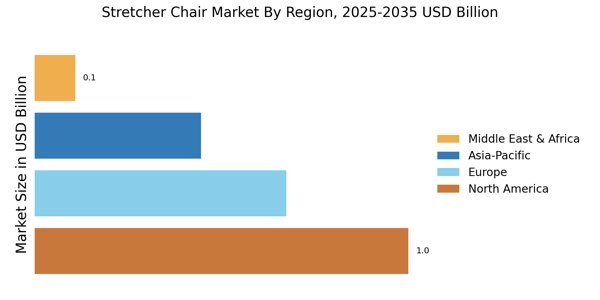
North America is the largest market for stretcher chairs, holding approximately 45% of the global market share. The growth is driven by an aging population, increasing healthcare expenditure, and advancements in medical technology. Regulatory support from agencies like the FDA ensures that products meet safety and efficacy standards, further boosting market demand. The region's focus on improving patient care and hospital infrastructure also contributes to this growth. The United States dominates the North American market, with key players such as Stryker Corporation, Hill-Rom Holdings Inc, and Invacare Corporation leading the competitive landscape. These companies are continuously innovating to enhance product features and improve patient comfort. The presence of advanced healthcare facilities and a robust distribution network further strengthens the market position of these key players, ensuring a steady supply of stretcher chairs across the region.
Europe is the second-largest market for stretcher chairs, accounting for approximately 30% of the global market share. The growth is propelled by increasing healthcare investments, a rising elderly population, and stringent regulations that ensure product quality and safety. The European Union's Medical Device Regulation (MDR) has set high standards for medical equipment, which encourages manufacturers to innovate and comply with safety protocols, thus driving market expansion. Leading countries in this region include Germany, France, and the UK, where healthcare systems are increasingly adopting advanced stretcher chair technologies. Key players like Arjo AB and Graham-Field Health Products Inc are actively participating in this market, focusing on enhancing product features and expanding their distribution networks. The competitive landscape is characterized by a mix of established companies and emerging startups, all striving to meet the evolving needs of healthcare providers and patients.
Asia-Pacific is witnessing rapid growth in the stretcher chair market, holding approximately 20% of the global market share. The region's growth is driven by increasing healthcare infrastructure investments, a growing population, and rising awareness of patient care standards. Countries like China and India are experiencing significant demand due to their expanding healthcare facilities and government initiatives aimed at improving healthcare access and quality, which act as catalysts for market growth. China and Japan are the leading countries in this region, with a strong presence of both local and international players. Companies like Karma Medical Products Co Ltd and Ferno-Washington Inc are focusing on product innovation and customization to cater to the diverse needs of healthcare providers. The competitive landscape is becoming increasingly dynamic, with new entrants emerging to capitalize on the growing demand for advanced medical equipment, including stretcher chairs.
The Middle East and Africa region is gradually emerging as a significant market for stretcher chairs, holding about 5% of the global market share. The growth is primarily driven by increasing healthcare investments, rising patient populations, and a focus on improving healthcare infrastructure. Governments in countries like the UAE and South Africa are implementing policies to enhance healthcare services, which is expected to boost the demand for stretcher chairs in the coming years. Leading countries in this region include the UAE, South Africa, and Saudi Arabia, where healthcare systems are evolving rapidly. The competitive landscape features both local manufacturers and international players looking to expand their footprint. Companies are focusing on establishing partnerships and collaborations to enhance their market presence and meet the growing demand for advanced medical equipment, including stretcher chairs.
The Stretcher Chair Market showcases a dynamic competitive landscape, characterized by innovation, strategic partnerships, and a growing drive towards enhancing patient mobility and comfort within healthcare settings. The market is influenced by a range of factors including demographic shifts, technological advancements, and increasing awareness of the importance of patient-centered care. As healthcare facilities evolve to meet the demands of a diverse patient population, the competition among manufacturers intensifies.
Companies are increasingly focused on meeting regulatory standards while also incorporating user-friendly designs, improved materials, and sophisticated features that cater to the specific needs of healthcare providers and patients alike. The rising incidence of chronic diseases and the subsequent need for efficient transportation solutions in hospitals further compounds the competitive dynamics of this market.
HillRom stands as a formidable player in the Stretcher Chair Market, recognized for its innovative approach and commitment to quality healthcare solutions. The company has established a strong market presence through its focus on ergonomic design and superior functionality, which greatly enhances patient comfort and caregiver efficiency. HillRom's strategic investments in research and development have led to the introduction of advanced stretcher chairs equipped with features such as adjustable seating positions, integrated monitoring systems, and durable materials.
Their products are widely used in hospitals and clinics, highlighting a robust distribution network that ensures their presence across various healthcare institutions globally. Additionally, HillRom’s dedication to improving patient and caregiver experiences has allowed it to forge lasting relationships with healthcare professionals, strengthening its position in this competitive market. Bionix is another key contender in the Stretcher Chair Market, known for its focus on specialized healthcare solutions and customer-centric products.
The company has carved out a niche by emphasizing innovation in design and functionality, which directly caters to the requirements of modern healthcare facilities. Bionix has successfully developed stretcher chairs that integrate advanced safety features and comfortable designs, making them essential for patient transport within hospitals. With a reputation built on quality and reliability, Bionix benefits from a strong customer loyalty due to its tailored solutions that address specific healthcare needs.
The company continually seeks to expand its market reach by leveraging partnerships and collaborations, ensuring its presence in both established and emerging markets. This strategic positioning, coupled with ongoing product improvements, allows Bionix to compete effectively in an evolving landscape, enhancing its visibility and prominence in the Stretcher Chair Market.





The Stretcher Chair Market has witnessed significant developments recently, with companies focusing on innovation and expansion. HillRom has continued to enhance its product portfolio, emphasizing ergonomic designs and patient comfort. Meanwhile, Bionix has made strides in integrating advanced technology into their stretcher chairs, improving usability and safety features.
Invacare is reportedly expanding its reach in emerging markets, contributing to the growth of the overall market. In terms of current affairs, the need for advanced emergency care solutions has been on the rise, driving demand for durable and efficient stretcher chairs.
Stryker has been expanding its manufacturing capabilities to meet increased market requirements, while Arjo has been involved in various strategic partnerships to improve distribution channels. Notably, there have been discussions around mergers and acquisitions involving companies like Medline and Zoll Medical, reflecting industry's consolidation trend aimed at enhancing competitive positioning.
The market valuation for these entities has seen considerable growth, indicating strong investor confidence and an optimistic future outlook, ultimately impacting on the overall dynamics of the Stretcher Chair Market positively as companies align their strategies with the increasing demand for innovative healthcare solutions.
The Stretcher Chair Market is projected to grow at a 5.82% CAGR from 2025 to 2035, driven by technological advancements, increasing healthcare demands, and an aging population.
New opportunities lie in:
By 2035, the Stretcher Chair Market is expected to achieve robust growth and enhanced market presence.
| MARKET SIZE 2024 | 2.254(USD Billion) |
| MARKET SIZE 2025 | 2.385(USD Billion) |
| MARKET SIZE 2035 | 4.199(USD Billion) |
| COMPOUND ANNUAL GROWTH RATE (CAGR) | 5.82% (2025 - 2035) |
| REPORT COVERAGE | Revenue Forecast, Competitive Landscape, Growth Factors, and Trends |
| BASE YEAR | 2024 |
| Market Forecast Period | 2025 - 2035 |
| Historical Data | 2019 - 2024 |
| Market Forecast Units | USD Billion |
| Key Companies Profiled | Stryker Corporation (US), Hill-Rom Holdings Inc (US), Invacare Corporation (US), Graham-Field Health Products Inc (US), Medline Industries Inc (US), Drive DeVilbiss Healthcare (US), Arjo AB (SE), Karma Medical Products Co Ltd (TW), Ferno-Washington Inc (US) |
| Segments Covered | Applications, Types, Material, End Use, Regional |
| Key Market Opportunities | Integration of advanced ergonomic designs and smart technology in the Stretcher Chair Market. |
| Key Market Dynamics | Rising demand for ergonomic designs in stretcher chairs drives innovation and competition among manufacturers. |
| Countries Covered | North America, Europe, APAC, South America, MEA |
The Stretcher Chair Market was valued at 2.254 USD Billion in 2024.
The market is projected to reach 4.199 USD Billion by 2035.
The expected CAGR for the Stretcher Chair Market during 2025 - 2035 is 5.82%.
In 2024, the Hospitals application segment had the highest valuation at 1.678 USD Billion.
The key types of stretcher chairs include Manual, Electric, Foldable, and Wheelchair Stretcher Chairs.
The Steel material segment is projected to grow significantly, with a valuation of 1.267 USD Billion by 2035.
Key players in the market include Stryker Corporation, Hill-Rom Holdings Inc, and Invacare Corporation.
The Ambulance Transport application segment was valued at 0.451 USD Billion in 2024.
In 2024, the Private Healthcare end-use segment was valued at 1.276 USD Billion, slightly higher than the Public Healthcare segment at 1.278 USD Billion.
The Home Healthcare end-use segment is expected to reach a valuation of 0.795 USD Billion by 2035.


Kindly complete the form below to receive a free sample of this Report

“This is really good guys. Excellent work on a tight deadline. I will continue to use you going forward and recommend you to others. Nice job”


“Thanks. It’s been a pleasure working with you, please use me as reference with any other Intel employees.”


“Thanks for sending the report it gives us a good global view of the Betaïne market.”


“Thank you, this will be very helpful for OQS.”


“We found the report very insightful! we found your research firm very helpful. I'm sending this email to secure our future business.”


“I am very pleased with how market segments have been defined in a relevant way for my purposes (such as "Portable Freezers & refrigerators" and "last-mile"). In general the report is well structured. Thanks very much for your efforts.”


“I have been reading the first document or the study, ,the Global HVAC and FP market report 2021 till 2026. Must say, good info! I have not gone in depth at all parts, but got a good indication of the data inside!”


“We got the report in time, we really thank you for your support in this process. I also thank to all of your team as they did a great job.”


“The Automotive 48V ECU Components Procurement Intelligence Study” was a complex project, but the Market Research Future (MRFR) team handled it with quality, agility, and customer-centricity. They delivered all requested data on time and within the agreed scope. The team, including Shubhendra Anand and Rahul Gotadki, was always readily available to clarify questions and swiftly implement necessary adjustments, driving the project to a successful conclusion within a very demanding timeframe.
I would also like to specifically commend Akshay Agarwal for his responsiveness and support at every stage—from our initial inquiry on May 6th through to final delivery on June 18th. His dedication made the entire process seamless.”



