Structural Adhesives Market

Key Players: Henkel AG, Sika AG, H.B. Fuller, Huntsman Corporation, Arkema (Bostik), Parker Hannifin (LORD), Permabond, Illinois Tool Works (ITW)

Structural Adhesives Market

Structural Adhesives Market Size, Share & Industry Analysis Research Report Information By Substrate (Metal, Composite, Wood, Plastic), By Application (Building & Construction, Automotive, Bus & Truck, Aerospace), And By Region (North America, Europe, Asia-Pacific, And Rest Of The World) – Market Forecast Till 2035
ID: MRFR/CnM/1616-HCR
111 Pages
Chitranshi Jaiswal
Last Updated: June 18, 2026

Structural Adhesives Market Summary

The Structural Adhesives Market reached an estimated USD 22.14 billion in 2025 and is projected to grow from USD 23.98 Billion in 2026 to USD 49.12 billion by 2035, registering a CAGR of 8.30% during the forecast period (2026–2035). This expansion is anchored in aggressive lightweighting mandates across automotive and aerospace sectors, where high-strength adhesives are replacing traditional mechanical fasteners to reduce vehicle and aircraft weight by 15–25%. The European Union's CO₂ emission targets for passenger vehicles — capped at 93.6 g/km by 2025 — have accelerated OEM adoption of epoxy structural adhesives and polyurethane adhesives for body-in-white assemblies [2].

The structural adhesives market is undergoing a significant technological transition. Engineering adhesive methods that attach incompatible materials—such as carbon fiber to aluminum and composites to steel—without thermal distortion are replacing outdated riveting, welding, and bolted-joint technologies. Between 2022 and 2024, Boeing and Airbus combined invested more than USD 4.2 billion in research and development for composite bonding materials, demonstrating the industry's dedication to next-generation airframes [3]. The capabilities of industrial bonding materials in high-stress applications are being further pushed by self-healing adhesive chemistries and UV-curable formulations.

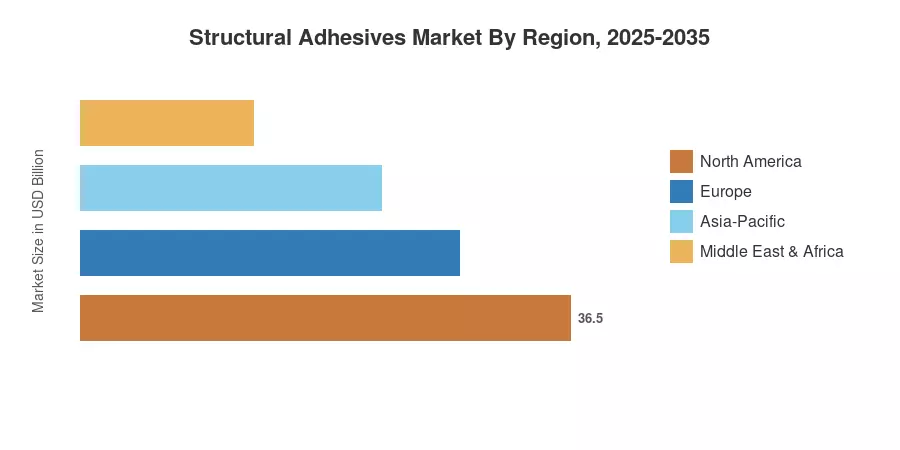
Due to China's construction boom and India's growing automobile production, the Asia-Pacific accounts for around 43% of the world's structural adhesives market revenue. At roughly 9.4%, the region also has the fastest CAGR. With a 23% stake, North America is the second-largest area, helped by the US aerospace industry and infrastructure restoration initiatives. Due to strict environmental rules that prioritize long-lasting adhesive compounds over mechanical attachment, Europe accounts for about 22% of the total. Automotive bonding adhesives and construction adhesive solutions will change the competitive landscape in every region over the course of the next ten years.


Key Report Takeaways

• By Resin Type

  • Epoxy resin adhesives dominate the Structural Adhesives Market with approximately 38% revenue share in 2025, benefiting from unmatched load-bearing adhesives performance in aerospace and wind energy applications.
  • Polyurethane adhesives represent the fastest-growing resin segment at an estimated 9.1% CAGR through 2035, fueled by demand for flexible industrial bonding materials in automotive assembly.
  • Acrylic-based formulations hold a Structural Adhesives Market value of approximately USD 3.76 Billion in 2025, gaining traction in electronics and marine applications.

• By End-User Industry

  • The construction sector accounts for the largest end-user share at roughly 32%, as urbanization drives the adoption of construction adhesive solutions globally.
  • Automotive bonding adhesives are projected to grow at 9.3% CAGR, the fastest among all end-user verticals, as EV platforms demand lightweight composite bonding materials.

• By Region

  • Asia-Pacific leads the Structural Adhesives Market with a 43% share, anchored by infrastructure spending exceeding USD 1.3 billion annually across China and India.
  • North America holds approximately USD 5.09 billion in 2025 market value, driven by defense aerospace and wind energy expansion.
  • The Middle East & Africa region registers a projected CAGR of 7.8%, supported by mega construction projects in Saudi Arabia and the UAE.


Market Size and Forecast (2021–2035)

MRFR's market sizing methodology integrates bottom-up revenue estimation from manufacturer filings and distributor data with top-down cross-validation using end-user industry consumption volumes. Historical figures (2021–2024) are derived from audited company reports, trade association data, and customs records. Forecast values (2026–2035) apply a calibrated compound growth model validated against downstream demand indicators, including automotive production volumes, construction permits, and wind turbine installation rates[4].
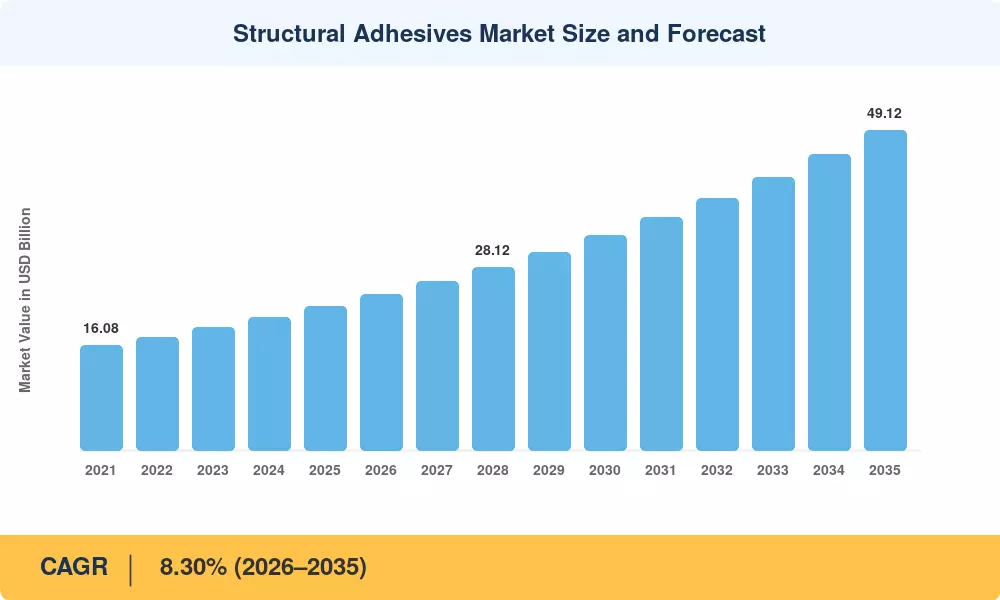
Structural Adhesives Market Size and Forecast
Our Impact
Enabled $4.3B Revenue Impact for Fortune 500 and Leading Multinationals
Partnering with 2000+ Global Organizations Each Year
30K+ Citations by Top-Tier Firms in the Industry

Driver Impact Analysis

Driver ~% Impact on CAGR Geographic Relevance Impact Timeline
Automotive lightweighting mandates ~22% Global Short-term (≤2 yr)
Aerospace composite adoption ~18% North America, Europe Medium-term (2–4 yr)
Wind energy capacity expansion ~16% Asia-Pacific, Europe Long-term (≥4 yr)
Green building regulations ~14% Europe, North America Medium-term (2–4 yr)
EV battery pack assembly demand ~12% Asia-Pacific, North America Short-term (≤2 yr)
Infrastructure modernization programs ~10% Asia-Pacific, MEA Long-term (≥4 yr)
Smart adhesive technology integration ~8% Global Long-term (≥4 yr)


Automotive Lightweighting and EV Transition

Global automotive manufacturers rely heavily on advanced structural bonding adhesives to navigate stringent fleet emission targets, such as the European Union's vehicle fleet targets and the US EPA's multi-pollutant emission standards. Because combining dissimilar materials like aluminum and carbon fiber with standard welds introduces mechanical limitations, high-strength bonding agents are essential to reduce overall chassis mass and optimize battery efficiency profiles across mainstream electric platforms.


Aerospace Composite Airframe Programs

Modern commercial and defense aerospace structures depend significantly on structural bonding technologies to secure high-performance composite configurations. Load-bearing structural adhesives replace thousands of heavy mechanical fasteners, drastically lowering deadweight while offering superior resistance to severe environmental conditions and fatigue cycling. This wide-scale transition toward specialized structural bonding systems remains central to achieving critical fuel-efficiency improvements across next-generation aviation networks.


Wind Energy Installation Momentum

The ongoing expansion of global wind energy capacity acts as a vital structural demand loop for high-durability industrial bonding systems. Modern wind turbine blades necessitate massive volumes of specialized polyurethane and epoxy structural adhesives for assembly of spar caps, root joints, and leading-edge reinforcements. These composite-bonding compounds are structurally engineered to endure extreme environmental stress, cyclic aerodynamic load patterns, and saltwater ingress across offshore installations.


Green Building and Construction Standards

The strict evolution of international green building rating systems pushes real estate development sectors to prioritize low-emission building components. Structural bonding adhesives designed to satisfy strict low-volatile organic compound (VOC) limits are progressively favored over standard solvent-heavy or rigid mechanical alternatives. These specialized, code-compliant adhesives facilitate durable material bonding across modern architectural systems while protecting indoor air quality standards.


Restraints Impact Analysis

Restraint ~% Drag on CAGR Geographic Relevance Impact Timeline
Volatile raw material pricing (MDI, BPA) ~–1.8% Global Short-term (≤2 yr)
Stringent VOC emission regulations ~–1.2% Europe, North America Medium-term (2–4 yr)
Limited surface prep infrastructure ~–0.9% South America, MEA Long-term (≥4 yr)
Long cure times vs. mechanical fasteners ~–0.7% Global Medium-term (2–4 yr)
Recyclability and end-of-life concerns ~–0.5% Europe Long-term (≥4 yr)


Raw Material Price Volatility

Fluctuations in chemical feedstocks create intense pricing uncertainty. The cost of bisphenol-A (BPA) and methylene diphenyl diisocyanate (MDI)—the essential base inputs for epoxy structural adhesives and polyurethane formulations—experienced severe volatility, swinging by 18% to 30% recently. These rapid shifts directly compress manufacturer profit margins and disrupt downstream commercial pricing structures due to lags in supply chain procurement cost pass-throughs.


Regulatory Pressure on VOC Emissions

Stringent environmental rules limit traditional adhesive formulations. The US EPA’s National Emission Standards for Hazardous Air Pollutants (NESHAP) establishes rigorous legal limits on volatile organic compounds (VOCs). Consequently, legacy solvent-based adhesives are losing manufacturing eligibility. Shifting production toward compliant water-based or reactive-cure technologies requires substantial capital investment in alternative dispensing systems and rigorous quality-control updates.


End-of-Life and Circular Economy Challenges

Modern sustainability frameworks directly challenge permanent assembly designs. The European Commission’s End-of-Life Vehicles (ELV) directive dictates that newly manufactured automobiles must meet strict circular economy targets, including 85% recyclability and 95% material recoverability by weight. Structural bonding of dissimilar materials severely complicates automated disassembly and component sorting, accelerating the need for expensive, pre-commercial reversible adhesive innovations.


Structural Adhesives Market Opportunities

Bio-Based and Sustainable Adhesive Formulations

Surging demand for green chemistry creates massive opportunities for bio-based structural adhesives derived from lignin, soy, and castor oil. Adhesives achieving UL GREENGUARD Gold or EU Ecolabel status command 10% to 15% pricing premiums. They secure crucial specifications with sustainability-focused industrial OEMs, transforming environmental compliance from a manufacturing cost burden into a strong margin driver.


Electric Vehicle Battery Pack Assembly

Electric vehicle battery enclosures require specialized thermally conductive, flame-retardant structural adhesives for cell-to-pack bonding. This application is growing at twice the rate of the traditional adhesives market. With average consumption at 3 to 5 kg of material per pack, rising global EV sales demand thousands of metric tons of high-performance structural bonding annually.


Digital Dispensing and Industry 4.0 Integration

Adopting automated adhesive dispensing systems integrated with machine vision and IoT sensors reduces material waste by 20% to 30%. This technology drastically optimizes bond-line consistency. Suppliers are increasingly leveraging innovative adhesive-as-a-service business models, managing the smart dispensing machinery directly on factory floors to convert heavy customer capital expenditure into predictable operating expenses.


Offshore Wind and Marine Applications

Rapid expansion of global offshore wind capacity requires specialized high-durability formulations. Wind turbines exceeding 10 megawatts utilize hundreds of kilograms of advanced epoxy structural adhesives for massive blade assembly and nacelle sealing. Concurrently, marine shipbuilders utilize these lightweight composite bonding materials to decrease hull weight and lower fuel consumption, opening up a highly lucrative cross-sector commercial market.


Structural Adhesives Market Future Outlook

Smart Adhesive Technologies and Self-Healing Chemistries

Integrating microcapsule-based self-healing mechanisms into structural bonding compounds marks a major shift for high-stress manufacturing maintenance. Peer-reviewed research demonstrates that epoxy systems can recover up to 90% of their baseline mechanical strength following initial micro-crack propagation (Ayala et al., 2022). Automating structural crack recovery directly minimizes recurring manual repair intervention, drastically lowering long-term maintenance, repair, and overhaul (MRO) expenses across aerospace and wind-energy fleets


Electrification Supercycle and Battery Bonding

The accelerating global transition toward alternative-fuel vehicles creates a massive demand vector for specialized engineering adhesives (Razavi, 0). Electric vehicle battery enclosures, motor housings, and power electronics assemblies require robust, multi-functional structural bonding systems to function safely. To protect electrical components and manage high thermal loads, auto manufacturers increasingly rely on specialized, flame-retardant structural formulations that meet rigorous international safety standards, including UL 94 V-0 metrics

.

ESG Reporting and Sustainable Supply Chains

Strict environmental frameworks, such as the European Union’s Corporate Sustainability Reporting Directive (CSRD), legally compel industrial chemical manufacturers to thoroughly document and mitigate their Scope 3 indirect value chain greenhouse gas emissions (Khan, 0). To preserve structural tier-supplier status with global automotive manufacturers, adhesive producers are actively altering their core raw material procurement. They are substituting fossil-derived chemicals with bio-based resin alternatives like lignin and castor oil to lower product footprints.

Additive Manufacturing and Hybrid Joining

Advanced 3D-printed structural components increasingly require secondary high-strength adhesive bonding to reach full industrial load-bearing specifications. The fast-growing additive manufacturing market relies on secondary chemical joining to reinforce printed composite parts against mechanical fatigue. Using industrial structural formulations eliminates mechanical fasteners, allowing engineers to maintain lightweight aerodynamic designs while successfully preventing early bond-line failures in complex medical devices and aerospace assemblies.


Structural Adhesives Market Segmentation

By Resin Type

Segment Key Metric Primary Demand Driver
Epoxy ~38% share (2025) Aerospace and wind energy bonding
Polyurethane CAGR ~9.1% Automotive flexibility and EV assembly
Acrylic USD 3.76 Billion (2025) Electronics and rapid-cure applications
Cyanoacrylate ~6% share (2025) Medical devices and small-part assembly
Methyl Methacrylate CAGR ~8.7% Marine and composite panel bonding
Other Resin Types USD 1.11 Billion (2025) Specialty and niche industrial uses


Epoxy structural adhesives maintain dominance across the Structural Adhesives Market thanks to their exceptional shear strength (typically 25–45 MPa), chemical resistance, and thermal stability above 150°C. Aerospace prime contractors specify two-part epoxy systems for primary structure bonding in composite airframes. At the same time, wind turbine manufacturers rely on epoxy paste adhesives for spar cap and shear web assembly. The segment's maturity means growth is steady rather than explosive, with innovation focused on faster cure cycles and improved toughness through nano-particle reinforcement [3][10].

Polyurethane adhesives represent the most dynamic resin category, driven by their unique combination of flexibility, impact resistance, and paintability — properties that make them ideal automotive bonding adhesives for body closures and structural hem flanges. As EV platforms demand materials that absorb crash energy while maintaining structural integrity, polyurethane adhesives offer a compelling balance that rigid epoxies cannot match. The segment is also gaining ground in construction adhesive solutions for insulated panel bonding and flooring applications [8][12].

By End-User Industry

Segment Key Metric Primary Demand Driver
Construction ~32% share (2025) Urbanization and green building codes
Automotive CAGR ~9.3% Lightweighting and EV assembly
Aerospace USD 3.54 Billion (2025) Composite airframe programs
Wind Energy CAGR ~9.6% Turbine blade manufacturing growth
Other End-User Industries ~8% share (2025) Marine, rail, electronics, medical


Construction remains the largest end-user of the Structural Adhesives Market by volume, consuming epoxy, polyurethane, and acrylic formulations across curtain wall bonding, flooring installation, prefabricated panel assembly, and concrete repair. Green building certification programs in over 80 countries now specify low-VOC construction adhesive solutions, creating a regulatory tailwind that rewards manufacturers investing in sustainable formulations [7][9].

The automotive sector is the fastest-growing end-user by value, as each new EV platform incorporates 15–25 kg of composite bonding materials versus 5–8 kg in traditional internal combustion vehicles. German and Japanese OEMs are leading this transition, with structural adhesive consumption per vehicle projected to double by 2030. Wind energy ranks as the fastest-growing segment by CAGR, reflecting the industry's projected capacity addition of over 150 GW annually by 2030 [6][8].


Regional Market Share Analysis

Region Key Metric Primary Investment Themes
Asia-Pacific ~43% share (2025) Infrastructure, EV manufacturing, wind energy
North America USD 5.09 Billion (2025) Aerospace, defense, EV battery assembly
Europe ~22% share (2025) Green building, automotive lightweighting
South America 7.1% CAGR (2026–2035) Construction, mining infrastructure
Middle East & Africa ~5% share (2025) Mega-projects, oil & gas maintenance
Total USD 22.14 Billion (2025)

The Structural Adhesives Market exhibits distinct regional growth patterns shaped by industrialization stage, regulatory environment, and end-user mix. Asia-Pacific retains its position as the dominant consumption center, while automotive bonding adhesives demand is reshaping competitive dynamics across North America and Europe.


North America

Country Key Metric Key Driver
US ~76% of regional share Aerospace OEM orders and defense procurement
Canada CAGR ~7.9% Wind energy and infrastructure renewal
Mexico USD 0.41 Billion (2025) Automotive nearshoring and export assembly


The US aerospace sector alone consumes over USD 1.8 billion in high-strength adhesives annually, with Boeing's Puget Sound and Lockheed Martin's Fort Worth facilities serving as primary demand hubs. Canada's offshore wind commitments in Nova Scotia and Newfoundland are accelerating polyurethane adhesives uptake. At the same time, Mexico's automotive corridor — home to over 30 OEM assembly plants — increasingly specifies engineering adhesive systems for mixed-material body structures [2][3].

Europe

Country Key Metric Key Driver
Germany ~28% of regional share Automotive OEMs and industrial manufacturing
UK CAGR ~8.1% Offshore wind and aerospace composites
France USD 0.62 Billion (2025) Aerospace (Airbus) and nuclear infrastructure
Italy ~10% of regional share Construction, renovation and marine
Spain CAGR ~7.6% Renewable energy installations
Nordic Countries USD 0.39 Billion (2025) Wind energy and green building codes
Russia ~5% of regional share Oil & gas pipeline maintenance
Rest of Europe CAGR ~7.3% General industrial growth


Germany's automotive sector drives the largest share of the European Structural Adhesives Market demand, with Volkswagen, BMW, and Mercedes-Benz collectively consuming over 45,000 metric tons of epoxy structural adhesives and automotive bonding adhesives in 2024. The UK's 50 GW offshore wind target by 2030 positions it as the fastest-growing European market for durable adhesive compounds used in turbine blade manufacturing [6].

Asia-Pacific

Country Key Metric Key Driver
China ~52% of regional share Construction, EV production, wind energy
India CAGR ~10.2% Infrastructure pipeline and automotive growth
Japan USD 1.14 Billion (2025) Electronics, automotive, aerospace
South Korea ~8% of regional share Shipbuilding and semiconductor packaging
ASEAN CAGR ~9.0% Urbanization and manufacturing FDI
Rest of Asia-Pacific USD 0.47 Billion (2025) Mining and general construction


China accounted for over half of the Asia-Pacific's Structural Adhesives Market revenue in 2025, powered by 22 million new vehicle registrations and over 350 GW of cumulative wind capacity. India is the fastest-growing country market globally, as the National Infrastructure Pipeline and Production-Linked Incentive scheme for automotive draws significant investment into construction adhesive solutions and industrial bonding materials [9].

South America

Country Key Metric Key Driver
Brazil ~58% of regional share Construction and automotive assembly
Argentina CAGR ~6.8% Mining infrastructure and energy
Rest of South America USD 0.24 Billion (2025) General industrial and construction


Brazil's "Minha Casa, Minha Vida" housing program and expanding automotive production base drive steady demand for construction adhesive solutions and composite bonding materials. Regional growth trails global averages due to currency volatility and import-dependency for specialty resin feedstocks, though local blending operations are expanding [13].

Middle East & Africa

Country Key Metric Key Driver
Saudi Arabia ~35% of regional share NEOM and Vision 2030 mega-projects
UAE CAGR ~8.5% Commercial construction and aviation MRO
South Africa USD 0.13 Billion (2025) Mining and infrastructure
Egypt ~10% of regional share New Administrative Capital and Suez Zone
Rest of MEA CAGR ~6.5% Oil & gas and general industrial


Saudi Arabia's Vision 2030 program is the single largest driver of Structural Adhesives Market growth in MEA, with NEOM, The Line, and Red Sea Global projects collectively demanding millions of square meters of curtain wall assemblies bonded with high-strength adhesives. UAE's aviation MRO hub status at Dubai and Abu Dhabi sustains demand for aerospace-grade epoxy structural adhesives [9].


Structural Adhesives Market By Region, 2025-2035

Competitive Benchmarking

The Structural Adhesives Market exhibits medium concentration, with the top five players holding an estimated 45–52% combined revenue share. The Herfindahl-Hirschman Index (HHI) falls in the 800–1,200 range, characteristic of a moderately competitive landscape where technology differentiation and application engineering expertise create meaningful barriers to entry. Dozens of regional formulators compete in construction and general industrial segments, while certified global suppliers dominate aerospace and automotive tiers.

Company Est. Revenue Share Range Key Offerings for the Structural Adhesives Market Strategic Positioning
Henkel AG ~12–15% Loctite epoxy and polyurethane systems Global leader in automotive and electronics bonding
3M Company ~8–11% Scotch-Weld structural adhesive portfolio Diversified across aerospace, automotive, and industrial
Sika AG ~7–10% SikaPower and SikaForce product lines Strong construction and wind energy focus
H.B. Fuller ~5–8% Royal and Swift adhesive systems Specialty industrial and packaging adjacency
Huntsman Corporation ~5–7% Araldite epoxy structural adhesives Aerospace and composite bonding specialist
Arkema (Bostik) ~4–6% Bostik industrial and construction lines Sustainability-focused formulation strategy
Parker Hannifin (LORD) ~3–5% LORD structural adhesives for aerospace Vibration management and aero-structure niche
Permabond ~2–4% Anaerobic and structural acrylic range Precision engineering and medical device focus
Illinois Tool Works (ITW) ~3–5% Plexus MMA and Devcon product lines Marine, wind energy, and infrastructure repair
Scott Bader ~2–3% Crestabond MMA adhesive range Composite bonding for transport and marine


Recent News & Developments

(Henkel & Celanese, January 2025) Henkel partnered with Celanese Corporation to produce water-based industrial adhesives utilizing circular emulsion polymers derived from captured carbon dioxide emissions.

(TruArc Partners, April 2026) Private equity firm TruArc Partners successfully acquired Matrix Adhesives Group to expand its specialty formulation, packaging, and technical compounding footprint.

(United Resins, March 2026): United Resins Group acquired a 50% stake in Florpinus to secure bio-based pine chemical feedstocks for sustainable industrial adhesive production.


Structural Adhesives Market Report Scope

Parameter Detail
Market Scope Global Structural Adhesives Market — all resin types and end-user industries
Study Period 2021–2035
CAGR (Forecast Period) 8.30% (2026–2035)
Market Size (2025) USD 22.14 Billion
Market Size (2035) USD 49.12 Billion
Fastest Growing Segment Wind Energy (by CAGR); Polyurethane (by resin type CAGR)
Companies Profiled Henkel, 3M, Sika, H.B. Fuller, Huntsman, Arkema, Parker Hannifin, Permabond, ITW, Scott Bader
Valuation Currency USD Billion


FAQs

How do procurement teams evaluate structural adhesive suppliers for mission-critical aerospace applications?

Buyers prioritize Nadcap-accredited suppliers with documented process control for surface preparation, mix ratios, and cure validation. Qualification typically requires 12–18 months of coupon-level and full-scale fatigue testing before production approval [3].

What distinguishes methyl methacrylate adhesives from epoxy systems for marine bonding?

MMA adhesives cure faster at ambient temperatures and tolerate oily or minimally prepared surfaces better than epoxies. This makes them preferred for field repair and secondary bonding on fiberglass and composite hulls [22].

How are tariff and trade policy shifts affecting the Structural Adhesives Market supply chain?

Anti-dumping duties on imported MDI and BPA resins have increased regional self-sufficiency investments, particularly in India and Southeast Asia. Localized production is reducing lead times but raising initial capital costs [11][13].

What role do nano-fillers play in next-generation high-strength adhesives?

Nano-silica and graphene additives improve fracture toughness by 30–50% without significantly increasing viscosity. Commercialization is advancing fastest in aerospace-grade epoxy structural adhesives [10].

Can structural adhesives fully replace welding in automotive body-in-white assembly?

Adhesives complement rather than fully replace welds, forming hybrid weld-bond joints that improve crash energy absorption by 20–30%. Full replacement remains limited to specific closures and non-safety-critical panels [2][8].

How does the Structural Adhesives Market address fire resistance requirements for construction?

Intumescent-modified epoxy and polyurethane adhesives achieve EN 13501 fire classification B-s1,d0, meeting most commercial building code requirements. Certification testing adds 6–9 months to product development cycles [7].

What sustainability certifications matter most for the Structural Adhesives Market in Europe?

EU Ecolabel and Cradle to Cradle certification drive specification preference among architects and general contractors. Products meeting these standards command 10–15% price premiums over conventional formulations [15][20].


Author
Author
Author Profile
Chitranshi Jaiswal LinkedIn
Team Lead - Research
Chitranshi is a Team Leader in the Chemicals & Materials (CnM) and Energy & Power (EnP) domains, with 6+ years of experience in market research. She leads and mentors teams to deliver cross-domain projects that equip clients with actionable insights and growth strategies. She is skilled in market estimation, forecasting, competitive benchmarking, and both primary & secondary research, enabling her to turn complex data into decision-ready insights. An engineer and MBA professional, she combines technical expertise with strategic acumen to solve dynamic market challenges. Chitranshi has successfully managed projects that support market entry, investment planning, and competitive positioning, while building strong client relationships. Certified in Advanced Excel & Power BI she leverages data-driven approaches to ensure accuracy, clarity, and impactful outcomes.

Research Approach


Secondary Research

The secondary research process involved comprehensive analysis of chemical regulatory frameworks, industrial standards databases, specialty chemical journals, and authoritative industry organizations. Key sources included the US Environmental Protection Agency (EPA), European Chemicals Agency (ECHA) REACH Database, Occupational Safety and Health Administration (OSHA), ASTM International (D1002, D5868, D3163 standards), International Organization for Standardization (ISO 4587, ISO 527), Adhesive and Sealant Council (ASC), FEICA (European Association of Adhesives and Sealants), American Chemistry Council (ACC), Society of Automotive Engineers (SAE International), International Code Council (ICC), American Concrete Institute (ACI), Construction Specifications Institute (CSI), PubChem (NCBI), Chemical Abstracts Service (CAS), Trade Map (ITC), US Census Bureau (Chemical Trade Statistics), Eurostat (Industrial Production Database), UN Comtrade, and national chemical industry associations from key manufacturing hubs. These sources were utilized to collect formulation data, regulatory compliance requirements (VOC emissions, REACH restrictions), substrate compatibility studies, industrial safety data sheets (SDS), trade flow analysis, and end-user industry consumption patterns for epoxy, polyurethane, acrylic, and methacrylate-based structural adhesive technologies.


Primary Research

To gain quantitative and qualitative insights unique to the structural bonding value chain, the primary research process involved interviewing players on both the supply and demand sides. Executives from structural adhesive formulators (Henkel, 3M, Sika, H.B. Fuller, ITW), raw material suppliers (specialty chemicals, polymers, curing agents), and original equipment manufacturer (OEM) component manufacturers were among the supply-side sources. They included global heads of adhesive technologies, vice presidents of industrial applications, chief technology officers (CTOs), regulatory compliance officers, and commercial directors. Senior Procurement Directors from Automotive OEMs (Body-in-White and Assembly divisions), Tier-1 Suppliers from the aerospace industry, Chief Engineers from commercial vehicle manufacturers, Construction Project Directors, Manufacturers of wind energy turbines, and Materials Selection Engineers from industrial fabrication facilities were all part of the demand side. The following is an overview of the main points covered in the research: trends in substrate segmentation, confirmation of curing technology roadmaps (ambient vs. heat-cure vs. UV-cure), acceptance of dissimilar material bonding, lightweighting techniques, and regulatory compliance costs (REACH, TSCA).

Primary Respondent Breakdown:

By Designation: C-level Primaries (28%), Director Level (35%), Others (37%)

By Region: North America (32%), Europe (30%), Asia-Pacific (33%), Rest of World (5%)


Market Size Estimation

Global market valuation was derived through volume-metric consumption analysis and value-chain revenue mapping. The methodology included:

Identification of 60+ key adhesive formulators and specialty chemical manufacturers across North America, Europe, Asia-Pacific, and Latin America

Product mapping across epoxy (structural), polyurethane (reactive hot-melts and two-part), acrylic (structural MMA), methacrylate, and cyanoacrylate technologies

Substrate-specific analysis (Metal-to-Metal, Metal-to-Composite, Plastic bonding) across Automotive Body Assembly, Aerospace Interior & Exterior, Bus & Truck Panel Bonding, and Construction Structural Glazing

Analysis of reported and modeled annual revenues specific to structural adhesive SBUs (Strategic Business Units), normalized for industrial vs. consumer segment splits

Coverage of manufacturers representing 75-80% of global market share in 2024

Extrapolation using bottom-up (end-use industry consumption volume × regional ASP by chemistry type) and top-down (manufacturer revenue validation weighted for channel margins) approaches to derive substrate-specific (Metal, Composite, Wood, Plastic) and application-specific (Building & Construction, Automotive, Bus & Truck, Aerospace) segment valuations

Triangulation with import/export data for uncured adhesive polymers (HTS Codes: 3506, 3907, 3909) to verify regional production-consumption balances

Download Free Sample

Kindly complete the form below to receive a free sample of this Report

Download PDF ×

We do not share your information with anyone. However, we may send you emails based on your report interest from time to time. You may contact us at any time to opt-out.