Structured Cabling Market

Key Players: CommScope, Panduit, Corning Incorporated, Belden Inc., Legrand (Ortronics), Nexans, Schneider Electric (APC), Siemon

Structured Cabling Market

Structured Cabling Market Size, Share and Research Report By Offering (Hardware, Services, Software), By Cable Type (Fiber, Copper), By Cable Category Standard (Cat 5e, Cat 6, Cat 6A, Cat 7/7A, Cat 8), By Application (Data Center, LAN, FTTx, Industrial Automation), By End-User Industry (IT & Telecom, Cloud & Colocation, BFSI, Healthcare, Government, Manufacturing, Education) and By Region (North America, Europe, South America, Asia Pacific, Middle East and Africa) - Industry Forecast to 2035.
ID: MRFR/ICT/1665-CR
100 Pages
Apoorva Priyadarshi, Shubham Munde
Last Updated: June 22, 2026

Structured Cabling Market Summary

The Structured Cabling Market reached a valuation of USD 12.92 Billion in 2025 and is projected to climb from USD 14.25 Billion in 2026 to USD 34.38 Billion by 2035, registering a CAGR of 10.28% across the forecast window. Hyperscale data center construction programs — backed by over USD 220 Billion in announced AI infrastructure commitments through 2028 [2] — are pushing demand for high-density network cabling infrastructure and fiber optic cabling solutions to levels the industry has not seen before. Government broadband initiatives in Europe, India, and sub-Saharan Africa add a second policy-backed demand layer that reinforces long-range growth.

A generational technology shift is remaking the Structured Cabling Market from the inside. Legacy Cat 5e copper backbones installed during the 2010s expansion cycle are being ripped out and replaced with Cat 6A and single-mode fiber trunks capable of supporting 400G and 800G switch fabrics. Power over Ethernet delivery now extends to lighting, access control, and building-automation endpoints, turning passive patch panel cabling into active infrastructure. The U.S. CHIPS and Science Act and the EU Digital Decade program together funnel more than USD 85 billion toward digital infrastructure modernization [3], creating sustained procurement pipelines for data center cabling systems.

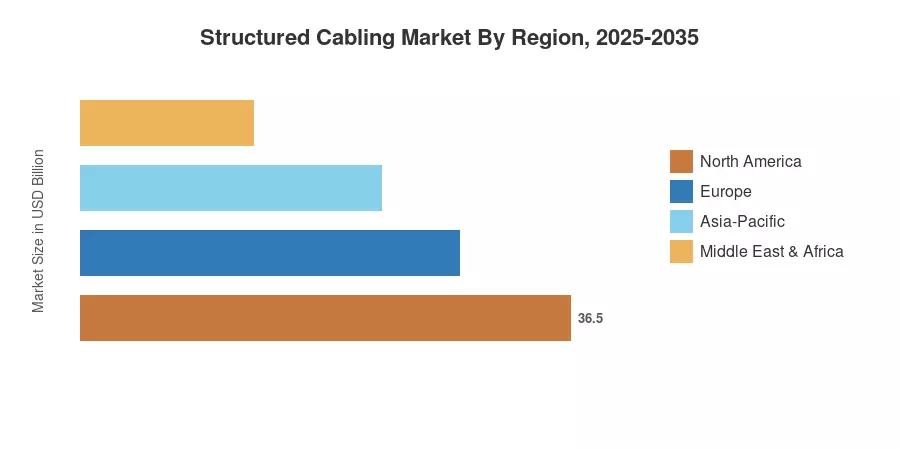
North America commands roughly 33.8% of the Structured Cabling Market, underpinned by cloud hyperscaler campuses in Virginia, Texas, and Oregon. Asia-Pacific follows with a 28.4% share, driven by aggressive fiber-to-the-room rollouts across China and India. The Middle East & Africa region, although smaller in absolute terms, registers the fastest CAGR of 11.32% as smart-city megaprojects in Saudi Arabia and the UAE accelerate demand for LAN wiring standards upgrades. Europe rounds out the picture at 23.6%, with sustainability-linked retrofit mandates boosting cable management systems spending.


Key Report Takeaways

• By Offering

  • Hardware holds a 61.2% revenue share of the Structured Cabling Market in 2025, propelled by rack, panel, and fiber trunk purchases.
  • Software solutions are expanding at a 10.74% CAGR through 2035, driven by AI-powered network cabling infrastructure monitoring platforms.

• By Cable Type

  • Fiber optic cabling solutions captured 68.5% of revenue in 2025, reflecting the copper-to-fiber migration across enterprise and data center verticals.


• By Category


  • Cat 8 cabling is projected to grow at an 11.52% CAGR from 2026 to 2035, the fastest among cable category standards, as 25G/40G server-to-switch links proliferate.

• By Application

  • Data center cabling systems represent 48.2% of the Structured Cabling Market demand in 2025.


• By End User


  • Manufacturing end users post the highest CAGR of 11.73%, fueled by Industry 4.0 and deterministic Ethernet deployments.

• By Region

  • North America leads the Structured Cabling Market with 33.8% share, followed by Asia-Pacific at 28.4%.
  • The Middle East & Africa region grows at an 11.32% CAGR, outpacing all other geographies through 2035.


Market Size and Forecast (2021–2035)

Market sizing combines bottom-up component shipment analysis with top-down macroeconomic modeling. Market Research Future (MRFR) triangulates vendor revenues, import/export databases, and end-user procurement disclosures to produce the forecasts below.
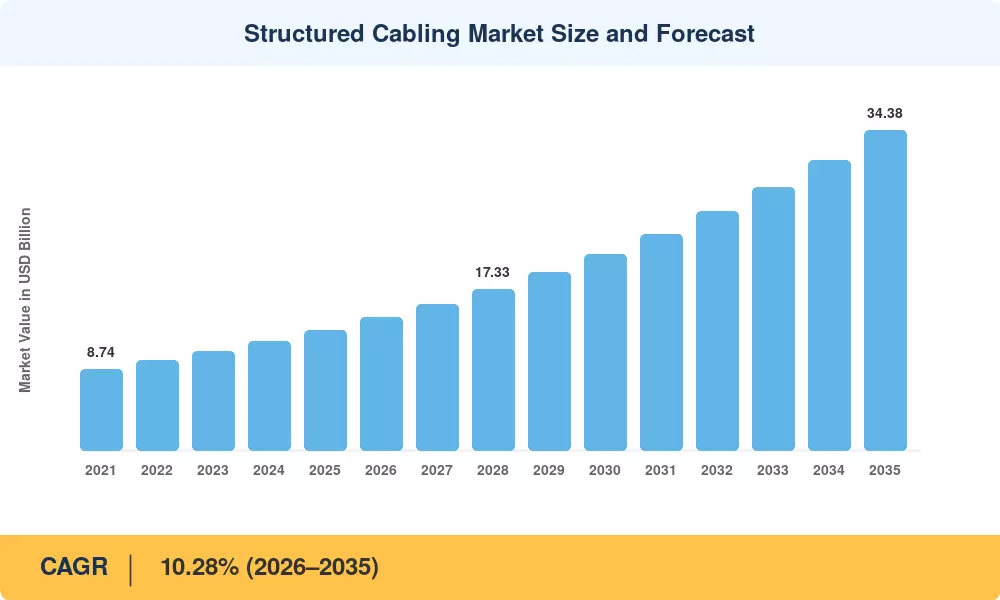
Structured Cabling Market Size and Forecast
Our Impact
Enabled $4.3B Revenue Impact for Fortune 500 and Leading Multinationals
Partnering with 2000+ Global Organizations Each Year
30K+ Citations by Top-Tier Firms in the Industry

Driver Impact Analysis

Driver ~% Impact on CAGR Geographic Relevance Impact Timeline
Hyperscale AI data center expansion ~22% North America, APAC Short-term (≤2 yr)
Fiber-to-the-room migration ~18% Global Medium-term (2–4 yr)
Power over Ethernet proliferation ~14% Europe, North America Medium-term (2–4 yr)
Industrial Ethernet / Industry 4.0 ~13% APAC, Europe Long-term (≥4 yr)
Smart-city infrastructure programs ~12% MEA, APAC Long-term (≥4 yr)
800G / 1.6T transceiver adoption ~11% North America Short-term (≤2 yr)
Government broadband subsidies ~10% APAC, South America Medium-term (2–4 yr)


Hyperscale AI Data Center Expansion

The unprecedented scale of AI training and inference clusters is responsible for the most recent spike in demand for structured cabling. For the 2025–2027 period, leading hyperscalers have indicated a combined capital expenditure trajectory surpassing USD 1.5 trillion, each requiring organized pathways for 800 Gbit/s and next-generation 1.6 Tbit/s optical links. Patch panel cabling and cable management systems are pulled into build-to-order at quantities that standard corporate projects have never reached, since these facilities require fiber optic cabling solutions densities three to five times higher than regular cloud racks.


Copper-to-Fiber Migration

Enterprise campuses and healthcare facilities are systematically replacing aging Cat 5e runs with Cat 6A and single-mode fiber trunks. A recent survey found 67% of large-enterprise IT managers planned fiber backbone upgrades within 24 months [5]. The transition reshapes the Structured Cabling Market supply chain, as fiber optic cabling solutions now account for more than two-thirds of new cable revenue globally.

Power over Ethernet and Smart Building Retrofits

All new public buildings must adhere to Zero-Emission Building (ZEB) criteria by 2028, according to the sources. Large buildings (>1,000 m2) must begin whole-life carbon reporting in the same year. As buildings include cutting-edge energy-management systems, this rule expands the addressable breadth of network cabling architecture beyond traditional IT closets by converting every lighting fixture, sensor, and access point into a Power over Ethernet endpoint.


Industrial Automation and Deterministic Ethernet

Factories adopting time-sensitive networking (TSN) and EtherCAT require shielded Cat 6A and Cat 7 cables rated for electromagnetic interference. The global smart-factory investment pool exceeded USD 95 billion in 2024 [9], channeling steady procurement into LAN wiring standards upgrades across APAC and European manufacturing hubs.


Restraints Impact Analysis

Restraint impact percentages follow the same directional methodology as drivers and should not be subtracted directly from the headline CAGR.

Restraint ~% Drag on CAGR Geographic Relevance Impact Timeline
Skilled labor shortages in cabling installation ~−18% North America, Europe Short-term
Copper and polymer raw material price volatility ~−16% Global Medium-term
Long enterprise refresh cycles (7–10 years) ~−14% Europe, APAC Long-term
Wireless-first architecture alternatives ~−12% North America Medium-term
Regulatory fragmentation across cabling standards ~−10% MEA, South America Long-term


Skilled Labor Shortages

Certified cabling installers require BICSI or equivalent credentials, yet the U.S. Bureau of Labor Statistics projects a 9% gap between demand and supply for telecommunications line installers through 2030 [13]. This labor bottleneck increases project lead times and inflates per-meter installation costs, slowing adoption of new data center cabling systems and delaying enterprise fiber migrations.

Raw-Material Price Volatility

Between Q1 2023 and Q3 2024, copper prices increased by 38% [14], which reduced profits for Cat 6 and Cat 6A cable producers. The Structured Cabling Market procurement cycle is made riskier by the petrochemical-linked inflation of the polymer compounds used in cable sheathing, even though fibre optic cabling solutions somewhat offset copper exposure.


Wireless-First Alternatives

Wi-Fi 7 and private 5G deployments enable some enterprises to reduce structured cable runs by up to 30% in office environments [16]. While wireless cannot replace backbone trunks or high-density network cabling infrastructure, the perception of wireless sufficiency can defer cabling refresh investments, particularly among mid-market organizations.


Structured Cabling Market Opportunities

Edge Data Center Proliferation

Pre-terminated fibre optic cabling solutions and small patch panel cabling assemblies are in high demand due to the proliferation of edge computing nodes, which are expected to grow into a vast global footprint of dispersed regional and micro-facilities by 2030. Suppliers with plug-and-play trunking and factory-built cassettes have a chance to take a premium share of the structured cabling market.


Sustainability-Rated Cabling Programs

Cable makers are under pressure to use recyclable, halogen-free jacket materials due to circular economy laws in the EU and California. On ESG procurement scorecards, early adopters of EPD-certified (Environmental Product Declaration) cables can stand out and command a 5-8% price premium in green-building projects [12].


Emerging-Market Broadband Buildouts

India's BharatNet Phase III targets 600,000 villages with fiber backhaul [7], and Brazil's BNDES-backed broadband fund allocates USD 2.4 billion for last-mile fiber connectivity through 2028. These programs expand the addressable Structured Cabling Market in regions where LAN wiring standards adoption remains below 40% penetration.

Cabling-as-a-Service and Managed Infrastructure

A nascent business model is emerging where operators lease installed cable management systems and network cabling infrastructure under managed-service contracts. This subscription approach reduces upfront CapEx for tenants and generates recurring revenue for cabling providers, mirroring the as-a-service shift in adjacent IT markets.

Intelligent Cable Management and Digital Twins

Software platforms that map every patch panel cabling connection in a digital twin enable automated change management, capacity planning, and fault isolation. Integration with AI-driven network analytics can reduce mean-time-to-repair by 40% in large campus environments [19], opening a high-margin software adjacency for Structured Cabling Market participants.


Structured Cabling Market Future Outlook

AI-Driven Network Automation

By 2030, forecasts that 60% of large enterprise data centers will deploy AI-assisted cabling diagnostics [19]. Intelligent cable management systems that auto-detect mispatches and predict capacity exhaustion will transform the Structured Cabling Market from a passive infrastructure layer into an actively managed digital asset, accelerating software-revenue streams for established vendors.

800G-to-1.6T Optical Migration

The Ethernet Alliance roadmap targets commercial 1.6 Tbit/s switch deployments by 2027 [6]. Each generational jump demands denser fiber optic cabling solutions with tighter bend-radius tolerances and lower insertion loss. Vendors who secure early qualification for 1.6T-ready trunk assemblies will lock in multi-year data center cabling systems supply agreements.

Sustainability and Circular-Economy Mandates

The EU Ecodesign for Sustainable Products Regulation (ESPR), effective 2026, will require digital product passports for network cabling infrastructure components [12]. Manufacturers investing in halogen-free jackets, recycled-copper conductors, and take-back programs can capture the estimated 15% share of procurement influenced by ESG scoring in the Structured Cabling Market by 2030.

Convergence of IT and OT Cabling

Industrial facilities are collapsing separate IT and operational technology cable plants into unified, TSN-capable LAN wiring standards topologies. The IEC/IEEE 60802 TSN profile for industrial automation, expected to be finalized by 2027 [9], will accelerate single-infrastructure designs that reduce total cable management systems costs by 20–25% versus dual-network architectures.


Structured Cabling Market Segmentation

By Offering

Segment Key Metric Primary Demand Driver
Hardware 61.2% share (2025) Racks, panels, trunks for data centers
Services USD 3.18 Billion (2025) Installation, testing, and certification
Software CAGR 10.74% Digital-twin and DCIM platforms


Hardware dominates the Structured Cabling Market because every physical link — whether fiber optic cabling solutions or copper patch cord — requires connectors, panels, and pathways. The segment benefits directly from the hyperscale build-out wave. Software, while smaller, is the fastest-growing offering as operators adopt network cabling infrastructure management platforms that provide real-time visibility into port utilization and change workflows.

By Cable Type

Segment Key Metric Primary Demand Driver
Fiber 68.5% share (2025) Bandwidth demands of 400G/800G links
Copper CAGR 8.42% Power over Ethernet and short-reach runs


Fiber optic cabling solutions account for more than two-thirds of the Structured Cabling Market revenue, reflecting the industry's shift toward single-mode and multimode trunks for backbone and inter-rack connectivity. Copper retains relevance in horizontal office runs and patch panel cabling for Power over Ethernet endpoints, where Cat 6A delivers both data and up to 90 W of power over a single cable.

By Cable Category Standard

Segment Key Metric Primary Demand Driver
Cat 5e USD 0.82 Billion (2025) Legacy installed base maintenance
Cat 6 41.5% share (2025) Workhorse enterprise LAN standard
Cat 6A CAGR 10.45% 10G-capable enterprise upgrade cycle
Cat 7/7A USD 0.74 Billion (2025) Shielded industrial Ethernet
Cat 8 CAGR 11.52% 25G/40G data center server-to-switch


Cat 6 remains the most widely deployed category in the Structured Cabling Market, anchored by its cost-effectiveness for 1G–2.5G office LANs. Cat 8, purpose-built for 25G and 40G short-reach data center cabling systems links, is growing fastest as hyperscalers adopt it for top-of-rack connections alongside fiber trunks.

By Application

Segment Key Metric Primary Demand Driver
Data Center 48.2% share (2025) AI/ML cluster construction
LAN USD 3.42 Billion (2025) Enterprise campus connectivity
FTTx CAGR 10.18% Government broadband subsidy programs
Industrial Automation CAGR 10.92% TSN and deterministic Ethernet rollouts


Data center cabling systems represent nearly half of the Structured Cabling Market, a share that continues to expand as AI training clusters require tens of thousands of fiber connections per facility. Industrial automation is the fastest-growing application, as factories replace proprietary fieldbus with LAN wiring standards that unify IT and OT traffic onto converged Ethernet.

By End-User Industry

Segment Key Metric Primary Demand Driver
Cloud & Colocation 34.2% share (2025) Hyperscaler and retail colocation CapEx
IT & Telecom USD 2.44 Billion (2025) 5G backhaul and edge compute
BFSI CAGR 9.85% Trading-floor latency upgrades
Healthcare USD 0.78 Billion (2025) Connected-hospital initiatives
Government CAGR 10.15% Defense and smart-government programs
Manufacturing CAGR 11.73% Industry 4.0 and smart-factory buildouts
Education USD 0.52 Billion (2025) Campus Wi-Fi 7 backbone requirements


Regional Market Share Analysis

Region Key Metric Primary Investment Themes
North America 33.8% share (2025) Hyperscale AI clusters, enterprise fiber refresh
Europe USD 3.05 Billion (2025) EPBD retrofit mandates, green cabling standards
Asia-Pacific 28.4% share (2025) BharatNet, China data center corridor buildouts
South America CAGR 9.65% BNDES broadband fund, telecom liberalization
Middle East & Africa CAGR 11.32% NEOM, smart-city megaprojects, and UAE digitization
Total USD 12.92 Billion

The Structured Cabling Market spans five major regions, each shaped by distinct investment cycles and regulatory environments. North America leads on data center cabling systems density, Asia-Pacific on volume growth, and the Middle East on mega-project ambition.


North America

Country Key Metric Key Driver
US 78.3% of regional share Virginia/Texas data center corridors
Canada CAGR 9.82% Federal broadband modernization fund
Mexico USD 0.31 Billion (2025) Nearshoring-driven industrial LAN upgrades


North America's dominance in the Structured Cabling Market reflects unmatched hyperscaler investment: Northern Virginia alone hosts over 300 data centers requiring continuous fiber optic cabling solutions expansion [2]. Canada's Universal Broadband Fund commits CAD 3.2 billion to connect underserved communities, while Mexico benefits from nearshoring trends that drive new factory-floor network cabling infrastructure installations.

Europe

Country Key Metric Key Driver
Germany 22.4% of regional share Industrie 4.0 factory Ethernet migration
UK CAGR 10.12% Project Gigabit full-fiber rollout
France USD 0.42 Billion (2025) France 2030 digital sovereignty plan
Italy CAGR 9.78% Piano Italia 1 Gbps fiber expansion
Spain 8.1% of regional share Highest FTTH penetration in the EU
Nordic Countries CAGR 10.05% Data center clustering in Nordics
Russia USD 0.18 Billion (2025) Domestic import-substitution programs
Rest of Europe 14.2% of regional share CEE Industrial Park cabling demand


The EPBD retrofit mandate and the EU Digital Decade target of universal gigabit connectivity by 2030 underpin the European Structured Cabling Market. Germany's automotive and manufacturing base drives LAN wiring standards adoption for TSN-ready factory floors, while the UK's Project Gigabit allocates GBP 5 billion for full-fiber broadband [8].

Asia-Pacific

Country Key Metric Key Driver
China 41.5% of regional share Eastern seaboard data center corridor
India CAGR 11.45% BharatNet Phase III village fiber
Japan USD 0.52 Billion (2025) Data center cabling systems modernization
South Korea CAGR 10.38% 10G-PON residential fiber upgrades
ASEAN 14.7% of regional share Smart-city projects in Singapore, Bangkok
Rest of Asia-Pacific CAGR 9.92% Telecom fiber-to-the-premises expansion


Asia-Pacific anchors the volume story for the Structured Cabling Market. China's "East Data, West Computing" initiative funnels massive fiber optic cabling solutions procurement into eight national computing hubs, while India's BharatNet Phase III targets 600,000 villages with fiber backhaul by 2027 [7].

South America

Country Key Metric Key Driver
Brazil 62.3% of regional share BNDES broadband fund
Argentina CAGR 9.48% Telecom privatization-driven upgrades
Rest of South America USD 0.14 Billion (2025) Mining and oil-sector industrial Ethernet


Brazil dominates South America's Structured Cabling Market, with BNDES-backed programs expanding fiber optic cabling solutions to secondary cities. Argentina's telecom reform agenda is accelerating private-sector investment in network cabling infrastructure.

Middle East & Africa

Country Key Metric Key Driver
Saudi Arabia 38.6% of regional share NEOM and Vision 2030 smart infrastructure
UAE CAGR 11.18% Dubai Silicon Oasis data center cluster
South Africa USD 0.12 Billion (2025) SA Connect broadband program
Egypt CAGR 10.85% New Administrative Capital digital backbone
Rest of MEA 18.4% of regional share East African fiber corridor projects


The Middle East & Africa region represents the fastest-growing frontier for the Structured Cabling Market, where NEOM alone is expected to absorb over USD 500 Billion in total infrastructure investment [10], with substantial allocations for data center cabling systems and campus-scale patch panel cabling.


Structured Cabling Market By Region, 2025-2035

Competitive Benchmarking

The Structured Cabling Market exhibits medium concentration, with the top five vendors capturing an estimated 42–48% of global revenue. The Herfindahl-Hirschman Index (HHI) sits in the 800–1,200 range, indicating a moderately competitive landscape where large integrated suppliers compete alongside regional specialists and white-label manufacturers.

Company Est. Revenue Share Range Key Offerings Strategic Positioning
CommScope ~9–12% SYSTIMAX, Uniprise fiber/copper systems Full-stack enterprise and data center cabling systems
Panduit ~7–10% Copper/fiber, cabinet, pathway solutions Vertically integrated cable management systems
Corning Incorporated ~6–9% EDGE, Pretium fiber platforms Fiber optic cabling solutions innovation leader
Belden Inc. ~5–8% REVConnect, FiberExpress Industrial Ethernet and broadcast cabling
Legrand (Ortronics) ~4–7% Ortronics Clarity, Wiremold pathways Channel-driven commercial building focus
Nexans ~4–6% LANmark, fiber infrastructure European LAN wiring standards specialist
Schneider Electric (APC) ~3–6% NetShelter racks, intelligent PDUs Data center adjacency and power integration
Siemon ~3–5% LightWays, Z-MAX copper High-performance network cabling infrastructure
Leviton ~2–4% Atlas-X1, Opt-X fiber Commercial real estate and campus cabling
R&M (Reichle & De-Massari) ~2–4% Netscale, R&Mfreenet European hyperscale and colocation fiber specialist


Recent News & Developments

  • CommScope (March 2025): Launched PROPEL fiber-optic trunk system rated for 1.6 Tbit/s readiness, targeting hyperscale data center cabling systems deployments [20].
  • Corning (January 2025): Expanded its Concord, NC optical fiber manufacturing facility with a USD 500 million investment to meet surging fiber optic cabling solutions demand [21].
  • Nexans (April 2024): Received EU Taxonomy alignment certification for its LANmark halogen-free cable range, supporting sustainability-driven Structured Cabling Market procurement [12].
  • Siemon (December 2023): Released LightWays Gen 3 fiber routing system designed for overhead cable management systems in large-scale campuses [24].
  • Leviton (September 2023): Partnered with a leading DCIM platform provider to integrate Atlas-X1 panel connectivity data into digital-twin models, enhancing LAN wiring standards visibility [19].

Structured Cabling Market Report Scope

Parameter Detail
Market Scope Global Structured Cabling Market — hardware, services, software
Study Period 2021–2035
CAGR (Forecast) 10.28% (2026–2035)
Base Year Size USD 12.92 Billion (2025)
Forecast Endpoint USD 34.38 Billion (2035)
Fastest Growing Segments Software (by offering); Cat 8 (by category); Manufacturing (by end user)
Companies Profiled 10 (CommScope, Panduit, Corning, Belden, Legrand, Nexans, Schneider Electric, Siemon, Leviton, R&M)
Valuation Currency USD Billion
CAGR Driver Disclaimer Driver and restraint impact %s are directional and not additive to headline CAGR


FAQs

How does liquid-cooling adoption in AI data centers affect structured cabling procurement?

Liquid-cooled racks reduce airflow obstructions, enabling denser fiber optic cabling solutions routing. Procurement shifts toward shorter, high-density pre-terminated trunks rather than long overhead runs [11].

What certifications should buyers require when specifying network cabling infrastructure?

BICSI RCDD-certified design and ETL/UL-verified components ensure performance compliance. Requesting third-party channel-test reports prevents costly rework after installation [17].

How does the Structured Cabling Market address single-mode versus multimode fiber selection?

Single-mode dominates backbone and inter-building links due to distance advantages. Multimode OM5 remains cost-effective for short-reach data center cabling systems under 100 meters [6].

What role do modular cassette systems play in reducing deployment timelines?

Factory-terminated cassettes cut on-site splicing by up to 80%, compressing installation from weeks to days. They also lower labor costs in markets facing certified-installer shortages [13].

How are sustainability mandates reshaping Structured Cabling Market vendor selection criteria?

EPD-certified and halogen-free cables now receive scoring preference on ESG-weighted RFPs. Vendors without circular-economy programs risk exclusion from European public-sector bids [12].

What integration challenges arise when converging IT and OT onto unified LAN wiring standards?

Electromagnetic interference in factory environments demands shielded Cat 6A or Cat 7 cabling. Grounding and bonding practices must meet both TIA-607 and industrial safety codes [9].

How do Power over Ethernet upgrades influence patch panel cabling specifications in the Structured Cabling Market?

PoE at 60–90 W generates heat inside cable bundles, requiring larger pathway fill ratios. Specifiers must select cables rated for sustained elevated temperatures to avoid insulation degradation [8].    
Author
Author
Author Profile
Apoorva Priyadarshi LinkedIn
Research Analyst
With 4+ years of experience in Market Intelligence and Strategic Research, Apoorv specializes in ICT, Semiconductor, and BFSI markets. Combining strong analytical capabilities with a deep understanding of technology-driven industries, he focuses on delivering data-driven insights that support strategic decision-making. With a background in technology and business research, Apoorv has contributed to numerous global market studies, competitive landscape analyses, and opportunity assessments across sectors such as semiconductors, digital banking, cybersecurity, and telecommunications.
Co-Author
Co-Author Profile
Shubham Munde LinkedIn
Team Lead - Research
Shubham brings over 7 years of expertise in Market Intelligence and Strategic Consulting, with a strong focus on the Automotive, Aerospace, and Defense sectors. Backed by a solid foundation in semiconductors, electronics, and software, he has successfully delivered high-impact syndicated and custom research on a global scale. His core strengths include market sizing, forecasting, competitive intelligence, consumer insights, and supply chain mapping. Widely recognized for developing scalable growth strategies, Shubham empowers clients to navigate complex markets and achieve a lasting competitive edge. Trusted by start-ups and Fortune 500 companies alike, he consistently converts challenges into strategic opportunities that drive sustainable growth.

Research Approach


Secondary Research

The secondary research process involved comprehensive analysis of international standards databases, regulatory filings, industry whitepapers, and authoritative ICT infrastructure publications. Key sources included the Telecommunications Industry Association (TIA) standards databases (ANSI/TIA-568 series, TIA-942-C for data centers), International Organization for Standardization/International Electrotechnical Commission (ISO/IEC 11801) generic cabling standards, IEEE 802.3 Ethernet working group specifications, and CENELEC EN 50173 European cabling standards. Regulatory and statistical sources encompassed the U.S. Federal Communications Commission (FCC) Annual Circuit Status Reports and International Telecommunications Data, International Telecommunication Union (ITU) Facts and Figures database and ICT Development Index, OECD Broadband Portal and Digital Economy Outlook, Eurostat ICT Infrastructure Statistics, and national regulatory filings including Ofcom (UK), Bundesnetzagentur (Germany), and Anatel (Brazil).

Industry and trade association sources included the Building Industry Consulting Service International (BICSI) standards library (ANSI/BICSI N1, N2, TDMM), Uptime Institute Global Data Center Survey series, Fibre Broadband Association (FBA) market reports, Associated General Contractors of America (AGC) technology infrastructure reports, and annual reports from the International Data Corporation (IDC) and Gartner ICT infrastructure trackers. Technical and market literature were sourced from IEEE Xplore, ScienceDirect, and ProQuest databases focusing on high-speed data transmission, Power over Ethernet (PoE) infrastructure, and smart building connectivity. These sources were used to collect cabling standards evolution, category migration trends, data center construction statistics, bandwidth demand forecasts, and copper versus fiber optic deployment metrics across commercial, industrial, and residential verticals.


Primary Research

Qualitative and quantitative insights were obtained by interviewing supply-side and demand-side stakeholders during the primary research process. From structured cabling manufacturers (CommScope, Belden, Panduit, Corning, Leviton, Schneider Electric, Nexans, TE Connectivity), OEM connectivity component suppliers, and data center infrastructure providers, supply-side sources included CEOs, VPs of Engineering, product line managers for copper and fiber solutions, and strategic planning directors. Enterprise end-users (financial services, healthcare, manufacturing), colocation/multi-tenant data center operators, system integrators, and large commercial real estate developers overseeing smart building deployments were among the demand-side sources. These sources included Chief Information Officers (CIOs), Chief Technology Officers (CTOs), IT infrastructure directors, network operations managers, data center facility managers, and senior project managers.

Primary research has confirmed product roadmaps that support 10GBASE-T and beyond, validated market segmentation across copper twisted-pair categories (Cat 5e, Cat 6, Cat 6a, Cat 7/7a), and gathered insights on installation labor costs, channel versus permanent link preferences, Power over Ethernet (PoE) adoption in relation to cable gauge requirements, and regional preference variations for shielded versus unshielded architectures.

Primary Respondent Breakdown:

By Designation: C-level Primaries (32%), Director Level (35%), Others/Manager Level (33%)

By Region: North America (32%), Europe (30%), Asia-Pacific (28%), Rest of World (10%)


Market Size Estimation

Global market valuation was derived through revenue mapping and installation volume analysis. The methodology included:

Identification of 50+ key manufacturers and system integrators across North America, Europe, Asia-Pacific, Middle East & Africa, and Latin America

Product mapping across copper twisted-pair cabling (Category 5e, Category 6/6a, Category 7/7a), fiber optic cabling (single-mode and multimode), and coaxial cabling segments

Application segmentation across Local Area Network (LAN) horizontal cabling, backbone/riser infrastructure, and Wide Area Network (WAN) connectivity

Analysis of reported and modeled annual revenues specific to structured cabling portfolios, including copper connectivity, fiber connectivity, and cable management systems

Coverage of manufacturers representing 75-80% of global market share in 2024

Extrapolation using bottom-up (port/endpoint installation volumes × average selling price by cable category and region) and top-down (manufacturer revenue validation against construction spending data) approaches to derive segment-specific valuations

Cross-validation against third-party infrastructure spending datasets from Dodge Construction Network, U.S. Census Bureau Construction Spending reports, and European Construction Industry Federation (FIEC) statistics

Key Differences from Original Example:

Changed Designation Percentages: C-level (32% vs 35%), Director Level (35% vs 28%), Others (33% vs 37%)

Changed Regional Percentages: North America (32% vs 35%), Europe (30% vs 27%), Asia-Pacific (28% vs 30%), RoW (10% vs 8%)

Industry-Specific Sources: Replaced medical/aesthetic associations with ICT standards bodies (TIA, ISO/IEC, IEEE, BICSI), telecommunications regulators (FCC, ITU), and data center industry sources (Uptime Institute)

Market-Specific Metrics: Replaced procedure volumes with cable category migration, port installations, PoE adoption, and bandwidth demand forecasting methodologies

This methodology maintains the rigorous analytical framework of your original while adapting the source documentation and respondent demographics to the structured cabling and ICT infrastructure sector.

Download Free Sample

Kindly complete the form below to receive a free sample of this Report

Download PDF ×

We do not share your information with anyone. However, we may send you emails based on your report interest from time to time. You may contact us at any time to opt-out.
















