×
Request Free Sample ×

Kindly complete the form below to receive a free sample of this Report

* Please use a valid business email

Leading companies partner with us for data-driven Insights

clients tt-cursor
Hero Background

Sugar Crops Biofuel Market

ID: MRFR/EnP/29596-HCR
128 Pages
Priya Nagrale
October 2025

Biofuel From Sugar Crops Market Research Report By Biofuel Type (Ethanol, Butanol, Biodiesel), By Sugar Crop Source (Sugarcane, Sugar Beets, Corn), By Production Technology (Fermentation, Transesterification, Hydrolysis), By Application (Transportation, Industrial, Power Generation), By Feedstock Type (First Generation, Second Generation) and By Regional (North America, Europe, South America, Asia Pacific, Middle East and Africa) - Forecast to 2035

Share:
Download PDF ×

We do not share your information with anyone. However, we may send you emails based on your report interest from time to time. You may contact us at any time to opt-out.

Sugar Crops Biofuel Market Infographic
Purchase Options

Sugar Crops Biofuel Market Summary

As per MRFR analysis, the Biofuel From Sugar Crops Market Size was estimated at 52.17 USD Billion in 2024. The biofuel industry is projected to grow from 54.95 USD Billion in 2025 to 92.38 USD Billion by 2035, exhibiting a compound annual growth rate (CAGR) of 5.33 during the forecast period 2025 - 2035.

Key Market Trends & Highlights

The Biofuel From Sugar Crops Market is experiencing robust growth driven by sustainability and technological advancements.

  • The demand for sustainable energy sources is rising, propelling the biofuel market forward.
  • Technological innovations in production processes are enhancing efficiency and reducing costs.
  • North America remains the largest market, while Asia-Pacific is emerging as the fastest-growing region.
  • Key drivers include increasing energy security and supportive regulatory frameworks that promote environmental sustainability.

Market Size & Forecast

2024 Market Size 52.17 (USD Billion)
2035 Market Size 92.38 (USD Billion)
CAGR (2025 - 2035) 5.33%

Major Players

Green Plains Inc (US), Royal Dutch Shell (NL), POET LLC (US), Archer Daniels Midland Company (US), Cargill Inc (US), Bunge Limited (US), Cosan Limited (BR), SABIC (SA), Abengoa Bioenergy (ES)

Sugar Crops Biofuel Market Trends

The Biofuel From Sugar Crops Market is currently experiencing a notable transformation, driven by a confluence of environmental concerns and technological advancements. As nations strive to reduce greenhouse gas emissions and enhance energy security, biofuels derived from sugar crops are increasingly viewed as a viable alternative to fossil fuels. This shift is further supported by government policies promoting renewable energy sources, which appear to encourage investment in biofuel production facilities. Additionally, the growing awareness of climate change impacts is prompting consumers and industries alike to seek sustainable energy solutions, thereby bolstering demand for biofuels. Moreover, innovations in processing technologies are likely to enhance the efficiency of biofuel production from sugar crops. These advancements may lead to improved yield rates and reduced production costs, making biofuels more competitive in the energy market. The integration of biotechnology in crop development could also result in higher sugar content in feedstocks, further optimizing biofuel outputs. As the Biofuel From Sugar Crops Market evolves, it seems poised to play a crucial role in the global energy landscape, aligning with broader sustainability goals and economic strategies.

Rising Demand for Sustainable Energy

The increasing emphasis on sustainability is driving a surge in demand for biofuels derived from sugar crops. As consumers and industries prioritize eco-friendly energy sources, biofuels are becoming a preferred choice, aligning with global efforts to combat climate change.

Technological Innovations in Production

Advancements in processing technologies are enhancing the efficiency of biofuel production from sugar crops. These innovations may lead to improved yield rates and lower production costs, making biofuels more competitive against traditional fossil fuels.

Government Support and Policy Frameworks

Supportive government policies are playing a pivotal role in the growth of the Biofuel From Sugar Crops Market. Incentives and regulations aimed at promoting renewable energy sources are encouraging investments in biofuel production, fostering market expansion.

Sugar Crops Biofuel Market Drivers

Increasing Energy Security

The Biofuel From Sugar Crops Market is experiencing a notable surge in interest due to the increasing emphasis on energy security. Nations are striving to reduce their dependence on fossil fuels, which are often subject to volatile prices and geopolitical tensions. By investing in biofuels derived from sugar crops, countries can enhance their energy independence and stabilize their energy supply. This shift is reflected in the growing production capacities, with biofuel production from sugar crops projected to reach approximately 30 billion liters by 2026. Such developments indicate a robust market potential, as governments and industries alike recognize the strategic importance of diversifying energy sources.

Supportive Regulatory Frameworks

The Biofuel From Sugar Crops Market is significantly shaped by supportive regulatory frameworks established by various governments. Policies aimed at promoting renewable energy sources, including biofuels, are being implemented to meet climate targets and reduce carbon footprints. Incentives such as tax credits, subsidies, and mandates for biofuel blending are encouraging the production and consumption of biofuels from sugar crops. For instance, several countries have set ambitious targets for biofuel usage, with some aiming for a 20% blend of biofuels in transportation fuels by 2030. Such regulatory support is crucial for the growth of the biofuel market, as it provides a conducive environment for investment and development.

Rising Consumer Awareness and Demand

The Biofuel From Sugar Crops Market is witnessing a rise in consumer awareness regarding the benefits of renewable energy sources. As individuals become more informed about the environmental impacts of fossil fuels, there is a growing preference for sustainable alternatives. This shift in consumer behavior is driving demand for biofuels, particularly those derived from sugar crops, which are perceived as eco-friendly options. Market Research Future indicates that consumer demand for biofuels is expected to increase by 15% over the next five years, reflecting a broader trend towards sustainability. This heightened awareness is likely to encourage further investments in the biofuel sector, fostering innovation and growth.

Advancements in Agricultural Practices

The Biofuel From Sugar Crops Market is benefiting from advancements in agricultural practices that enhance the yield and efficiency of sugar crop production. Innovations such as precision agriculture, genetically modified organisms, and improved crop management techniques are enabling farmers to produce more sugar crops with less resource input. This increase in productivity is crucial, as it supports the growing demand for biofuels while ensuring economic viability for producers. Recent data indicates that sugarcane yields have increased by approximately 20% over the past decade, which is likely to bolster the biofuel sector. Consequently, these advancements are pivotal in shaping the future landscape of the biofuel market.

Environmental Sustainability Initiatives

The Biofuel From Sugar Crops Market is significantly influenced by the global push towards environmental sustainability. As climate change concerns escalate, there is a concerted effort to transition from fossil fuels to renewable energy sources. Biofuels from sugar crops are perceived as a cleaner alternative, potentially reducing greenhouse gas emissions by up to 80% compared to traditional fuels. This environmental advantage is driving investments and innovations within the sector, with the market expected to grow at a compound annual growth rate of 5% over the next five years. Such trends underscore the alignment of biofuel production with sustainability goals, making it an attractive option for both consumers and policymakers.

Market Segment Insights

By Type: Ethanol (Largest) vs. Biodiesel (Fastest-Growing)

In the Biofuel From Sugar Crops Market, ethanol dominates the segment landscape, accounting for the majority of market share. Its widespread adoption is attributed to established production technologies and robust demand in the transportation sector. Biodiesel, while currently smaller in market share, is rapidly gaining traction as more industries pivot towards renewable energy sources and sustainability practices. Butanol, on the other hand, has a modest presence in the market, primarily serving niche applications.

Ethanol (Dominant) vs. Butanol (Emerging)

Ethanol remains the dominant biofuel in the market, benefiting from an extensive distribution network and significant government support in various regions. Its favorable energy content and compatibility with existing internal combustion engines bolster its position. In contrast, butanol is an emerging alternative that is gaining attention due to its higher energy density and potential for a lower vapor pressure, making it an increasingly attractive option. However, its production processes are less mature than ethanol’s, which may hinder adoption rates in the short term until advancements are made.

By Sugar Crop Source: Sugarcane (Largest) vs. Sugar Beets (Fastest-Growing)

In the Biofuel From Sugar Crops Market, Sugarcane dominates the segment, accounting for the largest market share due to its high sugar content and favorable growth conditions. Its extensive cultivation in tropical regions enhances its availability and processing prowess, making it a preferred choice for biofuel production. In contrast, Sugar Beets, while currently holding a smaller share, have shown significant growth potential, particularly in temperate regions where they provide an alternative to sugarcane, attracting investment and interest from biofuel producers.

Sugarcane (Dominant) vs. Corn (Emerging)

Sugarcane stands out as the dominant source in the biofuel market due to its efficiency in converting sugar to energy and established supply chain. It is favored for its high yield per acre compared to other crops, making it a cost-effective option. On the other hand, Corn is an emerging segment, often associated with ethanol production. While it has a well-developed infrastructure for biofuel, its sustainability concerns regarding water usage and fertilizer inputs are pushing researchers to explore more eco-friendly alternatives. Both crops exhibit unique strengths that cater to the evolving biofuel landscape.

By Production Technology: Fermentation (Largest) vs. Transesterification (Fastest-Growing)

The Biofuel From Sugar Crops Market showcases a diverse landscape in its production technologies. Fermentation holds a significant market share, predominantly due to its established processes and production efficiencies. In contrast, Transesterification is gaining traction and rapidly increasing its presence within the market, particularly in the realm of biodiesel production. Hydrolysis, while important, occupies a smaller segment of the market, focusing mainly on converting cellulose into fermentable sugars, which can then be utilized for biofuel production.

Production Technology: Fermentation (Dominant) vs. Hydrolysis (Emerging)

Fermentation technology remains the dominant method for converting sugar crops into biofuels, leveraging the biological processes of yeast and bacteria to produce ethanol. This method benefits from well-established practices and a robust supply chain, making it highly efficient. Meanwhile, Hydrolysis is emerging as a valuable alternative, breaking down complex carbohydrates into simple sugars, which can be fermented. The increased focus on renewable energy sources, coupled with advancements in enzyme technologies, positions Hydrolysis as a promising contender in the market's future, appealing to new investment and research opportunities as sustainability becomes more critical.

By Application: Transportation (Largest) vs. Industrial (Fastest-Growing)

In the Biofuel From Sugar Crops Market, the application segment reveals a diverse distribution of end-use categories, with transportation leading significantly. This sub-segment is driven by the global transition towards renewable energy sources, where biofuels are seen as a sustainable alternative for conventional fuels. The industrial application follows closely, catering to various milling, processing, and manufacturing needs, while power generation still holds a considerable share but is less prevalent than the other two. In recent years, the transportation segment has gained momentum due to increasing fuel efficiency mandates and a shift in consumer preference toward clean energy solutions. Conversely, the industrial application is touted as the fastest-growing segment, prompted by regulatory support and advancements in production technologies. Additionally, the heightened focus on reducing carbon emissions is driving more industries to adopt biofuels derived from sugar crops as a viable energy solution.

Transportation: Dominant vs. Industrial: Emerging

The transportation application remains the dominant player in the Biofuel From Sugar Crops Market, driven by its alignment with global efforts to reduce greenhouse gas emissions and reliance on fossil fuels. It encompasses a wide range of uses, including road, rail, and maritime transportation, where biofuels are increasingly adopted amid stringent environmental regulations. On the other hand, the industrial application is emerging robustly due to the versatility of biofuels in powering machinery and heating processes. As industries seek sustainable alternatives to traditional fossil fuels, the interest in biofuels has surged, facilitated by innovations in extraction and processing methods. This dual landscape within the application segment highlights a shift toward sustainability while accommodating varied market demands.

By Feedstock Type: First Generation (Largest) vs. Second Generation (Fastest-Growing)

In the Biofuel From Sugar Crops Market, the feedstock type segmentation reveals that First Generation biofuels hold a significant portion of the market share. These traditional biofuels, derived from food crops, are well-established and widely used due to their familiarity and existing infrastructure. Conversely, Second Generation biofuels, produced from non-food biomass, are emerging rapidly, appealing to environmental concerns and sustainability, thus attracting investment and research.

Feedstock Type: First Generation (Dominant) vs. Second Generation (Emerging)

First Generation biofuels dominate the market primarily because of their established production processes and the extensive supply chains that have been developed over years. These biofuels are derived from sugarcane and other food crops, contributing to their competition with food supply chains. On the other hand, Second Generation biofuels, which utilize lignocellulosic materials and waste materials, are on the rise as they address sustainability challenges and are less controversial regarding food security. As technological advancements reduce production costs and increase efficiency, Second Generation biofuels are predicted to become more mainstream, promising significant growth potential in the coming years.

Get more detailed insights about Sugar Crops Biofuel Market

Regional Insights

North America : Innovation and Sustainability Leader

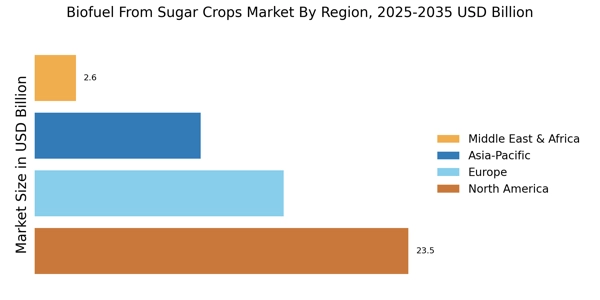
North America is the largest market for biofuels derived from sugar crops, holding approximately 45% of the global market share. The region's growth is driven by increasing demand for renewable energy, stringent environmental regulations, and advancements in biofuel technology. The U.S. government has implemented various incentives to promote biofuel production, including tax credits and grants, which further stimulate market growth. The United States is the leading country in this sector, with major players like Green Plains Inc, POET LLC, and Archer Daniels Midland Company dominating the landscape. These companies are investing heavily in research and development to enhance production efficiency and reduce costs. The competitive environment is characterized by a mix of large corporations and innovative startups, all striving to capture a share of the expanding biofuel market.

Europe : Regulatory Framework and Innovation

Europe is the second-largest market for biofuels from sugar crops, accounting for approximately 30% of the global market share. The region's growth is fueled by ambitious renewable energy targets set by the European Union, which aims to reduce greenhouse gas emissions and increase the share of renewables in the energy mix. Regulatory frameworks, such as the Renewable Energy Directive, play a crucial role in promoting biofuel adoption and ensuring sustainability standards are met. Leading countries in Europe include Germany, France, and the Netherlands, where significant investments in biofuel infrastructure are being made. Key players like Royal Dutch Shell and Abengoa Bioenergy are actively involved in the market, focusing on innovative technologies to enhance biofuel production. The competitive landscape is robust, with both established companies and emerging startups contributing to the sector's growth.

Asia-Pacific : Emerging Market Potential

The Asia-Pacific region is witnessing rapid growth in the biofuels market, driven by increasing energy demands and government initiatives to promote renewable energy sources. This region holds approximately 20% of the global market share, with countries like India and China leading the charge. Regulatory support, including subsidies and mandates for biofuel blending, is catalyzing market expansion and attracting investments in biofuel production facilities. India is emerging as a key player in the biofuel sector, with significant investments from both government and private entities. Companies like Cosan Limited and SABIC are exploring opportunities in this market, focusing on sustainable practices and innovative technologies. The competitive landscape is evolving, with a mix of local and international players vying for market share, indicating a promising future for biofuels in the region.

Middle East and Africa : Resource-Rich Opportunities

The Middle East and Africa region is gradually emerging in the biofuels market, holding about 5% of the global share. The growth is primarily driven by the need for energy diversification and the availability of agricultural resources suitable for biofuel production. Countries like South Africa and Brazil are exploring biofuel options to reduce dependency on fossil fuels and enhance energy security, supported by favorable government policies. In this region, the competitive landscape is still developing, with key players like Cargill Inc and Bunge Limited beginning to establish a presence. The focus is on leveraging local agricultural products for biofuel production, which presents unique opportunities for growth. As awareness of renewable energy benefits increases, the market is expected to expand, attracting more investments and innovations in biofuel technologies.

Sugar Crops Biofuel Market Regional Image

Key Players and Competitive Insights

The Biofuel From Sugar Crops Market is characterized by an increasing focus on sustainable energy sources, driven by the growing demand for renewable fuels and environmental regulations. This competitive landscape is marked by technological advancements, significant investments in research and development, and strategic partnerships among key players aiming to enhance production efficiency and reduce costs. Market dynamics are further influenced by fluctuating sugar crop prices, government policies supporting biofuel initiatives, and shifts in consumer preferences toward green energy. 

Additionally, the rise of biofuel projects across various regions is transforming the energy sector, thus intensifying competition among existing and emerging companies. The interplay between market demand, technological innovation, and regulatory frameworks will shape the strategies deployed by firms in the industry as they seek to gain a competitive edge and capitalize on market opportunities.

In the realm of the Global Biofuels From Sugar Crops Market, DuPont stands out due to its established reputation for innovation and development in biofuel production technologies. The company possesses a wealth of experience and a strong portfolio of patented processes that enable the efficient conversion of sugar crops into biofuels. DuPont's strength lies in its robust research and development capabilities, allowing it to consistently advance its biofuel production methodologies and improve process efficiencies. Furthermore, DuPont benefits from extensive collaborations with agricultural partners, enabling them to secure quality raw materials.

Their focus on sustainability and eco-friendly practices resonates well with the current market trends, solidifying their position as a leading player in the biofuel industry.

Novozymes, another significant contender in the Biofuel From Sugar Crops Market, holds a strategic advantage with its biotechnology solutions tailored for bioethanol production. The company has carved a niche in enzyme development specifically optimized for the fermentation processes essential in converting sugar crops into biofuels. With an unwavering dedication to innovation, Novozymes actively invests in cutting-edge research aimed at enhancing the efficiency of biofuels derived from sugar sources. Their position is further strengthened by a comprehensive global network that facilitates collaboration and distribution, allowing for agile responses to market trends and demands.

This focus on enzyme technology and sustainability aligns with the overall goals of the biofuel industry, establishing Novozymes as a key player committed to fostering a greener energy future.

Key Companies in the Sugar Crops Biofuel Market market include

Industry Developments

Recent developments in the Biofuel From Sugar Crops Market have been marked by increased investments and advancements in technology aimed at enhancing the efficiency of biofuel production. Several countries are adopting policies to promote the use of biofuels as part of their renewable energy initiatives, aligning with global sustainability goals. Notably, Brazil and the United States continue to lead in production, capitalizing on their abundant sugar crop resources. Additionally, innovations in genetic engineering and fermentation processes are being explored to optimize yield and reduce production costs.

The market is also witnessing rising interest from automotive manufacturers, who are looking to incorporate biofuels as a greener alternative to traditional fuels. Furthermore, global supply chain disruptions caused by geopolitical tensions and climate change are prompting stakeholders to assess their strategies, ensuring robustness in sourcing and production. As awareness about climate change and energy independence grows, the biofuel market is expected to play a crucial role in the transition to cleaner energy, with significant stakeholders positioning themselves to capitalize on future opportunities.

Future Outlook

Sugar Crops Biofuel Market Future Outlook

The Biofuel From Sugar Crops Market is projected to grow at a 5.33% CAGR from 2024 to 2035, driven by increasing demand for renewable energy and government policies supporting biofuel production.

New opportunities lie in:

  • Development of advanced fermentation technologies for higher yield
  • Expansion into emerging markets with tailored biofuel solutions
  • Partnerships with agricultural producers for sustainable feedstock sourcing

By 2035, the market is expected to be robust, driven by innovation and strategic partnerships.

Market Segmentation

Sugar Crops Biofuel Market Type Outlook

  • Ethanol
  • Butanol
  • Biodiesel

Sugar Crops Biofuel Market Application Outlook

  • Transportation
  • Industrial
  • Power Generation

Sugar Crops Biofuel Market Feedstock Type Outlook

  • First Generation
  • Second Generation

Sugar Crops Biofuel Market Sugar Crop Source Outlook

  • Sugarcane
  • Sugar Beets
  • Corn

Sugar Crops Biofuel Market Production Technology Outlook

  • Fermentation
  • Transesterification
  • Hydrolysis

Report Scope

MARKET SIZE 202452.17(USD Billion)
MARKET SIZE 202554.95(USD Billion)
MARKET SIZE 203592.38(USD Billion)
COMPOUND ANNUAL GROWTH RATE (CAGR)5.33% (2024 - 2035)
REPORT COVERAGERevenue Forecast, Competitive Landscape, Growth Factors, and Trends
BASE YEAR2024
Market Forecast Period2025 - 2035
Historical Data2019 - 2024
Market Forecast UnitsUSD Billion
Key Companies ProfiledMarket analysis in progress
Segments CoveredMarket segmentation analysis in progress
Key Market OpportunitiesGrowing demand for sustainable energy solutions drives innovation in the Biofuel From Sugar Crops Market.
Key Market DynamicsRising demand for sustainable energy sources drives innovation and competition in the biofuel from sugar crops market.
Countries CoveredNorth America, Europe, APAC, South America, MEA

Leave a Comment

FAQs

What is the current valuation of the Biofuel From Sugar Crops Market?

The market valuation reached 52.17 USD Billion in 2024.

What is the projected market size for the Biofuel From Sugar Crops Market by 2035?

The market is expected to grow to 92.38 USD Billion by 2035.

What is the expected CAGR for the Biofuel From Sugar Crops Market during the forecast period 2025 - 2035?

The market is projected to experience a CAGR of 5.33% from 2025 to 2035.

Which companies are considered key players in the Biofuel From Sugar Crops Market?

Key players include Green Plains Inc, Royal Dutch Shell, POET LLC, and Archer Daniels Midland Company.

What are the primary types of biofuels produced from sugar crops?

The main types include Ethanol, Butanol, and Biodiesel, with Ethanol valued between 30.0 and 50.0 USD Billion.

What are the leading sugar crop sources for biofuel production?

Sugarcane, Sugar Beets, and Corn are the primary sources, with Sugarcane valued between 20.0 and 35.0 USD Billion.

What production technologies are utilized in the Biofuel From Sugar Crops Market?

The market employs Fermentation, Transesterification, and Hydrolysis, with Fermentation valued between 20.0 and 35.0 USD Billion.

What applications are driving the demand for biofuels from sugar crops?

Key applications include Transportation, Industrial use, and Power Generation, with Transportation valued between 20.0 and 35.0 USD Billion.

What feedstock types are utilized in the Biofuel From Sugar Crops Market?

The market primarily uses First Generation and Second Generation feedstocks, with First Generation valued between 30.0 and 50.0 USD Billion.

How does the market performance of biofuels from sugar crops compare to other renewable energy sources?

While specific comparisons are not provided, the growth trajectory suggests a robust performance within the renewable energy sector.

Download Free Sample

Kindly complete the form below to receive a free sample of this Report

Compare Licence

×
Features License Type
Single User Multiuser License Enterprise User
Price $4,950 $5,950 $7,250
Maximum User Access Limit 1 User Upto 10 Users Unrestricted Access Throughout the Organization
Free Customization
Direct Access to Analyst
Deliverable Format
Platform Access
Discount on Next Purchase 10% 15% 15%
Printable Versions