Sulfuric Acid Market (2026 - 2035)

Sulfuric Acid Market Research Report Information By Raw Material (Elemental Sulfur, Pyrite Ores, Base Metal Smelters, Others), By Application (Fertilizers, Metal Processing, Petroleum Refining, Chemical Manufacturing, Others) and By Region - Global Forecast to 2035
ID: MRFR/CnM/1505-CR
128 Pages
Priya Nagrale
Last Updated: July 12, 2026
Sulfuric Acid Market
Market Size
Forecast Period2026-2035
CAGR (2026-2035)4.10%
2025 Market SizeUSD 12.80 Billion
2035 Market SizeUSD 19.14 Billion
Key Players
OCP Group
BASF SE
Aurubis AG
Boliden AB
Chemtrade Logistics
Glencore plc
Opportunities
  • Battery Recycling and Circular Acid Loops
  • African Phosphate Corridor Development
  • Digital Twins and AI-Driven Process Optimization

Sulfuric Acid Market Summary

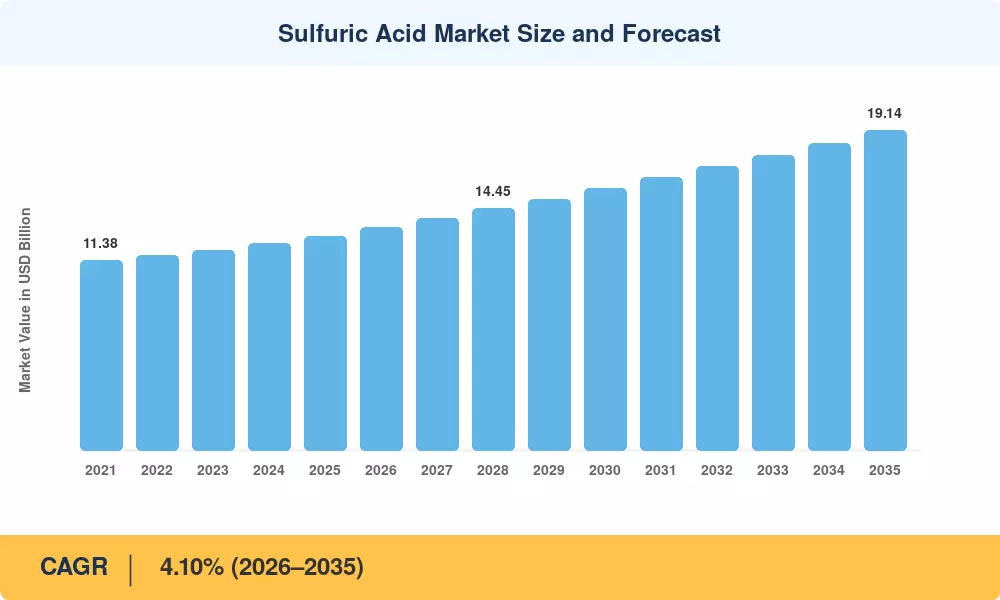
The Sulfuric Acid Market reached an estimated USD 12.80 billion in 2025 and is projected to grow from USD 13.33 billion in 2026 to USD 19.14 billion by 2035, registering a CAGR of 4.10% during the forecast period. Global food-security mandates and aggressive phosphate fertilizer expansion programs across South Asia and North Africa underpin this trajectory, with India's National Mission for Sustainable Agriculture and Morocco's OCP capacity-doubling initiative channeling billions into fertilizer production chemicals that rely on a steady sulfuric acid supply[2].

A structural transformation is reshaping the Sulfuric Acid Market as legacy single-contact acid plants give way to advanced double-contact double-absorption (DCDA) units equipped with real-time digital process controls. Capital commitments exceeding USD 4.2 billion in DCDA retrofit projects between 2023 and 2028 reflect tightening SOโ‚‚ emission limits under the EU Industrial Emissions Directive and China's Ultra-Low Emission Standards [3][4]. These upgrades cut tail-gas sulfur dioxide by over 99.7%, simultaneously lowering energy intensity and improving acid-grade consistency for downstream chemical processing acids and battery acid materials.

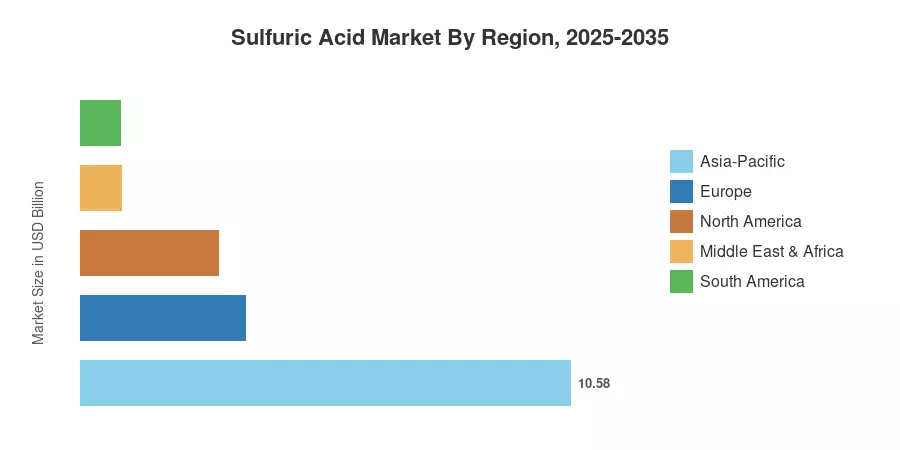
Asia-Pacific commands roughly 55.3% of the Sulfuric Acid Market, driven by China's integrated smelter-acid complexes and India's expanding fertilizer corridors. The region also posts the fastest CAGR at 4.35% through 2035. Europe holds the second-largest share at approximately 18.6%, bolstered by circular-economy mandates that incentivize acid recovery from metal processing chemicals and spent refinery chemical products. North America's shale-linked sulfur recovery keeps supply competitive, while emerging capacity in the Middle East and Africa positions the Sulfuric Acid Market for accelerating geographic diversification through the early 2030s.

Key Report Takeaways

โ€ข By Raw Material

  • Elemental sulfur accounted for 72.9% of the Sulfuric Acid Market in 2025, reflecting integrated supply chains between oil refinery desulfurization units and downstream acid plants.
  • Pyrite ore feedstock is forecast to register a 4.52% CAGR through 2035, supported by renewed interest in polymetallic mining chemical solutions across Central Asia.

โ€ข By Production Process

  • The DCDA route captured 83.1% share of the Sulfuric Acid Market in 2025, driven by stringent environmental regulations and superior conversion efficiency.
  • Single-contact plants remain relevant in cost-sensitive emerging markets, contributing USD 2.24 billion in 2025.

โ€ข By End-User Industry

  • Fertilizer applications dominated with 61.2% of the Sulfuric Acid Market revenue in 2025, anchored by phosphoric acid production for DAP and MAP fertilizers.
  • Chemical and pharmaceutical end users are projected to advance at the highest CAGR of 4.67% through 2035.

โ€ข By Region

  • Asia-Pacific led with 55.3% of the global Sulfuric Acid Market share in 2025.
  • North America is forecast to reach USD 2.98 billion by 2035, propelled by recovered sulfur streams from shale-gas processing and growing demand for battery acid materials.

Market Size and Forecast (2021โ€“2035)

MRFR employs a bottom-up estimation methodology combining production-capacity utilization data from national chemical associations, trade-flow analysis from UN Comtrade, and company-level revenue disclosures. Historical figures (2021โ€“2024) reflect actual industry outcomes adjusted for inventory swings, while forecast values (2026โ€“2035) are derived from segment-level demand modeling calibrated against macroeconomic and regulatory scenarios[5].
Sulfuric Acid Market Size and Forecast
Our Impact
Enabled $4.3B Revenue Impact for Fortune 500 and Leading Multinationals
Partnering with 2000+ Global Organizations Each Year
30K+ Citations by Top-Tier Firms in the Industry

Driver Impact Analysis

Driver ~% Impact on CAGR Geographic Relevance Impact Timeline
Phosphate fertilizer expansion +1.4% Asia-Pacific, Africa Long-term (โ‰ฅ4 yr)
DCDA emission-compliance upgrades +0.8% Europe, China Short-term (โ‰ค2 yr)
Battery-grade electrolyte demand +0.6% North America, Europe Medium-term (2โ€“4 yr)
Copper/zinc smelter integration +0.5% South America, Asia-Pacific Long-term (โ‰ฅ4 yr)
Ultra-low-sulfur fuel regulations +0.4% Global Short-term (โ‰ค2 yr)
Lithium ore acid-leach processing +0.3% South America, Australia Medium-term (2โ€“4 yr)
Digital process-control adoption +0.2% Global Medium-term (2โ€“4 yr)

ย 

Phosphate Fertilizer Expansion

Global phosphoric acid capacity is expected to increase by 18 million tonnes between 2025 and 2032, which will require about 2.5 tonnes of sulfuric acid each tonne of P2O5 produced [2]. India's Department of Fertilizers has earmarked INR 1.68 trillion (USD 20.1 billion) for subsidies in the 2024โ€“2025 fiscal year, directly fuelling the importation of inorganic acid compounds for DAP and NPK blending processes. Moroccoโ€™s OCP Group has pledged USD 13 billion through 2027 to quadruple the output of its fertilizer-producing chemicals, generating incremental acid demand in North and West Africa [10]. This single driver is driving more than one-third of the future growth in the Sulfuric Acid Market.

ย 

DCDA Compliance Mandates

China's Ministry of Ecology and Environment enforced parallel limits under the 2023 Ultra-Low Emission Standards, compelling hundreds of single-contact units to retrofit or close. Combined capital expenditure on DCDA conversions is tracking above USD 4.2 billion globally, benefiting engineering contractors and catalyst suppliers while raising the purity floor for industrial oxidizing agents produced in these upgraded plants [4].

Battery-Grade Electrolyte Demand

Lead-acid batteries still represent over 70% of the world's battery capacity by volume, and each GWh of lead-acid production uses almost 3,500 tonnes of concentrated sulfuric acid [9]. At the same time, the move to EVs is driving lithium-ion supply chains where high-purity sulphuric acid is a key leaching reagent for the recovery of nickel and cobalt from laterite ores. The USD 6 billion Battery Materials Processing Grant program by the U.S. Department of Energy strengthens the domestic demand of battery acid materials, producing a parallel growth vector across the Sulfuric Acid Market [13].

ย 

Smelter-Acid Vertical Integration

In non-ferrous smelters, especially copper and zinc, sulfuric acid is a by-product from the capture of pyrometallurgical off-gas. Companies such as Aurubis, Boliden, and Glencore are supplying captive acid supplies that are replacing merchant market tonnage and changing trade flows. Chile's copper expansion pipeline alone is expected to add 1.2 million tonnes of by-product acid per year by 2030, reinforcing the relationship between metal processing chemicals and the wider acid supply chain [7][11].

ย 

Restraints Impact Analysis

Restraint ~% Impact on CAGR Geographic Relevance Impact Timeline
Freight-rate volatility โ€“0.5% Global (trade-dependent) Short-term (โ‰ค2 yr)
ESG compliance outlays โ€“0.4% Europe, North America Medium-term (2โ€“4 yr)
Substitution by alternative acids โ€“0.3% Asia-Pacific, Europe Long-term (โ‰ฅ4 yr)
Sulfur oversupply cycles โ€“0.3% Middle East, North America Medium-term (2โ€“4 yr)
Permitting delays for greenfield plants โ€“0.2% Africa, South America Long-term (โ‰ฅ4 yr)

ย 

Freight-Rate Volatility and Trade Disruption

Sulfuric acid is a high-volume, low-value-density bulk industrial chemical, making it acutely sensitive to ocean freight costs. Landlocked markets in Sub-Saharan Africa face additional rail and road surcharges that can double delivered costs relative to FOB prices, discouraging investment in fertilizer production chemicals in the regions that need them most.

Rising ESG Compliance Costs

Acid producers exporting to Europe will have to meet Scope 1 and Scope 2 carbon accounting requirements and face associated financial consequences under the EUโ€™s Carbon Border Adjustment Mechanism (CBAM), which will be in full effect from 2026 [4]. For non-EU chemical processing acid facilities, third-party verification, emissions-monitoring instrumentation, and carbon credit acquisition add an estimated EUR 8-15 per tonne to operating costs. Smaller businesses without scale to absorb these outlays may see erosion of margins that may hasten consolidation throughout the Sulfuric Acid Market.

ย 

Substitution Risks from Alternative Acids

In selected metal pickling and mineral leaching applications, hydrochloric acid and nitric acid can replace sulfuric acid if chloride or nitrate chemistry gives process advantages [14]. In some places, some phosphoric acid companies are experimenting with direct acidulation with hydrochloric acid, although the economics are not yet advantageous at scale. Sulfuric acid continues in a solid cost position as the primary inorganic acid constituent, but incremental substitution takes about 0.3 percentage points off addressable demand growth.

ย 

Sulfuric Acid Market Opportunities

Battery Recycling and Circular Acid Loops

The EU Battery Regulation (2023/1542) mandates 63% collection rates for portable batteries by 2027, 73% by 2030, and imposes recycled-content floors for lithium-ion cells. Acid-leach hydrometallurgical processes used in battery recycling consume significant volumes of sulfuric acid, creating a circular demand loop where battery acid materials serve both initial cell manufacturing and end-of-life material recovery[9].

African Phosphate Corridor Development

Sub-Saharan Africa holds an estimated 25% of the world's remaining phosphate reserves, yet contributes less than 4% of global fertilizer production chemicals output. Multilateral investment vehicles โ€” including the African Development Bank's Feed Africa program โ€” are channeling USD 3.2 billion into integrated mine-to-fertilizer complexes in Tanzania, Senegal, and Togo, each requiring captive sulfuric acid capacity[11].

Digital Twins and AI-Driven Process Optimization

Advanced process-control platforms incorporating digital-twin models can boost acid-plant throughput by 3โ€“5% while cutting energy intensity per tonne of acid by 8โ€“12% [12]. Predictive maintenance algorithms reduce unplanned shutdowns, and real-time catalyst-bed monitoring extends converter life-cycles. Early adopters in the Sulfuric Acid Market are monetizing operational data through licensing analytics to smaller operators.

Lithium Hard-Rock Leaching Expansion

Australia's Pilbara and Western Australia spodumene projects are scaling acid-roast-leach circuits that consume 1.5โ€“2.5 tonnes of sulfuric acid per tonne of lithium carbonate equivalent produced. With global lithium demand projected to quadruple by 2035, mining chemical solutions providers face a substantial incremental opportunity[9].

Ultra-Pure Acid for Semiconductor Fabrication

Electronic-grade sulfuric acid (SEMI C12 specification) commands price premiums of 8โ€“15ร— over commodity grade. Expanding semiconductor fabrication in the United States, South Korea, and Japan under the CHIPS Act and K-CHIPS Act is driving localized demand for ultra-pure inorganic acid compounds, opening a high-margin niche within the broader Sulfuric Acid Market[15].

Sulfuric Acid Market Future Outlook

Autonomous Plant Operations and AI Integration

By the early 2030s, sulfuric acid plants will increasingly operate under autonomous control loops where AI-driven systems adjust converter temperatures, acid-tower flows, and catalyst-bed cycling in real time.

Circular Acid Economy and Industrial Symbiosis

Regulatory frameworks, including the EU Circular Economy Action Plan and China's 14th Five-Year Plan for Circular Economy, are mandating acid-recovery rates above 85% in metal pickling, titanium dioxide, and refinery chemical products operations. Closed-loop acid management platforms โ€” where spent acid is regenerated on-site โ€” reduce virgin acid consumption by 25โ€“40%, reshaping procurement patterns and creating new service-model revenue streams within the Sulfuric Acid Market [4][16].

Electrification Supercycle and Battery Materials

The IEA's Global EV Outlook projects 240 million electric vehicles on the road by 2035, each requiring processed cathode and anode materials that depend on sulfuric acid at multiple supply-chain stages [9]. Nickel sulfate, cobalt sulfate, and lithium sulfate production all consume battery acid materials in leaching, purification, and crystallization. This supercycle could add an estimated 12โ€“15 million tonnes of annual acid demand globally by the mid-2030s.

ESG Reporting and Decarbonization Pathways

Scope 3 emission disclosure requirements under the ISSB's IFRS S2 standard will require acid consumers to report upstream production emissions by 2028 [17]. Producers investing in waste-heat recovery, catalytic converter optimization, and renewable-powered auxiliary systems can offer lower-carbon inorganic acid compounds โ€” commanding price premiums of 5โ€“10% in ESG-conscious supply chains. The Sulfuric Acid Market will stratify between high-emission legacy plants and next-generation facilities competing on carbon intensity.

Sulfuric Acid Market Segmentation

By Raw Material Type

Segment Key Metric Primary Demand Driver
Elemental Sulfur 72.9% share (2025) Integrated refinery desulfurization feedstock
Pyrite Ore 4.52% CAGR Polymetallic mining operations in Central Asia
Other Raw Material Types USD 0.86 B (2025) Smelter off-gas and waste-acid regeneration

ย 

Elemental sulfur remains the backbone of the Sulfuric Acid Market's feedstock base, sourced predominantly from Claus-process desulfurization at oil refineries and natural-gas plants. The sulfur-burning route offers high purity and operational flexibility, making it the preferred pathway for producing fertilizer production chemicals and electronic-grade acid alike. Pyrite ore processing, historically dominant in China, is experiencing a selective renaissance as polymetallic deposits in Kazakhstan and Uzbekistan yield copper, gold, and zinc credits alongside acid, improving project economics for integrated mining chemical solutions operators [7].

By Production Process

Segment Key Metric Primary Demand Driver
Double Contact Double Absorption (DCDA) 83.1% share (2025) Emission compliance and conversion efficiency
Single Contact Process 4.28% CAGR Cost-sensitive emerging-market installations

ย 

The DCDA process dominates the Sulfuric Acid Market because its dual-absorption design achieves SOโ‚‚-to-SOโ‚ƒ conversion rates exceeding 99.7%, meeting the tightest environmental standards in Europe and East Asia. Single-contact plants persist in regions where capital constraints outweigh emission penalties, though their share is contracting as industrial oxidizing agents specifications tighten globally and lenders incorporate environmental conditionality into project financing [3].

By Concentration

Segment Key Metric Primary Demand Driver
Standard (93โ€“98 wt%) 90.0% share (2025) Fertilizer, metal pickling, petroleum refining
Oleum / Fuming Acid 4.01% CAGR Organic synthesis, explosives, surfactant production

ย 

Standard-grade acid dominates the Sulfuric Acid Market owing to its versatility across fertilizer production chemicals, refinery alkylation, and metal processing chemicals. Oleum โ€” containing dissolved SOโ‚ƒ above stoichiometric levels โ€” serves specialized applications in organic sulfonation and nitration reactions. Growing demand for surfactants, dyes, and pharmaceutical intermediates in the Asia-Pacific is expanding oleum consumption at a pace faster than the overall market [14].

By End-User Industry

Segment Key Metric Primary Demand Driver
Fertilizer 61.2% share (2025) Phosphoric acid and ammonium sulfate production
Chemical and Pharmaceutical 4.67% CAGR Organic synthesis, API manufacturing
Other End Users USD 2.14 B (2025) Petroleum refining, water treatment, pulp & paper

ย 

Fertilizer manufacturing absorbs the largest share of the Sulfuric Acid Market, with phosphoric acid production alone consuming over 50% of global output. Chemical and pharmaceutical applications represent the fastest-growing segment, driven by rising API volumes in India and China and expanding demand for bulk industrial chemicals in polymer and surfactant manufacturing [2]. Other end users โ€” including petroleum refining, wastewater treatment, and mineral processing โ€” provide stable baseload demand for inorganic acid compounds across mature economies.

Regional Market Share Analysis

Region Key Metric Primary Investment Themes
Asia-Pacific 55.3% share (2025) Smelter integration; phosphate fertilizer expansion
Europe 18.6% share (2025) DCDA retrofits; acid-recovery circular mandates
North America USD 2.98 B by 2035 Recovered sulfur; battery acid materials
South America 4.48% CAGR (2026โ€“2035) Copper smelter by-product acid; lithium leaching
Middle East & Africa 4.62% CAGR (2026โ€“2035) Greenfield fertilizer plants; phosphate mining
Total USD 19.14 B (2035) โ€”

The Sulfuric Acid Market exhibits pronounced regional asymmetry, with Asia-Pacific alone accounting for over half of global consumption. Demand patterns vary widely: mature markets in North America and Europe prioritize acid-recovery and circular-economy integration, while high-growth markets in Asia-Pacific and Africa are scaling greenfield capacity tied to fertilizer production chemicals and metal processing chemicals.

ย 

North America

Country Key Metric Key Driver
United States 68.4% of regional share Recovered sulfur from shale-gas processing
Canada 4.21% CAGR Potash-linked acid demand in Saskatchewan
Mexico USD 0.41 B (2025) Automotive metal pickling growth

ย 

The United States dominates North American supply through involuntary sulfur recovery at natural-gas and refinery chemical products facilities along the Gulf Coast, generating over 9 million tonnes of elemental sulfur feedstock annually [8]. Canada's potash expansion in Saskatchewan drives incremental acid demand for fertilizer-grade products, while Mexico's automotive-parts corridor sustains steady consumption of metal processing chemicals for steel pickling.

Europe

Country Key Metric Key Driver
Germany 22.1% of regional share Chemical-complex integration at BASF Ludwigshafen
United Kingdom 3.92% CAGR Pharmaceutical-grade acid demand
France USD 0.42 B (2025) Nuclear fuel-cycle processing
Italy 8.3% of regional share Titanium dioxide pigment production
Spain 3.78% CAGR Copper smelting in Huelva
Nordic Countries USD 0.31 B (2025) Boliden smelter by-product acid
Russia 11.7% of regional share Fertilizer export orientation
Rest of Europe 3.65% CAGR Varied industrial oxidizing agents demand

ย 

Europe's Sulfuric Acid Market centers on integrated chemical processing acid complexes in Germany, Belgium, and the Netherlands, where acid serves as an intermediary in dye, detergent, and pharmaceutical synthesis [4]. The EU's CBAM and updated BAT documents are accelerating closure of sub-scale single-contact plants, consolidating production among DCDA-equipped operators, and pushing inorganic acid compounds quality benchmarks higher.

Asia-Pacific

Country Key Metric Key Driver
China 58.2% of regional share Integrated copper-smelter acid; phosphate fertilizer hubs
India 4.58% CAGR Government fertilizer subsidy programs
Japan USD 0.68 B (2025) Semiconductor and electronic-grade acid
South Korea 3.95% CAGR Battery and petrochemical acid demand
ASEAN USD 0.52 B (2025) Nickel laterite leaching in Indonesia
Rest of Asia-Pacific 4.12% CAGR Mining and agricultural chemical growth

ย 

China's dominance in the Sulfuric Acid Market stems from its dual role as the world's largest non-ferrous smelter and largest phosphate fertilizer manufacturer. India's acid consumption is scaling rapidly under the National Mission on Use of Sea Water and government-mandated DAP self-sufficiency targets, while Southeast Asian nickel laterite operations in Indonesia and the Philippines are deploying high-pressure acid-leach circuits that consume mining chemical solutions at unprecedented rates [2][7].

South America

Country Key Metric Key Driver
Brazil 52.8% of regional share Phosphate and sugarcane-ethanol acid demand
Argentina 4.38% CAGR Lithium brine processing expansion
Rest of South America USD 0.18 B (2025) Copper smelter acid in Chile and Peru

ย 

South America's Sulfuric Acid Market growth hinges on the copper-smelting corridor stretching from Chile through Peru, where by-product acid volumes track mining output. Brazil's phosphate fertilizer deficit โ€” the country imports roughly 70% of its potassic and phosphatic needs โ€” creates structural pull for domestically produced bulk industrial chemicals [11].

Middle East & Africa

Country Key Metric Key Driver
Saudi Arabia 34.6% of regional share Ma'aden phosphate complex integration
UAE 4.15% CAGR Petrochemical diversification
South Africa USD 0.19 B (2025) Gold and platinum refining acid demand
Egypt 4.72% CAGR Abu Tartur phosphate expansion
Rest of MEA USD 0.24 B (2025) Greenfield fertilizer production chemicals projects

ย 

Saudi Arabia's Ma'aden-Mosaic joint venture operates one of the world's largest integrated phosphate-to-fertilizer complexes, anchoring regional acid demand. Egypt's Abu Tartur phosphate deposit and Tanzania's Minjingu project are attracting multilateral financing to build captive acid plants, positioning the Middle East & Africa as the fastest-growing contributor to the Sulfuric Acid Market over the forecast period [10][11].

Sulfuric Acid Market By Region, 2025-2035

Competitive Benchmarking

The Sulfuric Acid Market exhibits low concentration, with the top five producers collectively accounting for an estimated 18โ€“24% of global revenue. An HHI below 500 confirms a fragmented competitive structure where regional smelter-acid operators, integrated fertilizer companies, and merchant-acid specialists coexist. Scale advantages accrue primarily through raw-material access and logistics proximity rather than proprietary technology.

Company Est. Revenue Share Range Key Offerings Strategic Positioning
Mosaic Company ~4โ€“6% Integrated phosphate-acid production Vertically integrated fertilizer leader
OCP Group ~3โ€“5% Captive acid for Jorf Lasfar complex Largest African phosphate producer
BASF SE ~2โ€“4% Chemical-grade acid; by-product acid recovery Diversified chemical processing acids giant
Aurubis AG ~2โ€“3% Copper-smelter by-product acid Leading European copper recycler
Boliden AB ~2โ€“3% Zinc/copper smelter acid Nordic metal processing chemicals leader
Chemtrade Logistics ~2โ€“3% Merchant sulfuric acid; regen acid services North American distribution specialist
Glencore plc ~2โ€“4% Multi-commodity smelter acid Global mining and trading conglomerate
PVS Chemicals ~1โ€“2% Merchant acid; water treatment chemicals Regional U.S. distribution network
Nutrien Ltd. ~1โ€“3% Captive acid for fertilizer blending World's largest crop-input company
Ma'aden (Saudi Mining) ~1โ€“2% Integrated phosphate-acid complex Middle East bulk industrial chemicals anchor

ย 

Recent News & Developments

  • OCP Group (March 2025): Commissioned a new 1.4 million tonne/year sulfuric acid plant at Jorf Lasfar, Morocco, increasing the company's captive capacity to support fertilizer production chemicals expansion across Africa [10].
  • Aurubis AG (September 2025): Completed a EUR 320 million multi-metal recycling plant in Richmond, Georgia (USA), generating by-product sulfuric acid from secondary copper smelting and strengthening the North American supply of metal processing chemicals [18].
  • BASF SE (October 2024): Announced a strategic partnership with Siemens Energy to deploy AI-based digital twins across its Ludwigshafen acid-production units, targeting a 10% reduction in energy intensity for chemical processing acids [12].

ย 

  • Indian Department of Fertilizers (April 2024): Approved INR 22,303 crore (USD 2.7 billion) in nutrient-based subsidies for the 2024โ€“2025 Kharif season, directly stimulating domestic demand for inorganic acid compounds used in DAP manufacturing [2].
  • Saudi Ma'aden (November 2023): Signed a USD 126.4 billion joint-venture agreement with Ivanhoe Electric to develop the Wa'ad al-Shamal phosphate expansion, requiring an additional 2.8 million tonnes of sulfuric acid capacity by 2028 [10].

ย 

Sulfuric Acid Market Report Scope

Parameter Detail
Market Scope Global Sulfuric Acid Market by Raw Material, Production Process, Concentration, End-User Industry, and Region
Study Period 2021โ€“2035
CAGR (Forecast) 4.10% (2026โ€“2035)
Market Size (2025) USD 12.80 Billion
Market Size (2035) USD 19.14 Billion
Fastest Growing Segment Chemical and Pharmaceutical (4.67% CAGR)
Companies Profiled 10 (Mosaic, OCP, BASF, Aurubis, Boliden, Chemtrade, Glencore, PVS Chemicals, Nutrien, Ma'aden)
Valuation Currency USD (Billions)

ย 

FAQs

What purity specifications should procurement teams demand when sourcing sulfuric acid for semiconductor wafer cleaning?
SEMI C12-grade acid requires iron below 1 ppb, and particulate counts under 25 per mL at โ‰ฅ0.5 ยตm. Suppliers must provide lot-level certificates of analysis with ICP-MS validation [15].
How does the lead-acid battery recycling value chain create re-entry points for sulfuric acid suppliers?
Spent battery breakers recover dilute acid streams that require re-concentration or replacement with fresh acid for new cell formation. This secondary loop adds roughly 8โ€“10% to recurring order volumes for established suppliers [9].
What contractual structures best protect buyers against sulfur feedstock price swings?
Index-linked quarterly pricing tied to Tampa or Vancouver CFR sulfur benchmarks reduces spot exposure. Buyers can layer fixed-price tranches covering 40โ€“60% of volume to cap downside risk [22].
How do copper-smelter shutdowns for maintenance affect regional acid spot markets?
A major smelter turnaround can remove 300,000โ€“500,000 tonnes of by-product acid from regional supply for 4โ€“8 weeks, spiking spot premiums by 15โ€“25% in adjacent markets [7].
What catalyst technologies are extending DCDA converter bed life beyond current five-year norms?
Cesium-promoted vanadium pentoxide catalysts now sustain activity for 4โ€“6 years in the first pass, reducing replacement costs and improving sustained conversion for industrial oxidizing agents [12].
How are sulfuric acid producers adapting to Scope 3 emission reporting mandates from downstream customers?
Producers are deploying continuous-emissions-monitoring systems and publishing product carbon footprints per ISO 14067. Some offer carbon-differentiated acid at a 5โ€“10% premium [17].
What role does sulfuric acid play in rare-earth element extraction from unconventional sources like coal ash?
Acid baking at 200โ€“300 ยฐC followed by water leaching dissolves rare-earth oxides from coal fly ash. Pilot programs in Kentucky and Wyoming are targeting commercial-scale operations by 2028 [13]. ย  ย 
Author
Author
Author Profile
Priya Nagrale LinkedIn
Senior Research Analyst
With an experience of over five years in market research industry (Chemicals & Materials domain), I gather and analyze market data from diverse sources to produce results, which are then presented back to a client. Also, provide recommendations based on the findings. As a Senior Research Analyst, I perform quality checks (QC) for market estimations, QC for reports, and handle queries and work extensively on client customizations. Also, handle the responsibilities of client proposals, report planning, report finalization, and execution

Research Approach

ย 

Secondary Research

The secondary research process involved comprehensive analysis of chemical industry databases, geological surveys, regulatory frameworks, peer-reviewed industrial journals, and authoritative chemical industry organizations. Key sources included the United States Geological Survey (USGS), European Chemicals Agency (ECHA), US Environmental Protection Agency (EPA), Food and Agriculture Organization (FAO) of the United Nations, International Fertilizer Association (IFA), The Sulphur Institute (TSI), European Sulphuric Acid Association (ESA), European Chemical Industry Council (Cefic), American Chemistry Council (ACC), UN Comtrade Database, Eurostat Industrial Production Database, ICIS Chemical Pricing Database, British Geological Survey (BGS), Geoscience Australia, China Petroleum and Chemical Industry Federation (CPCIF), Indian Chemical Council (ICC), and national mineral statistics bureaus from key producing regions. These sources were utilized to collect production capacity data, trade flow statistics, feedstock availability metrics, environmental compliance costs, fertilizer consumption trends, base metal smelting outputs, and refinery operation rates for elemental sulfur-derived, pyrite-derived, and smelter off-gas recovery sulfuric acid processes.

ย 

Primary Research

Stakeholders from both the supply and demand sides of the sulfuric acid value chain were interviewed as part of the main research process in order to get both qualitative and quantitative insights. Chief executive officers, vice presidents, plant managers, and heads of raw material procurement from chemical conglomerates, independent sulfuric acid producers, base metal smelters, and phosphate fertilizer manufacturers were among the supply-side sources. Procurement managers from chemical synthesis plants, battery factories, petroleum refineries, copper mines, rare earth mines, and superphosphate fertilizer producers made up the demand-side sources. The primary research was conducted to verify the utilization rates of production capacity, check the timescales for brownfield development, and to learn more about the differences between spot and contract pricing, methods for acquiring sulfur feedstock, and investments in regulatory compliance.

Primary Respondent Breakdown:

โ€ข By Designation: C-level Primaries (32%), Director Level (35%), Others (33%)

โ€ข By Region: North America (32%), Europe (28%), Asia-Pacific (25%), Rest of World (15%)

ย 

Market Size Estimation

Global market valuation was derived through production volume mapping and capacity utilization analysis. The methodology included:

โ€ข Identification of 40+ key manufacturers and integrated producers across North America, Europe, Asia-Pacific, Latin America, and Middle East & Africa

โ€ข Product mapping across elemental sulfur-burning, pyrite roasting, and base metal smelter off-gas recovery production processes

โ€ข Analysis of reported and modeled annual revenues specific to sulfuric acid and derivative phosphate fertilizer portfolios

โ€ข Coverage of manufacturers and captively integrated producers representing 75-80% of global installed capacity in 2024

โ€ข Extrapolation using bottom-up (production volume ร— weighted average selling price by regional hub) and top-down (company segment revenue validation) approaches to derive raw material-specific and application-specific valuations

โ€ข Integration of smelter economics correlation models to account for sulfuric acid production as a by-product of copper, zinc, and lead processing operations

Download Free Sample

Kindly complete the form below to receive a free sample of this Report

Download PDF ×

We do not share your information with anyone. However, we may send you emails based on your report interest from time to time. You may contact us at any time to opt-out.
















