Download Free Sample
Kindly complete the form below to receive a free sample of this Report
Surgical Visualization System Market Research Report By Technology (Endoscopy, Laparoscopy, Augmented Reality, 3D Imaging, Fluorescence Imaging), By Application (Orthopedic Surgery, Cardiac Surgery, Neurosurgery, General Surgery, Ophthalmic Surgery), By Component (Camera Systems, Visualization Software, Display Systems, Light Sources, Endoscope), By End Use (Hospitals, Ambulatory Surgical Centers, Diagnostic Centers, Clinics) and By Regional (North America, Europe, South America, Asia Pacific, Middle East and Africa) - Growth & Industry Forecast 2025 To 2035
As per Market Research Future analysis, the Surgical Visualization System Market Size was estimated at 3.22 USD Billion in 2024. The Surgical Visualization System industry is projected to grow from 3.445 USD Billion in 2025 to 6.771 USD Billion by 2035, exhibiting a compound annual growth rate (CAGR) of 6.99% during the forecast period 2025 - 2035
The Surgical Visualization System Market is poised for substantial growth driven by technological advancements and increasing healthcare demands.
| 2024 Market Size | 3.22 (USD Billion) |
| 2035 Market Size | 6.771 (USD Billion) |
| CAGR (2025 - 2035) | 6.99% |
The Surgical Visualization System Market is currently experiencing a transformative phase, driven by advancements in technology and an increasing demand for minimally invasive surgical procedures. Surgeons and medical professionals are increasingly relying on high-definition imaging systems that enhance visualization during operations, thereby improving patient outcomes. The integration of augmented reality and artificial intelligence into surgical visualization tools appears to be a key factor in this evolution, as these technologies provide real-time data and insights that assist in complex surgical tasks. Furthermore, the growing emphasis on patient safety and the need for precision in surgical interventions are propelling the adoption of these sophisticated systems across various healthcare settings. In addition, the Surgical Visualization System Market is likely to benefit from the rising trend of telemedicine and remote surgeries. As healthcare providers seek to expand their reach and improve access to surgical care, the demand for advanced visualization systems that support remote consultations and procedures is expected to grow. This shift not only enhances the capabilities of surgeons but also addresses the challenges posed by geographical barriers. Overall, the market is poised for substantial growth, driven by innovation and the evolving needs of the healthcare industry.
The incorporation of augmented reality and artificial intelligence into surgical visualization systems is becoming increasingly prevalent. These technologies enhance the capabilities of surgeons by providing real-time data and interactive visualizations, which may lead to improved surgical precision and outcomes.
There is a noticeable shift towards minimally invasive surgical techniques, which require advanced visualization tools to ensure accuracy and safety. This trend is likely to drive the growth of the Surgical Visualization System Market as healthcare providers seek to adopt systems that facilitate such procedures.
The ongoing expansion of telemedicine is influencing the Surgical Visualization System Market. As remote surgeries and consultations become more common, the need for high-quality visualization systems that support these practices is expected to increase, thereby enhancing access to surgical care.
The surge in the geriatric population is likely to have a profound impact on the Surgical Visualization System Market. As individuals age, they often experience a higher incidence of health issues that require surgical intervention. The World Health Organization has indicated that the global population aged 60 years and older is expected to double by 2050, which could lead to an increased demand for surgical procedures. Consequently, healthcare facilities may invest more in advanced surgical visualization systems to cater to this demographic, enhancing the precision and safety of surgeries performed on older patients.
The integration of artificial intelligence (AI) into the Surgical Visualization System Market appears to be a pivotal driver. AI technologies enhance surgical visualization by providing real-time data analysis and predictive analytics, which can improve surgical outcomes. For instance, AI algorithms can assist in image recognition, enabling surgeons to identify critical structures during procedures. The market for AI in healthcare is projected to reach substantial figures, indicating a growing acceptance of these technologies in surgical settings. As AI continues to evolve, its applications in surgical visualization are likely to expand, potentially leading to more efficient and safer surgical practices.
The rising prevalence of chronic diseases is a significant driver for the Surgical Visualization System Market. Conditions such as cardiovascular diseases, diabetes, and cancer necessitate advanced surgical interventions, thereby increasing the demand for sophisticated visualization systems. According to recent statistics, the incidence of chronic diseases is on the rise, leading to a greater need for surgical procedures that require enhanced visualization capabilities. This trend suggests that healthcare providers are increasingly investing in advanced surgical visualization technologies to improve patient outcomes and streamline surgical processes, thereby propelling market growth.
Rising investment in healthcare infrastructure is a crucial driver for the Surgical Visualization System Market. Governments and private entities are increasingly allocating funds to enhance healthcare facilities, which includes the procurement of advanced surgical technologies. This trend is evident in various regions, where healthcare systems are modernizing to improve patient care and surgical outcomes. The investment in surgical visualization systems is expected to grow as healthcare providers recognize the importance of these technologies in delivering high-quality surgical services. This influx of capital could lead to a more competitive market landscape, fostering innovation and development in surgical visualization solutions.
Technological advancements in imaging techniques are driving the Surgical Visualization System Market forward. Innovations such as 3D imaging, augmented reality, and high-definition visualization systems are transforming surgical practices. These technologies provide surgeons with enhanced visual clarity and spatial awareness during procedures, which can lead to improved surgical outcomes. The market for advanced imaging technologies is expanding, with projections indicating significant growth in the coming years. As these technologies become more accessible, their adoption in surgical settings is likely to increase, further propelling the demand for sophisticated surgical visualization systems.
The Surgical Visualization System Market is characterized by diverse technological advancements, with Endoscopy leading the market share. This technology is extensively used in minimally invasive surgical procedures, rendering it a preferred choice among healthcare professionals. Following closely are Laparoscopy and 3D Imaging, which also hold significant share due to their effective visualization capabilities. Fluorescence Imaging, though smaller in share, is gaining traction for its unique applications in tumor identification during surgeries.
Current growth trends indicate an increasing preference for advanced visual technologies, primarily driven by the demand for minimally invasive surgeries. An emphasis on precision and better patient outcomes further propels the adoption of emerging technologies like Augmented Reality, which enhances surgical procedures by providing detailed overlays of patient anatomy. The rising incidence of chronic conditions necessitates more effective surgical interventions, thereby accelerating market growth.
Endoscopy (Dominant) vs. Augmented Reality (Emerging)
Endoscopy has established itself as the dominant force in the Surgical Visualization System Market, primarily due to its proven effectiveness and versatility in a range of procedures. As a visualization technique, it offers high-resolution images that are critical for diagnostic accuracy and surgical precision. In contrast, Augmented Reality is emerging as a revolutionary technology that overlays digital information onto the physical world. This innovation is gaining momentum, particularly in surgical education and planning, where it aids in visualizing complex anatomical structures. While Endoscopy remains a staple in operating rooms, Augmented Reality is poised to redefine surgical approaches by enhancing navigation and support during procedures, making it a compelling addition to surgical tools.
The Surgical Visualization System Market segmented by application shows orthopedic surgery as the largest segment, commanding a significant market share. This is largely attributed to the increased prevalence of orthopedic disorders, growing elderly population, and rising demand for minimally invasive surgeries that necessitate high-quality visualization systems. Cardiac surgery, while currently smaller, is rapidly expanding, driven by technological advancements and increasing awareness regarding cardiac health and preventive surgeries, positioning it as a key area of growth in the market.
Orthopedic Surgery: Dominant vs. Cardiac Surgery: Emerging
Orthopedic surgery stands out as the dominant application in the Surgical Visualization System Market, largely due to its established infrastructure and wide acceptance of advanced visualization techniques for procedures such as arthroscopy and joint replacements. The advancements in surgical techniques and equipment are enhancing the quality and outcomes of orthopedic surgeries. In contrast, cardiac surgery is emerging as a significant segment as well, courtesy of innovations like 3D imaging and robotic-assisted surgeries. With a surge in incidences of cardiovascular diseases and an increasing emphasis on early diagnosis and intervention, cardiac visualization systems are being adopted at a growing rate, promising to reshape surgical practices in this field.
Within the Surgical Visualization System Market, Camera Systems dominate the component segment, capturing the largest market share. This prevalence can be attributed to their critical role in delivering high-quality images necessary for precise surgical procedures. However, Visualization Software is quickly emerging as a pivotal force, with its share projected to grow significantly in the coming years as more surgical systems integrate advanced software capabilities to enhance visual performance and facilitate better surgical outcomes.
Camera Systems (Dominant) vs. Visualization Software (Emerging)
Camera Systems represent the dominant component within the Surgical Visualization System Market, known for their state-of-the-art imaging technology that provides unmatched clarity and precision during surgeries. Their established role in operating rooms establishes their significance among surgical teams. Conversely, Visualization Software is recognized as an emerging player that complements hardware by offering features such as 3D imaging and real-time analytics. This segment's rapid growth is fueled by the increasing demand for enhanced visualization options in minimally invasive surgeries, indicating a shift towards smarter, software-driven surgical environments.
The Surgical Visualization System Market showcases diverse end-use segments, with hospitals holding a significant majority share. This sector has benefited from advanced technologies and increased patient inflow, leading to a higher adoption of surgical visualization systems. Ambulatory surgical centers are also witnessing a rise in popularity due to their focus on same-day discharge procedures, prompting a swift integration of these systems to enhance surgical outcomes and patient experience.
Hospitals (Dominant) vs. Ambulatory Surgical Centers (Emerging)
Hospitals represent the dominant force in the Surgical Visualization System Market, driven by their expansive infrastructure and robust patient volume, which demands efficient surgical processes. These institutions are increasingly integrating advanced visualization systems to improve surgical precision and expand minimally invasive procedures. In contrast, ambulatory surgical centers are emerging as dynamic players, capitalizing on cost-effectiveness and shorter recovery times. These centers' rapid adoption of surgical visualization technologies enables them to enhance operational efficiency and attract more outpatient procedures, positioning them favorably against traditional hospital settings.
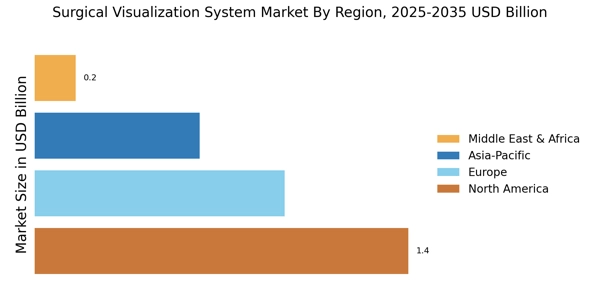
North America is the largest market for surgical visualization systems, holding approximately 45% of the global market share. The region's growth is driven by advanced healthcare infrastructure, increasing surgical procedures, and a rising demand for minimally invasive surgeries. Regulatory support from agencies like the FDA further catalyzes innovation and adoption of new technologies, enhancing market dynamics. The United States leads the North American market, with significant contributions from key players such as Medtronic, Stryker, and Intuitive Surgical. The competitive landscape is characterized by continuous technological advancements and strategic partnerships among leading companies. Canada also plays a vital role, focusing on improving healthcare delivery and surgical outcomes, thereby supporting market growth.
Europe is the second-largest market for surgical visualization systems, accounting for approximately 30% of the global market share. The region benefits from stringent regulatory frameworks that ensure high-quality standards in medical devices. Increasing investments in healthcare infrastructure and a growing elderly population are key drivers of market growth, alongside a rising preference for minimally invasive surgical techniques. Germany, the UK, and France are the leading countries in this market, with a strong presence of companies like Karl Storz and Olympus. The competitive landscape is marked by innovation and collaboration among manufacturers, healthcare providers, and research institutions. The European market is poised for growth, supported by favorable government initiatives and a focus on enhancing surgical outcomes.
Asia-Pacific is witnessing rapid growth in the surgical visualization system market, holding approximately 20% of the global market share. The region's expansion is fueled by increasing healthcare expenditure, a growing population, and rising awareness of advanced surgical technologies. Countries like China and India are investing heavily in healthcare infrastructure, which is expected to drive demand for surgical visualization systems significantly. China is the largest market in the region, followed by Japan and India. The competitive landscape is evolving, with both local and international players striving to capture market share. Key companies such as Olympus and Stryker are expanding their presence in the region, focusing on innovative solutions tailored to meet local healthcare needs. The increasing number of surgical procedures further supports market growth in this dynamic region.
The Middle East and Africa region is gradually emerging in the surgical visualization system market, holding about 5% of the global market share. Growth is driven by increasing healthcare investments, a rising prevalence of chronic diseases, and a growing demand for advanced surgical technologies. However, regulatory challenges and varying healthcare standards across countries pose significant hurdles to market expansion. Countries like South Africa and the UAE are leading the market, with a focus on improving healthcare infrastructure and surgical capabilities. The competitive landscape is characterized by a mix of local and international players, including Medtronic and Boston Scientific. As governments prioritize healthcare improvements, the market is expected to grow, albeit at a slower pace compared to other regions.
The Surgical Visualization System Market is characterized by rapid technological advancements and an increasing demand for enhanced surgical outcomes. As healthcare organizations continue to adopt innovative solutions, the market has become increasingly competitive, with various players striving to introduce cutting-edge visualization products. Surgical visualization systems are critical in modern surgeries as they facilitate better surgical precision, reduced complication rates, and improved patient outcomes.
The competitive landscape demonstrates an increase in collaboration, mergers, and partnerships among key players as they aim to leverage their strengths, expand their market presence, and develop advanced solutions that cater to the evolving needs of healthcare professionals and institutions. Stryker Corporation holds a prominent position in the Surgical Visualization System Market, boasting a robust portfolio of advanced medical technologies. Known for its commitment to innovation, Stryker continues to enhance surgical visualization capabilities through its state-of-the-art imaging systems, which are designed to improve surgical precision and patient safety.
The company's reputation for high-quality products and reliability, alongside extensive customer support services, fosters strong relationships with healthcare providers and surgical teams. Stryker’s ability to integrate advanced technology into surgical procedures not only enhances the efficiency of operations but also significantly contributes to better clinical outcomes, further solidifying its competitive advantage in the market. On the other hand, ConMed Corporation also plays a vital role in the Surgical Visualization System Market.
The company is well-recognized for its specialization in surgical and revenue cycle solutions, and it continually invests in the development of innovative visualization technologies to meet the demands of modern surgery. ConMed is noted for its user-friendly interfaces and high-definition imaging systems that enhance the surgical field, making it easier for surgeons to navigate complex procedures with confidence. The corporation's focus on expanding its product range and maintaining high standards in customer service helps it achieve significant market traction.
As it consistently aims to fulfill the growing need for advanced surgical visualization tools, ConMed Corporation enhances its position as a key player in this competitive landscape.






The Surgical Visualization System Market is witnessing significant advancements, with key players like Stryker Corporation, ConMed Corporation, and Fujifilm Holdings Corporation enhancing their technological offerings. In recent developments, Holo Surgical has gained attention for its innovative augmented reality solutions aimed at improving surgical precision, while Olympus Corporation has introduced upgraded visualization tools that emphasize minimally invasive procedures. Additionally, Smith and Nephew, and Intuitive Surgical are increasing their focus on developing robotic-assisted surgical systems, enhancing patient outcomes through advanced visualization techniques.
Recent acquisitions in the market include terms related to corporate strategies, where companies seek to strengthen their portfolio and expand market reach. Noteworthy is the continued investment by Karl Storz in expanding its imaging technologies, aligning with market growth. Boston Scientific and Medtronic are also enhancing their research initiatives to introduce novel surgical visualization products. This flurry of innovation and strategic movements indicates a growing market valuation, positively impacting surgical outcomes and operational efficiencies within healthcare settings. As surgical visualization continues to evolve, it is expected that more companies will enter the market, fostering competitive dynamics.
The Surgical Visualization System Market is projected to grow at a 6.99% CAGR from 2025 to 2035, driven by technological advancements, increasing surgical procedures, and rising demand for minimally invasive surgeries.
New opportunities lie in:
By 2035, the market is expected to achieve substantial growth, solidifying its position as a critical component in surgical procedures.
| MARKET SIZE 2024 | 3.22(USD Billion) |
| MARKET SIZE 2025 | 3.445(USD Billion) |
| MARKET SIZE 2035 | 6.771(USD Billion) |
| COMPOUND ANNUAL GROWTH RATE (CAGR) | 6.99% (2025 - 2035) |
| REPORT COVERAGE | Revenue Forecast, Competitive Landscape, Growth Factors, and Trends |
| BASE YEAR | 2024 |
| Market Forecast Period | 2025 - 2035 |
| Historical Data | 2019 - 2024 |
| Market Forecast Units | USD Billion |
| Key Companies Profiled | Medtronic (US), Stryker (US), Olympus (JP), Karl Storz (DE), Boston Scientific (US), Smith & Nephew (GB), Conmed (US), Hologic (US), Intuitive Surgical (US) |
| Segments Covered | Technology, Application, Component, End Use, Regional |
| Key Market Opportunities | Integration of augmented reality in Surgical Visualization System Market enhances surgical precision and training capabilities. |
| Key Market Dynamics | Technological advancements and regulatory changes drive innovation and competition in the Surgical Visualization System market. |
| Countries Covered | North America, Europe, APAC, South America, MEA |
The Surgical Visualization System Market is projected to reach approximately 6.771 USD Billion by 2035.
In 2024, the market valuation of the Surgical Visualization System Market was 3.22 USD Billion.
The expected CAGR for the Surgical Visualization System Market during the forecast period 2025 - 2035 is 6.99%.
The Endoscopy segment, valued at 0.9 USD Billion in 2024, is anticipated to grow to 1.8 USD Billion by 2035.
The Laparoscopy segment was valued at 0.8 USD Billion in 2024 and is projected to reach 1.6 USD Billion by 2035.
Key applications include General Surgery, which is expected to grow from 1.0 USD Billion in 2024 to 2.0 USD Billion by 2035.
Key players in the market include Medtronic, Stryker, Olympus, and Intuitive Surgical, among others.
The Endoscope component is projected to grow from 1.8 USD Billion in 2024 to 3.0 USD Billion by 2035.
In 2024, Hospitals accounted for a valuation of 1.5 USD Billion, expected to rise to 3.2 USD Billion by 2035.
The Fluorescence Imaging segment is expected to grow from 0.4 USD Billion in 2024 to 0.9 USD Billion by 2035.


Kindly complete the form below to receive a free sample of this Report

“This is really good guys. Excellent work on a tight deadline. I will continue to use you going forward and recommend you to others. Nice job”


“Thanks. It’s been a pleasure working with you, please use me as reference with any other Intel employees.”


“Thanks for sending the report it gives us a good global view of the Betaïne market.”


“Thank you, this will be very helpful for OQS.”


“We found the report very insightful! we found your research firm very helpful. I'm sending this email to secure our future business.”


“I am very pleased with how market segments have been defined in a relevant way for my purposes (such as "Portable Freezers & refrigerators" and "last-mile"). In general the report is well structured. Thanks very much for your efforts.”


“I have been reading the first document or the study, ,the Global HVAC and FP market report 2021 till 2026. Must say, good info! I have not gone in depth at all parts, but got a good indication of the data inside!”


“We got the report in time, we really thank you for your support in this process. I also thank to all of your team as they did a great job.”


“The Automotive 48V ECU Components Procurement Intelligence Study” was a complex project, but the Market Research Future (MRFR) team handled it with quality, agility, and customer-centricity. They delivered all requested data on time and within the agreed scope. The team, including Shubhendra Anand and Rahul Gotadki, was always readily available to clarify questions and swiftly implement necessary adjustments, driving the project to a successful conclusion within a very demanding timeframe.
I would also like to specifically commend Akshay Agarwal for his responsiveness and support at every stage—from our initial inquiry on May 6th through to final delivery on June 18th. His dedication made the entire process seamless.”



