Download Free Sample
Kindly complete the form below to receive a free sample of this Report
Sustainable Forestry Consulting Services Market Size, Share and Trends Analysis Research Report Information By Application (Forest Management, Wildlife Management, Environmental Impact Assessment, Land Use Planning), By Client Type (Government, NGOs, Private Companies, Academic Institutions), By Project Size (Small, Medium, Large), By Service Type (Consultation, Training, Certification, R&D), By Sustainability Focus (Carbon Sequestration, Biodiversity, Soil Health, Water Resource Management), And By Region – Market Forecast Till 2035.
As per MRFR analysis, the Sustainable Forestry Consulting Services Market was estimated at 3.5 USD Billion in 2024. The Sustainable Forestry Consulting Services industry is projected to grow from 3.65 USD Billion in 2025 to 5.5 USD Billion by 2035, exhibiting a compound annual growth rate (CAGR) of 4.19% during the forecast period 2025 - 2035.
The Sustainable Forestry Consulting Services Market is experiencing a robust shift towards integrating technology and sustainable practices.
| 2024 Market Size | 3.5 (USD Billion) |
| 2035 Market Size | 5.5 (USD Billion) |
| CAGR (2025 - 2035) | 4.19% |
WSP Global Inc (CA), Deloitte Consulting LLP (US), ERM (US), Ramboll Group A/S (DK), Sierra Club (US), The Nature Conservancy (US), Tetra Tech, Inc. (US), Wood PLC (GB), Sustainable Forestry Initiative (US)
Our Impact
Enabled $4.3B Revenue Impact for Fortune 500 and Leading Multinationals
Partnering with 2000+ Global Organizations Each Year
30K+ Citations by Top-Tier Firms in the Industry
The Sustainable Forestry Consulting Services Market is currently experiencing a notable evolution, driven by increasing awareness of environmental sustainability and the need for responsible forest management. Stakeholders, including governments, corporations, and non-profit organizations, are increasingly recognizing the importance of sustainable practices in forestry. This shift is prompting a demand for expert consulting services that can guide organizations in implementing sustainable strategies, ensuring compliance with regulations, and enhancing their overall environmental performance. As a result, consulting firms are adapting their offerings to meet the diverse needs of clients, ranging from small landowners to large corporations, all seeking to balance economic viability with ecological responsibility. Moreover, the Sustainable Forestry Consulting Services Market is likely to witness further growth as technological advancements continue to shape the industry. Innovations in data analytics, remote sensing, and geographic information systems are enabling consultants to provide more precise and effective solutions. These technologies facilitate better decision-making processes, allowing for improved resource management and conservation efforts. As the global community increasingly prioritizes sustainability, the role of consulting services in forestry is expected to expand, fostering a more resilient and sustainable future for forest ecosystems worldwide.
The Sustainable Forestry Consulting Services Market is witnessing a trend towards the integration of advanced technologies. Tools such as remote sensing, geographic information systems, and data analytics are becoming essential in providing accurate assessments and recommendations. This technological shift enhances the ability of consultants to offer tailored solutions that address specific client needs, thereby improving overall efficiency and effectiveness in forest management.
There is an increasing emphasis on regulatory compliance within the Sustainable Forestry Consulting Services Market. Governments and international bodies are implementing stricter regulations aimed at promoting sustainable practices. Consequently, organizations are seeking expert guidance to navigate these complex frameworks, ensuring adherence to legal requirements while also enhancing their sustainability credentials.
A notable trend in the Sustainable Forestry Consulting Services Market is the heightened focus on biodiversity and ecosystem services. Clients are increasingly aware of the ecological value of forests and are seeking consulting services that emphasize conservation and restoration efforts. This shift reflects a broader understanding of the interconnectedness of forest health and community well-being, driving demand for services that promote ecological integrity.
The Sustainable Forestry Consulting Services Market is experiencing a notable increase in demand for sustainable practices. This trend is driven by heightened awareness of environmental issues and the need for responsible resource management. Organizations are increasingly seeking consulting services to align their operations with sustainability goals. According to recent data, the market for sustainable forestry practices is projected to grow at a compound annual growth rate of approximately 10% over the next five years. This growth indicates a shift in corporate strategies towards sustainability, prompting consulting firms to adapt their services to meet these evolving needs. As businesses recognize the long-term benefits of sustainable forestry, the demand for expert consulting services is likely to continue its upward trajectory.
The Sustainable Forestry Consulting Services Market is being significantly influenced by technological advancements in forestry management. Innovations such as remote sensing, geographic information systems, and data analytics are transforming how forestry operations are managed. These technologies enable more efficient resource allocation, improved monitoring of forest health, and enhanced decision-making processes. As organizations increasingly adopt these technologies, the need for specialized consulting services that can integrate these tools into sustainable forestry practices becomes apparent. The market for forestry technology is expected to expand, with projections indicating a growth rate of around 12% annually. This trend suggests that consulting firms must stay abreast of technological developments to provide relevant and effective services.
In the Sustainable Forestry Consulting Services Market, there is a growing emphasis on corporate social responsibility (CSR) initiatives. Companies are increasingly aware that their operations impact the environment and society. As a result, many organizations are turning to consulting services to develop and implement effective CSR strategies. This shift is reflected in the rising number of companies committing to sustainable forestry practices as part of their CSR efforts. Data suggests that firms with robust CSR programs tend to outperform their peers, which further incentivizes the adoption of sustainable practices. Consequently, the demand for consulting services that specialize in sustainable forestry is likely to rise, as businesses seek to enhance their reputations and fulfill their social obligations.
Consumer preferences are shifting towards sustainable products, which is having a profound impact on the Sustainable Forestry Consulting Services Market. As consumers become more environmentally conscious, they are demanding products that are sourced sustainably. This trend is prompting companies to seek consulting services to ensure their supply chains adhere to sustainable forestry practices. Data indicates that a significant percentage of consumers are willing to pay a premium for sustainably sourced products, which further drives businesses to invest in sustainable practices. Consequently, the demand for consulting services that can guide companies in achieving sustainability certifications and improving their sourcing practices is likely to increase, reflecting the changing landscape of consumer behavior.
The Sustainable Forestry Consulting Services Market is also shaped by the strengthening of environmental regulations and policies. Governments and regulatory bodies are increasingly implementing stringent guidelines to promote sustainable forestry practices. This regulatory landscape compels organizations to seek expert consulting services to navigate compliance requirements effectively. The market for environmental consulting services is projected to grow as companies strive to meet these evolving regulations. Data suggests that firms that proactively engage with sustainability regulations tend to mitigate risks and enhance their operational efficiencies. As such, the demand for consulting services that specialize in sustainable forestry is expected to rise, as businesses seek to align their practices with regulatory expectations.
The Sustainable Forestry Consulting Services Market is primarily influenced by the diverse applications it serves. Among these, Forest Management holds the largest share, reflecting its critical role in ensuring sustainable practices and compliance with environmental regulations. This segment encompasses a range of services aimed at maximizing forest health and productivity, thereby attracting significant investment and attention from both public and private sectors. In contrast, Wildlife Management, while smaller in market share, is rapidly gaining traction as stakeholders increasingly recognize the importance of biodiversity preservation and ecosystem balance. This growing awareness is driving innovations and initiatives within this segment, contributing to its fast-paced growth.
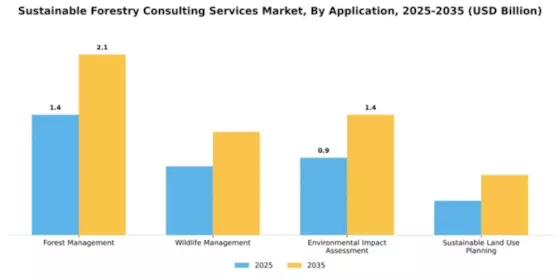
Forest Management (Dominant) vs. Environmental Impact Assessment (Emerging)
Forest Management is a dominant segment within the Sustainable Forestry Consulting Services Market, primarily focusing on the stewardship and conservation of forest resources. This segment emphasizes practices that ensure the ecological balance of forests while enhancing resource productivity. In contrast, Environmental Impact Assessment is an emerging segment that evaluates the potential environmental consequences of proposed projects or policies. This service is essential for companies and government bodies seeking to mitigate their ecological footprint. Although still developing, the importance of robust environmental assessments is gaining recognition, particularly in policy-making and project planning, positioning it as a critical component in advancing sustainability initiatives.
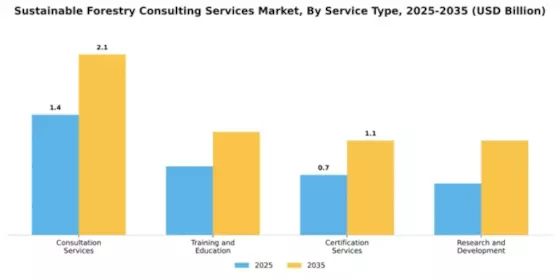
In the Sustainable Forestry Consulting Services Market, the segment distribution showcases Consultation Services as the leading contributor, providing a firm foundation for growth and influencing the market trends significantly. Training and Education, while not as established, is rapidly gaining traction, driven by an increasing demand for skilled professionals in sustainable practices, further diversifying the market landscape.
Consultation Services (Dominant) vs. Training and Education (Emerging)
Consultation Services emerges as the dominant segment in the Sustainable Forestry Consulting Services Market, often regarded as the backbone of industry support, helping organizations to implement sustainable practices effectively. This service incorporates expert guidance tailored to various forestry projects, ensuring compliance with environmental regulations and promoting best practices. In contrast, Training and Education is the emerging force, responding to the urgent need for sustainability awareness and expertise among professionals. This segment focuses on providing knowledge through workshops, certifications, and hands-on training, equipping individuals with the necessary skills to navigate the complexities of sustainable forestry.
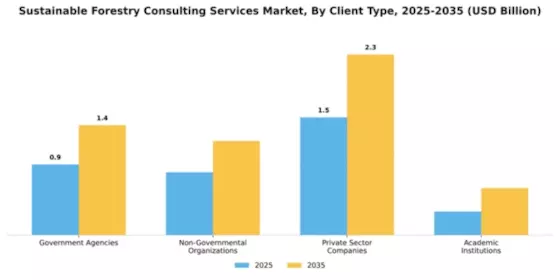
In the Sustainable Forestry Consulting Services Market, the distribution of market share among client types is notably dominated by Government Agencies, which leverage these services for public interest projects and environmental regulation compliance. Government initiatives to promote sustainable practices have resulted in a steady demand for consulting services, allowing them to maintain the largest share in the market. In contrast, Private Sector Companies are experiencing rapid growth as they shift towards sustainable practices driven by consumer awareness and regulatory pressures. They are increasingly engaging consulting services to enhance their sustainability strategies and meet corporate social responsibility objectives.
Government Agencies: Dominant vs. Private Sector Companies: Emerging
Government Agencies play a dominant role in the Sustainable Forestry Consulting Services Market, primarily due to their regulatory mandates and initiatives aimed at promoting forest conservation and sustainable practices. These agencies focus on implementing policies that require rigorous environmental assessments and sustainable resource management. In contrast, Private Sector Companies, though currently smaller in market share, are emerging rapidly as key players, propelled by an increasing commitment to sustainability and the necessity for compliance with evolving environmental standards. These companies often seek consultancy services to minimize their ecological footprint, optimize resource management, and enhance their reputation among environmentally-conscious consumers. This trend illustrates the critical dynamics at play within the market.
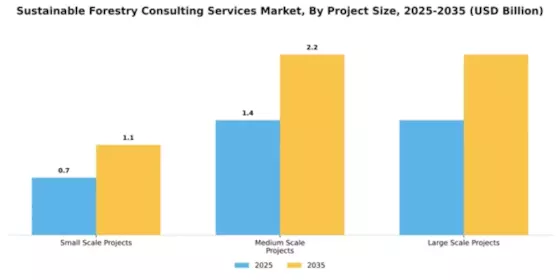
In the Sustainable Forestry Consulting Services Market, project size plays a crucial role in determining service needs and market dynamics. Large Scale Projects account for the majority of market share, driven by the increasing demand for sustainable practices in extensive land management. Their complexity necessitates specialized consulting services, making them a focal point for established firms. Small Scale Projects, while representing a smaller portion of the overall market share, are rapidly gaining traction as more individuals and small businesses prioritize sustainable practices. This growing trend indicates a shift towards localized sustainability efforts, pushing these projects into the spotlight.
Large Scale Projects (Dominant) vs. Small Scale Projects (Emerging)
Large Scale Projects are characterized by their extensive scope and complexity, focusing on significant initiatives such as reforestation, large-scale conservation plans, and ecosystem restoration. They typically involve in-depth analyses, strategic planning, and compliance with various regulations, making them essential for larger organizations and government entities aiming to enhance their sustainability footprint. On the other hand, Small Scale Projects are increasingly emerging as key players in the market. Often driven by local community initiatives and small landowners, these projects emphasize practical, sustainable practices that are manageable within limited budgets. Their growth is fueled by a rising awareness of environmental issues and the desire for personalized consultation services, making them an attractive option for those looking to impact their immediate environment positively.
The Sustainable Forestry Consulting Services Market showcases a diverse array of focus areas, with Carbon Sequestration commanding the largest share. This segment is pivotal in helping clients understand and implement strategies that enhance carbon capture through forest management practices. Conversely, Biodiversity Conservation is rapidly catching up, emerging as the fastest-growing segment due to increasing awareness and regulations surrounding ecosystem protection. Understanding the balance between these two areas is crucial for businesses aiming to achieve sustainability goals. As environmental concerns escalate, the demand for services in these areas is surging. Carbon Sequestration remains vital as organizations strive to mitigate climate change impacts. Meanwhile, Biodiversity Conservation is fueled by a growing recognition of the intrinsic value of biodiversity, backed by corporate responsibility initiatives and policy changes. This trend highlights a shift towards holistic sustainability practices that encompass both climate action and ecosystem preservation.
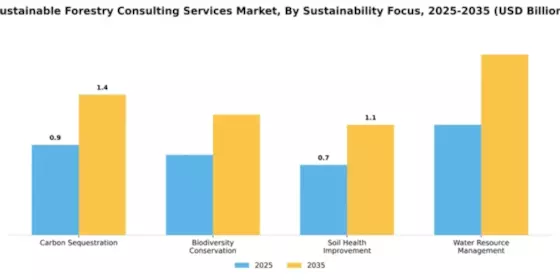
Carbon Sequestration (Dominant) vs. Soil Health Improvement (Emerging)
Carbon Sequestration stands as the dominant force within the Sustainable Forestry Consulting Services Market due to its integral role in climate change mitigation. This segment focuses on enhancing carbon capture through improved forestry practices and land management strategies. Clients often seek expertise in developing carbon offset projects, which is critical for meeting regulatory requirements and corporate sustainability objectives. Conversely, Soil Health Improvement is an emerging segment gaining traction as organizations recognize the importance of healthy soil ecosystems in promoting carbon storage and enhancing forest resilience. This area emphasizes practices that improve soil structure, fertility, and microbial activity, appealing to stakeholders who want to enhance both ecological and economic outcomes. As public awareness about environmental stewardship increases, the synergy between these segments will likely become even more pronounced.
Get more detailed insights about Sustainable Forestry Consulting Services Market Request Free Sample
North America leads the Sustainable Forestry Consulting Services Market with a share of $1.75B in 2024. The region's growth is driven by increasing environmental regulations, corporate sustainability initiatives, and a heightened public awareness of climate change. Demand for sustainable practices is further fueled by government incentives and funding for conservation projects, making it a pivotal area for consulting services. The competitive landscape is robust, featuring key players such as WSP Global Inc, Deloitte Consulting LLP, and The Nature Conservancy. The U.S. is the primary market, supported by a strong regulatory framework and a commitment to sustainable forestry practices. Canada also plays a significant role, with its vast forest resources and commitment to environmental stewardship, enhancing the region's market position.
Europe's Sustainable Forestry Consulting Services Market is valued at $1.2B, reflecting a strong commitment to sustainability and environmental protection. The region benefits from stringent EU regulations aimed at reducing carbon footprints and promoting biodiversity. Initiatives like the European Green Deal are driving demand for consulting services, as countries strive to meet ambitious climate targets and enhance forest management practices. Leading countries include Germany, France, and Sweden, where a mix of public and private sector investments is fostering innovation in sustainable forestry. Key players such as Ramboll Group A/S and ERM are actively involved in shaping the market. The competitive landscape is characterized by a focus on eco-friendly practices and collaboration with governmental bodies to implement sustainable solutions.
The Asia-Pacific region's Sustainable Forestry Consulting Services Market is valued at $0.8B, showcasing significant growth potential driven by increasing awareness of environmental issues and deforestation. Countries like China and India are ramping up efforts to implement sustainable forestry practices, supported by government policies and international partnerships aimed at enhancing forest conservation and management. The competitive landscape is evolving, with emerging players and local firms gaining traction. Key players are beginning to establish a presence, focusing on tailored solutions for regional challenges. The market is characterized by a mix of traditional practices and modern consulting approaches, as countries seek to balance economic growth with environmental sustainability.
The Middle East and Africa's Sustainable Forestry Consulting Services Market is valued at $0.15B, indicating a nascent but growing interest in sustainable practices. The region faces unique challenges, including land degradation and water scarcity, prompting governments to explore sustainable forestry as a viable solution. Initiatives aimed at reforestation and conservation are gaining traction, supported by international funding and partnerships. Countries like South Africa and Kenya are leading the charge, with local organizations and NGOs playing a crucial role in promoting sustainable forestry. The competitive landscape is still developing, with opportunities for both local and international players to establish a foothold in this emerging market. As awareness grows, the demand for consulting services is expected to rise significantly.
The Sustainable Forestry Consulting Services Market is currently characterized by a dynamic competitive landscape, driven by increasing global awareness of environmental sustainability and the need for responsible forest management. Key players such as WSP Global Inc (CA), Deloitte Consulting LLP (US), and ERM (US) are strategically positioned to leverage their expertise in environmental consulting to address these demands. WSP Global Inc (CA) focuses on integrating innovative technologies into their consulting services, enhancing their ability to provide data-driven insights for sustainable forestry practices. Meanwhile, Deloitte Consulting LLP (US) emphasizes partnerships with governmental and non-governmental organizations to expand their reach and influence in policy-making related to forestry management. ERM (US) has adopted a strategy centered on digital transformation, utilizing advanced analytics to optimize forest resource management, which collectively shapes a competitive environment that is increasingly reliant on technological advancements and collaborative efforts.The market structure appears moderately fragmented, with a mix of large multinational firms and smaller specialized consultancies. Key players are employing various business tactics, such as localizing their services to better meet regional needs and optimizing supply chains to enhance efficiency. This collective influence of major companies fosters a competitive atmosphere where innovation and adaptability are paramount, allowing firms to differentiate themselves in a crowded marketplace.In November WSP Global Inc (CA) announced a partnership with a leading technology firm to develop a new software platform aimed at improving forest carbon accounting. This strategic move is significant as it positions WSP at the forefront of carbon management solutions, addressing the growing demand for accurate carbon footprint assessments in forestry. The collaboration is expected to enhance their service offerings and attract clients focused on sustainability goals.In October Deloitte Consulting LLP (US) launched a comprehensive sustainability assessment tool designed for forestry operations. This initiative reflects Deloitte's commitment to providing actionable insights that help clients navigate the complexities of sustainable forestry practices. By equipping clients with robust analytical tools, Deloitte strengthens its market position and fosters long-term relationships with stakeholders invested in sustainable development.In September ERM (US) expanded its service portfolio by acquiring a niche consultancy specializing in biodiversity assessments. This acquisition is indicative of ERM's strategy to broaden its expertise in ecological consulting, which is increasingly relevant in sustainable forestry. By integrating these specialized services, ERM enhances its competitive edge and addresses the multifaceted challenges faced by clients in the forestry sector.As of December the competitive trends in the Sustainable Forestry Consulting Services Market are heavily influenced by digitalization, sustainability initiatives, and the integration of artificial intelligence (AI) into consulting practices. Strategic alliances are becoming more prevalent, as companies recognize the value of collaboration in addressing complex environmental challenges. Looking ahead, competitive differentiation is likely to evolve from traditional price-based competition to a focus on innovation, technological integration, and supply chain reliability, underscoring the importance of adaptability in a rapidly changing market.




The Sustainable Forestry Consulting Services Market is projected to grow at a 4.19% CAGR from 2025 to 2035, driven by increasing environmental regulations, demand for sustainable practices, and technological advancements.
New opportunities lie in:
By 2035, the market is expected to be robust, reflecting a strong commitment to sustainable forestry practices.
| MARKET SIZE 2024 | 3.5(USD Billion) |
| MARKET SIZE 2025 | 3.65(USD Billion) |
| MARKET SIZE 2035 | 5.5(USD Billion) |
| COMPOUND ANNUAL GROWTH RATE (CAGR) | 4.19% (2025 - 2035) |
| REPORT COVERAGE | Revenue Forecast, Competitive Landscape, Growth Factors, and Trends |
| BASE YEAR | 2024 |
| Market Forecast Period | 2025 - 2035 |
| Historical Data | 2019 - 2024 |
| Market Forecast Units | USD Billion |
| Key Companies Profiled | WSP Global Inc (CA), Deloitte Consulting LLP (US), ERM (US), Ramboll Group A/S (DK), Sierra Club (US), The Nature Conservancy (US), Tetra Tech, Inc. (US), Wood PLC (GB), Sustainable Forestry Initiative (US) |
| Segments Covered | Application, Service Type, Client Type, Project Size, Sustainability Focus |
| Key Market Opportunities | Integration of advanced technologies for sustainable forest management enhances consulting service demand. |
| Key Market Dynamics | Rising demand for sustainable practices drives growth in consulting services amid evolving regulatory frameworks and technological advancements. |
| Countries Covered | North America, Europe, APAC, South America, MEA |
The market valuation reached 3.5 USD Billion in 2024.
The market is expected to grow to 5.5 USD Billion by 2035.
The market is projected to experience a CAGR of 4.19% from 2025 to 2035.
Key segments include Forest Management, Wildlife Management, Environmental Impact Assessment, and Sustainable Land Use Planning.
The main service types encompass Consultation Services, Training and Education, Certification Services, and Research and Development.
Prominent players include WSP Global Inc, Deloitte Consulting LLP, ERM, and The Nature Conservancy.
The market serves Government Agencies, Non-Governmental Organizations, Private Sector Companies, and Academic Institutions.
The market addresses Small Scale, Medium Scale, and Large Scale Projects.
Key sustainability focuses include Carbon Sequestration, Biodiversity Conservation, Soil Health Improvement, and Water Resource Management.
In 2024, Forest Management was valued at 1.4 USD Billion, while Wildlife Management reached 0.8 USD Billion.


Kindly complete the form below to receive a free sample of this Report

“This is really good guys. Excellent work on a tight deadline. I will continue to use you going forward and recommend you to others. Nice job”


“Thanks. It’s been a pleasure working with you, please use me as reference with any other Intel employees.”


“Thanks for sending the report it gives us a good global view of the Betaïne market.”


“Thank you, this will be very helpful for OQS.”


“We found the report very insightful! we found your research firm very helpful. I'm sending this email to secure our future business.”


“I am very pleased with how market segments have been defined in a relevant way for my purposes (such as "Portable Freezers & refrigerators" and "last-mile"). In general the report is well structured. Thanks very much for your efforts.”


“I have been reading the first document or the study, ,the Global HVAC and FP market report 2021 till 2026. Must say, good info! I have not gone in depth at all parts, but got a good indication of the data inside!”


“We got the report in time, we really thank you for your support in this process. I also thank to all of your team as they did a great job.”


“The Automotive 48V ECU Components Procurement Intelligence Study” was a complex project, but the Market Research Future (MRFR) team handled it with quality, agility, and customer-centricity. They delivered all requested data on time and within the agreed scope. The team, including Shubhendra Anand and Rahul Gotadki, was always readily available to clarify questions and swiftly implement necessary adjustments, driving the project to a successful conclusion within a very demanding timeframe.
I would also like to specifically commend Akshay Agarwal for his responsiveness and support at every stage—from our initial inquiry on May 6th through to final delivery on June 18th. His dedication made the entire process seamless.”



