Download Free Sample
Kindly complete the form below to receive a free sample of this Report
Sustainable Investing Advisory Services Market Research Report: Size, Share, Trend Analysis By Client Type Outlook (Institutional Investors, Retail Investors, High Net Worth Individuals, Family Offices) By Service Type Outlook (Portfolio Management, Investment Advisory, Risk Assessment, Impact Measurement) By Investment Type Outlook (Equity Investment, Debt Investment, Real Estate Investment, Alternative Investment) By Sustainability Focus Outlook (Environmental Sustainability, Social Responsibility, Governance Practices, Sustainable Development Goals), By Region (North America, Europe, APAC, South America, MEA) - Growth Outlook & Industry Forecast To 2035
As per MRFR analysis, the Sustainable Investing Advisory Services Market was estimated at 6.5 USD Billion in 2024. The Sustainable Investing Advisory Services industry is projected to grow from 7.01 USD Billion in 2025 to 15.0 USD Billion by 2035, exhibiting a compound annual growth rate (CAGR) of 7.9% during the forecast period 2025 - 2035.
The Sustainable Investing Advisory Services Market is experiencing robust growth driven by increasing demand for responsible investment strategies.
| 2024 Market Size | 6.5 (USD Billion) |
| 2035 Market Size | 15.0 (USD Billion) |
| CAGR (2025 - 2035) | 7.9% |
BlackRock (US), Vanguard Group (US), State Street Global Advisors (US), Morgan Stanley (US), Goldman Sachs (US), J.P. Morgan Asset Management (US), Amundi (FR), UBS (CH), BNP Paribas Asset Management (FR), Northern Trust (US)
Our Impact
Enabled $4.3B Revenue Impact for Fortune 500 and Leading Multinationals
Partnering with 2000+ Global Organizations Each Year
30K+ Citations by Top-Tier Firms in the Industry
The Sustainable Investing Advisory Services Market is currently experiencing a notable evolution, driven by a growing awareness of environmental, social, and governance (ESG) factors among investors. This shift reflects a broader societal trend towards sustainability, where stakeholders increasingly prioritize ethical considerations alongside financial returns. As a result, advisory services are adapting to meet the demands of clients who seek to align their investment strategies with their values. The market appears to be expanding as more firms recognize the importance of integrating sustainability into their core operations, potentially leading to a more responsible investment landscape. Moreover, the Sustainable Investing Advisory Services Market is likely to witness an influx of innovative solutions aimed at enhancing transparency and accountability. Clients are increasingly seeking guidance on how to navigate the complexities of sustainable investments, which may include evaluating the impact of their portfolios on climate change and social equity. This trend suggests that advisory firms must not only provide traditional financial advice but also offer insights into the long-term implications of investment choices. As the market continues to mature, the emphasis on sustainability is expected to shape the future of investment advisory services, fostering a more conscientious approach to capital allocation.
Advisory services are increasingly incorporating environmental, social, and governance criteria into their investment strategies. This integration reflects a growing recognition that sustainable practices can enhance long-term financial performance.
Clients are expressing a heightened need for transparency regarding the sustainability of their investments. This trend indicates that advisory firms must provide clear metrics and reporting on the impact of investments.
There is a noticeable shift towards impact investing, where clients seek to generate measurable social and environmental benefits alongside financial returns. This trend suggests a broader redefinition of success in the investment landscape.
Investor awareness regarding sustainability issues is on the rise, significantly impacting the Sustainable Investing Advisory Services Market. A growing number of investors, including millennials and institutional players, are increasingly prioritizing investments that align with their values and contribute positively to society. According to recent surveys, approximately 75% of investors express interest in sustainable investment options, indicating a shift in investment preferences. This heightened awareness is driving demand for advisory services that can provide insights into sustainable investment opportunities and strategies. Consequently, the Sustainable Investing Advisory Services Market is poised for growth as more investors seek guidance on how to effectively incorporate sustainability into their portfolios.
The Sustainable Investing Advisory Services Market is witnessing a paradigm shift towards long-term value creation, as investors increasingly recognize the importance of sustainability in driving financial performance. Research indicates that companies with strong ESG practices tend to outperform their peers over the long term, leading to a growing interest in sustainable investment strategies. This shift is prompting advisory firms to develop tailored services that emphasize long-term sustainability goals rather than short-term gains. By aligning investment strategies with long-term value creation, the Sustainable Investing Advisory Services Market is likely to attract a broader client base seeking to achieve both financial returns and positive societal impact.
The emergence of innovative sustainable finance products is significantly influencing the Sustainable Investing Advisory Services Market. Financial institutions are increasingly developing products such as green bonds, social impact funds, and ESG-focused exchange-traded funds (ETFs) to cater to the growing demand for sustainable investment options. These products not only provide investors with opportunities to support sustainable initiatives but also offer competitive returns. As the market for sustainable finance products expands, advisory services are becoming essential in guiding investors through the complexities of these offerings. The Sustainable Investing Advisory Services Market is thus positioned to benefit from the increasing variety of sustainable finance products, as clients seek expert advice on how to incorporate these options into their investment strategies.
The Sustainable Investing Advisory Services Market is experiencing a notable increase in regulatory support aimed at promoting sustainable investment practices. Governments and regulatory bodies are implementing frameworks that encourage the integration of environmental, social, and governance (ESG) factors into investment decision-making. For instance, recent regulations mandate that institutional investors disclose their ESG strategies and performance metrics. This regulatory push not only enhances transparency but also fosters a competitive environment where sustainable investment practices are prioritized. As a result, the Sustainable Investing Advisory Services Market is likely to witness a surge in demand for advisory services that help clients navigate these evolving regulations and align their investment strategies accordingly.
Technological advancements are reshaping the landscape of the Sustainable Investing Advisory Services Market. The integration of artificial intelligence, big data analytics, and machine learning is enabling advisors to analyze vast amounts of ESG data more efficiently. These technologies facilitate the identification of sustainable investment opportunities and enhance the accuracy of risk assessments. As a result, advisory firms are increasingly adopting these tools to provide clients with data-driven insights and recommendations. The ability to leverage technology not only improves the quality of advisory services but also positions firms competitively within the Sustainable Investing Advisory Services Market, as clients seek innovative solutions to meet their sustainability goals.
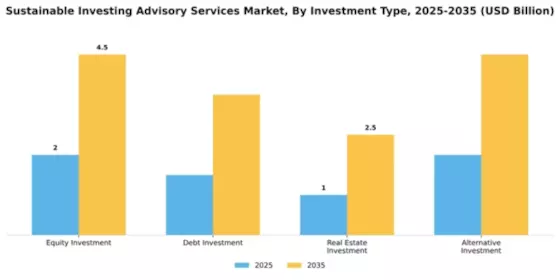
In the Sustainable Investing Advisory Services Market, the equity investment segment leads with the largest market share, driven by a growing concentration of funds directed toward sustainable companies. Investors are increasingly prioritizing socially responsible investing, which has resulted in a higher allocation of capital to equity investments that emphasize environmental, social, and governance (ESG) criteria. The debt investment segment, while smaller in proportion, is the fastest-growing segment, benefiting from increasing interest in green bonds and sustainable corporate financing mechanisms. The growth trends within this market are indicative of a broader shift towards sustainable financial practices. The equity sector is bolstered by rising consumer awareness and corporate responsibility, leading to greater investments in companies with sustainable practices. In contrast, the debt investment category is gaining traction due to evolving regulatory frameworks promoting green financing and the demand for sustainable investment products. This dual trend indicates a positive outlook for both segments, reflecting the changing landscape of investment preferences.
Equity Investment (Dominant) vs. Debt Investment (Emerging)
Equity investment stands out as the dominant force in the Sustainable Investing Advisory Services Market, given its robust alignment with current investor values and societal trends favoring sustainability. This segment typically involves investments in stocks of companies that are committed to social and environmental standards, attracting a broad base of investors seeking both financial returns and positive impact. On the other hand, the debt investment segment is emerging rapidly, characterized by a focus on fixed-income securities like green bonds, which are specifically earmarked for environmentally sustainable projects. The emergence of this investment type highlights a shift where investors are looking for not just profit, but also the sustainability of their investments, making it a pivotal part of contemporary investment strategies.
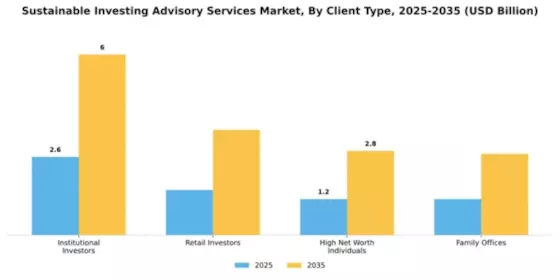
The Sustainable Investing Advisory Services Market is notably dominated by Institutional Investors, who hold a significant share due to their larger capital allocations and the increasing pressure to integrate sustainability into investment strategies. This segment encompasses pension funds, insurance companies, and endowments that prioritize environmental, social, and governance (ESG) factors, making them substantial players in the market. Conversely, Retail Investors are witnessing rapid growth as more individual investors recognize the importance of sustainable investing, driven by heightened awareness of climate change and social responsibility. As sustainable investment options become more accessible, Retail Investors are increasingly engaging with advisory services that cater to their ethical concerns and financial goals. Growth in this segment is further propelled by innovative platforms and technology, which simplify investment processes and provide tailored advice for individual situations. The emerging interest in sustainable products among younger demographics also contributes to the acceleration of Retail Investors in this space, allowing them to leverage their investments toward a more sustainable future.
Institutional Investors (Dominant) vs. High Net Worth Individuals (Emerging)
Institutional Investors remain the dominant force in the Sustainable Investing Advisory Services Market, characterized by their long-term investment horizons and fiduciary responsibilities. These entities typically follow structured investment policies that heavily incorporate ESG criteria into their decision-making processes, resulting in substantial allocations toward sustainable assets. In contrast, High Net Worth Individuals are emerging as a significant market segment, showing strong interest in personalized advisory services that align with their values. This demographic is increasingly seeking to invest in sustainable initiatives that reflect their social and environmental concerns. As they often have the flexibility to engage in more innovative investment strategies, this segment may contribute to evolving trends within the market, making their collective influence increasingly vital.
The service type segment of the Sustainable Investing Advisory Services Market comprises various critical services, with Portfolio Management holding the largest share. This segment is favored by investors looking to align their financial goals with sustainability objectives. Following close behind is Investment Advisory, which also accounts for a significant portion of the market. Risk Assessment and Impact Measurement, while smaller in terms of current share, play crucial roles in shaping investment strategies aimed at sustainability.
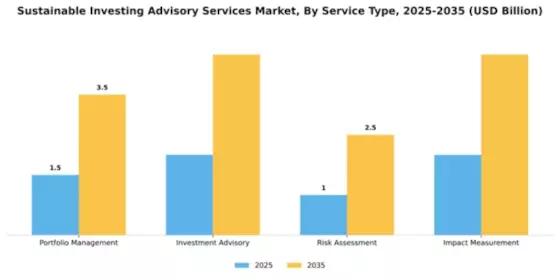
Investment Advisory: Portfolio Management (Dominant) vs. Impact Measurement (Emerging)
In the Sustainable Investing Advisory Services Market, Portfolio Management leads in demand, providing tailored strategies that balance financial returns with sustainability. Investment Advisory is also strong, guiding clients through the complexities of socially responsible investments. Impact Measurement, emerging as a critical service, focuses on quantifying the social and environmental effects of investments, thereby gaining traction among clients eager to demonstrate accountability and performance. Risk Assessment remains foundational, helping investors navigate potential threats while facilitating informed decisions, thus complementing the more growth-oriented services.
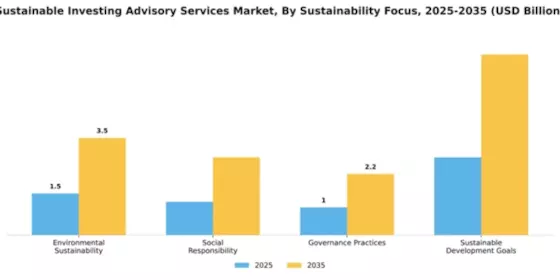
In the realm of Sustainable Investing Advisory Services, Environmental Sustainability holds the largest market share, reflecting a robust prioritization among investors seeking eco-friendly options. This is often driven by heightened awareness of climate change and its associated risks, leading to a substantial focus on investment opportunities that foster environmental well-being. Social Responsibility, while currently smaller, is rapidly gaining traction as more investors incorporate ethical considerations into their portfolios, thus driving its growth and popularity.
Environmental Sustainability (Dominant) vs. Social Responsibility (Emerging)
Environmental Sustainability represents the core of sustainable investing, encompassing initiatives focused on reducing carbon emissions, fostering renewable energy, and encouraging sustainable resource management. This segment is marked by a strong alignment with legislative changes and corporate accountability, which amplify its appeal among investors. In contrast, Social Responsibility is an emerging focus area, emphasizing the impact of investments on societal welfare. This incorporates aspects like community engagement, labor practices, and social equity. While Environmental Sustainability remains dominant, the rising awareness and interest around Social Responsibility reflect a shifting paradigm among investors, highlighting the evolving landscape of sustainability in finance.
Get more detailed insights about Sustainable Investing Advisory Services Market Request Free Sample
North America continues to lead the Sustainable Investing Advisory Services Market, holding a significant market share of 3.25 in 2024. The region's growth is driven by increasing demand for ESG (Environmental, Social, and Governance) investments, supported by regulatory frameworks promoting sustainable practices. The rise of socially responsible investing is further fueled by consumer awareness and corporate responsibility initiatives, making it a pivotal market for sustainable finance. The competitive landscape is dominated by key players such as BlackRock, Vanguard Group, and J.P. Morgan Asset Management, which are actively expanding their sustainable investment offerings. The U.S. remains the largest market, with Canada also showing promising growth in sustainable finance. The presence of major financial institutions and a robust regulatory environment positions North America as a hub for innovation in sustainable investing.
Europe is rapidly becoming a central player in the Sustainable Investing Advisory Services Market, with a market size of 2.0. The region's growth is propelled by stringent regulations aimed at promoting sustainability, such as the EU Taxonomy and the Sustainable Finance Disclosure Regulation (SFDR). These frameworks are designed to enhance transparency and encourage investments in sustainable projects, driving demand for advisory services in this sector. Leading countries like Germany, France, and the UK are at the forefront of this movement, with numerous financial institutions adapting their strategies to align with sustainability goals. Key players such as Amundi and BNP Paribas Asset Management are expanding their portfolios to include more sustainable options. The competitive landscape is characterized by a strong emphasis on ESG criteria, making Europe a vital region for sustainable investment growth.
Asia-Pacific is witnessing a burgeoning interest in sustainable investing, with a market size of 1.75. The region's growth is driven by increasing awareness of environmental issues and a shift towards responsible investment practices. Governments are implementing policies to encourage sustainable finance, which is catalyzing demand for advisory services in this sector. The rise of green bonds and ESG funds is indicative of this trend, as investors seek to align their portfolios with sustainable goals. Countries like Japan, Australia, and China are leading the charge in sustainable finance, with significant investments flowing into green projects. The competitive landscape features both local and international players, including major firms like UBS and Morgan Stanley, which are expanding their sustainable investment offerings. This growing focus on sustainability positions Asia-Pacific as a key region for future growth in the advisory services market.
The Middle East and Africa represent an emerging frontier in the Sustainable Investing Advisory Services Market, with a market size of 0.5. The region is beginning to recognize the importance of sustainable finance, driven by increasing environmental challenges and a need for economic diversification. Governments are starting to implement policies that promote sustainable investments, which is gradually enhancing the demand for advisory services in this area. Countries like South Africa and the UAE are taking the lead in integrating sustainability into their financial systems. The competitive landscape is still developing, with local firms beginning to explore sustainable investment opportunities. As awareness grows and regulatory frameworks strengthen, the Middle East and Africa are poised for significant growth in sustainable investing, attracting both local and international players.
The Sustainable Investing Advisory Services Market is currently characterized by a dynamic competitive landscape, driven by increasing demand for responsible investment strategies and regulatory pressures for sustainability. Major players such as BlackRock (US), Vanguard Group (US), and J.P. Morgan Asset Management (US) are at the forefront, each adopting distinct strategies to enhance their market positioning. BlackRock (US) emphasizes innovation through its technology-driven investment platforms, while Vanguard Group (US) focuses on expanding its ESG (Environmental, Social, and Governance) product offerings. J.P. Morgan Asset Management (US) is actively pursuing partnerships to bolster its sustainable investment capabilities, thereby shaping a competitive environment that is increasingly focused on sustainability and technological integration.The market structure appears moderately fragmented, with a mix of large institutional players and smaller boutique firms. Key business tactics include localizing investment strategies to cater to regional sustainability goals and optimizing supply chains to enhance transparency and accountability. The collective influence of these major players is significant, as they not only set industry standards but also drive innovation in sustainable investment practices.In November BlackRock (US) announced a strategic partnership with a leading fintech firm to enhance its ESG analytics capabilities. This move is likely to strengthen BlackRock's position in the market by providing clients with more sophisticated tools for assessing sustainability risks and opportunities. The integration of advanced analytics into their advisory services could potentially lead to improved investment outcomes and greater client satisfaction.In October Vanguard Group (US) launched a new suite of sustainable index funds aimed at retail investors. This initiative reflects Vanguard's commitment to democratizing access to sustainable investing, allowing a broader audience to participate in ESG-focused investment strategies. By catering to retail investors, Vanguard may enhance its market share and foster a more inclusive investment environment.In September J.P. Morgan Asset Management (US) expanded its sustainable investment team by hiring several Market Research Future. This strategic move underscores the firm's dedication to enhancing its advisory services and aligning its investment strategies with evolving market demands. The addition of experienced professionals is expected to bolster J.P. Morgan's capabilities in delivering tailored sustainable investment solutions to its clients.As of December current trends in the Sustainable Investing Advisory Services Market indicate a strong emphasis on digitalization, AI integration, and sustainability. Strategic alliances among key players are increasingly shaping the competitive landscape, fostering innovation and collaboration. The shift from price-based competition to a focus on technological advancement and supply chain reliability is evident, suggesting that future competitive differentiation will hinge on the ability to innovate and adapt to changing market dynamics.


The Sustainable Investing Advisory Services Market is projected to grow at a 7.9% CAGR from 2025 to 2035, driven by increasing regulatory pressures, consumer demand for sustainability, and technological advancements.
New opportunities lie in:
By 2035, the market is expected to be robust, reflecting a strong commitment to sustainable investment practices.
| MARKET SIZE 2024 | 6.5(USD Billion) |
| MARKET SIZE 2025 | 7.01(USD Billion) |
| MARKET SIZE 2035 | 15.0(USD Billion) |
| COMPOUND ANNUAL GROWTH RATE (CAGR) | 7.9% (2025 - 2035) |
| REPORT COVERAGE | Revenue Forecast, Competitive Landscape, Growth Factors, and Trends |
| BASE YEAR | 2024 |
| Market Forecast Period | 2025 - 2035 |
| Historical Data | 2019 - 2024 |
| Market Forecast Units | USD Billion |
| Key Companies Profiled | BlackRock (US), Vanguard Group (US), State Street Global Advisors (US), Morgan Stanley (US), Goldman Sachs (US), J.P. Morgan Asset Management (US), Amundi (FR), UBS (CH), BNP Paribas Asset Management (FR), Northern Trust (US) |
| Segments Covered | Investment Type, Client Type, Service Type, Sustainability Focus |
| Key Market Opportunities | Growing demand for ESG integration in investment strategies presents opportunities in the Sustainable Investing Advisory Services Market. |
| Key Market Dynamics | Rising demand for sustainable investment strategies drives competition among advisory firms and influences regulatory frameworks. |
| Countries Covered | North America, Europe, APAC, South America, MEA |
The market is projected to reach a valuation of 15.0 USD Billion by 2035.
The overall market valuation was 6.5 USD Billion in 2024.
The expected CAGR for the market during this period is 7.9%.
The Equity Investment segment is projected to grow from 2.0 to 4.5 USD Billion.
Institutional investors are expected to increase their contribution from 2.6 to 6.0 USD Billion.
Key service types include Investment Advisory, which is projected to grow from 2.0 to 4.5 USD Billion.
Key players include BlackRock, Vanguard Group, and Morgan Stanley, among others.
The Real Estate Investment segment is expected to grow from 1.0 to 2.5 USD Billion.
The focus on Sustainable Development Goals is projected to grow from 2.8 to 6.5 USD Billion.
Family offices are expected to increase their investment from 1.2 to 2.7 USD Billion.


Kindly complete the form below to receive a free sample of this Report

“This is really good guys. Excellent work on a tight deadline. I will continue to use you going forward and recommend you to others. Nice job”


“Thanks. It’s been a pleasure working with you, please use me as reference with any other Intel employees.”


“Thanks for sending the report it gives us a good global view of the Betaïne market.”


“Thank you, this will be very helpful for OQS.”


“We found the report very insightful! we found your research firm very helpful. I'm sending this email to secure our future business.”


“I am very pleased with how market segments have been defined in a relevant way for my purposes (such as "Portable Freezers & refrigerators" and "last-mile"). In general the report is well structured. Thanks very much for your efforts.”


“I have been reading the first document or the study, ,the Global HVAC and FP market report 2021 till 2026. Must say, good info! I have not gone in depth at all parts, but got a good indication of the data inside!”


“We got the report in time, we really thank you for your support in this process. I also thank to all of your team as they did a great job.”


“The Automotive 48V ECU Components Procurement Intelligence Study” was a complex project, but the Market Research Future (MRFR) team handled it with quality, agility, and customer-centricity. They delivered all requested data on time and within the agreed scope. The team, including Shubhendra Anand and Rahul Gotadki, was always readily available to clarify questions and swiftly implement necessary adjustments, driving the project to a successful conclusion within a very demanding timeframe.
I would also like to specifically commend Akshay Agarwal for his responsiveness and support at every stage—from our initial inquiry on May 6th through to final delivery on June 18th. His dedication made the entire process seamless.”



