×
Request Free Sample ×

Kindly complete the form below to receive a free sample of this Report

* Please use a valid business email

Leading companies partner with us for data-driven Insights

clients tt-cursor
Hero Background

Swab Market

ID: MRFR/MED/0338-HCR
81 Pages
Rahul Gotadki
October 2025

Swab Market Research Report Information by Type (DNA, Urine, Saliva, Others), By Product (Alcohol, Cotton, Dry and gauze, Others), By Application (Pharmaceuticals, Microbiology, Laboratory, Others), By Shaft (Aluminum, Polypropylene, Others), And By Region (North America, Europe, Asia-Pacific, And Rest Of The World) – Market Forecast Till 2035

Share:
Download PDF ×

We do not share your information with anyone. However, we may send you emails based on your report interest from time to time. You may contact us at any time to opt-out.

Swab Market Infographic
Purchase Options

Swab Market Summary

As per MRFR analysis, the Swab Market Size was estimated at 1695.26 USD Million in 2024. The Swab industry is projected to grow from 1807.49 USD Million in 2025 to 3431.41 USD Million by 2035, exhibiting a compound annual growth rate (CAGR) of 6.62 during the forecast period 2025 - 2035.

Key Market Trends & Highlights

The Swab Market is experiencing a dynamic shift driven by innovation and evolving healthcare needs.

  • North America remains the largest market for swabs, driven by advanced healthcare infrastructure and high demand for diagnostic testing.
  • Asia-Pacific is emerging as the fastest-growing region, fueled by increasing investments in healthcare and rising awareness of hygiene practices.
  • The Clinical Diagnostics segment dominates the market, while the Research Laboratories segment is witnessing rapid growth due to technological advancements.
  • Key market drivers include rising demand for diagnostic testing and innovations in swab technology, which are shaping the future of the industry.

Market Size & Forecast

2024 Market Size 1695.26 (USD Million)
2035 Market Size 3431.41 (USD Million)
CAGR (2025 - 2035) 6.62%

Major Players

Thermo Fisher Scientific (US), BD (US), Abbott Laboratories (US), Merck KGaA (DE), F. Hoffmann-La Roche AG (CH), Qiagen N.V. (NL), Eppendorf AG (DE), Medline Industries, Inc. (US)

Swab Market Trends

The Swab Market is currently experiencing a dynamic evolution, driven by various factors that influence its growth trajectory. The increasing demand for swabs in healthcare settings, particularly for diagnostic purposes, appears to be a primary catalyst. This trend is further supported by advancements in materials and manufacturing processes, which enhance the efficacy and reliability of swabs. Additionally, the rising awareness regarding hygiene and infection control measures seems to bolster the market, as consumers and healthcare providers alike prioritize safety and cleanliness. Furthermore, the expansion of applications beyond traditional medical uses, such as in environmental testing and food safety, indicates a diversification of the market landscape. In December 2025, the Swab Market reflects a complex interplay of innovation and consumer needs. Manufacturers are likely focusing on developing eco-friendly alternatives, responding to the growing environmental concerns associated with single-use products. This shift towards sustainability may reshape consumer preferences and influence purchasing decisions. Moreover, the ongoing integration of technology in swab production and usage, such as smart swabs equipped with sensors, suggests a potential transformation in how swabs are utilized in various sectors. Overall, the Swab Market appears poised for continued growth, driven by evolving consumer demands and technological advancements.

Sustainability Initiatives

The Swab Market is witnessing a notable shift towards sustainable practices. Manufacturers are increasingly exploring biodegradable materials and eco-friendly production methods. This trend reflects a growing consumer preference for environmentally responsible products, which may influence purchasing behaviors and brand loyalty.

Technological Integration

The integration of technology within the Swab Market is becoming more pronounced. Innovations such as smart swabs, which incorporate sensors for enhanced diagnostic capabilities, are emerging. This trend suggests a potential transformation in the functionality and application of swabs across various sectors.

Diversification of Applications

The Swab Market is expanding beyond traditional medical uses. Applications in environmental monitoring and food safety are gaining traction, indicating a broader scope for swab utilization. This diversification may open new avenues for growth and innovation within the market.

Swab Market Drivers

Rising Demand for Diagnostic Testing

The Global Swab Market Industry experiences a notable increase in demand for diagnostic testing, driven by the growing prevalence of infectious diseases and the need for rapid testing solutions. In 2024, the market is valued at approximately 1.7 USD Billion, reflecting a heightened focus on early detection and treatment. This trend is further supported by advancements in swab technology, which enhance the accuracy and efficiency of testing processes. As healthcare systems worldwide prioritize diagnostic capabilities, the Global Swab Market Industry is poised for substantial growth, with projections indicating a market value of 3.43 USD Billion by 2035.

Market Segment Insights

By Application: Clinical Diagnostics (Largest) vs. Research Laboratories (Fastest-Growing)

The Swab Market showcases a diverse application landscape, with Clinical Diagnostics leading the market share. This segment, encompassing various medical testing applications, has established itself as the primary consumer of swab products, capitalizing on the increasing demand for accurate diagnostic solutions. Following closely are Environmental Testing and Forensic Science, which, while significant, do not match the dominance of Clinical Diagnostics in terms of revenue contribution. Research Laboratories are emerging rapidly, driven by advancements in scientific research and a growing need for quality control and sample collection. This segment is gaining traction as more research facilities adopt innovative swab technologies, heightening the efficiency and reliability of sample handling processes. The rising focus on research in various fields, including biotechnology and pharmaceuticals, is propelling this segment's growth trajectory.

Forensic Science: Clinical Diagnostics (Dominant) vs. Forensic Science (Emerging)

The Clinical Diagnostics segment has solidified its position as the dominant player in the Swab Market, fueled by the essential role that swabs play in laboratory testing for infectious diseases and other health conditions. As healthcare practices evolve, this segment continues to innovate, reflecting a commitment to improving patient diagnostics. On the other hand, the Forensic Science segment is emerging as a significant growth driver, benefiting from the increasing use of DNA evidence in criminal investigations and the expanding scope of forensic analysis. The forensic sector is experiencing technological advancements and a rising acceptance of forensic science within legal frameworks, contributing to its rapid expansion in the swab market.

By Type: Swab Stick (Largest) vs. Swab Collection Kit (Fastest-Growing)

In the swab market, the type segment exhibits an interesting distribution with the Swab Stick emerging as the largest market segment. It dominates the overall share due to its widespread application in medical diagnostics and research. Meanwhile, the Swab Collection Kit holds a significant position, tailored for ease of use and efficiency in specimen collection, catering to various healthcare settings. This diversification in product offerings enables the market to meet varying needs and preferences in swab applications efficiently. Growth trends in this segment are driven by increased demand for diagnostic testing, especially in the wake of global healthcare challenges. The Swab Collection Kit is witnessing rapid adoption, thanks to its comprehensive packaging and user-friendly design that enhances sample integrity and reduces contamination risk. Innovations in material and design of swab products further act as catalysts promoting growth within this segment, addressing specific needs across different sectors, including clinical and research environments.

Swab Stick (Dominant) vs. Swab Transport Medium (Emerging)

The Swab Stick is the cornerstone of the swab market, characterized by its simple design and multifaceted applications in both clinical and at-home testing scenarios. Its dominance can be attributed to its effectiveness in sample collection, user acceptability, and established presence in the market. Conversely, the Swab Transport Medium is an emerging segment that has gained traction, particularly in specimen transportation, ensuring viable sample preservation for successful testing. As diagnostic practices evolve, the need for reliable transport mediums becomes increasingly vital, addressing concerns of sample integrity. This segment's innovative formulations are catering to the rising demand for efficient diagnostics, setting a promising trajectory for growth as healthcare providers focus on improving testing accuracy.

By Material: Cotton (Largest) vs. Polyester (Fastest-Growing)

In the Swab Market, the material segment is predominantly represented by cotton swabs, which hold the largest market share due to their natural composition and user preference for softness and absorbency. Other materials such as polyester, nylon, and foam are also present, but their shares are significantly smaller, with polyester beginning to carve out a notable place for itself among consumers due to its versatility and durability. Cotton continues to lead, especially in consumer applications, reflecting the trend towards organic and biodegradable products.

Cotton: Dominant vs. Polyester: Emerging

Cotton swabs dominate the Swab Market due to their traditional use, excellent absorbency, and consumer preference for natural materials. They are widely used in medical, cosmetic, and personal care applications, bolstered by growing environmental concerns driving the demand for biodegradable products. Conversely, polyester swabs are emerging as a flexible alternative, gaining traction in industrial and professional settings thanks to their durability and ability to withstand harsher environments. This shift is largely influenced by advancements in manufacturing technologies, resulting in innovative designs and expanded functionalities that meet diverse consumer needs.

By End Use: Hospitals (Largest) vs. Diagnostic Laboratories (Fastest-Growing)

In the Swab Market, the end-use segment is primarily dominated by hospitals, which account for the largest share due to their high demand for sterile and efficient specimen collection methods. This segment benefits from the increased number of surgeries and patient admissions, ensuring consistent demand for swabs. Diagnostic laboratories follow closely, capitalizing on their essential role in conducting tests and analyses that require precision sampling. Home care and research institutions, while important, contribute comparatively lesser shares to the market yet show significant relevance in specialized applications and patient care settings. Growth trends in the end-use segment are driven by advancements in healthcare practices and innovations in swabbing technology. Hospitals are experiencing a steady increase in patient volume, leading to an uptick in swab usage for various procedures. Meanwhile, diagnostic laboratories are witnessing the fastest growth owing to a rise in chronic disease prevalence and a broader range of diagnostics being offered. This growth is further supported by the push for at-home testing solutions, which has expanded the market's reach into home care applications and research sectors, fostering a more versatile swab usage landscape.

Hospitals (Dominant) vs. Research Institutions (Emerging)

Hospitals hold a dominant position in the Swab Market, leveraging their expansive infrastructure and continual patient inflow to maintain high volumes of swab usage. The critical nature of their services necessitates a wide array of swab types, tailored to various procedures, from routine checks to innovative surgical applications. In contrast, research institutions represent an emerging segment, increasingly gaining ground due to their involvement in clinical trials and scientific investigations. They are pivotal in developing and validating new swabbing methodologies and applications. As research expands its focus on diagnostics and microbiology, the demand for specialized swabs tailored to specific experimental needs is expected to rise, positioning research institutions as a vital player in the evolving swab market.

By Packaging Type: Individual Pack (Largest) vs. Bulk Pack (Fastest-Growing)

The Swab Market exhibits a diverse distribution of packaging types, prominently featuring the Individual Pack segment, which currently holds the largest market share. This segment appeals to consumers looking for convenience and hygiene, significantly influencing purchasing decisions. Bulk Pack, on the other hand, is rapidly increasing in popularity due to its cost-effectiveness and demand from institutions and clinics that require high volumes for efficient operation.

Swabs: Individual Pack (Dominant) vs. Bulk Pack (Emerging)

Individual Packs are characterized by single-use swabs, ensuring sterility and convenience, making them ideal for personal care and medical applications. This packaging type remains dominant due to its consumer-friendly nature, appealing to health-conscious buyers. In contrast, Bulk Packs offer larger quantities, making them a preferred choice for clinics and healthcare professionals. The rising trend of bulk purchasing in hospitals and laboratories highlights the value of this emerging segment, positioning it as a crucial player in the market as businesses seek both cost savings and efficiency.

Get more detailed insights about Swab Market

Regional Insights

North America : Market Leader in Swab Production

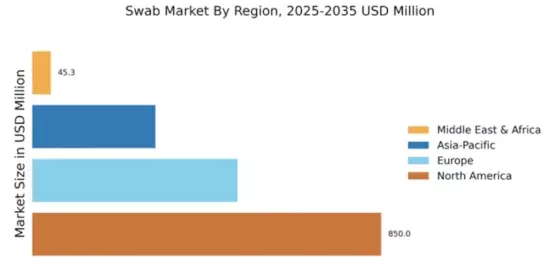
North America is poised to maintain its leadership in the swab market, holding a significant share of $850.0M in 2025. The region's growth is driven by increasing healthcare expenditures, a rise in diagnostic testing, and stringent regulatory frameworks that ensure product quality and safety. The demand for swabs is further fueled by the ongoing need for COVID-19 testing and other infectious disease diagnostics, making it a critical component of public health strategies. The competitive landscape in North America is robust, featuring key players such as Thermo Fisher Scientific, BD, and Abbott Laboratories. These companies are investing heavily in R&D to innovate and expand their product offerings. The presence of advanced healthcare infrastructure and a strong focus on quality assurance regulations contribute to the region's dominance, ensuring that North America remains at the forefront of the swab market.

Europe : Emerging Market with Growth Potential

Europe's swab market is projected to grow significantly, with a market size of $500.0M in 2025. The growth is driven by increasing awareness of hygiene and infection control, alongside regulatory support for medical devices. The European Medicines Agency (EMA) has been proactive in establishing guidelines that enhance product safety and efficacy, which is crucial for market expansion. The rising prevalence of chronic diseases also contributes to the demand for diagnostic testing, further boosting the swab market. Leading countries in this region include Germany, France, and the UK, where major players like Merck KGaA and F. Hoffmann-La Roche AG are actively involved. The competitive landscape is characterized by innovation and strategic partnerships aimed at enhancing product offerings. The presence of established healthcare systems and a focus on quality standards position Europe as a key player in The Swab.

Asia-Pacific : Rapidly Growing Market Segment

The Asia-Pacific region is witnessing rapid growth in the swab market, with a projected size of $300.0M by 2025. This growth is fueled by increasing healthcare investments, a rising population, and a growing emphasis on preventive healthcare measures. Governments in countries like China and India are implementing policies to enhance healthcare access, which is driving demand for diagnostic tools, including swabs. The region's diverse healthcare needs present significant opportunities for market expansion. Key players in the Asia-Pacific market include Qiagen N.V. and Eppendorf AG, who are focusing on local partnerships to enhance their market presence. Countries such as Japan and Australia are leading in terms of technological advancements and quality standards. The competitive landscape is evolving, with a mix of local and international players striving to capture market share in this burgeoning segment.

Middle East and Africa : Emerging Market with Challenges

The Middle East and Africa (MEA) region is gradually emerging in the swab market, with a market size of $45.26M in 2025. The growth is primarily driven by increasing healthcare investments and a rising focus on disease prevention and control. However, challenges such as limited healthcare infrastructure and regulatory hurdles can impede market growth. Governments are beginning to recognize the importance of diagnostic tools, which is expected to catalyze future growth in the swab market. Countries like South Africa and the UAE are leading the way in adopting advanced healthcare solutions. The competitive landscape is characterized by a mix of local and international players, with companies like Medline Industries, Inc. making significant inroads. The region's unique challenges present both risks and opportunities for market participants looking to expand their footprint in the swab market.

Key Players and Competitive Insights

The Swab Market is currently characterized by a dynamic competitive landscape, driven by increasing demand for diagnostic testing and advancements in swab technology. Key players such as Thermo Fisher Scientific (US), BD (US), and Abbott Laboratories (US) are strategically positioned to leverage innovation and expand their market presence. Thermo Fisher Scientific (US) focuses on enhancing its product portfolio through continuous research and development, while BD (US) emphasizes strategic partnerships to bolster its distribution capabilities. Abbott Laboratories (US) is actively pursuing regional expansion, particularly in emerging markets, which collectively shapes a competitive environment that is both collaborative and competitive.

In terms of business tactics, companies are increasingly localizing manufacturing to reduce lead times and optimize supply chains. The market structure appears moderately fragmented, with several players vying for market share. However, the collective influence of major companies like Merck KGaA (DE) and F. Hoffmann-La Roche AG (CH) suggests a trend towards consolidation, as these firms seek to enhance their operational efficiencies and market reach.

In November 2025, Merck KGaA (DE) announced a strategic partnership with a leading biotechnology firm to co-develop next-generation swab technologies. This collaboration is expected to enhance product offerings and accelerate time-to-market for innovative solutions, thereby positioning Merck KGaA (DE) as a frontrunner in the swab technology space. The strategic importance of this partnership lies in its potential to leverage combined expertise and resources, ultimately driving growth in a competitive market.

In October 2025, F. Hoffmann-La Roche AG (CH) launched a new line of high-precision swabs designed for molecular diagnostics. This product introduction is significant as it aligns with the growing trend towards personalized medicine and precision diagnostics. By focusing on high-quality, specialized products, Roche is likely to strengthen its market position and cater to the evolving needs of healthcare providers.

In December 2025, Abbott Laboratories (US) revealed plans to invest $100 million in expanding its manufacturing capabilities in North America. This investment is indicative of Abbott's commitment to enhancing supply chain reliability and meeting the increasing demand for swab products. Such strategic moves are essential for maintaining competitive differentiation in a market that is shifting towards innovation and technology-driven solutions.

As of December 2025, current competitive trends in the Swab Market include a pronounced focus on digitalization, sustainability, and the integration of artificial intelligence (AI) in product development. Strategic alliances are increasingly shaping the landscape, enabling companies to pool resources and expertise. Looking ahead, competitive differentiation is expected to evolve, with a shift from price-based competition to a focus on innovation, technology, and supply chain reliability. This transition underscores the importance of agility and responsiveness in a rapidly changing market.

Key Companies in the Swab Market market include

Industry Developments

March 2021: Roche launched a new rapid antigen test designed to detect the presence of viral antigens in a patient's sample, providing results in under 15 minutes. The test can be administered without needing laboratory equipment, making it suitable in various settings, including hospitals, G.P. surgeries, and care homes. The availability of this test is expected to increase the speed of diagnoses, helping to contain the spread of the virus.

April 2020:  The approval of the Q-tip type polyester swab by the U.S. FDA has boosted the production of these products, thereby meeting the increasing demand for COVID-19 testing kits. Using these swabs in COVID-19 tests will help healthcare systems diagnose SARS-CoV-2 infection more effectively and efficiently.

Future Outlook

Swab Market Future Outlook

The Swab Market is projected to grow at a 6.62% CAGR from 2024 to 2035, driven by increasing healthcare demands, technological advancements, and rising hygiene awareness.

New opportunities lie in:

  • Expansion into emerging markets with tailored product offerings.
  • Development of eco-friendly swab materials to meet sustainability demands.
  • Integration of smart technology for real-time usage tracking and analytics.

By 2035, the Swab Market is expected to achieve robust growth, positioning itself as a leader in healthcare solutions.

Market Segmentation

Swab Market Type Outlook

  • Swab Stick
  • Swab Tip
  • Swab Transport Medium
  • Swab Collection Kit

Swab Market End Use Outlook

  • Hospitals
  • Diagnostic Laboratories
  • Home Care
  • Research Institutions

Swab Market Material Outlook

  • Cotton
  • Polyester
  • Nylon
  • Foam

Swab Market Application Outlook

  • Clinical Diagnostics
  • Environmental Testing
  • Forensic Science
  • Research Laboratories

Swab Market Packaging Type Outlook

  • Individual Pack
  • Bulk Pack
  • Sterile Pack
  • Non-Sterile Pack

Report Scope

MARKET SIZE 20241695.26(USD Million)
MARKET SIZE 20251807.49(USD Million)
MARKET SIZE 20353431.41(USD Million)
COMPOUND ANNUAL GROWTH RATE (CAGR)6.62% (2024 - 2035)
REPORT COVERAGERevenue Forecast, Competitive Landscape, Growth Factors, and Trends
BASE YEAR2024
Market Forecast Period2025 - 2035
Historical Data2019 - 2024
Market Forecast UnitsUSD Million
Key Companies ProfiledThermo Fisher Scientific (US), BD (US), Abbott Laboratories (US), Merck KGaA (DE), F. Hoffmann-La Roche AG (CH), Qiagen N.V. (NL), Eppendorf AG (DE), Medline Industries, Inc. (US)
Segments CoveredApplication, Type, Material, End Use, Packaging Type
Key Market OpportunitiesIntegration of advanced materials and automation in Swab Market production processes.
Key Market DynamicsRising demand for innovative swab technologies drives competition and influences regulatory standards across diverse applications.
Countries CoveredNorth America, Europe, APAC, South America, MEA

Market Highlights

Author
Rahul Gotadki
Assistant Manager

He holds an experience of about 7+ years in Market Research and Business Consulting, working under the spectrum of Life Sciences and Healthcare domains. Rahul conceptualizes and implements a scalable business strategy and provides strategic leadership to the clients. His expertise lies in market estimation, competitive intelligence, pipeline analysis, customer assessment, etc. In addition to the above, his other responsibility includes strategic tracking of high growth markets & advising clients on the potential areas of focus they could direct their business initiatives

Leave a Comment

FAQs

What is the projected growth of the Swab market?

The Swab market is the expected increase in total market value of 3.43 USD billion over a defined forecast period 2025–2035. It is driven by factors such as demand trends, technological advances, regulatory changes, and geographic expansion.

What is the size of the Swab market?

Swab market size was valued at approximately 1.7 billion USD in 2024. This figure will reach 3.43 billion USD covering all regions (America, Europe, Asia, MEA and ROW), focusing its segments / services / distribution channels till 2035.

What is the CAGR of the Swab market?

Swab market is expected to grow at a CAGR of 6.62% between 2025 and 2035.

How much will the Swab market be worth by 2035?

Swab market is expected to be worth of 3.43 billion USD, reflecting growth driven by usage, technology and global demands by the end of 2035.

How will the Swab market perform over the next 10 years?

Over the next 10 years the Swab market is expected to shift from usd billion 1.7 to 3.43 billion USD, led by adoption of advanced tech, demographic trends, regulatory approvals, with potential headwinds from 2025 to 2035.

Which region held the largest market share in the market?

North America had the largest share of the global market

Download Free Sample

Kindly complete the form below to receive a free sample of this Report

Compare Licence

×
Features License Type
Single User Multiuser License Enterprise User
Price $4,950 $5,950 $7,250
Maximum User Access Limit 1 User Upto 10 Users Unrestricted Access Throughout the Organization
Free Customization
Direct Access to Analyst
Deliverable Format
Platform Access
Discount on Next Purchase 10% 15% 15%
Printable Versions